When keyboard and mouse are no longer enough, input becomes the lever of digital transformation.
Hero image: Modern input in industrial practice | AI-generated illustration, not a product photo | XR Stager Online Magazine | VISORIC GmbH
A maintenance team stands in front of a pump. The technician holds a tablet, the plant shows a holographic status. What looks simple in the picture is the bottleneck in many plants: systems have been modernized, data flows, but operation remains limited to keyboard and mouse. Anyone working with gloves, under time pressure, or in sterile zones quickly hits the limits of classic input.
Digital processes often fail not because of the software, but because of the interface to the human. Voice control, eye tracking, gestures, and multimodal interfaces change how technicians control plants, retrieve knowledge, and deliver service. This article positions modern input strategically. It is aimed at decision-makers in digitalization, production, service, and IT.
The maintenance team scenario is for illustration. It is fictional and condensed, not a real customer case. The technical statements are based on studies and reviews. Recommendations are marked as such.
- Input is a design lever of digitalization in its own right, not just an accessory to software.
- Voice, gaze, gesture, and multimodal systems solve different tasks better than keyboard and mouse.
- Value shows in behavior and metrics in daily work, not just in excitement during the first test.
- Organization, data protection, and total cost of ownership decide success.
- The entry point is a clearly bounded use case with a measurable work goal.
These points show why input should be treated as its own design lever, not as an accessory. Anyone who modernizes systems and leaves operation unchanged leaves potential on the table. The technician with the tablet stands not for technology for its own sake, but for an interface that fits the work context. The first step makes clear why input becomes strategically relevant and which questions need answering before the first investment.
Why input is a digitalization lever
Step 1 of 8 · Frame
Digital transformation is often thought of in terms of data, automation, and new interfaces. The question of how people control systems remains secondary. Yet input limits what digitalization actually delivers in daily work. Anyone working with gloves, under time pressure, or in sterile zones quickly hits the limits of classic operation. The technician in the picture holds the tablet not because it is modern, but because it leaves the hands free and directs the gaze to the plant.
Modern input shifts the interface from explicit commands toward more natural signals. Voice names intentions. Gaze shows attention. Gesture points to places and objects. Together these channels can reduce cognitive load and bring actions closer to the real work flow. Studies on multimodal interfaces show that combining modalities brings advantages especially when the task is spatial or procedural and the hands are occupied.
For leaders the framing is therefore: modern input is not a gadget topic. It is a design field for productivity, safety, accessibility, and new service quality. Anyone who only buys hardware without clarifying work goal and organization remains stuck in a technology test.
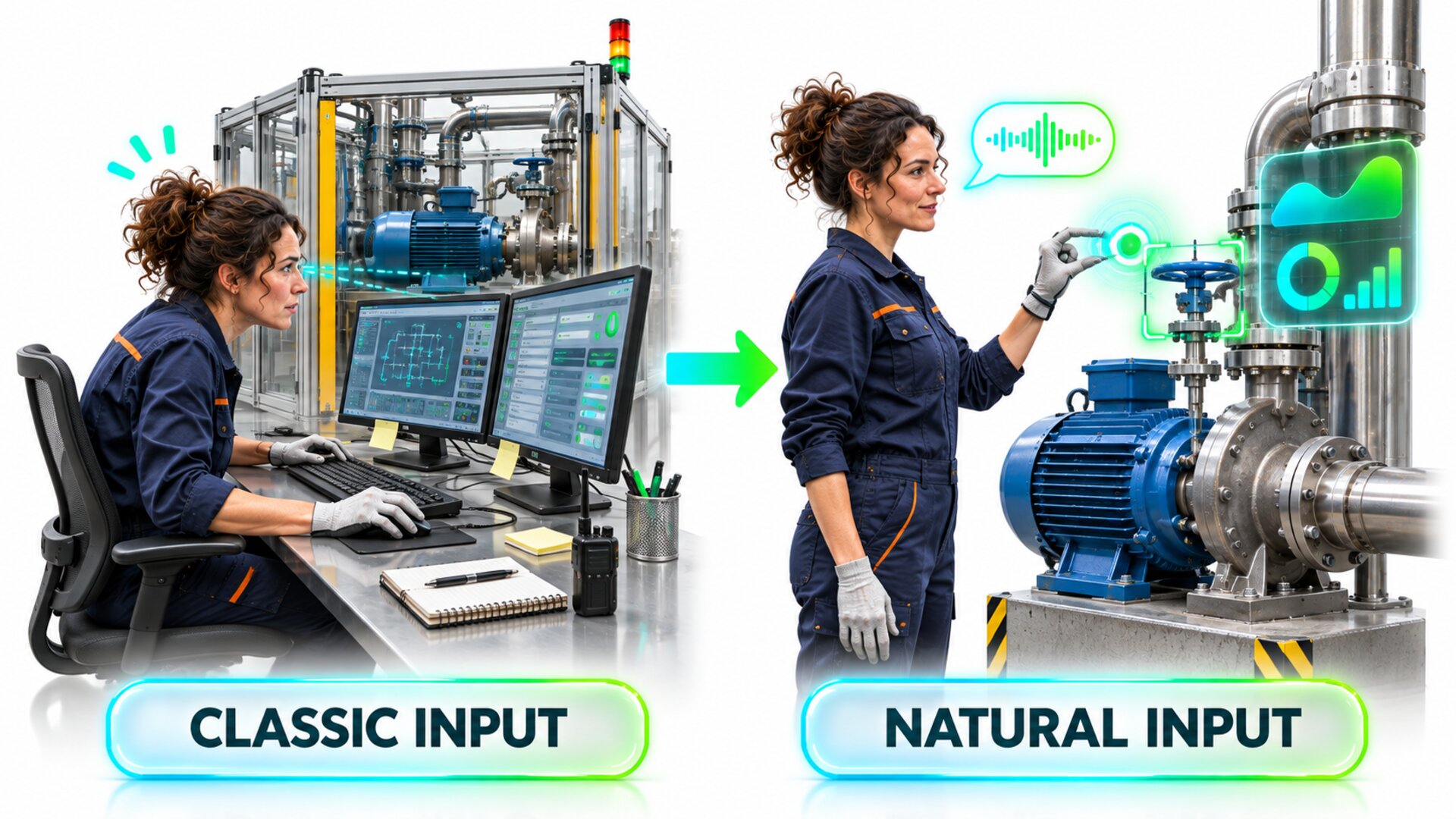
The interface to the human decides whether digitalization arrives in daily work.
Image: Step 1 – from classic operation to intentional, multimodal input | AI-generated illustration, not a product photo | XR Stager Online Magazine | VISORIC GmbH
- Many digital projects optimize systems, but not operation.
- Input limits what automation and data deliver in daily work.
- Voice, gaze, and gesture enable more natural, context-close control.
- Relevance comes from work goals such as safety, speed, and inclusion.
- Without a clear goal, new input remains a technology test.
This framing makes clear: modern input is not a technology topic, but a work-goal topic. Without a clear goal it remains a test that generates excitement and fades in daily work. The question is not which sensor is the most modern, but which action should become safer, faster, or more accessible. Which format fits which task is clarified in the next step.
Which input fits which task
Step 2 of 8 · Select
Not every task deserves a new sensor. Voice control fits when hands are occupied or knowledge needs to be retrieved quickly – for example during assembly with gloves while an instruction is queried in parallel. Eye tracking helps when attention is measured or barrier-free selection is needed. Gesture control helps when surfaces should not be touched. Multimodal systems combine these strengths depending on the situation.
For dense table work, fine construction, or pure fact delivery, keyboard, mouse, touch, or a real device often remain the better choice. The rule is simple: the format follows the task. Only when spatial understanding, hands-free execution, contactlessness, or accessibility are central does modern input enter the shortlist.
Studies on immersive and multimodal interfaces show advantages mainly in spatial and procedural understanding. In pure factual knowledge the differences are smaller. Selection should therefore start from the work goal, not from the hardware catalog. The picture shows the match: gaze, voice, and gesture face the task, not the sensor.
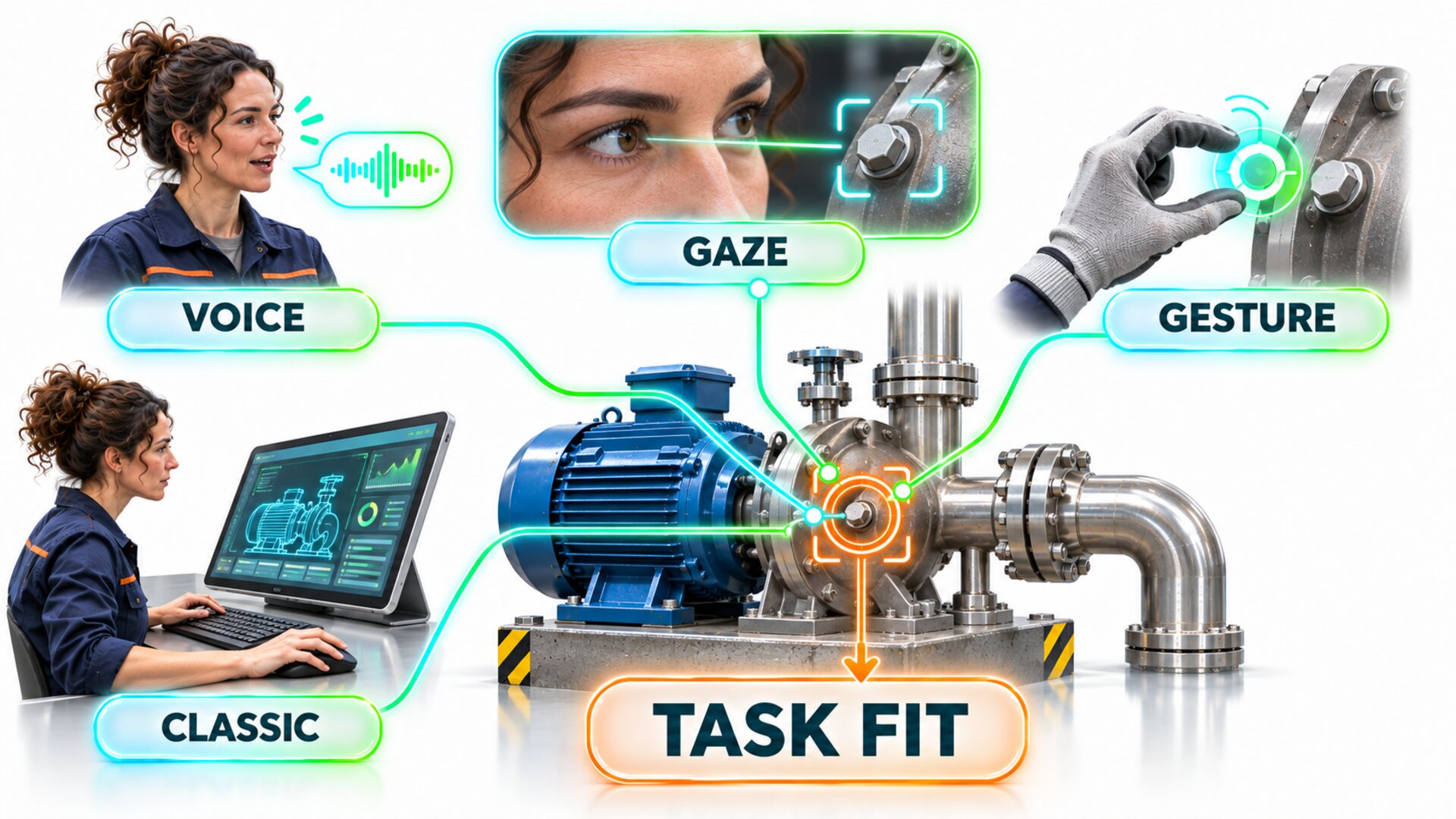
The input format follows the task, not the sensor.
Image: Step 2 – voice, gaze, gesture, and classic input compared to the task | AI-generated illustration, not a product photo | XR Stager Online Magazine | VISORIC GmbH
- Voice for hands-free commands and knowledge retrieval.
- Gaze for attention and barrier-free selection.
- Gesture for contactless operation.
- Classic input often remains superior for precision and dense data.
- The task determines the format, not the other way around.
The selection rule is simple but decisive: the format follows the task. Only when spatial understanding, hands-free execution, or contactlessness are central does modern input enter the shortlist. For dense data work or pure facts, classic paths often remain superior. Once the direction is set, the work goal must lead the interaction – not the technology the action.
First the action, then the technology
Step 3 of 8 · Design
Effective input begins with an observable action. Should someone execute a sequence safely, recognize a deviation, or make a decision? From this action come interaction, feedback, and evaluation. Without this core, impressive technology remains without clear work value.
The viable loop is: action, concrete feedback, repetition. Every step should direct attention, trigger a decision, or confirm an action. For a first prototype, one typical procedure, one typical error, and clear feedback are often enough. Only when experts and users confirm that the exercise meaningfully maps the real task is expansion worthwhile.
The picture shows the loop: on the left the action at the pump, in the middle the feedback, on the right the repetition. Feedback can come from a colleague or the system itself – what matters is that it comes quickly and concretely.

Action, feedback, and repetition form the loop of productive input.
Image: Step 3 – from action to interaction and back | AI-generated illustration, not a product photo | XR Stager Online Magazine | VISORIC GmbH
- It starts with the observable action.
- Interaction and feedback derive from it.
- Fast, action-related feedback increases learning success.
- The first prototype stays deliberately lean.
- Expert confirmation of the mapping comes before feature richness.
The loop of action, feedback, and repetition is the core of productive input. Without it, technology remains impressive but low-impact. The technician in the picture acts, receives feedback, and repeats – exactly this sequence turns a demonstration into a capability. Whether the solution works in operation is shown only by measurement.
Measure value instead of collecting excitement
Step 4 of 8 · Measure
Excitement in the first deployment is a signal, not proof. Anyone who wants to steer separates four levels: acceptance, learning, behavior at the workplace, and operational result. Each level needs its own method. A satisfaction score explains no error rate. A knowledge test right after does not prove behavior weeks later.
For decision-makers the connection of transfer and metric counts most: is the action executed correctly in daily work, and does a relevant value improve? Measurement plans belong before the first productive deployment. The picture shows the stages from first deployment to daily work – learning alone is not enough, transfer and result decide.
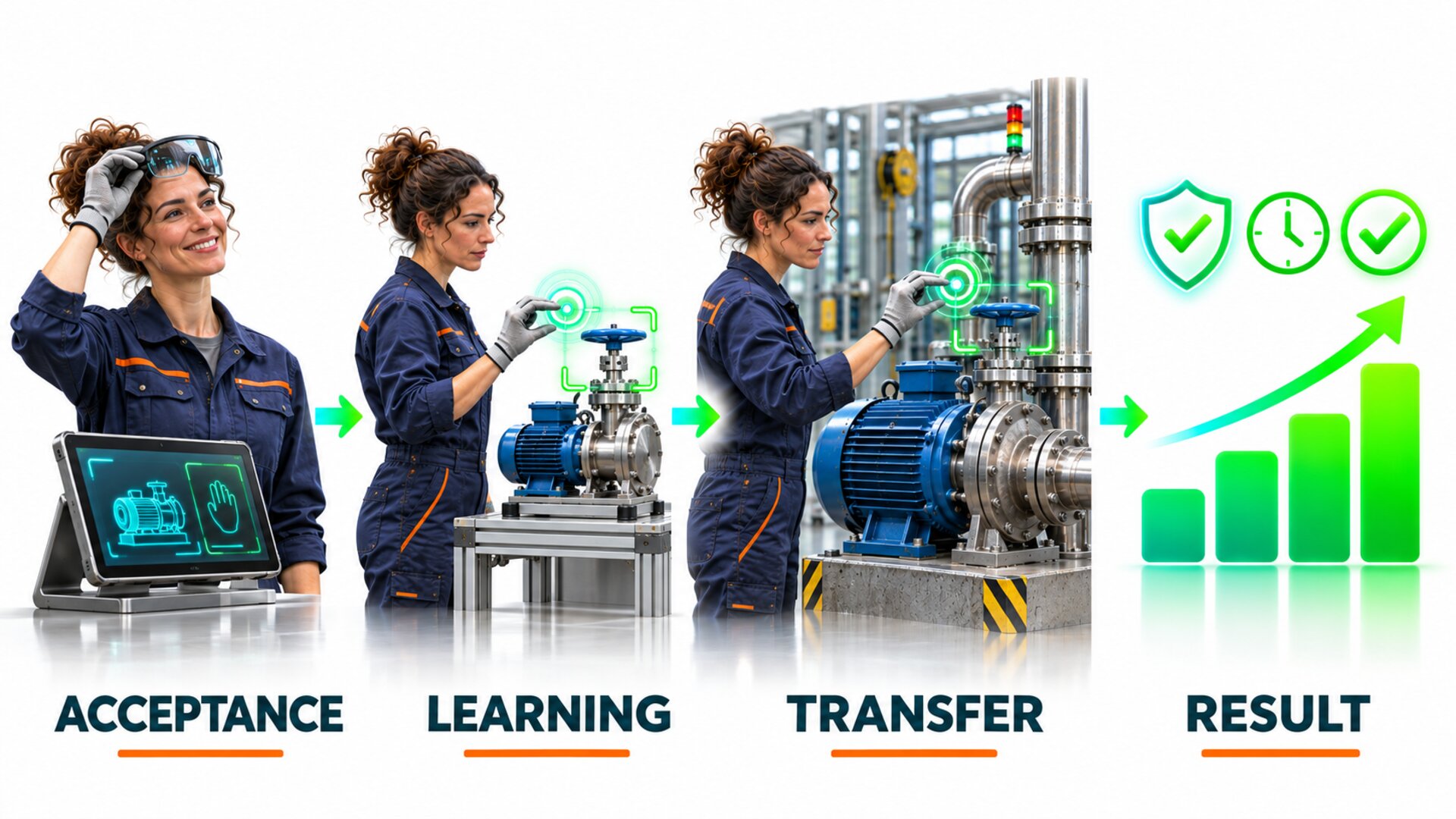
The closer measurement is to daily work, the more reliable the decision.
Image: Step 4 – from learning to transfer and operational result | AI-generated illustration, not a product photo | XR Stager Online Magazine | VISORIC GmbH
| Level | Guiding question | Example |
|---|---|---|
| Acceptance | Is operation understandable and acceptable? | Short survey, dropout rate |
| Learning | Has knowledge or skill changed? | Test or performance probe |
| Transfer | Is the action executed correctly in daily work? | Observation, inspection log |
| Result | Does an operational metric improve? | Error rate, time, safety |
- Excitement does not replace proof of impact.
- Transfer and metrics decide business value.
- Each level needs a fitting method.
- Comparison with the previous approach provides orientation.
- Measurement is planned before rollout.
These four levels separate excitement from value. A satisfaction score explains no error rate, a knowledge test right after does not prove behavior weeks later. Transfer and operational result decide business value. That is why measurement belongs before rollout and not only where the project team has already moved on.
Think organization and trust from the start
Step 5 of 8 · Own
New input changes responsibilities. Devices, models, content, support, and data protection need clear owners. Voice and camera in particular generate sensitive data. Purpose limitation, legal basis, storage location, and access must be clarified before productive use.
Technical feasibility alone is not enough. Introduction succeeds when operation, training, and governance are thought through from the start. The picture shows the three pillars: data protection, trust, and clear responsibility. Without these, modern input remains a technology project without operations.

Ownership, budget, and data protection stand before sustained use.
Image: Step 5 – Privacy, Trust, and operational ownership | AI-generated illustration, not a product photo | XR Stager Online Magazine | VISORIC GmbH
- Every productive input needs named ownership.
- Data protection and co-determination belong before rollout.
- Support and updates are part of the operational role.
- Trust arises through transparency about data flows.
- Organization co-decides the success of the technology.
Without named ownership and clarified data protection, modern input remains a technology project without operations. Voice and camera generate sensitive data – purpose limitation, legal basis, and access must stand before productive use. Organization and trust co-decide the success of the technology.
Total cost instead of device price
Step 6 of 8 · Calculate
The purchase price of the hardware is rarely the largest item. Integration, training, support, updates, downtime, and process adaptation determine total cost. A sensible view is cost per qualified person over the planned period of use.
Frontier technologies such as brain-computer interfaces are suitable today mainly for tightly bounded scenarios with very high value. The economic question is not “What does the device cost?” but “What measurable work advantage are we buying over the lifetime?” The picture shows the three cost blocks: integration, support, and operation – the device price is only the beginning.
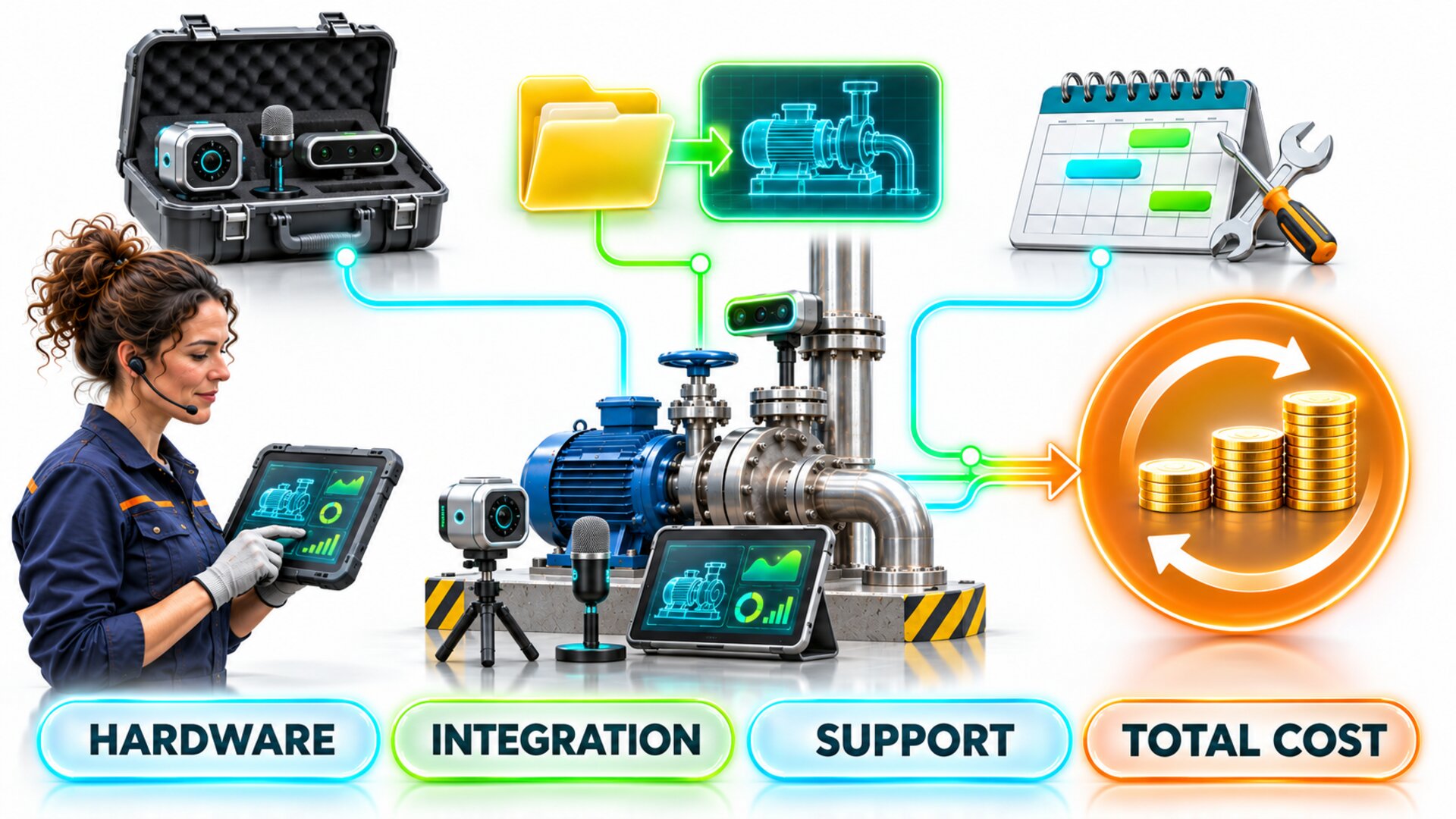
Total cost per qualified person beats pure device price.
Image: Step 6 – Integration, Support, and economics | AI-generated illustration, not a product photo | XR Stager Online Magazine | VISORIC GmbH
- Total cost covers far more than hardware.
- Comparison with the previous format makes additional value visible.
- A tight scope reduces risk and accelerates learning.
- Value per person and period is the viable metric.
- Technology without an operations concept remains expensive and low-impact.
The device price is rarely the largest item. Integration, training, support, updates, and process adaptation determine total cost. The economic question is not “What does the device cost?” but “What measurable work advantage are we buying over the lifetime?” Total cost per qualified person makes the additional value visible.
Test under real conditions
Step 7 of 8 · Validate
Lab tests are not enough. Gesture recognition reacts to light, distance, and gloves. Speech recognition depends on acoustics, technical terms, and background noise. Manufacturer claims without context are hard to transfer.
A reliable deployment tests with the real target group, measures baseline and later transfer, and defines in advance when to stop, improve, or expand. The picture shows testing under real conditions: the plant, the technician, the actual environment – not the lab.
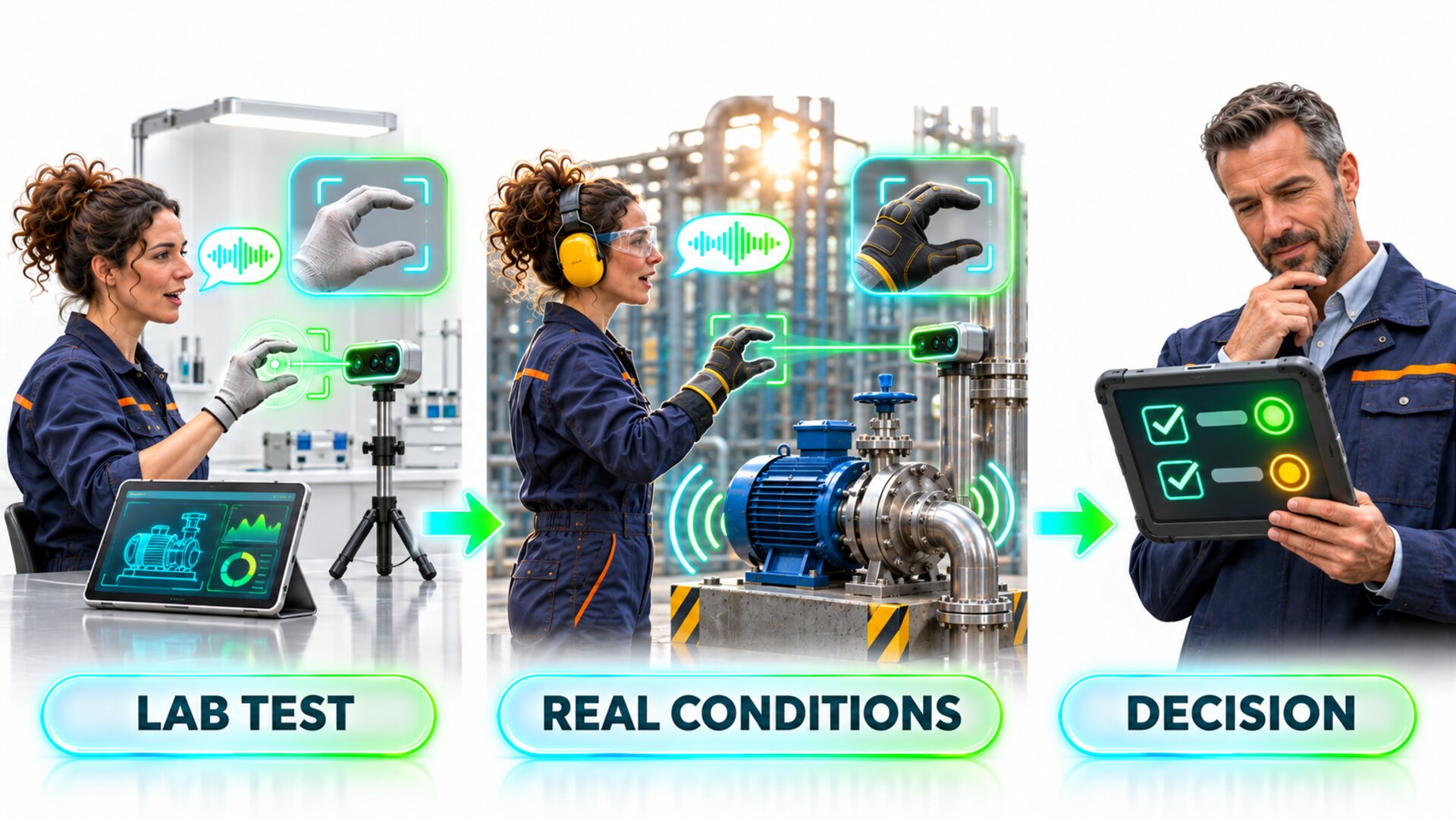
A decision becomes reliable when measured before and after under real conditions.
Image: Step 7 – Real conditions instead of pure lab test | AI-generated illustration, not a product photo | XR Stager Online Magazine | VISORIC GmbH
- Real conditions belong in testing before rollout.
- Metrics need information on setting and measure.
- Baseline and follow-up make impact visible.
- Decision thresholds are fixed before the start.
- Without a real-world test, value remains an assumption.
Without testing under real conditions, value remains an assumption. Gesture recognition reacts to light and gloves, speech recognition to acoustics and technical terms. Manufacturer claims without context are hard to transfer. Baseline and follow-up measurement under real conditions make the decision reliable.
From first deployment to capability in the company
Step 8 of 8 · Scale
After the first successful deployment comes not the company-wide rollout, but a second, similar area. There it becomes clear what can be standardized and what remains local. Reusable are often interaction logic, evaluation model, and support. Site- or plant-specific remain models, language, and approvals.
The viable sequence is: clear use case, stable operation, second site, then portfolio. At each stage, value, effort, and cost are reassessed. The picture shows the path from the first site to the second, connected by reusable standards.
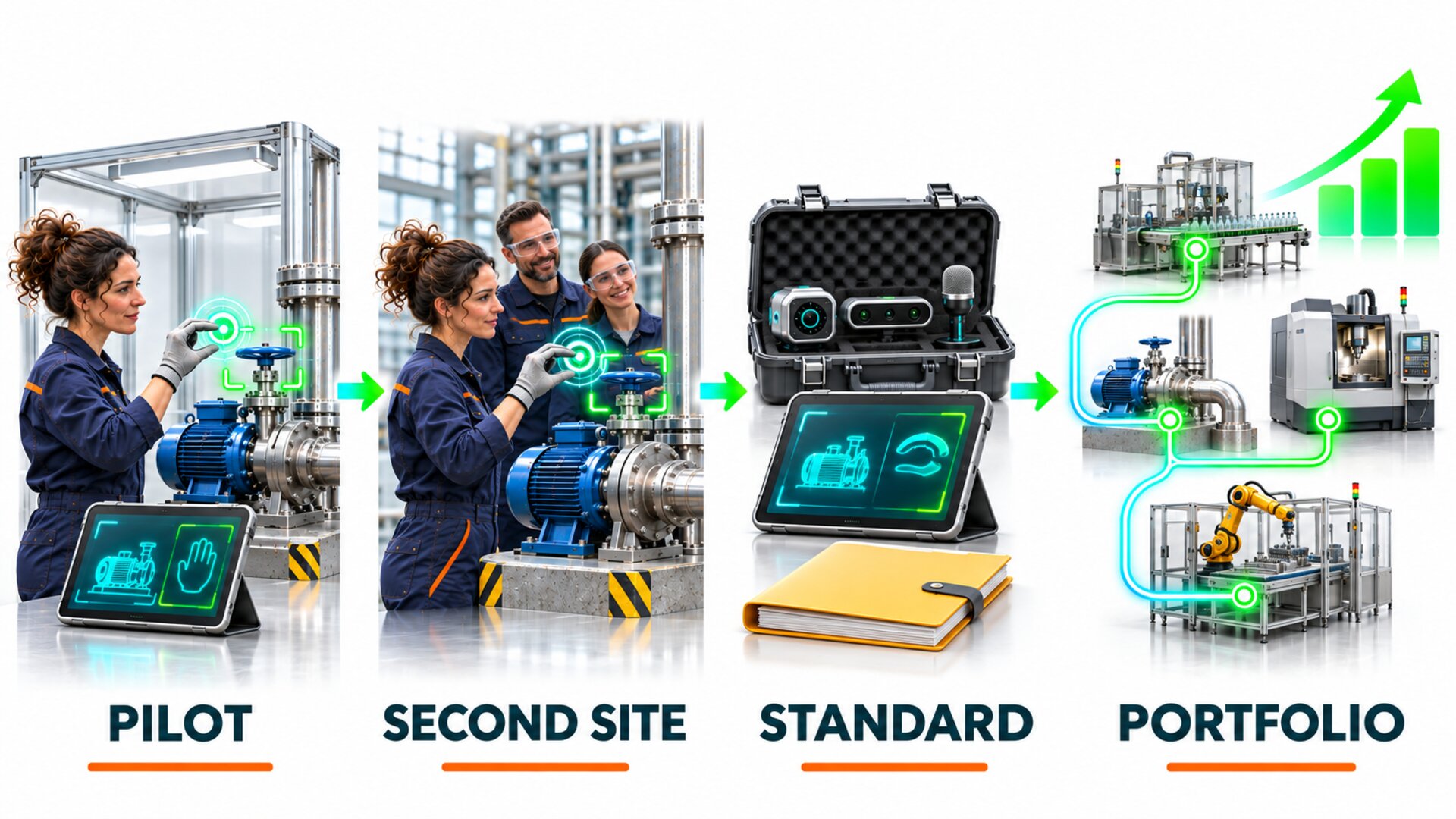
Expansion starts with the next similar area, not with all sites at once.
Image: Step 8 – Second site and standard as the path to scaling | AI-generated illustration, not a product photo | XR Stager Online Magazine | VISORIC GmbH
| Check field | Guiding question |
|---|---|
| Work goal | Which action should become safer, faster, or more accessible? |
| Format fit | What additional value does the new input offer over existing paths? |
| Operation | Who owns technology, support, data protection, and updates? |
| Impact | Which data prove transfer and operational value? |
| Economics | What total costs arise per person over the period of use? |
| Expansion | When do we stop, improve, or expand to the next area? |
- Expansion starts with the next similar area.
- Standard and local adaptation are deliberately separated.
- Value and effort are reassessed stage by stage.
- The goal is an operable capability, not a one-time technology test.
Expansion starts with the next similar area, not with all sites at once. There it becomes clear what can be standardized and what remains local. Value and effort are reassessed stage by stage. The goal is an operable capability, not a one-time technology test. How clear these points already are for you is checked by the following practice check.
Practice Check: Input that stays
Step 9 · Sharpen the assessment
The interactive check tests in 16 questions how clearly work goals, format choice, measurement, organization, and expansion are already thought through for you. The result shows strengths and the biggest lever and can optionally be discussed with the VISORIC expert team.
Interactive check on modern input | VISORIC GmbH | XR Stager Online Magazine
The next concrete step
Step 10 · Conversation
Modern input becomes valuable when it solves a clear work goal better than existing paths and is organized sustainably in operations. The entry rarely succeeds via the big vision, but via a bounded use case with measurable value.
The team of VISORIC GmbH from Munich combines over 15 years of experience in 3D, AI, and XR with the implementation of interactive systems for technical processes. Together we clarify which use case fits, which input format carries, and how operation and measurement are set up.
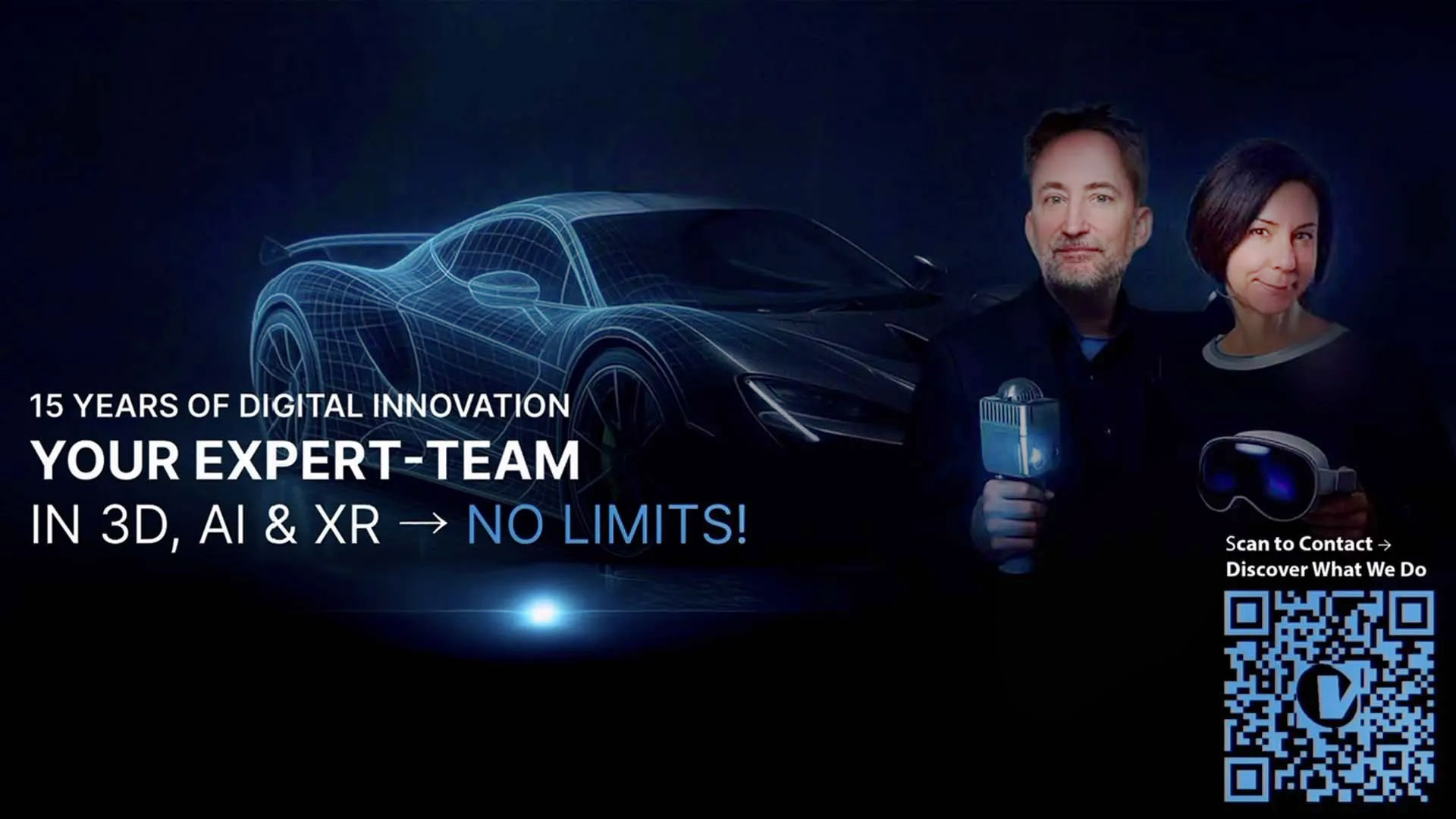
15 years of experience in 3D, AI, and XR: the VISORIC expert team from Munich.
Image: © Ulrich Buckenlei | XR Stager Online Magazine | VISORIC GmbH
A well-thought-out pilot with a single use case and a clearly bounded learning environment can often be realized much faster and more cost-effectively than many companies expect. The entry consists of three steps:
- Sharpen use case and work goal, including the question whether modern input offers additional value over keyboard, mouse, or touch.
- Set up the pilot as an operational trial, with named roles, measurement plan, and decision thresholds.
- Plan the path to expansion in stages, from the second area to the input portfolio.
This is exactly the starting point for a conversation: not at the big, company-wide vision, but at a clearly bounded, quickly implementable first step.
Who will run this input in your company in the seventh month, when the project team has long moved on?
Talk to the VISORIC expert team from Munich about spatial computing, multimodal interfaces, and industrial input systems. Together we develop a precise, traceable next step from your use case.
Contact:
Email: info@visoric.com
Phone: +49 89 21552678
Sources and references
- Stefan, Mortimer, Horan. Evaluating the effectiveness of virtual reality for safety-relevant training. Virtual Reality 27, 2023.
- Baceviciute et al. Investigating the value of immersive virtual reality tools for organizational training. Journal of Computer Assisted Learning 38(2), 2022.
- Jongbloed, Chaker, Lavoué. Immersive procedural training in virtual reality. Computers & Education, 2024.
- Kirkpatrick & Kirkpatrick. Evaluating Training Programs. Berrett-Koehler, 2006.
- Oviatt, S. Multimodal Interfaces. In: The Human-Computer Interaction Handbook.
- Kouijzer et al. Implementation of virtual reality in healthcare. Implementation Science Communications 4, 2023.
- Saredakis et al. Factors Associated With Virtual Reality Sickness in Head-Mounted Displays. Frontiers in Human Neuroscience 14, 2020.
- Carvalho et al. The Impact of Virtual Reality on Employee Training and Learning. Applied Sciences 15(19), 2025.
- Betriebsverfassungsgesetz, § 87 Abs. 1 Nr. 6.
- VISORIC practice projects in digital twins, real-time 3D, and spatial computing.
- XR Stager platform for industrial spatial computing applications.
Contact Persons:
Ulrich Buckenlei (Creative Director)
Mobile: +49 152 53532871
Email: ulrich.buckenlei@visoric.com
Nataliya Daniltseva (Project Manager)
Mobile: +49 176 72805705
Email: nataliya.daniltseva@visoric.com
Address:
VISORIC GmbH
Bayerstraße 13
D-80335 Munich