

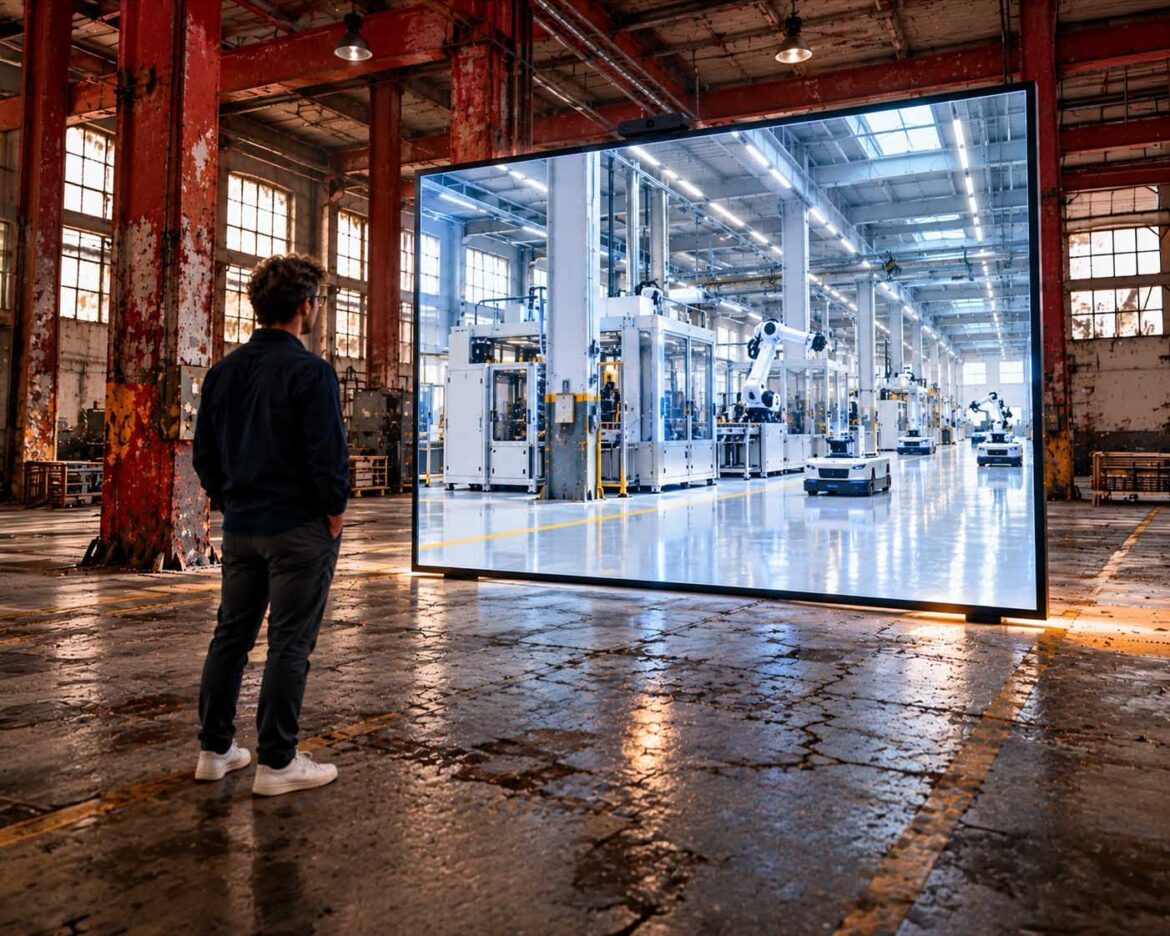
Gaussian Splatting reconstructs the existing space, CAD and 3D data show the future, and head tracking turns the screen into a spatial window.
Visualization: A screen in an existing factory hall showing the space reconstructed as a Gaussian Splat with a planned installation from CAD data inserted in its correct position | Image: © Ulrich Buckenlei | XR Stager Online Magazin | VISORIC GmbH
In many companies, every major change in an existing hall begins with the same uncertainty. Will the new installation fit into the intended space, will walkways and safety clearances remain free, and how will the machine look next to its neighbors once it is actually in place? Floor plans, CAD views and presentations answer these questions only in part, because they show the future on paper or on a screen, separated from the space in which it is meant to happen. Wrong decisions therefore often only become apparent once foundations have been poured and cables laid. Each of these late corrections costs time, delays commissioning and strains budgets that are already tightly calculated in investment decisions.
A current prototype suggests how this separation can be overcome. Creative technologist Hugues Bruyère of the creative studio Dpt. has developed a screen called Vitre that behaves like a window. Behind the glass appears a photorealistic 3D reconstruction of his office, created from photographs as a so-called Gaussian Splat and precisely aligned with the real room. A webcam tracks the viewer’s head position and adjusts the perspective in real time, so that digital and physical space appear to merge into one another.[1]
Bruyère has been working with this technology for years. As early as 2023, Dpt. showed how a photorealistic portrait can be created as a Gaussian Splat from just 13 HD images, running in real time at around 300 frames per second on a powerful computer.[2] What is new about Vitre is the combination of this reconstruction with an old but effective principle of computer graphics: view-dependent perspective, which turns an ordinary monitor into a spatial window.
For industrial companies, this is more than a visual effect. If a real space can be digitized photorealistically with reasonable effort, CAD, BIM or other 3D planning data can be inserted into this existing space in their correct position. Planned machines, layout variants or conversions then appear exactly where they are actually meant to stand later. This article explains the technology behind it, places the research in context, shows the limits of the current prototype and describes the conditions under which the principle can find its way into factory planning.
- Factory planning usually shows the future separated from reality.
- Vitre turns a screen into a spatial window.
- Gaussian Splatting reconstructs spaces photorealistically from photographs.
- Head tracking adjusts the perspective in real time.
- The principle opens new paths for planning and heritage.
The following article shows how photos become a photorealistic space, why Gaussian Splatting brought the breakthrough to real time, how the window principle works, what the Vitre prototype achieves, where applications in factories and cultural heritage lie and which hurdles remain on the way to a standard.
From Photo to Photorealistic Space
Reconstructing spaces from photographs is not a new idea. For decades, photogrammetry has calculated point clouds and surface models from overlapping images, and terrestrial laser scanners capture buildings and installations with high geometric accuracy. Both methods deliver excellent measurement data but often look technical when displayed: reflections, fine structures and soft light transitions are lost, and the results are more reminiscent of a model than of the space itself.
A turning point came in 2020 with the work on Neural Radiance Fields, NeRF for short. Instead of reconstructing surfaces, a neural network learns how light appears at every point in a space in every direction. From a series of photos, new photorealistic views are created from angles that were never photographed.[3] The quality was impressive, but rendering was slow, as every image had to be computed at great effort. Fluid interaction, in which the viewing angle changes continuously, was initially out of the question.
It was precisely this hurdle that a research group at Inria overcame in 2023 with 3D Gaussian Splatting. The authors showed that complete, unbounded scenes can be rendered in high quality at a minimum of 30 frames per second at 1080p, a value no previous method had achieved for such scenes.[4] This turned photorealistic novel view synthesis into a technology that can be used interactively in high display quality.
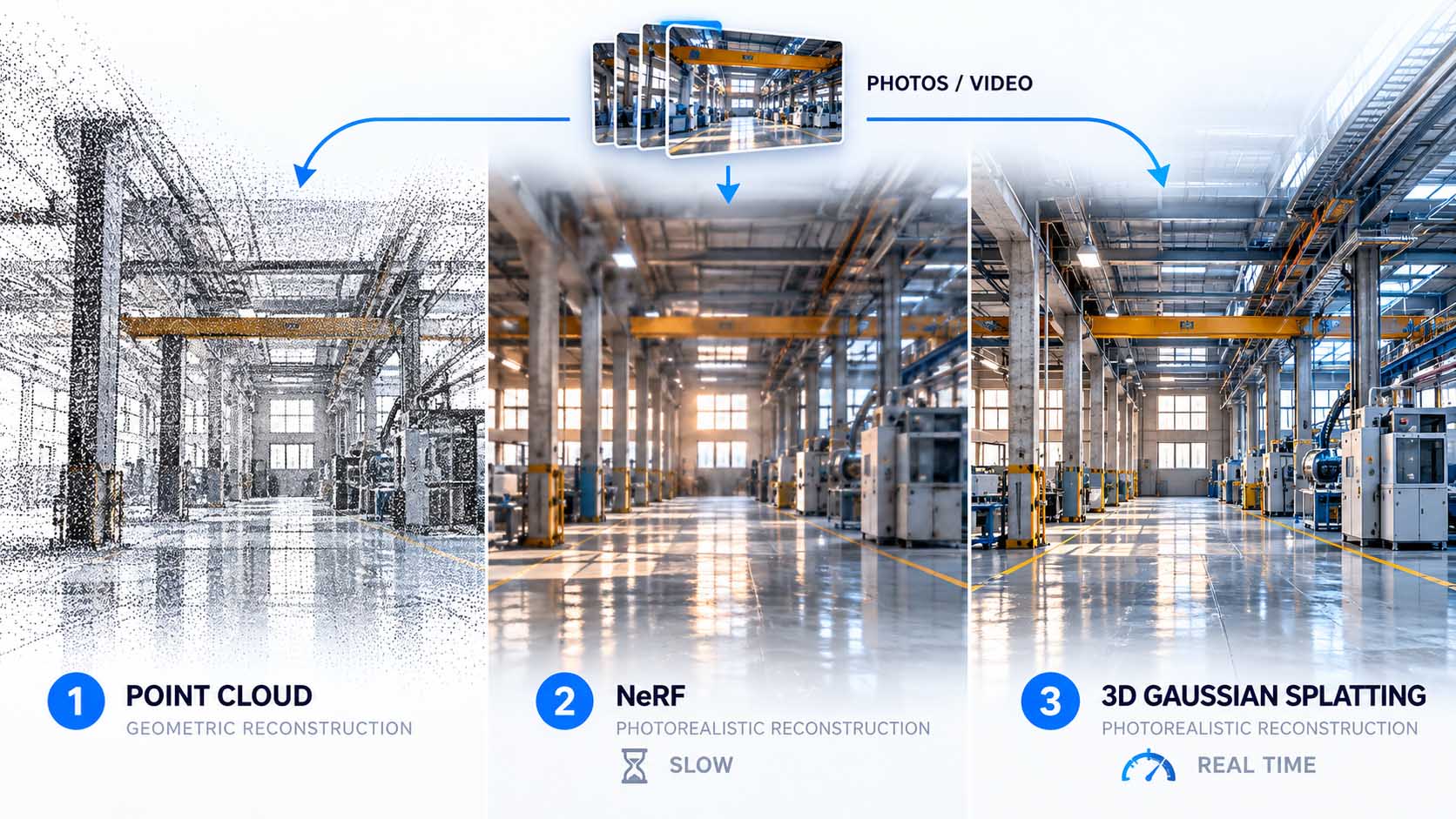
One common origin, three ways of representation.
Infographic: Point cloud, NeRF and 3D Gaussian Splatting as three representation approaches from the same photos of an existing hall | Graphic: © Ulrich Buckenlei | XR Stager Online Magazin | VISORIC GmbH
For practical use, this leap is decisive. A photorealistic reconstruction whose new views cannot be computed quickly enough for fluid interaction is only of limited use for view-dependent applications. A scene in which the viewing angle can be changed in real time, on the other hand, opens up possibilities for planning, coordination and training. Only this real-time capability makes it practical to continuously couple the display to the movement of a viewer, as Vitre does. In addition, the effort for visual capture is comparatively low: photos or videos from off-the-shelf cameras can be sufficient for a photorealistic Gaussian Splat reconstruction. Where geometric accuracy and reliable dimensions are required, however, photogrammetry and laser scanning remain important reference methods.
How Gaussian Splatting achieves this speed and why the method is so well suited to photorealistic spaces is shown in the next chapter.
- Photogrammetry and laser scanning deliver precise but technical-looking models.
- In 2020, NeRF generated photorealistic views from new angles.
- NeRF was initially too slow for fluid interaction.
- The original paper achieves at least 30 fps at 1080p.
- Real time makes reconstructions usable for planning.
The development from classic point clouds via NeRF to Gaussian Splatting shows how quickly the line between measurement model and photorealistic representation is shifting. For companies, this creates a particularly interesting combination of photographic realism and real-time capability.
How Gaussian Splatting Represents a Space
The name sounds technical, but the basic principle is remarkably intuitive: a space is not assembled from triangles but from millions of small, blurry clouds of color.
Each of these clouds is a three-dimensional Gaussian distribution with position, extent, orientation, opacity and view-dependent color. The starting point is a sparse point cloud that is created anyway during the camera calibration of the photos. An optimization process then adjusts the Gaussians until their rendering from each camera position matches the respective photo as closely as possible. Where more detail is needed, additional Gaussians are created, superfluous ones are removed, and empty space causes no computational effort.[4] The result is a scene that was not modeled but learned from reality, with all the reflections, materials and lighting moods contained in the photos.
The speed advantage arises during rendering. Instead of querying a neural network for every pixel as NeRF does, the Gaussians are projected directly onto the screen and layered in the correct order, a process that modern graphics cards handle extremely efficiently. A comprehensive survey in the journal IEEE Transactions on Visualization and Computer Graphics therefore describes Gaussian Splatting as a new era of explicit scene representation and classifies the rapidly growing number of further developments.[5]
Current research shows that the method also works in industrial environments. A study published in August 2026 describes how spatial constraints in industrial facilities often limit data capture to just a few viewpoints. It presents a semantically guided method that produces consistent, detailed reconstructions for industrial digital twins even from such sparse captures.[6]
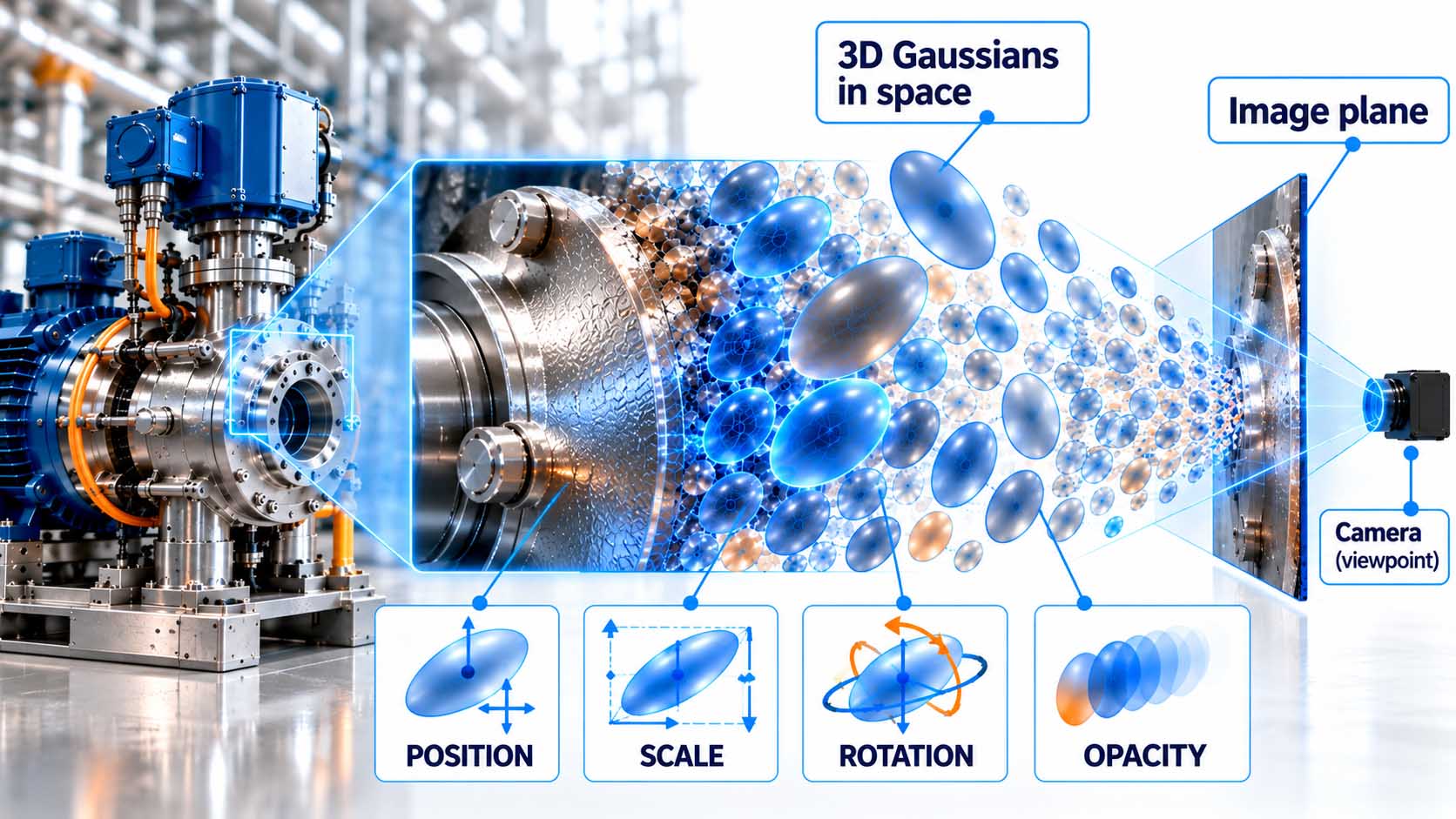
Millions of blurry clouds of color create a photorealistic image.
Infographic: The basic principle of 3D Gaussian Splatting, from a single Gaussian distribution to a photorealistic surface | Graphic: © Ulrich Buckenlei | XR Stager Online Magazin | VISORIC GmbH
For users, this means: a Gaussian Splat is not a classic 3D model made of cleanly defined surfaces and edges, but an explicit scene representation optimized for photorealistic views. This makes it ideal for visual tasks such as walkthroughs, planning and communication, but less suitable for anything that requires exact geometry, such as collision checks or taking measurements. This distinction runs through all practical applications and should be part of every project plan from the outset.
For such a splat to become a window, however, a second building block is needed, one that is considerably older than any neural reconstruction. What this is, is shown in the next chapter.
- Spaces emerge from millions of blurry, colored Gaussians.
- An optimization matches the rendering with the photos.
- Graphics cards project the Gaussians directly and quickly.
- Industrial variants also work with few viewpoints.
- Splats are photorealistic but not exact measurement models.
Gaussian Splatting thus combines photographic realism with the speed of modern graphics hardware. This very combination is the prerequisite for coupling a reconstruction to a person’s gaze in real time.
Why a Screen Can Become a Window
An ordinary monitor always shows a 3D scene from the same fixed perspective, no matter where the viewer is standing. A real window behaves differently: whoever moves their head sees more or less of the space behind it.
This behavior can be replicated technically. If the viewer’s head position is captured and the perspective of the display is continuously adjusted to it, motion parallax occurs: nearby objects shift more than distant ones, and the brain interprets the scene as spatial. The screen is then no longer perceived as an image but as an opening into a space behind it. It is the same effect that reveals the distance of the landscape when we look out of a train window.
This principle was already researched in the early 1990s under the term Fish Tank Virtual Reality. In 1993, Colin Ware, Kevin Arthur and Kellogg Booth showed that coupling the perspective to the head position may be more important for spatial perception than stereoscopy. In a task in which participants had to trace branches in a three-dimensional tree diagram, the error rate dropped from 22 percent with a static display to 3.2 percent with head coupling alone, while stereoscopy alone only reached 14.7 percent.[7]
A more detailed evaluation by the same research group in ACM Transactions on Information Systems confirmed these findings. Participants consistently preferred head coupling without stereoscopy over stereoscopy without head coupling, and with the combined display, error rates improved by an order of magnitude compared to a static display.[8]
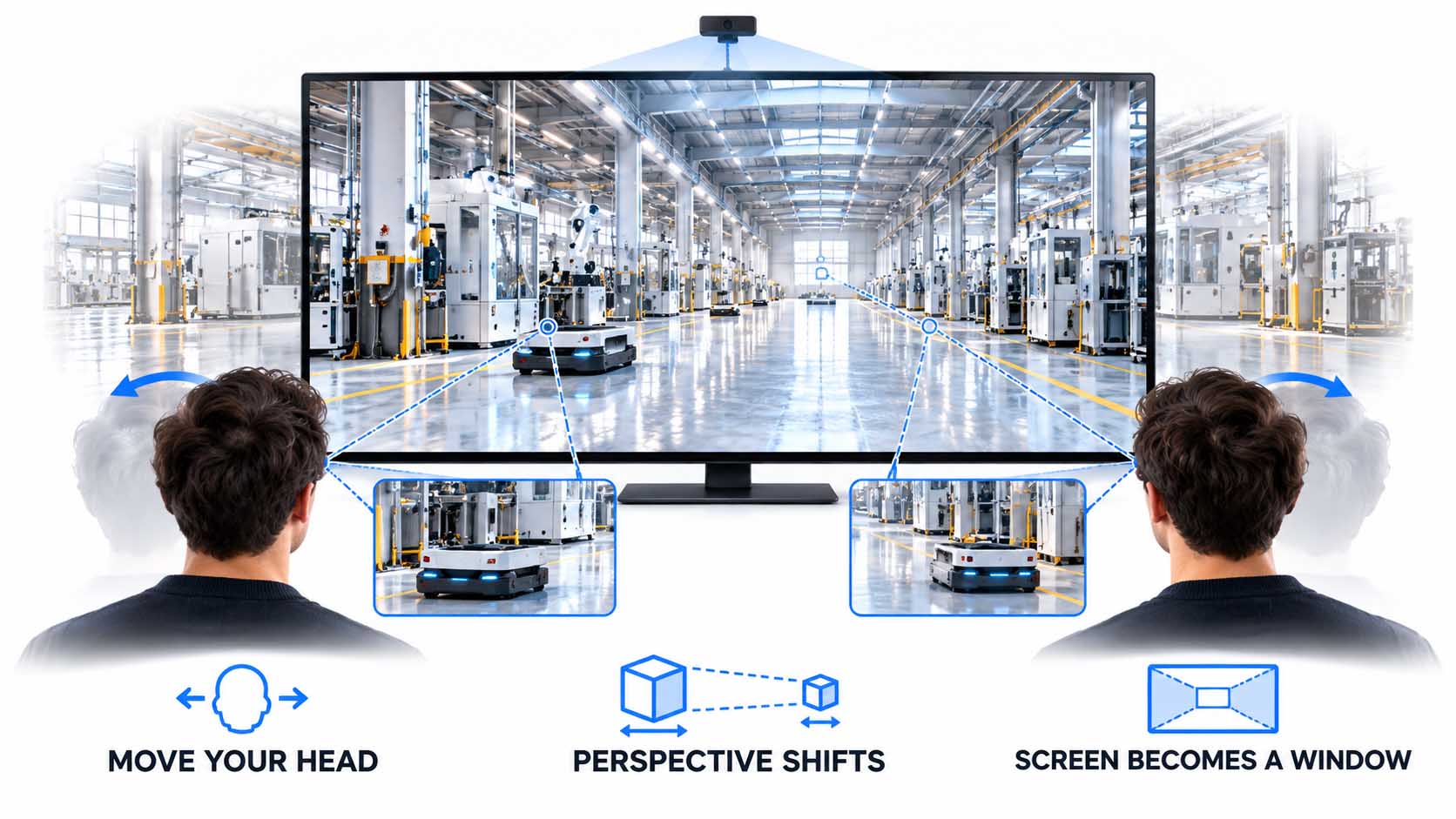
The perspective follows the head, the screen becomes a pane of glass.
Infographic: The principle of view-dependent perspective, in which the visible section changes with the head position | Graphic: © Ulrich Buckenlei | XR Stager Online Magazin | VISORIC GmbH
For today’s applications, this finding is remarkable. It means that a convincing spatial impression does not necessarily require a headset or a 3D monitor. An ordinary screen and a camera that tracks the head can already achieve a large part of the effect without the viewer having to wear anything. This lowers the barrier to entry considerably, for example for meetings, trade fair stands or exhibitions where not every participant wants to put on a headset.
What was made difficult for decades by more complex hardware and limited options for photorealistic real-time content can now be implemented much more easily with modern camera technology and Gaussian Splatting. How Vitre brings these two building blocks together is shown in the next chapter.
- Head tracking couples the perspective to head position.
- Motion parallax creates a strong spatial impression.
- Head coupling cut errors from 22 to 3.2 percent.
- Participants preferred head coupling over pure stereoscopy.
- Spatial perception does not necessarily require a headset.
The window principle is therefore scientifically well established and older than many assume. What is new is not the idea, but the quality of the content that can appear behind the window today.
What the Vitre Prototype Shows and What It Does Not Yet Show
Vitre combines the two building blocks described in a strikingly simple way. Hugues Bruyère’s office was reconstructed from photographs as a Gaussian Splat and then aligned so that the digital scene connects precisely with the real room. A webcam tracks the viewer’s head, and the display adjusts its perspective in real time. When the person moves, the section behind the screen shifts as if they were looking through a pane of glass into the room.[1]
That head tracking can be implemented without additional equipment on the head is not a new insight either. As early as 1995, Jun Rekimoto presented a camera-based head tracker for Fish Tank Virtual Reality that explicitly worked without headgear and determined the head position by image processing.[9] What required specialized hardware and software back then can now be implemented much more easily with off-the-shelf cameras and modern image processing. This lowers the cost of such a window to a level that is reasonable even for individual meeting rooms or trade fair stands.
At the same time, the prototype openly acknowledges its limits. Vitre is an early proof of concept that currently shows the captured room, and the effect is designed for a single tracked viewer. Calibration and latency remain challenges.[1] How sensitively the spatial impression reacts to time delays was already investigated in early research on head-coupled displays, which analyzed the effects of temporal artifacts on performance in spatial tasks in a dedicated experiment.[10]
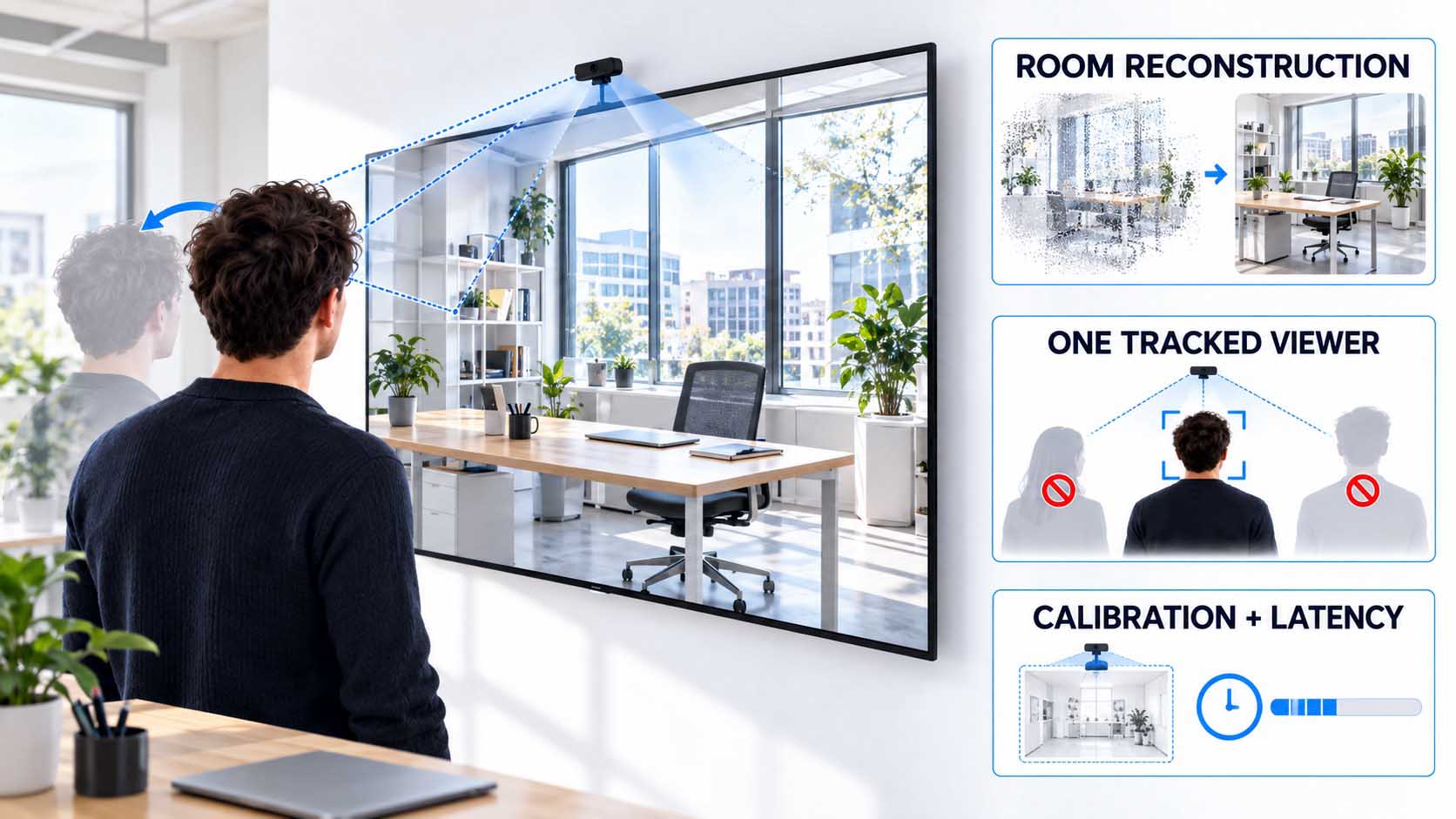
Reconstruction, alignment and tracking create the illusion.
Infographic: The structure of the Vitre prototype consisting of Gaussian Splat, spatial alignment and webcam tracking | Graphic: © Ulrich Buckenlei | XR Stager Online Magazin | VISORIC GmbH
For a realistic assessment, it is therefore important to note what Vitre does not show. Scenes from the future or the past, such as a planned machine or a historical interior, are possibilities suggested by the concept, not functions demonstrated in the prototype. Likewise, the single-viewer effect is a fundamental property of the method: the perspective is only correct for the tracked viewer, all others present see a distorted image.
It is precisely this clarity that makes the prototype valuable, because it shows a principle and not a finished product. How this principle could be transferred to the planning of machines and factories is shown in the next chapter.
- Vitre couples a Gaussian Splat with webcam tracking.
- Camera-based head tracking without headgear exists since 1995.
- The effect only works for one tracked viewer.
- Calibration and latency remain key challenges.
- Future and past scenes are concept, not demonstration.
Vitre is thus a proof of concept in the best sense. It makes an idea tangible whose technical building blocks have long been tested individually, and invites us to think about concrete applications.
A Window into the Future of the Factory
The most obvious industrial application is planning in existing buildings. A large part of layout planning does not take place on a greenfield site but in halls that have grown over time, with older installations, existing cabling and often missing or outdated CAD data. This is where it is decided whether a new machine really fits into the intended space, whether walkways remain clear and whether employees can cope with the changed workflow.
Researchers at Chalmers University of Technology accompanied industrial studies over eight years in which 3D laser scanning and immersive virtual reality were used for layout planning in brownfield factories. They identified typical problems as the availability and accuracy of existing data, the perception of scale and perspective, and the communication of planned changes. Realistic virtual models significantly reduced these problems and made it possible to involve more people in planning.[11]
Gaussian Splatting could accelerate this approach considerably. At the real-world lab of the ARENA2036 research campus, various methods for digitizing existing facilities were compared. Manual modeling achieved the highest accuracy with 93.4 percent according to the mAP metric but was very time-consuming, while Gaussian Splatting from a simple video scan achieved a reported mAP value of 91.2 percent within a few minutes. The project explicitly names the question of whether a new machine fits into the existing space as a concrete benefit.[12]
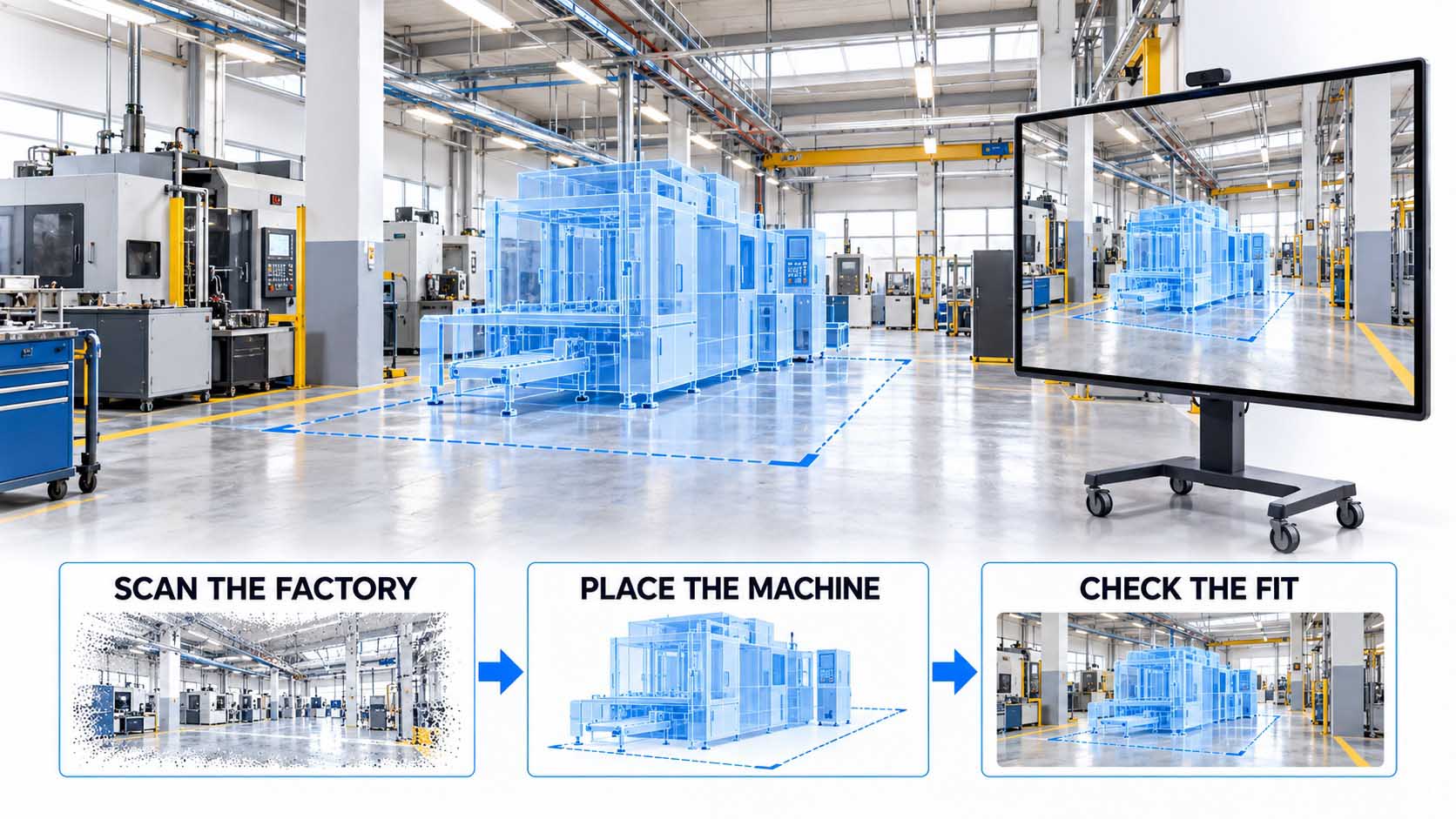
The planned installation appears where it will stand later.
Infographic: Gaussian Splat of an existing hall with a planned installation from CAD data inserted in its correct position | Graphic: © Ulrich Buckenlei | XR Stager Online Magazin | VISORIC GmbH
Combining these possibilities with the window principle creates an impressive planning tool. The hall is captured as a Gaussian Splat, the planned installation is inserted from CAD data, and a screen at the intended location shows both in the correct position and view-dependently. Decision-makers, maintenance staff and employees see the new machine where it will stand before it is built and can compare variants directly without having to hand out headsets. Especially in early project phases, when many stakeholders with different backgrounds need to agree, such a shared picture can shorten discussions and avoid misunderstandings that easily remain hidden in abstract plans.
The distinction from chapter 2 applies here: for coordination and communication, the visual quality of a splat is sufficient, while collision checks and binding dimensions still require exact geometry. That the window principle can look not only into the future but also into the past is shown in the next chapter.
- A large part of layout planning concerns brownfield factories.
- Realistic models improve scale, perspective and communication.
- Gaussian Splatting digitizes halls via video scan in minutes.
- The mAP value comes close to manual modeling.
- Binding dimensions still require exact geometry.
For companies, the value lies above all in better decisions before the investment. Errors that become visible in the real space before foundations are poured cost a fraction of what their later correction would.
A Window into the Past
The same window principle that makes a planned machine from CAD data visible in a reconstructed existing space can also show a room as it once was. The present-day space can be captured spatially for this purpose, while the historical state is reconstructed from archival photos, building plans, paintings or existing 3D data and inserted in its correct position. In museums, historic buildings or former homes of famous people, visitors could thus look through a window into an earlier interior. The historical state would no longer be described on an information panel but experienced in its correct position within today’s space.
The political framework for such applications is already in place in Europe. With Recommendation (EU) 2021/1970 on a common European data space for cultural heritage, the European Commission called on member states to accelerate the digitization of their cultural heritage and set concrete targets for 2030: all monuments and sites at risk as well as 50 percent of the most visited ones are to be digitized in 3D.[13]
Gaussian Splatting is now being systematically investigated in heritage conservation. A comparative study published in the ISPRS Archives in 2026 comes to an insightful conclusion: Gaussian Splatting clearly outperforms classic photogrammetry in rendering quality and real-time visualization, but is usually slightly lower in geometric accuracy, especially with small datasets or low image resolution.[14]
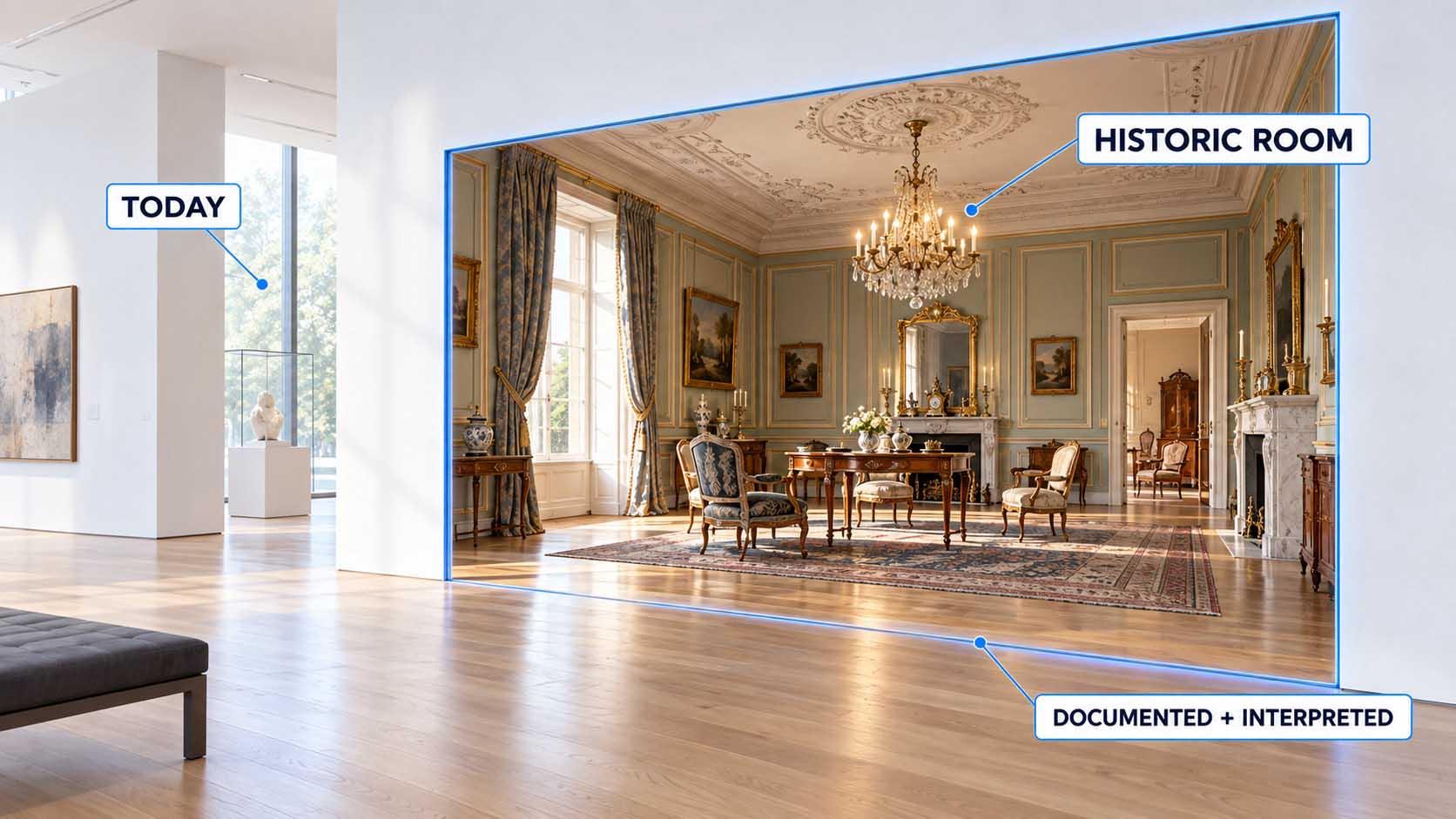
The historical room appears within today’s room.
Infographic: Reconstructed historical interior as a correctly positioned window in a present-day museum room | Graphic: © Ulrich Buckenlei | XR Stager Online Magazin | VISORIC GmbH
This division of labor fits the window principle perfectly. For the exact documentation of a monument, laser scanning and photogrammetry remain the reference, while for experience, communication and exhibition, Gaussian Splatting offers a realism that classic models rarely achieve. Reconstructed historical states bring an additional responsibility: what is based on sources and what has been supplemented or interpreted should remain recognizable to visitors. A convincing display must not give the impression that every detail is historically documented when it is in fact based on a professionally justified assumption.
Whether future or past, in both cases the quality of data and implementation determines whether a window convinces or irritates. Which hurdles can realistically be expected is shown in the next chapter.
- Reconstructed interiors could appear within today’s spaces.
- The EU calls for 3D digitization of heritage by 2030.
- Splats outperform photogrammetry in rendering quality.
- Photogrammetry usually leads slightly in geometric accuracy.
- Additions in reconstructions should remain recognizable.
Cultural heritage thus impressively shows how broadly the principle applies. For industrial companies, it is at the same time an indication that the technology is already being scientifically measured in a demanding environment.
Where the Limits of the Window Lie
As convincing as the effect is, several limits are fundamental in nature. The first concerns accuracy. A Gaussian Splat is optimized for visual effect, not for measurability. Anyone who wants to derive binding dimensions for foundations, connections or safety clearances from a reconstruction must know how accurate the geometry actually is and under what conditions it was captured.
Research provides nuanced results on this. A comparative study from geodesy published in 2025 compared terrestrial laser scanning, photogrammetry and Gaussian Splatting. Laser scanning achieved the highest accuracy and confirmed its role as the reference method, albeit with considerable time and cost. In this study, Gaussian Splatting achieved higher precision than photogrammetry, with high visual realism and significantly lower hardware requirements.[15]
Other studies are more cautious. An investigation into the creation of facade orthophotos compared Gaussian Splatting with multi-view stereo and laser scanning and explicitly asked at what point the new method becomes worthwhile compared to established methods.[16] Together with the study from chapter 6, a clear picture emerges: accuracy depends heavily on capture conditions, dataset and processing, and laser scanning remains the reference when millimeters matter.
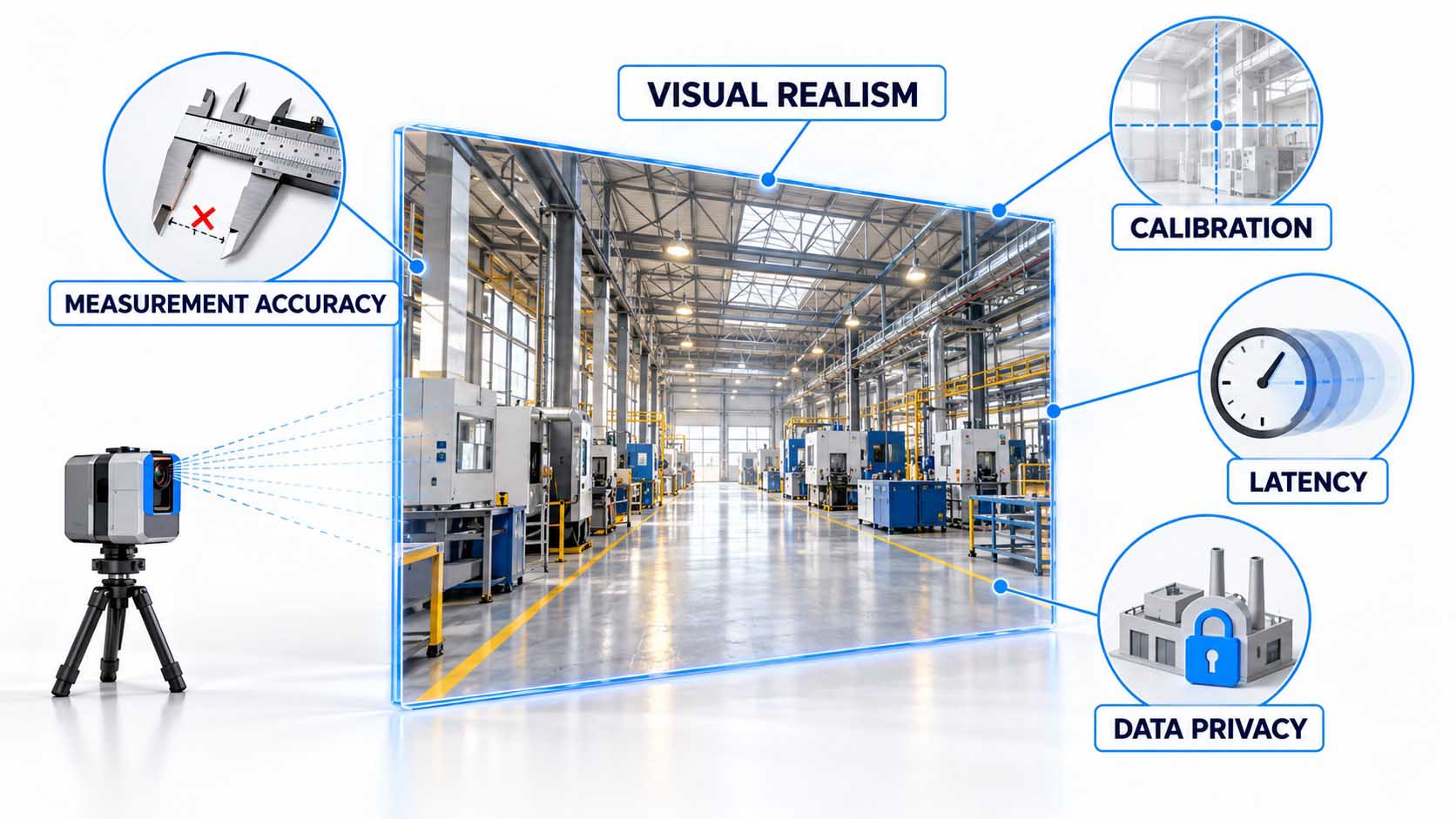
Accuracy, calibration, latency and confidentiality set limits.
Infographic: The key limits of view-dependent Gaussian Splat displays in industrial use | Graphic: © Ulrich Buckenlei | XR Stager Online Magazin | VISORIC GmbH
There are also practical hurdles. The alignment of digital and real space must be carefully calibrated, otherwise the illusion breaks down with every movement. A noticeable delay between head movement and image update is quickly perceived as jitter. The single-viewer effect limits use with groups. Finally, questions of rights and confidentiality arise: a photorealistic reconstruction of a production hall may show installations, processes and people that should not be visible to everyone. Anyone creating reconstructions should therefore determine from the outset which areas are captured, who has access and how long the data is stored.
None of these limits speaks against the principle, but they determine what it is suitable for. What the path from prototype to a reliable tool can look like is shown in the next chapter.
- Splats are optimized for visual effect, not measurability.
- Laser scanning remains the reference when millimeters matter.
- Studies on accuracy reach different conclusions.
- Calibration and latency determine the illusion.
- Reconstructions of halls raise confidentiality and rights questions.
Those who know these limits use the technology where it plays to its strengths: in coordination, communication and experience. For binding planning, it remains a complement to proven measurement methods, not a replacement.
From Prototype to Industry Standard
For a technology to make the leap from the lab into everyday business, it takes more than impressive demonstrations. It requires open formats that work across tools, reliable playback on common devices and workflows that fit into existing planning processes. This very development is currently emerging for Gaussian Splatting.
In February 2026, the Khronos Group, the consortium behind standards such as OpenGL, Vulkan and glTF, presented a release candidate for the KHR_gaussian_splatting extension. It makes it possible to store Gaussian Splats in the widely used 3D exchange format glTF 2.0, is deliberately kept open for future methods and is intended to prevent fragmentation between platforms. Khronos describes Gaussian Splatting as production-ready, including on mobile devices.[17]
OpenUSD is also evolving in parallel. With OpenUSD v26.03, a native schema family for 3D Gaussian Splats was introduced in 2026, allowing photorealistic reconstructions to be used together with classic USD content in a single scene.[18] Khronos and the Alliance for OpenUSD coordinate their developments to enable the smoothest possible exchange of Gaussian Splats between glTF and OpenUSD.[17] For industrial companies, this is an important signal, as it brings the connection to existing 3D and digital twin tools within reach.
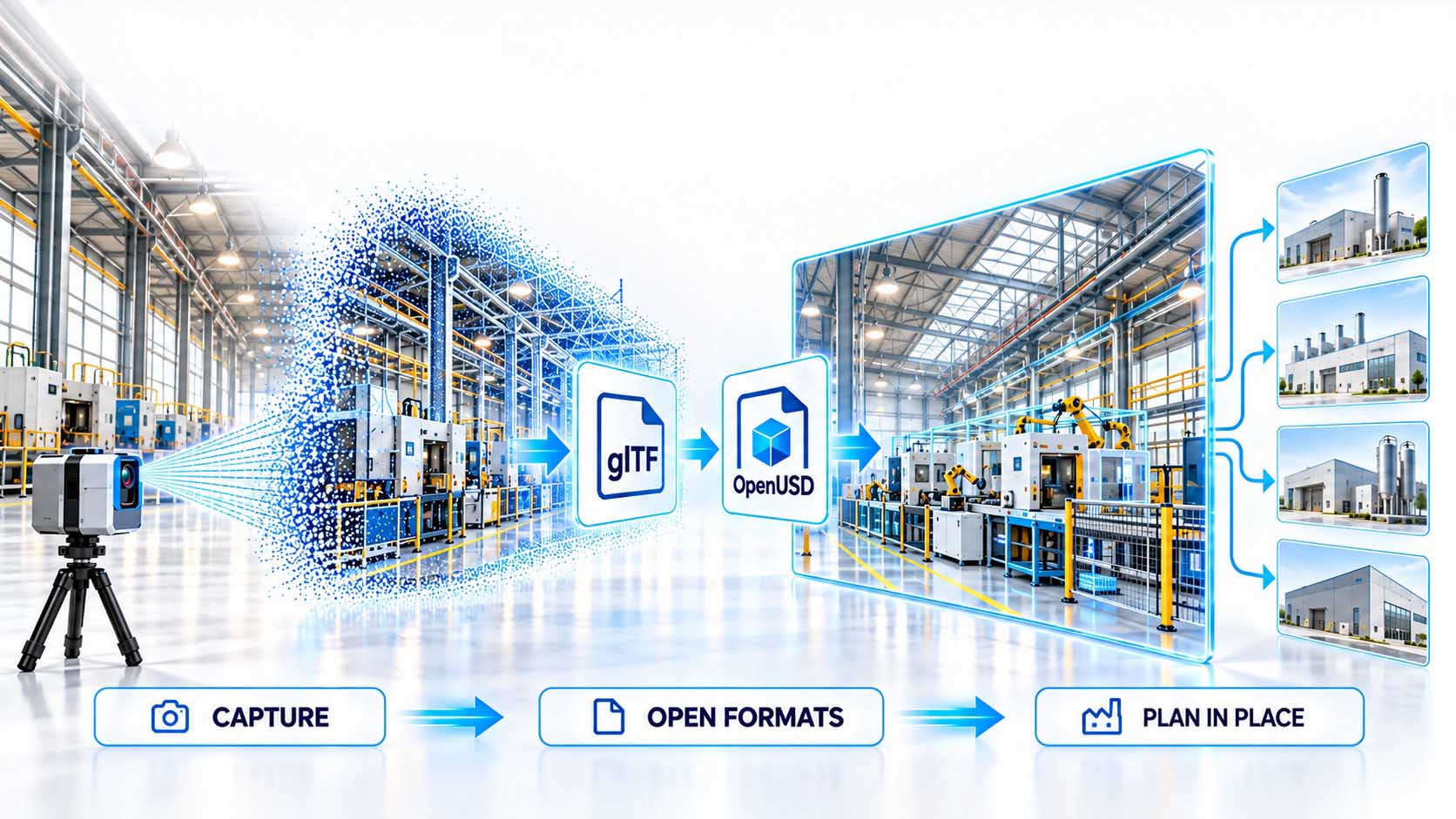
From capture via open formats to the window in the hall.
Infographic: The path from prototype to industrial use via capture, open exchange formats and display | Graphic: © Ulrich Buckenlei | XR Stager Online Magazin | VISORIC GmbH
A clearly defined pilot is therefore recommended for getting started. A hall or section of a hall is captured, a planned installation from CAD data is inserted and the display is tested in a real planning session. What is measured is whether coordination succeeds faster, whether planning errors become apparent earlier and how high the effort for capture, preparation and maintenance actually is. It is equally important to clarify early on who may see the reconstruction and where it is stored.
The technical building blocks for this are available today, from capture via video and open formats to display in the browser or on a screen with a camera. Whether they pay off in one’s own company is decided not by the fascination of the technology, but by a concrete planning task with a measurable result. Those who gain initial experience today can assess the technology before it becomes a standard planning tool and prepare existing data for it at an early stage.
- Khronos presented a glTF extension in February 2026.
- Gaussian Splats thus become exchangeable between tools.
- OpenUSD natively supports Gaussian Splats since version 26.03.
- Khronos and AOUSD coordinate exchange between both formats.
- A defined pilot creates a reliable basis for decisions.
In the end, there is a tool that brings planning to where it becomes effective: into real space. How convincing the effect already is today is shown in the following video.
A Screen That Behaves Like a Pane of Glass
How impressive the principle is in practice is difficult to convey in words. The embedded video shows Hugues Bruyère’s Vitre prototype in action: a round screen in the office, behind which the reconstructed scene of the room appears.[1]
When the viewer moves, the section behind the glass changes just as one would expect from a real window. It is based on a Gaussian Splat created from photographs of the office, together with a webcam that tracks the head position and continuously adjusts the perspective.
The recording thus combines the central building blocks of this article: a photorealistic reconstruction in real time, the view-dependent perspective from research in the 1990s and a precise alignment between digital and real space.
Video: Vitre, a screen with view-dependent display of a Gaussian Splat that behaves like a window into real space | Visuals by Hugues Bruyère (@smallfly), Dpt., original idea @kcimc | Analysis, voiceover, editing and video production: © Ulrich Buckenlei | XR Stager Online Magazin | VISORIC GmbH
It is remarkable how little visible technology the effect requires. There is no headset, no controller and no marker on the body, only a screen, a camera and a carefully prepared reconstruction. It is precisely this simplicity that makes the principle interesting for meeting rooms, trade fair stands or factory halls, where many stakeholders are meant to look at a plan together without first having to put on any equipment.
The assessment also includes this: Vitre is an early proof of concept, designed for one viewer and currently limited to the captured room. The views into the future and the past described in this article are applications suggested by the concept, not functions already shown in the video.
- The video shows Hugues Bruyère’s Vitre prototype.
- The view follows head movement like a window.
- A Gaussian Splat delivers the photorealistic scene.
- The effect works without headset or markers.
- Future and past scenes are concept, not demonstration.
The example shows how close space and representation have come. As soon as virtual and real space overlap, time becomes another layer that can be opened in both directions.
Making Planning Tangible in Real Space
A convincing window into the future of a hall is the result of several disciplines: careful capture of the existing space, preparation of CAD data for real-time rendering, precise alignment of digital and real space, and a platform on which variants can be compared and shared. This very combination is at the core of VISORIC GmbH’s work.
For more than 15 years, the Munich-based team has been developing applications in 3D, AI and XR for industrial companies, with a focus on spatial computing, real-time 3D and digital twins. VISORIC captures spaces and installations, including with Gaussian Splatting, prepares CAD data for interactive display and brings both together in the XR Stager platform, in the browser, on large displays or in XR.

15 years of experience in 3D, AI and XR: the VISORIC expert team from Munich.
Image: © Ulrich Buckenlei | XR Stager Online Magazin | VISORIC GmbH
Getting started does not have to be big. A single section of a hall and one planned installation are enough to reliably assess the effort, quality and benefit for your own planning. VISORIC accompanies this path from capture and preparation to testing in a real planning session.
- Capture of halls and installations as photorealistic Gaussian Splats.
- Correctly positioned integration of planned machines from CAD data.
- Display in the browser, on screens and in XR.
Precisely because the standards for Gaussian Splatting are emerging now, this is a good time to gain initial experience with the technology in your own environment.
Would you like to see how a planned installation looks in your existing hall before it is built?
Talk to the VISORIC expert team in Munich. Together, we select a suitable area, capture the existing space and show your plans exactly where they are meant to become reality.
Contact:
Email: info@visoric.com
Phone: +49 89 21552678
Sources and References
- Hugues Bruyère (@smallfly), Dpt. Vitre, prototype of a view-dependent Gaussian Splat window, original idea @kcimc. Instagram and LinkedIn, 2026.
- Dpt. Portrait dataset from 13 HD images as a real-time 3D Gaussian Splat. LinkedIn, 2023.
- Mildenhall, B. et al. NeRF, Representing Scenes as Neural Radiance Fields for View Synthesis. European Conference on Computer Vision (ECCV), 2020.
- Kerbl, B., Kopanas, G., Leimkühler, T., Drettakis, G. 3D Gaussian Splatting for Real-Time Radiance Field Rendering. ACM Transactions on Graphics, 42(4), 2023. arxiv.org/abs/2308.04079.
- Fei, B. et al. 3D Gaussian Splatting as New Era, A Survey. IEEE Transactions on Visualization and Computer Graphics, 2024.
- Semantic-guided 3D Gaussian splatting for sparse-view reconstruction in industrial digital twins. Visual Computing for Industry, Biomedicine, and Art, 2026. doi.org/10.1186/s42492-026-00229-x.
- Ware, C., Arthur, K., Booth, K. S. Fish Tank Virtual Reality. Proceedings of INTERCHI 1993, ACM, 37-42. doi.org/10.1145/169059.169066.
- Arthur, K., Booth, K. S., Ware, C. Evaluating 3D Task Performance for Fish Tank Virtual Worlds. ACM Transactions on Information Systems, 11(3), 239-265, 1993.
- Rekimoto, J. A Vision-Based Head Tracker for Fish Tank Virtual Reality, VR without Head Gear. Proceedings of VRAIS 1995, IEEE.
- Arthur, K. W. 3D Task Performance Using Head-Coupled Stereo Displays. Master’s thesis, University of British Columbia, 1993.
- Chalmers University of Technology. Virtual Engineering Using Realistic Virtual Models in Brownfield Factory Layout Planning. Journal article, 2021. research.chalmers.se.
- ARENA2036. Brownfield and GenAI, the future of the existing factory, technology comparison at the real-world lab. arena2036.de.
- European Commission. Recommendation (EU) 2021/1970 on a common European data space for cultural heritage. Official Journal of the European Union, 2021.
- Photogrammetry and 3D Gaussian Splatting for Cultural Heritage. ISPRS Archives, XLIX-B2-2026, 451, 2026. doi.org/10.5194/isprs-archives-XLIX-B2-2026-451-2026.
- Zayats, I., Voitekhin, T. Comparison of Modern 3D Modelling Methods, The Case Study of the A. Sheptytskyi Monument. International Conference of Young Professionals GeoTerrace-2025, EAGE, 2025. doi.org/10.3997/2214-4609.202552025.
- Murtiyoso, A., Macher, H. Gaussian Splatting for Facade Orthophoto Generation, Comparison with MVS and TLS. ISPRS Archives, XLVIII-M-9-2025, 1059, 2025. doi.org/10.5194/isprs-archives-XLVIII-M-9-2025-1059-2025.
- Khronos Group. Khronos Announces glTF Gaussian Splatting Extension. khronos.org, February 3, 2026.
- Alliance for OpenUSD. Announcing OpenUSD v26.03, Key Features and Improvements. aousd.org, March 23, 2026.
- VISORIC practical projects in the fields of digital twins, real-time 3D and spatial computing.
- XR Stager platform for real-time 3D, digital twins and industrial spatial computing applications.
Contact Persons:
Ulrich Buckenlei (Creative Director)
Mobile: +49 152 53532871
Email: ulrich.buckenlei@visoric.com
Nataliya Daniltseva (Project Manager)
Mobile: +49 176 72805705
Email: nataliya.daniltseva@visoric.com
Address:
VISORIC GmbH
Bayerstraße 13
D-80335 Munich