

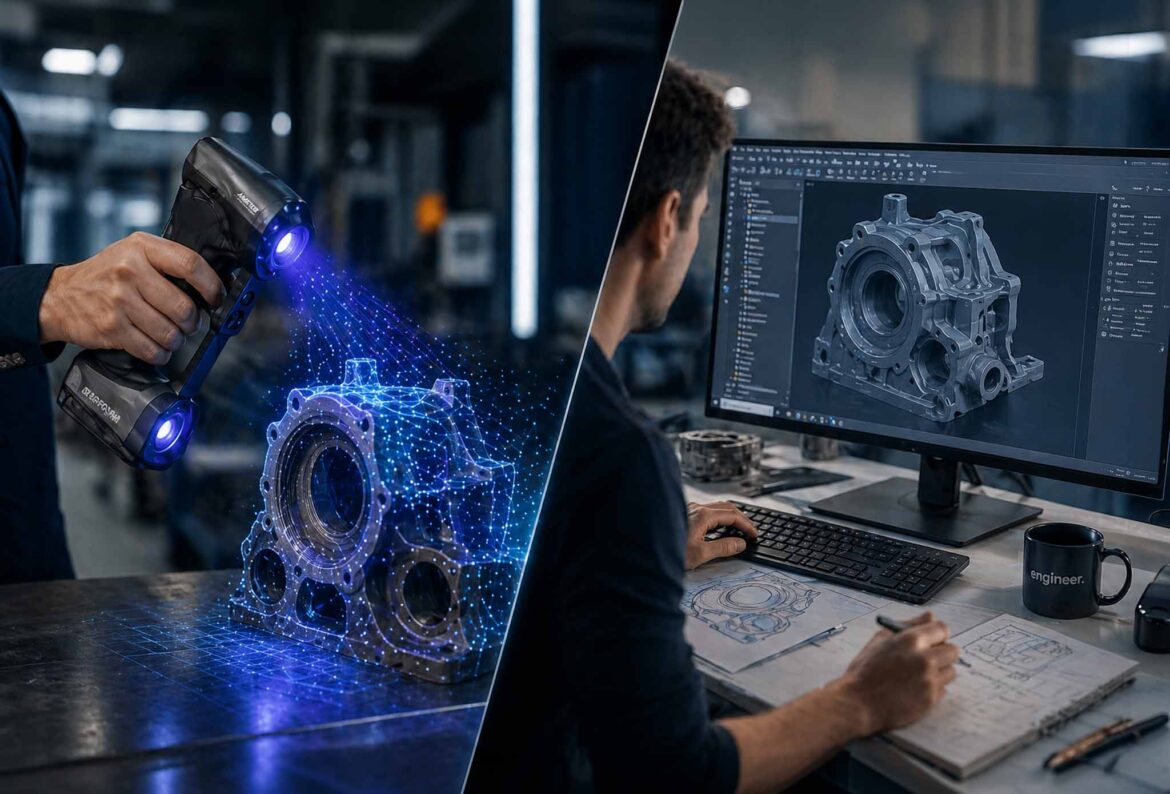
3D Scanning and CAD Design in the Interaction of Modern Industrial Processes
Visualization: Digital capture of a component using 3D scanning and parallel transformation into structured CAD data for engineering and industrial applications | Image: © Ulrich Buckenlei | Visoric Research
The digitalization of industrial processes is currently being strongly driven by new technologies such as 3D scanning, digital twins, and modern visualization. Companies can now capture real objects faster than ever and transform them into visual models.
At the same time, a key question arises: What role will CAD data play in the future if existing systems can be directly scanned and made digitally usable?
In practice, however, it becomes clear that both approaches have different strengths. 3D scanning enables fast and realistic capture, while CAD ensures technical logic and editability. Only the targeted combination of these two worlds leads to models that are not only visually convincing but also functionally usable.
This is exactly where the decisive added value for companies emerges. Digital models are no longer used only for visualization, but become tools for analysis, planning, and decision-making processes. [4]
The next chapter therefore analyzes the role of 3D scanning as the starting point of these digital models and where its strengths and limitations lie.
3D Scanning as the Starting Point of Digital Models
3D scanning now forms the foundation of many digitalization processes. Real objects, machines, and systems can be quickly captured and made available as digital models. Especially in existing environments, this enables efficient digitalization without complex reconstruction.[5]
Modern methods go beyond traditional point clouds. Technologies such as Gaussian Splatting generate visually high-resolution models that realistically represent material properties, lighting behavior, and spatial depth. [1]
The following aspects highlight the role of 3D scanning as the starting point of digital models:
- Reality Capture → fast acquisition of real objects and systems
- Visual Quality → realistic representation through modern techniques
- Context → existing systems are fully digitally mapped
These characteristics make 3D scanning particularly valuable for initial analysis and understanding of complex systems. At the same time, it creates a visual foundation that can be immediately used in many areas.
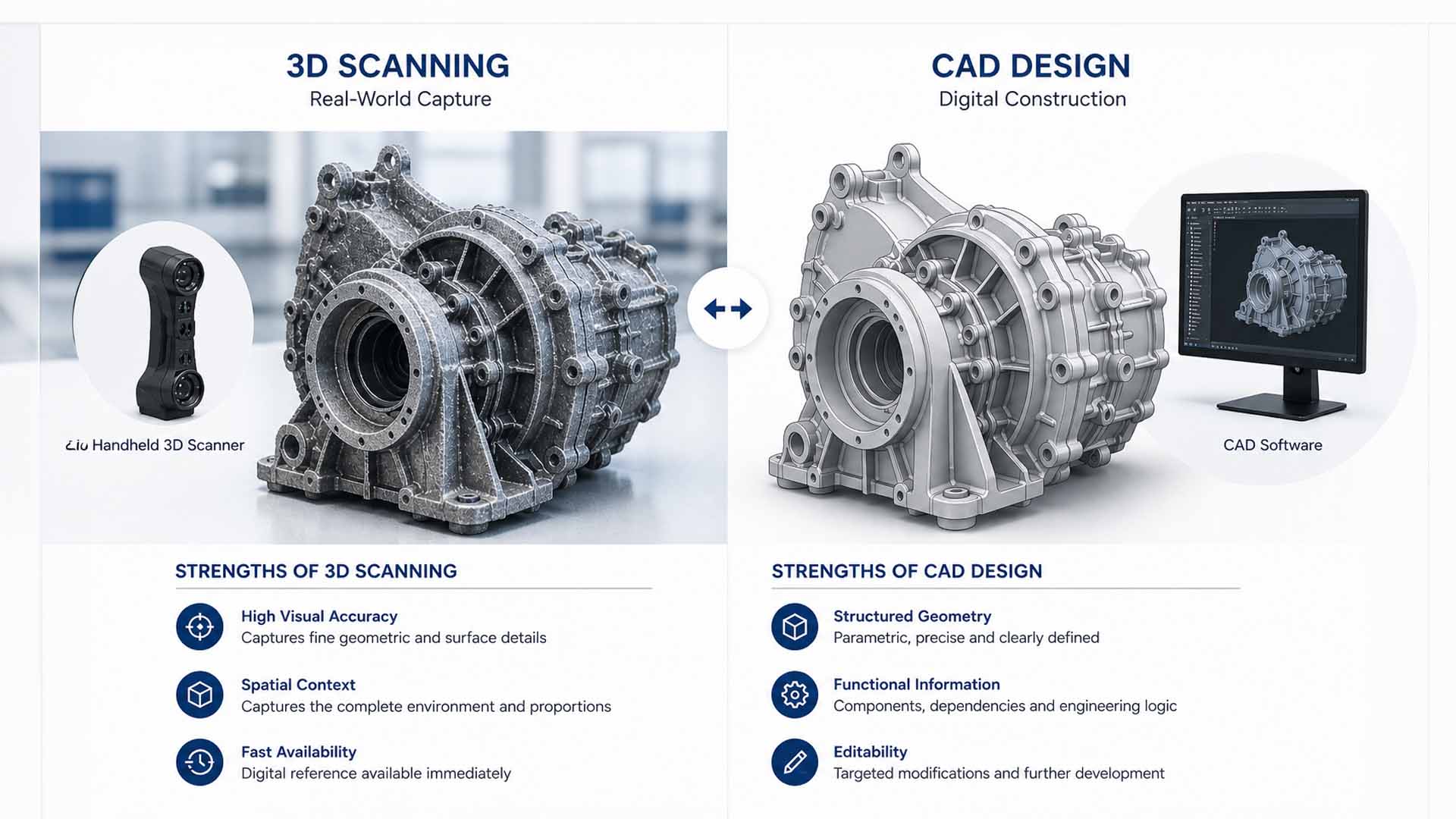
3D scanning as a visual foundation of digital models compared to structured CAD design
Visualization: On the left a realistic 3D scan of a component using Gaussian Splatting and a handheld scanner, on the right a structured CAD model as a reference for functional use | © Visoric Research
The image illustrates the strength of 3D scanning. A real system is digitally captured and immediately available as a visual reference. Geometry, proportions, and spatial context are directly visible and can be analyzed.
At the same time, the comparison with the CAD model shows a clear limitation of this technology. While the appearance is captured precisely, structured information about components, functions, and technical relationships is missing in the scan.
This makes it clear that 3D scanning enables entry into digital models but is not sufficient on its own to integrate them into engineering or production processes.
The next chapter therefore examines why CAD data remains indispensable despite all advances in 3D scanning and what role it plays in the functional use of digital models.
CAD Data as the Foundation of Functional Digital Models
While 3D scanning enables entry into digital models, CAD forms the basis for their technical usability. CAD models do not only describe the appearance of an object but define geometry, component structure, and functional relationships.[11]
This structured model logic is essential for all applications where digital models must be modified, analyzed, or further developed. Design, simulation, and engineering rely on this exact ability for targeted editing.
Unlike scan data, CAD models are not just representations but mathematically defined systems. Geometries are described parametrically, components are interconnected, and can be precisely adjusted.
The following characteristics show why CAD data continues to play a central role in many technical applications:
- Structure → parametric and clearly defined geometry
- Function → representation of components, relationships, and technical logic
- Editability → targeted modification and further development of models
These properties allow digital models not only to be viewed but actively used. Changes can be simulated, variants developed, and technical relationships verified.
This makes CAD the central foundation for all applications that go beyond pure visualization.
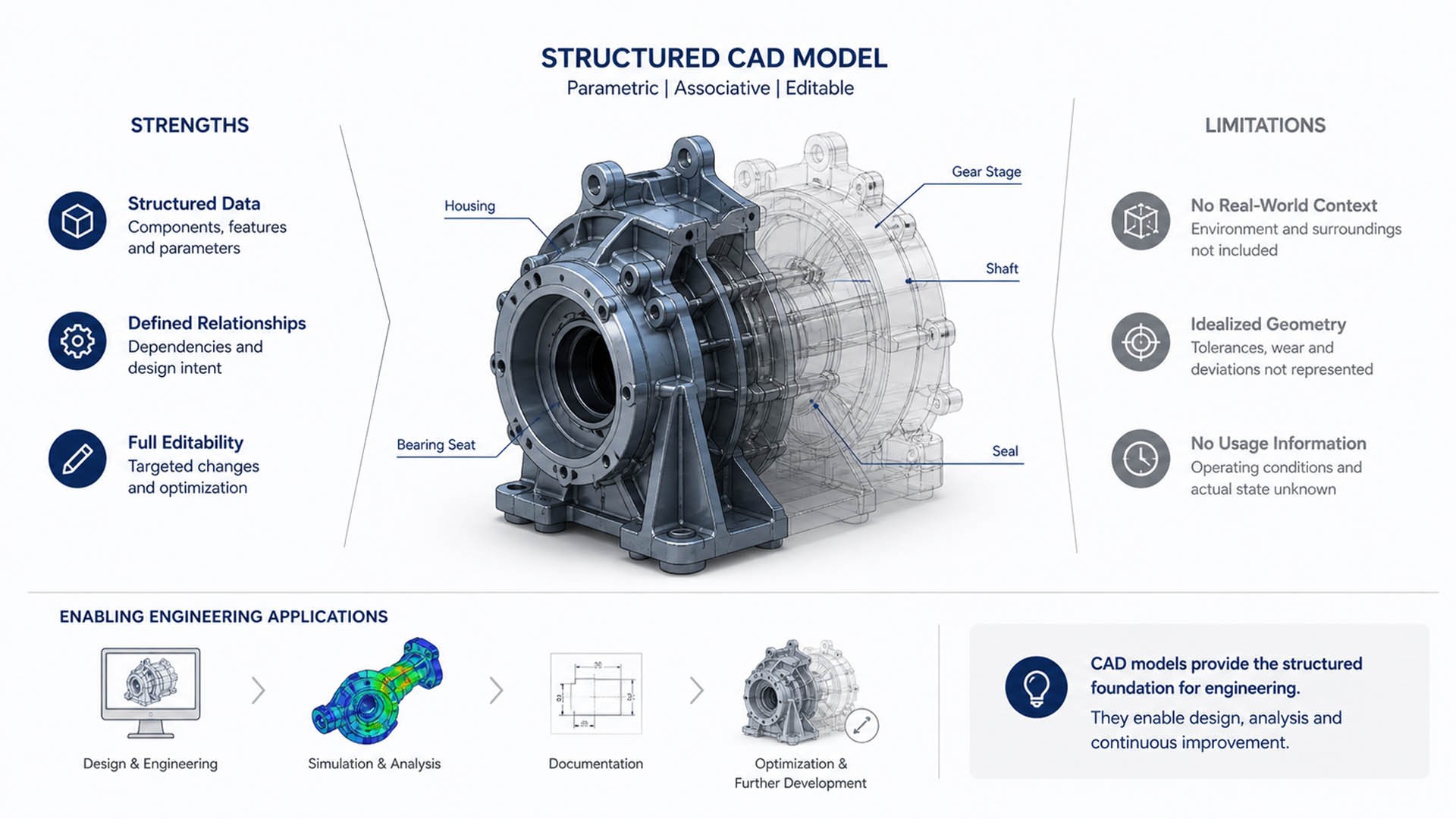
Structured CAD models as the foundation for design, simulation, and technical development
Visualization: Schematic representation of a parametric CAD model with component structure and dependencies | © Visoric Research
The image highlights the difference from pure capture. While scan data primarily represents the outer shape, the CAD model shows the underlying structure and logic of a system.
Components are clearly defined, relationships are traceable, and changes are possible in a targeted manner. These properties make CAD models a prerequisite for any advanced technical use.
At the same time, it becomes clear that these models are created without real context. Environment, usage scenarios, and actual condition are not included.
The next chapter therefore analyzes why a central gap arises between these two worlds and what impact this has on the use of digital models.
The Central Gap Between Visual Capture and Technical Usability
The comparison between 3D scanning and CAD reveals a fundamental difference. Both technologies generate digital models but follow completely different approaches in structure and purpose.
Scan data primarily represents the external appearance of an object. It captures geometry, surfaces, and spatial relationships in high detail. CAD models, on the other hand, describe the underlying structure, define components, and enable targeted technical adjustments.
From this difference arises a central structural gap between visual representation and technical usability. Digital models are either visually realistic or technically functional, but rarely both at the same time.[9]
This separation has direct consequences for use in industrial applications. Models based solely on scan data can only be further processed to a limited extent. CAD models, in turn, often lack context, real conditions, and visual clarity.
The following aspects illustrate this gap:
- Scan data → high visual accuracy but missing component structure
- CAD data → clear structure but without real context and environment
- System break → no continuous use between visualization and engineering
This discrepancy leads to digital models often being usable only in individual phases. A model is either suitable for visualization or for technical application, but not both simultaneously.
This creates a structural problem in digitalization. Data must be recreated, adapted, or manually transferred to meet different requirements.
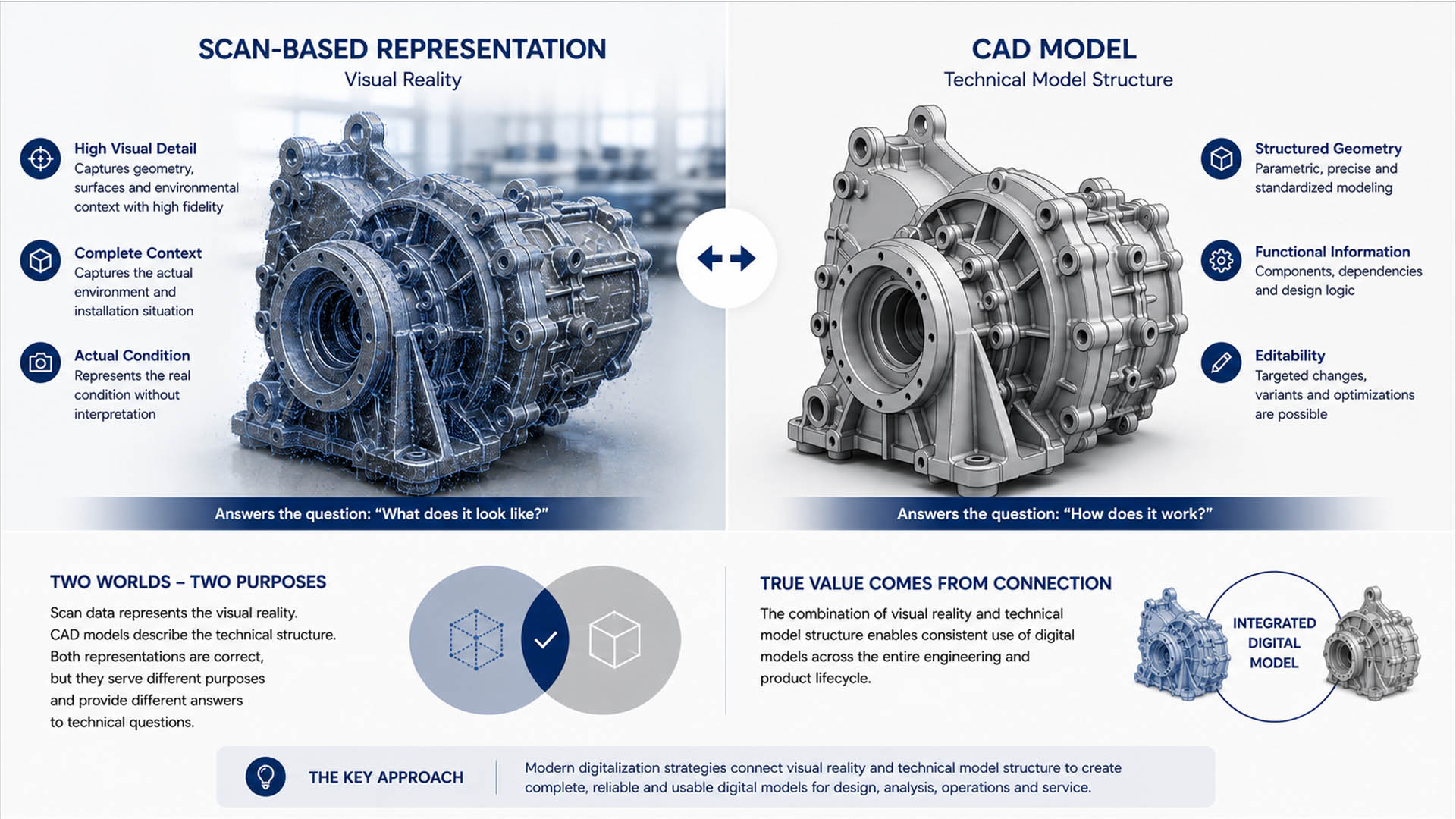
Separation between visual reality and technical model structure in digital systems
Visualization: Comparison of scan-based representation and CAD model to illustrate structural differences | © Visoric Research
The image illustrates the separation between both worlds. On one side is a visually detailed model that precisely reflects reality. On the other side is a structured CAD model describing components and functions.
Both representations are correct, but they serve different purposes. Only their connection enables continuous use of digital models.
This is the key starting point for modern digitalization strategies. The next chapter therefore analyzes how these two worlds can be combined and what new possibilities arise.
Combining 3D Scanning and CAD as the Basis for Usable Models
The previously described gap between visual capture and technical structure is not a contradiction, but an indication of necessary evolution. Instead of considering both approaches separately, the greatest value is created through their targeted combination.
3D scanning provides real context, while CAD delivers functional structure. Only when both levels are merged do digital models emerge that are both understandable and operationally usable.[9]
In practice, this means that visual information from scan data is enriched with structured CAD models. The appearance of a system is combined with its technical logic.
This combination leads to a new quality of digital models that, for the first time, unite visual reality and technical usability in one system. These models are no longer just representations or constructions, but integrated systems capable of meeting multiple requirements simultaneously.[12]
The following aspects show how this connection works in practice:
- Context + Structure → real environment combined with technical logic
- Visualization + Function → models are understandable and editable
- Continuity → usage across multiple applications without media breaks
Through this integration, models are created that are not limited to individual purposes but can be used across different domains. They can simultaneously support visualization, planning, and technical processes.
This makes the combination of 3D scanning and CAD a strategic building block for the successful use of digital models.
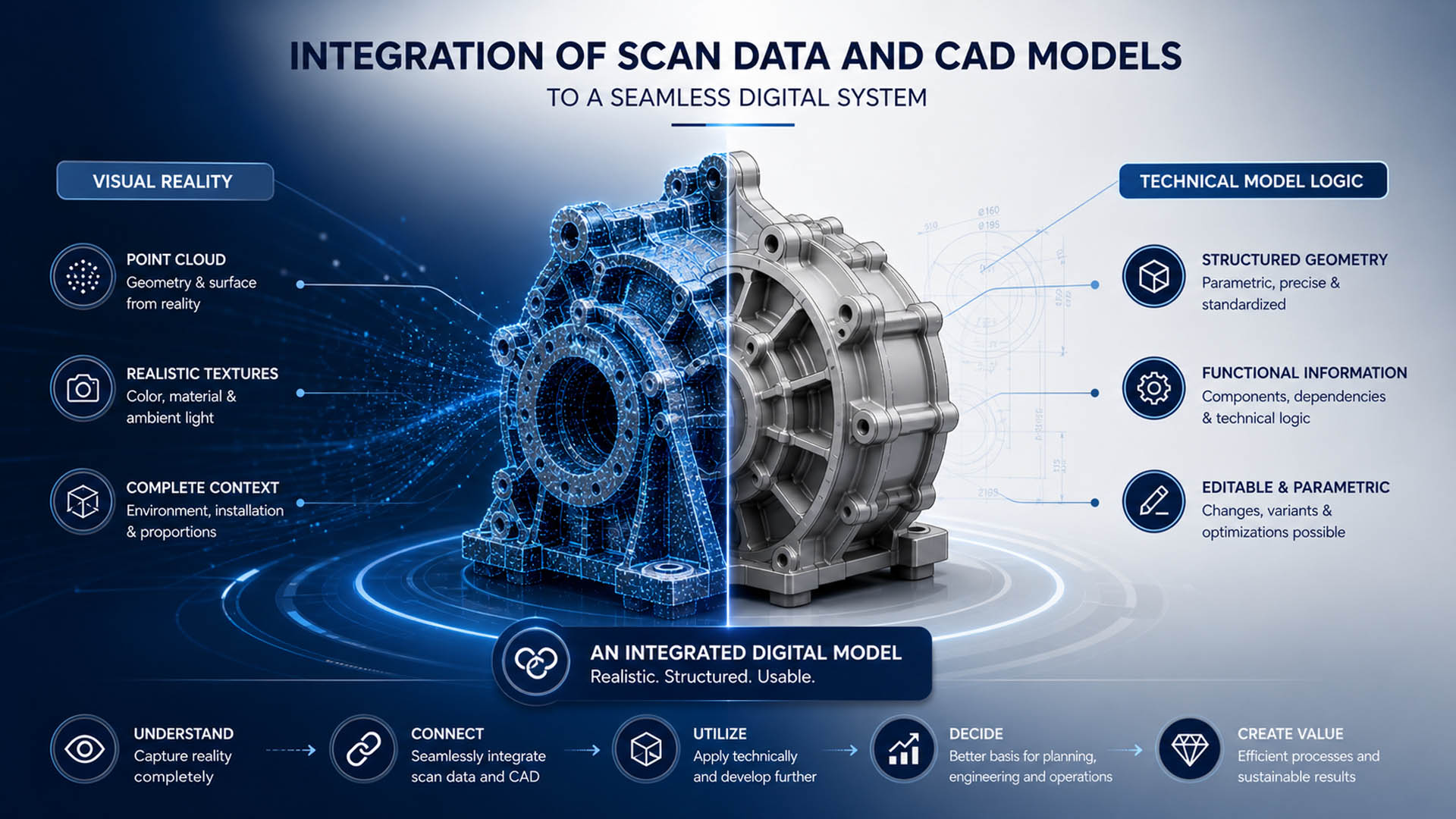
Integration of scan data and CAD models into a continuous digital system
Visualization: Merging visual reality and structured model logic into a hybrid digital model | © Visoric Research
The image shows the connection between both worlds. Visual data from scanning is combined with structured CAD information to form a unified model.
This creates a system that reflects real conditions while also being technically usable. This connection forms the basis for modern applications.
The next chapter therefore analyzes how this combination is transferred into concrete processes and the role of a structured toolchain.
From Combination to Application – The Industrial Toolchain
The combination of 3D scanning and CAD forms the basis for usable digital models. The decisive step, however, lies in transferring these models into concrete processes. Only through a structured toolchain does a continuous workflow emerge that can be used in companies. [8]
In practice, this means that different processing steps must be clearly defined and coordinated. From capture to structuring to application, a digital process chain is created that integrates various technologies.
This toolchain is not only technically relevant but significantly determines the efficiency and scalability of the entire solution. Companies benefit especially when data can be processed without disruption and remains usable across applications.
The following steps describe the typical structure of such a process chain:
- Capture → acquisition of real objects through 3D scanning
- Processing → preparation and structuring of scan and CAD data
- Integration → incorporation into existing systems and applications
This structure enables a clear separation of individual process steps while ensuring seamless integration. Data is not viewed in isolation but as part of a continuous system.
This creates a scalable foundation for various use cases, from visualization to planning and technical processes.
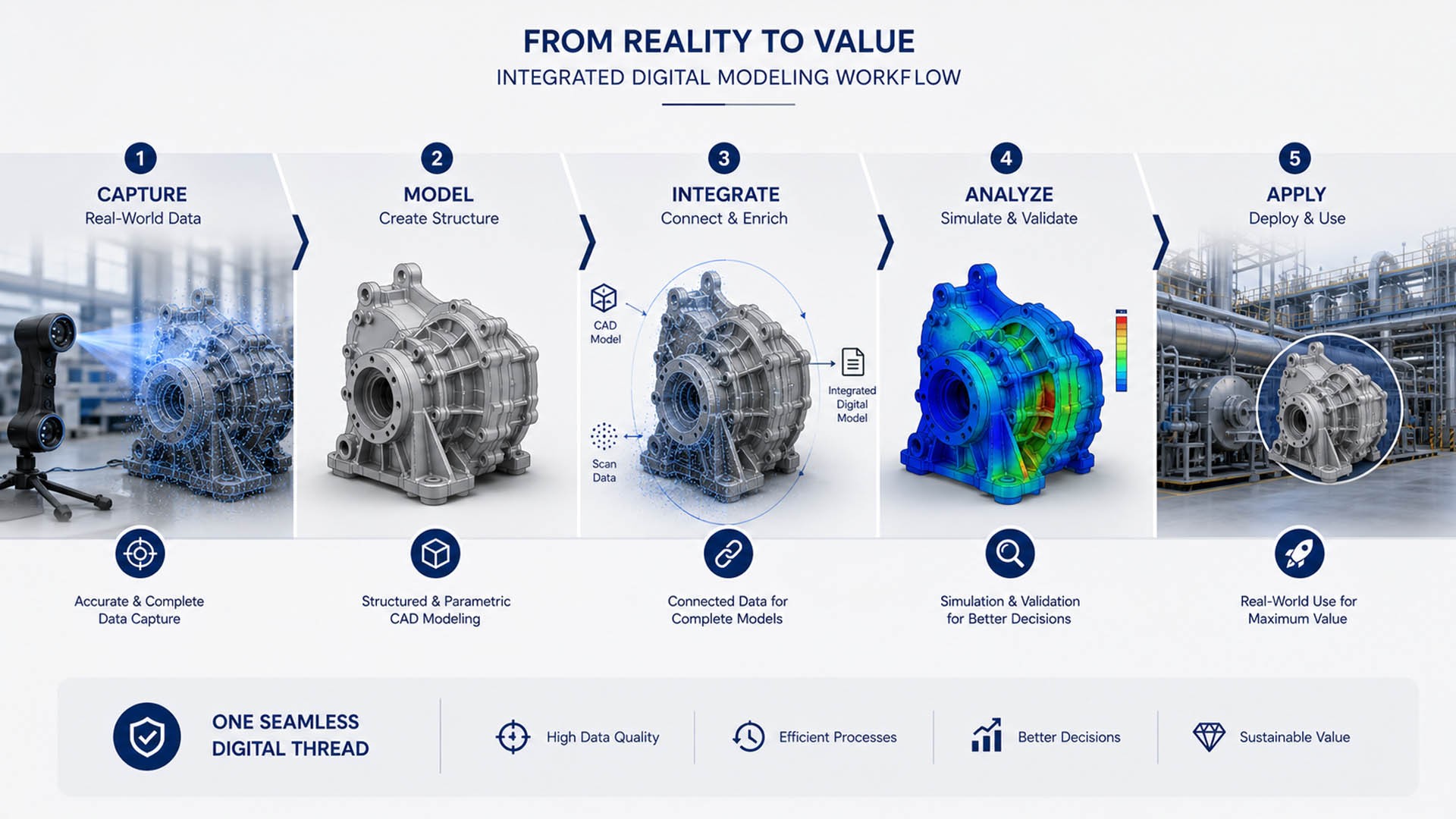
Structured process chain from capture to modeling to application of digital models
Visualization: Schematic representation of an industrial toolchain for integrating scan and CAD data | © Visoric Research
The image shows the individual steps of the digital process chain and their connection. From capturing real data to application, a continuous workflow is created.
Each step builds on the previous one and contributes to the quality of the overall system. This structure is crucial for making digital models not only created but sustainably usable.
The next chapter therefore analyzes which organizational and technical requirements are necessary to anchor these processes sustainably within a company.
Integration and Scaling as a Prerequisite for Sustainable Use
The technical combination of 3D scanning and CAD, along with a functioning toolchain, forms the foundation for usable digital models. Long-term success, however, depends on how these structures are integrated into existing company processes. [3]
In practice, it becomes clear that the biggest challenge is not the technology itself, but its integration into existing systems, workflows, and organizations. Digital models must not only be created but continuously maintained, updated, and used.
This shifts the focus from pure implementation to sustainable integration within the company. Data, processes, and responsibilities must be clearly defined to ensure continuous use.
The following factors are crucial for successful integration:
- System Integration → connection to existing IT and engineering systems
- Data Management → maintenance, versioning, and updating of digital models
- Process Adaptation → integration into existing workflows and responsibilities
These prerequisites ensure that digital models do not remain isolated but can be actively used across different areas. Only through this integration does stable and long-term added value emerge.
At the same time, it becomes clear that digitalization is not only a technological but also an organizational task. Companies must create structures that enable the continuous use of digital models.
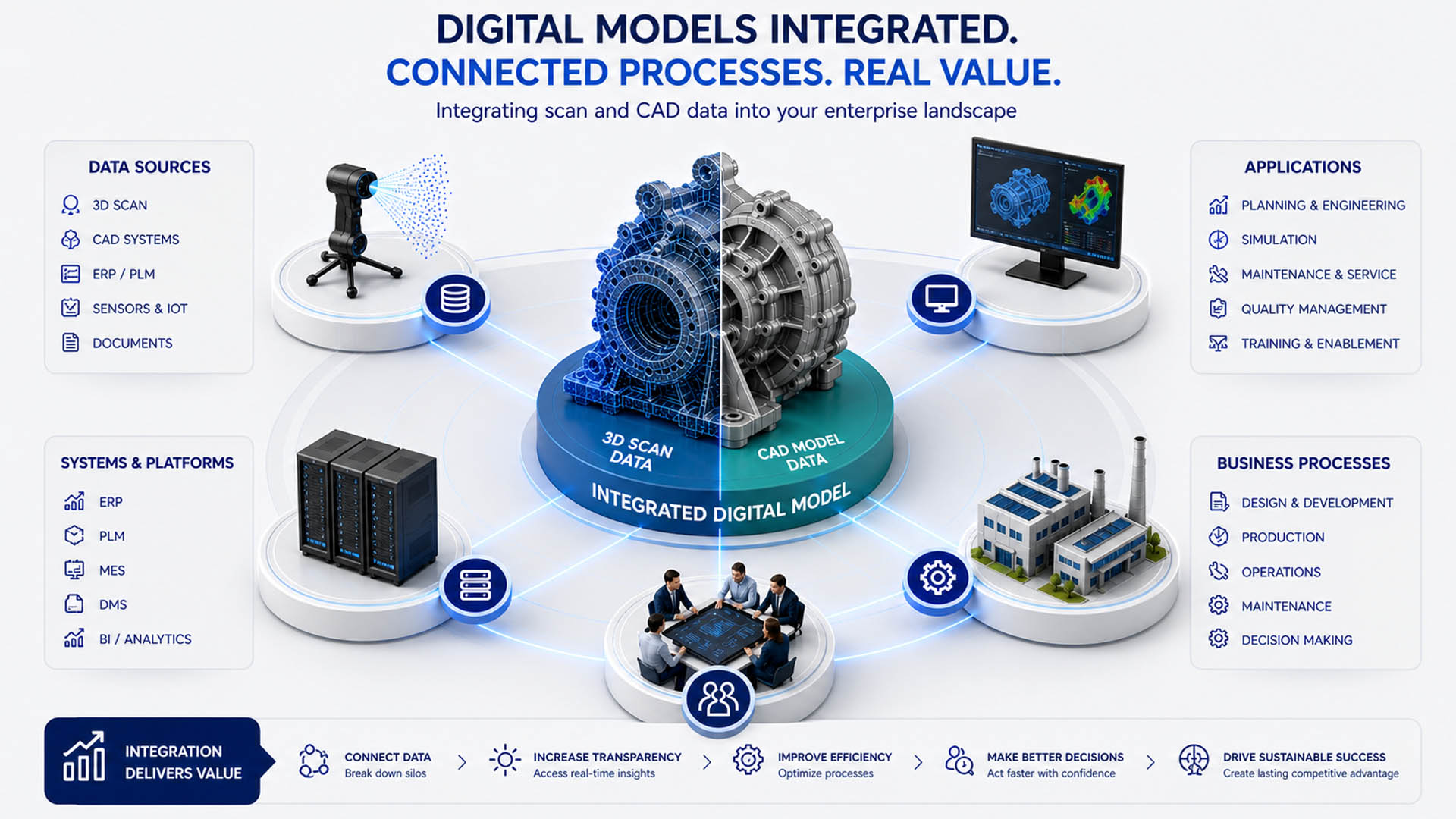
Integration of digital models into existing system landscapes and company processes
Visualization: Integration of 3D scan and CAD data into a connected enterprise architecture | © Visoric Research
The image shows the integration of digital models into an existing system landscape. Different applications and data sources are interconnected to form an integrated overall system.
This creates an infrastructure where digital models are not used in isolation but become part of processes and decisions. This integration is crucial for sustainable success.
This completes the circle of the article. In the following section, the sources used are consolidated and the content is placed in a scientific context.
Sources and References
- Kerbl et al., “3D Gaussian Splatting”, SIGGRAPH, 2023. [1]
- Khronos Group, “glTF 2.0 and 3D Standards”, Documentation, 2024–2026. [2]
- ISO, ISO 23247-1: Digital Twin Framework, 2021. [3]
- McKinsey & Company, “Digital Twins in Industry”, 2023–2025. [4]
- Creaform, “3D Scanning for CAD and Reverse Engineering”, 2025. [5]
- Pix4D, “Reality Capture in Industry”, 2025. [6]
- Deloitte, “Simulation and Digital Twins”, 2023–2025. [7]
- Plattform Industrie 4.0, “Digital Industrial Architectures”, 2023–2025. [8]
- IEEE Access, “Hybrid Digital Twin Systems”, 2022–2025. [9]
- Fraunhofer, “Industrial Digital Twins”, 2023–2025. [10]
- Autodesk Research, “CAD and Simulation Workflows”, 2022–2025. [11]
- Nature / Scientific Reports, “CAD and Gaussian Splatting Integration”, 2025. [12]
- Volinga, “Gaussian Splatting Trends”, 2026. [13]
- ioLabs, “Photoreal 3D from Video”, 2026. [14]
- Visoric Research, “Scan vs CAD Workflows”, 2026. [15]
From 3D Scanning and CAD Data to Real Applications in Companies
The combination of 3D scanning and CAD data opens enormous potential. However, what matters is not the technology itself, but its targeted application in real processes.
Many companies already have scan data or CAD models. In practice, however, these often remain isolated and are not transferred into continuous applications. This is where the greatest untapped value lies.
The central question is therefore not whether the technologies are available, but how they can be meaningfully combined and integrated into existing workflows. What data exists, what structure is missing, and how can a usable system for different departments be created from it.
This is exactly where VISORIC comes in. We support companies from the first idea to scalable implementation and connect 3D scanning, CAD data, and applications into a functional overall structure.
Integration of 3D scanning and CAD data into continuous applications for engineering, planning, and industrial processes
Source: VISORIC GmbH | Munich
Our collaboration is clearly structured and focused on results:
- Concept → analysis of existing data and identification of meaningful use cases
- Proof of Concept → development of initial functional applications for validation
- Pipeline → creation of a continuous data and process structure
- Creation → development of 3D models and applications
- Testing → validation and optimization in real use
- Integration → use across different departments and systems
This results in systems that are not isolated solutions but are actually used within the company and create long-term value.
If you want to evaluate how 3D scanning and CAD data can be optimally used in your company, a structured discussion is worthwhile.
Together, we analyze your starting point and show concrete ways to transform existing data into functional applications.
This is particularly relevant for companies that have already invested in 3D scanning or CAD and have not yet fully utilized this potential.
Contact Persons:
Ulrich Buckenlei (Creative Director)
Mobile: +49 152 53532871
Email: ulrich.buckenlei@visoric.com
Nataliya Daniltseva (Project Manager)
Mobile: +49 176 72805705
Email: nataliya.daniltseva@visoric.com
Address:
VISORIC GmbH
Bayerstraße 13
D-80335 Munich