


The End of the Physical Spare Parts Warehouse
Visualization: Digital spare parts, AI supported engineering workflows, and additive manufacturing are transforming how industrial spare parts will be managed, produced, and delivered in the future | Image: © Ulrich Buckenlei | VISORIC GmbH
A critical spare part fails in a production facility. The engineering data already exists. The technical expertise is available. Modern manufacturing technologies are ready. Yet companies often wait weeks or even months for a component to be delivered. This paradox defines many industrial supply chains today. The technology is not missing. What is missing is the infrastructure that transforms existing knowledge into available production.[1]
For decades, the physical spare parts warehouse was considered an essential pillar of industrial resilience. Companies stored thousands of components across multiple locations to prevent production downtime and shorten delivery times. This model worked reliably for a long time. However, rising inventory costs, global supply chain disruptions, increasing product complexity, and shorter innovation cycles are pushing traditional inventory strategies to their limits.[2]
The cover image of this article illustrates exactly this transformation. Where shelves once filled with spare parts secured supply availability, digital spare parts libraries, AI supported engineering platforms, and additive manufacturing networks are now emerging. Spare parts are increasingly no longer stored physically but managed as validated digital assets that can be produced locally whenever needed.
This development becomes particularly exciting where artificial intelligence, digital twins, 3D printing, and connected engineering systems work together. Spare parts are evolving from physical inventory into digital information objects that are globally available and locally manufacturable. As a result, not only maintenance processes change, but entire industrial value chains are transformed.[3]
Major industrial enterprises are also increasingly investing in digital spare parts strategies. Their goal is to reduce inventory levels, improve supply chain resilience, and preserve engineering knowledge over the long term. The central question is therefore no longer simply where spare parts should be stored. Increasingly, the question becomes how digital information can be made available faster than physical components.
- Physical inventories create high costs and tie up capital
- Global supply chains increase risks and response times
- Digital spare parts create new flexibility in maintenance and production
- AI supports the management and delivery of technical information
- Additive manufacturing enables production directly at the point of demand
This development becomes particularly compelling where digital spare parts are no longer viewed as a future vision but are already beginning to complement and partially replace traditional inventory structures.
Why the Spare Parts Warehouse Is Reaching Its Limits
For decades, the spare parts warehouse was regarded as a symbol of industrial supply security. Companies invested significant resources in warehouse space, inventory management, and international logistics networks to ensure that critical components were always available. This model emerged during a time when production, engineering, and supply chains were considerably more stable and predictable than they are today.[3]
The underlying conditions have fundamentally changed. Global supply chains have become more complex, product life cycles are shorter, and technical systems consist of an ever-growing number of specialized components. At the same time, expectations regarding availability and response speed continue to increase. Many companies therefore face a dilemma: they tie up enormous amounts of capital in inventory while still being unable to guarantee that the required spare part will actually be available when it is needed most.[4]
The image in this chapter illustrates precisely this challenge. Modern high bay warehouses often contain thousands of different components and represent substantial investments. Yet the absence of a single critical part can still be enough to delay maintenance activities or interrupt production processes.
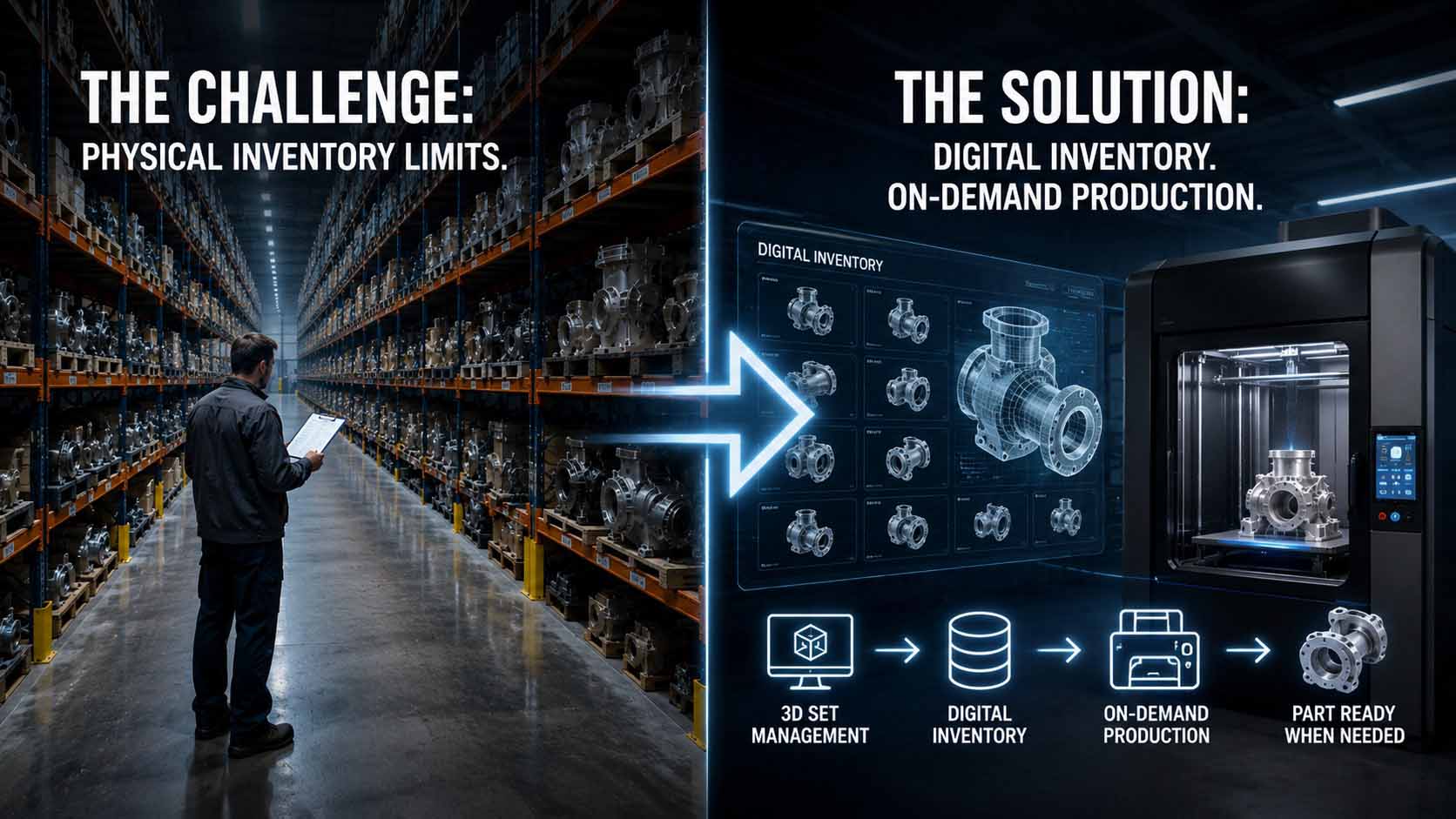
High Inventory Levels Do Not Automatically Guarantee High Availability
Visualization: Modern spare parts warehouses contain thousands of components and tie up substantial capital resources without being able to fully guarantee every supply requirement | Image: © Ulrich Buckenlei | VISORIC GmbH
There is another challenge as well. Many spare parts are only required infrequently. Some components remain in storage for years before being used. Others are never used because products are discontinued, facilities are upgraded, or technical specifications change. This results in high storage costs, additional administrative effort, and increasing pressure on supply chain structures.[4]
As a result, leading industrial companies are exploring new strategies for the future of spare parts supply. Rather than relying exclusively on physical inventory, digital spare parts libraries, additive manufacturing, and connected production networks are gaining increasing importance. The objective is to make spare parts available wherever they are needed without permanently maintaining physical inventory.
- Physical spare parts warehouses tie up substantial capital resources
- Increasing product complexity raises management effort
- Global supply chains create new dependencies and risks
- Many spare parts are rarely or never used
- Companies are seeking more flexible and digital alternatives
This is precisely where the concept of the digital spare part begins. Instead of physically storing components for years, they are managed as digital models and produced only when they are actually required.
From Digital Spare Parts to On Demand Production
Once a spare part has been digitally captured, validated, and documented, the real transformation begins. Engineering drawings, CAD models, material data, and manufacturing information are combined to create a digital spare part that remains available independently of any physical inventory. The key shift is that the component itself is no longer stored. Instead, the knowledge required to manufacture it is preserved.[5]
For decades, the availability of a spare part was directly tied to a physical storage location. When a component needed replacement, the search began across regional warehouses, central distribution centers, or global supply chains. Digital spare parts libraries follow a different approach. Rather than maintaining physical inventories, structured data platforms are created to centrally manage technical information, material properties, certifications, and manufacturing parameters.[6]
This creates far more than a digital archive. The digital spare part becomes a production ready asset that is globally accessible and can be transmitted immediately to a qualified manufacturing location whenever required. A static inventory is transformed into a dynamic production pipeline.
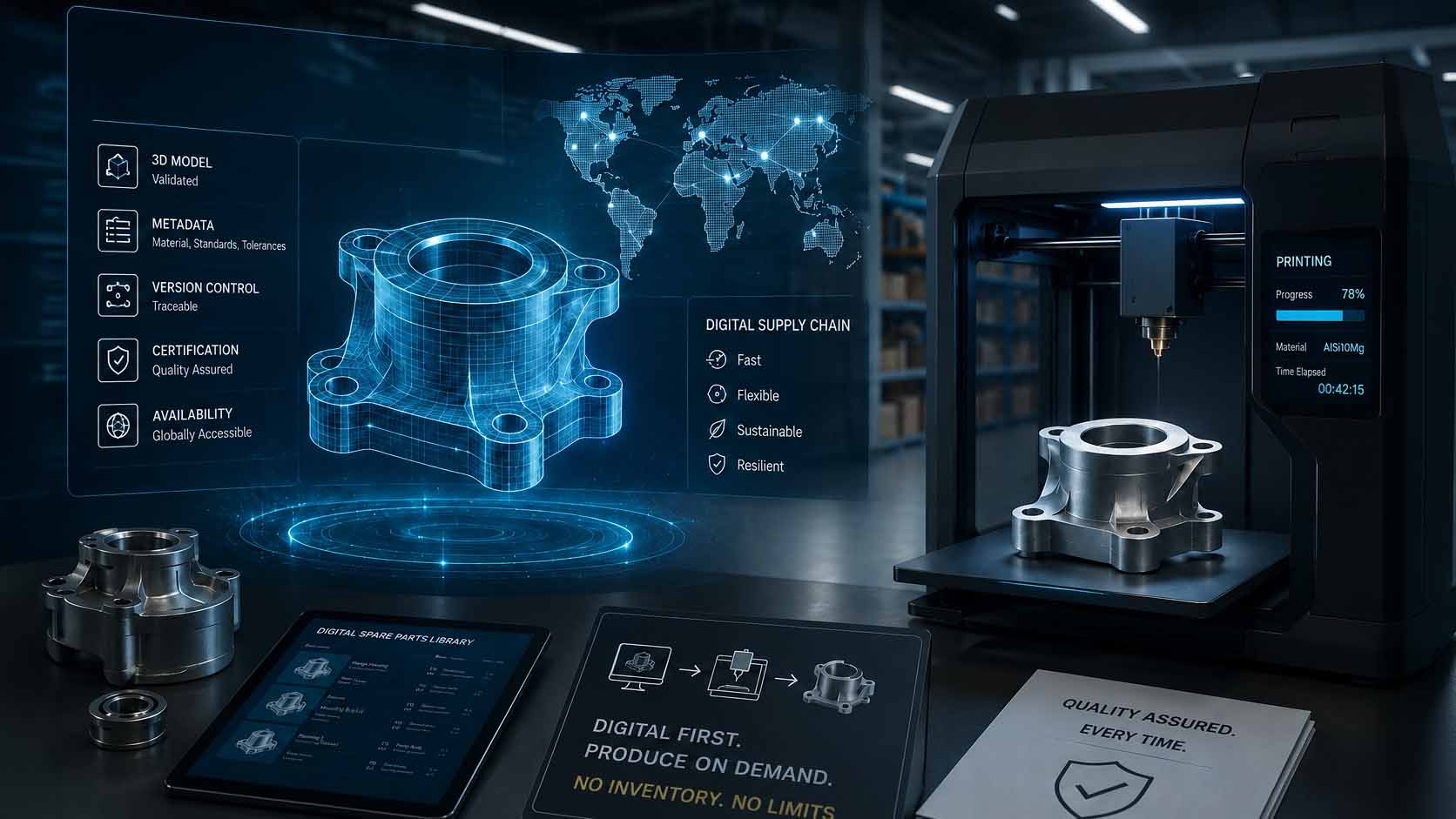
From Inventory to a Digital Spare Parts Library
Visualization: Digital spare part models, global data availability, and additive manufacturing enable industrial components to be produced exactly when they are needed | Image: © Ulrich Buckenlei | VISORIC GmbH
The image in this chapter illustrates this transition. On the left side, digital spare part information, validation data, and engineering knowledge are managed. On the right side, the physical component is only produced when actual demand arises. As a result, inventory management shifts from warehouse shelves into digital infrastructure.
This approach becomes especially attractive for companies with complex product portfolios, long term spare part obligations, or globally distributed locations. Instead of physically storing thousands of components for years, digital spare parts libraries can provide a far more flexible supply model. At the same time, dependence on centralized warehouses and international transportation routes is reduced.[6]
- Digital spare parts do not completely replace physical inventory but significantly reduce it
- Technical knowledge becomes available long term and independent of location
- Production data can be distributed globally and utilized locally
- Engineering information becomes the true carrier of value
- Production takes place only when actual demand exists
However, the availability of digital spare parts alone is not enough. To transform a dataset into a functional industrial component, material properties, quality requirements, and manufacturing processes must be implemented reliably. This is where the next major evolution of industrial spare parts supply begins.
AI Becomes the Decision Layer of Spare Parts Supply
Once digital spare parts libraries have been established and production data is available in a structured form, the true strength of modern systems begins. Artificial intelligence no longer analyzes only individual components, but evaluates availability, risks, production options and potential supply bottlenecks. At this point, spare parts supply evolves from a reactive inventory strategy into a data driven decision system.[7]
Traditionally, many decisions were based on experience, manual assessments and historical demand. Companies had to estimate which components might be needed in the future and which inventories should be kept as a precaution. Modern AI systems follow a different approach. They analyze maintenance data, failure patterns, operating conditions, production capacities and supply chain information simultaneously. This creates much more precise decision making foundations for spare parts planning.[8]
This becomes particularly interesting in complex industrial plants. Instead of merely reacting to a defect, intelligent systems can identify at an early stage which components may be needed in the future. The real challenge is no longer to store as many parts as possible, but to make the right information available at the right time.
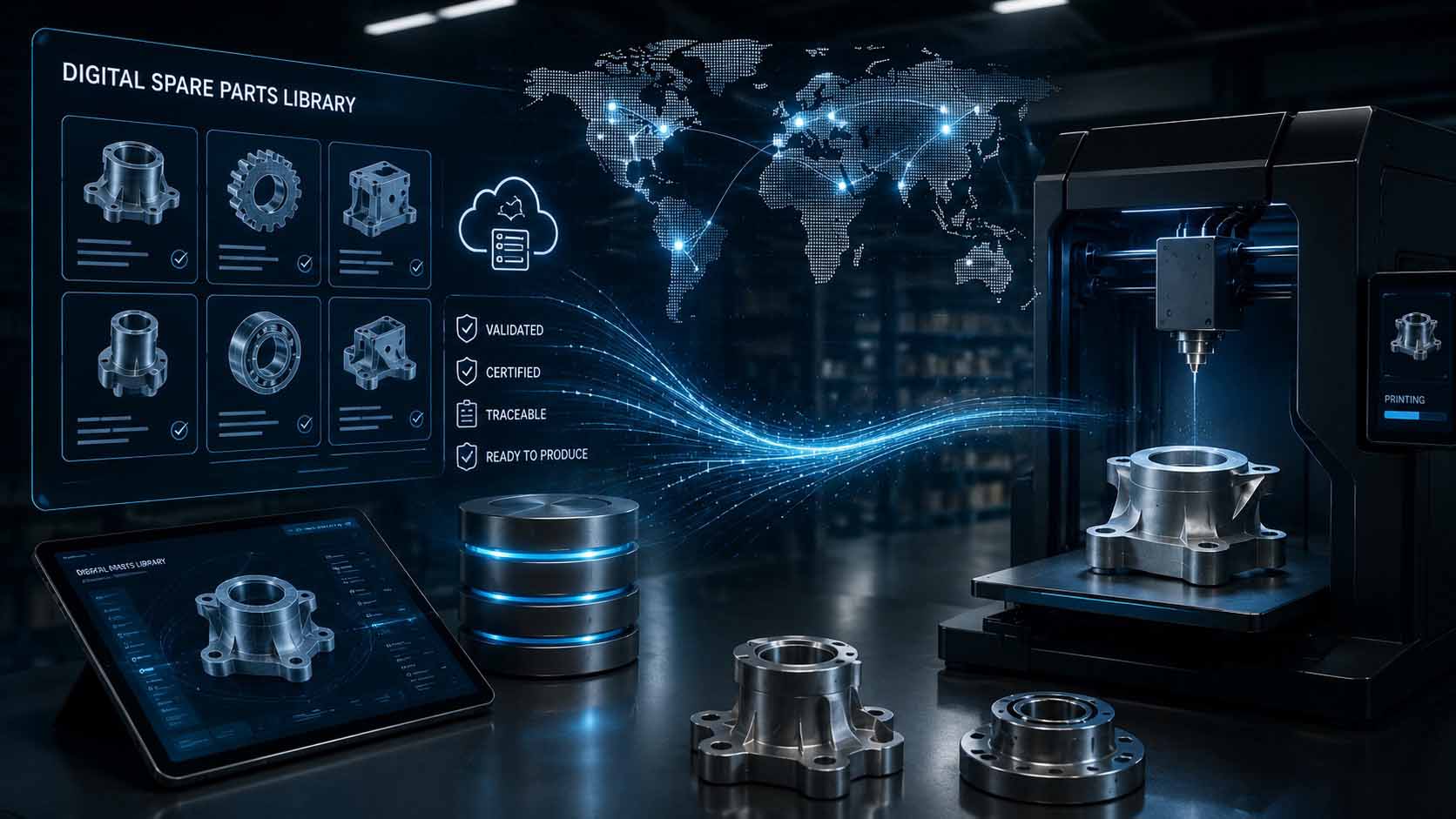
From Spare Parts Management to an Intelligent Decision Platform
Visualization: Artificial intelligence analyzes digital spare part models, production options and global availability to support informed decisions in real time | Image: © Ulrich Buckenlei | VISORIC GmbH
The image in this chapter shows exactly this transformation. Digital spare parts libraries, global production networks and additive manufacturing systems are connected through intelligent analytics layers. AI not only evaluates technical data, but also takes quality requirements, material availability, certifications and production capacities into account at the same time.
This creates a new form of industrial decision support. Companies can identify more quickly which spare parts should be produced, which manufacturing site is suitable and which delivery routes can be avoided. Digital spare parts supply therefore evolves from a warehouse function into a strategic capability within modern industrial companies.[8]
- AI analyzes failure patterns and future spare parts demand
- Production options are evaluated automatically
- Materials, certifications and manufacturing data are intelligently connected
- Decisions are based on real time data instead of estimates
- Digital spare parts networks become more efficient and resilient
This development becomes especially exciting where artificial intelligence no longer evaluates only individual components, but considers complete plants, production environments and maintenance strategies as one connected system.
From Spare Parts Management to an Intelligent Production Network
The digitalization of individual spare parts and the use of artificial intelligence already create significant advantages. However, the development becomes even more interesting when the focus shifts from individual components to complete production networks. Today, modern industrial companies operate global manufacturing sites, regional service centers, external suppliers and specialized production partners. The real challenge is to connect these resources intelligently.[9]
For decades, traditional supply chains were organized as linear processes. Spare parts were produced, transported, stored and finally used. Digital spare parts strategies fundamentally change this model. Instead of a fixed material flow, connected production ecosystems are emerging, in which digital information is exchanged between engineering, manufacturing, quality management and service. As a result, the supply chain itself increasingly becomes an intelligent infrastructure.[10]
This development becomes particularly exciting through the combination of real time data, artificial intelligence and globally distributed production capacities. Systems can automatically evaluate which location has available capacity, which materials are available and which manufacturing route offers the fastest or most economical solution. A traditional supply chain thus becomes a dynamic production network.
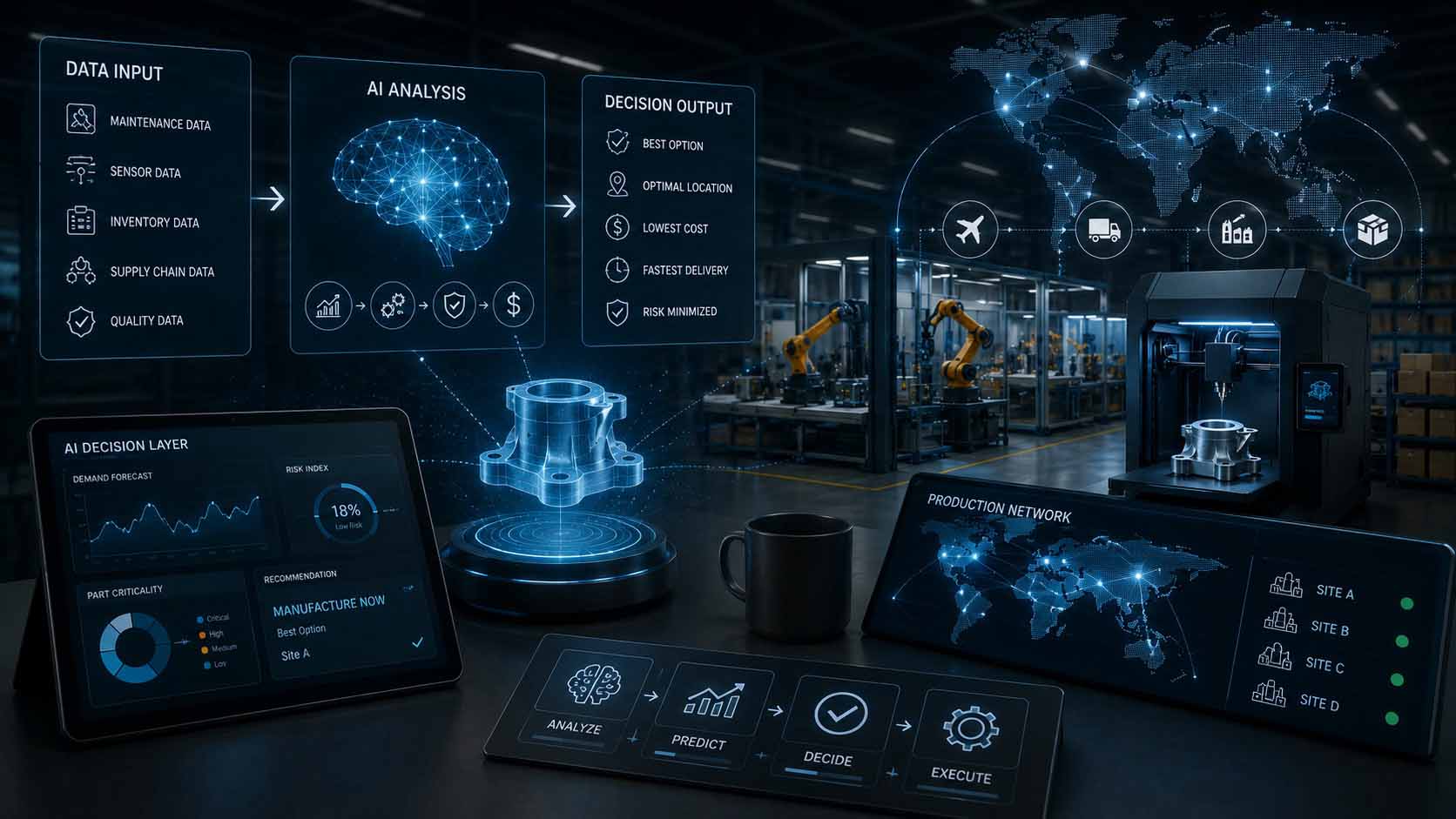
Global Production Networks Instead of Local Inventories
Visualization: Artificial intelligence connects digital spare parts, manufacturing sites, quality data and production capacities into an intelligent global production network | Image: © Ulrich Buckenlei | VISORIC GmbH
The image in this chapter shows exactly this transformation. The focus is no longer on the individual spare part, but on the digital infrastructure that connects information, production systems and decision making processes. AI acts as a higher level decision layer that analyzes production options, evaluates risks and recommends optimal manufacturing routes.
For industrial companies, this creates a major strategic advantage. Spare parts can be produced closer to the point of use, delivery times are shortened and production capacities can be used much more flexibly. At the same time, dependence on individual warehouse locations or international transport routes decreases. Resilience no longer comes from larger inventories, but from intelligently connected production systems.[10]
- Digital spare parts become part of global production networks
- AI evaluates manufacturing options in real time
- Production capacities can be used flexibly
- Delivery times are reduced through local manufacturing
- Resilience is created through connectivity instead of inventory
Yet even the most intelligent production network requires a digital representation of the real assets and processes. This is exactly where digital twins come into play, offering far more than pure visualization in the future.
Digital Twins Become the Central Knowledge Platform
Digital spare parts, artificial intelligence and connected production networks already create significant advantages. However, these technologies only unfold their full potential when all information is brought together in a shared digital twin. This creates far more than a technical visualization. The digital twin evolves into the central knowledge platform for engineering, maintenance, production and service.[11]
Traditionally, technical information was often distributed across different systems. Design data was located in engineering, maintenance information in service, quality data in separate databases and production parameters in manufacturing systems. Digital twins connect this information for the first time into a shared digital representation of a product, a machine or even an entire production environment.[12]
This creates a comprehensive digital representation that not only documents the current state, but also takes historical developments, maintenance events, quality information and future action options into account. The digital twin thus becomes the central source of information for everyone involved across the entire product life cycle.
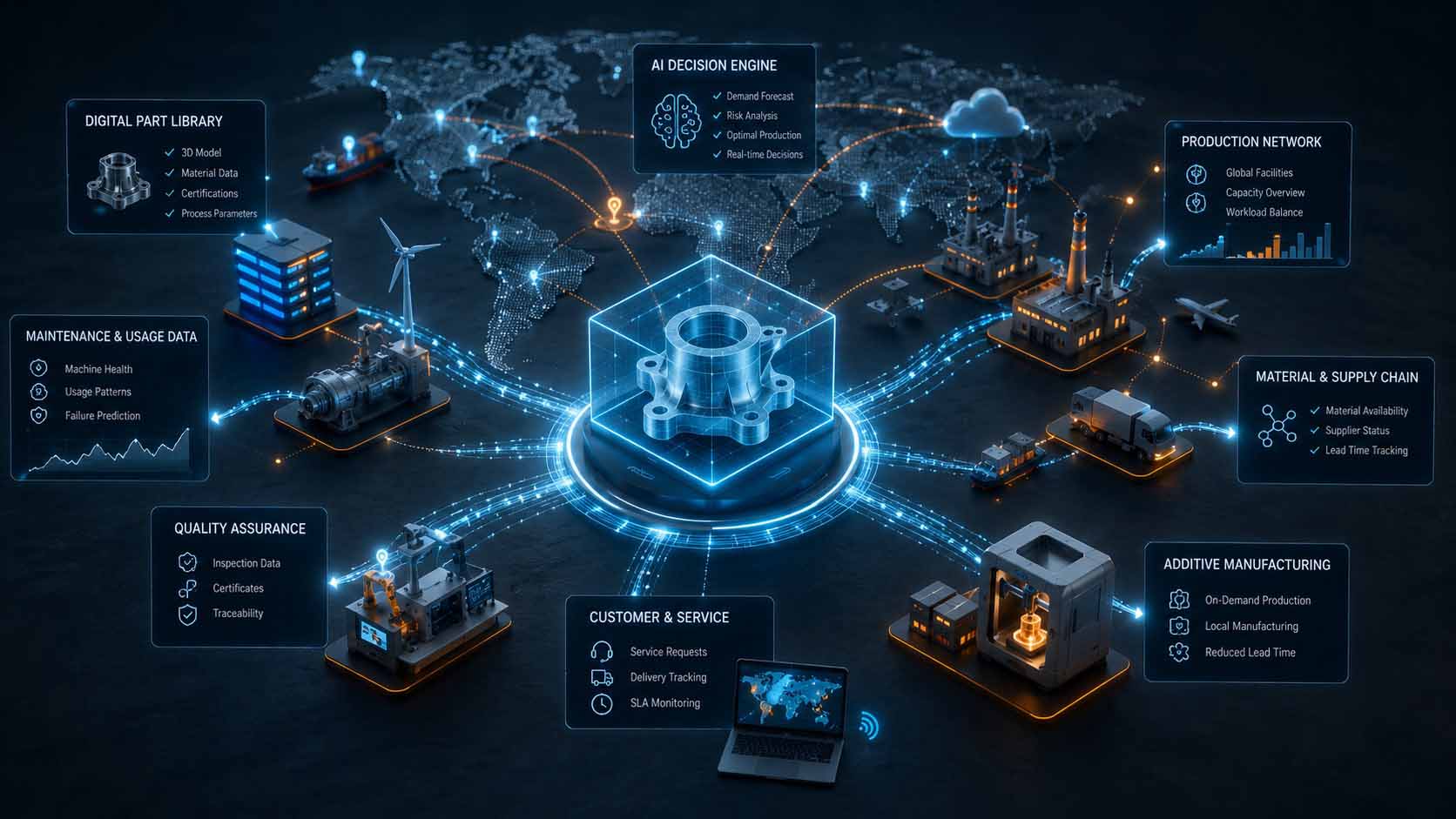
Digital Twins Connect Knowledge, Processes and Production Networks
Visualization: A digital twin connects engineering data, quality information, service processes, production capacities and supply chains into a shared decision platform | Image: © Ulrich Buckenlei | VISORIC GmbH
The image in this chapter shows exactly this approach. At the center is the digital spare part as a digital twin. Around this model, quality data, production information, maintenance data, supply chain information and service processes are connected. This creates a digital ecosystem that goes far beyond traditional spare parts management.
For industrial companies, this results in significant advantages. Information no longer needs to be brought together from different systems. Instead, a shared data foundation is available that accelerates decisions, reduces errors and improves collaboration between engineering, manufacturing and service. Digital twins are therefore increasingly becoming the foundation of modern industrial value creation processes.[12]
- Digital twins unite information from engineering, production and service
- Technical knowledge remains available across the entire product life cycle
- Quality data and certifications are managed centrally
- Decisions are based on a shared data foundation
- Digital ecosystems replace isolated information silos
This development becomes especially exciting where digital twins no longer merely represent existing processes, but begin, together with AI and real time data, to predict future events and prepare autonomous decisions.
Digital Twins Become Operational Work Environments
Digital twins have long since ceased to serve exclusively as visualizations of products or systems. Their real added value emerges where they are actively integrated into operational processes. Static models become dynamic work environments in which engineering data, production information, maintenance status and AI analyses are brought together in real time. At precisely this point, the digital twin evolves from an information model into an operational tool.[13]
For many years, technical information was distributed across different systems. Designers worked with CAD data, production planners with manufacturing systems and service teams with maintenance documentation. Modern digital twin platforms follow a different approach. They connect this information within one shared environment and thereby create a unified view of products, systems and processes.[14]
This becomes especially exciting in complex industrial facilities. Employees can access current status information, simulate maintenance scenarios, analyze production workflows or evaluate future changes before they are implemented in the real world. This creates new opportunities for collaboration, decision making and operational optimization.
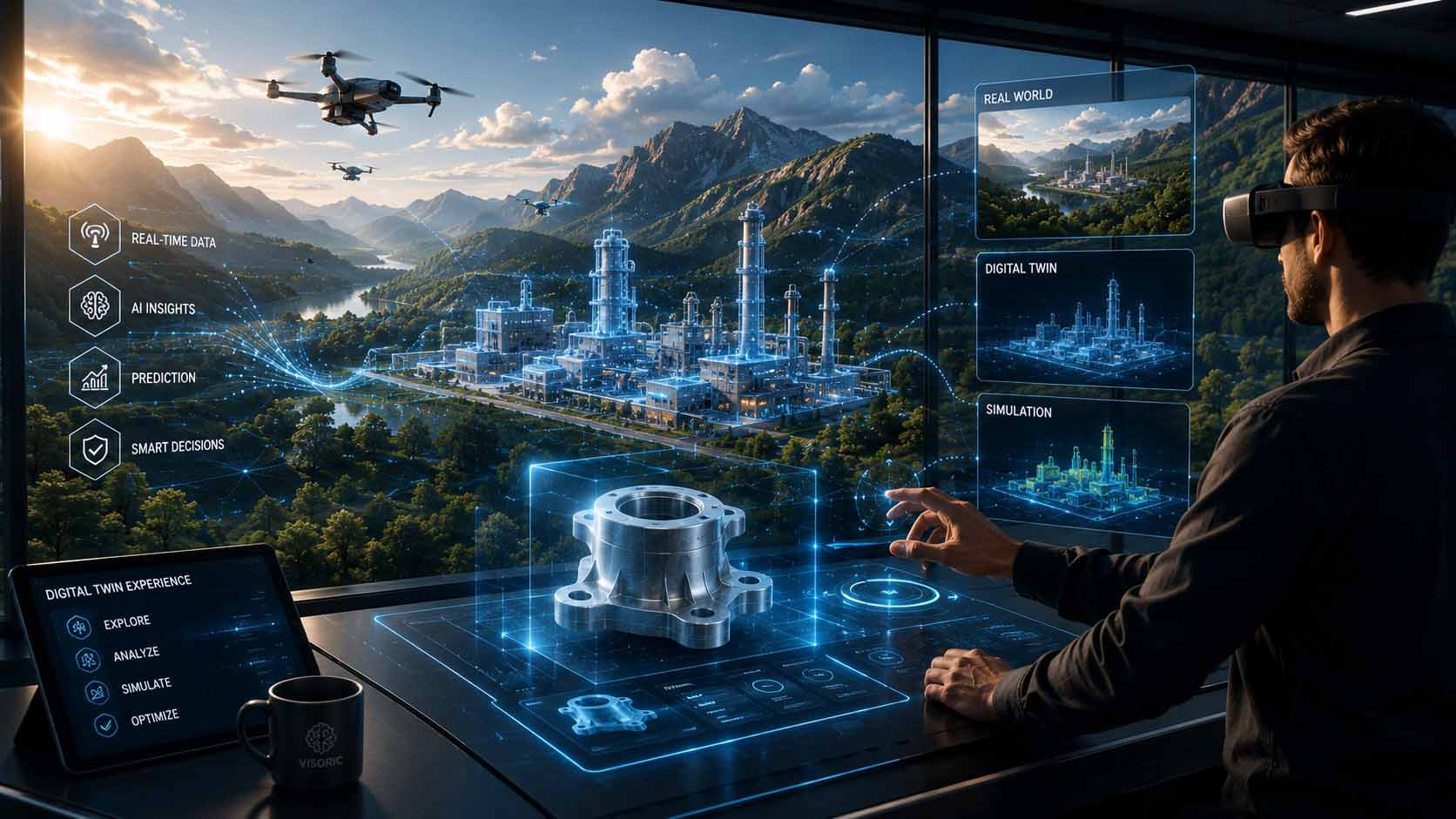
From Information Model to Operational Decision Environment
Visualization: Digital twins connect engineering data, real time information, maintenance processes and AI analyses within a shared industrial work environment | Image: © Ulrich Buckenlei | VISORIC GmbH
The image in this chapter shows exactly this transformation. An employee interacts directly with a digital twin and gains access to technical information, status data and recommendations for action. The digital environment is not only used for visualization, but serves as a central work platform for analysis, planning and decision support.
For industrial companies, this creates significant advantages. Knowledge becomes available more quickly, decisions can be made on a more informed basis and teams gain shared access to complex technical information. Digital twins are therefore increasingly becoming a central component of modern industrial operating models.[14]
- Digital twins are actively integrated into operational processes
- Engineering, production and service work on a shared data foundation
- Real time information improves decisions and response speed
- Simulations support planning and maintenance strategies
- Technical knowledge becomes centrally available to everyone involved
This development becomes especially exciting where digital twins, artificial intelligence and autonomous systems begin not only to support industrial processes, but to actively shape them.
The Evolution of Spare Parts Supply
The digitalization of individual spare parts, the use of artificial intelligence and the application of digital twins are not isolated developments. Together, they mark the beginning of a fundamental structural transformation within industrial value chains. What was based for decades on physical inventories and global supply networks is increasingly evolving into a data driven infrastructure in which information becomes more important than inventory.[13]
Industrial spare parts supply is moving through several stages of evolution. It began with local inventories and physical spare parts warehouses. Later, global distribution networks followed, increasing reach while at the same time creating new dependencies and complexity. With digital spare parts, the shift began from physical stock to a digital information model. Digital twins expanded this approach with real time data, condition information and life cycle knowledge. Today, this is giving rise to a new generation of AI supported production networks.[14]
This development becomes especially exciting because individual technologies are no longer at the center. What matters is the interaction between digital spare parts, additive manufacturing, artificial intelligence, digital twins and global production capacities. Together, they form the foundation of a much more flexible and resilient industry.
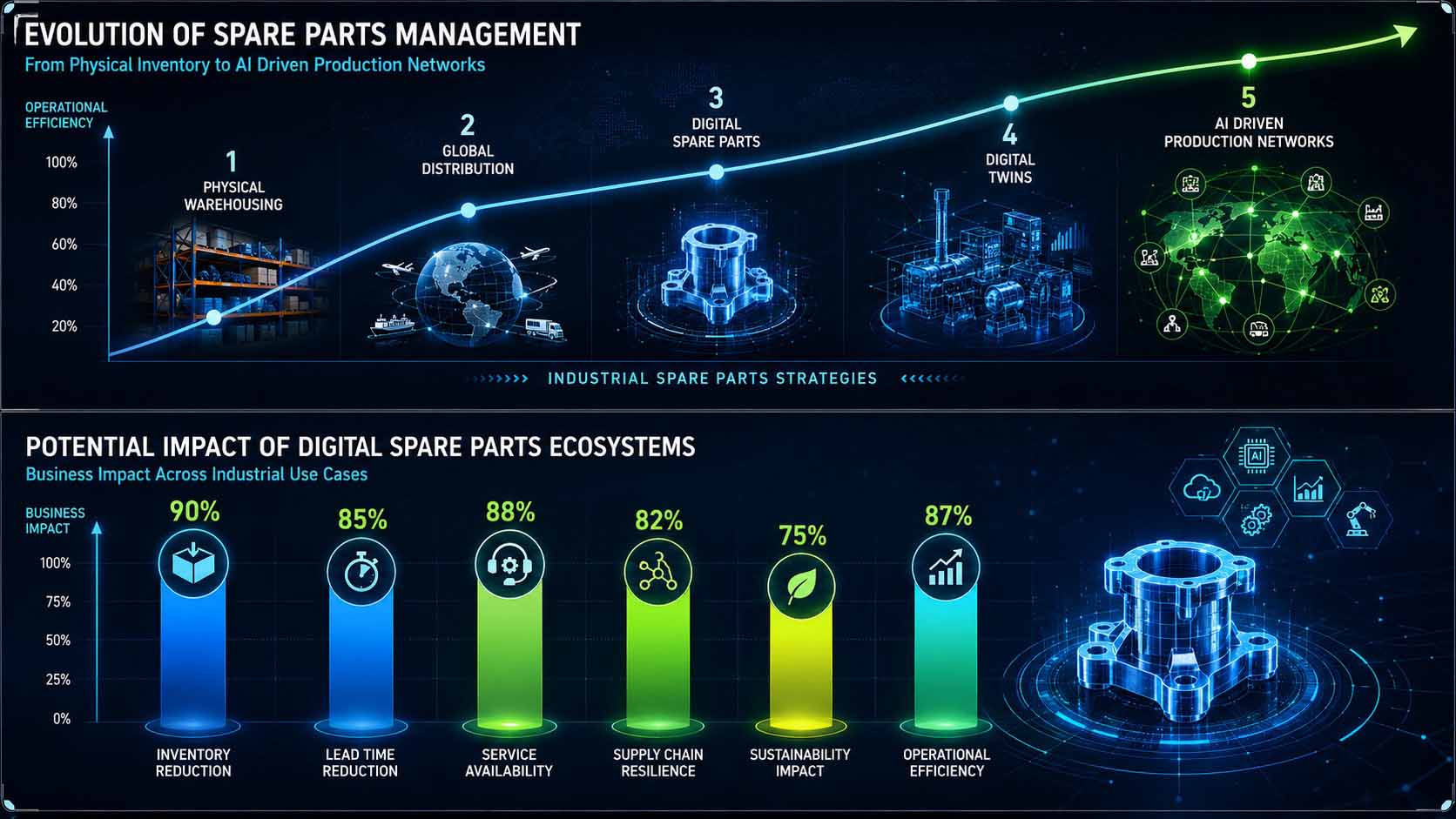
From Physical Inventories to AI Supported Production Networks
Visualization: The infographic shows the development of industrial spare parts strategies from traditional warehouse concepts through digital spare parts and digital twins to intelligent production networks. At the same time, the potential economic impact of digital spare parts ecosystems is presented | Image: © Ulrich Buckenlei | VISORIC GmbH
The upper half of the infographic illustrates the strategic development of recent decades. With each evolutionary stage, operational efficiency increases while dependence on physical inventories decreases. The transition from traditional warehousing to digital twins and AI supported production networks becomes particularly clear, as these connect information, manufacturing and decision making processes.
The lower half of the graphic highlights the potential economic impact of this development. Particularly strong effects can be seen in the reduction of inventories, the improvement of service availability and the shortening of delivery times. At the same time, the data shows that digital spare parts strategies not only create economic benefits, but can also improve resilience, sustainability and operational efficiency.[14]
For industrial companies, this creates a new understanding of supply security. In the future, resilience will be defined less by large inventories and more by the ability to intelligently connect knowledge, production capacities and digital information. The real resource is no longer the spare part itself, but the ability to make it available at any time.
- Industry is evolving from physical inventory strategies to digital production networks
- Digital spare parts reduce dependence on inventories
- Digital twins connect information across the entire life cycle
- AI supports planning, production and decision making
- Resilience is created through intelligent connectivity instead of inventory
The transformation of spare parts supply is now at a similar point to digital twins or cloud technologies a few years ago. What is visible today in pilot projects and early industrial applications could soon become the new standard of industrial value creation. This is exactly what the following video also shows.
From Digital Spare Parts to Resilient Production Networks
The future of industrial spare parts supply will not be determined by 3D printing, artificial intelligence or digital twins alone. The real transformation begins where these technologies grow together into a continuous digital ecosystem. Spare parts are no longer viewed exclusively as physical components. They are evolving into digital information objects that are globally available, intelligently manageable and locally producible.
For industrial companies, this opens up new opportunities to make supply chains more robust, reduce inventory costs and keep technical knowledge available over the long term. Digital spare parts libraries, AI supported decision platforms and digital twins create the foundation for a new generation of connected production systems. The real strength does not lie in individual technologies, but in their intelligent interaction.

Digital twins, AI and real time data connect engineering, production and service into a shared industrial knowledge platform.
Visualization: Digital twins, artificial intelligence, realtime 3D and connected data platforms create the foundation for resilient production networks and the next generation of industrial value creation | Image: © Ulrich Buckenlei | VISORIC GmbH
The Munich based VISORIC expert team works at the intersection of digital twins, realtime 3D, artificial intelligence and immersive visualization technologies. We support companies in transforming complex technical information into interactive platforms for analysis, planning, training and decision making.
Whether digital spare parts strategies, industrial digital twins, AI supported assistance systems, connected production environments or immersive engineering platforms, the central challenge remains the same: making knowledge available faster than physical resources. This is precisely where the greatest potential for efficiency, resilience and competitiveness emerges.
- Digital twins for machines, systems and production networks
- Digital spare parts libraries and additive manufacturing workflows
- AI supported decision platforms for service and operations
- Realtime 3D applications for analysis, simulation and training
- Individual strategies for industrial digitalization and transformation
Contact the VISORIC expert team and discover how digital twins, artificial intelligence, additive manufacturing and intelligent data platforms can redefine spare parts supply and industrial value creation.
Contact:
Email: info@visoric.com
Phone: +49 89 21552678
Sources and References
- World Economic Forum, Future of Manufacturing and Supply Chains, analyses of industrial resilience, supply chains and production networks.
- McKinsey & Company, Risk, Resilience and Rebalancing in Global Value Chains, studies on inventory strategies and global supply chain risks.
- World Economic Forum, Future of Manufacturing and Supply Chains, industrial supply security and digital transformation.
- McKinsey & Company, Supply Chain Resilience Research, best practices for risk reduction in global supply chains.
- Siemens Digital Industries Software, additive manufacturing and digital spare parts strategies.
- Ulrich Buckenlei, “The End of the Spare Parts Warehouse”, Engineers Outlook, analysis of the transformation from physical spare parts warehouses to digital spare parts libraries, AI supported workflows and additive manufacturing.
- EOS GmbH, industrial additive manufacturing and on demand production of spare parts.
- Stratasys, studies on the industrial use of 3D printing in spare parts supply.
- NVIDIA, industrial AI and physical AI for industrial decision making processes.
- IBM, artificial intelligence in asset management and predictive maintenance.
- Siemens Digital Twin Research, digital twins for engineering, production and service.
- Ansys, simulation and digital twin technologies for industrial applications.
- PTC Vuforia, industrial augmented reality for maintenance, service and knowledge management.
- Microsoft Mixed Reality, spatial computing and assistance systems for industrial applications.
- World Economic Forum, Global Lighthouse Network and digital industrial ecosystems.
- Accenture, connected manufacturing and future value creation networks.
- NVIDIA Omniverse, physical AI, industrial simulation and autonomous production systems.
- Boston Consulting Group, The Factory of the Future and autonomous manufacturing strategies.
- See sources [1], [5], [9] and [17] for the convergence of AI, digital twins, additive manufacturing and physical AI.
- Based on current publications on industrial digitalization, digital spare parts and intelligent production ecosystems.
- VISORIC practical projects on AI, digital twins, XR and industrial digitalization.
- Analysis, storyline, technological classification and editorial contextualization: © Ulrich Buckenlei | VISORIC GmbH.
Contact Persons:
Ulrich Buckenlei (Creative Director)
Mobile: +49 152 53532871
Email: ulrich.buckenlei@visoric.com
Nataliya Daniltseva (Project Manager)
Mobile: +49 176 72805705
Email: nataliya.daniltseva@visoric.com
Address:
VISORIC GmbH
Bayerstraße 13
D-80335 Munich