

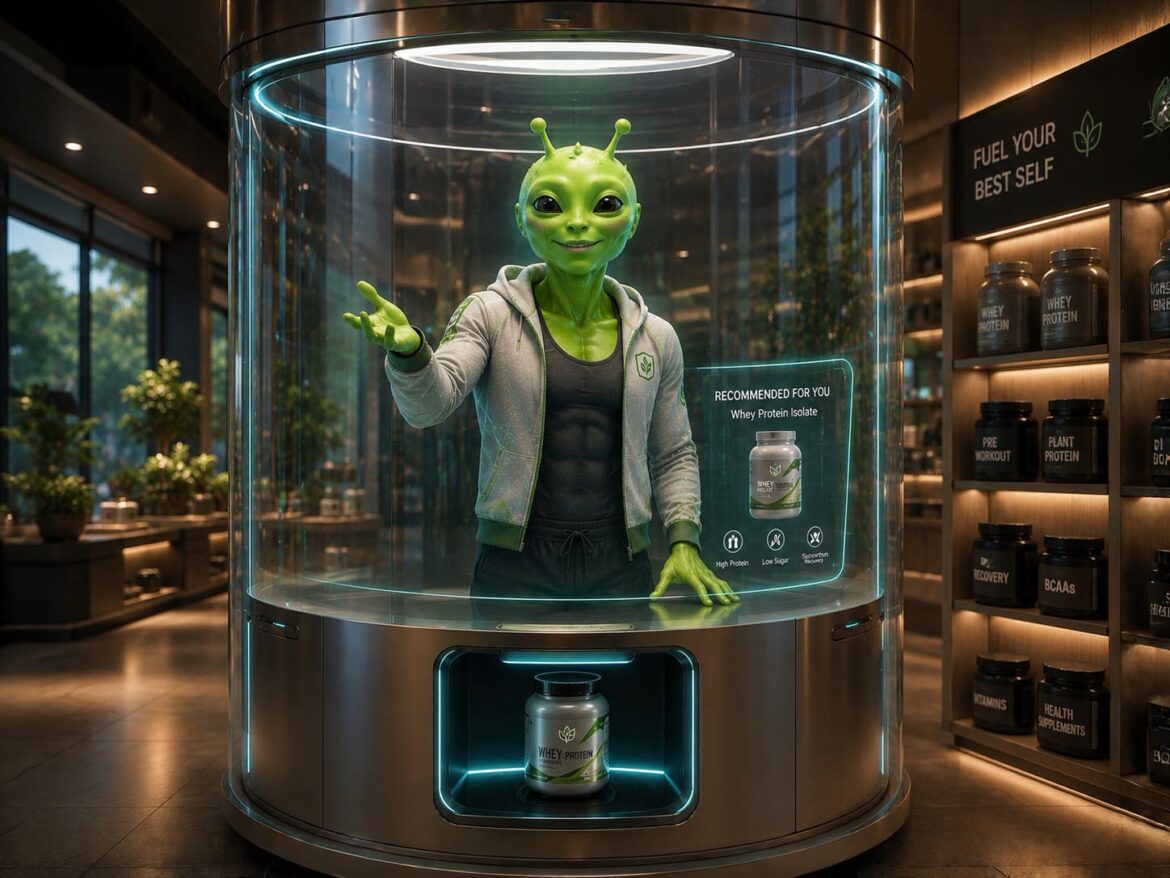
The title image shows an AI powered service avatar in a transparent consultation kiosk that personally addresses, advises, and can dispense an individually suitable product to customers in a real environment.
Visualization: Avatar as a Service, intelligent fitness and nutrition advisor, transparent consultation kiosk, AI powered product recommendation, personalized dispensing and spatially embedded service avatars | Image: © Ulrich Buckenlei | VISORIC GmbH
Service avatars could fundamentally change how people interact with digital systems, products, and companies in the coming years. What today usually still happens through apps, websites, chat windows, or classic terminals is increasingly shifting into real spaces. Digital assistants therefore no longer appear only on screens, but emerge as spatially perceptible points of contact in stores, hotels, clinics, industrial environments, educational institutions, or public buildings.[1]
The decisive step lies in giving artificial intelligence a visible, understandable, and situation related form. A service avatar can listen, ask questions, explain products, evaluate data, give recommendations, and trigger concrete actions. This creates a new interface between people, space, digital knowledge, and physical service.[2]
The title graphic of this article visualizes exactly this development. A friendly, fictional fitness avatar is no longer located in an app, but in a transparent Plexiglas column that functions like an intelligent consultation kiosk. Customers can speak with the avatar, describe their goals, and then receive a personalized recommendation for nutrition, fitness, or health.
What is particularly interesting is the connection between the real product world and digital consultation. The avatar not only analyzes a request, but connects conversation, product database, personalization, and dispensing mechanics. At the end, there is not only information, but a concrete result. The suitable product is provided, similar to a beverage vending machine, but with an intelligent consultation logic in front of it.
This fundamentally changes the role of digital avatars. They no longer become only visual characters or marketing effects. They develop into real service points that connect consultation, orientation, knowledge transfer, and action in a physical environment. This is exactly where the idea of Avatar as a Service begins.
For companies, this development opens up new possibilities. Service avatars can be used in highly frequented places, be available around the clock, and communicate complex information in an understandable way. At the same time, they can enable personal interaction without every consultation situation having to be permanently covered by human staff.
- Service avatars bring digital intelligence into real environments
- Physical kiosks connect consultation, personalization, and product dispensing
- AI systems can combine conversation, data analysis, and recommendation
- Companies receive new scalable service points in space
- Digital assistants become visible points of contact in everyday life
This development becomes particularly exciting where people not only see the avatar, but also understand which technical architecture is behind it.
How Service Avatars Enter the Real World
For a Service Avatar to appear credibly in a real environment, a screen alone is not sufficient. A technical infrastructure is required that connects visual presence, speech, sensor technology, artificial intelligence, product data, and physical dispensing systems. Only then does an interface emerge that feels like a natural point of contact within the space for users.[3]
At the center of such systems is an avatar unit that becomes visible on a transparent display, through a projection, or within a holographic looking column. The avatar can display gestures, simulate eye contact, and respond to speech. At the same time, microphones, cameras, or depth sensors detect whether a person is standing in front of the system, how they interact, and which inputs are relevant for the consultation.
The actual intelligence is created through the connection with AI models, knowledge databases, and personalization logics. As a result, a Service Avatar can not only provide predefined answers, but also understand questions, classify goals, and generate suitable recommendations. In a fitness or nutrition scenario, this could mean that training goals, nutritional preferences, product selection, and availability are evaluated together.[4]
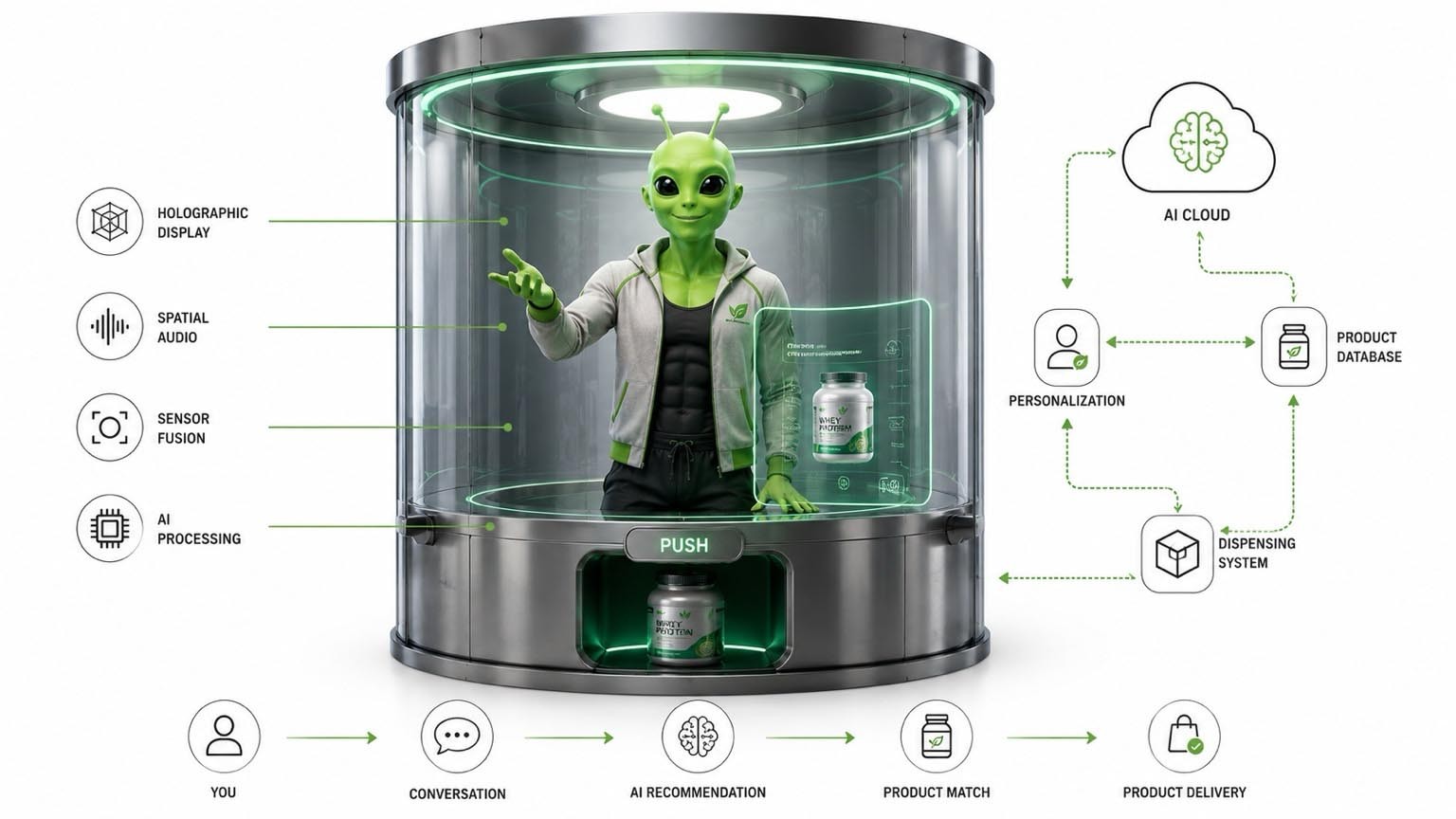
The technical illustration shows how a Service Avatar can be integrated into a real environment through display technology, sensor systems, spatial audio, AI processing, product databases, and a dispensing system.
Visualization: Technical architecture of an Avatar as a Service kiosk with holographic display, spatial audio, sensor fusion, AI cloud, personalization, product database, and automatic product dispensing | Image: © Ulrich Buckenlei | VISORIC GmbH
The image in this chapter makes it visible that Avatar as a Service is not a single interface, but a composite system. On the left, the physical components are shown that make the avatar perceptible within the space. On the right, the digital logic becomes visible that connects conversation, personalization, database access, and product dispensing.
Particularly important is the connection between visible presence and functional action. An avatar that only speaks remains a digital interface. An avatar that translates a recommendation into a real action becomes a service point. It is precisely this step that makes the technology particularly interesting for retail, healthcare, education, public institutions, and businesses.
Such systems can be structured modularly. Depending on the location of use, they can appear as a consultation column, product kiosk, reception system, training station, or information point. The visual figure may appear human, be intentionally stylized, or take the form of a brand character. What matters is that the technical foundation functions reliably and can scale.
The VISORIC expert team in Munich considers such systems particularly in connection with real time 3D, Digital Humans, AI supported interaction, and spatial media architecture. Because only when design, technology, and user guidance come together does an avatar emerge that does not appear as an effect, but as a meaningful part of the environment.
- Service Avatars require display technology, audio, sensor systems, and AI processing
- Personalization emerges through the connection of conversation and data
- Product databases make recommendations concrete and actionable
- Dispensing systems connect digital consultation with a physical result
- Scalable architecture makes Avatar Services usable across many industries
Once this technical foundation is in place, an abstract AI system can become a concrete consultation kiosk that supports people directly at the product.
Service Avatars Become Part of Our Real Environment
For Service Avatars to be accepted in everyday life, they must appear where people actually work, learn, shop, or make decisions. Development is therefore increasingly shifting away from purely digital user interfaces toward spatially anchored avatar systems that are visibly present within the physical environment.[5]
While today’s AI assistants are mostly used on smartphones, tablets, or computers, future Service Avatars could appear directly within the space. Technical implementation can take place in different ways. Projection systems, transparent displays, holographic columns, LED installations, or XR headsets make it possible to visibly integrate digital personalities into real environments.
The decisive difference is that users no longer communicate with abstract software. Instead, the impression of a present digital counterpart is created. Speech, facial expressions, gestures, and spatial presence create a more natural form of interaction and can make complex information easier to understand.
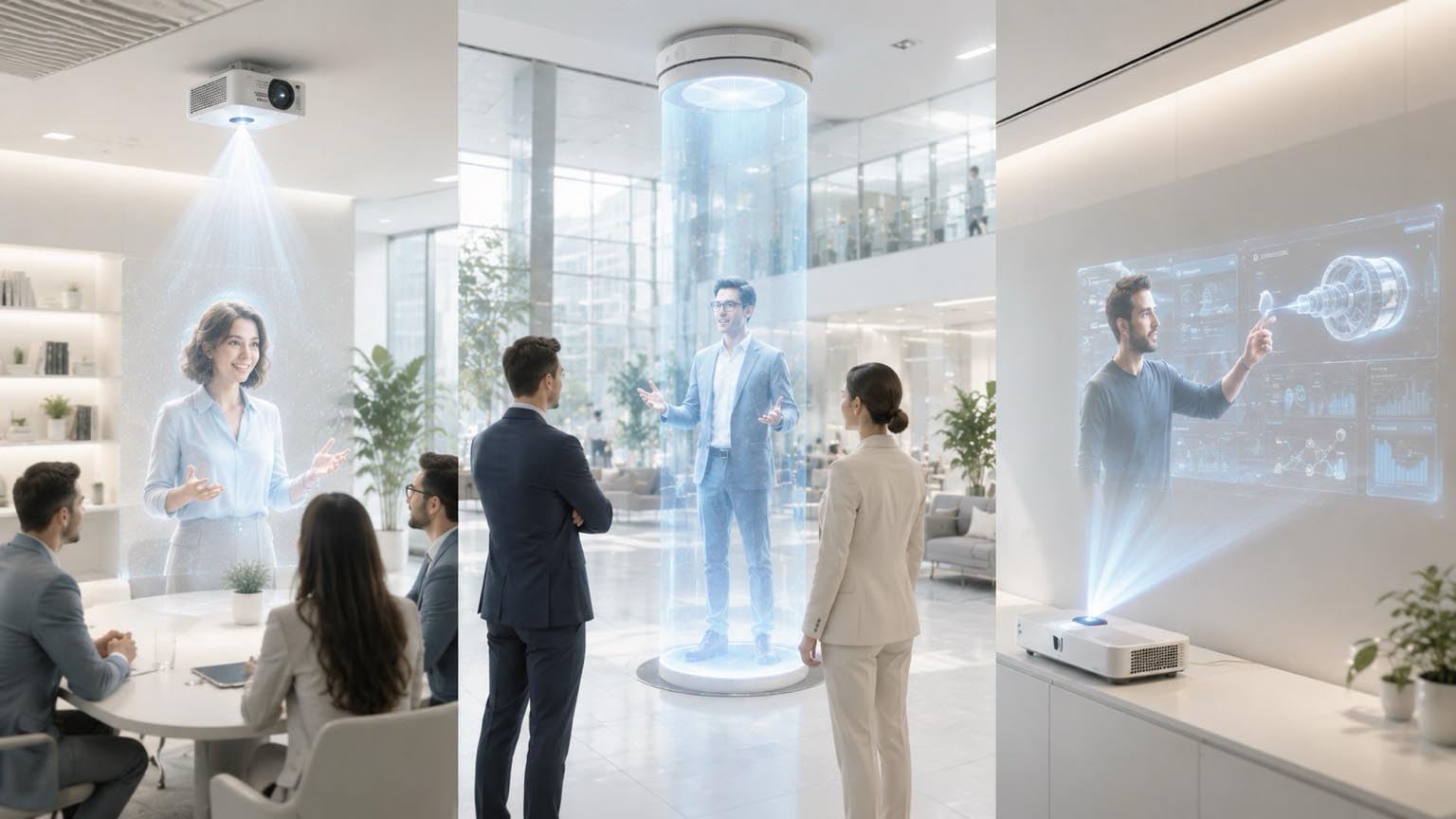
The concept image shows different technical approaches for integrating Service Avatars into real environments, ranging from projections and transparent displays to holographic columns.
Visualization: Possible implementation forms of Avatar as a Service systems in meeting rooms, reception areas, public buildings, and work environments | Image: © Ulrich Buckenlei | VISORIC GmbH
The illustrated scenarios make it clear that there will not be only a single technology. Depending on the field of application, different solutions may be appropriate. In a conference room, an avatar could appear through projection technologies, while transparent displays or holographic columns may be used in reception areas. In industrial environments, Service Avatars can be connected directly with machine information or Digital Twins.
This creates entirely new possibilities for knowledge transfer, customer service, and expert support. Companies can provide information not only as content, but in the form of a digital conversational partner. Interaction becomes more personal, more understandable, and significantly closer to a human consultation situation.
With the increasing capabilities of generative AI, such systems could in the future welcome visitors, explain processes, conduct training sessions, or serve as digital points of contact for complex specialist topics. The technology delivers not only answers, but also a visible and comprehensible form of communication.
- Service Avatars can become visible through projections, displays, or holographic systems
- Digital personalities create a more natural human machine interaction
- Spatial presence increases attention and understanding
- The technology is suitable for business, education, service, and public institutions
- Avatar systems connect AI, visualization, and real environments into a new form of communication
However, Service Avatars do not only have to present information. The development becomes particularly interesting when real machines, buildings, and technical systems themselves receive a digital point of contact.
Digital Experts Directly at the Machine
Service Avatars reveal particularly great potential wherever complex knowledge must be available quickly. In production facilities, manufacturing lines, and technical infrastructures, employees work daily with highly complex machines whose condition, maintenance requirements, and performance data are continuously monitored. Although this information exists, it is often located in different systems, dashboards, or documentation.[7]
Service Avatars could act here as digital experts directly connected to machines, sensors, and Digital Twins. Instead of manually searching for technical information, employees can ask questions and receive understandable answers in natural language. The avatar thereby becomes a visible interface between people, machines, and data models.
The actual innovation does not lie in displaying additional information. What matters is the ability to communicate complex expertise in an understandable way. An avatar can explain maintenance procedures, describe fault conditions, classify production metrics, or support new employees with technical tasks. This creates a significantly more intuitive form of knowledge access.
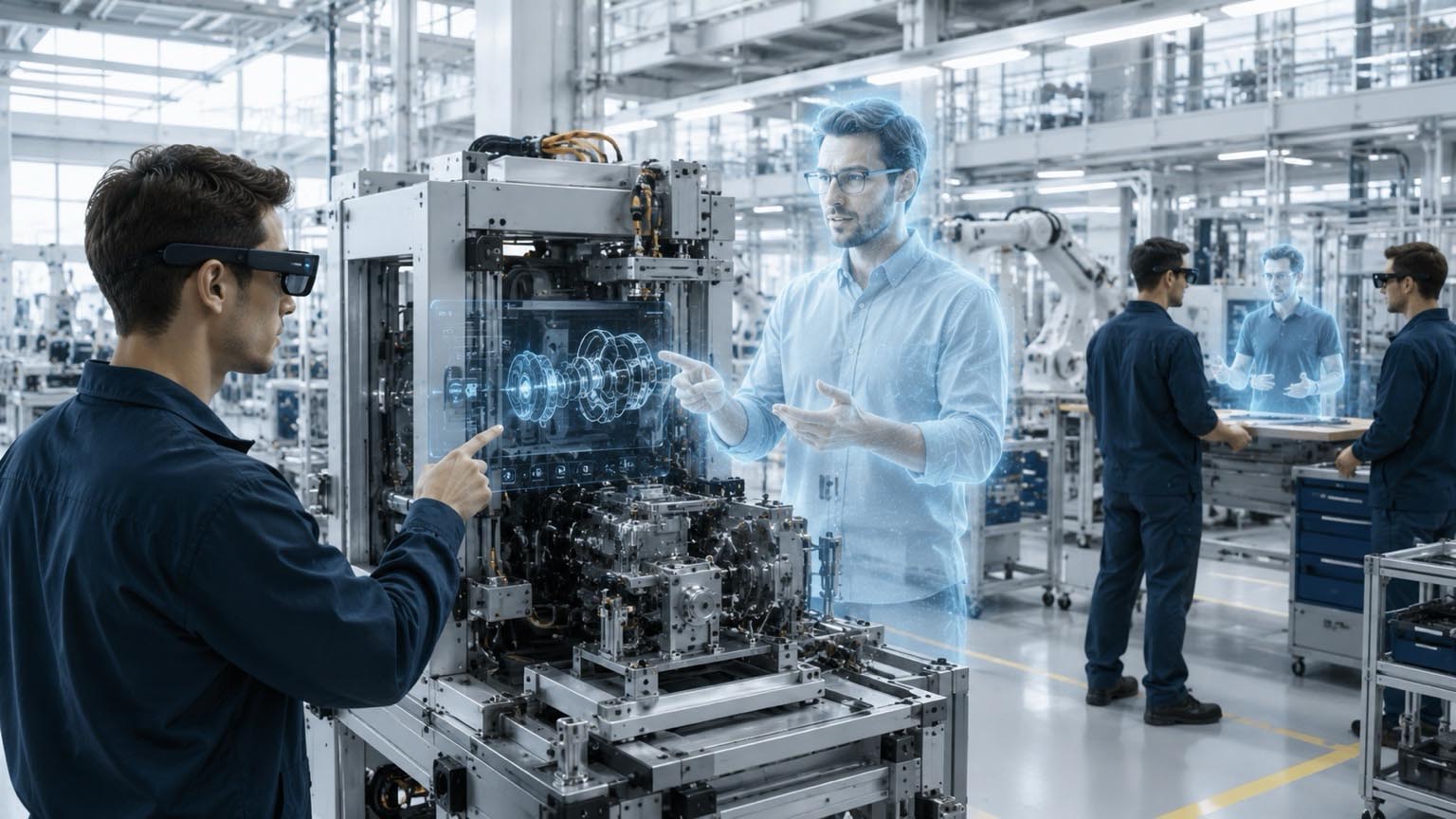
The visualization shows a Service Avatar appearing directly at a production facility and supporting employees with analysis, maintenance, and knowledge transfer.
Visualization: Industrial avatar as a conversational expert for production facilities, machine conditions, maintenance information, and technical assistance based on real time data and Digital Twin technologies | Image: © Ulrich Buckenlei | VISORIC GmbH
The illustrated scenario shows an employee communicating directly with a digital expert using an AR headset. The avatar appears immediately beside the machine and can spatially visualize technical relationships. At the same time, components, process steps, or operating conditions can be explained directly on the real object.
As a result, knowledge is no longer communicated exclusively through manuals, training sessions, or specialized software. Information appears exactly where it is needed. Service Avatars could make experienced expert knowledge permanently available and support employees with complex tasks, regardless of shift schedules or location boundaries.
For companies, this opens new possibilities in maintenance, service, training, and operations. Expertise becomes scalable, processes become easier to understand, and new employees can be onboarded more quickly. The avatar does not replace skilled professionals, but expands their capabilities through immediate access to relevant knowledge.
Especially in combination with real time data, Digital Twins, and Spatial Computing, a new generation of intelligent assistance systems emerges. Machines no longer only deliver data. They receive a digital expert capable of explaining what is happening, why it is happening, and which action makes sense.
- Service Avatars can make machine knowledge available directly at the point of use
- Technical information is translated into understandable language
- AR and Spatial Computing enable spatial knowledge transfer
- Maintenance, training, and operations benefit from digital expert knowledge
- Avatar as a Service connects employees directly with real time data and Digital Twins
However, Service Avatars do not have to remain tied to a fixed location. The development becomes particularly exciting when the same digital personality becomes available simultaneously across different devices and platforms.
When Real Systems Receive a Digital Point of Contact
Avatar as a Service becomes particularly interesting when digital personalities do not merely support individual tasks, but are connected directly with real systems. Production facilities, buildings, energy infrastructures, and logistics networks already generate enormous amounts of data today. The challenge is not collecting this information, but making it understandable and usable.[9]
This is exactly where Service Avatars can take on a new role. They function as a visible and conversational interface between people and the Digital Twin. Instead of interpreting dashboards or evaluating reports, employees can speak directly with a digital expert who knows the current condition of a system and can explain it in an understandable way.
The technology is not limited to factories. A Building Avatar could explain energy consumption, indoor climate, or maintenance conditions. An Energy Avatar could provide information about wind farms, solar installations, or power grids. A Logistics Avatar could make goods flows, storage capacities, or transport processes transparent. At the same time, production facilities receive a specialized Industrial Avatar that explains processes and machine conditions in an understandable way.[10]
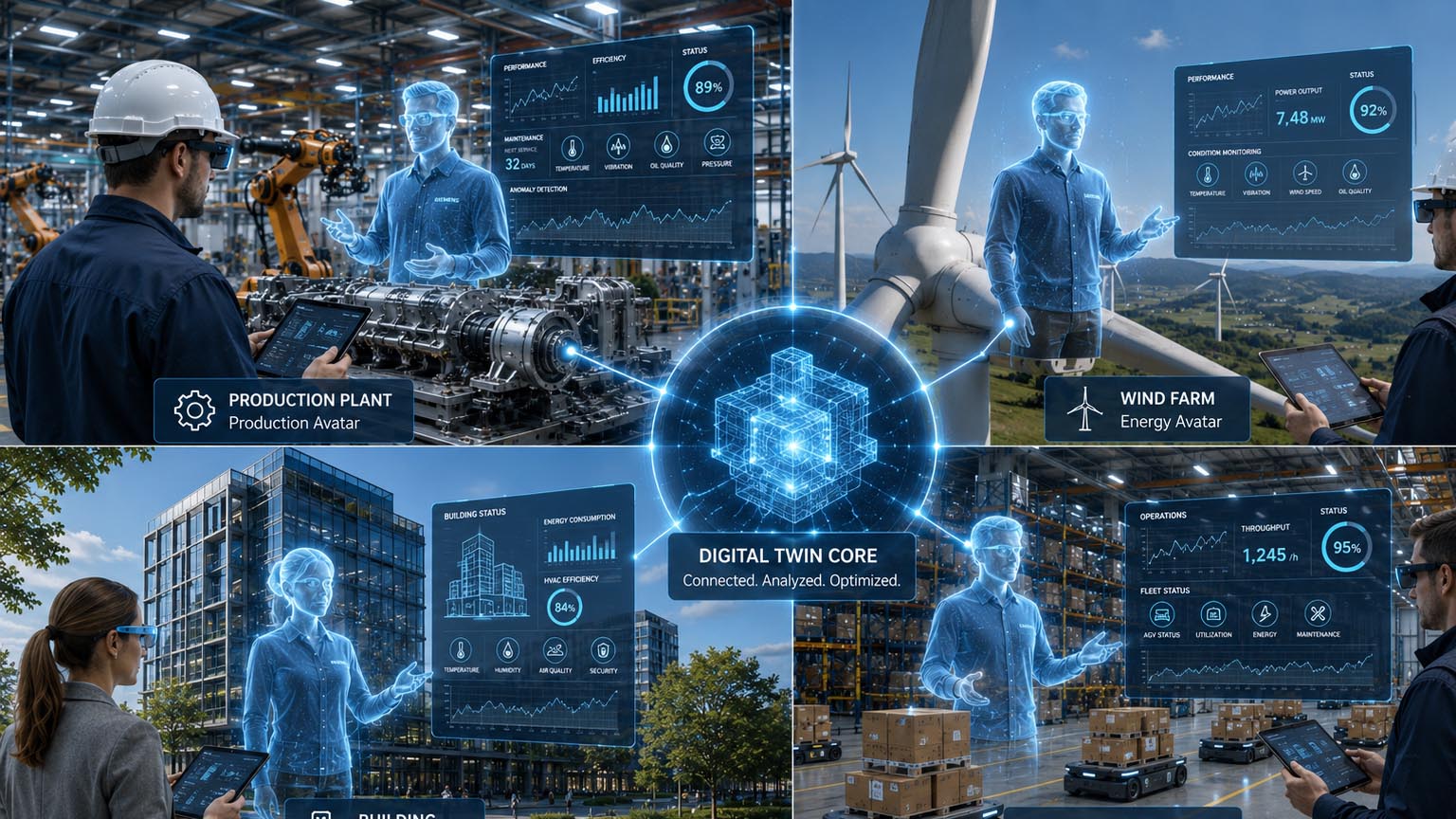
The concept image shows how Digital Twins from production, energy, building management, and logistics can become more understandable and conversational through specialized Service Avatars.
Visualization: Service Avatars as intelligent interfaces for production facilities, wind farms, buildings, and logistics centers based on real time data, AI, and Digital Twin technologies | Image: © Ulrich Buckenlei | VISORIC GmbH
The visualization illustrates that behind every avatar there is a specialized knowledge space. While the underlying systems remain complex, users receive simple access to relevant information. The avatar thus becomes a kind of digital point of contact for real objects, processes, and infrastructures.
For companies, this creates a new approach to knowledge transfer. Data leaves its isolated specialist systems and becomes available directly where decisions are made. Employees can ask questions, understand relationships, and react more quickly to changes.
In the long term, such avatars could become a permanent part of modern operating environments. Every important system receives its own digital personality that not only provides information but actively explains it. In this way, a Digital Twin becomes an understandable conversational partner.
- Service Avatars can make Digital Twins understandable and conversational
- Production, energy, buildings, and logistics receive specialized digital experts
- Complex operational data is translated into natural language
- Knowledge becomes available directly at the place where decisions are made
- Avatar as a Service connects real systems with human communication
However, an avatar does not have to remain tied to a single system. The development becomes particularly exciting when the same digital personality becomes available simultaneously across different devices and platforms.
Projection Systems as Access to Avatar Services
Not every environment is suitable for XR headsets. In hotels, reception areas, showrooms, trade fairs, museums, educational institutions, or public buildings, digital points of contact often need to be visible to several people at the same time. This is exactly why projection technologies, transparent displays, and spatial media surfaces play a central role in the next stage of development for Avatar as a Service.[11]
A Service Avatar can appear through different output systems. It can become visible as a table projection in a consultation room, appear as a life sized figure in a transparent column, or explain technical content through a wall projection. What matters is not the individual technology, but the ability to transfer digital presence into real spaces.
This creates new forms of communication design. An avatar can welcome visitors, explain products, visualize complex data, or guide people through an exhibition. It can act as a digital host, serve as a learning companion, or provide a brand with a recognizable personality. The space itself thereby becomes the interface.[12]
The visualization shows different possibilities for integrating Service Avatars into real environments through projection, transparent columns, and spatial displays.
Visualization: Avatar projection systems with table projection, transparent holography column, wall projection, spatial display, interactive consultation, and real service environment | Image: © Ulrich Buckenlei | VISORIC GmbH
The image in this chapter shows three different forms of avatar presentation. On the left, an avatar is created through a compact projection system in a meeting room. In the center stands a transparent column in which a figure appears to be spatially present. On the right, a technical explanation becomes visible through wall projection and interface layers.
This variety is important because Service Avatars should not be understood as a standardized device. In some scenarios, a kiosk is appropriate. In others, a projection is sufficient. Other applications require a combination of display technology, sensor systems, spatial audio, and real time visualization. The technology follows the context of use.
For companies, this means that Avatar as a Service can be viewed as a modular infrastructure. An avatar can use the same knowledge base while appearing differently in different locations. In a store as an advisor, in a showroom as a product guide, in a museum as a storyteller, in industry as an expert, and in a meeting room as a data moderator.
This is precisely where an important difference from traditional digital assistants lies. The avatar is not trapped within a single device. It can be deployed through different forms of spatial media. This creates a new connection between content, space, interaction, and service.
- Service Avatars can appear through projection, displays, and transparent columns
- Spatial media make digital points of contact visible to groups
- An avatar can be represented differently depending on the context
- Showrooms, events, museums, and reception areas become new deployment locations
- Avatar as a Service thereby becomes a modular spatial technology
The more visible and present avatars become in real environments, the more important trust, identity, and clear responsibility structures become.
Trust, Identity, and Responsible Avatars
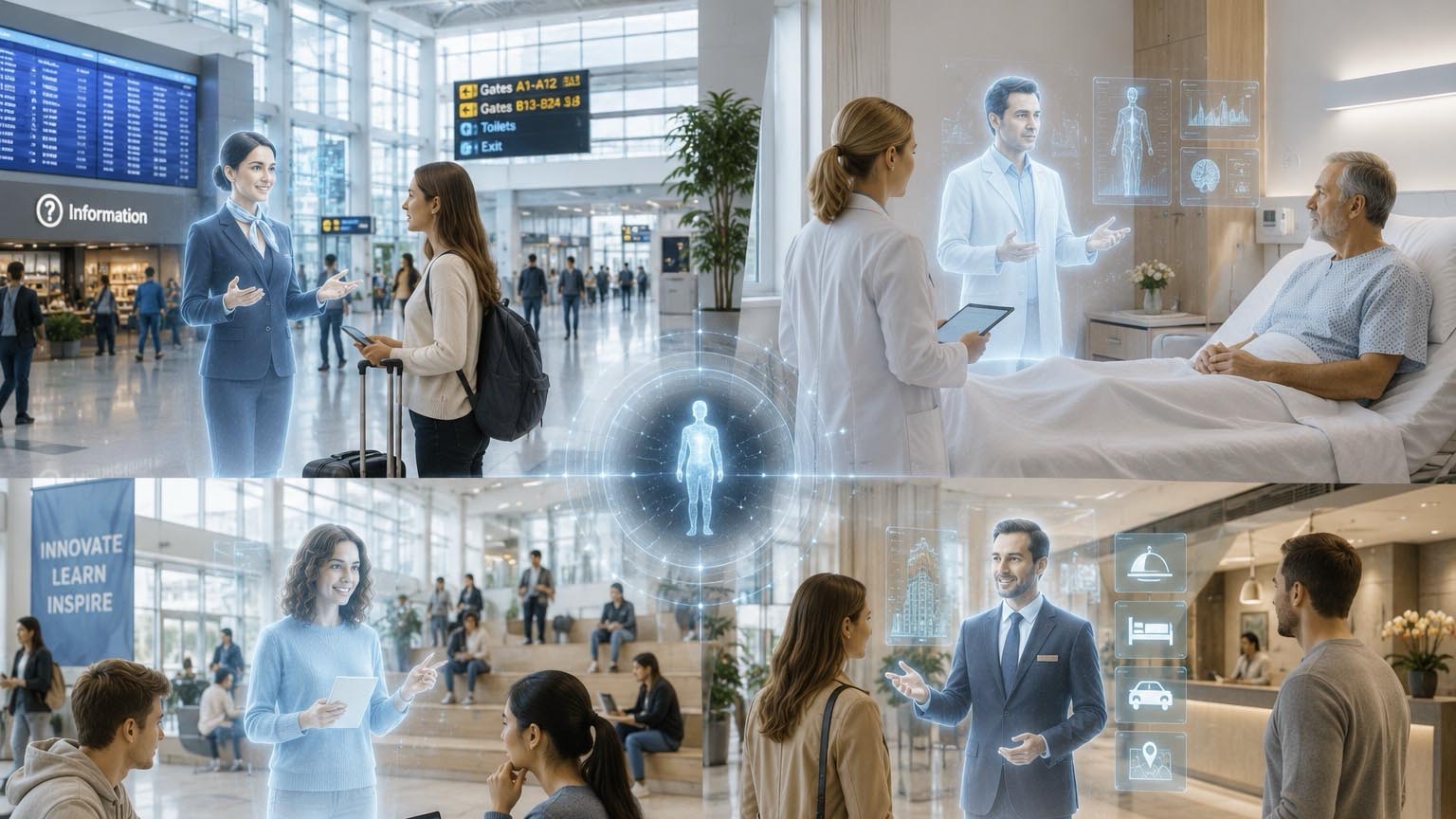
When Service Avatars appear in real environments, a central question arises: Who do people actually trust when a digital point of contact provides recommendations, processes data, or prepares decisions? This question is not only technically relevant, but also socially and economically important. Avatar as a Service therefore requires clear rules for identity, responsibility, and transparency.[13]
An avatar must make clear which role it fulfills. Does it act as a brand advisor, medical information assistant, learning companion, technical support agent, or digital host? Users must be able to understand what the avatar is permitted to do, which data is used, and when human responsibility remains necessary.
Particularly in sensitive areas such as healthcare, education, travel, financial services, or public administration, a convincing appearance alone is not sufficient. What matters is that the interaction remains understandable and traceable. Recommendations must be explainable. Data must be protected. And the avatar must not suggest that it knows more or is allowed to decide more than is actually intended.[14]
The image shows Service Avatars in various sensitive application areas and presents trust, identity, and responsibility as the central foundation of spatial AI interaction.
Visualization: Trusted Avatars in Healthcare, Travel, Education, and Hospitality with digital identity, responsible AI, transparent interaction, and human centered service design | Image: © Ulrich Buckenlei | VISORIC GmbH
The image in this chapter connects four application scenarios through a central identity symbol. A medical avatar provides support in a healthcare context. A Travel Avatar assists at the airport. An Education Avatar communicates knowledge. A Hospitality Avatar accompanies guests in a hotel. All scenes demonstrate one thing: the avatar is valuable only when the interaction is designed in a trustworthy way.
Particularly important is the balance between automation and human control. Service Avatars can make information available more quickly and answer routine questions. At the same time, critical decisions, sensitive consultations, and legally relevant processes must remain clearly regulated. The avatar should support, but not act without control.
For companies, this means that Avatar as a Service must not be understood solely as a creative or technology project. It requires governance, role models, data strategy, security concepts, and clear user communication. The figure itself is only the visible surface of a responsibly designed system.
This is exactly where a decisive quality difference emerges. A well designed Service Avatar does not only appear impressive, but also trustworthy. It explains its role, respects boundaries, and makes clear when a human person becomes involved.
- Service Avatars require clear roles, identities, and responsibilities
- Trust emerges through transparency, data protection, and understandable recommendations
- Sensitive industries require human control and clear escalation paths
- Governance is a central component of successful avatar platforms
- Responsible design determines acceptance and impact
When trust, identity, and control are clearly defined, Avatar as a Service can become a scalable digital infrastructure for many devices, locations, and usage scenarios.
Avatar as a Service as Digital Infrastructure
The actual strength of Avatar as a Service emerges when an avatar is not only used in a single location, but is available across different devices, platforms, and environments. A digital expert can then appear in the showroom, be continued on a tablet, be visible through an XR headset in the workspace, or appear as a projection in a meeting.[15]
This turns the avatar from a single application into an infrastructure. The visible figure can appear differently depending on the situation, while the underlying knowledge base, identity, conversation history, and service logic remain connected. This is exactly how a consistent experience is created across different channels.
For companies, this idea is particularly relevant. A Service Avatar can advise customers, support employees, accompany training sessions, explain product data, or visualize management information. Instead of developing separate applications for each channel, a central avatar platform is created that orchestrates content, roles, and interactions.[16]

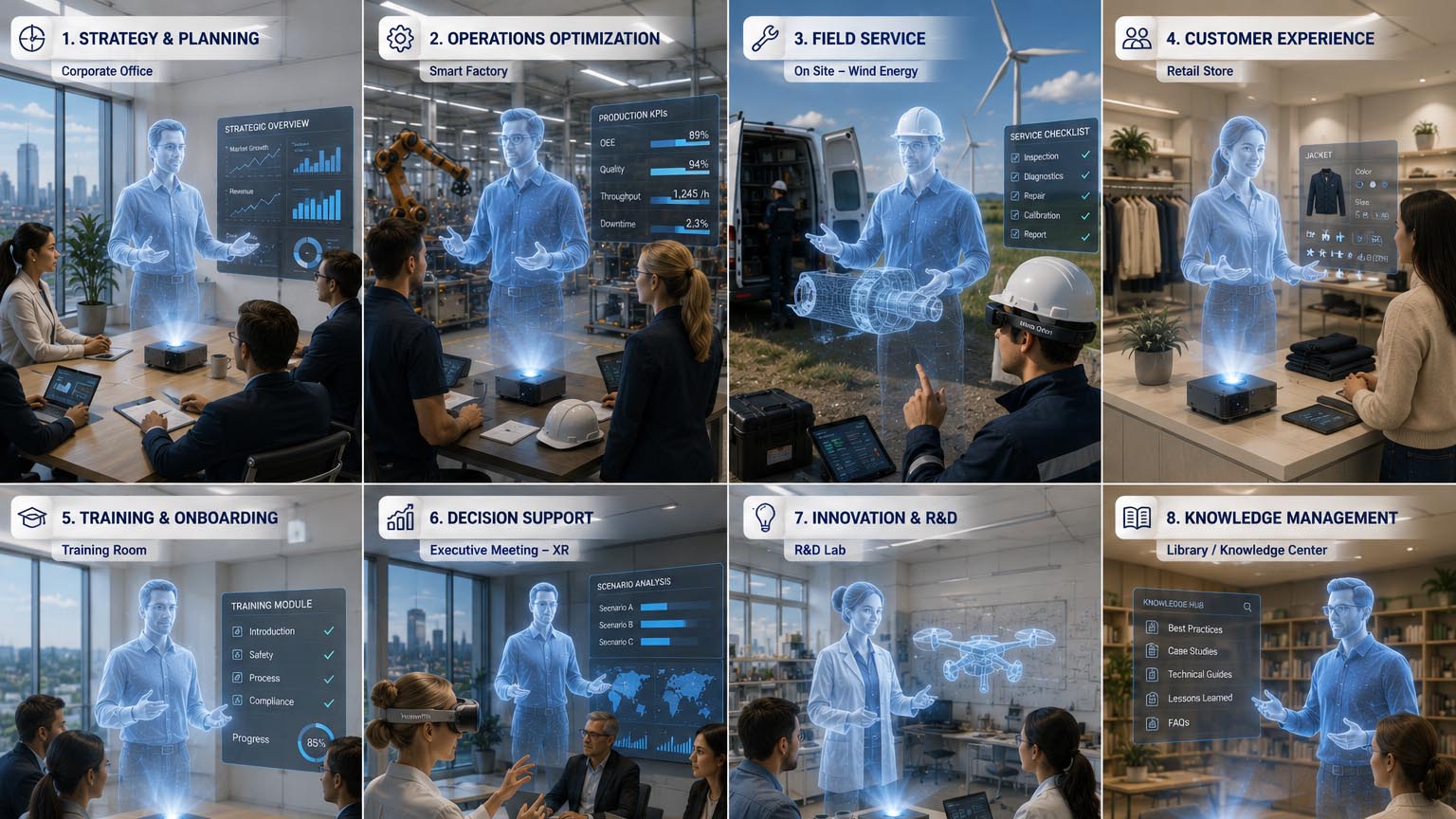
The visualization shows Avatar as a Service as a connected platform in which a digital expert appears across cloud, XR headsets, tablets, projections, and spatial interfaces in different environments.
Visualization: Avatar as a Service platform with avatar cloud, multi device orchestration, XR headsets, projections, tablet control, spatial presence, and connected service infrastructure | Image: © Ulrich Buckenlei | VISORIC GmbH
The image in this chapter shows an avatar that becomes usable simultaneously through different output forms. On the left, a person interacts through an XR headset. In an industrial environment, a technical model is explained. In a meeting room, the avatar appears as a data moderator. In a reception area, it is used as a visible service point.
This structure makes clear why Avatar as a Service is more than a single digital character. What matters is the platform behind it. It connects speech, knowledge, roles, devices, security logic, and real action possibilities. The avatar thereby becomes an interface between organization, technology, and people.
Particularly exciting is the possibility of using the same avatar identity across many places. A customer begins a conversation in the store. Later, the consultation is continued online. An employee learns a procedure during training and later uses the same avatar during maintenance. A management team receives key figures in the meeting and can ask follow up questions in natural language.
This creates a new form of digital continuity. Information does not remain in separate channels. It follows the task, the user, and the context. This is exactly where Avatar as a Service can become an important foundation for future service, training, and decision platforms.
- Avatar as a Service connects many devices and locations through a central platform
- An avatar can appear as a kiosk, projection, XR companion, or tablet interface
- Knowledge, roles, and conversation logic remain consistent across channels
- Companies can centrally orchestrate service, training, and consultation
- Digital experts become scalable infrastructure components
This lays the foundation for a larger development. When avatars are no longer individual applications, but are operated as platforms, a new Avatar Economy emerges step by step.
The Emergence of an Avatar Economy
When Service Avatars are no longer conceived as individual installations, but as reusable, scalable, and connected platforms, a new economic model emerges. Companies then develop not only a digital point of contact for a specific location, but an avatar infrastructure that can be used across branches, showrooms, industrial facilities, learning environments, and digital channels.[17]
This fundamentally shifts the view of digital avatars. They are no longer understood only as the visual surface of artificial intelligence, but as a new service class. An avatar can advise, explain, train, accompany, evaluate data, and translate complex content into understandable dialogues. It is precisely from this connection of AI, spatial presence, and real benefit that an Avatar Economy gradually emerges.[18]
Scalability is particularly interesting here. Once developed, an avatar can be used in different industries, languages, roles, and environments. The technical platform remains connected in the background, while the visible form is adapted to the respective context.
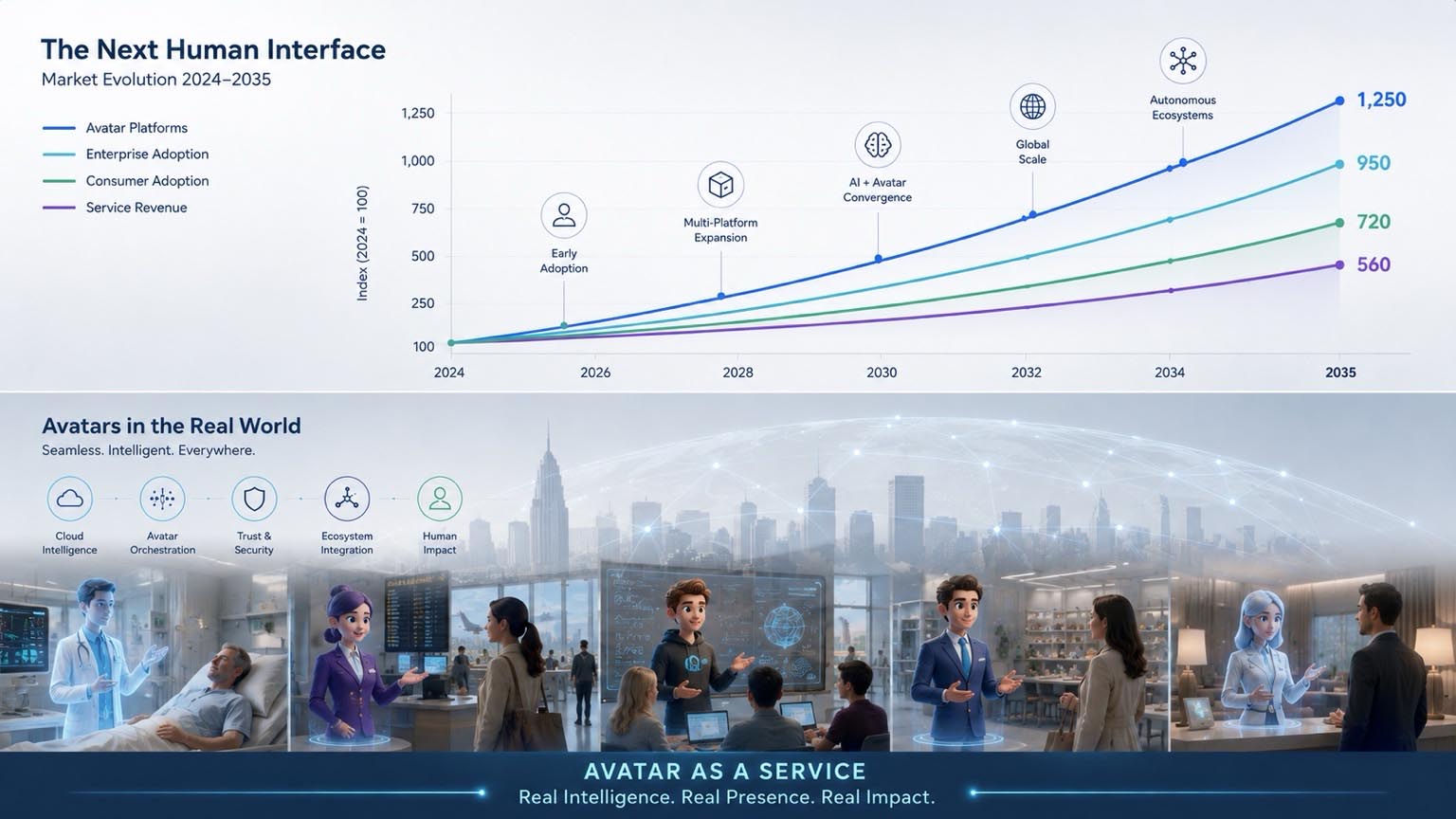
The infographic shows the development of avatar platforms, enterprise adoption, consumer adoption, and service revenue through 2035, as well as the possible anchoring of avatars in real environments.
Visualization: The Next Human Interface, Market Evolution 2024 to 2035, Avatars in the Real World, Cloud Intelligence, Avatar Orchestration, Trust and Security, Ecosystem Integration, and Human Impact | Image: © Ulrich Buckenlei | VISORIC GmbH
The diagram in this chapter does not describe a single product idea, but a larger transformation process. In the upper area, it becomes visible how avatar platforms, enterprise applications, consumer applications, and service revenues could gain significant importance in the coming years. The lower area shows how avatars can be embedded into real spaces, from healthcare and education to industry, retail, and personal assistance systems.
From a scientific perspective, the connection between three developments is particularly relevant. First, AI models are becoming more powerful and more conversational. Second, spatial interfaces, projections, XR systems, and real time 3D platforms are emerging that make avatars visible. Third, the need for scalable service forms that make knowledge available everywhere is growing.
For companies, this means that Avatar as a Service is not only a communication format. It can become a new digital value creation layer. Brands can build their own digital experts. Industrial companies can make machine knowledge conversational. Educational institutions can scale learning companions. Service providers can make consultation available around the clock.
At the same time, new requirements for quality, responsibility, and operation emerge. Avatars require maintained knowledge databases, clear roles, secure data processes, regular updates, and reliable technical infrastructure. The Avatar Economy will therefore not emerge from beautiful figures alone, but from robust platforms, meaningful use cases, and measurable benefit.
- Avatar as a Service can develop into a new scalable service class
- AI, spatial interfaces, and real time 3D create the technical foundation
- Companies can use digital experts across many locations and channels
- Avatars connect knowledge, consultation, training, and real service processes
- The Avatar Economy emerges where digital presence creates real benefit
This completes the circle of the article. From an AI avatar in a single consultation kiosk, a larger perspective emerges: intelligent digital personalities that appear in real environments, make knowledge accessible, and enable new forms of service, training, consultation, and collaboration.
When Digital Experts Become Part of Our Environment
The development of Avatar as a Service is often reduced to artificial intelligence. But the actual change does not arise solely from more intelligent systems. The decisive step consists of giving artificial intelligence a fixed place in our physical environment. This exact vision of the future is at the center of the following video.
While digital assistants today are mostly limited to smartphones, websites, or displays, future Service Avatars could be present directly in our living spaces, workplaces, shops, hotels, healthcare facilities, or industrial plants. They appear where information is needed and become visible points of contact within our real environment.
The technologies required for this are already developing at high speed today. Realtime 3D engines enable photorealistic representations. Spatial tracking recognizes positions and movements in space. Modern projection systems create spatial illusions. Artificial intelligence provides knowledge, context, and natural communication. Only the interaction of these technologies makes Avatar as a Service a realistic perspective for the coming years.
The video visualizes a future in which intelligent avatars no longer remain hidden behind screens, but become part of our everyday environment as visible digital personalities.
Video inspiration: Spatial AI avatars, digital presence, projection mapping, Spatial Computing, and intelligent environments | Analysis and editorial classification: © Ulrich Buckenlei | VISORIC GmbH
Perhaps in the future we will encounter digital trainers in the gym. Digital advisors in retail stores. Technical experts directly at machines. Personal health assistants in hospitals. Or intelligent hosts in hotels, airports, and public institutions.
This is not about replacing people. Rather, a new service layer is emerging that makes knowledge permanently available and provides information where it is needed. Avatars become a natural extension of our digital infrastructure.
The video illustrates exactly this idea. The future of artificial intelligence will not be defined by its intelligence alone. It will also be determined by the places where we encounter it.
- AI leaves the screen and becomes part of real spaces
- Projection mapping and Spatial Computing create new forms of digital presence
- Service Avatars can appear as advisors, trainers, experts, or hosts
- Digital personalities become spatially anchored and usable in context
- The question is no longer how intelligent AI becomes, but where we encounter it
From the Idea to a Productive Service Avatar
Avatar as a Service is currently developing from a future vision into a real technology platform for companies, organizations, and public institutions. The possible applications range from digital reception staff and interactive product advisors to industrial experts, training assistants, and intelligent service platforms.
The VISORIC expert team in Munich supports companies in the development of individual avatar solutions from the first idea to productive operation. This does not create generic systems, but tailor made Service Avatars that are precisely aligned with processes, target groups, products, and business goals.
Our services include strategic conception, the development of digital personalities, the integration of AI systems, the creation of photorealistic avatars, realtime 3D applications, Spatial Computing solutions, XR integrations, and the connection to existing data sources and enterprise systems.
In addition, we accompany the complete rollout including infrastructure planning, content development, training, maintenance, further development, and long term operation. This creates sustainable platforms that can grow with the requirements of your company.
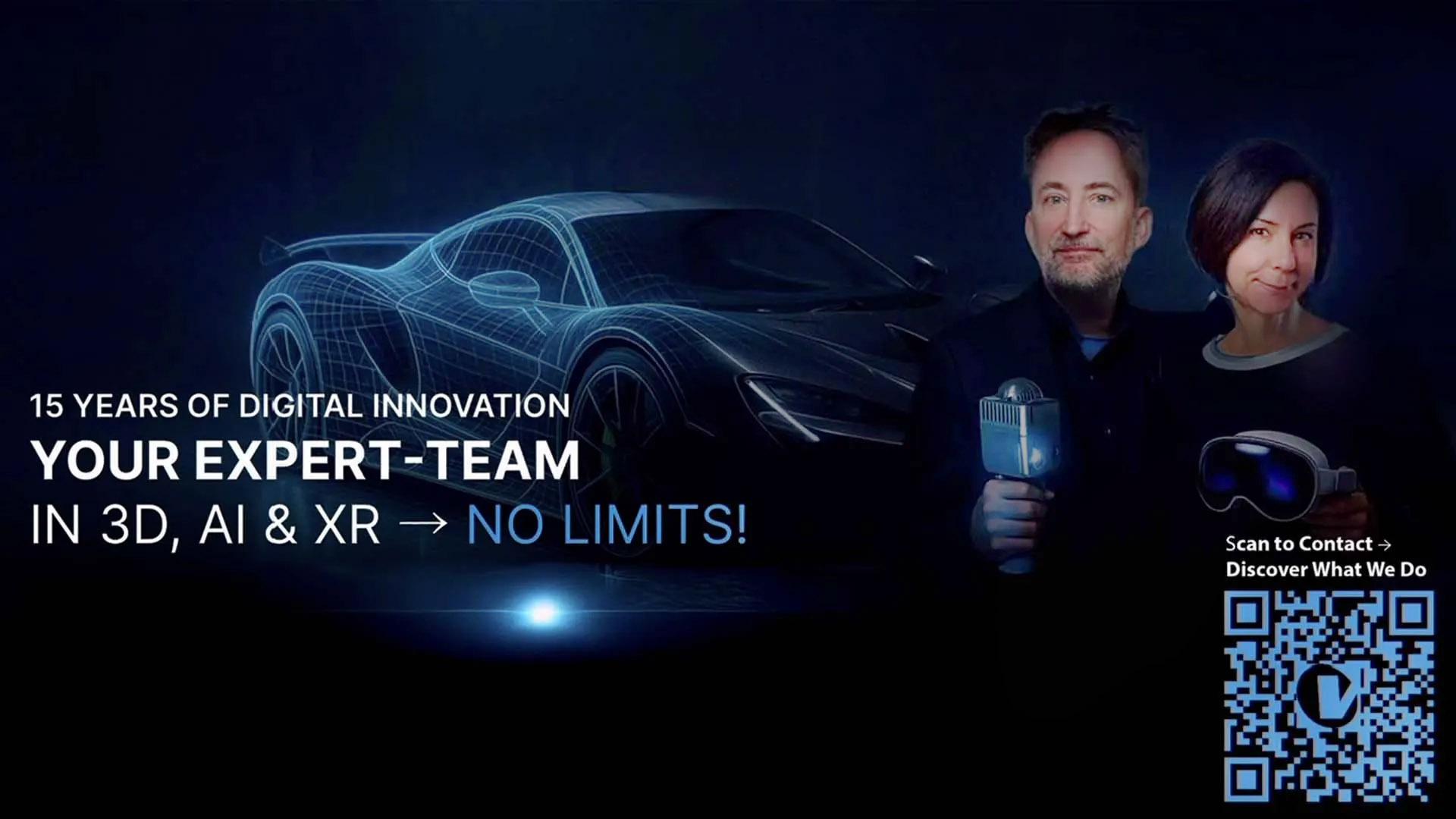
The VISORIC expert team in Munich connects artificial intelligence, Digital Twins, realtime 3D, computer vision, and Spatial Computing into intelligent Service Avatar platforms for the real world.
Visualization: Development of intelligent Service Avatars, Digital Humans, Spatial Computing applications, computer vision systems, and Digital Twin platforms for industry, retail, education, and public institutions | Image: © Ulrich Buckenlei | VISORIC GmbH
The VISORIC expert team in Munich connects artificial intelligence, Digital Twins, realtime 3D, computer vision, and Spatial Computing into practical Service Avatar solutions. Individual technologies become intelligent systems that communicate knowledge in an understandable way, support processes, and integrate digital personalities into real environments.
Whether interactive consultation kiosks, digital product experts, avatar platforms for companies, intelligent reception systems, industrial assistance solutions, or spatial AI applications, what matters is not the individual technology, but its intelligent combination. It is exactly at this interface that VISORIC has been developing individual solutions for industry, retail, education, infrastructure, and public institutions for many years.
With experience from numerous projects around XR, AI, Digital Twins, and interactive realtime platforms, we accompany our customers from the first idea to long term operation. This creates scalable Service Avatar systems that generate real added value and can adapt flexibly to new requirements.
- Strategy, consulting, and development of individual avatar concepts
- AI integration, knowledge databases, and intelligent dialogue systems
- Digital Humans, stylized characters, and brand avatars
- Spatial Computing, XR, realtime 3D, and projection systems
- Technical implementation, rollout, and system integration
- Content maintenance, servicing, support, and continuous further development
If you would like to find out how Service Avatars, digital experts, or intelligent avatar platforms can be used in your company, the VISORIC expert team in Munich looks forward to the exchange. Together, we develop individual solutions from strategic conception, design, AI integration, and software development through to rollout, operation, maintenance, and continuous further development. This turns an idea into a productive avatar platform for the real world.
Sources and References
- Stanford Human Centered AI Institute, research on generative AI, digital assistants, human centered AI, and the societal impact of intelligent systems.
- MIT Media Lab, Human Computer Interaction, Ambient Intelligence, spatial interfaces, and future forms of digital presence.
- OpenAI Research, multimodal AI systems, language models, realtime interaction, AI agents, and conversational assistance systems.
- NVIDIA ACE, Digital Humans, AI avatars, and interactive realtime agents for companies, consultation, and customer interaction.
- Accenture Technology Vision, AI agents, digital employees, personalized services, and intelligent customer experiences.
- Harvard Business Review, generative AI in customer service, personalized consultation, and data based service processes.
- NVIDIA Omniverse, Digital Twins, realtime simulation, industrial 3D workflows, and conversational system models.
- Microsoft Azure Digital Twins, intelligent models of real buildings, facilities, production systems, and connected infrastructures.
- Siemens Digital Industries, Industrial AI, Digital Twins, industrial copilots, and intelligent production environments.
- Meta, Apple Vision Pro, and Microsoft Mesh, Spatial Computing, Mixed Reality, spatial avatars, and industrial XR applications.
- Looking Glass Factory, holographic displays, spatial visualization, and digital content without classic headsets.
- Fraunhofer research on projection technologies, human machine interaction, immersive displays, and spatial media interfaces.
- OECD AI Principles, international guidelines for trustworthy, transparent, and responsible artificial intelligence.
- IEEE Ethically Aligned Design, ethical design of intelligent and autonomous systems, responsibility, control, and traceability.
- McKinsey Digital, AI assistants, scalable service platforms, digital experts, and enterprise wide AI integration.
- Accenture Technology Vision, platform economy, AI agents, digital service architectures, and new business models in the age of generative AI.
- World Economic Forum, Future of Work, AI Agents, digital workforces, and the impact of artificial intelligence on business and society.
- Gartner Emerging Technologies Research, Spatial Computing, AI Agents, Digital Humans, and new digital platform ecosystems.
- Original video material and inspiration: vint3d, spatially anchored AI avatars, digital presence, and intelligent environments.
- Analysis, storyline, and technological classification: © Ulrich Buckenlei | VISORIC GmbH.
- VISORIC GmbH, project practice in AI avatars, Digital Humans, Spatial Computing, realtime 3D, XR platforms, and interactive service environments.
- Bayern Innovativ Royal Reception with AI Avatar by VISORIC, practical example for digital hosts, event communication, and interactive visitor experiences.
Contact Persons:
Ulrich Buckenlei (Creative Director)
Mobile: +49 152 53532871
Email: ulrich.buckenlei@visoric.com
Nataliya Daniltseva (Project Manager)
Mobile: +49 176 72805705
Email: nataliya.daniltseva@visoric.com
Address:
VISORIC GmbH
Bayerstraße 13
D-80335 Munich