

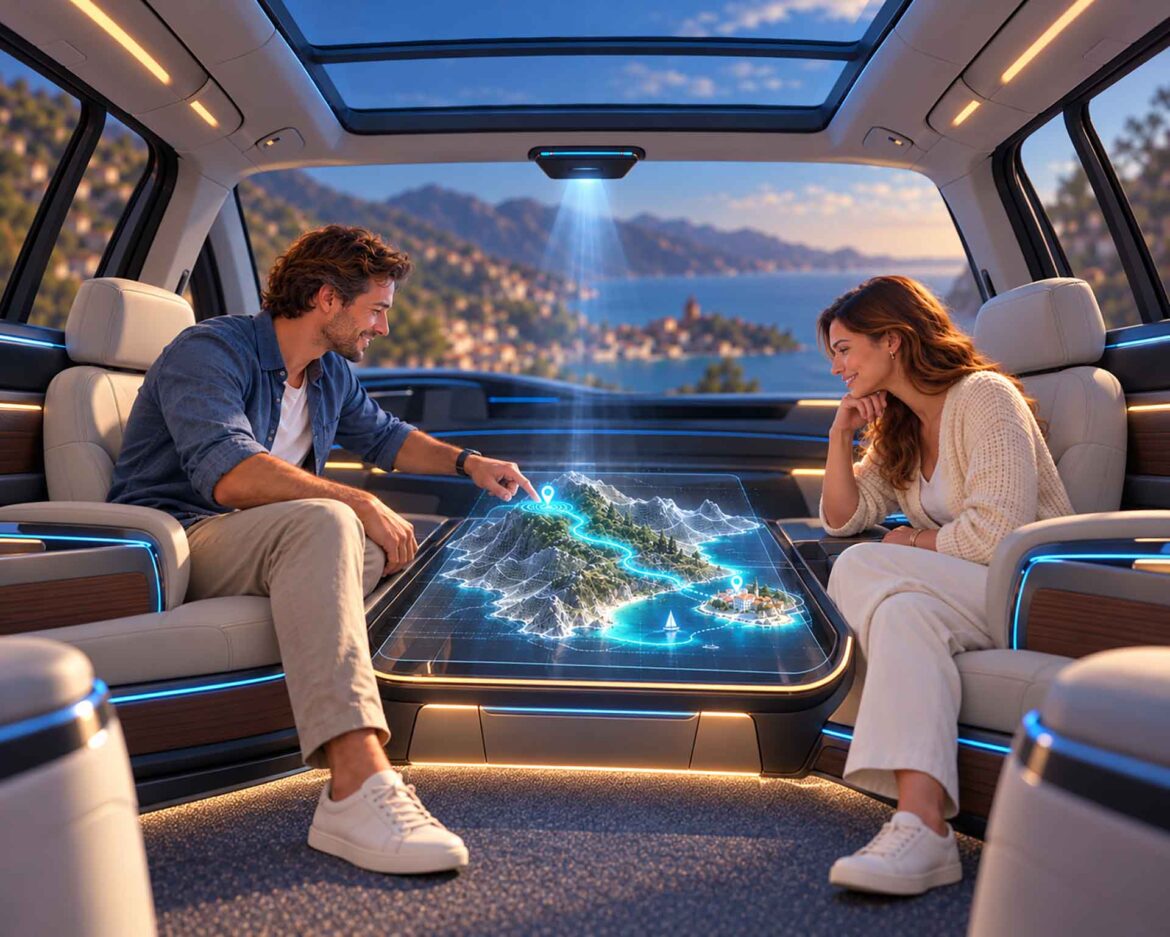
Fog, glass, a particle or a headset. Every image in space needs something for the light to hit, and that is exactly what determines use and cost.
Visualization: An image appears to float freely, yet its quality depends entirely on what carries the light | Image: © Ulrich Buckenlei | XR Stager Online Magazine | VISORIC GmbH
For decades, cinema has shown images that float freely in space. A message appears above a table, a conversation partner stands in the room as a figure of light, and nobody needs glasses to see it. This idea has become so familiar that many people consider it only a matter of time. Attention is correspondingly high whenever a video shows a glowing image that seems to stand in mid-air.
Exactly such a video triggered a lively expert discussion in October 2026. It shows a projection onto a thin layer of fog. The readers’ questions quickly went beyond the video. Are there other, lesser-known carriers for such images? Can two beams of light meet in the air and create an image there? Could you project onto clouds? And what does it mean when such information appears in a driver’s field of view?
Behind all of these questions lies a common core. Light only becomes visible to the eye when it hits something. Every technology that brings an image into space therefore has to answer what that something is: fog, glass, a floating particle, the air itself or a headset in front of the eye. This answer determines image quality, brightness, safety, size and cost.
For companies, this is more than a detail of physics. Anyone investing in a trade show appearance, a showroom, a control room or a display in a vehicle is always also buying an assumption about how people perceive information in space. This article examines the most important methods one by one: what they deliver, where their limits lie and which spaces they suit. It also shows why every good decision starts not with the technology but with the purpose.
- Floating images are among the best-known expectations of technology.
- Light only becomes visible when it hits a medium.
- The medium determines image quality, safety and cost.
- Research and market are still far apart.
- The purpose comes first, not the technology.
The following article describes the gap between expectation and technology, answers the questions of physics, fog, the lab, perception, attention and application, and outlines how companies arrive at the right display technology for their space in four steps.
An Expectation Gap Lies Between Science Fiction and the Trade Show Booth
The term hologram leads two lives. In everyday language, it describes almost any image that appears to float in space. In physics, it describes something very specific. In the late 1940s, the Hungarian-British physicist Dennis Gabor developed a method that records not only the brightness of light, as a photograph does, but also its waveform. For this he received the Nobel Prize in Physics in 1971. The prize explicitly honored the invention and development of the holographic method.[1]
A true hologram is therefore not an image in the air but a recording on a carrier, such as a coated glass plate or a film. When it is illuminated, the original light field is recreated, and the viewer sees an object with real depth that can be looked around to some extent. So this image needs a carrier as well. It does not float freely. It forms at and behind a surface.
The expectation that companies encounter today comes from a different source. In their book Make It So, the design researchers Nathan Shedroff and Christopher Noessel systematically analyzed the user interfaces from decades of science fiction and derived lessons for real-world design. Images projected freely into space are among the recurring motifs of this genre.[2] What people have seen again and again over decades, they regard as an obvious requirement. Science fiction often delivers the interaction concept long before the technology exists.
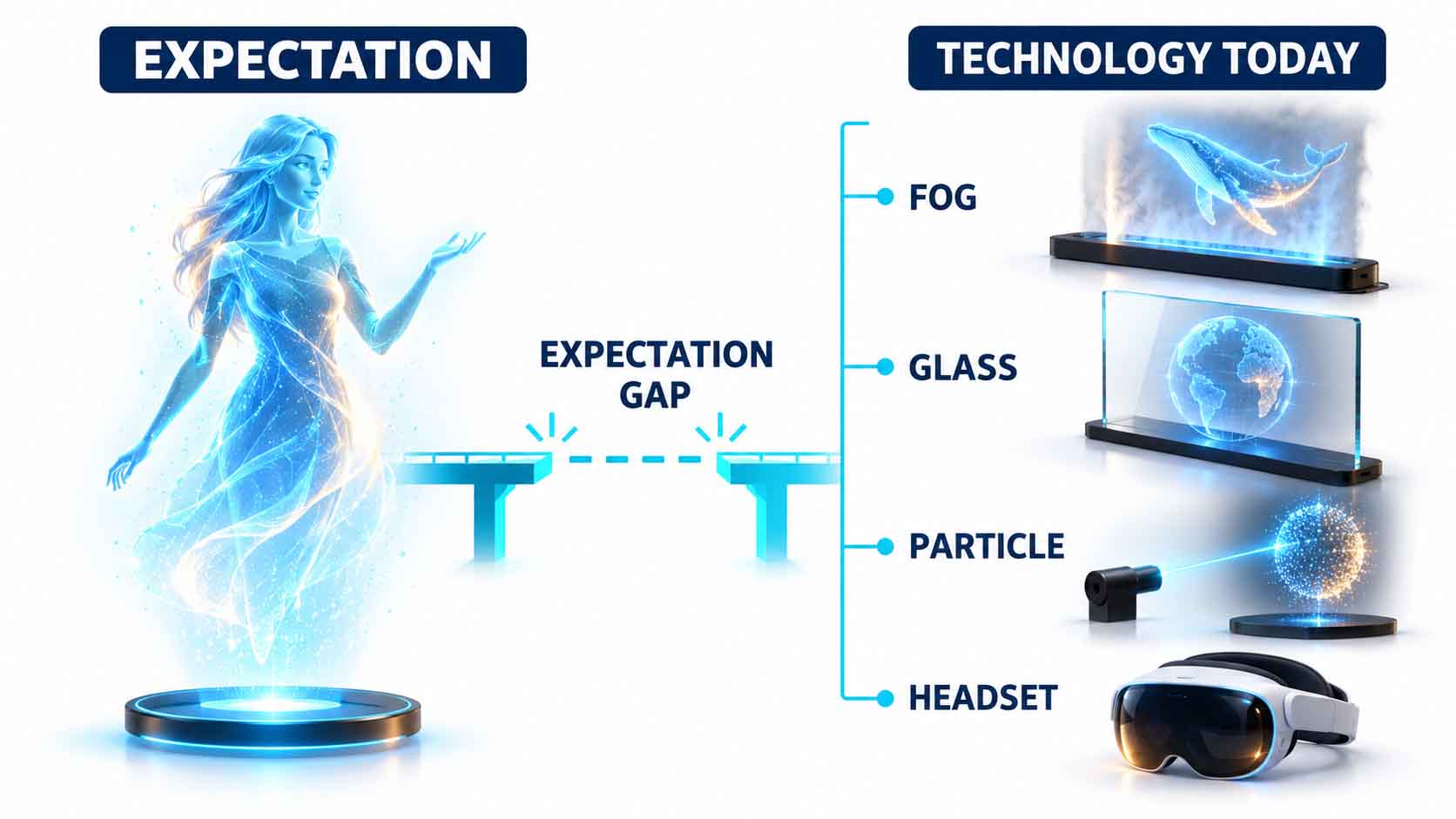
The everyday term hologram and the technology behind it rarely mean the same thing.
Infographic: What is called a hologram is almost always an image on a carrier, and the carrier determines the result | Graphic: © Ulrich Buckenlei | XR Stager Online Magazine | VISORIC GmbH
For companies, this gap is a double challenge. On the one hand, very different products are offered under the name hologram, from fog screens and reflective glass setups to rotating LED strips and screens with a depth effect. They differ considerably in price, effort and impact. On the other hand, customers, executives and trade show visitors arrive with an idea that none of these products fully delivers. Anyone who does not clarify the terms risks an investment that works technically and still disappoints.
The good news: the gap can be closed by judging the technology not by its name but by one simple question. What does the light hit? The next chapter shows why this question is unavoidable.
- A hologram in the physical sense is a recording on a carrier.
- Dennis Gabor received the Nobel Prize in Physics for it in 1971.
- The expectation of floating images comes from science fiction.
- Very different products are sold under the name hologram.
- Unclear terms lead to disappointed expectations.
The expectation is real, and it is a business factor. Those who know it can serve it deliberately instead of failing because of it.
The Physics Question. Why Light Stays Invisible Without a Medium
A beam of light traveling through perfectly clean air cannot be seen from the side. It only becomes visible when dust, smoke or water droplets deflect part of the light toward the eyes. Experts call this process scattering. The phenomenon is familiar from sunbeams that only appear as bright shafts in the haze of a forest or the dust of an attic. For any kind of image in space, this leads to a clear condition: at the point where a picture element is to appear, there must be something that directs light toward the viewer.
An obvious idea is to cross two beams of light so that they meet in the air and light up there. This question also came up in the discussion about the video. The answer from physics is clear. Particles of light, called photons, carry no electric charge and pass through each other under everyday conditions without influencing one another. Two beams of light that cross simply continue undisturbed. That light can be scattered by light at all was first shown directly by the ATLAS experiment at the European research center CERN in 2017, and only under extreme conditions in collisions of lead nuclei in the LHC particle accelerator. In more than four billion analyzed events, the researchers found 13 candidates for this process.[3]
How research deals with this condition is shown by a study from Brigham Young University published in the journal Nature in 2018. The team led by Daniel Smalley wanted to create picture elements freely in the air that are visible from all sides. The solution was not to do without a medium but to make it as small as possible. A single microscopic particle is held in the air by a laser beam, moved through space very quickly and illuminated in color. The eye merges the luminous trail into an image.[4] So even the free-floating image of research forms on matter.
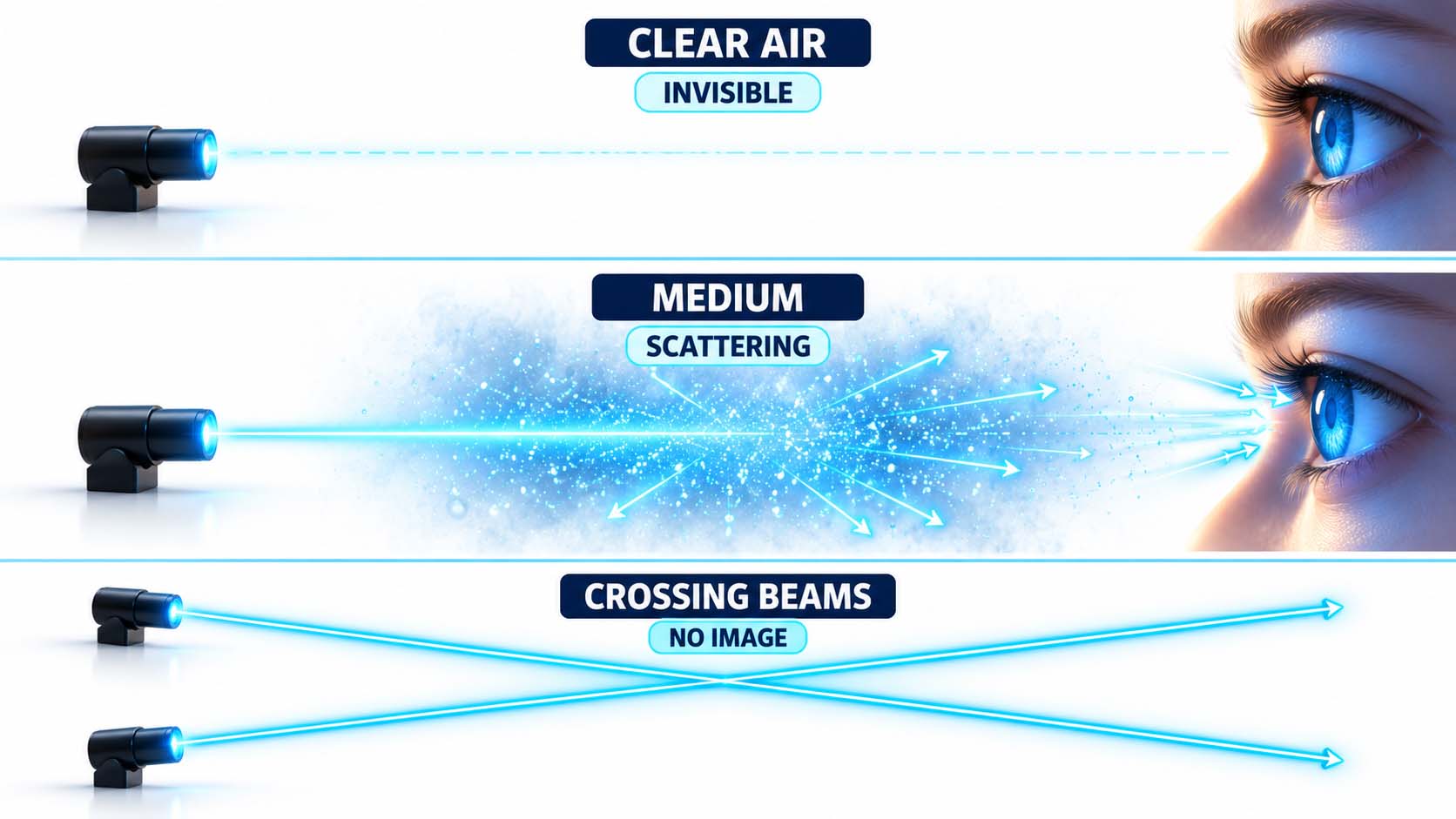
No scattering, no image. The medium is not a weakness of the technology but its prerequisite.
Infographic: Every technology for images in space answers the same question, namely what directs the light toward the viewer | Graphic: © Ulrich Buckenlei | XR Stager Online Magazine | VISORIC GmbH
For companies, this insight has very practical value. It turns a confusing market into a manageable map. Every offer can be classified with a single follow-up question: what is the medium in this system? The further questions follow almost automatically from the answer. A medium made of fog reacts to air movement. A medium made of glass needs a fixed setup and a specific viewing angle. A medium in front of the eye requires every viewer to wear a device. Anyone who asks this way recognizes promises that physics cannot keep before a budget is committed.
The medium with the longest track record for walk-through images in space is also the most inconspicuous: fine fog. The next chapter shows what it can do and where it reaches its limits.
- Light only becomes visible through scattering on matter.
- Two beams of light do not create an image in the air.
- Light scattering off light was first shown directly at CERN in 2017.
- Lab methods for free picture elements also use a particle as the medium.
- The question of the medium classifies every offer on the market.
The physics question is thus answered. An image in space always needs a carrier. The only open question is which one.
The Fog Question. What Projection onto Fog, Water and Clouds Can Do
The idea of projecting onto fog is old. It only became usable once it was possible to keep the fog steady. In 2002, the Finnish researchers Ismo Rakkolainen and Karri Palovuori of Tampere University of Technology described a solution that still forms the basis of these devices today. A thin layer of fog is embedded in a uniform, turbulence-free airflow that experts call laminar. The layers of air on both sides protect the fog like two invisible panes. The result is a flat projection surface that people can walk through.[5]
The developers themselves explain why this effort is necessary. Unprotected fog disperses quickly because friction and pressure differences arise between the moving fog layer and the still room air, which triggers turbulence.[5] The stability of the airflow therefore comes before any optimization of brightness or contrast. Once the layer starts to move, the image loses sharpness, and software can compensate for this only to a limited extent. There is also an optical peculiarity. Fog droplets do not scatter light evenly in all directions. In 2017, a team at the University of Sussex presented MistForm, a shape-changing fog surface the size of a 39-inch television that addresses exactly these weaknesses and computationally corrects distortion and uneven brightness.[6]
The same principle is known from water screens in theme parks and light shows, where images are projected onto fine veils of water. The difference lies in scale and in control over the medium. This also explains why projection onto clouds is possible in principle, because cloud droplets scatter light, but hardly works as a display. A cloud is not a flat surface, it moves and constantly changes its density. With distance, the light also spreads over an ever larger area, so brightness drops quickly. The less the medium can be controlled, the less the image can be controlled.
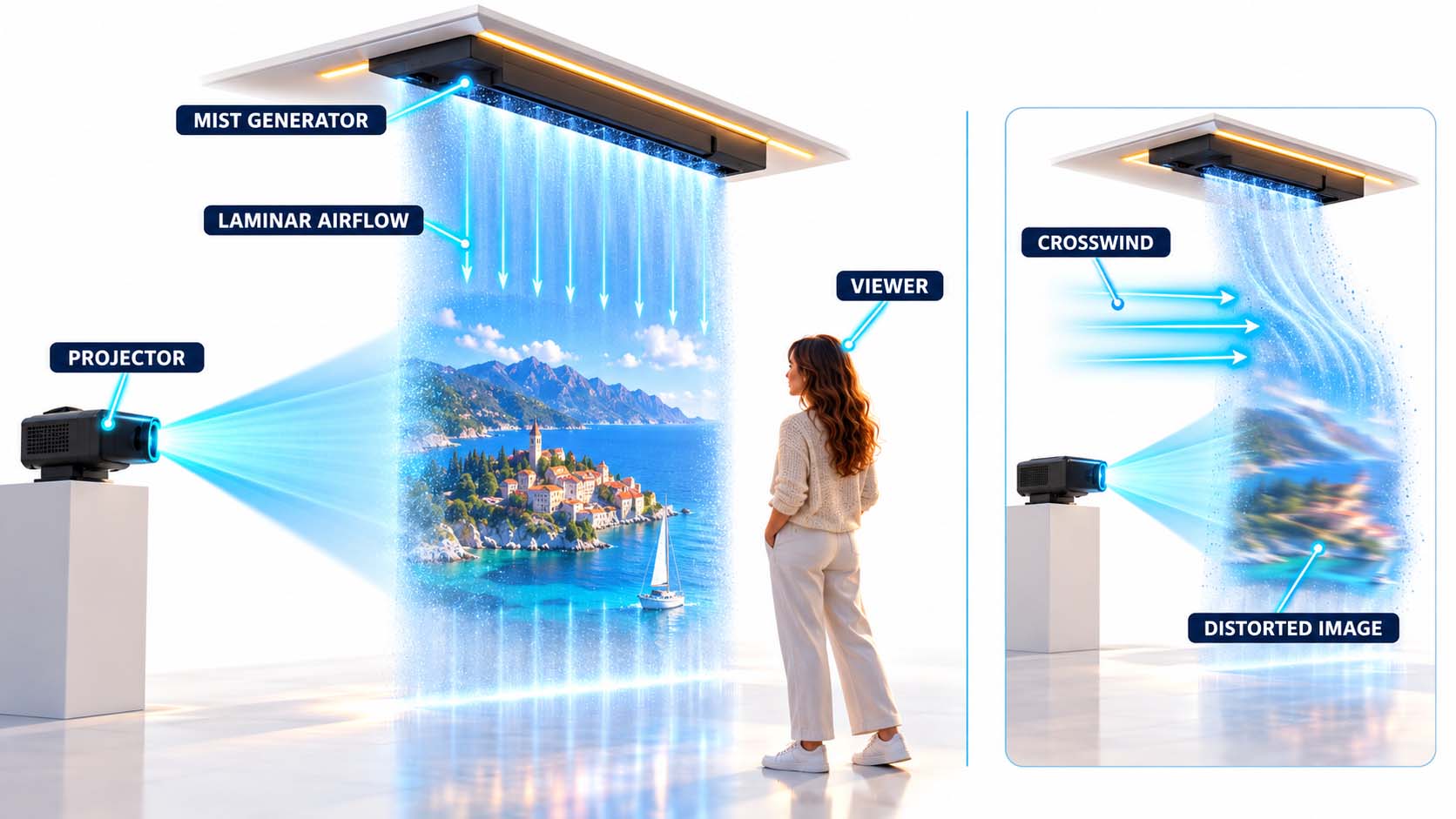
The airflow decides, not the projector.
Infographic: A fog projection is only as good as the stillness of its air layer, which is why the installation site matters more than the light output | Graphic: © Ulrich Buckenlei | XR Stager Online Magazine | VISORIC GmbH
For companies, this results in a clear profile. Fog projection creates a flat image at a real location in space, not a three-dimensional object. Its strength is its impact: the image has no frame, it lets the background show through, and visitors can reach or walk through it. According to their developers, such fog screens are frequently used at trade shows, in theme parks, museums and at concerts, so far mostly as passive projection surfaces.[7] Their weaknesses lie in the environment. Air conditioning, open hall doors, people walking past and bright daylight affect the image directly. Fine print, technical drawings and anything that has to be read precisely are poorly served by fog.
Fog brings an image into space, but not an object with real depth. The next chapter shows how close research has come to the free-floating image that is visible from all sides.
- Fog projection only works with steady, laminar airflow.
- The method was described scientifically in Finland in 2002.
- The result is a flat image in space, not a 3D object.
- Drafts and daylight are the biggest adversaries.
- Clouds scatter light but are not a controllable surface.
The fog question is thus answered. Fog is suited to impact and staging in controlled spaces, not to precise information.
The Lab Question. How Close Research Comes to the Free-Floating Image
An image that is visible from all sides and actually occupies space is what experts call volumetric. Each picture element really sits at its position in space, just like a point on the surface of a real object. The Brigham Young University study mentioned earlier creates such points by holding a single particle with a laser beam, moving it quickly through the air and illuminating it with red, green and blue laser light. Because the eye fuses rapid sequences into one impression, a colored image emerges that stands freely in the air.[4]
In 2019, a team at the University of Sussex took a different approach and also published it in Nature. Here, ultrasound instead of light keeps the particle suspended. Sound waves beyond the range of hearing create a force field that carries a small bead and moves it very quickly. What the system does in addition is remarkable. The researchers describe a display that produces tactile and audible content alongside the visible image. The image can therefore be seen, heard and felt.[8]
A third approach works without any added particle at all. Japanese researchers led by Yoichi Ochiai of the University of Tsukuba focus extremely short laser pulses so tightly on one point that the air itself begins to glow there for an instant. In physical terms, a plasma forms, a state in which air molecules give up electrons. Here the medium is the air itself. The researchers report openly on the scale: the workspace of their system covered up to one cubic centimeter, and the two lasers tested achieved 4,000 and 200,000 dots per second respectively.[9] For comparison, a single frame of a standard Full HD screen consists of around two million pixels. The study also notes that very short pulses are less harmful than longer ones. Safety nevertheless remains a central question with lasers of this intensity.
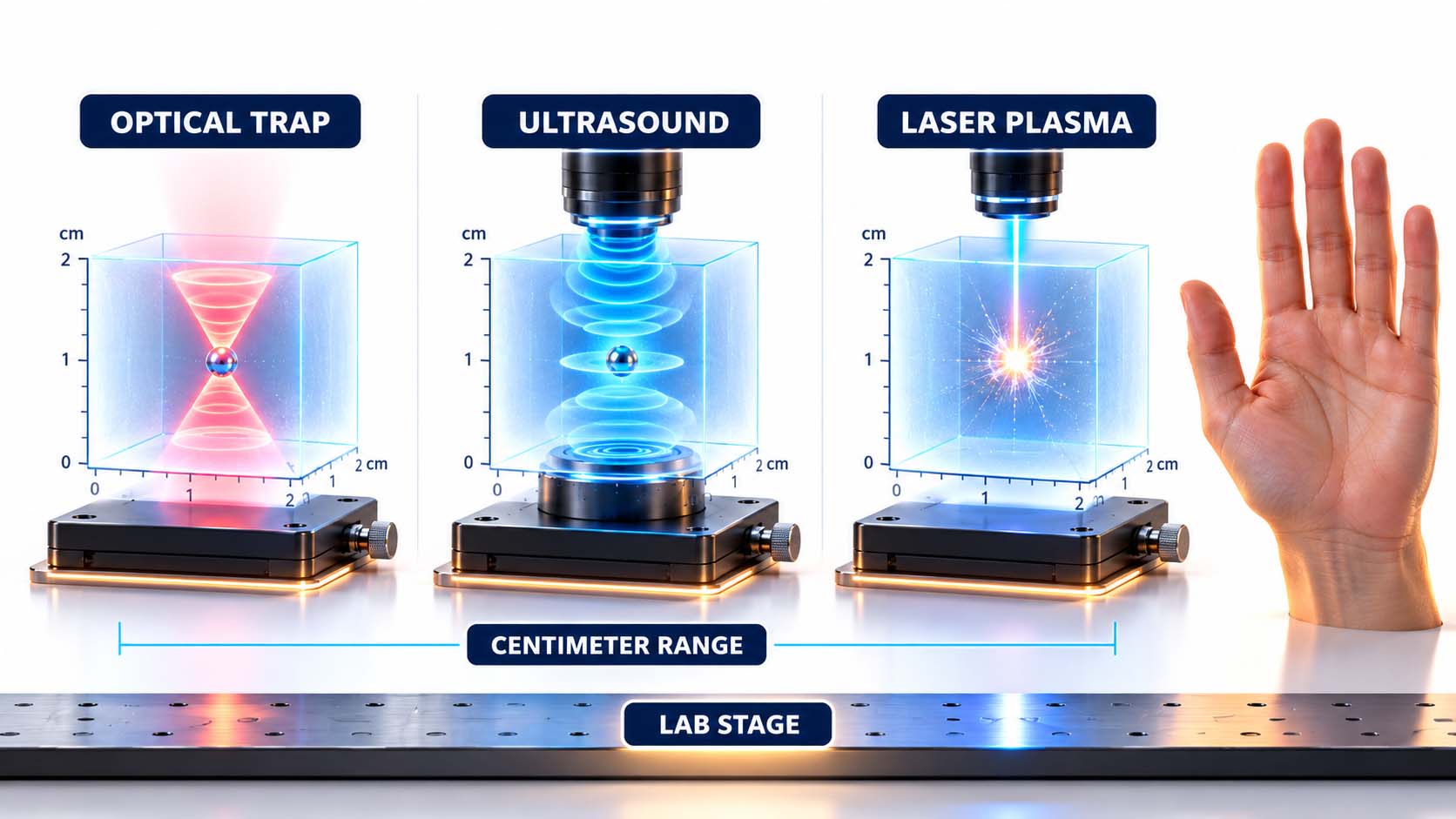
True images in space exist, so far on a scale of a few centimeters.
Infographic: Research proves the feasibility of volumetric images, but the path to size, brightness and safety in everyday use is still long | Graphic: © Ulrich Buckenlei | XR Stager Online Magazine | VISORIC GmbH
For companies, these studies matter for two reasons, even though none of the methods is available today for a trade show booth or a vehicle. First, they show where development is heading and help assess which announcements are realistic. Anyone who knows that the state of research is a few centimeters will meet the offer of a room-filling, free-floating 3D image with the right follow-up questions. Second, they name the four measures against which all progress can be judged: image size, brightness, resolution and safety. As long as these four are not solved together, the free-floating image remains a subject of research.
The decisive question for practice is therefore a different one. If true volumetric images are not yet available, how much spatiality does a viewer actually need in order to experience content as spatial? The answer lies not in optics but in the brain.
- Volumetric images have real picture elements in space.
- Light or ultrasound keeps a particle suspended for this purpose.
- Laser plasma uses the air itself as the medium.
- The workspace is so far in the centimeter range.
- Size, brightness, resolution and safety are the open tasks.
The lab question is thus answered. The free-floating image is physically possible but not yet available for everyday business use.
The Perception Question. When the Brain Reads an Image as Spatial
Spatial vision is not a single ability but the interplay of several cues that the brain continuously compares with one another. Both eyes see an object from slightly different angles. When the head moves, nearby objects shift more than distant ones. Objects in front hide those behind. And the eyes do two things at once: they rotate so that both look at the same point, which experts call vergence, and their lenses focus on the distance of that point, known as accommodation.
What happens when these cues contradict each other was shown by a widely cited study from the University of California, Berkeley. With conventional 3D displays that use two slightly offset images, the eyes align on an object that appears near or far but still have to focus on the fixed screen surface. The researchers led by David Hoffman and Martin Banks demonstrated that this conflict impairs visual performance and causes visual fatigue.[10] An image is therefore convincing not because it supplies as many depth cues as possible but because its cues agree with each other.
This explains the effect of fog projection. Its image is flat, but it is actually located at the place where it appears. The eyes align on this spot and focus on the same spot. The background remains visible and shifts naturally against the image with every head movement. A frame that would identify the image as a screen is missing. The brain receives few but consistent cues and assigns the image to the space. In parallel, research is working on setting true holograms in Gabor’s sense in motion. In 2021, a team at the Massachusetts Institute of Technology showed in Nature that a neural network can compute the required light patterns, previously very computationally expensive, in real time.[11]
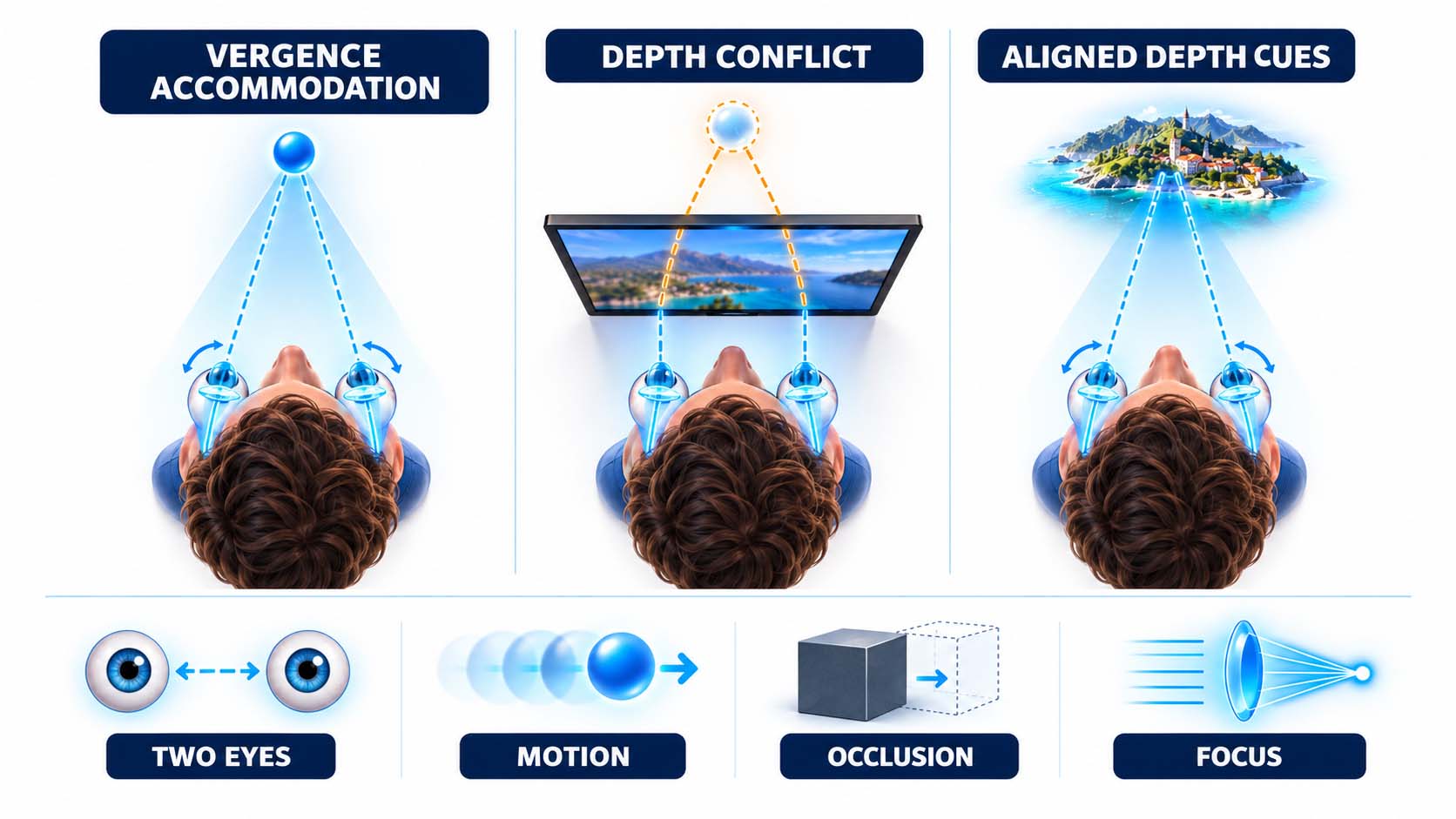
The convincing image is not the one with the most depth cues but the one without contradiction.
Infographic: A flat image at a real location in space can appear more natural than an elaborate 3D display with conflicting signals | Graphic: © Ulrich Buckenlei | XR Stager Online Magazine | VISORIC GmbH
For companies, this shifts the yardstick for evaluation. The question of whether a display is true 3D rarely leads to the right decision. A more helpful question is whether the display helps the viewer understand something faster, find their way or interact more naturally. A machine model that a group of visitors is meant to walk around together places different demands than a cue that is meant to appear at a specific spot in the room. In the first case, real depth and many viewing angles matter. In the second, a flat image in the right place is enough.
Perception has a second side, however. Whatever appears in space attracts the eye, whether it helps there or not. As soon as information lies in the field of view of a person who is performing a task at the same time, the selection of content itself becomes a safety question.
- Spatial vision arises from several cues at once.
- Conflicting cues demonstrably tire the eyes.
- A flat image at a real location delivers consistent signals.
- Neural networks now compute true holograms in real time.
- What counts is the benefit for understanding, not the 3D label.
The perception question is thus answered. What is consistent appears spatial, and what makes a task easier for the viewer is valuable.
The Attention Question. What May Appear in the Field of View
The discussion about information in the field of view is most advanced where mistakes have the gravest consequences: in the vehicle. Euro NCAP, the European assessment program whose stars make the safety of new vehicles comparable, has revised its test protocols for 2026. What is new is a dedicated assessment of the interface between human and vehicle, covering the placement, clarity and ease of use of essential functions. This includes the availability of physical buttons for frequently used functions. At the same time, systems that monitor driver attention are given more weight.[12]
The scientific basis for this has been known for years. In 2014, Joseph Gabbard and his colleagues at Virginia Tech described in the Proceedings of the IEEE which opportunities and which challenges arise when digital content is displayed directly in the driver’s view. The advantage is obvious: the eyes stay on the road. The challenges are less obvious. Displayed content can tie up attention, overlay real objects and has to remain legible in changing light and against changing backgrounds.[13]
How manufacturers respond can be seen in series production. BMW has announced a display for its new vehicle generation that projects information across the entire width of the windshield. The technical detail is revealing. The projection is directed onto a dark-coated area at the lower edge of the windshield in order to achieve higher light intensity and higher contrast.[14] So the rule from chapter two applies here as well. Even in the vehicle, light needs a defined surface. And the location of this surface is chosen deliberately, at the edge of the field of view and not in its center.
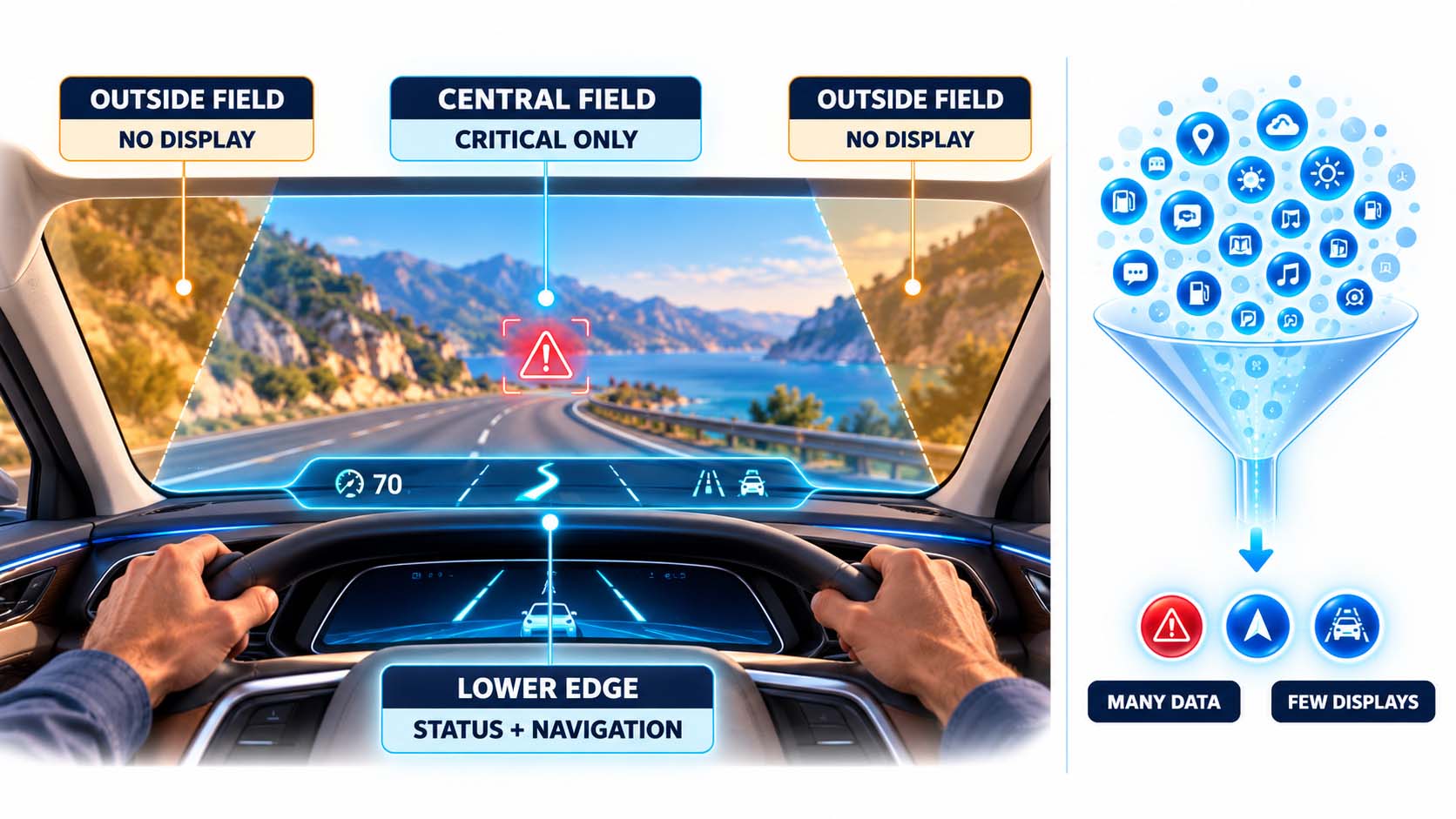
The closer a display is to the line of sight, the stricter the selection has to be.
Infographic: With information in the field of view, selecting the content is part of the technology and not a downstream design question | Graphic: © Ulrich Buckenlei | XR Stager Online Magazine | VISORIC GmbH
For companies outside the automotive industry, this transfers directly. In a control room, at a machine or on an assembly line, people also work under time pressure and with divided attention. Spatial displays can shorten paths there because the information appears where the action is. But they can just as easily distract if everything that is technically available is displayed. In the discussion about the video, this point was put aptly: display technology is only one part of the problem. Once information sits in a driver’s field of attention, deciding what deserves to be seen becomes part of the engineering itself. A spatial display is therefore never just a hardware project. It needs rules for which information appears when, where and for how long.
This marks out the boundaries. Physics demands a medium, perception demands consistency, attention demands selection. Within these boundaries, there are applications in which spatial displays already create value today.
- From 2026, Euro NCAP assesses the in-vehicle user interface separately.
- Displays in the field of view keep the eyes on the road.
- But they can tie up attention and overlay what is real.
- In the vehicle, too, projection is directed onto a defined surface.
- Selecting the content is part of the engineering task.
The attention question is thus answered. Not everything that can be displayed deserves a place in the field of view.
The Application Question. Where Spatial Displays Create Value Today
The economic idea behind spatial displays is older than the current generation of devices. Harvard economist Michael Porter and James Heppelmann, then head of the software company PTC, formulated it in the Harvard Business Review in 2017. Reality is three-dimensional, but the data that companies use to decide and act sits on two-dimensional pages and screens. Between the two lies a gap that people have to bridge in their heads. Every technology that brings information to where it is needed narrows this gap.[15]
The need is most visible at trade shows. AUMA, the Association of the German Trade Fair Industry, surveys 400 exhibiting companies every year. For 2026 and 2027, they plan an average of 5.1 trade show participations, after 5.4 in the previous two-year period. The association reads this as a concentration on slightly fewer but strategically more important shows and notes that many exhibitors are investing more in the quality of their appearances.[16] When fewer appearances have to achieve more, the value of every minute a visitor spends at the booth rises.
This is exactly where the methods described have their place, though each at a different point. A fog projection at the entrance of a booth creates attention and a moment that visitors talk about afterward. A screen with real depth, known as a light field display, which shows several viewers different viewing angles without glasses, explains the inner workings of a machine that would be too large or too heavy to transport to the show. A headset guides a single person through a complete plant at full scale. And a large-format display with an interactive 3D model often remains the most economical solution for conversations in a group.
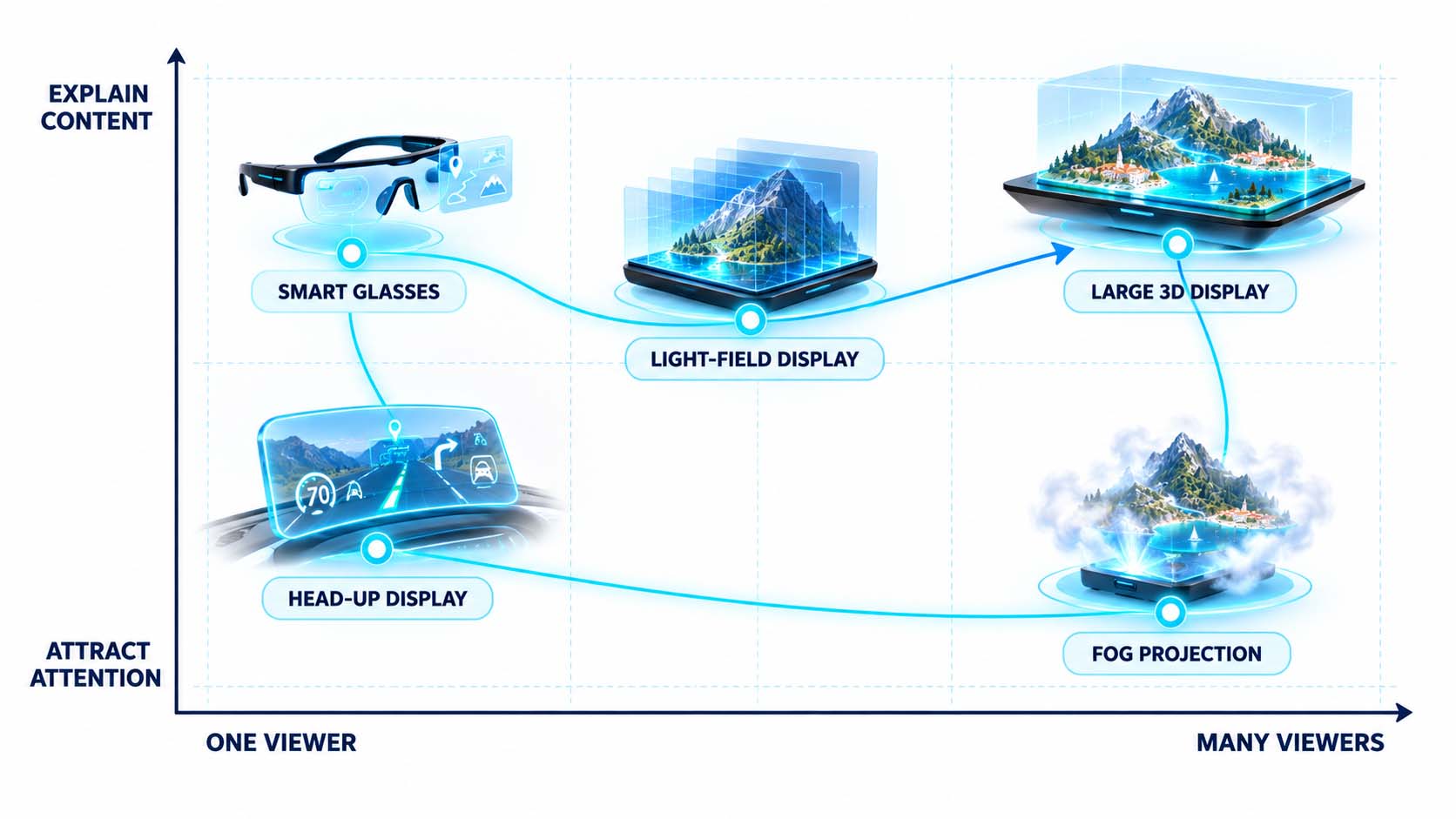
Every method has its place, none replaces the others.
Infographic: The number of viewers and the goal of the display determine which spatial display pays off at which point | Graphic: © Ulrich Buckenlei | XR Stager Online Magazine | VISORIC GmbH
For companies, this means viewing spatial displays not as individual purchases but as building blocks of a sequence. At a trade show, this sequence is the path from the first glance from the aisle to the expert conversation. In the showroom, it is the path from impression to configuration. In training, it is the step from understanding to practicing. A second lesson belongs here: the effort is rarely in the device. It is in the content, meaning the prepared 3D model of the company’s own product. Once this model exists, it can be shown on different displays. Those who invest first in the content and only then in the hardware stay flexible as display technology evolves.
The question remains how this variety becomes a concrete decision without a company having to try out every method itself. That is the subject of the final chapter.
- Data is flat, reality is spatial.
- Exhibitors plan slightly fewer shows and invest in quality.
- Fog attracts attention, light field displays explain.
- Headsets show entire plants at full scale.
- The real value lies in the prepared 3D content.
The application question is thus answered. Value is created where the display fits the goal, the space and the number of viewers.
First the Purpose, Then the Display Technology
The major analyst firms also see the connection between digital information and real space as a strategic topic. Gartner counts spatial computing, meaning technology that anchors digital content in the real environment, among the top strategic technology trends for 2025. The firm expects this market to grow from 110 billion US dollars in 2023 to 1.7 trillion US dollars in 2033, and that by 2028 one in five people will use a spatial, location-based application once a week, up from less than one percent in 2023.[17]
Deloitte covers the topic in its technology report Tech Trends 2025 under the heading that spatial computing takes center stage. The reasoning is sober. Companies are interested because information silos can be broken down and employees and customers alike can interact with information in more natural ways.[18] Neither analysis recommends a particular device. Both describe a purpose.
This results in a sequence of four steps. First, the purpose is clarified: should the display attract attention, explain something, prepare a decision or guide an action? Then the space is described, meaning ambient light, air movement, distance and number of viewers. In the third step, the content is examined: does it need real depth and many viewing angles, or is an image in the right place enough? Only in the fourth step does the choice of technology follow. The overview below the graphic summarizes the methods described in this article.
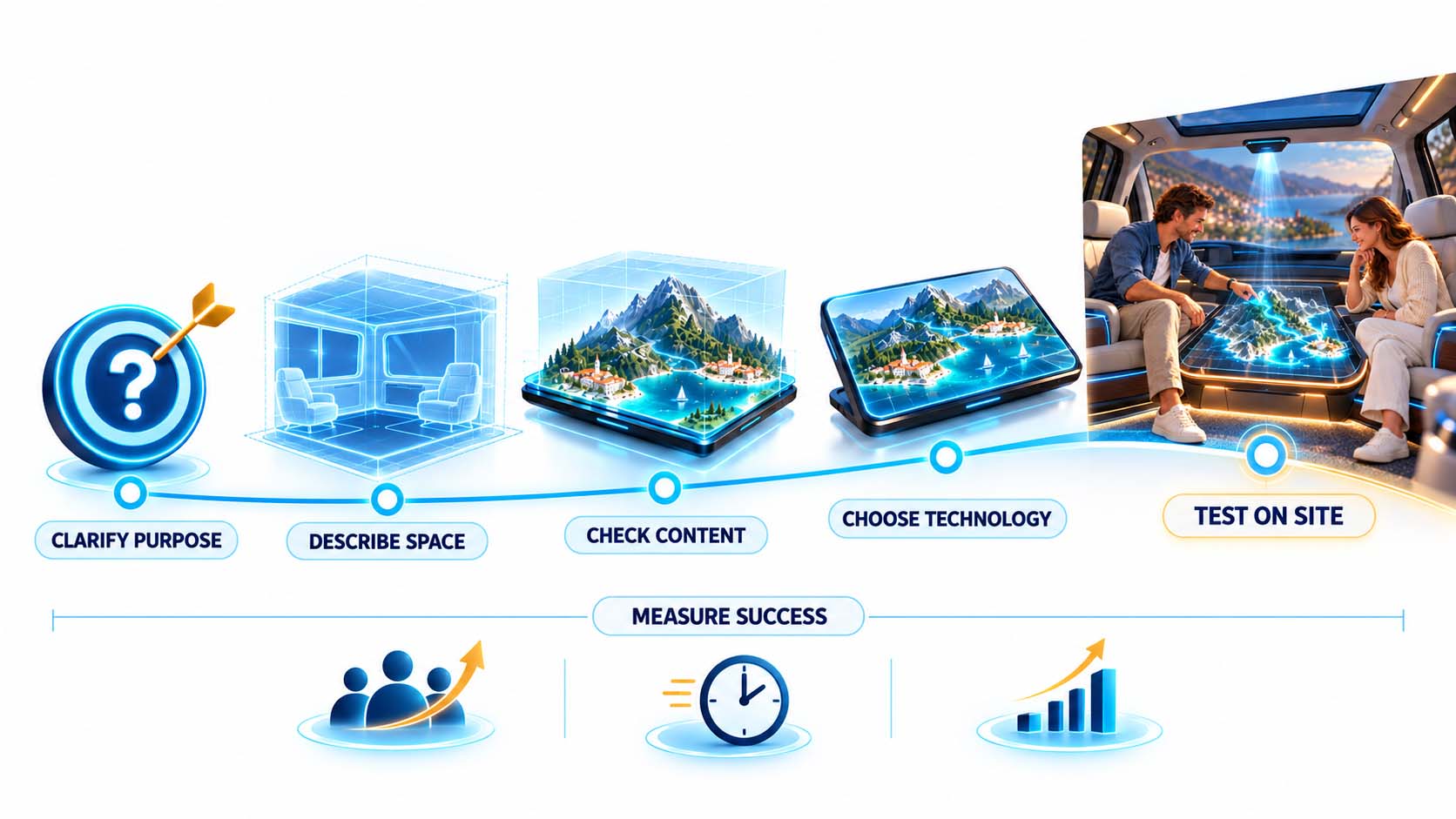
The purpose determines space, content and technology.
Infographic: A display decision that starts with the purpose protects against devices that impress and still explain nothing | Graphic: © Ulrich Buckenlei | XR Stager Online Magazine | VISORIC GmbH
| Method | What the light hits | Maturity | Main limitation |
|---|---|---|---|
| Projection onto fog | Fine droplets in laminar airflow | Available, in use at events | Drafts, daylight, low detail sharpness |
| Reflective glass or film optics | Angled, semi-transparent surface | Available, established on stages and in display cases | Fixed setup, limited viewing angle |
| Light field display | Screen with optics mounted in front | Available, depth effect without glasses | Limited image size and viewing angle |
| Headset | Display directly in front of the eye | Available, in industrial use | Every viewer needs a device |
| Head-up display | Windshield or coated windshield area | Series production in vehicles | Small area, strict selection of content |
| Floating particle, held by light or ultrasound | A single, rapidly moving particle | Lab | Image size in the centimeter range |
| Laser plasma | The air itself | Lab | Workspace up to one cubic centimeter, laser safety |
Overview: Spatial display methods compared, ordered by availability, classified on the basis of the cited sources and own analysis | Table: © Ulrich Buckenlei | XR Stager Online Magazine | VISORIC GmbH
For companies, this sequence is the most effective protection against misguided investments. Two recommendations complement it. First, every selection should be tested in a small trial at the actual place of use, because hall lighting, air conditioning and visitor flows cannot be read from a data sheet. Second, it pays to define in advance how success will be measured: by dwell time at the booth, by the number of qualified conversations, by the time it takes to understand a product or by the error rate in a training session.
What the method that triggered this discussion looks like, and what can be learned from it, is shown in the following video.
- Gartner expects a market of 1.7 trillion US dollars by 2033.
- Deloitte sees spatial computing at the center of interaction.
- The decision follows four steps: purpose, space, content, technology.
- A trial at the actual place of use replaces any data sheet.
- Success criteria are defined before the investment.
In the end, success is decided not by the most impressive device but by clarity about what people in this space should see and understand.
The Floating Image in the Fog on Video
The starting point of this article was a video that appeared on LinkedIn in October 2026 as part of Ulrich Buckenlei’s daily analyses. It shows a glowing image that appears to stand freely in the air.
The technology behind it is the projection onto fog described in chapter three. A thin layer of fine droplets is embedded in a steady airflow and serves the projector as a surface. The image is flat, but it is actually located at the spot in space where it appears. That is exactly where its effect lies. It has no frame, the background remains visible, and a hand can reach through it.
The discussion the video triggered was remarkable. The experts among the readers hardly asked about the effect itself. They asked about the principle: about other carriers for such images, about the possibility of crossing beams of light in the air, about projection onto clouds and about the responsibility for content in a driver’s field of view.[19] These questions form the outline of this article.
Video: Projection onto a laminar fog layer whose image appears to stand freely in space | Visuals by original creators | Analysis, voiceover script, editorial work and video editing: © Ulrich Buckenlei | XR Stager Online Magazine | VISORIC GmbH
It is remarkable how little of what is shown is a vision of the future. The method has been scientifically described for more than two decades and is used in the event sector. What is new is not the technology but the attention that spatial displays are receiving through headsets, vehicle displays and artificial intelligence.
For context, it is equally important to note: the video shows neither a hologram in the physical sense nor a three-dimensional object. Image quality depends heavily on air movement and ambient light, and the method is not suitable for content that has to be read precisely.
- The video shows a projection onto a layer of fog.
- The image is flat but stands at a real location in space.
- The absence of a frame and the see-through effect create the floating impression.
- The readers’ questions were about the principle, not the effect.
- Air movement and ambient light limit the quality.
The video makes visible what the chapters describe: an image in space is only ever as good as the medium its light hits.
You Bring the Purpose, We Bring the Technology Selection
A good display decision arises from two kinds of knowledge. The company knows its product, its customers and the space in which something is to be shown. Selection and implementation require an overview of the available methods, experience in preparing 3D data and a realistic judgment of what a technology delivers in everyday use. This combination is at the core of the work of VISORIC GmbH.
For more than 15 years, the Munich-based expert team has been developing applications in 3D, AI and XR for companies ranging from mid-sized businesses to DAX-listed corporations. Part of this work is technology and product scouting. At international technology events, VISORIC observes which display and interaction technologies are ready for the market and which remain announcements. On this basis, the team prepares existing engineering data for spatial display and brings it together in the XR Stager platform, in the browser, on large displays or in XR.
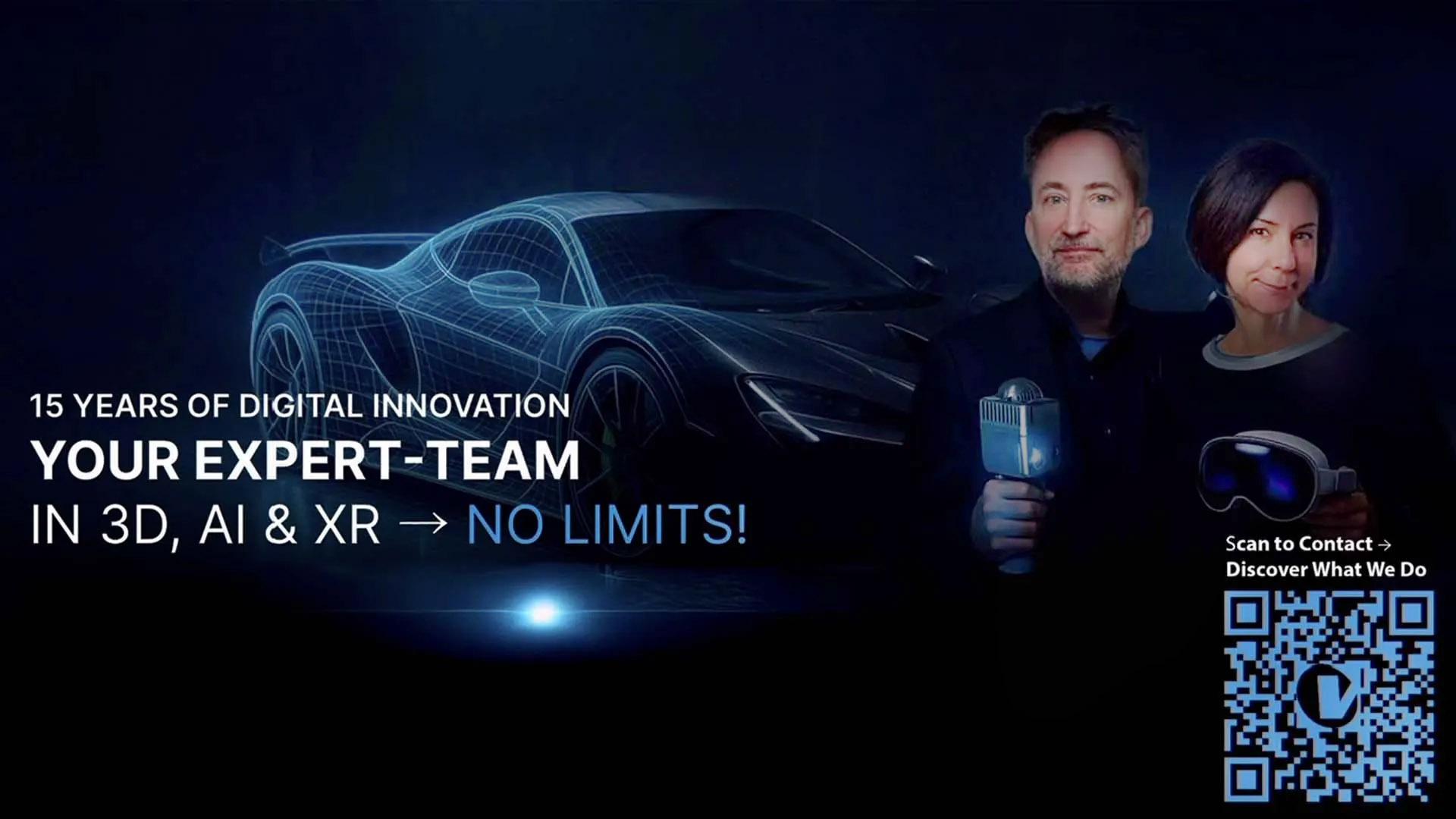
Purpose and technology expertise together result in the right display.
Image: The company contributes the goal and the space, the expert team the overview of the methods, and the decision is tested on a prototype | © Ulrich Buckenlei | XR Stager Online Magazine | VISORIC GmbH
Getting started begins with a conversation about the purpose. Together, we clarify what people in your space should see and understand, which methods are suitable for this and what a first prototype could look like that can be tested under real conditions.
- Classification of the available display methods for your purpose.
- Preparation of existing 3D and CAD data for spatial display.
- Prototype and testing at the actual place of use before the investment.
Precisely because such different things are offered under the name hologram, now is a good time to put the decision on a factual basis.
What should people in your space see and understand?
Talk to the VISORIC expert team in Munich. Together, we clarify your purpose, compare the suitable methods and develop a first prototype that shows what spatial display can achieve for your product.
Contact:
Email: info@visoric.com
Phone: +49 89 21552678
Sources and References
- The Nobel Prize in Physics 1971, Dennis Gabor, for his invention and development of the holographic method. Nobel Prize Outreach. nobelprize.org.
- Shedroff, N., Noessel, C. Make It So. Interaction Design Lessons from Science Fiction. Rosenfeld Media, 2012.
- ATLAS Collaboration. Evidence for light-by-light scattering in heavy-ion collisions with the ATLAS detector at the LHC. Nature Physics 13, 852-858, 2017. doi.org/10.1038/nphys4208.
- Smalley, D. E. et al. A photophoretic-trap volumetric display. Nature 553, 486-490, 2018. doi.org/10.1038/nature25176.
- Rakkolainen, I., Palovuori, K. Walk-thru screen. Proceedings of SPIE 4657, Projection Displays VIII, 2002. doi.org/10.1117/12.463792.
- Tokuda, Y., Norasikin, M. A., Subramanian, S., Martinez Plasencia, D. MistForm. Adaptive Shape Changing Fog Screens. Proceedings of the 2017 CHI Conference on Human Factors in Computing Systems, ACM, 2017. doi.org/10.1145/3025453.3025608.
- Palovuori, K., Rakkolainen, I. Improved Interaction for Mid-Air Projection Screen Technology. IGI Global, 2015. doi.org/10.4018/978-1-4666-7377-9.ch006.
- Hirayama, R., Martinez Plasencia, D., Masuda, N., Subramanian, S. A volumetric display for visual, tactile and audio presentation using acoustic trapping. Nature 575, 320-323, 2019. doi.org/10.1038/s41586-019-1739-5.
- Ochiai, Y., Kumagai, K., Hoshi, T., Rekimoto, J., Hasegawa, S., Hayasaki, Y. Fairy Lights in Femtoseconds. Aerial and Volumetric Graphics Rendered by Focused Femtosecond Laser Combined with Computational Holographic Fields. ACM Transactions on Graphics 35(2), 2016. doi.org/10.1145/2850414.
- Hoffman, D. M., Girshick, A. R., Akeley, K., Banks, M. S. Vergence-accommodation conflicts hinder visual performance and cause visual fatigue. Journal of Vision 8(3), 33, 2008. doi.org/10.1167/8.3.33.
- Shi, L., Li, B., Kim, C., Kellnhofer, P., Matusik, W. Towards real-time photorealistic 3D holography with deep neural networks. Nature 591, 234-239, 2021. doi.org/10.1038/s41586-020-03152-0.
- Euro NCAP. Euro NCAP announces 2026 protocol changes to tackle modern driving risks. Press release, 2025. euroncap.com.
- Gabbard, J. L., Fitch, G. M., Kim, H. Behind the Glass. Driver Challenges and Opportunities for AR Automotive Applications. Proceedings of the IEEE 102(2), 124-136, 2014. doi.org/10.1109/JPROC.2013.2294642.
- BMW Group. The BMW Panoramic Vision. New head-up display across the entire width of the windscreen will be in series production in 2025. BMW Group PressClub, 2023. press.bmwgroup.com.
- Porter, M. E., Heppelmann, J. E. Why Every Organization Needs an Augmented Reality Strategy. Harvard Business Review 95(6), 46-58, November/December 2017. hbr.org.
- AUMA, Association of the German Trade Fair Industry. AUMA-Aussteller-Ausblick 2026/2027. Messebeteiligungen zwischen Wirkung und Wirtschaftlichkeit. Survey of 400 exhibiting companies. auma.de.
- Gartner. Top Strategic Technology Trends for 2025, Spatial Computing. Trend report and press release, October 21, 2024. gartner.com.
- Deloitte Insights. Tech Trends 2025, chapter Spatial computing takes center stage. Deloitte, 2024. deloitte.com.
- Buckenlei, U. LinkedIn post on projection onto fog with subsequent expert discussion, October 2026. lnkd.in/p/dmgii8eX.
- VISORIC practical projects in the fields of digital twins, real-time 3D and spatial computing.
- XR Stager platform for real-time 3D, digital twins and industrial spatial computing applications.
Contact Persons:
Ulrich Buckenlei (Creative Director)
Mobile: +49 152 53532871
Email: ulrich.buckenlei@visoric.com
Nataliya Daniltseva (Project Manager)
Mobile: +49 176 72805705
Email: nataliya.daniltseva@visoric.com
Address:
VISORIC GmbH
Bayerstraße 13
D-80335 Munich