

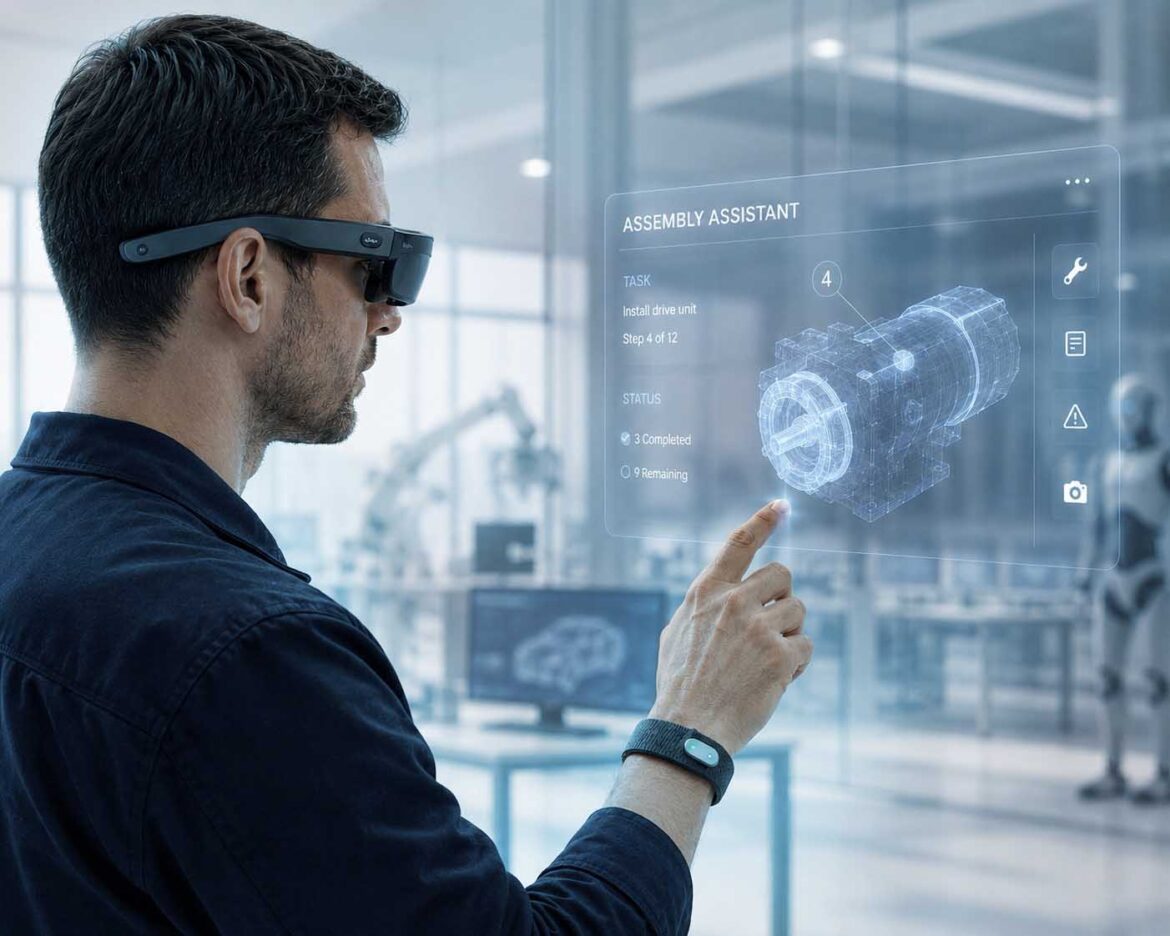
An engineer monitors and controls autonomous machines using intelligent smart glasses. Spatial Computing connects Physical AI, Digital Twins, and Artificial Intelligence directly to the real working environment, creating a new form of human-machine interaction.
Visualization: Intelligent smart glasses bring information, Digital Twins, and AI assistants directly into the user’s field of view. Instead of operating machines exclusively through monitors, spatial user interfaces for Physical AI are emerging across modern industrial environments | Image: © Ulrich Buckenlei | XR Stager Online Magazine | VISORIC GmbH
For decades, people have operated machines through computer screens, keyboards, touch panels, or mobile devices. However, the rise of autonomous systems is fundamentally changing this approach. Robots, AI agents, and Digital Twins are increasingly making independent decisions, analyzing their surroundings in real time, and assisting employees with complex tasks. This raises an important question: How will people interact with an artificial intelligence that can understand and interpret its environment on its own?
This is where one of the most exciting developments in industrial digitalization is currently taking shape. Intelligent smart glasses are evolving from simple display devices into spatial user interfaces for Physical AI. Information no longer appears on a distant monitor but exactly where work takes place—directly at the machine, the robot, or the workpiece. Workers keep their eyes on the real world while digital information is seamlessly integrated into their field of view.
This transformation is made possible through the combination of several key technologies. Sensors continuously capture the surrounding environment, Digital Twins create virtual representations of machines and production systems, and Artificial Intelligence analyzes massive amounts of data within seconds. Spatial Computing then precisely anchors this information in the physical workspace. Individual data points become spatially meaningful insights that people can immediately understand.
As a result, not only the presentation of information changes, but also the entire collaboration between people and machines. Instead of reacting to warning messages or dashboards, employees receive contextual guidance exactly when and where it is needed. Maintenance instructions, safety information, quality data, and navigation cues appear directly within their field of view, supporting decisions at the very place where they are made.
Leading industrial companies are already investing heavily in this transformation. Siemens has been developing Industrial AI, Digital Twins, and immersive engineering solutions for years. BMW, Audi, Mercedes-Benz, Porsche, and Bosch are also evaluating Augmented Reality and Mixed Reality for engineering, manufacturing, and service applications. Although companies rarely discuss concrete rollout strategies publicly, many indicators suggest that intelligent smart glasses could become a standard component of future industrial workplaces.
The focus is no longer limited to visualizing information. In the future, employees may supervise autonomous robots, operate production systems, analyze Digital Twins, or collaborate with AI assistants—all without looking away from their primary tasks. The user interface is gradually disappearing into the surrounding space and becoming part of the real working environment.
For businesses, this evolution opens entirely new opportunities. Decisions can be made faster, errors identified earlier, and workflows optimized more efficiently. At the same time, more intuitive interaction concepts make complex technologies significantly easier to use. Traditional industrial workplaces are evolving into intelligent work environments where people and Artificial Intelligence collaborate continuously.
- Intelligent smart glasses are evolving into the primary user interface for Physical AI.
- Spatial Computing connects Digital Twins, AI, and real working environments in real time.
- Employees receive information exactly where decisions are made.
- Industrial companies are increasingly investing in Industrial AI, Mixed Reality, and spatial assistance systems.
- The future of industrial work is no longer on the screen—it is directly within the user’s field of view.
In this article, we explain why intelligent smart glasses could become one of the key technologies of the next industrial revolution. We explore how Physical AI, Digital Twins, Spatial Computing, and Artificial Intelligence work together, examine the role of companies such as Siemens, BMW, and Audi, and show why spatial user interfaces have the potential to fundamentally reshape collaboration between people and machines.
Why the Screen Is No Longer Enough
For decades, computer monitors, operator panels, and later tablets served as the primary interface between people and machines. Production data, maintenance information, sensor readings, and technical documentation were displayed on screens before being translated into actions in the real working environment. As industrial processes became increasingly digitalized, this model proved highly effective. However, the emergence of Artificial Intelligence has fundamentally changed both the quantity and complexity of available information.[3]
Modern production facilities continuously generate data. Digital Twins provide real-time representations of machine conditions, sensors capture environmental changes instantly, and AI systems analyze thousands of relationships simultaneously. The resulting information density has reached a level where traditional displays are becoming increasingly difficult to manage. Employees constantly shift their attention between monitors, machines, and their physical surroundings. This is exactly where delays, misunderstandings, and avoidable errors begin to occur.[4]
The following infographic illustrates this transition. While information has traditionally been displayed on external monitors, intelligent smart glasses are rapidly evolving into spatial user interfaces. Relevant information appears directly on machines, workpieces, or robots. As a result, information is not only processed more quickly but is also immediately connected to its physical context.
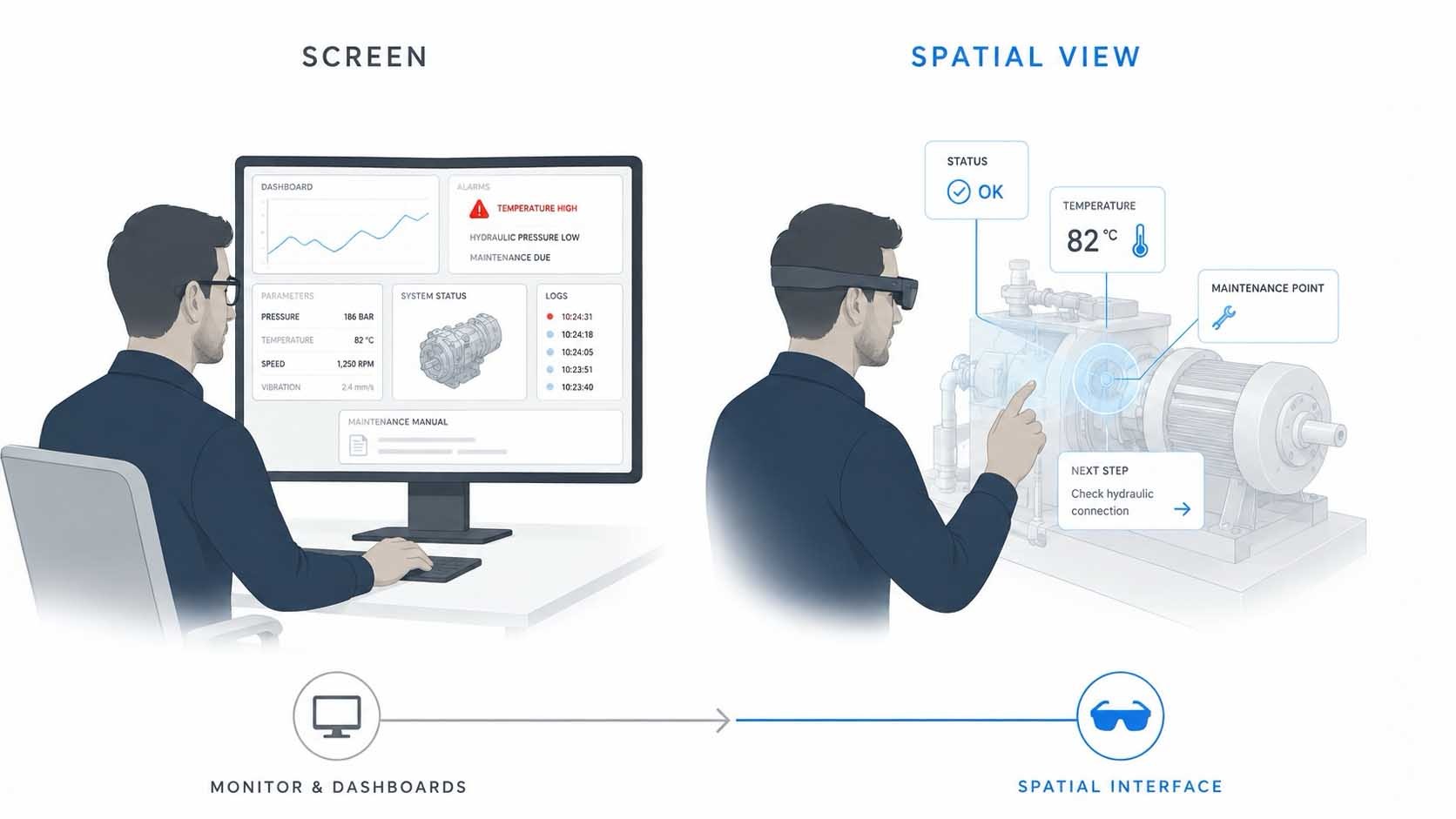
The infographic illustrates the transition from traditional screen-based workplaces to spatial user interfaces, where information appears directly within the user’s field of view.
Infographic: The evolution from monitors and dashboards to intelligent spatial interfaces powered by smart glasses | Graphic: © Ulrich Buckenlei | XR Stager Online Magazine | VISORIC GmbH
The key difference is not that less information will be available in the future. Quite the opposite. Artificial Intelligence continuously generates more analyses, warnings, and recommendations. The real challenge is delivering this information exactly where it is needed. Intelligent smart glasses integrate digital content directly into the physical workspace, creating a far more intuitive form of human-machine interaction.
For companies, this opens entirely new possibilities. Maintenance procedures become easier to understand, service operations become more efficient, and complex production processes become significantly easier to manage. Information leaves the screen and becomes part of the real working environment. This transformation forms the technological foundation for Physical AI, Digital Twins, and the next generation of industrial workplaces.
- Traditional screens are reaching their limits as information density continues to increase.
- Artificial Intelligence generates ever-growing volumes of data, analysis, and recommendations.
- Intelligent smart glasses bring information directly into the user’s field of view.
- Spatial Computing precisely connects digital content with the real working environment.
- The industrial user interface is moving from the screen into physical space.
The next step, however, extends far beyond simply displaying information. Truly intelligent work environments emerge only when machines can understand their surroundings themselves, enabling people, robots, and Artificial Intelligence to collaborate on the same shared spatial foundation of information.
Mixed Reality Becomes the New User Interface
While traditional industrial workplaces have relied on monitors, operator panels, and mobile devices for decades, a new form of human-machine interaction is now emerging. Mixed Reality seamlessly integrates digital information into the real working environment. Instructions, machine status data, and virtual models no longer appear separately on external displays but exactly where employees need them—directly on the machine, the workpiece, or the robot.[5]
This transformation is primarily driven by the growing importance of Artificial Intelligence and autonomous systems. Modern machines generate vast amounts of sensor data, Digital Twins represent their current state in real time, and AI systems identify patterns, detect anomalies, and recommend the next course of action. To make this information truly useful for people, it must be presented in a clear, contextual, and intuitive way. Mixed Reality serves as the spatial user interface that makes this possible.
Intelligent smart glasses recognize where a person is looking, identify the workstation they are operating at, and determine which object is currently relevant. As a result, the displayed information automatically adapts to the current situation. Instead of searching a tablet for the correct machine, part number, or maintenance manual, the required information appears directly on the corresponding physical object.
This approach becomes particularly compelling in modern manufacturing environments. Employees can inspect the status of production equipment, follow assembly procedures, or visualize the movements of a robot without leaving the real work environment. Safety-related information can also be presented spatially. Planned robot trajectories, hazardous areas, and access restrictions become visible before a machine or autonomous system performs an action.[6]
The following infographic illustrates this transition. On the left are traditional screen-based workplaces with monitors, tablets, and isolated dashboards. At the center are intelligent smart glasses and a wearable control band serving as the new human-machine interface. On the right, people, Digital Twins, AI, and robotics collaborate within a shared spatial working environment.
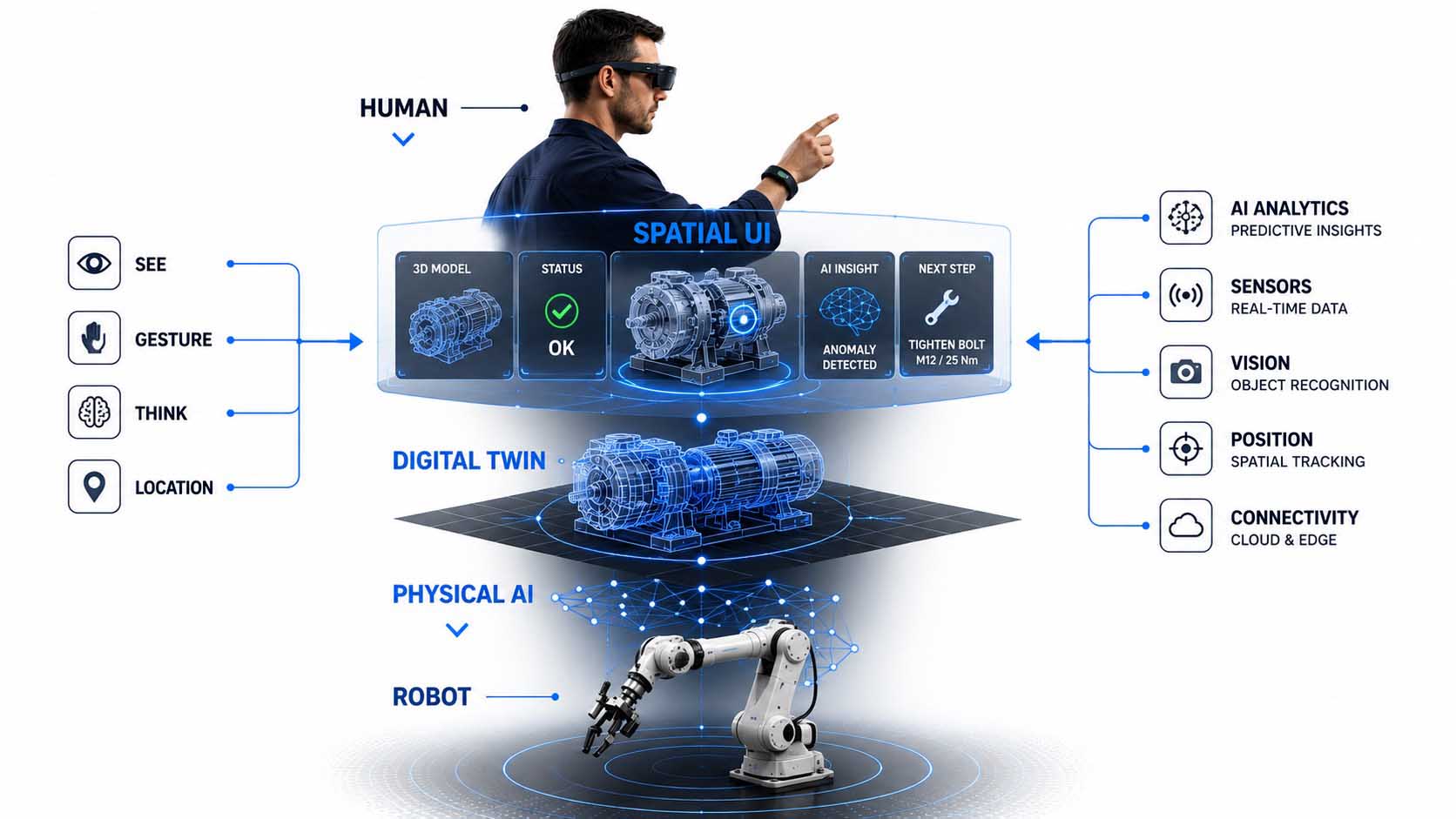
The infographic illustrates the transition from traditional screen-based workplaces to a spatial user interface that enables people to interact directly with Digital Twins, AI systems, and autonomous machines.
Infographic: The evolution from monitors and mobile devices to intelligent smart glasses and wearable controls, leading to a shared spatial working environment for people, Digital Twins, robotics, and Physical AI | Graphic: © Ulrich Buckenlei | XR Stager Online Magazine | VISORIC GmbH
The following infographic summarizes the evolution of industrial user interfaces in a clear process diagram. It illustrates the transition from traditional screen-based workplaces to spatial user interfaces and ultimately to a shared working environment in which people, Artificial Intelligence, and autonomous systems collaborate based on the same information.
At the center of this transformation is not the smart glasses device itself, but its role as the spatial interface between digital information and the physical world. Information is no longer displayed separately on a screen but is directly overlaid onto machines, workpieces, and work areas. This creates an immediate spatial relationship between digital information and physical objects.
SCREENS → SPATIAL UI → SHARED UNDERSTANDING → PHYSICAL AI
The process flow illustrates the technological shift from conventional screen-based workplaces toward a shared spatial working environment. Digital information becomes visible exactly where it is needed. Employees no longer have to mentally transfer information between monitors and machines; instead, they receive it directly within the context of their work.
For industrial applications, this approach offers significant potential. Work instructions can be displayed contextually, machine conditions become easier to understand, and complex processes can be interpreted much faster. Engineering, manufacturing, assembly, maintenance, and quality assurance all benefit from more efficient workflows because digital information is directly connected to the physical environment.
When Machines Understand Their Environment
For Mixed Reality to become a truly intelligent user interface, it is not enough to simply overlay digital information in front of the user’s eyes. The system must understand what exists in the real environment, where individual objects are located, and what role they play in the current task. Only then can smart glasses display relevant information precisely on the correct machine, component, or work area.[7]
People recognize these relationships almost intuitively. A single glance is enough to distinguish an electric motor, a valve, a tool, or a robot. For a machine, however, perception begins with camera images, depth information, LiDAR point clouds, and sensor measurements. Computer Vision processes these inputs to identify shapes, edges, surfaces, and movements within the scene.
The next stage of development is assigning meaning to these visual structures. Instead of merely recognizing a geometric object, the system can identify an electric motor, a pipeline, a safety valve, or a collaborative robot. This combination of spatial perception and semantic interpretation is commonly referred to as Semantic Scene Understanding or Spatial AI.
This becomes even more powerful when combined with modern 3D reconstruction technologies. Gaussian Splatting enables highly photorealistic and spatially accurate reconstructions of real environments. When these reconstructions are enriched with semantic information, they evolve from visual 3D scenes into machine-readable spatial models. Objects can be identified, distinguished from one another, and precisely localized within the reconstructed environment.[8]
The following infographic illustrates this transformation in three distinct stages. On the left is a real industrial workspace. In the center, it is reconstructed as a photorealistic spatial model. On the right, Artificial Intelligence identifies and classifies individual machines, components, people, and work areas. A visible environment is transformed into a semantically understood world model.
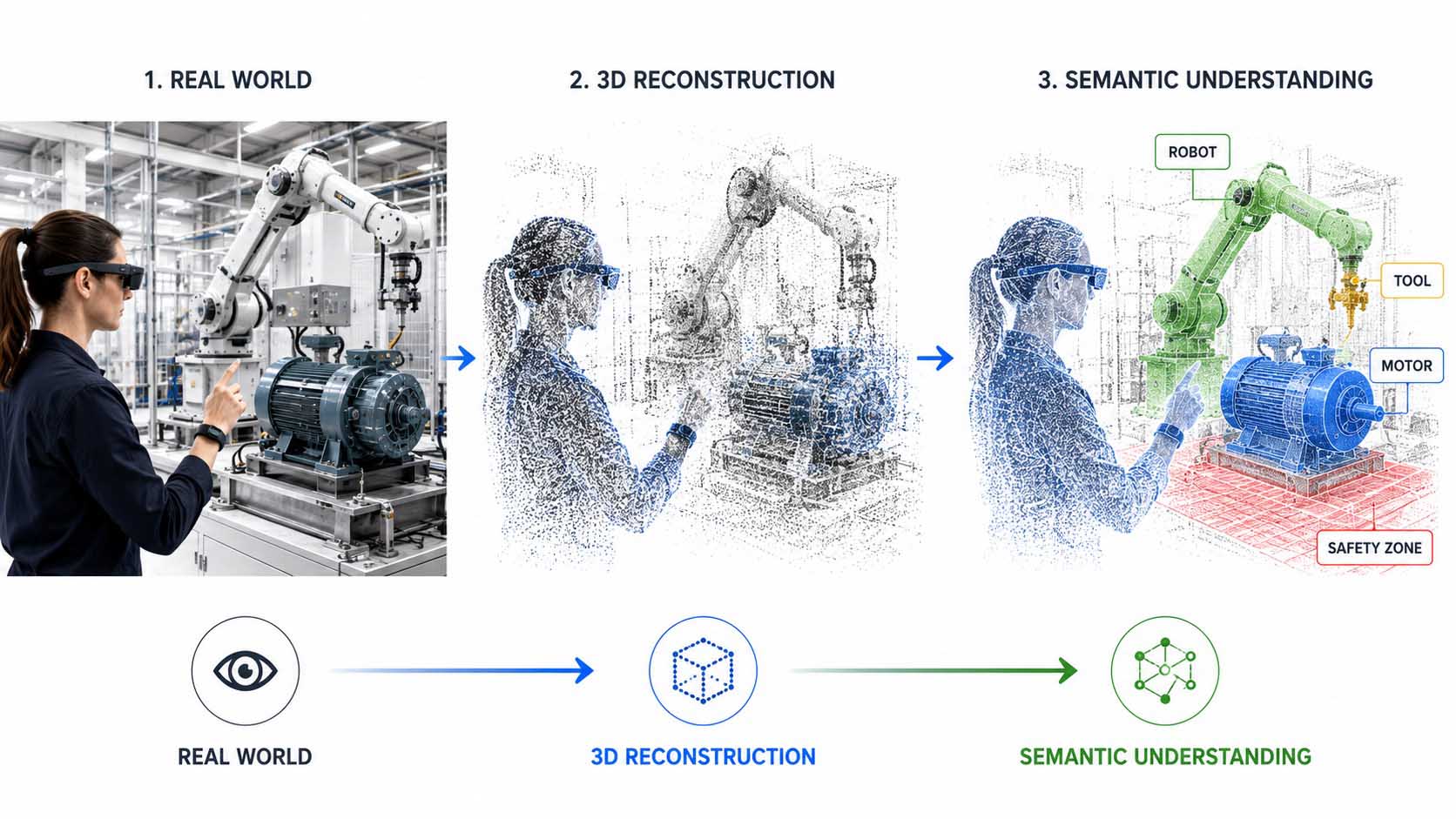
The infographic illustrates how a real industrial environment is first reconstructed spatially and then transformed into a machine-readable world model through Computer Vision and Semantic AI.
Infographic: From the real working environment through photorealistic 3D reconstruction to semantic recognition and spatial classification of machines, components, and work areas | Graphic: © Ulrich Buckenlei | XR Stager Online Magazine | VISORIC GmbH
The following infographic demonstrates how the spatial perception capabilities of Artificial Intelligence evolve—from the real environment to its digital reconstruction and finally to a semantic understanding of industrial workspaces. Only through this progression can intelligent assistance systems, autonomous robots, and Mixed Reality applications reliably interpret complex production environments.
The process begins with the real working environment containing machines, tools, and people. In the next step, modern reality capture technologies and neural reconstruction methods generate a precise three-dimensional representation of the scene. Technologies such as Gaussian Splatting enable highly photorealistic digital replicas of real environments that serve as the foundation for Digital Twins.
REAL WORLD → 3D RECONSTRUCTION → SEMANTIC UNDERSTANDING
The true breakthrough, however, comes from the semantic interpretation of these 3D models. Artificial Intelligence no longer recognizes only geometric shapes or point clouds but identifies machines, tools, safety zones, and other objects within their functional context. As a result, a digital reconstruction evolves into an intelligent spatial world model.
For Spatial Computing and intelligent smart glasses, this level of understanding is essential. Only when the system can uniquely identify and accurately locate an object in three-dimensional space can maintenance instructions, process information, or workflow guidance be displayed at precisely the right position. Digital information therefore appears directly within the working context, supporting employees exactly where it is needed.
Autonomous robotic systems also benefit from semantic 3D world models. They can distinguish between people, machines, tools, and safety zones, plan movements proactively, and continuously adapt their actions to the current situation. People, robots, and Artificial Intelligence all rely on the same spatial information foundation, creating a shared understanding of the operational environment.
For industrial applications, this approach opens a wide range of opportunities. AI systems can automatically highlight relevant machine components, detect changes between different production states, or identify potential risks at an early stage. At the same time, Mixed Reality applications and autonomous systems use the same semantic world models to present information consistently and coordinate complex workflows more efficiently.
The VISORIC expert team in Munich combines these technologies into fully integrated industrial workflows and development processes. Reality Capture, Gaussian Splatting, Computer Vision, Semantic AI, Digital Twins, and Mixed Reality are not viewed as isolated technologies but as interconnected building blocks. Their real value emerges when physical environments are transformed into spatially accurate, semantically understandable, and machine-readable models that can be used equally by people and intelligent systems.
- Computer Vision recognizes shapes, objects, and movement within real industrial environments.
- Semantic AI enriches visual perception with meaning and contextual understanding.
- Gaussian Splatting enables highly photorealistic spatial reconstructions.
- Machines, components, and safety zones can be identified and localized automatically.
- People, smart glasses, and robots can all operate on the same shared spatial information model.
Once machines can not only see their surroundings but also understand them, the Digital Twin takes on an entirely new role. It evolves from a visual 3D model into a shared world model that combines real-world objects, semantic information, sensor data, and Artificial Intelligence into a unified spatial representation.
From Assistance to Collaboration
The first generation of industrial smart glasses was primarily used as digital work instructions. They displayed assembly steps, overlaid maintenance information, or enabled remote expert assistance. Even today, these applications save time and reduce errors. However, the real transformation is only just beginning: Artificial Intelligence and robotics are evolving from tools into active team members within industrial workflows.[11]
Modern Physical AI systems do more than simply observe their surroundings. They continuously analyze situations, recognize relationships, and proactively recommend appropriate actions. At the same time, employees receive the same information directly through their smart glasses. Both humans and intelligent systems therefore operate on the same real-time data, gradually developing a shared understanding of the current situation.
This fundamentally changes the role of people in industrial operations. Instead of performing every individual task themselves, employees increasingly focus on supervision, coordination, and decision-making. Routine activities can be carried out autonomously by robots, while Artificial Intelligence continuously evaluates machine conditions, detects risks, and identifies deviations. People concentrate on complex decisions, quality assurance, and coordinating multiple interconnected systems.
Mixed Reality serves as the key interface between people and machines. Smart glasses do more than display information—they become a shared communication platform. Maintenance instructions appear directly on the affected equipment, robot trajectories become visible, safety zones are highlighted, and recommended actions are spatially overlaid onto the real environment. Information leaves the traditional screen and becomes an integral part of the physical workspace.[12]
The following infographic illustrates the transition from conventional assistance systems to collaborative cooperation between people, Artificial Intelligence, and autonomous robotic systems. While today’s digital tools often support individual tasks, they are increasingly evolving into active partners within shared industrial workflows.
ASSISTANCE → COLLABORATION
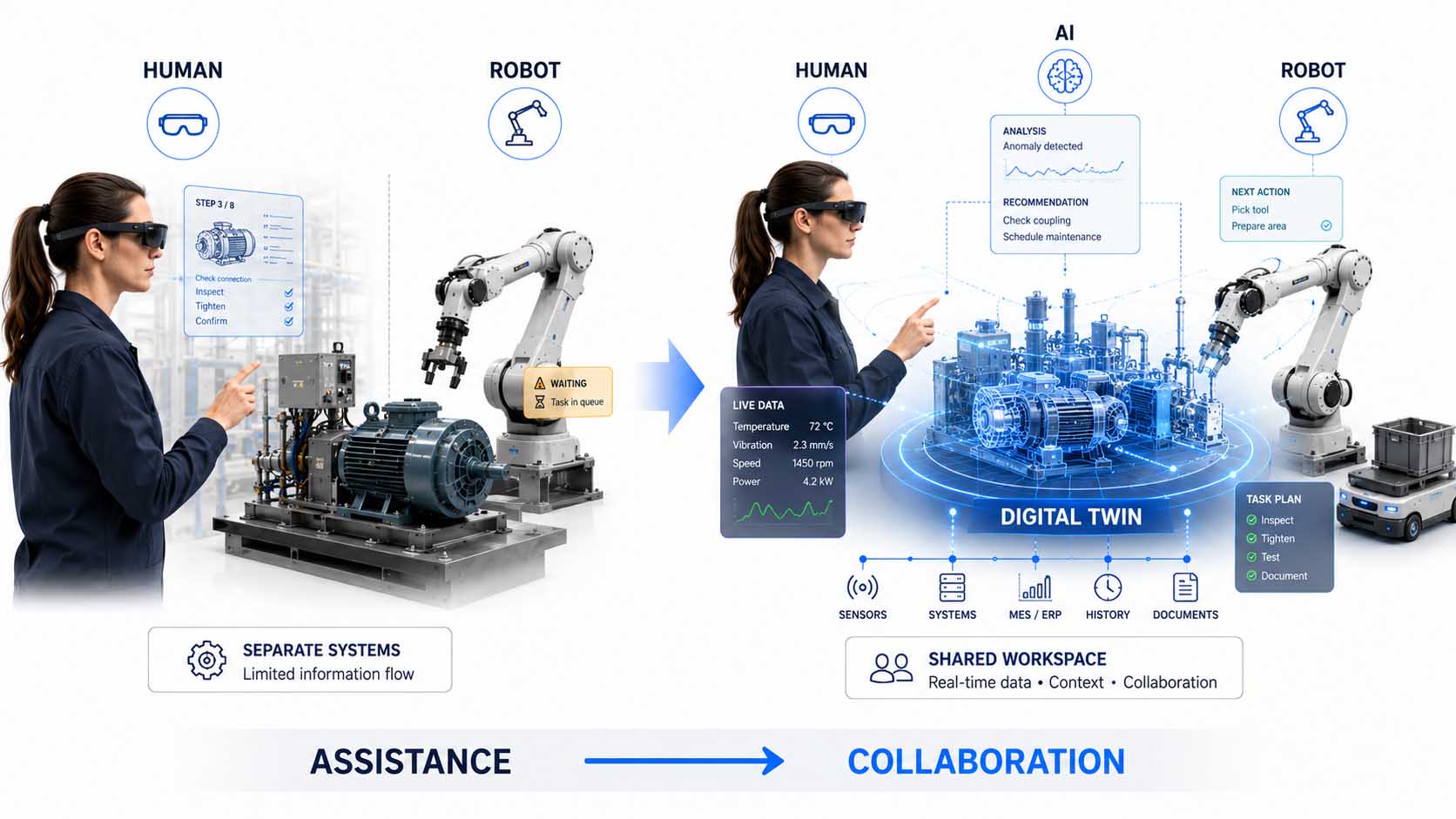
People, Artificial Intelligence, and robotics access the same real-time information through a shared Digital Twin, evolving from isolated systems into a collaborative team.
Diagram: The evolution from industrial assistance through Mixed Reality toward collaborative cooperation between people, robotics, Industrial AI, and Digital Twins | Graphic: © Ulrich Buckenlei | XR Stager Online Magazine | VISORIC GmbH
The key difference is that, in the future, every participant will access the same shared spatial information model. Digital Twins connect people, machines, sensors, robotics, and Artificial Intelligence within a common working environment. Information is no longer exchanged between isolated systems but becomes available to everyone in real time.
This creates entirely new forms of collaboration across manufacturing, assembly, maintenance, and quality assurance. While robotic systems transport workpieces or perform repetitive tasks, Industrial AI continuously analyzes sensor data, evaluates process conditions, and detects potential deviations. Employees receive all relevant information through spatial user interfaces, enabling informed decisions directly at their workplace.
Remote support is also undergoing a fundamental transformation. External specialists no longer rely solely on video streams. Instead, they collaborate within the same Digital Twin as on-site employees. Machine states, spatial annotations, and process information are shared in real time, enabling far more efficient collaboration across locations.
Modern simulation platforms such as NVIDIA Isaac Sim already demonstrate how autonomous robots can be trained entirely within Digital Twins before performing real-world tasks. At the same time, Mixed Reality platforms such as PTC Vuforia enable seamless collaboration between employees, remote experts, and intelligent assistance systems. These developments are increasingly converging, forming the foundation for a new generation of industrial workplaces.
The objective is not to replace people with Artificial Intelligence but to distribute responsibilities intelligently. People continue to provide judgment, experience, and problem-solving capabilities, while AI systems analyze information, recommend actions, and coordinate autonomous systems. Individual assistance functions evolve into a shared digital workspace where people and intelligent machines combine their respective strengths.
- Smart glasses are evolving from display devices into shared spatial work interfaces.
- Digital Twins create a common information foundation for people, AI, and robotic systems.
- Industrial AI analyzes processes in real time and supports informed decision-making directly at the workplace.
- Remote support is evolving into cross-site collaboration within shared Digital Twin environments.
- Traditional assistance systems are becoming collaborative workspaces where people and intelligent machines work together efficiently.
When people, Artificial Intelligence, and autonomous systems share the same spatial information foundation, it transforms more than the individual workplace. It creates an entirely new model of industrial collaboration, paving the way for connected, adaptive, and increasingly autonomous production environments.
From the Factory to the Intelligent Industry
Intelligent smart glasses are transforming far more than individual workplaces. Their greatest potential emerges when they are connected with Digital Twins, Artificial Intelligence, sensors, and networked production systems to form a unified industrial infrastructure. What begins as isolated assistance solutions gradually evolves into an intelligent working environment in which information, machines, and people are continuously connected.[13]
In conventional factories, many processes are still distributed across separate systems. Production data resides in manufacturing execution systems, maintenance information is stored in dedicated applications, and technical documentation is scattered across local devices or archives. Employees must search for this information, compare it, and mentally relate it to the real-world situation. This consumes valuable time and makes rapid decisions particularly difficult when equipment failures, quality issues, or safety-critical situations occur.
Mixed Reality can significantly shorten these information pathways. Smart glasses recognize the current workstation, identify machines and components, and display exactly the information required for the current task. Maintenance instructions appear directly on the affected component, quality deviations are highlighted spatially, and remote experts can instantly join the same view of the production system.
Artificial Intelligence adds an entirely new layer of assistance. It continuously analyzes sensor data, detects patterns, and evaluates potential anomalies. Instead of merely reporting an error, AI can narrow down possible causes, recommend the next steps, or retrieve the most relevant technical documentation. Employees receive contextual support precisely where work is being performed.[14]
The following infographic illustrates the evolution from isolated industrial solutions toward an intelligently connected industry. The focus is not on introducing individual technologies but on progressively connecting machines, employees, Artificial Intelligence, and enterprise systems into a shared spatial working environment.
ISOLATED → CONNECTED → INTELLIGENT
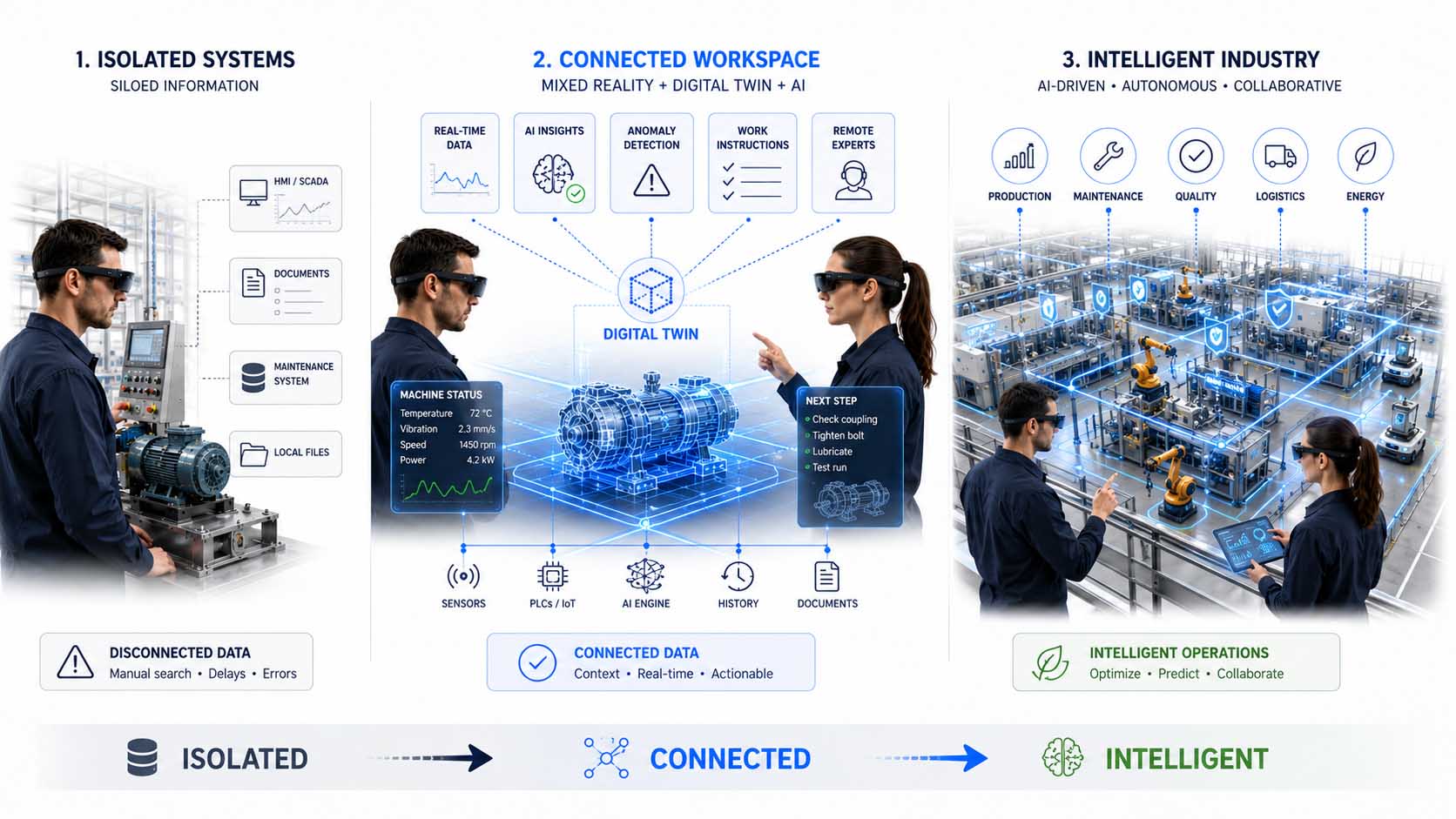
The infographic illustrates how individual industrial assistance systems evolve into a connected working environment in which people, machines, Digital Twins, and Artificial Intelligence share access to real-time information.
Infographic: The evolution from isolated industrial workplaces through Mixed Reality and Digital Twins to an intelligently connected factory featuring AI-powered assistance, remote support, and automated processes | Graphic: © Ulrich Buckenlei | XR Stager Online Magazine | VISORIC GmbH
In many organizations, machines, sensors, production data, and enterprise applications still operate as isolated systems. Valuable information is generated in different locations but can only be consolidated with considerable effort. As a result, fragmented workflows, manual coordination, and delayed decision-making remain part of everyday industrial operations.
Spatial Computing and Digital Twins introduce a fundamentally new model of collaboration. Machines, sensors, Artificial Intelligence, and employees all operate on the same shared spatial information foundation. Process data is no longer confined to traditional screens but appears directly within the working context—exactly where decisions are made and tasks are performed.
This approach creates significant advantages for maintenance, manufacturing, and quality assurance. Service technicians can immediately identify affected assemblies, access current machine conditions, and receive contextual maintenance guidance directly within the field of view of their smart glasses. Production processes can be monitored spatially, product variants considered automatically, and quality deviations detected at an early stage. At the same time, Industrial AI continuously analyzes operational data and supports decision-making with intelligent real-time recommendations.
Remote support is also fundamentally changing. External experts no longer work solely from video streams but access the same Digital Twin, identical sensor data, and shared spatial annotations as on-site personnel. This accelerates collaboration, reduces misunderstandings, and makes complex technical situations significantly more transparent.
Research organizations such as the Fraunhofer IPA and leading technology companies already demonstrate how Mixed Reality, Computer Vision, Industrial AI, and Digital Twins are converging into a unified technological platform. The objective is not merely to digitalize individual work steps but to build an intelligently connected industry where people, machines, and Artificial Intelligence collaborate continuously on the basis of shared information.
The journey does not have to begin with a fully connected factory. Even a clearly defined pilot project—for example in maintenance, production, or quality assurance—can establish the foundation for a scalable architecture. Step by step, additional machines, production sites, data sources, and AI capabilities can be integrated into a company-wide industrial platform.
- Spatial Computing connects physical workplaces with digital information and real-time operational data.
- Industrial AI supports maintenance, manufacturing, and quality assurance through contextual analysis.
- Remote support leverages shared Digital Twins for more efficient collaboration across locations.
- Digital Twins connect machines, sensors, enterprise systems, and employees within a unified world model.
- Scalable pilot projects create the foundation for building an intelligently connected industry step by step.
The intelligent industry will not emerge from individual devices or isolated software solutions. It is built upon a shared digital infrastructure in which data, processes, Artificial Intelligence, and spatial user interfaces work together seamlessly. This convergence forms the technological foundation for the next generation of industrial value creation.
Why Companies Are Building the Foundation Today
The adoption of intelligent smart glasses is only the visible part of a much larger transformation. Around the world, industrial companies are investing in Digital Twins, Spatial AI, robotics, and connected manufacturing platforms. The objective is not to fully automate existing workplaces but to enable people, machines, and Artificial Intelligence to collaborate on a shared digital foundation.[15]
This transformation goes far beyond isolated pilot projects. Modern production facilities already generate enormous volumes of data. Sensors continuously monitor machine conditions, cameras inspect product quality, autonomous vehicles transport materials, and robots perform repetitive manufacturing tasks. Without a shared digital context, however, these data streams often remain disconnected and cannot realize their full potential.
This is where Digital Twins become essential. They create virtual real-time representations of machines, production lines, or even entire factories. Changes to production equipment become immediately visible, new processes can be simulated, and optimizations can be tested before being implemented in the physical environment. Companies thereby establish a common information foundation that can be accessed simultaneously by people, machines, and Artificial Intelligence.
Platforms such as NVIDIA Omniverse are enabling the creation of industrial world models in which simulation, robotics, Computer Vision, and Physical AI converge into a unified environment. At the same time, geospatial information platforms such as Esri ArcGIS are developing spatial Digital Twins of entire factories, industrial campuses, and cities. Both developments point in the same direction: future decisions will increasingly be based on a shared digital representation of the physical world.[16]
The following infographic illustrates how individual intelligent workplaces gradually evolve into enterprise-wide industrial ecosystems. It begins with a connected workplace where employees interact with the Digital Twin of a machine through spatial user interfaces. From there, multiple production cells, facilities, and infrastructures are connected into a common digital platform.
WORKPLACE → FACTORY → ENTERPRISE → ECOSYSTEM
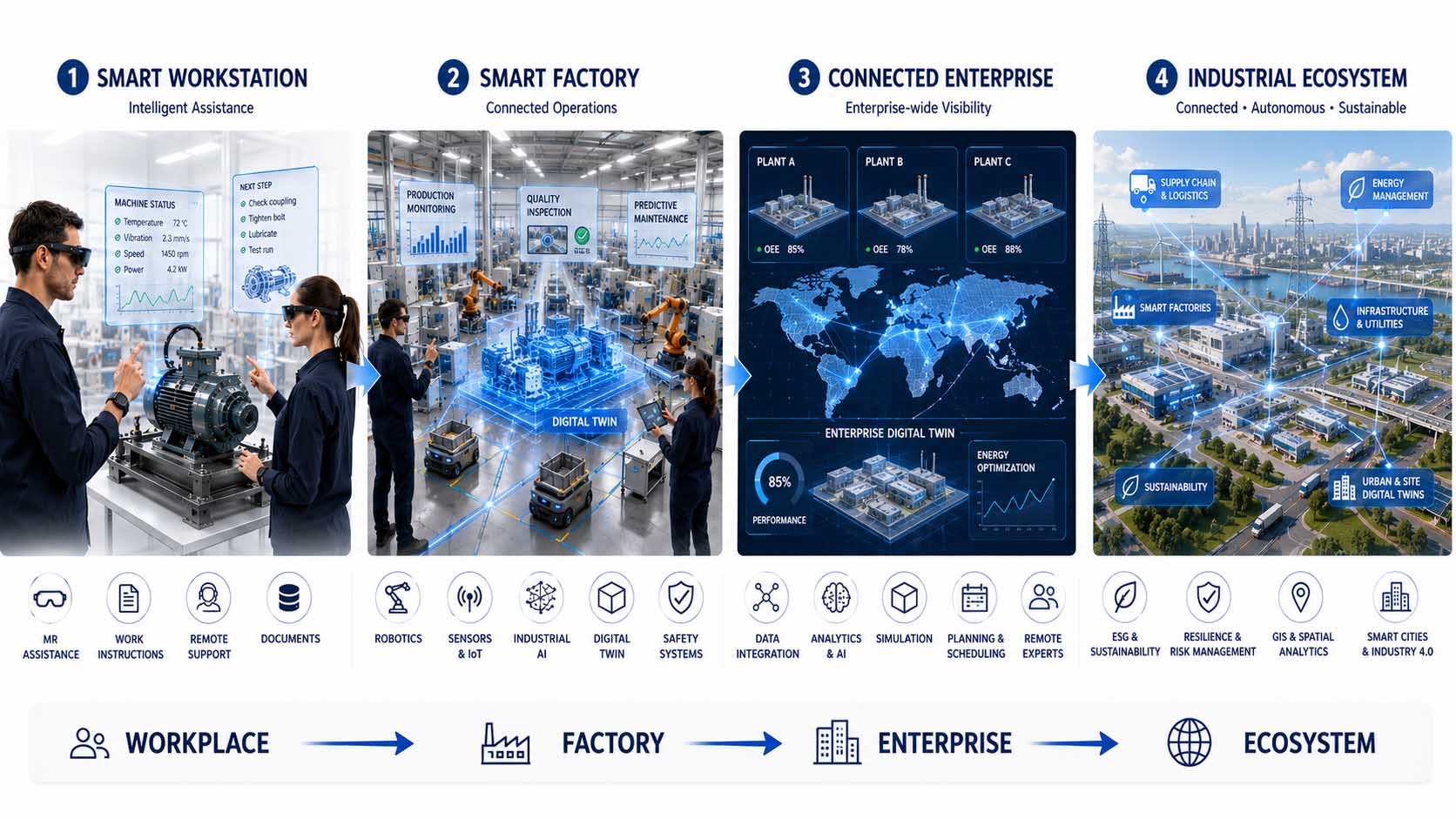
Digital Twins are evolving from representations of individual machines into connected industrial and infrastructure platforms where people, Artificial Intelligence, and autonomous systems collaborate on a shared spatial foundation.
Diagram: The evolution from individual Digital Twins through Smart Factories to enterprise-wide spatial platforms for manufacturing, logistics, energy, and infrastructure | Graphic: © Ulrich Buckenlei | XR Stager Online Magazine | VISORIC GmbH
The first stage establishes an intelligent workplace in which employees, machines, and Artificial Intelligence collaborate within a shared spatial information environment. Smart glasses serve as the interface to the Digital Twin, presenting relevant information directly within the working context.
As multiple workplaces and production cells become interconnected, they evolve into a Smart Factory. Robots, autonomous transport systems, production equipment, and employees all operate on the same shared information foundation. Manufacturing processes can therefore be monitored, simulated, and optimized in real time.
At the enterprise level, multiple production sites, data sources, and AI models become interconnected across locations. Simulations, process information, and Digital Twins can be shared and synchronized continuously, resulting in faster coordination and significantly improved strategic and operational decision-making.
The next stage is a complete industrial ecosystem in which manufacturing, logistics, energy systems, and infrastructure collaborate within a common spatial information model. Individual Digital Twins evolve into a connected platform that extends far beyond a single machine or production facility.
For companies, this transformation offers significant strategic advantages. New production lines can be planned more accurately, processes continuously optimized, and autonomous systems safely integrated into existing operations. At the same time, different business units gain access to the same consistent information, enabling much faster and better-informed decisions.
Intelligent smart glasses also play a central role within this ecosystem. They connect people directly to the Digital Twin, making machine conditions, simulations, maintenance information, and AI recommendations visible exactly where work is performed. The traditional user interface evolves into a spatial working environment that dynamically adapts to the task, location, and operational context.
This transformation is already underway. Companies are laying the technological foundation through Digital Twins, advanced sensor technologies, Computer Vision, Industrial AI, and scalable data platforms. Even though not every application is visible today, the underlying infrastructure is being built to support the next generation of industrial workflows.
- Digital Twins are evolving from individual machine models into enterprise-wide industrial platforms.
- Smart Factories connect manufacturing, logistics, robotics, and Artificial Intelligence on a shared data foundation.
- Spatial information models enable realistic simulations and faster decision-making.
- Smart glasses become the direct interface between employees and Digital Twins.
- Connected data infrastructures provide the foundation for future industrial AI applications.
Companies are therefore investing not only in individual devices or software applications but in a scalable digital infrastructure that will enable people, machines, and intelligent systems to collaborate seamlessly across sites and organizational boundaries.
This naturally raises the final question: how will these technological advances transform everyday industrial work over the coming years? The next chapter explores this future outlook.
The Next Generation of Industrial Work
Spatial Computing is still in its early stages. Today, intelligent smart glasses primarily assist employees with individual tasks by displaying digital work instructions or visualizing information directly within their field of view. Over the coming years, however, these systems will evolve fundamentally. By combining Industrial AI, Digital Twins, and Physical AI, a new generation of intelligent assistance systems is emerging—systems that understand spatial context and support employees throughout entire workflows.[17]
The user interface itself is also undergoing a transformation. Information will no longer be confined to monitors or tablets but will appear exactly where it is needed. Machines, workpieces, robots, and even entire production lines become part of a shared spatial user interface. The Digital Twin serves as the common world model, while Artificial Intelligence interprets the current situation and recommends the most appropriate next actions based on real-time context.
Industrial Copilots extend far beyond traditional assistance systems. They understand spoken language, recognize objects within the user’s field of view, consider the current stage of a workflow, and access the Digital Twin of the production system. This enables a continuous dialogue between people and machines. Employees no longer need to search for information manually—relevant guidance appears automatically at exactly the right moment and directly on the relevant object.
At the same time, Physical AI is evolving into a key technology for modern industry. Robots analyze their surroundings using Computer Vision, Spatial AI, and Digital Twins. Together with human workers, they create adaptive workplaces where both share the same spatial understanding of the environment and access the same digital information. The Digital Twin therefore becomes the shared knowledge base for people, robots, and Artificial Intelligence.[18]
The following infographic illustrates that this transformation goes far beyond individual tools—it fundamentally reshapes human-machine interaction. Digital information becomes part of the physical working environment and is simultaneously available to all participating systems. This creates a shared understanding of the current situation, regardless of whether a task is performed by a person, a robot, or an AI system.
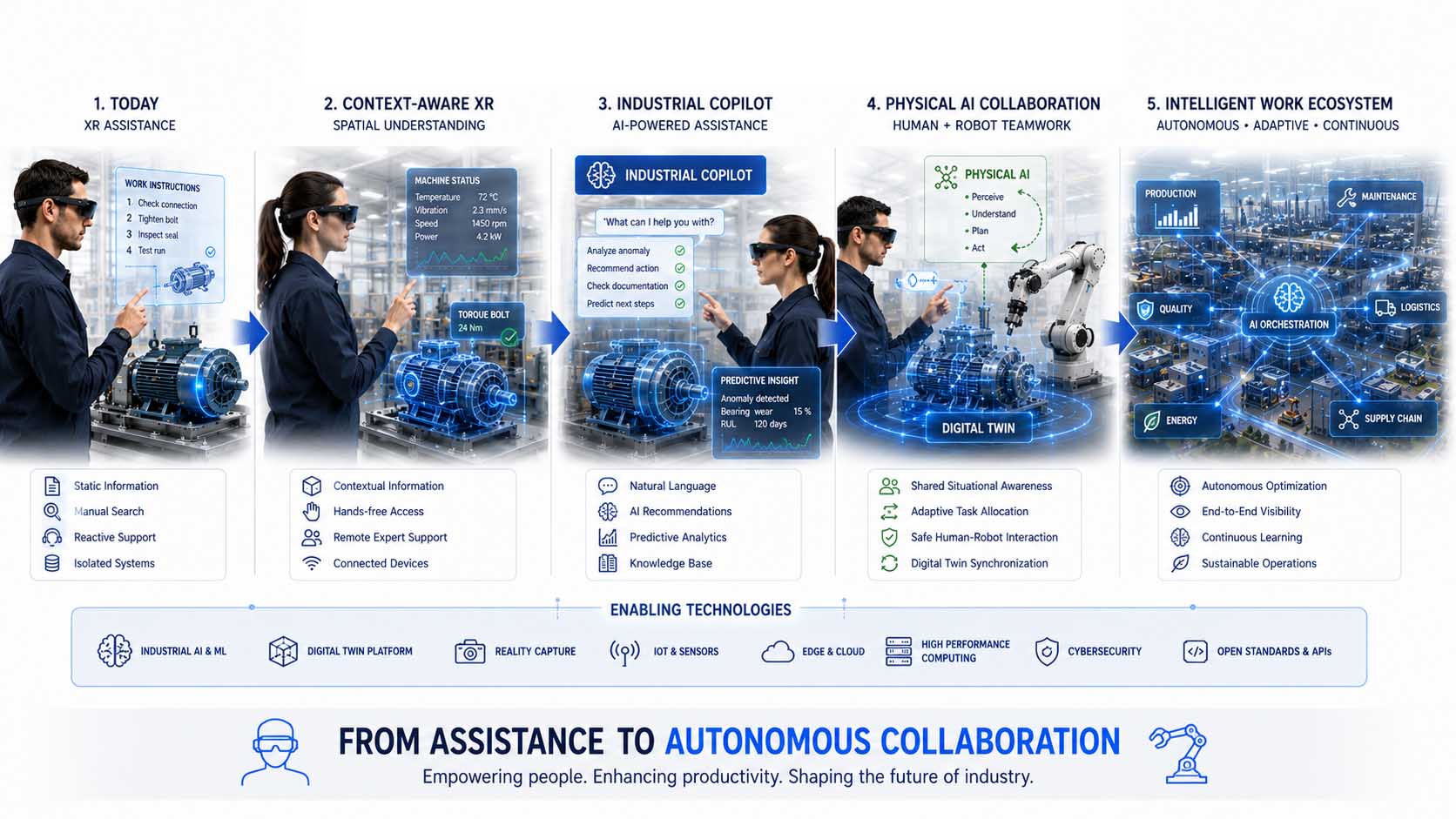
Industrial AI combines Spatial Computing, Digital Twins, and Physical AI into a shared spatial working environment for people and intelligent machines.
Diagram: The evolution from today’s XR assistance systems toward a shared spatial working environment powered by Industrial AI, Digital Twins, Industrial Copilots, and Physical AI | Graphic: © Ulrich Buckenlei | XR Stager Online Magazine | VISORIC GmbH
For companies, this represents a fundamental shift. Employees receive contextual assistance directly within their field of view, while Industrial AI continuously analyzes processes, detects quality deviations, and provides optimization recommendations in real time. Predictive Analytics, Computer Vision, and Spatial AI converge into an intelligent assistance system that remains continuously synchronized with the Digital Twin.
Over the long term, this will create adaptive working environments that automatically adjust to machine conditions, production processes, and individual users. Knowledge will no longer exist only in manuals or documentation but will be delivered exactly where decisions are made. Traditional user interfaces will evolve into intelligent spatial work environments where people and Artificial Intelligence collaborate seamlessly.
- Industrial AI provides contextual assistance throughout complete industrial workflows.
- Industrial Copilots combine natural language, Computer Vision, and spatial situational awareness.
- Digital Twins become the shared knowledge foundation for people, machines, and robots.
- Physical AI enables adaptive collaboration between people and intelligent robotic systems.
- Spatial Computing is evolving into the primary user interface of the intelligent industrial enterprise.
The transformation therefore extends far beyond a new generation of hardware. What truly matters is the convergence of the physical world, Digital Twins, Industrial AI, and Physical AI into a shared spatial working environment. It is this intelligent integration that will define the next generation of industrial work.
Physical AI Gains a Spatial User Interface
The previous chapters have shown how industrial user interfaces are evolving step by step. Information is moving beyond the traditional screen, intelligent smart glasses connect digital content with the physical workplace, and Digital Twins provide a shared information foundation for people, machines, and Artificial Intelligence. The following video brings these developments together in a practical demonstration.
The demonstration shows a robot whose spatial perception becomes directly visible through a Mixed Reality headset. Navigation paths, recognized objects, spatial markers, and planned movement trajectories are overlaid directly onto the real environment. Instead of observing abstract robot data on a monitor, the user gains an immediate understanding of how the autonomous system perceives and interprets its surroundings.
This is what makes the demonstration particularly significant. Mixed Reality becomes the spatial user interface for Physical AI. People and autonomous machines share a common view of the same situation. While the robot perceives its environment through cameras, sensors, and spatial world models, the smart glasses make this machine perception understandable and visible to the human operator.[19]
Original demonstration: Nigel Hartman (@XRarchitect) using Snap Spectacles in Experimental Mode | Technology analysis, narration, editorial review, and video production: © Ulrich Buckenlei | XR Stager Online Magazine | VISORIC GmbH
The application presented in the video goes far beyond a conventional Augmented Reality demonstration. It provides a glimpse into how people and autonomous systems may collaborate in the future. Instead of analyzing a robot’s behavior afterward through logs or camera recordings, its perception and intended actions become visible directly within the physical environment where they occur.
For employees, this creates a far more intuitive way of understanding complex AI systems. They can immediately see which areas the robot is monitoring, which objects it has identified, and which path it intends to follow next. This becomes especially important as autonomous machines increasingly collaborate with people in shared industrial workspaces.
The technological foundation consists of Computer Vision, spatial sensing, semantic object recognition, and digital world models. Together, these technologies enable autonomous systems not only to measure their surroundings geometrically but also to interpret objects and spatial relationships semantically. The Mixed Reality headset then translates this machine understanding directly into the user’s field of view.[20]
This creates a shared form of spatial perception. Although people and machines perceive the environment differently, both rely on the same digital world model. Hazard zones, navigation paths, work instructions, and machine conditions become clearly visible and understandable for both human operators and autonomous systems.
This approach is particularly relevant for industrial environments where people and autonomous systems increasingly work side by side. In manufacturing, logistics, plant maintenance, infrastructure inspection, and construction, spatial user interfaces can help accelerate decision-making while making the behavior of intelligent machines significantly easier to understand.
Digital Twins also play a central role within this ecosystem. They connect physical machines, sensor data, spatial information, and Artificial Intelligence into a unified digital model. Smart glasses become the visible interface to this system, presenting exactly the information required at the right place and at the right moment.
In the long term, industrial user interfaces may no longer be tied to individual devices or conventional screens. Machines, robots, tools, and workspaces themselves become interactive elements of a shared digital environment. Rather than communicating with Artificial Intelligence exclusively through menus and dashboards, people will increasingly interact through natural language, gaze, gestures, and spatial interaction.
- Mixed Reality makes the spatial perception of autonomous systems visible to people.
- Navigation paths, recognized objects, and machine conditions appear directly within the real working environment.
- Computer Vision and Semantic AI create a shared spatial understanding.
- Digital Twins connect people, sensors, Artificial Intelligence, and robotics within a common world model.
- Smart glasses are evolving into the spatial user interface for Physical AI.
The real breakthrough therefore lies not simply in more capable smart glasses or more intelligent robots. It lies in the creation of a shared spatial information foundation that enables people and autonomous systems to understand the same situation and coordinate their actions seamlessly.
The next user interface for Physical AI will not simply be another screen—it will increasingly become the physical workplace itself.
From Vision to a Successful Industrial AI Project
The technologies presented in this article are no longer a vision of the future. Mixed Reality, Spatial Computing, Digital Twins, Computer Vision, Industrial AI, and Physical AI are already converging into a unified technological platform for the next generation of industrial work. The real challenge is therefore not implementing individual technologies but integrating them into a seamless end-to-end solution.
The greatest value is achieved when companies begin with a clearly defined use case. A pilot project in manufacturing, assembly, maintenance, field service, or quality assurance allows new workflows to be evaluated under real operating conditions. Technical feasibility, user acceptance, business value, and system integration can be assessed at an early stage before the solution is gradually expanded across additional production lines, facilities, or business processes.
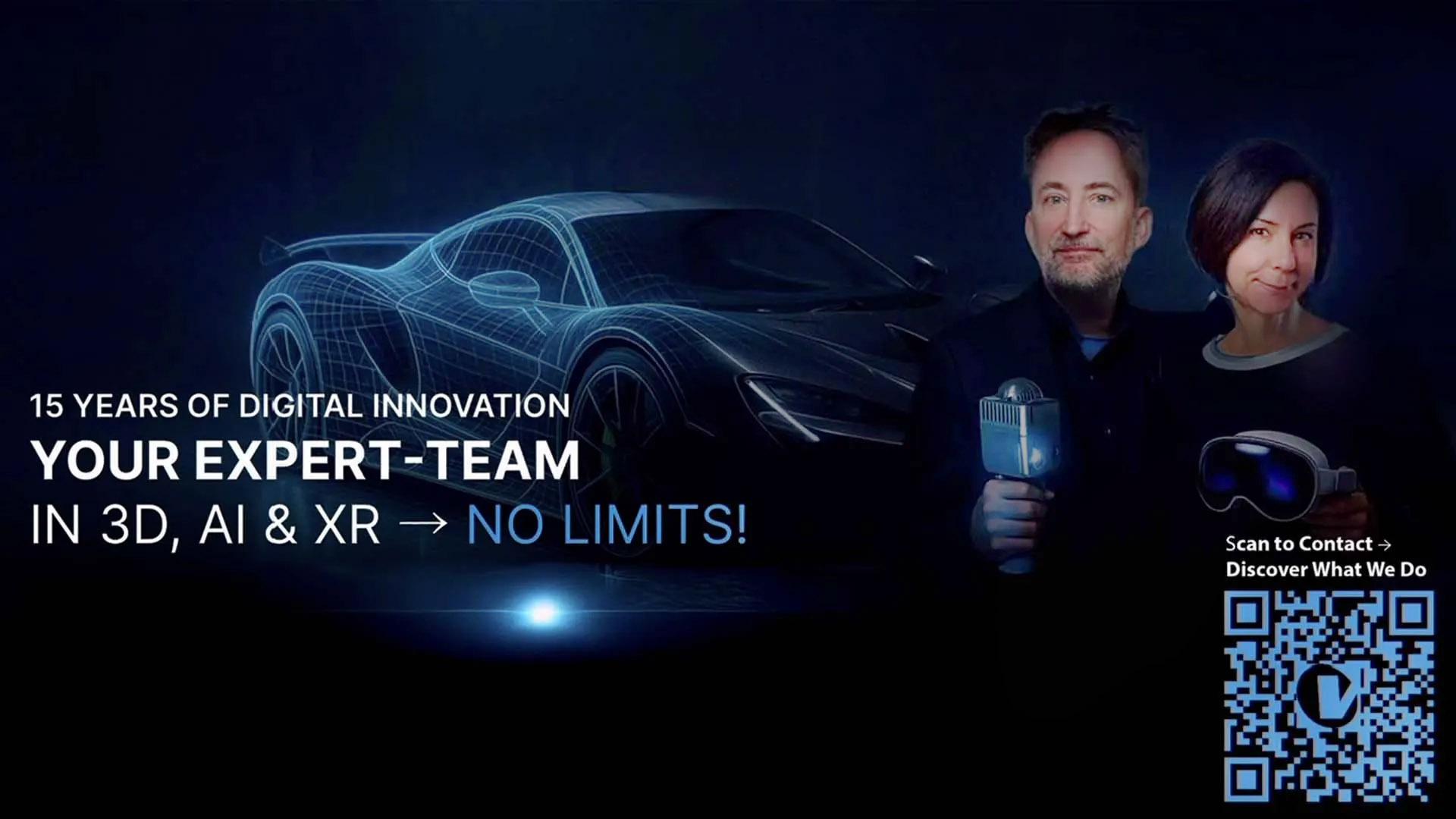
Successful Industrial AI projects are created by intelligently combining Spatial Computing, Digital Twins, Computer Vision, and Artificial Intelligence—aligned with real industrial workflows.
Visualization: Industrial AI, Mixed Reality, Physical AI, Digital Twins, Computer Vision, robotics, and intelligent assistance systems for manufacturing, production, service, and engineering | Image: © Ulrich Buckenlei | VISORIC GmbH
How to Get Started Successfully:
- Identify a suitable pilot use case with measurable business value.
- Integrate Digital Twins, Artificial Intelligence, and Spatial Computing into existing workflows.
- Validate the solution and scale it step by step across additional business areas.
Successful projects do not begin with a specific pair of smart glasses or a single AI model. They begin with a clear objective and an architecture that connects people, machines, and digital information within a shared spatial workspace.
The VISORIC expert team in Munich supports organizations from the initial concept through successful production deployment:
- Strategy, consulting, and development of customized Industrial AI and Spatial Computing solutions.
- Integration of Digital Twins, Computer Vision, robotics, and real-time 3D into a unified enterprise platform.
- Implementation, validation, and international scaling of pilot projects.
Would you like to implement Spatial Computing, Industrial AI, Digital Twins, or intelligent assistance systems in your organization?
Talk to the VISORIC expert team in Munich about your specific use case. Together, we will develop a scalable pilot project that integrates seamlessly into your existing technology landscape and lays the foundation for the next generation of industrial workflows.
Contact
Email: info@visoric.com
Phone: +49 89 21552678
Sources and References
- Siemens AG – Industrial AI, Industrial Copilot, and the digital transformation of industry.
- World Economic Forum – Artificial Intelligence, manufacturing, and the future of work.
- Microsoft Mixed Reality – Industrial applications of Mixed Reality and smart glasses.
- Qualcomm Technologies – Snapdragon AR platforms and industrial smart glasses.
- BMW Group – Production digitalization, Physical AI, and intelligent manufacturing.
- NVIDIA – Physical AI and the next generation of industrial robotics.
- NVIDIA Research – Semantic Gaussian Splatting and neural scene representations.
- IEEE / CVPR – Computer Vision, Semantic Scene Understanding, and Spatial AI.
- Digital Twin Consortium – Architecture Framework and intelligent Digital Twins.
- NVIDIA Omniverse – Industrial Digital Twins and Spatial Computing.
- NVIDIA Isaac Sim – Robotics, simulation, and Physical AI.
- PTC Vuforia – Spatial Computing, industrial assistance systems, and remote support.
- Microsoft Mixed Reality – XR for maintenance, service, and industrial workflows.
- Fraunhofer IPA – AI-powered assistance systems and intelligent manufacturing.
- NVIDIA Omniverse – Industrial Digital Twins, Smart Factories, and Smart Cities.
- Esri – ArcGIS Digital Twins and Urban Analytics.
- Siemens AG – Industrial AI, Predictive Analytics, and Industrial Copilot.
- NVIDIA – AI Blueprint for Digital Twins and Physical AI.
- Original demonstration video by Nigel Hartman (@XRarchitect) using Snap Spectacles (Experimental Mode).
- SensAI Hackademy / The World Labs – Semantic AI, Spatial Computing, and Computer Vision.
- VISORIC GmbH – Real-world projects in Reality Capture, Digital Twins, Spatial Computing, Mixed Reality, and Industrial AI.
- NVIDIA Omniverse Enterprise – Platforms for intelligent Digital Twins, robotics, and Physical AI.
Contact Persons:
Ulrich Buckenlei (Creative Director)
Mobile: +49 152 53532871
Email: ulrich.buckenlei@visoric.com
Nataliya Daniltseva (Project Manager)
Mobile: +49 176 72805705
Email: nataliya.daniltseva@visoric.com
Address:
VISORIC GmbH
Bayerstraße 13
D-80335 Munich