

Using Ultra-Thin Transparent Displays Effectively
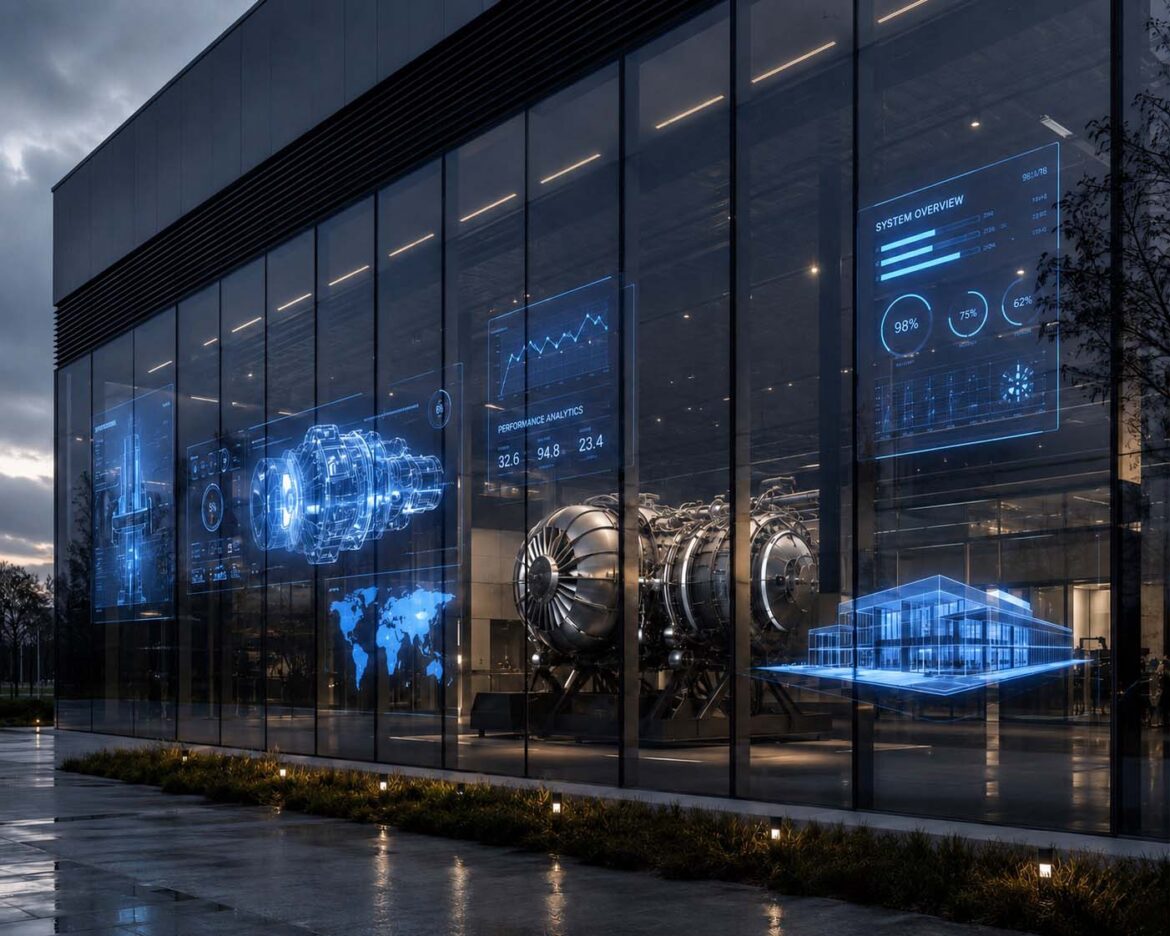
Visualization: Ultra-thin transparent LED films transform existing glass surfaces into intelligent communication platforms for showrooms, retail, trade fairs, corporate buildings, and digital brand environments | Image: © Ulrich Buckenlei | VISORIC GmbH
For many years, glass in buildings was regarded primarily as an architectural element. It provided daylight, transparency, and openness but played only a minor role in digital communication. Information was displayed on monitors, LED walls, or projection surfaces, while windows and glass façades remained largely unused. With the emergence of ultra-thin transparent LED films, this relationship is fundamentally changing. Glass is increasingly becoming a digital communication surface without losing its primary function as transparent architecture.[1]
This development has been made possible by several technological advances occurring simultaneously. Miniaturized LEDs, transparent conductive pathways, flexible carrier materials, and energy-efficient control systems now enable displays that are only about one millimeter thick and can be mounted directly onto existing glass surfaces. When switched off, they remain almost invisible. Only when activated do digital contents appear to float on the glass surface. This creates entirely new opportunities for businesses to present information where previously only architecture was visible.[2]
The opening image of this article illustrates this transformation perfectly. At its center is a modern glass façade that no longer serves only as a building envelope but simultaneously becomes a digital communication platform. Interactive content, product visualizations, real-time information, and digital twins merge seamlessly with the physical environment. The boundary between architecture and digital communication is beginning to disappear.
This evolution becomes even more exciting when combined with artificial intelligence. Transparent displays will no longer be limited to showing pre-produced content. They will automatically update product information, respond to events, display multiple languages, and personalize content for individual visitors. As a result, adaptive communication systems emerge that go far beyond traditional digital signage solutions.
The market is currently evolving rapidly as well. Alongside established manufacturers of transparent OLED and LED technologies, numerous companies are investing in flexible LED films, intelligent control systems, and cloud-based content platforms. At the same time, new applications are emerging in retail, industry, museums, corporate headquarters, hotels, airports, and trade fairs. Transparent displays are therefore evolving from niche solutions into an essential component of modern corporate communication.
- Ultra-thin LED films transform existing glass surfaces into digital communication platforms.
- Architecture and digital content merge into a unified user interface.
- Businesses can present products, information, and brand experiences directly on glass.
- Artificial intelligence will enable adaptive and personalized real-time content.
- Transparent displays are becoming a core element of intelligent commercial buildings.
This article explains how transparent display technologies have evolved, which solutions are available today, where companies can use them most effectively, and how software, artificial intelligence, and digital twins will shape the next generation of transparent communication platforms.
Why Ultra-Thin Transparent Displays Are Reaching Their Breakthrough Today
Transparent displays have been considered a fascinating future technology for many years. The first transparent LCD systems were introduced in the early 2000s, followed later by transparent OLED displays designed for premium applications. Despite impressive demonstrations, these solutions remained limited to isolated pilot projects for a long time. High production costs, limited display sizes, insufficient brightness, and complex installations prevented widespread adoption in architecture and corporate communication.[3]
In recent years, however, the technological foundations have changed fundamentally. Advances in LED miniaturization, transparent conductive pathways, flexible substrate materials, and energy-efficient control electronics have enabled ultra-thin transparent LED films that are only about one millimeter thick. They can be applied directly to existing glass surfaces, cut to custom dimensions, and even installed on slightly curved glass. In many cases, this eliminates the need to replace existing windows or glass façades.
The following illustration highlights the key technological developments that made this transformation possible. While early generations were dominated by rigid display technologies, modern transparent LED films combine several innovations into one integrated system. Flexible materials, more powerful LEDs, and intelligent control systems together form the foundation of an entirely new generation of transparent communication surfaces.
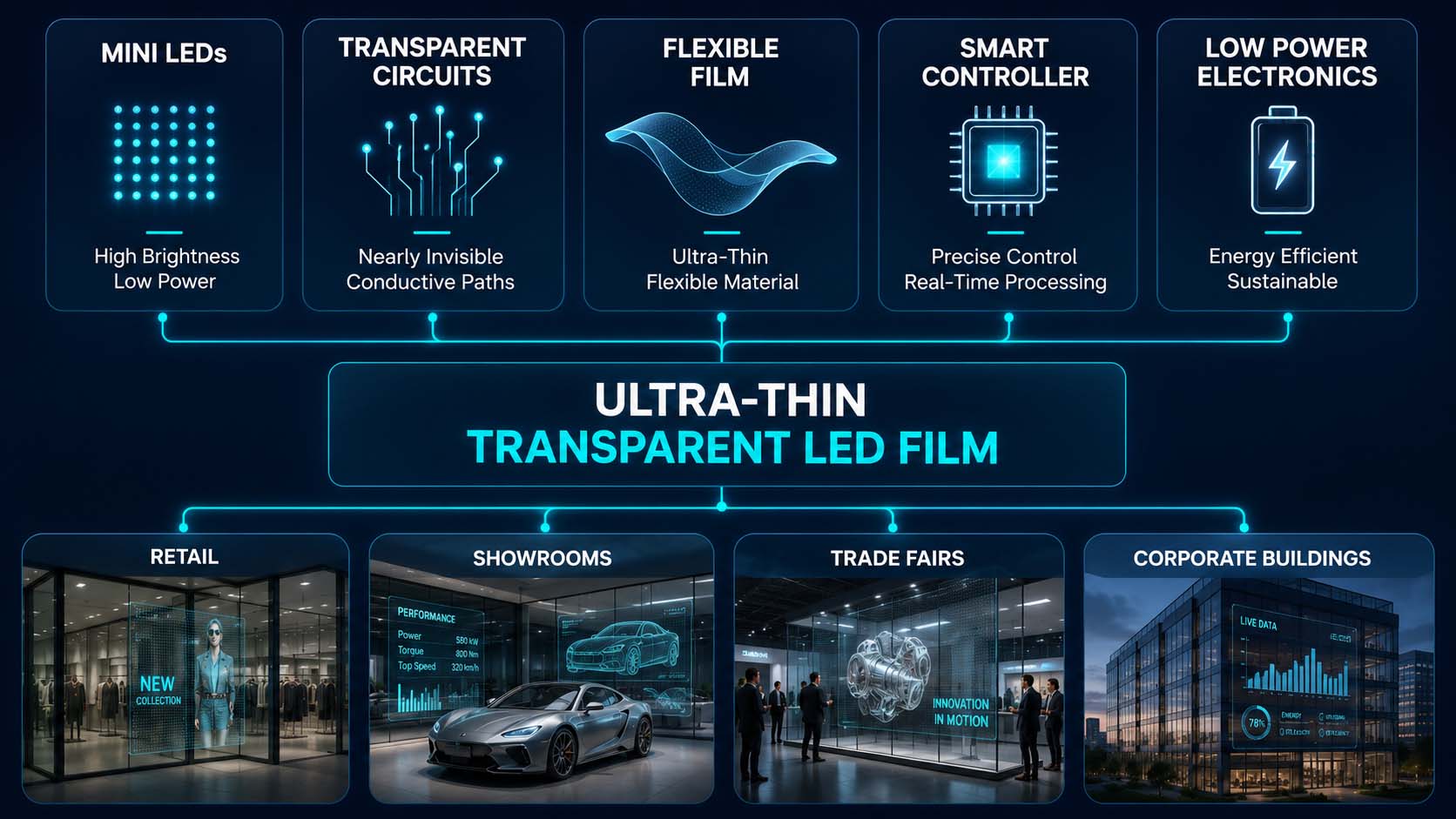
Only the combination of multiple technological innovations made ultra-thin transparent LED films economically and architecturally attractive.
Diagram: Evolution of transparent display technologies driven by advances in LEDs, transparent conductive pathways, flexible materials, and intelligent control systems | Graphic: © Ulrich Buckenlei | VISORIC GmbH
The diagram demonstrates that today’s state of the art is not based on a single invention. Improved LED chips provide higher brightness while consuming less energy. Transparent conductive pathways transmit electrical signals almost invisibly across the entire glass surface. Flexible carrier films enable installation on existing windows, while modern controllers precisely manage millions of individual LEDs. Together, these technologies create systems that integrate almost invisibly into architecture while displaying large-format digital content.[4]
Economically, this development also represents a turning point. Companies no longer need to install entirely new glass façades in order to implement transparent display solutions. Existing windows, entrance areas, and storefronts can now be digitally upgraded. This significantly reduces investment costs while opening new opportunities for marketing, product presentation, and digital corporate communication.
Another important factor further accelerates this development. The combination of modern display technology, cloud platforms, real-time data, and artificial intelligence fundamentally changes the role of transparent displays. Instead of functioning merely as display surfaces, they become intelligent communication platforms capable of managing content dynamically and eventually adapting automatically to changing situations.
- Miniaturized LEDs provide high brightness with low energy consumption.
- Transparent conductive pathways enable nearly invisible installations.
- Flexible LED films can be mounted directly onto existing glass surfaces.
- Modern controllers manage millions of LEDs with high precision and efficiency.
- Cloud platforms, software, and AI transform transparent displays into intelligent communication systems.
The current breakthrough in transparent displays is therefore not the result of a single innovation. Only the combination of advanced materials, LED technology, intelligent electronics, and powerful software makes the technology economically attractive for businesses today while enabling applications that would have been difficult to realize only a few years ago.
Today’s Transparent Display Technologies
Not every transparent display is based on the same technology. Over the past several years, different approaches have emerged, each optimized for specific applications. Alongside transparent LCD and OLED displays, ultra-thin transparent LED films are becoming increasingly important. They offer significant advantages because they can be applied directly to existing glass surfaces without requiring entirely new glass installations.[7]
The following illustration compares today’s most important transparent display technologies. On the left are conventional LCD and OLED solutions, which are generally manufactured as complete display systems. The center section presents transparent MicroLED and LED Glass systems designed for large-format installations. On the right, the latest generation is shown: ultra-thin self-adhesive transparent LED films that can be custom-cut, installed on curved glass surfaces, and integrated almost invisibly.
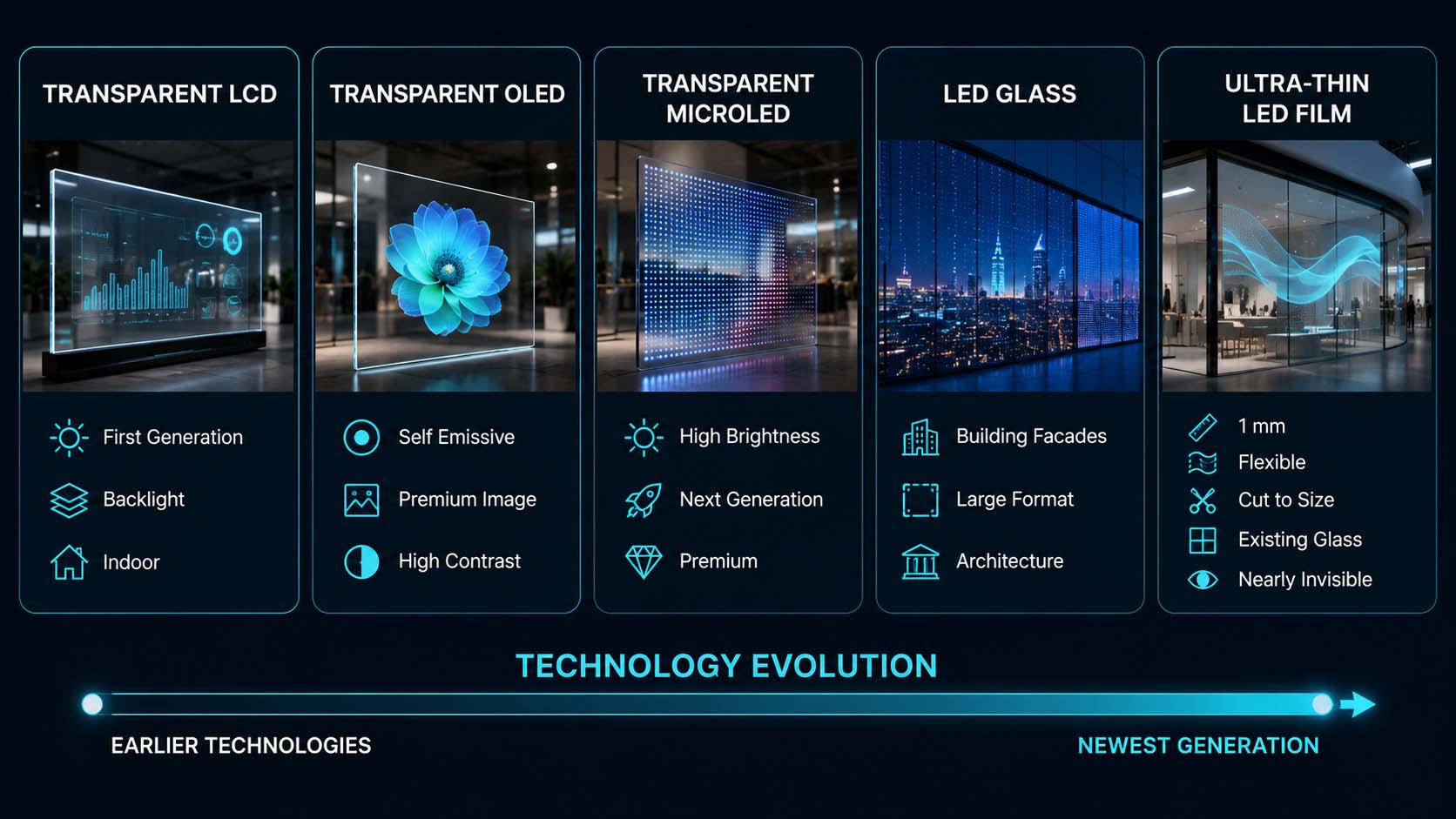
The major transparent display technologies differ in structure, transparency, flexibility, and typical application scenarios.
Diagram: Comparison of Transparent LCD, Transparent OLED, Transparent MicroLED, LED Glass, and Ultra-Thin Transparent LED Films | Graphic: © Ulrich Buckenlei | VISORIC GmbH
The diagram illustrates the individual strengths of each technology. Transparent LCD displays were the first commercially available solutions but require backlighting and achieve only limited contrast. Transparent OLED panels are self-emissive and provide outstanding image quality, although their size and cost remain limiting factors. Transparent MicroLED is considered one of the most promising future technologies but currently remains concentrated in the premium market.
The fastest technological progress is currently taking place in transparent LED films. Flexible conductive pathways, ultra-thin substrate materials, and miniaturized LEDs enable systems that can be installed directly onto existing glass surfaces. Windows, façades, and storefronts can therefore be transformed into digital communication surfaces without major structural modifications. At the same time, the glass remains largely transparent when the system is switched off.[8]
The best technology therefore depends less on image quality alone than on the intended application. Museums and premium showrooms often prefer OLED solutions, large architectural façades frequently rely on LED Glass systems, while modern retail concepts and trade fairs increasingly adopt ultra-thin LED films. Companies should therefore define their application scenario first rather than comparing individual products in isolation.
- Transparent LCD laid the foundation for early transparent displays.
- Transparent OLED delivers excellent image quality through self-emissive pixels.
- Transparent MicroLED is considered a high-performance technology for the future.
- LED Glass is particularly suitable for large-scale façades and architectural applications.
- Ultra-thin LED films enable flexible retrofitting of existing glass surfaces.
The evolution of transparent displays clearly demonstrates that hardware alone no longer determines success. With every new generation, the possibilities for integrating architecture, digital content, and interactive applications continue to expand, creating entirely new use cases far beyond traditional digital signage solutions.
Where Companies Can Benefit Most from Transparent Displays
Ultra-thin transparent displays deliver their greatest value wherever digital information and physical objects need to remain visible simultaneously. Unlike conventional monitors or LED walls, they neither obscure products nor architecture. Instead, they add a digital layer to existing glass surfaces. This creates entirely new opportunities for corporate communication, product presentation, and brand storytelling.[9]
The following illustration highlights the most important application areas for transparent displays. At its center is the transparent glass surface as a shared communication platform. Around it are typical use cases including retail, showrooms, trade fairs, museums, corporate headquarters, hotels, airports, and industrial environments. Although the requirements differ across these sectors, they all share one common objective: making information visible without blocking the view of the real environment.
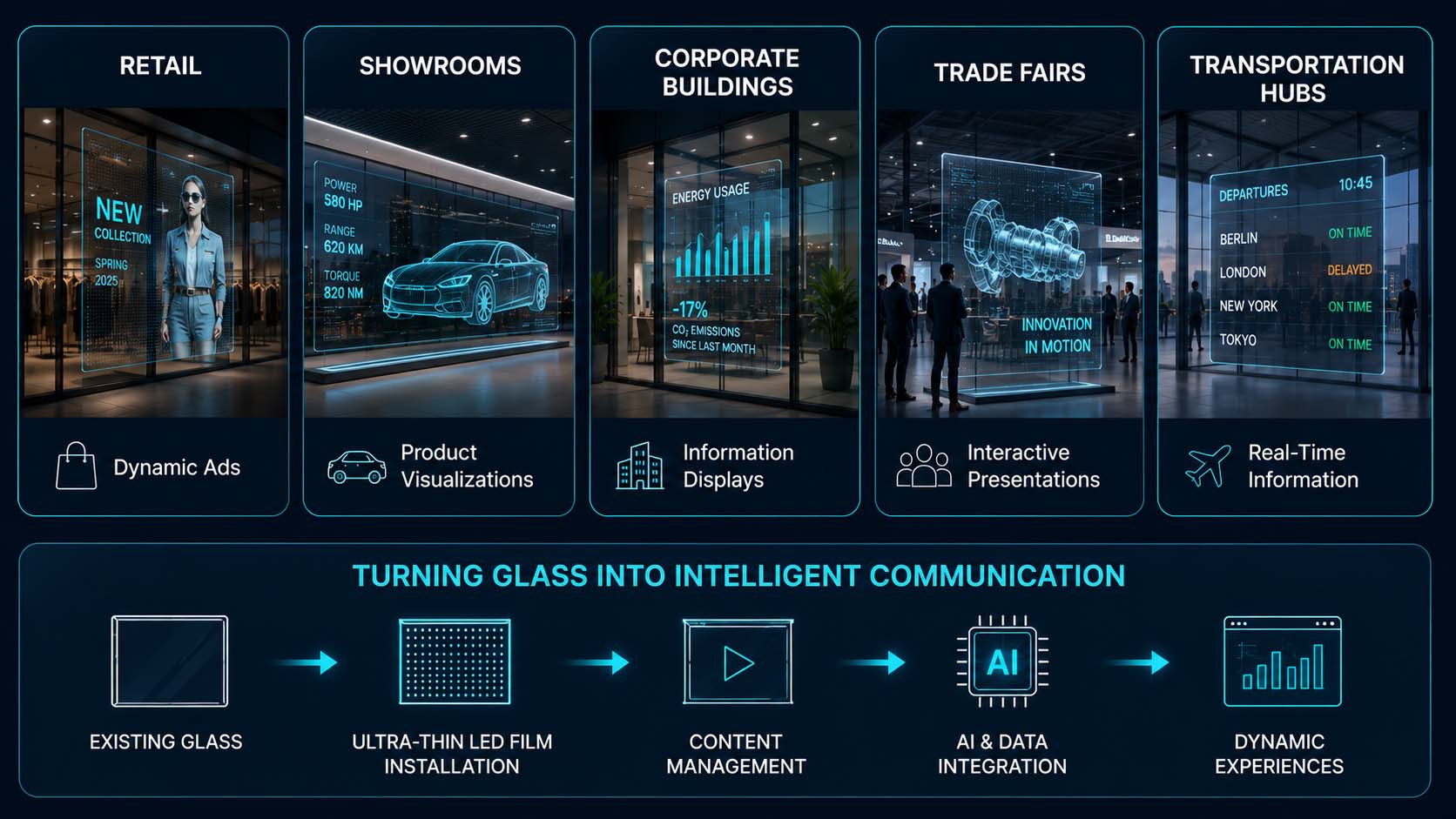
Transparent displays create new opportunities for showrooms, trade fairs, retail, architecture, and digital corporate communication.
Diagram: Typical applications of transparent displays in retail, showrooms, industry, hospitality, museums, and corporate buildings | Graphic: © Ulrich Buckenlei | VISORIC GmbH
In retail, digital storefronts can showcase products effectively even outside regular business hours. In showrooms, machinery, vehicles, and technical products can be enhanced with animations, technical specifications, and interactive 3D models. At trade fairs, transparent displays enrich physical exhibits without obscuring them. Museums and exhibitions use the technology to overlay additional information directly onto objects, while hotels and corporate headquarters welcome visitors with dynamic greeting and information systems.[10]
The technology also unlocks new opportunities in industrial environments. Glass surfaces in control rooms, laboratories, and production facilities can display live operating data, maintenance information, and process metrics without restricting the view of machines or equipment. This creates modern workspaces where digital information is seamlessly integrated with the physical production environment.
Transparent displays become even more powerful when combined with digital twins and real-time 3D technologies. Products can be explained virtually, technical relationships can be visualized intuitively, and complex information can be presented directly alongside physical objects. The result is an interactive product experience that extends far beyond traditional digital signage.
- Digital storefronts combine products with dynamic information.
- Showrooms enhance physical exhibits with 3D models and animations.
- Trade fairs create attention-grabbing and highly flexible presentation environments.
- Museums and exhibitions enrich physical objects with digital information.
- Industrial facilities and corporate buildings integrate real-time data directly into their architecture.
The application possibilities of transparent displays continue to expand. As software, real-time data, artificial intelligence, and digital twins become increasingly integrated into these systems, intelligent communication platforms emerge that can adapt flexibly to different industries and application scenarios.
The Limitations and Challenges Companies Should Understand
Ultra-thin transparent displays open up entirely new possibilities for corporate communication. At the same time, they differ significantly from conventional LED walls and large-format displays in both technical performance and design considerations. Companies should account for these differences during the concept phase. The success of a project often depends less on the display technology itself than on realistic planning of the installation environment, content strategy, and technical framework.[13]
The following illustration summarizes the most important planning factors. At the center is the transparent display itself. Surrounding it are architecture, ambient lighting, content, viewing distance, transparency, pixel pitch, power supply, and software. Only the balanced interaction of these elements determines whether an installation delivers an outstanding visual experience or falls short of expectations.
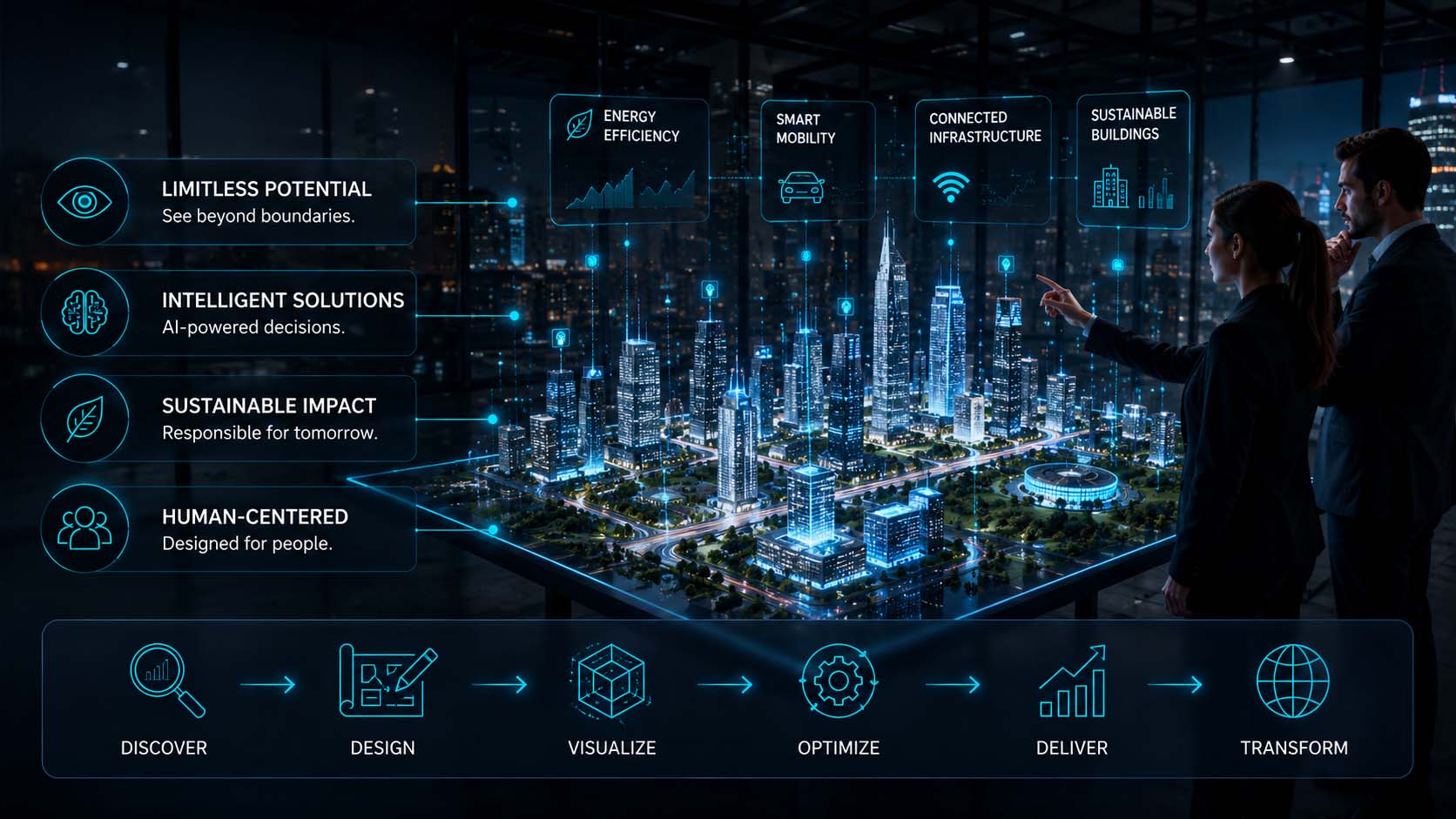
The success of transparent displays depends on the interaction of architecture, content, technology, and the installation environment.
Diagram: Key planning and success factors for transparent displays in architecture, retail, showrooms, and corporate communication | Graphic: © Ulrich Buckenlei | VISORIC GmbH
The diagram illustrates that transparent displays have fundamentally different requirements than conventional screens. A high level of transparency inevitably reduces perceived brightness and contrast. In addition, sunlight, reflections, and viewing angles all influence content visibility. For this reason, content must be specifically designed for transparent displays. Strong contrast, clean animations, and reduced information density often produce significantly better results than traditional screen layouts.[14]
Architecture also plays a crucial role. Glass surfaces differ considerably in size, orientation, structural characteristics, and lighting conditions. Even small changes in installation height, viewing distance, or pixel pitch can noticeably affect how content is perceived. Careful technical planning minimizes later adjustments and ensures that physical products and digital information complement each other perfectly.
As artificial intelligence becomes more deeply integrated, additional considerations arise. Whenever cameras or sensors are used, data privacy, transparency, and cybersecurity must be addressed from the very beginning. At the same time, a scalable software architecture is recommended so that future capabilities such as real-time data integration, personalization, and digital twins can be implemented without requiring a complete system redesign.
- Sunlight, reflections, and viewing angles influence image quality.
- Transparency and pixel pitch must be optimized for the intended application.
- Content requires a design specifically created for glass-based displays.
- Software and system architecture should be designed for future scalability.
- Data privacy and cybersecurity become increasingly important in AI-powered applications.
Transparent displays are therefore not a universal solution for every glass surface. However, when planned correctly, they enable exceptional communication concepts that seamlessly combine architecture with digital content. The key to success lies in a holistic planning approach that considers technology, design, and the intended use case as one integrated system from the outset.
The Opportunities Transparent Displays Create for Businesses
Ultra-thin transparent displays offer far more than a new advertising medium. They enable companies to actively integrate existing architecture into digital communication while combining physical products with digital information. This creates communication solutions that conventional displays can only provide to a limited extent. The greatest value lies not in the transparency itself, but in the ability to merge physical spaces with digital content.[11]
The following illustration highlights the key business opportunities created by transparent displays. At the center is the glass surface as a shared communication platform. From this foundation emerge numerous advantages for marketing, sales, product presentation, and corporate communication. Existing windows, storefronts, and glass façades become digital information surfaces while preserving their original function as transparent architectural elements.
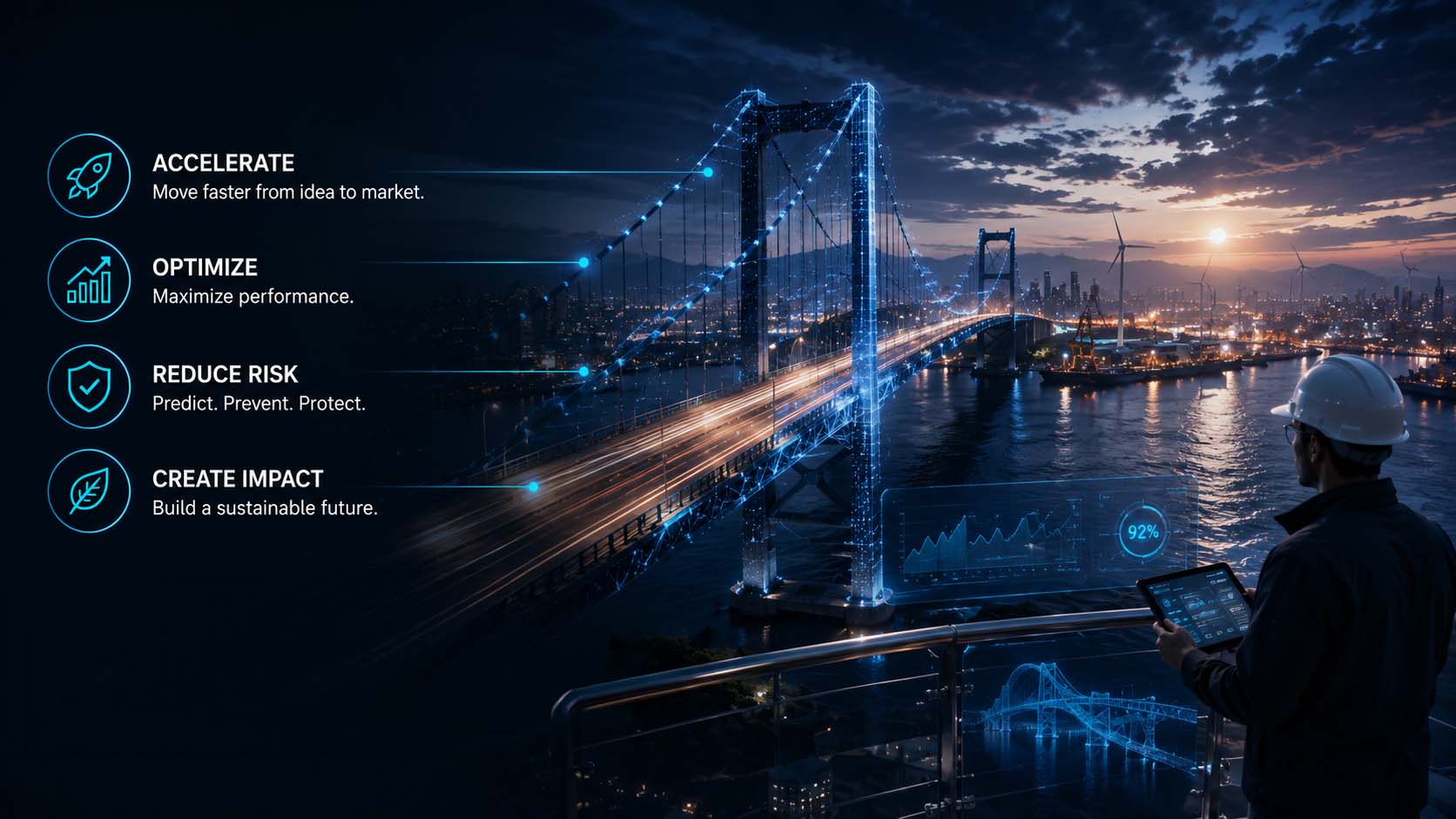
Transparent displays combine architecture, products, and digital content into a new generation of interactive corporate communication.
Diagram: Business potential of transparent displays for marketing, sales, showrooms, trade fairs, and digital corporate communication | Graphic: © Ulrich Buckenlei | VISORIC GmbH
The diagram demonstrates that transparent displays offer far more than the ability to present conventional advertising content. They capture attention without obscuring physical products while simultaneously enabling flexible digital communication. Companies can update content at any time, manage campaigns across multiple locations, and utilize existing glass surfaces for multiple purposes. This enables communication concepts that can be adapted much faster to new products, target audiences, and events.[12]
Transparent displays become particularly powerful when combined with interactive 3D content, digital twins, and real-time data. Products can be enhanced with animations, technical features can be visualized, and additional information can be displayed directly on the glass surface. Visitors benefit from a significantly richer product experience, while companies can centrally manage and continuously improve their digital content.
There are also substantial economic advantages. Instead of producing new physical advertising materials for every campaign, companies can update content digitally. Glass surfaces simultaneously fulfill multiple roles: they remain part of the building’s architecture while also serving as digital communication platforms. This creates flexible long-term systems that can easily adapt to changing business requirements.
- Existing glass surfaces become digital communication media.
- Physical products can be combined with digital information.
- Content can be managed centrally and updated at any time.
- Showrooms, trade fairs, and storefronts attract significantly more attention.
- Digital twins and interactive 3D content create entirely new product experiences.
The greatest opportunity of transparent displays therefore does not lie in the hardware itself. It lies in the ability to combine architecture, products, and digital content into a unified communication platform. This creates entirely new forms of brand communication, product presentation, and customer interaction.
When Artificial Intelligence Makes Transparent Displays Truly Intelligent
The true future of transparent displays does not begin with higher resolution or greater brightness. It begins where artificial intelligence analyzes, generates, and adapts displayed content in real time according to the current context. A static presentation surface evolves into an intelligent communication platform capable of responding to visitors, products, times of day, and events.[13]
The following illustration visualizes this transformation. At its center is the transparent display serving as a digital interface between architecture and people. Around this glass surface, multiple technologies interact seamlessly. Computer Vision recognizes products and visitors, sensors provide live contextual information, cloud services deliver content, and artificial intelligence generates context-aware experiences. At the same time, Digital Twins, real-time data, and 3D models can be visualized directly on the glass surface, creating a fully connected communication ecosystem.

Artificial intelligence connects transparent displays with real-time data, Digital Twins, and personalized content.
Diagram: Transparent displays as an intelligent communication platform powered by Artificial Intelligence, Computer Vision, Cloud services, Digital Twins, and real-time data | Graphic: © Ulrich Buckenlei | VISORIC GmbH
The diagram illustrates that transparent displays will no longer operate as isolated systems. Instead, they become part of a unified digital infrastructure. Content is delivered from content management systems, enterprise databases, and cloud platforms, where it can be updated automatically. Product information, event calendars, inventory levels, and technical specifications can all be integrated through open APIs. This creates applications that extend far beyond traditional digital signage.[14]
Artificial intelligence makes this evolution particularly compelling. Large language models can automatically generate product descriptions, translate content into multiple languages, or personalize presentations for different visitor groups. Computer Vision detects objects and movement, triggering context-sensitive content. Sensors contribute additional information such as time of day, weather conditions, or visitor density. As a result, transparent displays evolve into adaptive communication systems capable of delivering information dynamically according to the current situation.
This creates entirely new opportunities for businesses. Storefronts can automatically respond to changing product assortments, exhibition booths can present different content depending on visitor interests, and showrooms can combine physical products with Digital Twins and interactive 3D models. The architecture itself remains unchanged while gaining an intelligent digital layer.
- Artificial intelligence generates and personalizes content in real time.
- Computer Vision recognizes products, visitors, and usage scenarios.
- Cloud platforms centrally manage content across multiple locations.
- Digital Twins and real-time 3D enrich physical products with digital information.
- Transparent displays evolve into intelligent communication systems.
The greatest transformation therefore does not lie in the display technology itself. The real breakthrough comes from intelligently connecting software, data, artificial intelligence, and architecture into a unified communication platform. This is where the intelligent business environments of the next generation begin.
From LED Film to an Intelligent Communication Platform
Ultra-thin transparent displays have long evolved beyond being just an LED film combined with a media player. Behind today’s modern installations operates a complete software architecture that manages content, processes data, connects multiple systems, and will increasingly be enhanced by artificial intelligence. The real innovation therefore lies not only in the display technology itself, but in the intelligent integration of all system components.[15]
The following illustration shows the typical architecture of a modern transparent display solution. At the foundation is the transparent LED film together with its control electronics. Above it operate controllers, content management systems, and cloud platforms that centrally manage content and distribute it across virtually unlimited locations. Open interfaces allow the integration of product information, event calendars, ERP systems, IoT sensors, and external data sources. At the top of the architecture, artificial intelligence extends the entire platform with automated content generation, personalization, and intelligent decision support.
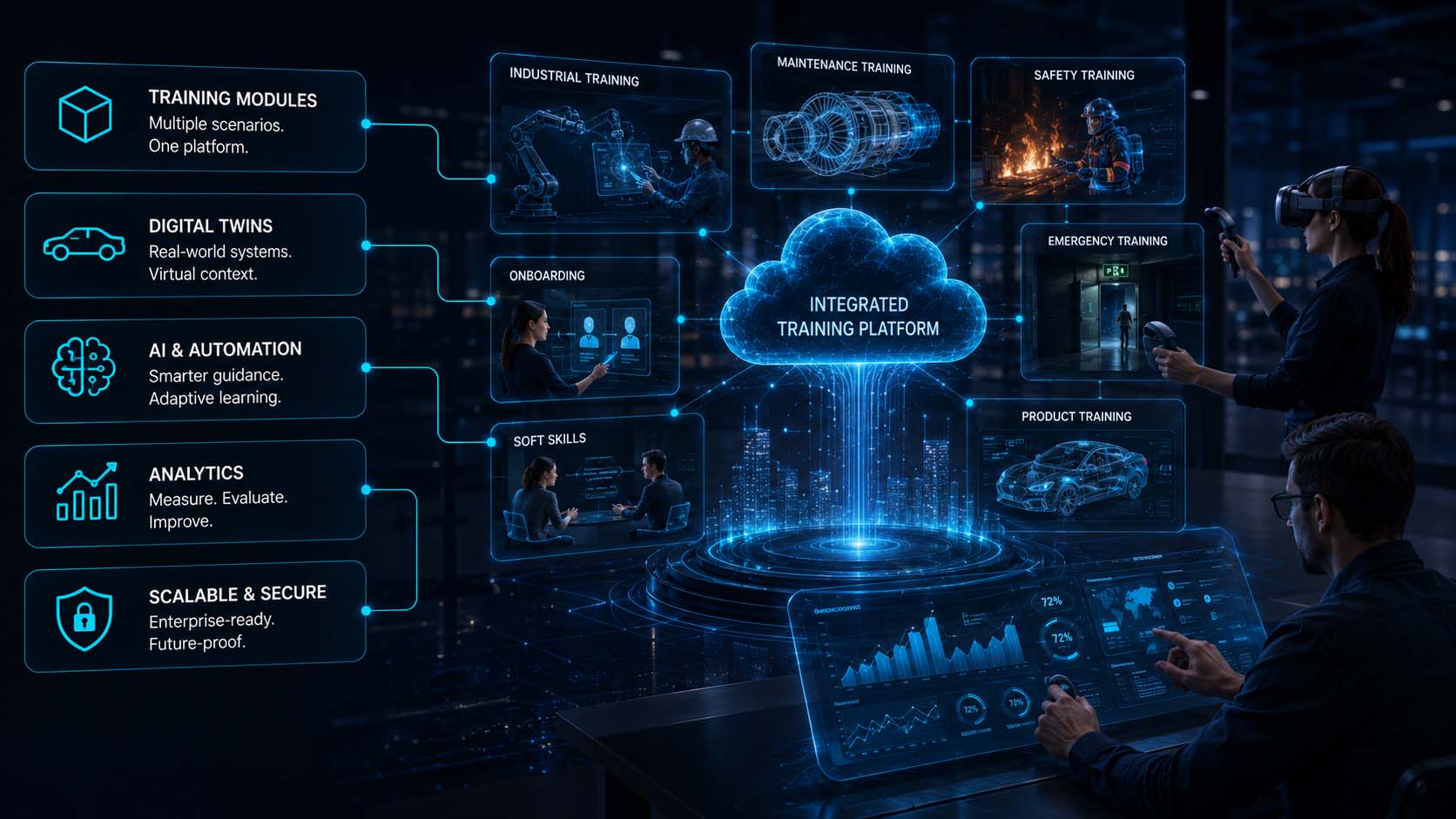
A modern transparent display solution combines hardware, cloud services, software, Digital Twins, and artificial intelligence into a unified platform.
Diagram: System architecture of transparent display platforms featuring LED film, controllers, CMS, cloud services, APIs, Digital Twins, and Artificial Intelligence | Graphic: © Ulrich Buckenlei | VISORIC GmbH
The illustration also highlights that content is no longer limited to pre-produced videos. Companies are increasingly integrating interactive 3D models, Digital Twins, product configurators, and real-time information into their communication environments. As a result, applications become significantly more flexible than traditional digital signage systems. Content can be updated automatically, adapted to different audiences, and centrally managed worldwide through cloud-based platforms.[16]
This evolution becomes even more compelling through the integration of artificial intelligence. Language models can automatically generate product descriptions, translate content into multiple languages, or personalize presentations according to visitor profiles. Computer Vision recognizes products and situations, while real-time data feeds continuously enrich displayed information. Transparent displays are therefore evolving from passive display surfaces into active communication systems.
For businesses, this represents a fundamental paradigm shift. Hardware is becoming increasingly interchangeable, while software, content, data integration, and artificial intelligence create the true competitive advantage. This is where scalable platforms emerge that can expand from individual displays to entire showrooms, corporate buildings, trade fair installations, and international locations.
- Controllers, CMS, and cloud platforms form the foundation of modern display solutions.
- APIs connect transparent displays with ERP, PIM, CRM, and IoT systems.
- Digital Twins and real-time 3D extend traditional digital signage applications.
- Artificial intelligence automates content creation and enables personalization.
- Software becomes the decisive success factor for transparent display solutions.
The future of transparent displays will therefore not be defined solely by better hardware. The decisive factor will be the intelligent platform behind it, bringing together content, data, artificial intelligence, and interactive applications into a unified digital communication solution.
The Future of Transparent Displays
Transparent displays are currently evolving from standalone display technology into intelligent communication platforms. While the first systems primarily made digital content visible on glass surfaces, today’s fully connected solutions integrate software, real-time data, artificial intelligence, and interactive user interfaces. As a result, not only the technology behind transparent displays is changing, but also the way companies will communicate with customers, employees, and visitors in the future.[17]
The following illustration summarizes this evolution. On the left, the technological journey begins with conventional transparent displays whose primary purpose was to present digital information without obscuring the architecture behind the glass. The next stage introduces interactive 3D content, product visualizations, and Digital Twins. A static display surface evolves into a dynamic communication environment.
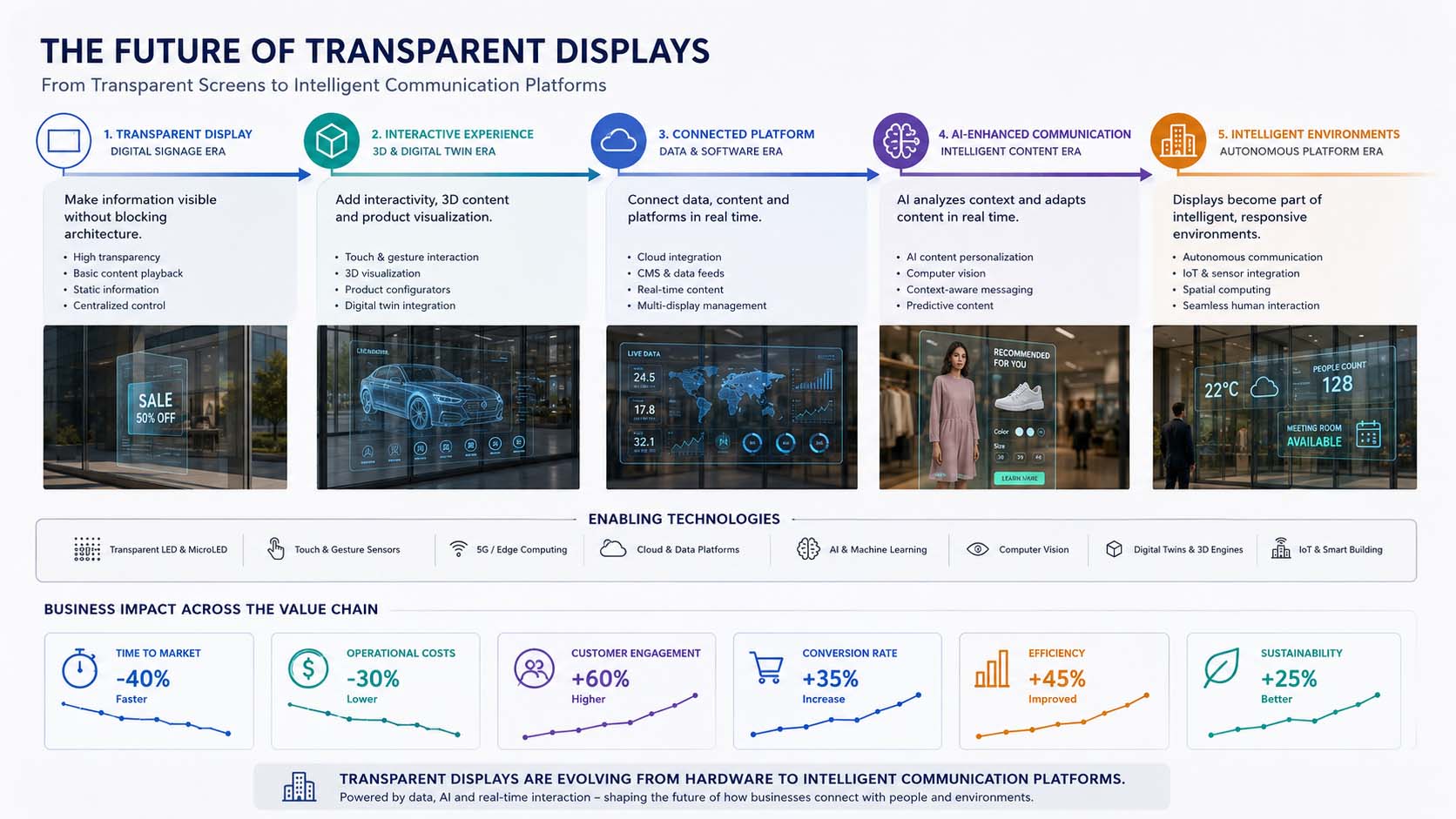
The evolution of transparent displays from conventional digital signage to intelligent AI-powered communication platforms.
Diagram: Evolution of transparent display technologies from digital signage through Digital Twins and artificial intelligence toward intelligent buildings | Graphic: © Ulrich Buckenlei | VISORIC GmbH
The central section of the illustration demonstrates that software is increasingly becoming the key success factor. Content will no longer originate solely from pre-produced videos. Instead, product information, cloud services, content management systems, real-time data, and Digital Twins converge within a single platform. Displays evolve from output devices into interactive user interfaces for businesses.
The right side illustrates the next stage of development. Artificial intelligence will analyze situations, visitor flows, products, and events, automatically adapting content to the respective context. Computer Vision, sensor technologies, and language models enable adaptive communication systems that generate, update, and personalize information dynamically. As a result, buildings will no longer simply display information—they will communicate with people according to the current situation.[18]
This evolution becomes particularly exciting where transparent displays converge with Digital Twins and Spatial Computing. Physical products can be enhanced with digital content, machinery can be explained interactively, and complex technical relationships can be visualized directly on glass surfaces. This opens entirely new opportunities for sales, product presentation, training, and collaboration.
- Transparent displays are evolving from hardware into intelligent communication platforms.
- Software and content become more important than the display technology itself.
- Artificial intelligence enables adaptive and personalized real-time content.
- Digital Twins and real-time 3D create interactive product experiences on glass surfaces.
- Buildings will evolve into intelligent interfaces between the physical and digital worlds.
The greatest transformation therefore does not lie in higher transparency or increased display resolution. It lies in the intelligent convergence of architecture, software, artificial intelligence, and interactive content. Individual glass surfaces become adaptive communication platforms that deliver context-aware information and create entirely new opportunities for digital interaction.
Ultra-Thin, Transparent, and Ready for Artificial Intelligence
Ultra-thin transparent LED films represent one of the most exciting innovations in digital corporate communication. With a material thickness of only about one millimeter, they can be applied almost invisibly to existing glass surfaces, cut to custom dimensions, and even installed on curved structures. When switched off, they remain nearly transparent and have minimal impact on the surrounding architecture. Only when content is displayed do windows, façades, and glass walls transform into digital communication surfaces.
The true strength of this technology, however, lies not in the hardware alone. It is the combination of intelligent software, real-time data, and artificial intelligence that creates adaptive communication platforms capable of automatically adjusting content to products, visitors, events, or times of day. A transparent display therefore evolves into a dynamic medium that presents information precisely where it is needed.
The following video demonstrates this evolution through a current real-world example. It showcases the flexibility of ultra-thin transparent LED films while offering a glimpse into how artificial intelligence could soon generate and control content dynamically in real time.
Video source: Original video discovered via @ashancduk | Analysis, technology assessment, narration, and editorial work: © Ulrich Buckenlei | XR Stager Online Magazine | VISORIC GmbH
Today, transparent displays are primarily operated using pre-produced videos or scheduled content. Over the coming years, this is expected to change fundamentally. Artificial intelligence will automatically generate, update, and personalize content for different audiences. Product information may change in real time, storefronts could display personalized recommendations, and exhibition booths may automatically adapt their content according to conversations, products, or events.
This evolution becomes particularly exciting when combined with Digital Twins and real-time 3D technologies. Instead of conventional advertising videos, interactive product models, technical simulations, and Digital Twins can be presented directly behind glass. Visitors no longer simply receive information—they can experience products spatially and interact with them. Transparent displays therefore evolve from passive presentation surfaces into intelligent user interfaces connecting the physical and digital worlds.
- Ultra-thin LED films integrate almost invisibly into existing glass surfaces.
- Existing windows and façades become digital communication environments.
- Artificial intelligence enables adaptive and personalized content.
- Digital Twins and real-time 3D create interactive product experiences.
- Transparent displays evolve into intelligent communication platforms.
The greatest transformation therefore does not lie in the display technology itself. It lies in the intelligent convergence of architecture, software, artificial intelligence, and interactive content. This is where the next generation of digital corporate communication begins.
From Transparent Display to a Successful Pilot Project
Ultra-thin transparent displays deliver their greatest value not as standalone hardware but as part of an integrated communication strategy. The key questions are which content appears on the glass surface, how it is managed, and what measurable value it creates for visitors, customers, or employees.
Companies should therefore begin not by selecting a display, but by defining a clear business use case. A trade fair booth, showroom, storefront, or internal presentation area is often a better starting point than a large-scale rollout. This allows the visual impact, technical requirements, and content strategy to be evaluated under realistic operating conditions.
The successful deployment of transparent displays begins with a clearly defined use case, compelling content, and a scalable software platform.
Visualization: Transparent displays, interactive 3D content, Digital Twins, content management, trade fair experiences, and AI-powered communication platforms | Image: © Ulrich Buckenlei | VISORIC GmbH
A practical approach for getting started:
- Select a clearly defined pilot application, such as a trade fair booth, showroom, reception area, or storefront.
- Evaluate transparency, brightness, viewing distance, and existing glass surfaces from a technical perspective.
- Develop a content strategy for video, animation, 3D products, and Digital Twins.
- Plan software, controllers, content management, and data sources as one integrated system from the outset.
- Test interactive features such as touch, sensors, smartphone control, or AI in a targeted pilot environment.
- Evaluate the pilot project and then expand it to additional locations or communication spaces.
For trade fair and showroom applications, content should be planned before the hardware is installed. Products require clean cut-outs, strong visual motion, and designs that preserve a clear view of the physical objects behind the glass. The most compelling experiences combine real exhibits with digital information, animations, and interactive product models.
The software architecture is equally critical for long-term success. Content should be centrally managed, scheduled, and distributed across multiple displays. Product information, marketing campaigns, event data, and real-time information can all be integrated through standardized interfaces. This transforms a single LED film into a scalable communication platform.
The VISORIC expert team in Munich supports companies throughout the planning and implementation of these solutions:
- Strategy development and feasibility studies for transparent display projects.
- Technical design of display hardware, controllers, software, and system integration.
- Development of trade fair, showroom, and retail experiences.
- Production of video, animation, real-time 3D content, and Digital Twins.
- Centralized content management and interactive applications using XR Stager.
- Integration of enterprise data sources, sensor technologies, and AI-powered personalization.
- Pilot implementation, commissioning, and continuous expansion of scalable solutions.
Are you planning to deploy ultra-thin transparent displays in a showroom, at a trade fair, or as part of your corporate communication strategy?
Talk to the VISORIC expert team in Munich about a practical pilot project, the right software architecture, and the development of compelling digital experiences.
Contact
Email: info@visoric.com
Phone: +49 89 21552678
Sources and References
- IEEE and Kent State University, “Dual-Sided Transparent Display,” research on the development of transparent displays as new media and interaction platforms.
- LG Display and Samsung Electronics, developments in transparent OLED and MicroLED displays and their role in the evolution of commercial transparent display technologies.
- D. Shavit, “Developments of LEDs and SMD Electronics on Transparent Conductive Polyester Films,” foundational research on integrating LEDs and conductive traces into transparent flexible films.
- Ran Bi et al., “Breaking Through the Plasma Wavelength Barrier to Extend the Transparency Range of Ultrathin Indium Tin Oxide Films,” research on ultra-thin transparent conductive structures with high optical transparency.
- LG Business Solutions and LG Display, Transparent OLED and commercial transparent display solutions for retail, showrooms, museums, and corporate communication.
- Product portfolios and technical documentation from Samsung, Leyard, Unilumin, INFiLED, Muxwave, ClearLED, Nexnovo, and YIPLED covering transparent MicroLED, LED mesh, and self-adhesive LED film systems.
- LG Display, Transparent OLED Technology, self-emissive transparent OLED panels and their application in premium commercial display solutions.
- Samsung Electronics, Transparent MICRO LED, together with scientific and industrial publications covering Transparent LCD, OLED, MicroLED, LED Mesh, LED Glass, and flexible LED film technologies.
- LG Business Solutions, reference applications for transparent displays in retail, museums, transportation, hospitality, showrooms, and public information environments.
- Integrated Systems Europe and AVIXA, practical examples of transparent LED systems, digital signage, immersive brand environments, and connected commercial display solutions.
- Pine, B. Joseph and Gilmore, James H., “The Experience Economy,” foundational concepts on creating economic value through differentiated and memorable customer experiences.
- McKinsey & Company, analyses of next-generation customer experience, personalized communication, and digital customer touchpoints in retail, marketing, and enterprise environments.
- IEC 62368-1 and IEC 62471, standards covering the safety of audiovisual systems and the photobiological safety of LED and lighting systems.
- European General Data Protection Regulation (GDPR) and the European Data Protection Board, requirements for transparency, data minimization, and Privacy by Design in camera-based analytics and personalized communication.
- W3C and Khronos Group, WebGL, WebXR, glTF, and open web standards for interactive 3D content, real-time visualization, and cross-device digital experiences.
- LG Business Cloud, Navori Labs, and Signagelive, cloud-based CMS platforms, API-driven control, remote monitoring, scheduling, and data-driven digital signage management.
- Gartner, Emerging Technologies and Trends Impact Radar, analysis of Artificial Intelligence, Computer Vision, Spatial Computing, and intelligent user interfaces.
- Accenture Technology Vision, perspectives on generative AI, adaptive digital experiences, and intelligent physical environments for enterprises and customer communication.
- Original video material and editorial case study demonstrating ultra-thin transparent LED films, flexible installation, custom shaping, and the use of existing glass surfaces as digital communication platforms.
- Narration, technical analysis, editorial classification, and contextualization: © Ulrich Buckenlei | XR Stager Online Magazine | VISORIC GmbH.
- See sources [3], [5], [7], [9], [13], [15], and [17] regarding the convergence of display technology, architecture, content management, real-time 3D, and artificial intelligence.
- Based on current scientific publications, manufacturer documentation, and industry references covering Transparent OLED, MicroLED, LED Film, Digital Signage, Computer Vision, and Spatial Computing.
- VISORIC project experience and services for transparent display concepts, trade fair and showroom experiences, interactive 3D visualization, Digital Twins, content production, and AI-powered corporate communication.
- XR Stager platform for centralized content management, interactive product presentations, real-time 3D, Digital Twins, cloud-based content distribution, and scalable applications across displays, mobile devices, and XR systems.
Contact Persons:
Ulrich Buckenlei (Creative Director)
Mobile: +49 152 53532871
Email: ulrich.buckenlei@visoric.com
Nataliya Daniltseva (Project Manager)
Mobile: +49 176 72805705
Email: nataliya.daniltseva@visoric.com
Address:
VISORIC GmbH
Bayerstraße 13
D-80335 Munich