


The title image illustrates the vision of everyday Spatial Computing through lightweight AR glasses. Real time translation, navigation, AI assistance, remote collaboration, industrial support, cooking guidance and live contextual information become seamlessly integrated into the user’s physical environment.
Visualization: Snap Spectacles, wearable Spatial Computing, Augmented Reality interfaces, AI assistants, live translation, navigation, industrial guidance, remote collaboration and context aware digital experiences | Image: © Ulrich Buckenlei | VISORIC GmbH
From Smart Glasses to Everyday Spatial Computing
For decades, digital information has been tied to screens. Smartphones, tablets, laptops and monitors became the primary gateways to knowledge, communication and productivity. The next generation of computing may fundamentally change that relationship by moving digital content directly into the user’s field of view. Instead of looking down at a device, information becomes part of the surrounding environment.[1]
Recent advances in wearable technology, artificial intelligence, computer vision and Spatial Computing are bringing this vision closer to reality. Lightweight AR glasses can display contextual information, understand the physical world, recognize objects and locations, translate conversations, support navigation and provide intelligent assistance exactly when it is needed.[2]
The title image of this article visualizes that transition. A single pair of smart glasses becomes the gateway to multiple digital experiences. Real time language translation enables communication across cultures. Navigation instructions appear directly within the environment. AI assistants provide contextual support. Remote collaboration becomes more natural. Industrial maintenance information can be displayed at the point of work. Even cooking instructions or sports analytics can be integrated directly into the user’s view.
What makes this development particularly significant is the convergence of technologies that previously existed separately. Artificial intelligence provides understanding and reasoning. Computer vision interprets the environment. Spatial tracking anchors digital objects in physical space. Lightweight displays present information naturally within the user’s surroundings. Together, these capabilities create a new form of computing that feels less like operating a device and more like interacting with the world itself.
This shift has the potential to affect nearly every industry. Education, healthcare, manufacturing, logistics, retail, tourism, entertainment and professional services could all benefit from context aware information delivered precisely where it is needed. The interface gradually disappears while the information becomes more accessible.
The result is not simply another gadget category. It represents a broader evolution toward ambient computing, where digital services become continuously available without demanding constant attention. Instead of opening applications, users interact with information that already understands context, location and intent.
- Spatial Computing moves digital content directly into the user’s environment
- AR glasses combine AI, computer vision and contextual awareness
- Information becomes available exactly where it is needed
- Real time translation, navigation and assistance become hands free experiences
- Multiple industries could benefit from wearable digital interfaces
The key question is no longer whether AR glasses are technically possible. The real question is whether they are finally becoming practical enough for everyday use.
The Emergence of Practical AR Glasses
For many years, wearable Augmented Reality devices faced a common challenge. Most systems were either too heavy, too expensive, too limited or too dependent on external hardware to become part of everyday life. As a result, many promising concepts remained confined to research laboratories, enterprise projects or early adopter communities.[3]
A new generation of devices is attempting to solve those limitations by focusing on wearability, mobility and integrated computing power. Rather than requiring large headsets or external processing units, modern AR glasses are becoming lighter, more compact and increasingly capable of performing Spatial Computing tasks directly on the device itself.[4]
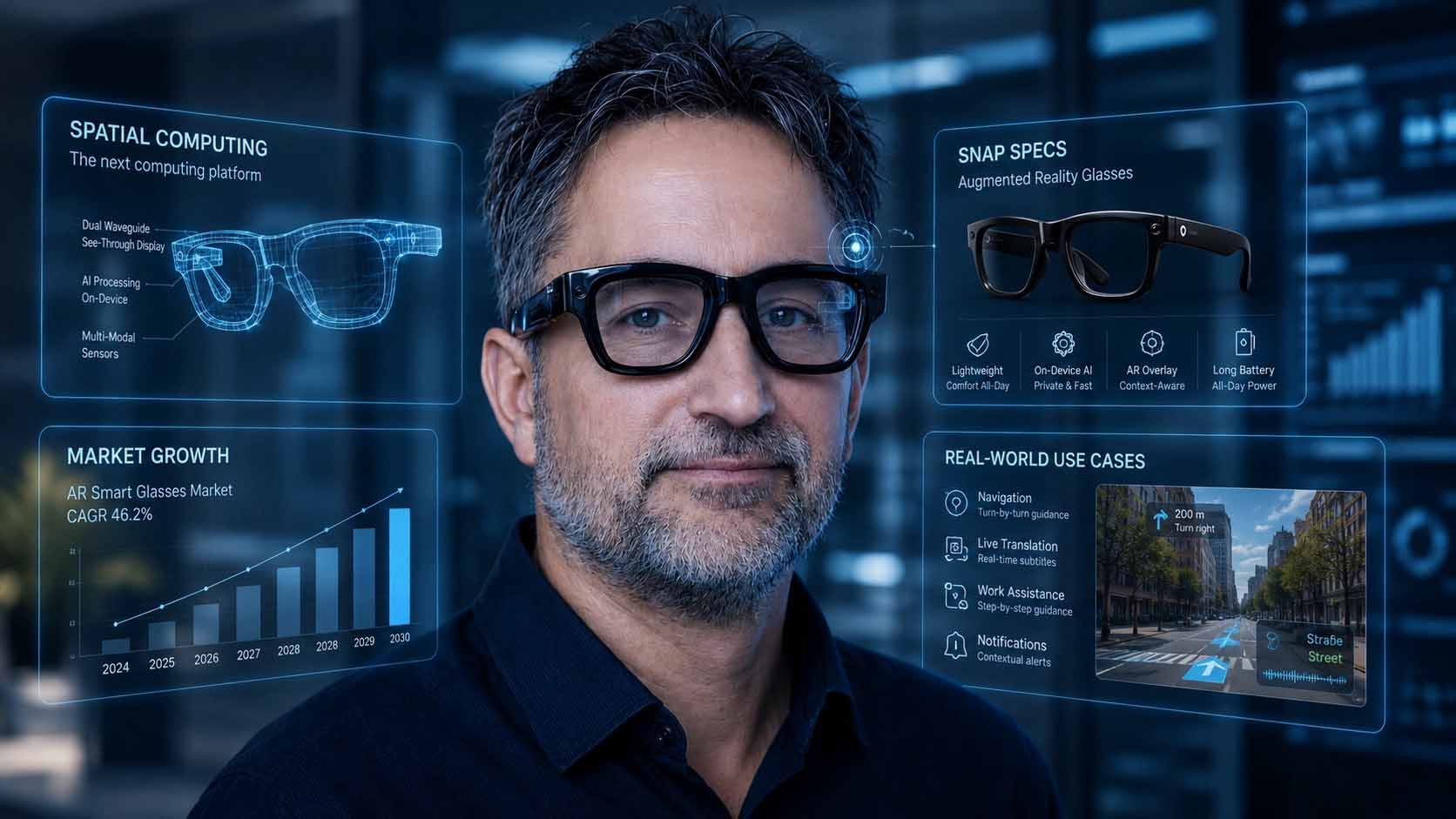
The visualization combines market analysis, Spatial Computing, integrated AI and real world use cases into a comprehensive picture of the next generation of everyday AR glasses.
Visualization: Analysis of the Snap Specs platform, Spatial Computing, on device AI, Smart Glasses market potential, digital assistance systems and future Augmented Reality use cases in everyday life | Image: © Ulrich Buckenlei | VISORIC GmbH
The image highlights the most important developments shaping modern AR glasses. Spatial Computing, integrated AI, emerging use cases and improved wearability are bringing the technology one step closer to everyday adoption.
Modern AR glasses are increasingly positioned as platforms rather than standalone products. They combine displays, cameras, sensors, microphones, AI processing and wireless connectivity into a single wearable form factor. This allows them to deliver information while keeping the user’s hands free and attention focused on the surrounding environment.
One of the most important developments is on device Spatial Computing. Instead of relying entirely on cloud services or external compute packs, new hardware architectures can process environmental information locally. This improves responsiveness, reduces latency and enables more natural interactions with digital content.
At the same time, the market remains in an early phase. Battery life, visual quality, comfort, privacy concerns and affordability continue to influence adoption rates. While devices such as Snap Spectacles demonstrate meaningful progress, significant engineering challenges still remain before wearable AR becomes as common as smartphones.
From an industry perspective, however, the direction is becoming increasingly clear. Computing is gradually moving away from isolated screens toward context aware systems that integrate directly into daily activities. AR glasses represent one of the most visible manifestations of that broader transition.
- Modern AR glasses prioritize comfort, mobility and integrated computing
- On device Spatial Computing reduces dependence on external hardware
- Wearable interfaces keep users connected to their physical environment
- AI, sensors and displays increasingly function as a unified platform
- The industry is moving toward context aware everyday computing
As hardware continues to mature, the next step is understanding how these capabilities translate into practical use cases across work, learning, communication and everyday life.
A New Generation of Standalone AR Glasses
For many years, Augmented Reality glasses struggled to move beyond prototypes, developer kits and niche enterprise deployments. Limited battery life, bulky hardware, narrow fields of view and dependence on external processing units often prevented broader adoption. The latest generation of wearable AR devices aims to overcome these barriers by combining lightweight design, integrated computing and increasingly capable display technologies.[5]
One of the most interesting developments is the emergence of fully standalone Spatial Computing glasses. Instead of relying on smartphones, external compute packs or tethered systems, modern devices increasingly integrate processing, sensors, cameras, displays and connectivity directly into the wearable form factor. This significantly improves mobility and creates a more natural user experience.[6]
The combination of waveguide optics, advanced sensors, AI powered perception and on device processing enables digital information to appear directly within the user’s environment. Navigation instructions, contextual assistance, live translation, collaboration tools and interactive digital content can be accessed without interrupting everyday activities. As a result, AR glasses are gradually evolving from experimental devices into practical computing platforms.
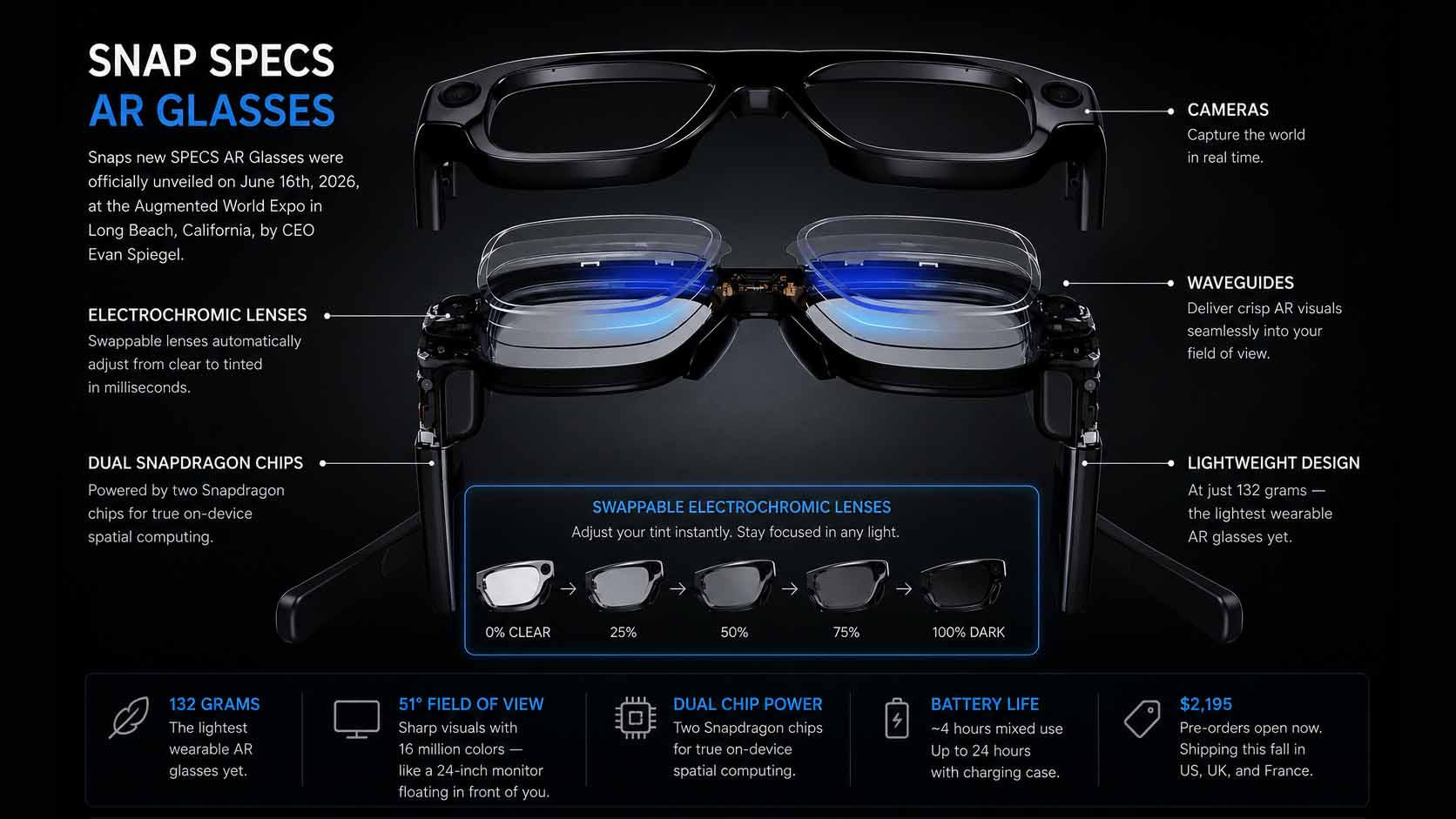
The infographic highlights the key technologies behind modern standalone AR glasses, including waveguide displays, integrated cameras, electrochromic lenses, dual processor architectures and wearable Spatial Computing capabilities.
Visualization: Snap Specs AR glasses architecture, waveguide optics, electrochromic lenses, wearable Spatial Computing, on device AI processing, integrated sensors and next generation Augmented Reality hardware | Image: © Ulrich Buckenlei | VISORIC GmbH
The visualization illustrates how multiple technologies converge into a single wearable platform. Cameras continuously capture environmental information, waveguide displays project digital content into the user’s field of view and dedicated processors handle real time Spatial Computing tasks. Together, these components transform the glasses from a simple display device into an intelligent computing system.
Particularly noteworthy is the integration of electrochromic lenses. These lenses can dynamically adjust transparency depending on lighting conditions, improving visibility and comfort across different environments. Combined with lightweight construction and onboard processing, this approach moves AR hardware closer to everyday usability.
At the same time, important challenges remain. Battery capacity, thermal management, device cost and social acceptance continue to influence adoption. While the technology has progressed significantly, the industry is still searching for the optimal balance between performance, comfort and affordability.
Nevertheless, the direction is becoming increasingly clear. The goal is no longer simply displaying information. The objective is creating a wearable computing platform that can accompany users throughout the day while seamlessly blending digital services into the physical world.
- Standalone AR glasses integrate displays, sensors and processing into a single device
- Waveguide optics enable digital content to appear within the real world
- Electrochromic lenses improve visibility across changing environments
- On device Spatial Computing reduces reliance on external hardware
- Wearable AR platforms are moving closer to everyday practicality
As the hardware becomes more capable, attention increasingly shifts from technical specifications toward a different question: what can people actually accomplish with these devices in everyday life?
From Developer Hardware to the First Step Toward Mass Adoption
The evolution of modern AR glasses is not driven by technological innovation alone. Equally important is whether these devices become affordable and practical enough to reach a broader audience. While early Spatial Computing systems were primarily designed for research, development and enterprise applications, the market is now gradually moving toward commercially available products designed for everyday use.[7]
With the new Snap Specs, Snap introduces an AR device that places a stronger emphasis on mobility, comfort and day to day usability than many previous systems. At the same time, the launch highlights a central challenge facing the industry: making advanced Spatial Computing hardware accessible to a larger market while maintaining meaningful functionality and performance.[8]
This development resembles the early years of smartphones, smartwatches and other wearable technologies. First generation products typically target developers, technology enthusiasts and professional users. Only as manufacturing scales, component costs decrease and demand grows do these devices become attractive to mainstream consumers.
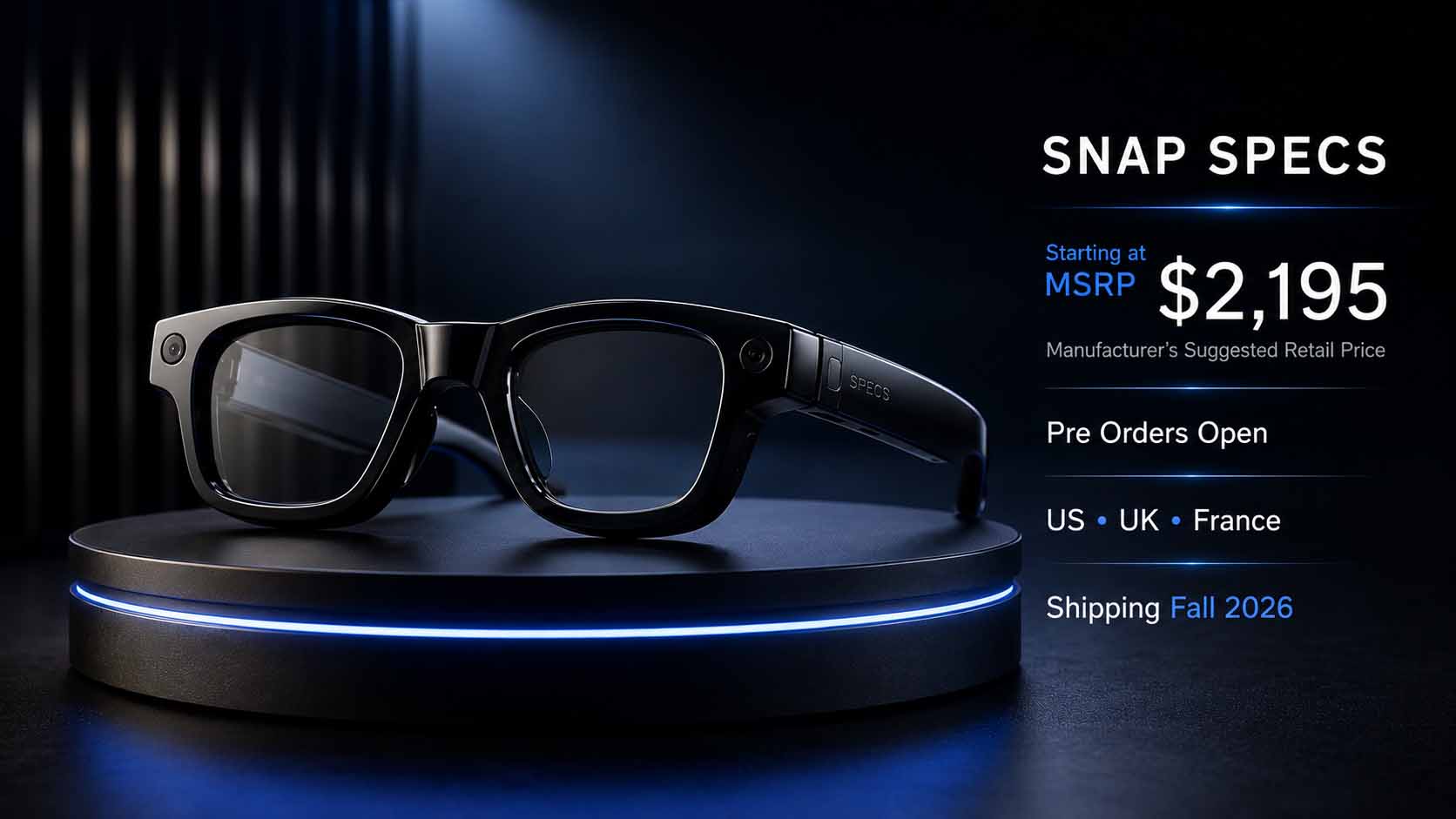
The product visualization highlights the launch of the new Snap Specs and illustrates how pricing, availability and market positioning may influence the path toward everyday AR glasses.
Visualization: Snap Specs market launch, pricing strategy, Spatial Computing hardware, international availability, smart glasses market development and the next generation of wearable AR systems | Image: © Ulrich Buckenlei | VISORIC GmbH
The image illustrates how the conversation around AR glasses is increasingly shifting from technical demonstrations toward real commercial products. With a starting price of 2,195 USD, the new Snap Specs are positioned significantly below the Apple Vision Pro, which launched at approximately 3,500 USD. Nevertheless, the price remains substantial for many consumers and reflects the fact that the technology is still in an early market phase.
Equally noteworthy is the geographical rollout. While many previous AR devices initially launched only in the United States, Snap announced availability in the United States, the United Kingdom and France. This suggests that manufacturers increasingly see international potential for Spatial Computing and are beginning to expand beyond a single domestic market.
From a business perspective, the industry appears to be reaching an important turning point. Devices are becoming lighter, more capable and more suitable for everyday use. At the same time, cost, battery life and overall usability still require significant improvements before adoption levels can approach those of smartphones.
For industry analysts, the real significance therefore lies not in the price of a single product, but in the broader signal it sends. AR glasses are gradually moving beyond the status of developer hardware and becoming commercially available products designed for practical real world applications.
- Snap Specs launch with a starting price of 2,195 USD
- The device costs significantly less than the Apple Vision Pro
- Pricing remains a challenge for mainstream adoption
- Initial availability includes the United States, United Kingdom and France
- The market is gradually evolving from developer hardware to consumer products
The key question is therefore no longer whether AR glasses are technically possible. The more important question is when price, comfort and practical value will align well enough for millions of people to use them as a natural part of everyday life.
Spatial Computing as the Interface Between People and Knowledge
One of the most important advantages of modern AR glasses is their ability to bring digital knowledge directly to the point of action. Information no longer appears on a separate screen but within the user’s field of view, exactly where it is needed. Particularly for maintenance, training, technical assistance, and industrial workflows, this form of Spatial Computing can provide significant benefits.[9]
This shift fundamentally changes how people interact with complex information. Instead of searching through manuals, navigating software interfaces, or switching between applications, context relevant guidance can appear directly next to a component, machine, or current task. The real environment itself becomes the user interface.
Modern AR glasses demonstrate how digital overlays can support real world workflows. Instructions, diagnostics, visual guidance, sensor data, and expert knowledge become available without interrupting work processes. As artificial intelligence continues to advance, these systems are evolving from simple displays into intelligent assistants capable of understanding context and delivering personalized support.[10]
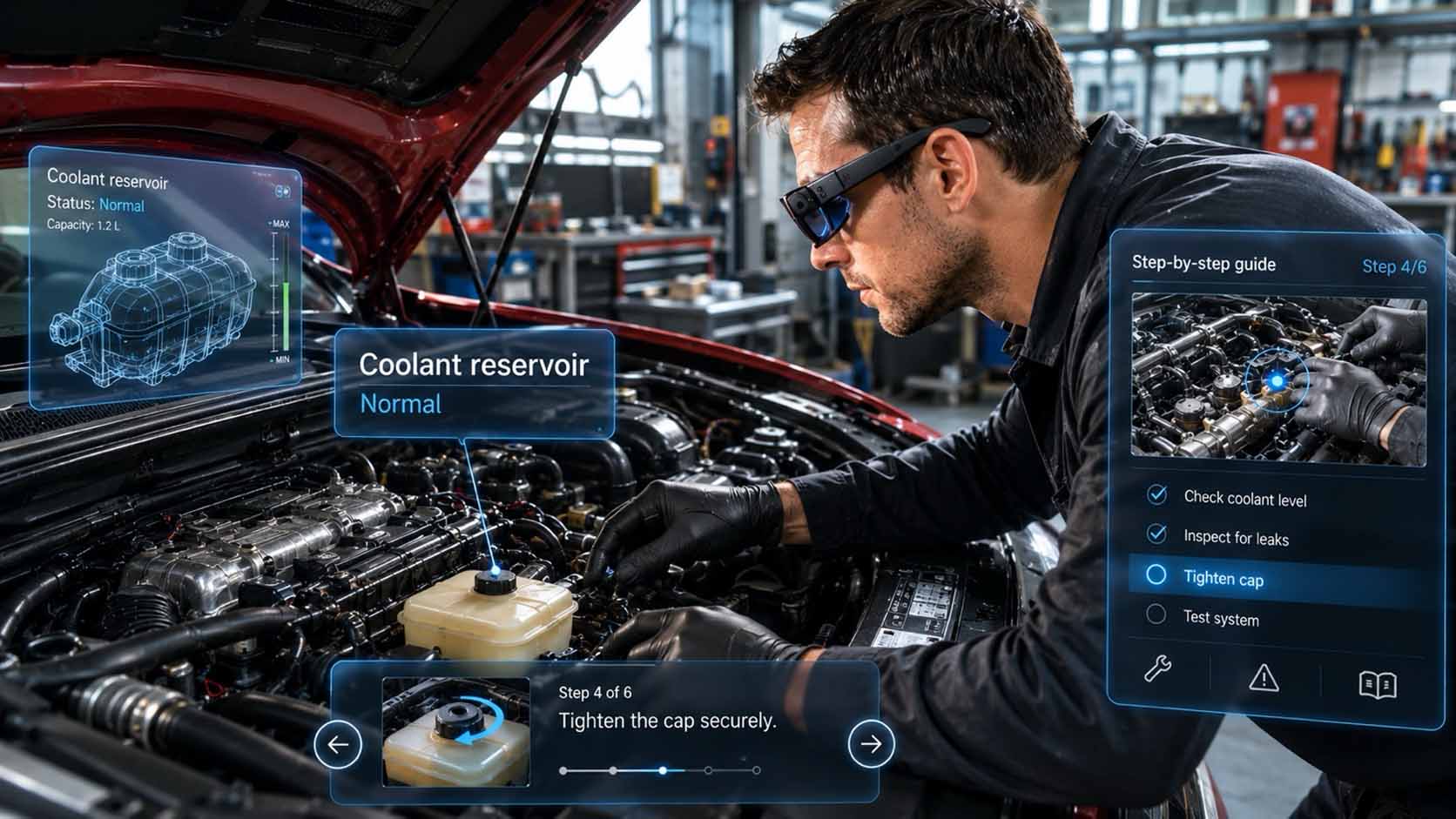
The visualization demonstrates how AR glasses can display technical information, step by step instructions, and AI powered assistance directly within real working environments.
Visualization: Spatial Computing support for industrial maintenance, AR guided repair processes, context aware knowledge delivery, AI assistance, real time visualization, and intelligent human machine interaction | Image: © Ulrich Buckenlei | VISORIC GmbH
The image shows a technician receiving step by step instructions directly within the field of view of AR glasses. Instead of consulting separate documentation, relevant information is spatially anchored to the physical object. As a result, technical knowledge becomes instantly accessible and significantly easier to understand.
This concept extends far beyond automotive maintenance. The same technology can support service technicians, production workers, logistics teams, medical professionals, and trainees. Information appears precisely where it is needed. Complexity is reduced while accuracy and productivity increase.
For businesses, this creates new opportunities for training, support, and knowledge transfer. Expertise can be made available across locations and remains accessible at all times for both experienced specialists and new employees.
The long term significance lies in the convergence of artificial intelligence, Spatial Computing, and digital knowledge systems. Together, they create a new generation of intelligent interfaces that help people understand information faster, learn more efficiently, and act with greater precision.
- AR glasses bring information directly to the location of the task
- AI powered assistance reduces dependence on manuals and traditional user interfaces
- Context aware support improves productivity and decision making
- Knowledge becomes available exactly where real work is performed
- Spatial Computing can fundamentally transform training, maintenance, and operational support
While industrial workflows represent one of the most important application areas, the same principles can also reshape everyday life by integrating intelligent assistance into many personal situations.
From Industrial Assistance to Everyday Digital Companions
The future of AR glasses extends far beyond industrial applications. As wearable devices become increasingly powerful, intelligent assistants may accompany users across many aspects of daily life. Cooking, learning, shopping, traveling, sports, and managing everyday tasks can all benefit from context aware digital support delivered directly within the field of view.[11]
Unlike traditional applications that require constant interaction with smartphones or tablets, Spatial Computing enables continuous access to information without interrupting the primary activity. Instructions, reminders, recommendations, and interactive guidance appear directly within the surrounding environment, allowing users to remain focused on their real world tasks.
Artificial intelligence adds an important layer of personalization to this evolution. Instead of providing static instructions, future systems will be able to dynamically adapt content based on user preferences, progress, context, and behavior. As a result, digital assistance evolves from a passive source of information into an active and responsive companion.[12]
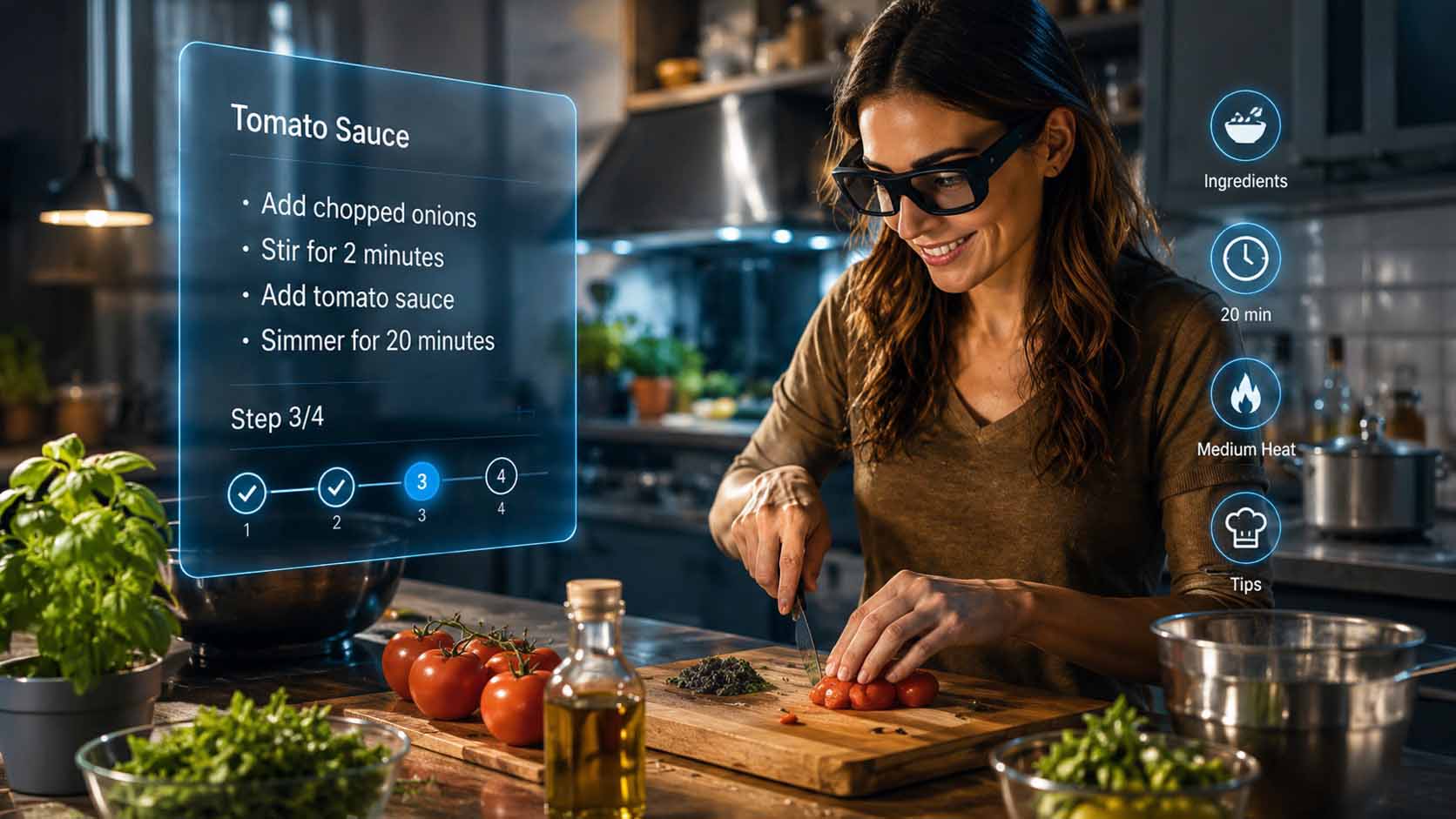
The visualization demonstrates how AR glasses can support everyday activities through context aware instructions, recommendations, and intelligent assistance directly within the real environment.
Visualization: AI assisted cooking guidance, wearable AR interfaces, context aware information delivery, intelligent recommendations, digital everyday companions, and Spatial Computing applications for consumers | Image: © Ulrich Buckenlei | VISORIC GmbH
The image presents a simple yet highly illustrative example. While preparing a meal, the user receives step by step instructions, timing information, and contextual guidance without needing to look at a separate device. All information remains visible and accessible while both hands stay free for the actual task.
The same principle can be applied to countless everyday scenarios. Fitness coaching, home improvement projects, education, travel assistance, language learning, and personal productivity all benefit from information delivered at the right place and the right time.
For businesses, these developments create new opportunities to offer digital services. Brands can provide interactive product guidance, personalized support, and intelligent customer experiences that go far beyond traditional applications or websites.
As artificial intelligence, Spatial Computing, and wearable AR systems continue to converge, the boundary between software and environment begins to blur. Digital services become an integrated part of daily life and remain available whenever and wherever they are needed.
- AR glasses can support everyday activities through context aware assistance
- Spatial Computing helps users remain focused on real world tasks
- Artificial intelligence enables personalized and adaptive assistance
- Hands free interaction improves usability and accessibility
- Digital companions may become a natural part of everyday life
The more visible and deeply integrated intelligent assistance systems become in everyday life, the more important questions of trust, transparency, identity, and long term responsibility will become.
From Personal AI Assistants to Trusted Digital Companions
As artificial intelligence becomes more deeply integrated into AR glasses and Spatial Computing systems, the role of digital assistance is changing significantly. Users no longer interact solely with software displayed on a screen. Instead, they receive context aware insights, analyses, and recommendations directly within their field of view. This evolution raises important questions about trust, transparency, and responsibility.[13]
Future AR glasses could support people in knowledge work, project development, engineering, research, learning, and creative processes. Instead of constantly switching between applications, relevant information appears exactly where it is needed. As a result, the glasses become more than a display. They evolve into an intelligent interface connecting people, tasks, and digital knowledge.
The central challenge is ensuring that users always understand what information an AI assistant is processing, what role it plays, and where human responsibility begins. Particularly in professional decision making, technical evaluations, and creative workflows, it must remain clear how recommendations are generated and where the system’s limitations exist.[14]
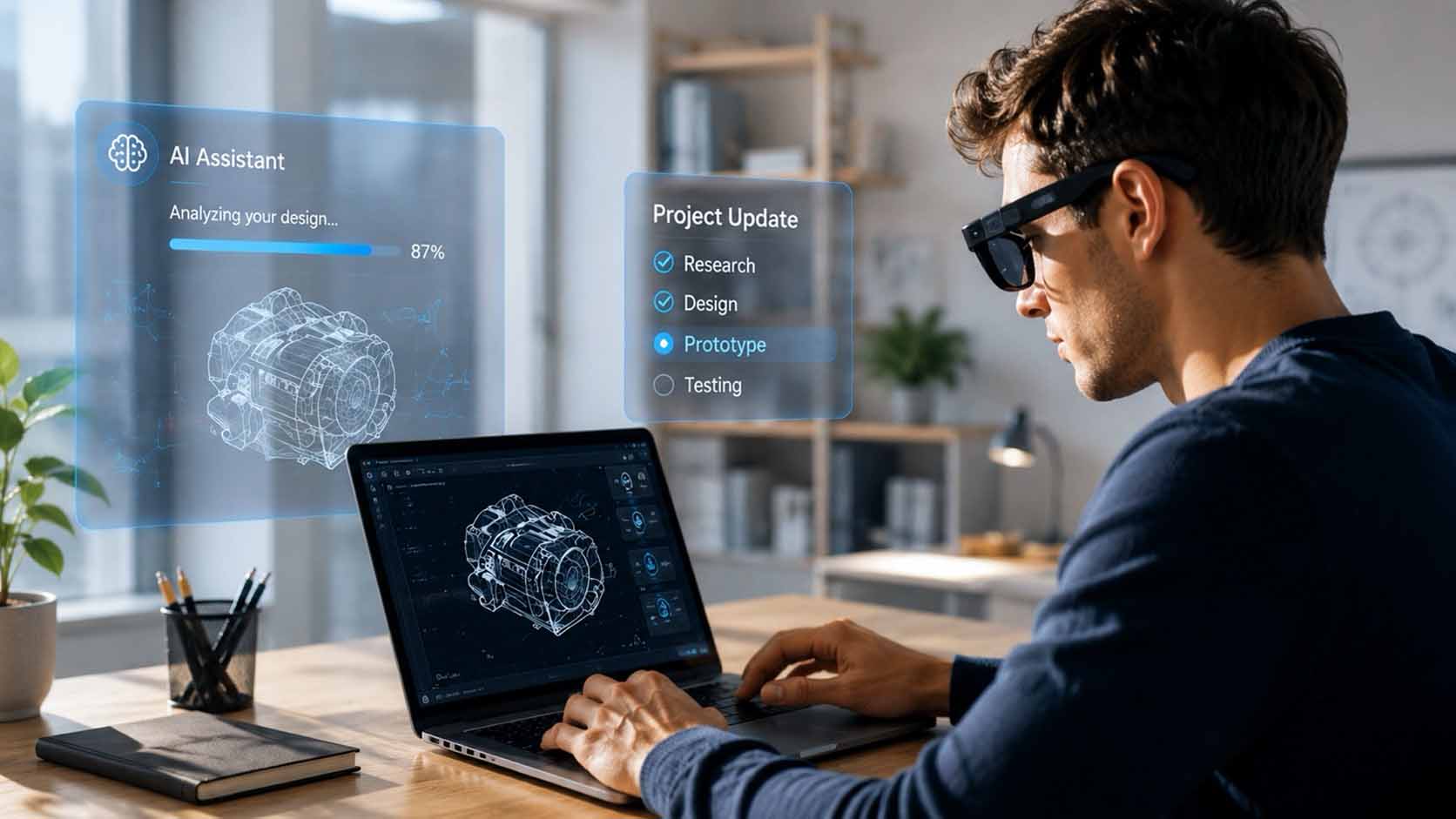
The visualization demonstrates how AI powered AR glasses can support knowledge work, engineering, project management, and creative processes through context aware information delivered directly within the working environment.
Visualization: AI assistant for productivity, knowledge management, project coordination, engineering workflows, Spatial Computing interfaces, responsible artificial intelligence, and trustworthy digital assistance | Image: © Ulrich Buckenlei | VISORIC GmbH
The image illustrates a future workplace in which an AI assistant actively supports project development. A technical model is being edited on a laptop while additional analytical insights and project status information appear as spatial layers within the surrounding environment. This creates a workflow where digital guidance is seamlessly integrated into the actual process.
This represents a significant evolution of digital interaction. The assistant becomes more than a traditional software tool. It organizes information, identifies relationships, supports decision making, and helps make complex content easier to understand.
For businesses, this creates new opportunities to increase productivity, accelerate learning processes, and make expertise more accessible. At the same time, the importance of clear policies for privacy, transparency, and responsible AI usage continues to grow.
Ultimately, the success of AI powered AR glasses will not be determined solely by technical performance. Their long term value depends on whether users perceive them as reliable, understandable, and trustworthy digital companions.
- AI assistants can support workflows directly within the user’s field of view
- Trust requires transparency, explainability, and clear accountability
- Context aware information improves productivity and decision making
- Organizations require governance frameworks for AI powered Spatial Computing applications
- Responsible design is essential for long term adoption
As trust grows and intelligent assistance systems become increasingly capable, the next step emerges: digital content is no longer simply displayed but becomes accessible across devices, spaces, and experiences.
AR Glasses as a Gateway to New Digital Experiences
The true potential of AR glasses emerges when they do more than display information and begin enabling entirely new forms of interaction. Spatial Computing connects real environments with digital objects, applications, and experiences. This creates scenarios in which people can create, learn, play, perform music, and collaborate on content together.[15]
Advances in sensors, hand tracking, artificial intelligence, and spatial visualization are making this vision increasingly realistic. Users can place digital objects within physical spaces, interact with virtual instruments, experience educational content directly in their surroundings, and collaborate with others on spatial content. As a result, the glasses become an interface for creativity, education, entertainment, and collaboration.
This continuity fundamentally changes the relationship between people and digital systems. Information is no longer confined to individual applications or devices. Instead, it appears in context and can be directly connected to real world actions.[16]
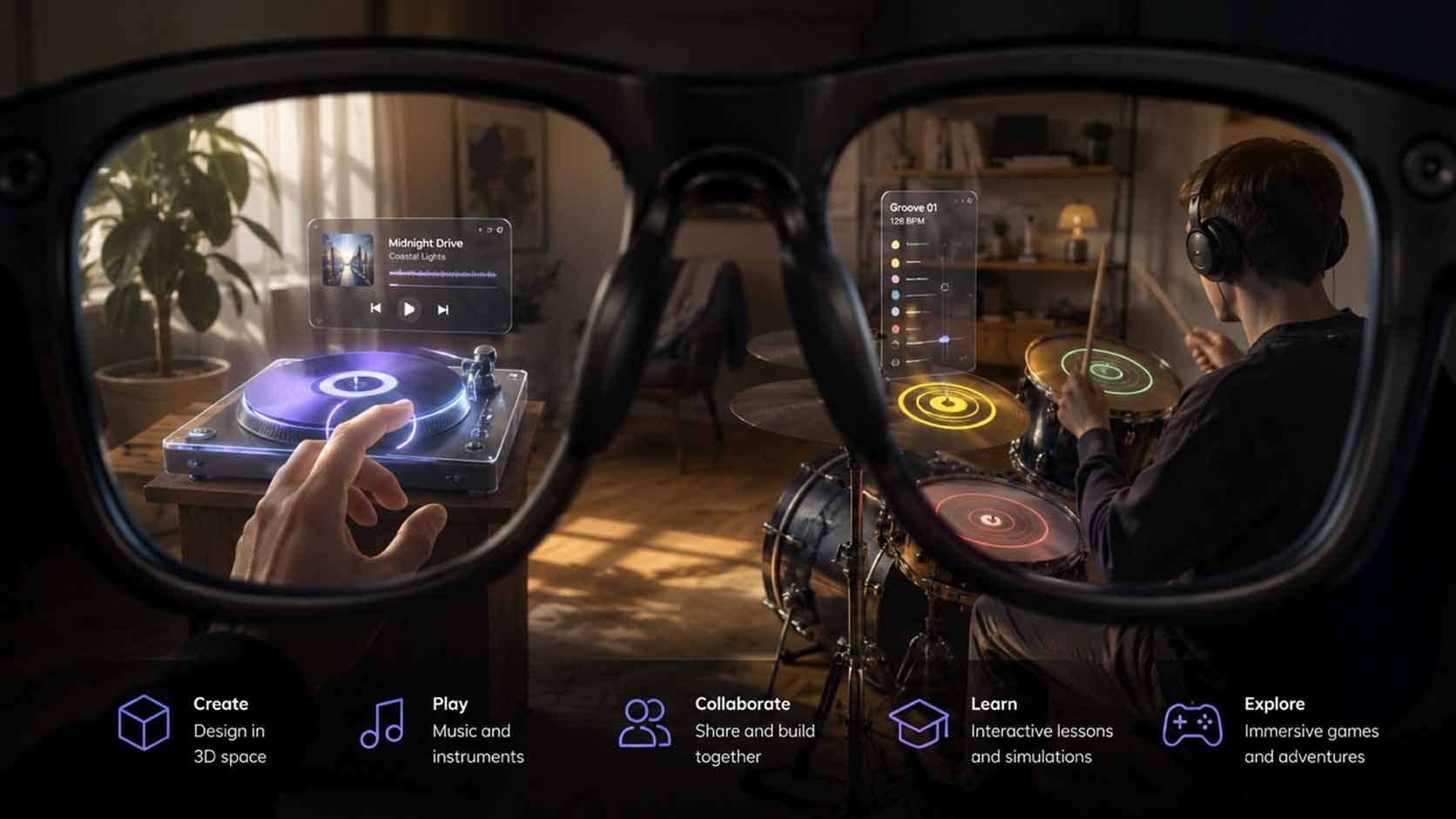
The visualization demonstrates how AR glasses can support creative work, music, learning, collaboration, and immersive experiences directly within the user’s field of view and physical surroundings.
Visualization: Spatial Computing ecosystem, AR glasses, immersive collaboration, creative workflows, interactive music applications, learning simulations, intelligent assistance, and cloud connected digital experiences | Image: © Ulrich Buckenlei | VISORIC GmbH
The image illustrates a future in which digital services are seamlessly integrated into everyday activities. Music controls, interactive instruments, collaborative applications, educational content, and immersive experiences appear directly within the field of view. The physical environment remains intact while being expanded with digital possibilities for interaction.
This approach transforms AR glasses from simple information displays into platforms for active digital experiences. Users do not merely consume information. They create, control, learn, collaborate, and interact with digital elements embedded within physical space.
For businesses, this creates substantial opportunities. A single Spatial Computing platform can support customer experiences, employee training, product presentations, creative applications, remote collaboration, and knowledge sharing across a wide range of scenarios.
The long term outcome is a new layer of digital infrastructure. Information and applications follow the user instead of remaining confined to individual devices or applications. AR glasses may therefore become a permanent access point for knowledge, services, and experiences.
- AR glasses can spatially enhance creativity, learning, collaboration, and entertainment
- Spatial Computing creates continuity between digital and physical experiences
- Digital content becomes actively usable rather than simply displayed
- Businesses can rethink service delivery, training, and product communication
- Connected AR platforms may become a new infrastructure layer
As these platforms continue to mature, an important question arises: how do Snap Specs compare with other AR and MR devices, and what role could they play on the path toward truly everyday AR glasses?
Snap Specs and the Path Toward Everyday AR Glasses
The development of smart glasses and Spatial Computing has reached a critical turning point. For decades, digital content has been tied to screens. Smartphones, tablets, and computers served as the primary interface between people and information. With the emergence of lightweight AR glasses, this relationship may fundamentally change. Information no longer appears on a separate device but directly within the user’s field of view.[17]
This is precisely where the new Snap Specs enter the conversation. While many previous AR systems were limited by excessive weight, restricted mobility, or complex hardware concepts, Snap is pursuing a different approach. The goal is to bring Spatial Computing closer to everyday life and make digital content available wherever people learn, work, communicate, and create.
This development is particularly exciting because the market remains in an exploratory phase. Different manufacturers are pursuing different strategies. Some focus on maximum immersion and computing power, while others prioritize comfort, everyday usability, and mobility. The key question is therefore not only which device offers the highest technical performance, but which concept has the potential to become part of daily life for millions of people over the long term.[18]
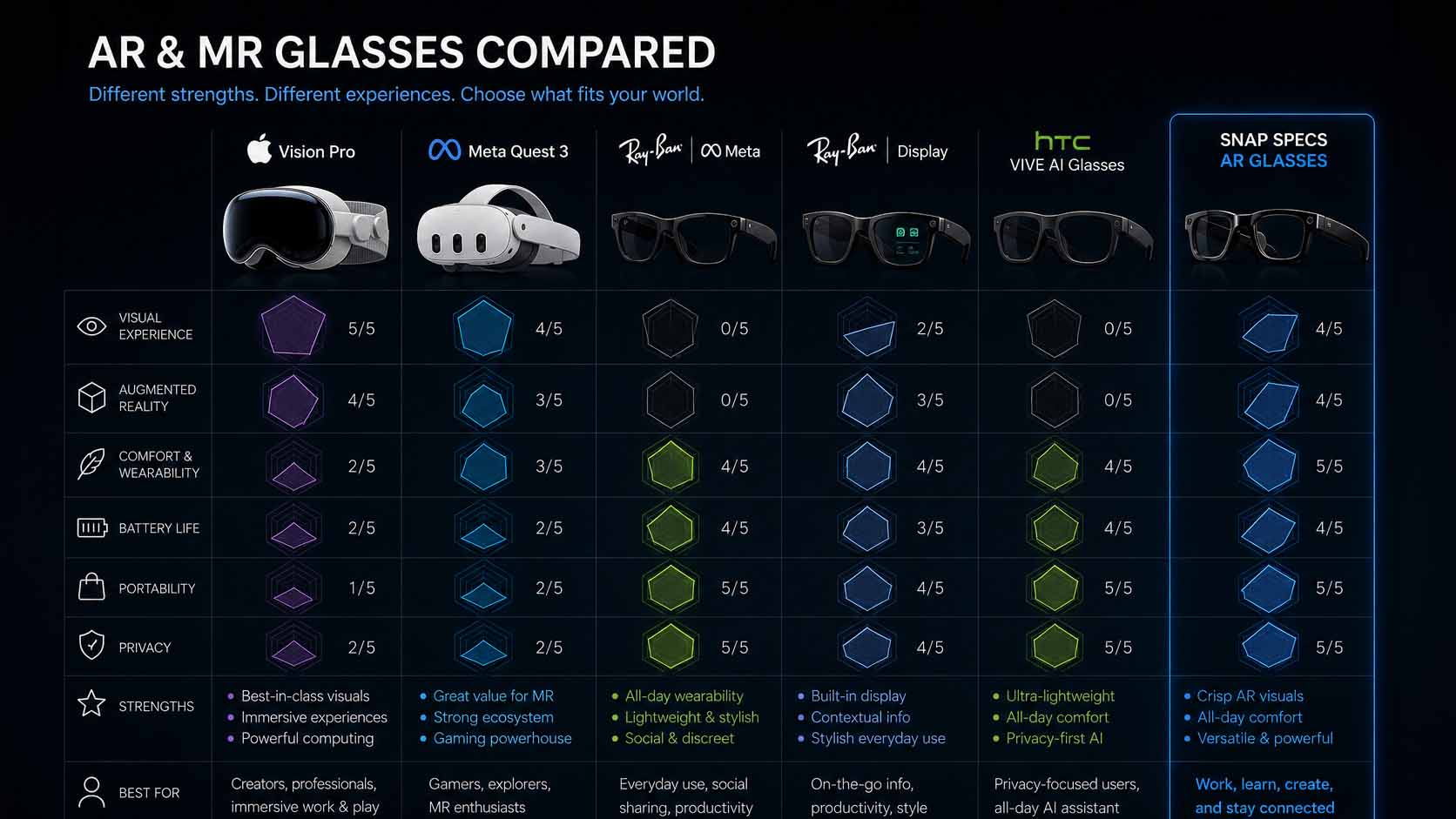
The infographic compares current AR and MR devices in terms of visual quality, augmented reality capabilities, comfort, mobility, battery life, and potential suitability for everyday use.
Visualization: Comparison of Apple Vision Pro, Meta Quest 3, Ray Ban Meta, Ray Ban Display, HTC Vive AI Glasses, and Snap Specs, evaluating visual quality, augmented reality capabilities, comfort, mobility, privacy, and future everyday usability | Analysis and Visualization: © Ulrich Buckenlei | VISORIC GmbH
The infographic clearly demonstrates that each device has its own strengths. Apple Vision Pro currently delivers the most immersive visual experience and sets new benchmarks for mixed reality applications. Meta Quest 3 offers an attractive balance between performance and cost. Ray Ban Meta focuses on wearable AI capabilities and everyday usability, while HTC emphasizes AI assistance and privacy focused features.
The positioning of Snap Specs is particularly interesting. The analysis highlights an unusually balanced combination of augmented reality capabilities, comfort, battery life, and mobility. This balance could become a decisive factor over the long term. The history of technology platforms repeatedly shows that the most powerful solution does not always prevail. More often, success belongs to the solution that integrates most naturally into everyday life.
For businesses, educational institutions, and developers, this creates new opportunities. AR glasses may eventually serve as universal access points for digital services. Navigation, communication, knowledge sharing, training, collaboration, entertainment, and AI assistance can converge into a unified user experience.
At the same time, the comparison makes it clear that the industry is still searching for the ideal form factor. Battery life, weight, display technology, privacy, and social acceptance remain significant challenges. The perfect AR glasses do not yet exist. Nevertheless, devices such as Snap Specs demonstrate that the industry is steadily moving closer to that goal.
In the long term, this evolution is about much more than hardware. The real question concerns how people will interact with digital information in the future. If content becomes continuously available, context aware, and enhanced by artificial intelligence, AR glasses could become one of the most important interfaces connecting people, knowledge, and digital services.
- The AR and MR glasses market is approaching a critical turning point
- Snap Specs focus on combining augmented reality, mobility, and everyday usability
- Comfort, battery life, and wearing experience are becoming increasingly important than raw computing power
- AR glasses may become universal access points for digital services
- The industry continues to search for the ideal mass market form factor
- Spatial Computing may ultimately become the next major human machine interface
Whether Snap Specs will truly mark the breakthrough toward everyday AR glasses remains impossible to determine today. However, current developments clearly demonstrate that the vision of lightweight, intelligent, and continuously available augmented reality glasses appears closer than ever before. This could mark the beginning of a new phase of Spatial Computing, where digital information no longer lives on screens but becomes a natural part of our physical environment.
Will Everyday Augmented Reality Finally Arrive?
For years, the promise of Augmented Reality has been limited by bulky hardware, external compute packs and short battery life. The latest generation of AR glasses suggests that the industry may finally be approaching a turning point. Devices are becoming lighter, more capable and increasingly suitable for everyday use.
Snap’s new Spectacles provide a glimpse into that future. Rather than focusing solely on technical specifications, the broader significance lies in the convergence of multiple technologies. Lightweight wearable hardware, on device AI processing, spatial tracking, contextual computing and intuitive interaction are beginning to merge into a single product category designed for real world use.
This development signals a shift from experimental AR experiences toward practical Spatial Computing. Digital content is no longer confined to smartphones or traditional displays. Instead, information, collaboration tools, entertainment and intelligent assistants can become part of the user’s physical environment.
The video highlights how lightweight AR glasses could bring Spatial Computing into everyday life through immersive visuals, on device processing and context aware digital experiences.
Video source and product presentation: Snap Inc. | Spectacles AR Glasses announcement and demonstration | Analysis, technology assessment and editorial commentary: © Ulrich Buckenlei | VISORIC GmbH
The video demonstrates several important developments currently shaping the future of wearable computing. At only 132 grams, Spectacles are significantly lighter than most Mixed Reality headsets available today. Electrochromic lenses automatically adapt to changing lighting conditions, while dual Snapdragon processors enable Spatial Computing directly on the device without relying on external hardware.
Equally important is the user experience. Virtual objects remain spatially anchored within the environment, allowing digital content to coexist naturally with the physical world. Whether for learning, communication, navigation, productivity, entertainment or industrial support, the underlying goal remains the same: making digital information available exactly where it is needed.
At the same time, challenges remain. Battery life, device size, visual quality, comfort and affordability continue to be critical factors for widespread adoption. While products such as Spectacles demonstrate significant progress, the industry is still working toward the ultimate goal of making Spatial Computing nearly invisible to the wearer.
The video therefore represents more than a product announcement. It illustrates a broader industry transition toward everyday wearable computing, where intelligent digital experiences become seamlessly integrated into daily life.
- Lightweight AR glasses bring Spatial Computing closer to everyday use
- On device processing enables responsive and self contained experiences
- Digital content can remain anchored directly within the user’s environment
- Applications range from learning and collaboration to entertainment and industrial support
- Comfort, battery life and affordability remain key challenges for mass adoption
- Wearable computing is moving from experimentation toward practical daily use
From Smart Glasses to Real World Spatial Computing
Augmented Reality Glasses are entering a new phase. What was once limited to research laboratories and experimental prototypes is rapidly evolving into practical products that support communication, learning, productivity, navigation, entertainment and industrial workflows in everyday life.
The latest generation of AI powered wearables demonstrates that the future of computing will no longer be confined to smartphones, tablets or traditional screens. Instead, digital information, intelligent assistants and interactive content are becoming part of the physical world around us. Spatial Computing is moving beyond the headset and into lightweight devices designed for everyday use.
The Munich based VISORIC expert team supports companies throughout this transformation. We help organizations identify valuable use cases, develop immersive user experiences and create practical solutions that combine Artificial Intelligence, Augmented Reality, Mixed Reality, Computer Vision and Real Time 3D technologies.

The Munich VISORIC expert team develops next generation Spatial Computing solutions that combine AI, Augmented Reality, Digital Twins, Computer Vision and Real Time 3D technologies for practical business applications.
Visualization: Development of AI powered wearable experiences, Spatial Computing platforms, Smart Glasses applications, Digital Twin ecosystems and immersive enterprise solutions for industry, education, healthcare and business | Image: © Ulrich Buckenlei | VISORIC GmbH
VISORIC combines years of experience in XR, Artificial Intelligence, Digital Twins and interactive software platforms to create future ready Spatial Computing solutions. Whether the goal is industrial assistance, guided maintenance, immersive training, remote collaboration, AI supported workflows or next generation customer experiences, successful projects require the intelligent integration of multiple technologies into a seamless user experience.
From lightweight AI Glasses and contextual assistants to immersive Mixed Reality environments and Digital Twin ecosystems, the technologies highlighted in this article represent only the beginning of a much broader transformation. Organizations across manufacturing, healthcare, education, logistics, engineering and field service are already exploring how wearable computing can improve efficiency, reduce complexity and make information available exactly when and where it is needed.
The VISORIC expert team helps companies move beyond experimentation and into productive deployment. Our specialists combine strategy, user experience design, software engineering, AI integration, Real Time 3D, Digital Twins and enterprise system connectivity to create scalable solutions that generate measurable business value.
- Strategy and consulting for Smart Glasses and Spatial Computing initiatives
- AI assistants, multimodal interfaces and intelligent knowledge systems
- Augmented Reality applications for industry, maintenance and training
- Real Time 3D, Digital Twins and immersive visualization platforms
- Computer Vision, hand tracking and context aware interaction concepts
- Implementation, deployment, support and continuous platform evolution
If you would like to explore how Smart Glasses, Augmented Reality and Spatial Computing can create measurable value for your organization, the Munich VISORIC expert team would be pleased to support your journey. Together, we evaluate opportunities, identify suitable use cases and develop customized solutions that align with your business goals.
From AI powered assistants and immersive training platforms to Digital Twin applications, industrial guidance systems and next generation customer experiences, we help organizations transform emerging technologies into productive business tools. Our expertise spans strategy, UX design, software development, AI integration, Real Time 3D, Computer Vision, cloud connectivity and enterprise deployment.
The future of Spatial Computing will not be defined by hardware alone. It will be shaped by meaningful experiences, intelligent workflows and practical applications that improve how people learn, work, create and collaborate. VISORIC helps turn that vision into reality.
Quellen und Referenzen
- Snap Inc. Spectacles Developer Platform, Informationen zu Spectacles, Spatial Computing, AR Experiences, Hand Tracking, Machine Learning und Entwicklerökosystem.
- Augmented World Expo (AWE), internationale Fachkonferenz zu Augmented Reality, Mixed Reality, Spatial Computing und Wearable Computing.
- Qualcomm Snapdragon AR Plattformen, XR Chipsätze, Edge AI, Spatial Computing und energieeffiziente AR Systeme.
- Deloitte Technology Trends, Wearable Computing, AI Assistants, Smart Glasses und zukünftige Mensch Maschine Interaktionen.
- Meta Reality Labs Research, Augmented Reality Interfaces, Echtzeitinformationen, Navigation und digitale Assistenzsysteme.
- Google Research, Live Translation, multimodale KI Systeme, Kontextverständnis und sprachbasierte Assistenzfunktionen.
- MIT Media Lab, Tangible Interfaces, Spatial Interaction, Creative Computing und immersive Lernumgebungen.
- Stanford Human Computer Interaction Group, räumliche Benutzeroberflächen, XR Lernsysteme und kollaborative digitale Arbeitsräume.
- PTC Vuforia, industrielle Augmented Reality, digitale Arbeitsanweisungen, Remote Assistance und Wartungsprozesse.
- Siemens Digital Industries, industrielle XR Anwendungen, digitale Zwillinge, Assistenzsysteme und intelligente Fertigung.
- OpenAI Research, multimodale KI Modelle, Sprachinteraktion, visuelles Verständnis und kontextbasierte Assistenzsysteme.
- Microsoft AI Research, Copilot Systeme, Wearable AI, digitale Assistenten und produktive Mensch KI Zusammenarbeit.
- Snap Spectacles Hardware Dokumentation, Waveguide Technologie, elektrochrome Gläser, Sichtfeld, Sensorik und Spatial Computing Architektur.
- IEEE Spectrum, Forschung zu AR Displays, Waveguides, Micro Displays und zukünftigen optischen Systemen für Smart Glasses.
- Apple Vision Pro technische Spezifikationen, räumliches Computing, Eye Tracking, Hand Tracking und immersive Benutzeroberflächen.
- Meta Quest 3 technische Dokumentation, Mixed Reality Funktionen, Passthrough Technologie und XR Anwendungen.
- Ray Ban Meta Smart Glasses, KI Funktionen, Audio Plattform, Kamera Features und sprachbasierte Interaktion ohne Display.
- HTC Vive AI Glasses, AI Assistenz, Kamera Systeme, Audio Interaktion und Wearable AI Konzepte ohne integriertes Display.
- Gartner Emerging Technologies Research, Spatial Computing, Smart Glasses, Ambient Computing und zukünftige XR Plattformen.
- McKinsey Technology Outlook, Wearables, künstliche Intelligenz, XR Systeme und zukünftige digitale Ökosysteme.
- Originales Videomaterial und Produktdemonstrationen: Snap Inc. Spectacles, Spatial Computing Experiences, Hand Tracking und interaktive AR Anwendungen.
- Analyse, Storyline, Marktvergleich und technologische Einordnung: © Ulrich Buckenlei | VISORIC GmbH.
- Produktbilder, Hardware Visualisierungen und technische Darstellungen: Snap Inc., Spectacles Developer Program und offizielles Pressematerial.
- Zusätzliche Visualisierungen, Vergleichsgrafiken, Marktanalysen und redaktionelle Aufbereitung: © VISORIC GmbH.
- VISORIC GmbH, Projektpraxis in Spatial Computing, Augmented Reality, Mixed Reality, Echtzeit 3D, Digital Twins und AI Assistants.
- XR Stager, Analysen, Produkttests und Marktbeobachtung zu Smart Glasses, AI Wearables, Spatial Computing und immersiven Technologien.
Contact Persons:
Ulrich Buckenlei (Creative Director)
Mobile: +49 152 53532871
Email: ulrich.buckenlei@visoric.com
Nataliya Daniltseva (Project Manager)
Mobile: +49 176 72805705
Email: nataliya.daniltseva@visoric.com
Address:
VISORIC GmbH
Bayerstraße 13
D-80335 Munich