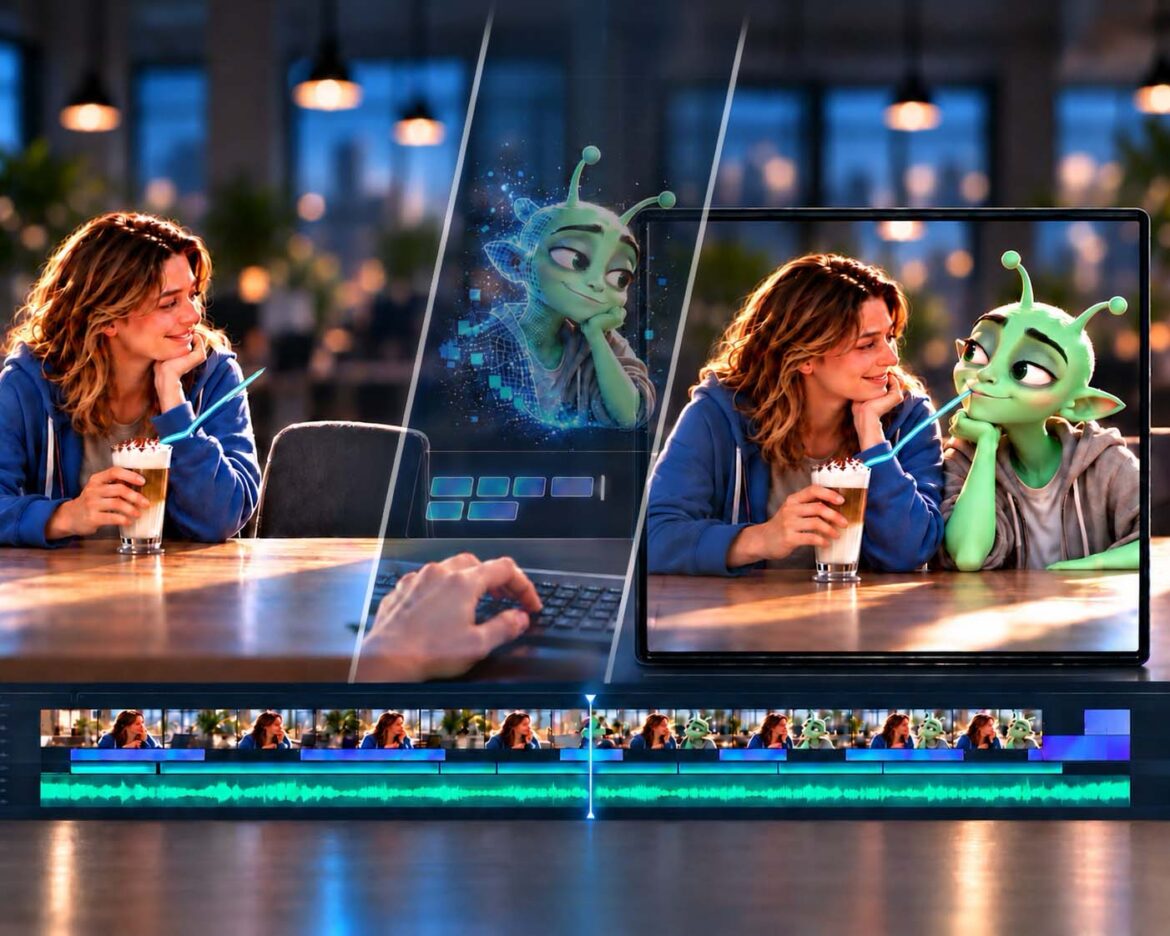
A real recording receives an AI character afterwards, one that only comes into being in the cloud after the shoot.
Visualization: From shoot to editing to the finished image, the character is only added in post-production | AI-generated illustration, not a product photo | XR Stager Online Magazine | VISORIC GmbH
AI compositing inserts computer-generated characters into real footage after the fact, in such a way that light, shadows and perspective match the filmed environment. The results are now so convincing that many viewers assume the artificial intelligence (AI) already works in real time, meaning at the very moment the camera is running. This is exactly where production and Spatial Computing part ways, Spatial Computing being the display of digital content that relates live to the real space around it.[1]
This distinction matters for companies. Anyone producing commercials, product videos or training content can use such tools today. Anyone planning Spatial Computing applications, on the other hand, needs an honest assessment of how far the technology still is from real time. This article provides one: it explains how AI compositing works, introduces four established tools, shows the technical hurdles on the way to real time and describes which developments could close the gap.
- Today’s AI compositing tools deliver finished films, not real-time interaction.
- Reality-Aware Rendering analyzes a recording after the camera has stopped.
- Four tools cover very different workflows, prices and skill requirements.
- Real time is held back by computing power, latency and scene understanding.
- Those who build experience today make use of the window before the next technology stage.
The article guides you through the topic in eight steps: from the question of what separates AI compositing from real-time AR, through how the method works, the four most important tools, the limits of real time, the opportunity offered by Gaussian Splatting and the chip roadmap, to an example film and the timeline from post-production to presence.
What Separates AI Compositing from Real-Time AR
In classic compositing, several image layers are combined into one film, for example a real recording and a computer-generated character. AI is taking over more and more of the individual steps: the character’s movement, the matching lighting and the adaptation to the environment. This saves time and money compared with elaborate effects productions, known as VFX workflows.
Real-time AR, by contrast, means that digital content is generated and displayed at the moment a person moves and perceives the environment. This requires perception and response to happen simultaneously. That is precisely the big promise of Spatial Computing: digital content that understands its physical environment and responds to it.
Whether a tool already fulfills this promise today determines how production teams, marketing departments and Spatial Computing specialists should evaluate it. A tool for film production is judged by image quality, cost and working time. A platform for real-time experiences is judged by response time, reliability and hardware. The two yardsticks lead to completely different decisions.
The image illustrates the core of the difference. On the left is the recording: a woman sits at a table with a latte and looks to the side, the seat next to her is empty. On the right is the finished result: a friendly green character sits next to her and drinks from her straw. Between the two lies a processing step in the cloud.
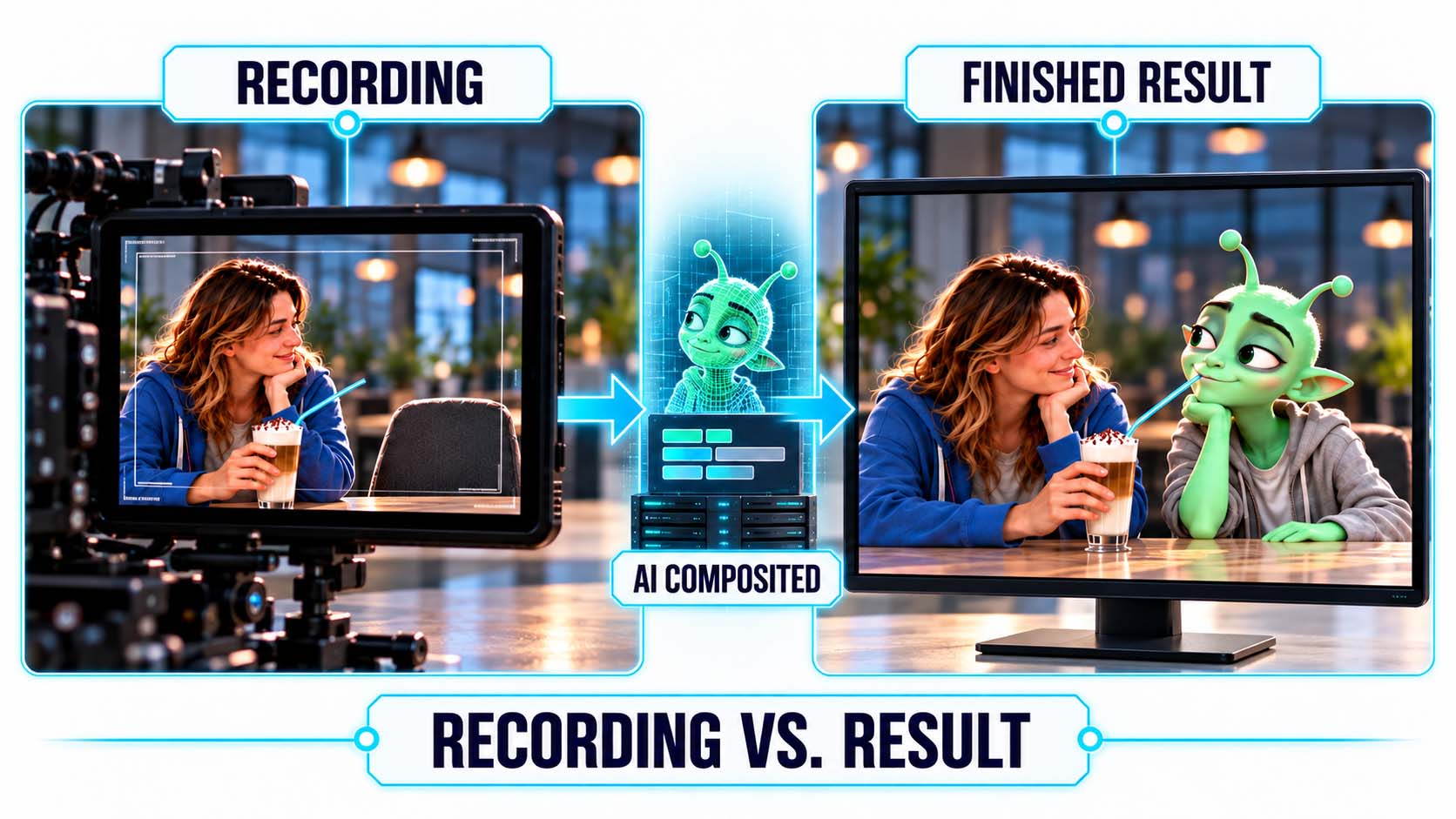
Between the recording and the finished image lies a processing step in which the character is first created.
Infographic: The character is not present during the shoot and is only added in the cloud after the recording[1] | AI-generated illustration, not a product photo | XR Stager Online Magazine | VISORIC GmbH
Anyone evaluating such a result should therefore separate two questions. The first is: how good is the image? The answer is impressive. The second is: when was it created? The answer is: afterwards. Both questions are legitimate, but they lead to different conclusions for your own planning.
- AI compositing combines real recordings and computer-generated characters into one film.
- Real-time AR requires perception and response to happen at the same moment.
- A production tool and a real-time platform have different evaluation criteria.[1]
- With today’s tools, the character is created after the recording, not during the shoot.
- This assessment decides whether a tool fits your task today or only in a few years.
How the method works in detail is shown in the next chapter.
What Reality-Aware Rendering Actually Does
Reality-Aware Rendering, as used by the tool Simulon, is a post-production process in the cloud. The workflow has several stages. First comes the concept: the creatives define which scene is shown, which props appear and how the character interacts with the environment. Then an iPhone app scans the room all around and uses the scan to create a lighting model, which is later used to recreate the lighting of the real environment.[1]
Next comes the recording. The performer acts out the planned interactions, and the camera records the so-called plate, meaning the real footage into which the character is later inserted. This recording is uploaded together with the scene scan and a prompt, a short text instruction describing what the character should do, for example a friendly green character drinking from the straw. In the cloud, the AI analyzes movement, speech and light and generates a new character performance from them. A few minutes later, the finished, composited film is available.[1]
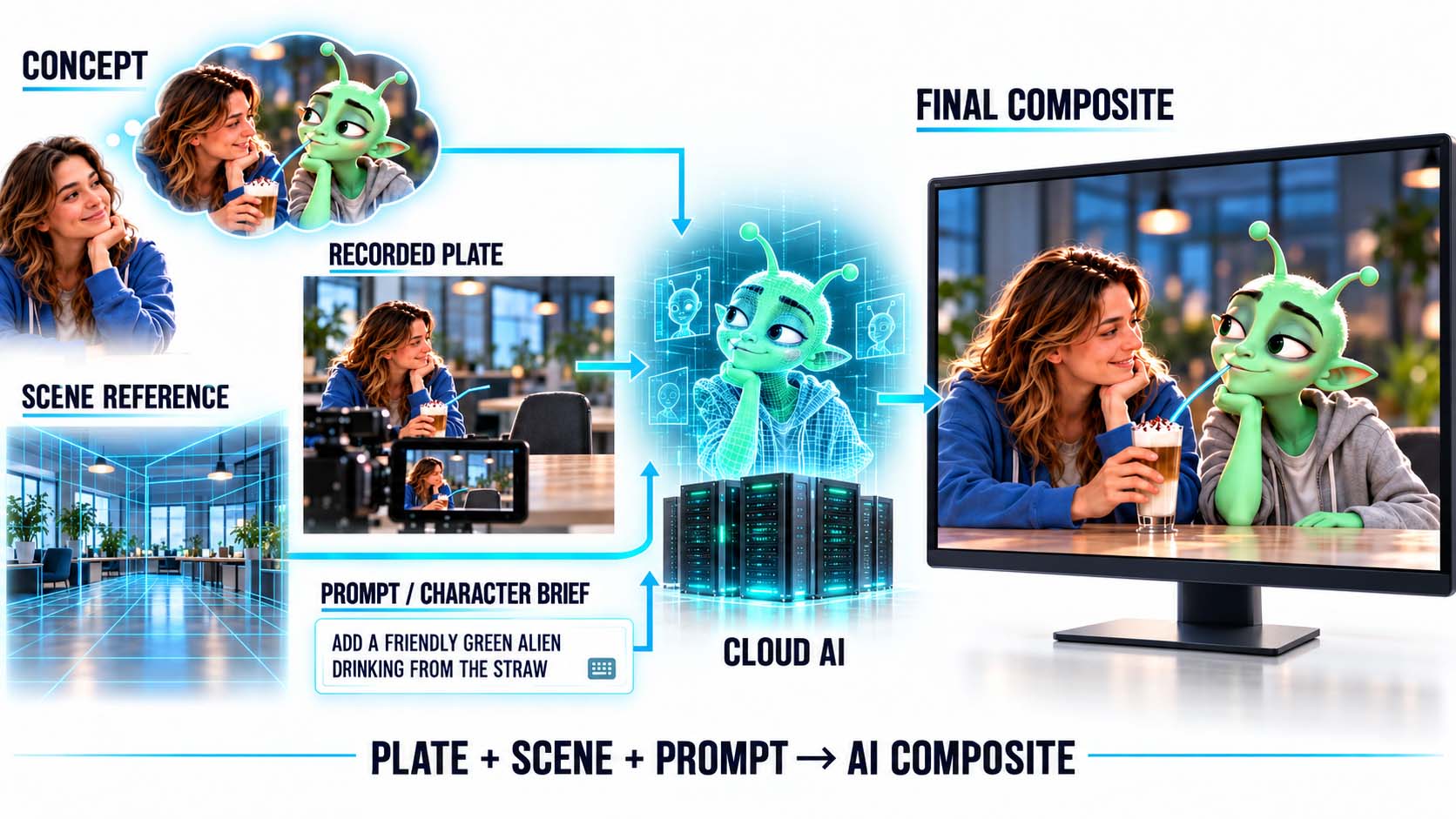
Three inputs, the recording, the scene reference and the text instruction, produce a finished film in the cloud.
Infographic: Recording, scene scan and prompt flow into the cloud AI, and the finished image only emerges afterwards[1] | AI-generated illustration, not a product photo | XR Stager Online Magazine | VISORIC GmbH
The character does not perceive the real world itself. It emerges from the analysis of a recording of the real world, which only exists after the camera has stopped. The term Reality-Aware is accurate in a narrow sense: the system is informed by reality. But it processes this information with a time delay rather than simultaneously.
In practice, this is not a weakness but a characteristic. A time-delayed workflow makes it possible to plan recordings carefully, compute variants and check results before they are published. For applications in which a person is supposed to interact live with the character, however, it is not enough.
- Reality-Aware Rendering is a cloud post-production process with several stages from planning to the finished film.[1]
- An iPhone scan creates a lighting model of the real space.[1]
- The AI analyzes recording, movement, speech and light and generates the character performance from them.[1]
- The character responds to an analysis of the recording, not to reality at the moment of the shoot.
- The system is informed by reality but processes it with a time delay.
Simulon is not the only tool of this kind. Which other approaches exist is shown in the next chapter.
Four Tools, Four Ways of Working
Besides Simulon, four tools shape today’s field of AI-assisted 3D character compositing. They differ in workflow, price and the skills they require.
Autodesk Flow Studio works as a complete solution in the browser: a video is uploaded, several AI models run in parallel, and the result is a composited image or an output for Maya, Blender or Nuke.[2] Move.ai replaces classic motion capture with special suits and markers by analyzing ordinary videos and delivers motion data for 3D artists.[3] MetaHuman Animator in Unreal Engine 5 transfers facial and body movement from an iPhone or webcam to a highly detailed digital character and is considered especially photorealistic.[4] Adobe Firefly Video extends editing in Premiere Pro with AI-generated additional footage, extended shots and the adding and removing of objects.[5]
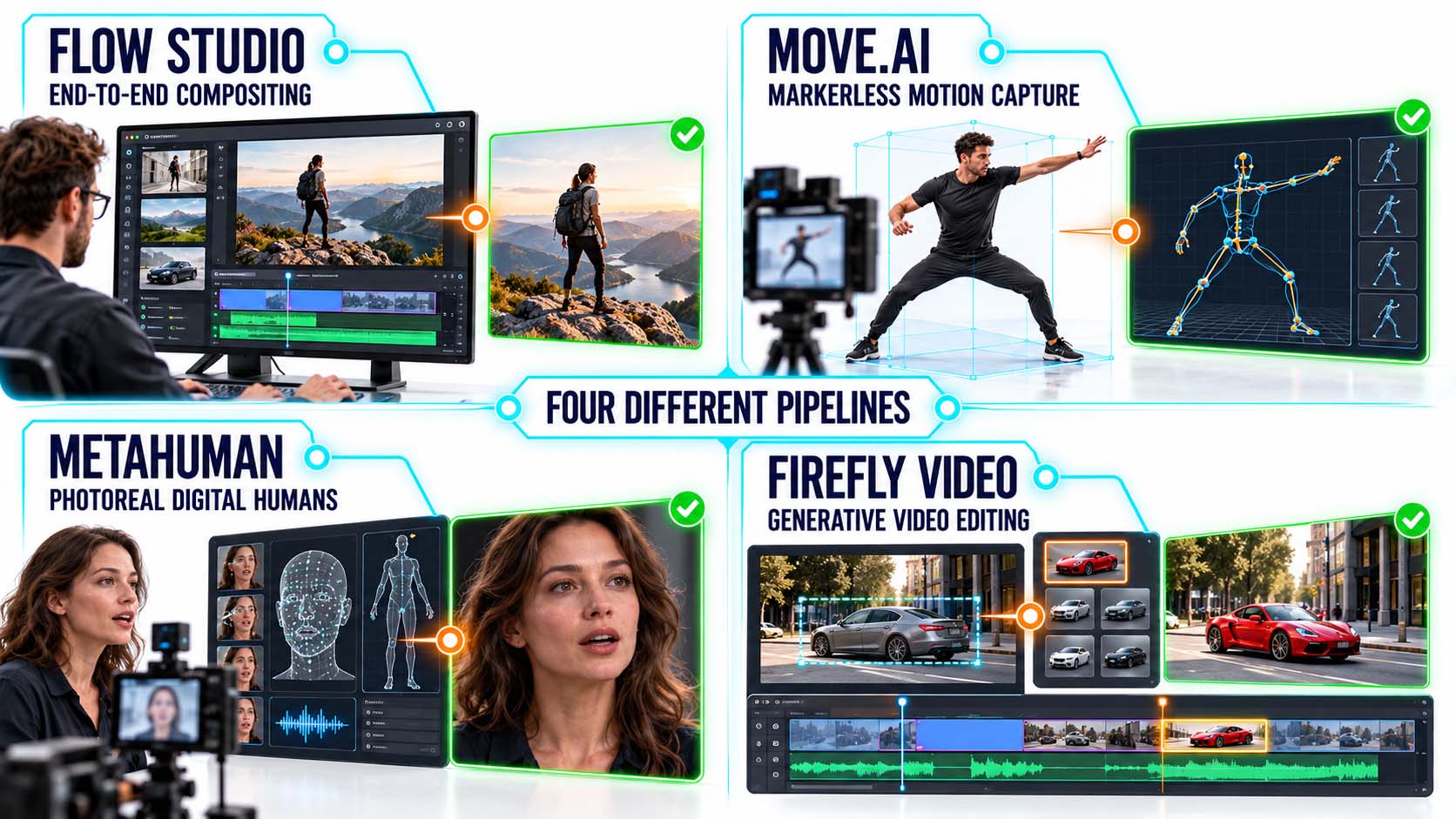
Four tools solve four different tasks, they are not interchangeable alternatives.
Infographic: Full workflow, motion capture, digital humans and video editing as four separate pipelines[2][3][4][5] | AI-generated illustration, not a product photo | XR Stager Online Magazine | VISORIC GmbH
| Tool | Workflow | Well suited for | Price according to manufacturer |
|---|---|---|---|
| Autodesk Flow Studio | Browser upload, 25 parallel AI models, composited output or export for Maya, Blender, Nuke | Complete compositing without a dedicated VFX team | Free (720p) to USD 95 per month |
| Move.ai | Video upload, markerless motion capture, export as FBX or USD | Studios with 3D artists who want to replace physical motion capture | From USD 50 per month |
| MetaHuman Animator (Unreal Engine 5) | iPhone or webcam, facial and body animation on a MetaHuman character, compositing in UE5 | Highest photorealism, studios with under USD 1 million in revenue | Free or USD 1,850 per seat per year |
| Adobe Firefly Video | AI B-roll, Generative Extend, adding or removing objects in Premiere Pro | Marketing and editorial teams in the Adobe environment | Included in Creative Cloud, from approx. USD 55 per month |
Each tool starts at a different point in the production chain.
Table: Four tools at a glance, manufacturer information, prices may have changed and should be checked before booking[2][3][4][5] | XR Stager Online Magazine | VISORIC GmbH
All four have one thing in common: none of them is a real-time system. All process footage after the recording, and the waiting time in the cloud ranges from seconds to minutes. Adobe Firefly Video comes closest to instant feedback, but it generates additional footage and extensions, not individual photorealistic characters that interact with a scene.
- Flow Studio offers a complete browser-based solution for compositing without a VFX team.[2]
- Move.ai replaces motion capture with special suits by analyzing ordinary videos.[3]
- MetaHuman Animator offers the highest photorealism but requires knowledge of Unreal Engine.[4]
- Firefly Video supports editing in Premiere Pro with AI footage.[5]
- None of the four tools works in real time.
Why real time is such a much bigger hurdle than faster rendering is shown in the next chapter.
Why Real Time Does Not Work Yet
The obstacles on the way to an AI character in real time are fundamental, not a matter of small improvements. Three problems have to be solved at the same time, and each is demanding in its own right.
The first is the compute gap. According to the sources, a current flagship smartphone delivers around 3.8 TFLOPS of graphics performance (Adreno 750), while a desktop graphics card such as the RTX 4090 delivers about 165 TFLOPS. TFLOPS stands for trillions of calculations per second. That corresponds to a factor of roughly 30 to 40. The gap is a physical problem, not a software problem. The neural processors in smartphones, NPUs for short, reach 35 to 100 TOPS, but they are designed for running AI models, not for photorealistic rendering. Heat adds to this: in benchmarks, the frame rate dropped by around 40 percent after ten minutes of continuous load.[6]
The second problem is latency, meaning delay. For AR, the target is 7 to 15 milliseconds between head movement and the displayed image, the so-called motion-to-photon latency.[9] A round trip from a smartphone to a data center and back takes at least 50 to 200 milliseconds on the network alone, and AI computation adds another 300 milliseconds to two seconds. Even if Mobile Edge Computing, that is, data centers close to the cell tower, pushes the network time below 10 milliseconds, the time budget for a frame is used up before the AI starts computing. NVIDIA describes its CloudXR system as unusable from 150 milliseconds of one-way delay.[8]
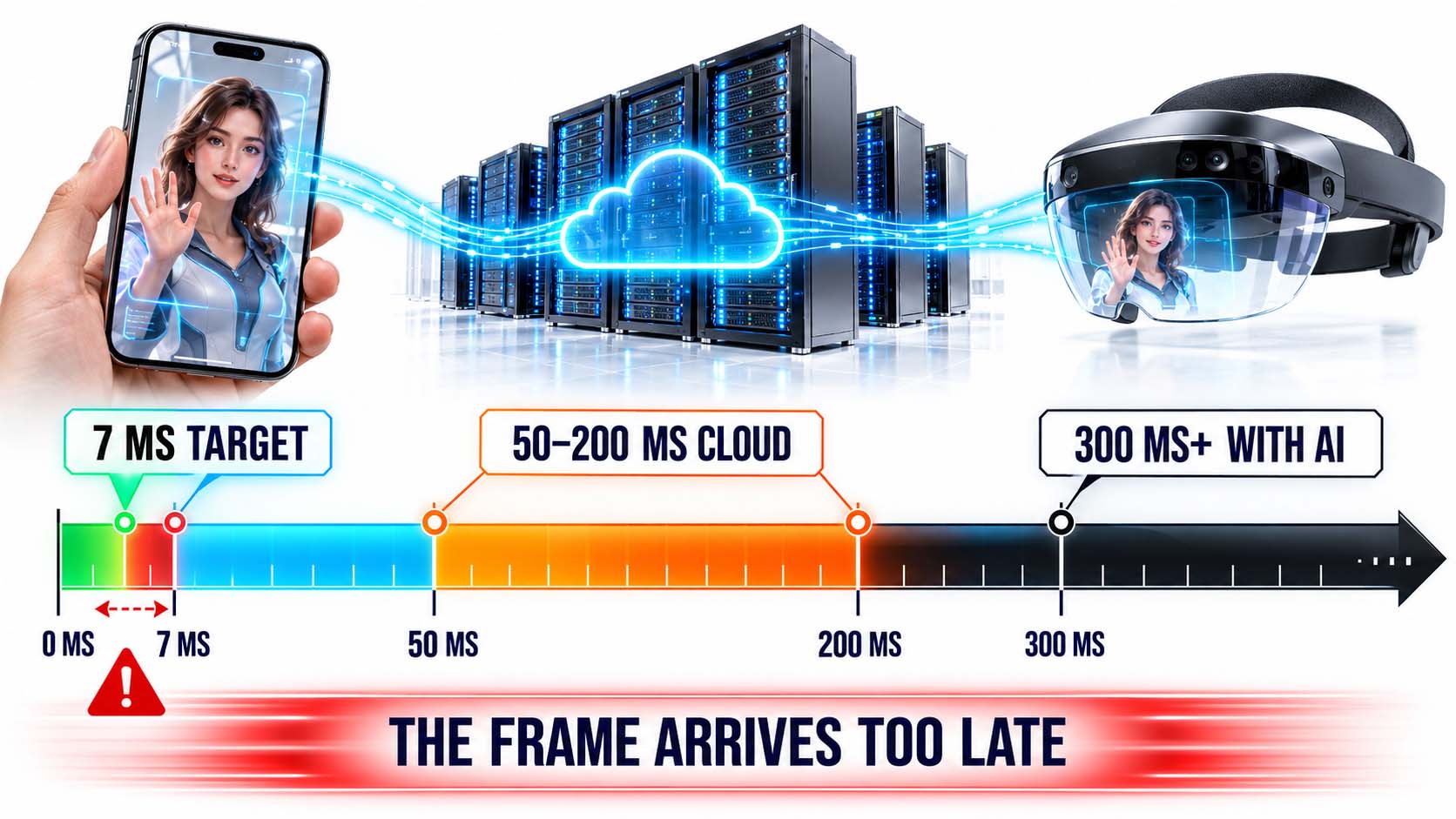
The image arrives too late, because the cloud round trip alone blows the time budget of a few milliseconds.
Infographic: AR target of 7 milliseconds compared with cloud round-trip time and the time with AI computation[8][9] | AI-generated illustration, not a product photo | XR Stager Online Magazine | VISORIC GmbH
| Metric | Value | Meaning |
|---|---|---|
| Target for AR (motion-to-photon) | 7 to 15 ms | Limit beyond which the image is perceived as delayed |
| Cloud round trip on the network | 50 to 200 ms | Minimum duration for the round trip alone |
| Cloud round trip with AI computation | 300 ms to 2 s | A multiple of the permissible time budget |
| Unusability threshold for CloudXR | 150 ms one-way delay | Manufacturer information from NVIDIA |
| Compute gap between smartphone and desktop | Factor of 30 to 40 | Around 3.8 versus 165 TFLOPS |
| Performance drop due to heat | Around 40 % after 10 minutes | Benchmark under continuous load |
The network time alone is already a multiple of the permissible time budget.
Table: Timing and performance values for real-time capability, figures from the sources cited[6][8][9] | XR Stager Online Magazine | VISORIC GmbH
The third problem is scene understanding. A photorealistic character that responds correctly to its environment requires the system to understand geometry, light, physics and human intent at the same time. Today’s systems analyze recordings after the fact. Dynamic relighting of a character in real time when the light changes is currently considered the hardest unsolved problem in the field, harder even than available computing power.
- Smartphone graphics lag desktop hardware by roughly a factor of 30 to 40.[6]
- AR demands 7 to 15 milliseconds, while the cloud round trip needs 50 to 200 milliseconds on the network alone.[8][9]
- With AI computation, the round-trip time rises to between 300 milliseconds and two seconds.
- Heat significantly reduces the sustained performance of smartphones.[6]
- Dynamic relighting in real time is the hardest unsolved sub-problem.
One technology that already overcomes part of these hurdles is Gaussian Splatting. It is the focus of the next chapter.
What Gaussian Splatting Changes
Gaussian Splatting is regarded as the most important recent development in real-time 3D rendering, and it already runs on mobile devices. The technique describes a 3D scene not with triangular surfaces but with millions of semi-transparent ellipsoids, the so-called splats. From these, new views from arbitrary angles can be computed very quickly.[7]
That this works on mobile devices is shown by the Mobile-GS paper at the CVPR 2025 conference: it reached 116 frames per second on a device with a Snapdragon 8 Gen 3 and, after thermal equilibrium, meaning after a period of heating up, still 74 frames per second.[6] For comparison: smooth display starts at about 60 frames per second.
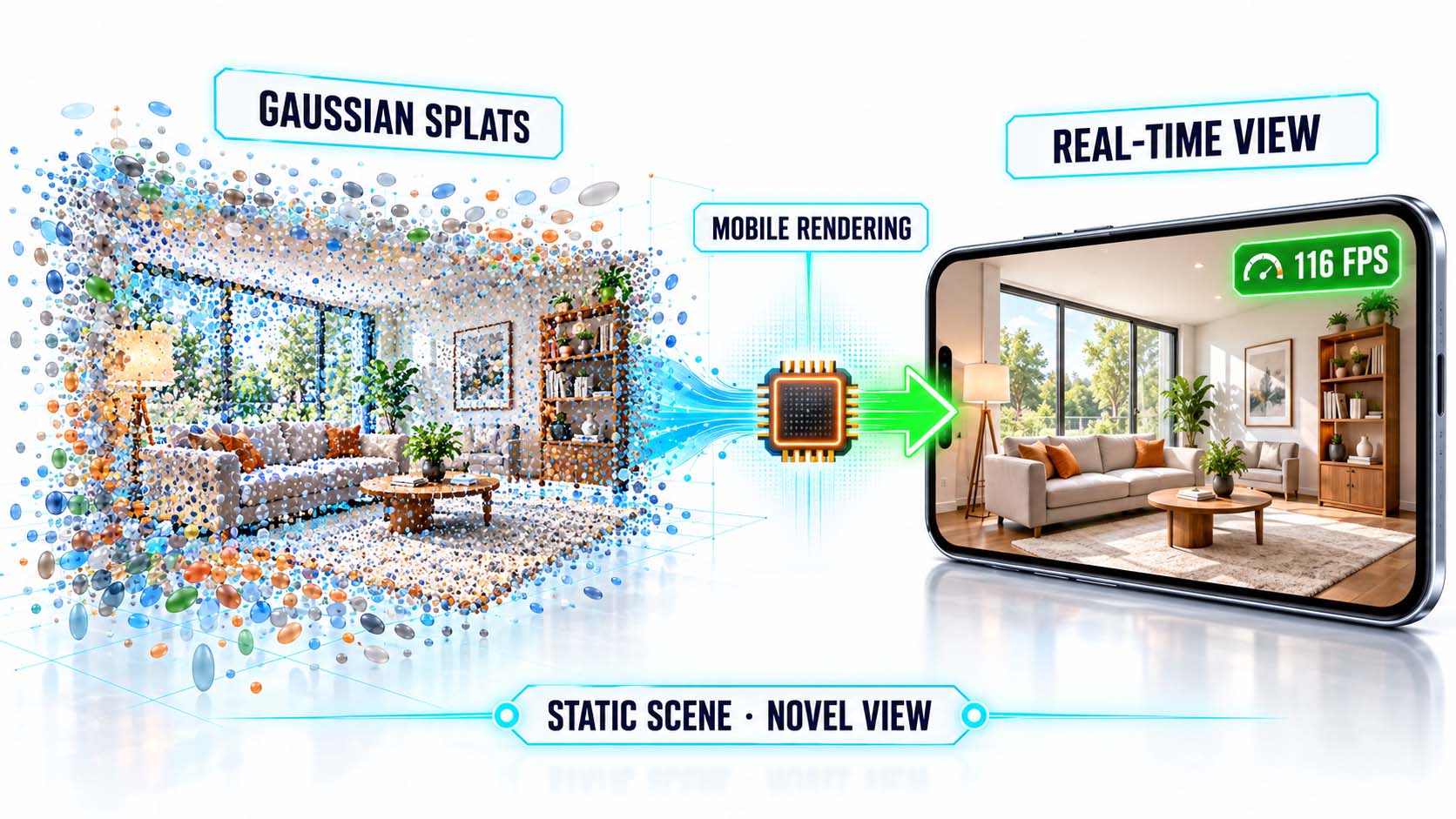
Once captured, a fixed scene can be viewed smoothly on a smartphone from any angle.
Infographic: Millions of splats become a real-time view of a static scene at 116 frames per second on a mobile device[6][7] | AI-generated illustration, not a product photo | XR Stager Online Magazine | VISORIC GmbH
The decisive limitation is this: Gaussian Splatting currently handles static, pre-trained scenes. A room, a landscape or a building interior can be scanned, trained into a splat model and then viewed in real time from any angle. According to all published research up to 2026, full-body characters that can be animated and are rendered at photorealistic quality using Gaussian Splatting run only on desktop computers. The gap between displaying static scenes and generating dynamic characters is the next frontier.
- Gaussian Splatting describes scenes with millions of semi-transparent ellipsoids instead of polygons.[7]
- Mobile-GS reached 116 frames per second on a Snapdragon 8 Gen 3.[6]
- After thermal equilibrium, 74 frames per second remained.[6]
- The technique handles fixed scenes, not freely moving, generative characters.
- Animatable full-body characters of this quality so far run only on the desktop.
Whether and when chips and models will close this gap depends on the hardware roadmap. That is shown in the next chapter.
Chips and Smaller Models as a Roadmap
The performance curve of computing chips is rising steeply. The measure used is TOPS, trillions of operations per second for AI tasks. Apple’s M4 delivers 38 TOPS for neural processing. For the M5, a value of around 133 TOPS is cited, backed by a new architecture with AI accelerators directly in each graphics core, so that AI computation runs in parallel with rendering.[10] Qualcomm’s Snapdragon X Elite reaches 45 TOPS via its NPU, and that of the 8 Elite Gen 5 is reportedly 37 percent faster than its 2024 predecessor.[11] The values for the M5 are manufacturer information or projections and should be verified before planning.
At the same time, the AI models themselves are getting smaller. So-called INT4 quantization stores a model’s weights with less precision and thereby achieves four to thirteen times faster output with a five to six times smaller model size and minimal quality loss. Meta’s SqueezeMe method displays three photorealistic full-body avatars simultaneously at 72 frames per second on the Meta Quest 3. That is already real time, but for pre-captured characters.[13]
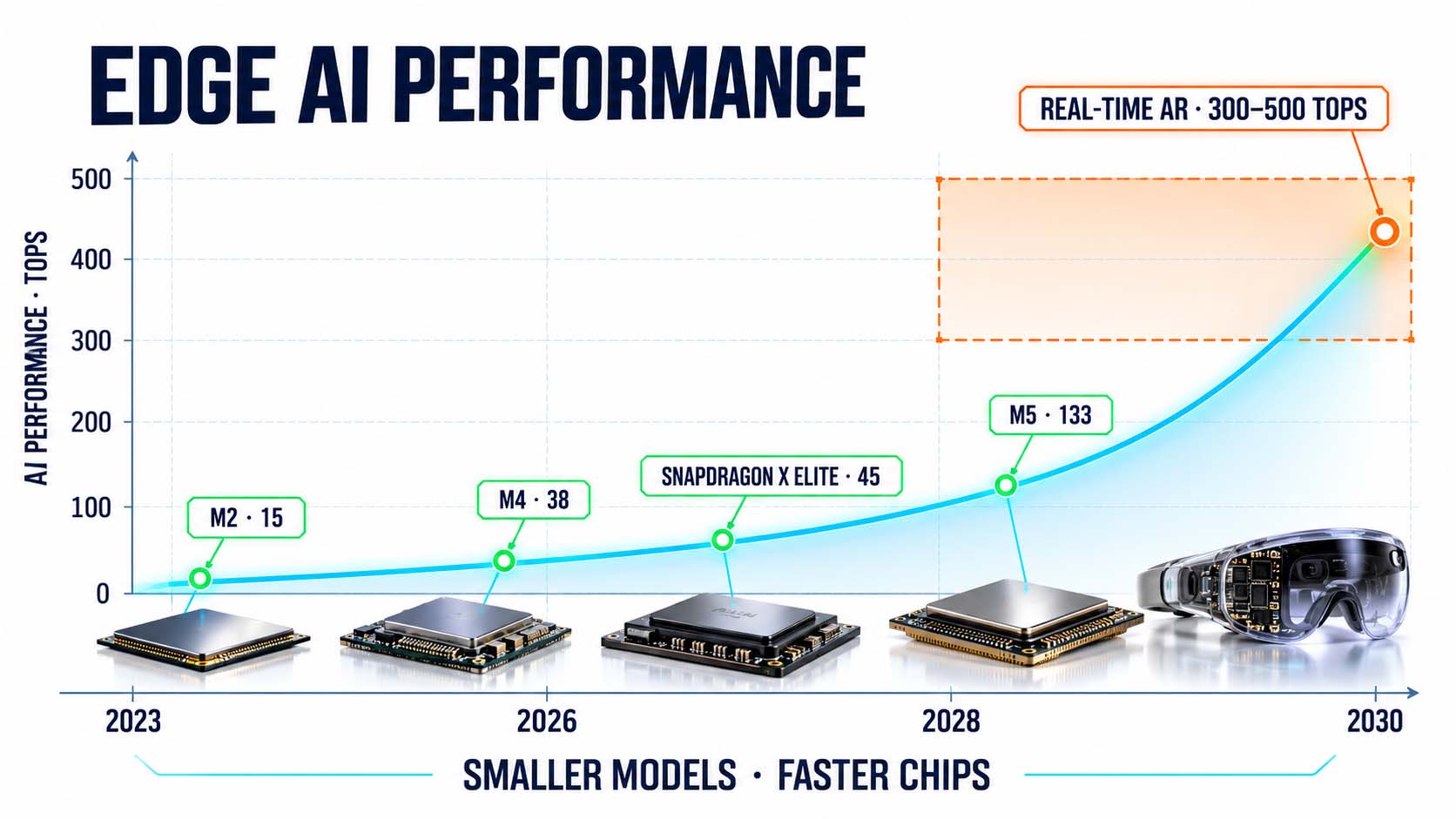
The curve rises steeply, but the threshold for generative real-time characters still lies far above it.
Infographic: AI performance of current chips compared with the estimated threshold for generative real-time AR, years on the axis are a rough guide[10][11] | AI-generated illustration, not a product photo | XR Stager Online Magazine | VISORIC GmbH
| Chip or threshold | AI performance | Classification |
|---|---|---|
| Apple M2 | 15 TOPS | Starting point of the curve |
| Apple M4 | 38 TOPS | Manufacturer information |
| Qualcomm Snapdragon X Elite | 45 TOPS | Manufacturer information on the NPU |
| Apple M5 | Around 133 TOPS | Cited value, to be treated as a projection |
| Generative real-time AR | 300 to 500 TOPS | Estimated on-device threshold |
The estimated threshold for generative real-time characters lies roughly two to four times above the highest cited chip value.
Table: AI performance of selected chips compared with the estimated real-time threshold, manufacturer information and estimates[10][11] | XR Stager Online Magazine | VISORIC GmbH
Fully generative AI characters with dynamic relighting, the harder problem, require 300 to 500 TOPS directly on the device according to current estimates. Researchers expect this threshold in the period 2028 to 2030, but only under conditions: compressed 3D diffusion models and a solved real-time relighting pipeline are needed.
- Apple’s M4 reaches 38 TOPS, and a value of around 133 TOPS is cited for the M5.[10]
- Snapdragon X Elite delivers 45 TOPS via its NPU.[11]
- INT4 quantization makes models up to six times smaller with minimal quality loss.
- SqueezeMe shows three pre-captured avatars at 72 frames per second on the Quest 3.[13]
- Generative real-time characters need an estimated 300 to 500 TOPS, expected for 2028 to 2030.
How today’s technology looks in a concrete example film, and what the finished film does not reveal, is shown in the following chapter.
What a Finished AI Film Does Not Show
A demonstration film on LinkedIn shows what current AI compositing tools deliver at their best. A Neanderthal moves through real environments: he leans against a modern car, sits at a laptop in an open-plan office and stands holding a spear in a mountain landscape. The light adapts to each location, shadows fall correctly, and the character’s size and perspective match the environment.[1][15]
The post received a big response, with over 800 likes and more than 100 reposts, and many comments assumed it was real-time AR.[14] In fact, it is a post-produced film. For film, advertising and branded content, this is nonetheless a genuine reduction in cost and effort compared with classic VFX workflows.
What is not visible in the finished film are the steps before and after. The image shows them in three stages: first a sketch of the scene is created (Planned), then a person records the scene with a smartphone (Recorded), and only afterwards does the cloud compute the finished film (Rendered).
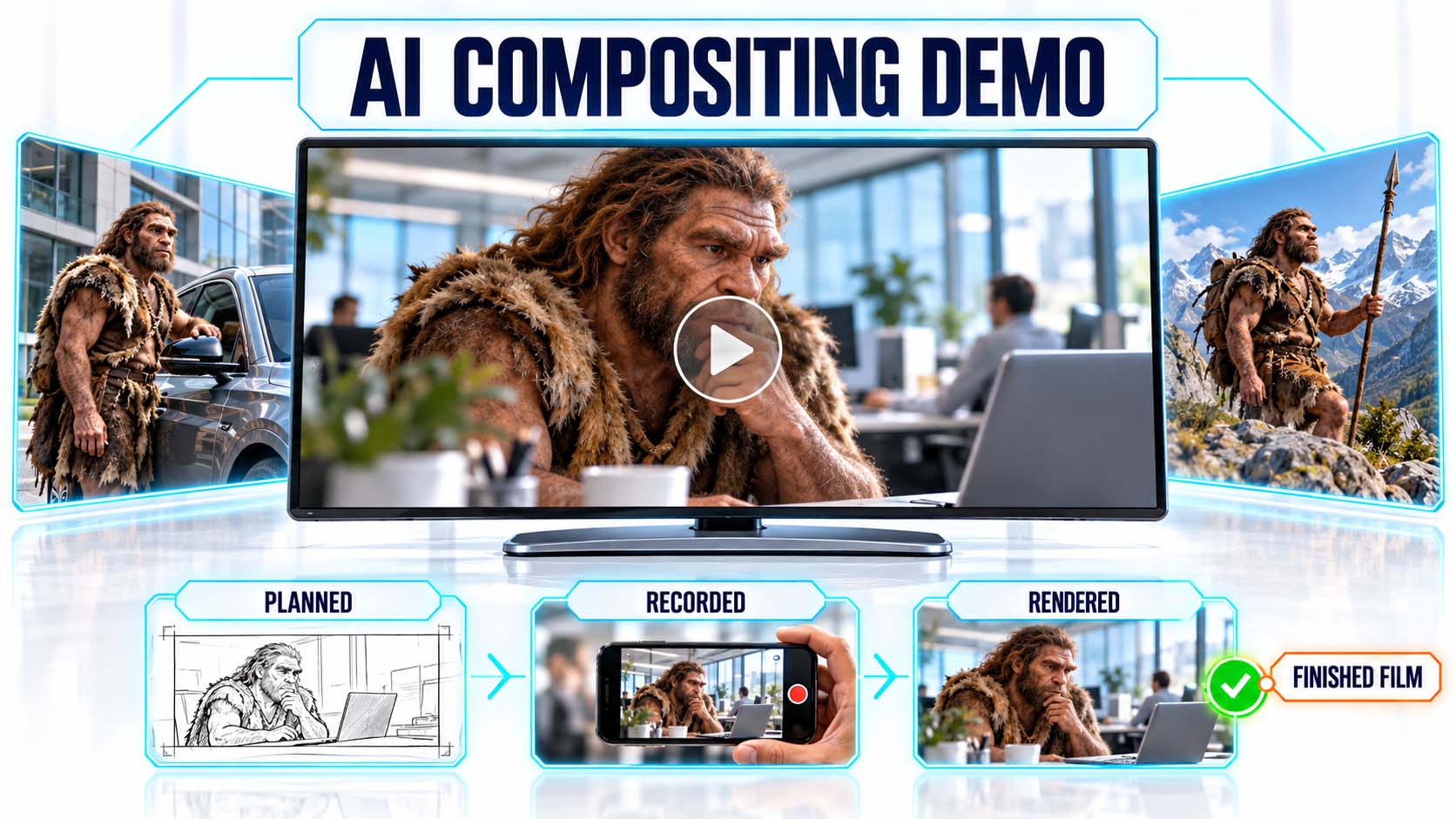
The finished film is created in three separate steps, and only the last one is visible in the result.
Infographic: From the sketch through the smartphone recording to the computed film, the steps happen one after another and not simultaneously[1][15] | AI-generated illustration, not a product photo | XR Stager Online Magazine | VISORIC GmbH
The seamlessness of the result hides the time-delayed nature of the process. Anyone evaluating the example should therefore distinguish two roles: as a production tool, the technology is already convincing today. As a platform for Spatial Computing that reacts to real space in real time, it is not there yet.
- The demonstration film shows a Neanderthal in an office, on a street and in a mountain landscape with matching light and shadows.[15]
- Behind the finished film lie planning, smartphone recording and cloud computation.[1]
- For film, advertising and branded content, the method reduces cost and time compared with classic VFX workflows.
- Many viewers took the result for real-time AR, but it is a post-produced film.[14]
- Convincing as a production tool, not yet as a real-time platform.
How the path from post-production to real-time presence could look is shown in the next chapter.
From Post-Production to Presence
The path from today’s compositing tools to true spatial real-time AR follows a logical sequence of three stages that are already emerging on the hardware roadmap. The following image again uses the Neanderthal from the example film as its sample character.
Today, AI film tools are at the center: cloud rendering in minutes to hours, high output quality, but no real time. Their value lies in film, advertising and branded content. In 2026 to 2027, pre-captured avatars follow. Neural head avatars and pre-trained character models run at over 60 frames per second on current iPhone and headset systems, such as PrismAvatar or Meta SqueezeMe.[12][13] That is real time, but the character is fixed and does not respond generatively to the environment. In 2028 to 2030, generative real-time characters could follow, which generate themselves and respond to their environment, provided that the conditions mentioned above are met.
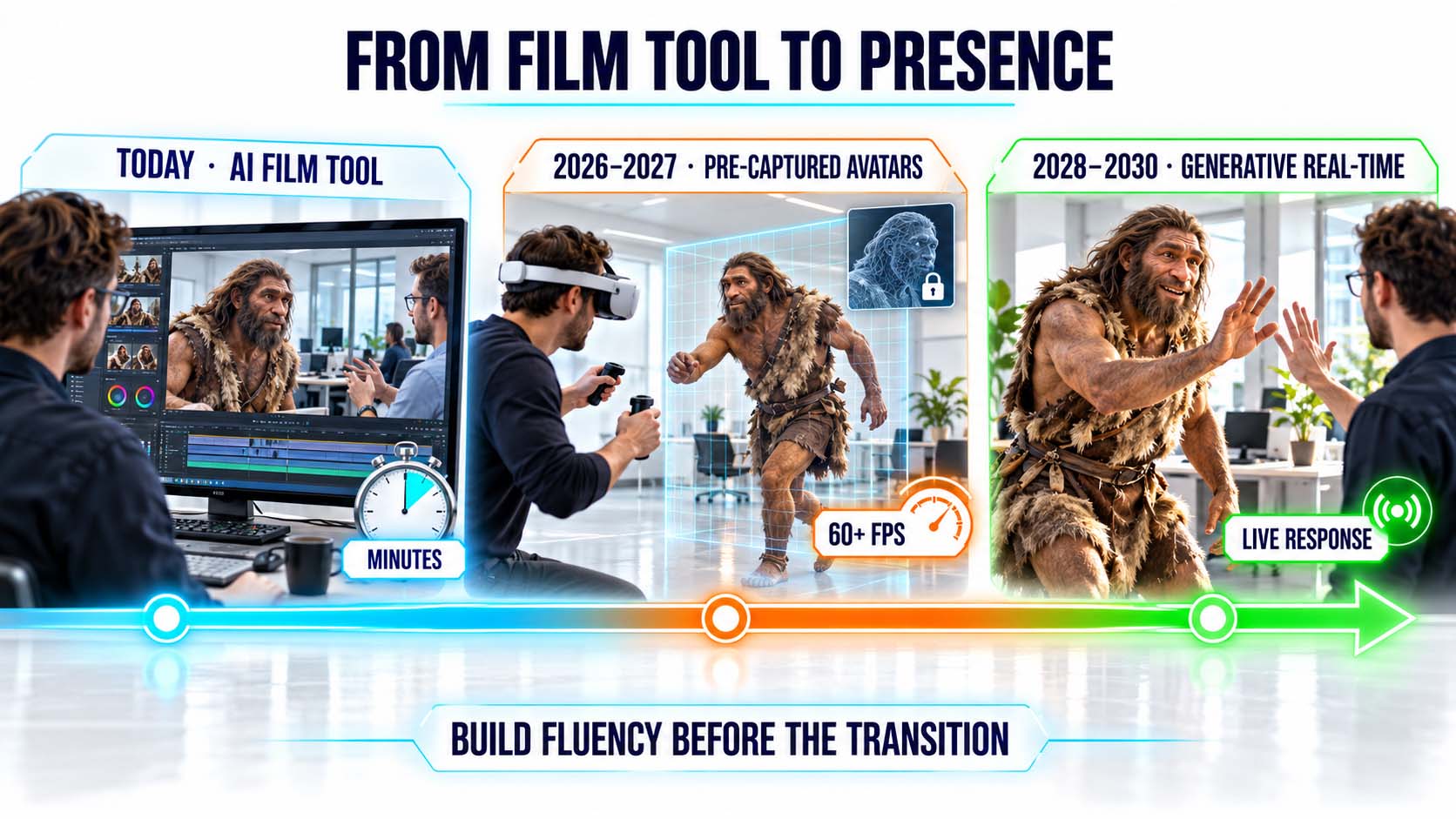
Three stages lead from minutes of waiting to live response, and the time in between is a preparation window.
Infographic: From today’s AI film tools through pre-captured avatars to generative real-time characters, years are expectations and not commitments[12][13] | AI-generated illustration, not a product photo | XR Stager Online Magazine | VISORIC GmbH
| Stage | What is possible | Limitation |
|---|---|---|
| Today, AI film tools | High-quality cloud rendering for film, advertising and branded content | Minutes to hours, no real time |
| 2026 to 2027, pre-captured avatars | Neural avatars at over 60 frames per second on current hardware | Character is fixed, not generative |
| 2028 to 2030, generative real time | Characters that generate themselves and react live to the environment | Conditional on 300 to 500 TOPS, compressed 3D models and solved relighting |
Each stage has its own limitation, which only the next stage removes.
Table: Three development stages with capabilities and limitations, time frames are expectations[12][13] | XR Stager Online Magazine | VISORIC GmbH
For production teams and brand managers, this raises a strategic rather than a technical question: which part of the curve do you want to be on when the transition happens? Teams that gather experience with AI compositing today are building production workflows, content libraries and knowledge that can later be transferred directly to real-time Spatial Computing. The gap between today’s tools and future capability is a preparation window, not a waiting period.
- Today, AI film tools deliver high quality with waiting times of minutes to hours.
- In 2026 to 2027, pre-captured avatars run at over 60 frames per second.[12][13]
- In 2028 to 2030, generative real-time characters could follow, under clear conditions.
- Workflows and content built up now can later be transferred to real time.
- The time until then is a preparation window.
How such a film looks in motion is shown in the following video.
Das Demonstrationsvideo in Bewegung
Die vorangegangenen Kapitel haben erklärt, wie KI-Compositing funktioniert, wo die Grenzen der Echtzeit liegen und wie der Weg dorthin aussehen könnte. Wie das Ergebnis tatsächlich wirkt, lässt sich am unmittelbarsten im Film beobachten.
Das folgende Video stammt vom Creator Divesh Naidoo und zeigt die Technologie Simulon, ein Werkzeug für KI-Compositing mit Reality-Aware Rendering, das Kapitel 2 beschrieben hat. Der Clip dauert 49 Sekunden. Ein Standbild des zugehörigen Beitrags zeigt ein Mammut auf einem Büroschreibtisch neben Tastatur und Glas, darunter ist eine Person im Büro zu sehen. Auf den ersten Blick wirkt das wie eine Augmented-Reality-Figur, die live und intelligent auf einen echten Menschen reagiert.[15]
Der Ablauf dahinter folgt dem Prinzip aus Kapitel 2. Der Creator nimmt eine geplante Szene auf. Simulon verarbeitet anschließend Bewegung, Sprache, Beleuchtung und Umgebung und erzeugt daraus eine neue Figurendarstellung, die zum aufgenommenen Material passt.[1] Die Figur entsteht also nach der Aufnahme und nicht während des Drehs.
Beim Anschauen lohnt sich ein Blick auf vier Dinge: wie das Licht der Figur zur Umgebung passt, ob Schatten und Kontakt mit Objekten glaubwürdig wirken, ob Größe und Perspektive über alle Einstellungen hinweg stimmen und wie die Figur auf die Bewegungen und Worte der Person reagiert. Aussagen über Verarbeitungszeit oder technischen Ablauf lassen sich aus dem Video allein nicht ableiten, diese Angaben stammen aus der Dokumentation des Herstellers.[1]
Video: KI-Compositing-Demo von Divesh Naidoo mit der Technologie Simulon[1][15] | Visuals by original creators | Analysis by Ulrich Buckenlei | XR Stager Online Magazin | VISORIC GmbH
Auffällig ist, wie gut sich die Figur in die Szene einfügt. Das ist eine redaktionelle Beobachtung, kein Nachweis für Echtzeitfähigkeit. Der Clip ist ein fertiger Film, der nach der Aufnahme erzeugt wurde. Die Figur reagiert nicht live auf die Person oder die Umgebung, während die Szene gedreht wird.
Warum das heute nicht anders geht, zeigt die Latenz. Cloud-Rendering liefert erhebliche Rechenleistung, aber Szenendaten zu senden und das Ergebnis zurückzuerhalten kostet Zeit. Reaktionsfähige AR braucht eine vollständige Interaktionsschleife, die deutlich unter einer Sekunde arbeitet, idealerweise unter etwa 100 Millisekunden. Diese Angabe beschreibt die gesamte Schleife aus Wahrnehmen, Entscheiden, Animieren und Darstellen. Für die reine Bildausgabe gilt ein noch deutlich strengerer Wert von 7 bis 15 Millisekunden, wie Kapitel 4 gezeigt hat.
Hinzu kommt die Aufgabe selbst. Eine lebendige KI-Figur muss die Person, den Raum, die Bewegung und den Kontext verstehen, während sie sich verändern. Sie muss entscheiden, wie sie antwortet, diese Antwort animieren und im selben Interaktionsfenster darstellen. Jede dieser vier Stufen, Szenenverständnis, Antworterzeugung, Animation und Rendering, kann zum Engpass werden.
Der Weg nach vorn führt über Edge-KI, kleinere Modelle und dedizierte Hardware für Spatial Computing, die diese Lücke Schritt für Schritt schließen. Das Ziel ist eine KI-Figur, die wahrnehmen, reagieren und im Raum um uns überzeugend präsent bleiben kann. Schon heute ist die Technik ein leistungsfähiges Werkzeug für die Filmproduktion. Der nächste Sprung besteht darin, die Figur wirklich präsent zu machen.
- Das Video stammt vom Creator Divesh Naidoo, die eingesetzte Technologie heißt Simulon.[1][15]
- Der Clip ist ein fertiger Film, der nach der Aufnahme erzeugt wurde, keine Live-AR.
- Achten sollte man auf Licht, Schatten, Objektkontakt, Größe, Perspektive und die Reaktion der Figur.
- Reaktionsfähige AR braucht eine Interaktionsschleife unter etwa 100 Millisekunden, die Bildausgabe allein 7 bis 15 Millisekunden.
- Edge-KI, kleinere Modelle und dedizierte Hardware sollen die Lücke schrittweise schließen.
Dieses Beispiel macht greifbar, warum der Weg vom Film zur Echtzeit-Präsenz Vorbereitung braucht.
From Understanding to Preparation
Those who classify AI compositing and real-time AR correctly can make decisions that bring benefits today while also preparing for future capabilities. This requires a sober assessment of the tools against your own requirements: which task is to be solved, how much delay is acceptable, and which content can be reused later?
The expert team at VISORIC GmbH in Munich has advised industrial and B2B companies for over 15 years on 3D visualization, VR/XR applications and Spatial Computing. It combines technical depth with production experience: from interactive 3D platforms and VR training environments to AI-assisted content production and Spatial Computing strategies.[16][17]

15 years of experience in 3D, AI and XR: the VISORIC expert team from Munich.
Image: © Ulrich Buckenlei | XR Stager Online Magazine | VISORIC GmbH
A single, clearly defined use case can often be implemented much faster and more cost-effectively than many companies expect.
- Assessment of AI compositing tools against real production requirements.
- Building workflows and content that can later be reused in real-time Spatial Computing.
- Implementation roadmaps that deliver value today and prepare for upcoming capabilities.
That is exactly the starting point for a conversation: not the big vision, but the question of which first step makes sense today.
Which part of the curve does your organization want to be on when the transition to real time happens?
Talk to the VISORIC expert team in Munich about AI-assisted content production, Spatial Computing and digital twins. Together, we will develop a precise, traceable next step from your task.
Contact:
Email: info@visoric.com
Phone: +49 89 21552678
Sources and References
- Simulon. Reality-Aware Rendering, documentation and product page, manufacturer information. simulon.ai.
- Autodesk. Flow Studio (formerly Wonder Studio), manufacturer documentation. autodesk.com/flow-studio.
- Move.ai. Markerless motion capture, product page, manufacturer information. move.ai.
- Epic Games. MetaHuman Animator, documentation. dev.epicgames.com.
- Adobe. Firefly Video, manufacturer information. adobe.com/firefly/features/video.
- Mobile-GS: Efficient Gaussian Splatting for Mobile Devices. CVPR 2025. arxiv.org/abs/2408.08206.
- Kerbl et al. 3D Gaussian Splatting for Real-Time Novel View Synthesis, 2023. repo.cs.univie.ac.at.
- NVIDIA. CloudXR, latency documentation, manufacturer information. developer.nvidia.com/cloudxr-sdk.
- 3GPP. TR 22.872, Study on AR/VR requirements. 3gpp.org.
- Apple. M5 Neural Engine, architecture notes, manufacturer information. developer.apple.com.
- Qualcomm. Snapdragon X Elite, whitepaper on AI performance, manufacturer information. qualcomm.com.
- PrismAvatar. Real-time neural head avatar on mobile, February 2025.
- Meta. SqueezeMe, photorealistic avatars on Quest 3, 2025.
- Swapratim Roy. LinkedIn post on Simulon, October 2026.
- Divesh Naidoo. Product demonstration video for Simulon, 2026.
- VISORIC practice projects in the areas of 3D visualization, VR/XR and Spatial Computing.
- XR Stager platform for real-time 3D, digital twins and industrial Spatial Computing applications.
Contact Persons:
Ulrich Buckenlei (Creative Director)
Mobile: +49 152 53532871
Email: ulrich.buckenlei@visoric.com
Nataliya Daniltseva (Project Manager)
Mobile: +49 176 72805705
Email: nataliya.daniltseva@visoric.com
Address:
VISORIC GmbH
Bayerstraße 13
D-80335 Munich