


When a touch meets a digital response.
Visualization: When an everyday gesture is enough to trigger a digital, intelligent response | Image: © Ulrich Buckenlei | XR Stager Online Magazine | VISORIC GmbH
A short video experiment initially looks like nothing more than a visual effect: A camera captures a hand in front of a picture frame, a projector mirrors it in real time as a glowing silhouette on the opposite side, creating the impression that the hand is physically reaching through the frame. This portal experiment was built by creator @buildwbrendan.[1] The full video is embedded further down in this article.
The interesting part, however, only emerges on a closer look at an earlier version of the same project. There, zones could be freely defined around physical objects, and as soon as a tracked fingertip entered one of these zones, the system triggered a predefined software action.[2] A visual effect thereby becomes an input mechanism: The physical presence of an object or a hand becomes an event, similar to a click, a touch, or a sensor signal.
Combined with Artificial Intelligence, this logic reaches far beyond a single creative project. As soon as a system not only detects that something is present in a defined area, but also understands which object it is and in what context it appears, a new class of interface emerges: tools that trigger their own digital instructions, exhibits that react to visitors, products that provide information the moment they enter a defined zone.
This article deliberately looks beyond the single creative experiment to the underlying principle, which reaches far beyond installations: How computer vision recognizes physical objects and spaces, how reliable digital triggers emerge from this, where the technical limits lie, and why this principle is already economically relevant today for training, maintenance, trade shows, and showrooms.
- Physical objects and spaces can become digital triggers.
- Computer vision recognizes objects, AI gives them meaning and context.
- Spatial zones and anchors link real areas to digital actions.
- Visitors and people can be used as triggers as well.
- The principle is economically relevant across many industries, not just creative projects.
This article explains how the principle works technically, which fields of application arise from it, where the limits lie, and how companies can put it to use for themselves.
When Real Objects Become Digital Triggers
The portal effect itself relies on a comparatively simple technical setup: A camera captures one side of a picture frame, software processes the image, isolates the hand from the background, and turns it into a projected silhouette that appears on the opposite side in real time. The visual trick creates the illusion that the hand is passing through the physical frame.
The truly interesting idea, however, is not the visual effect itself, but an earlier development stage of the same project. There, zones could be freely defined around physical objects, and as soon as a fingertip tracked by the camera entered one of these zones, the software triggered a predefined action. Objects that enter the camera’s field of view thereby become triggers themselves.
For software architecture, this represents a fundamental shift in perspective: Physical presence becomes an input event, comparable to a mouse click, a touch, or a sensor signal, just without a screen, keyboard, or physical device. For a system to make this decision, however, it must first reliably recognize which object is actually present in the frame.
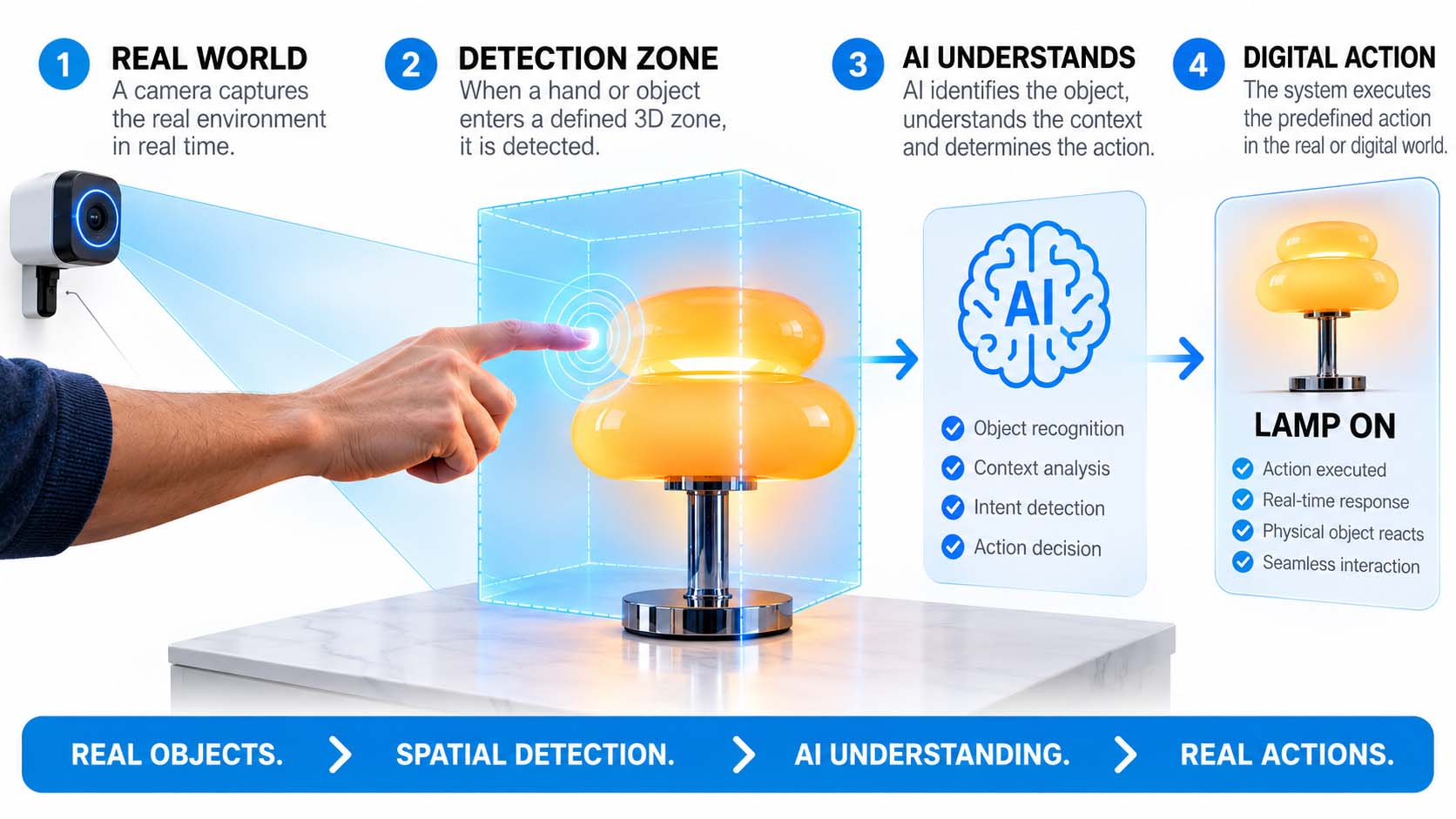
A touch becomes a digital event.
Infographic: A touch is enough for physical presence to become a digital event | Graphic: © Ulrich Buckenlei | XR Stager Online Magazine | VISORIC GmbH
- The portal effect relies on camera, image processing, and real-time projection.
- An earlier version defined zones that were triggered by objects.
- Physical presence thereby becomes a digital input event.
- The principle works independently of the specific visual effect.
- It forms the foundation for considerably broader applications.
Before a system can decide at all whether a relevant object is present in a given area, it must first reliably recognize that object. This recognition capability is the technical foundation on which every object-reactive system is built, regardless of how the effect is ultimately designed. How computer vision performs this recognition in detail is covered in the next chapter.
How Computer Vision Recognizes Objects and AI Gives Them Meaning
Object detection identifies and locates multiple objects simultaneously within a camera image, not merely that something is present, but precisely where and which object class it belongs to.[3] Modern models from the YOLO family achieve high detection rates while requiring very little processing time; current, edge-optimized variants process well over 100 frames per second on standard hardware.[3]
Detection itself is only the first step in a longer processing chain. Visual recognition is followed by a decision layer that translates the result into a concrete action: a notification to an operator, an automated process step, a logged data point, or a visual confirmation. This entire sequence, from image capture to the triggered action, now runs in milliseconds.[3]
This is precisely where the task of Artificial Intelligence begins. Computer vision initially delivers only the detection: an object, a position, an object class. Only AI models give this result meaning by factoring in context, such as which tool was recognized, in what sequence it is typically used, or whether a detected situation requires a response at all. Spatial computing systems increasingly move beyond passive observation: agentic AI systems increasingly act autonomously based on what they see, combining object detection with reasoning rather than mere listing.[4]
This division of labor can be clearly separated: Computer vision answers the question of what is located where in the image; AI answers the question of what that information means and what action should follow. Only in the interplay of both layers does pure detection become a meaningful, context-aware response. However, how reliable such detection actually is depends heavily on training data, lighting conditions, and the complexity of the scene, a point a later chapter addresses.
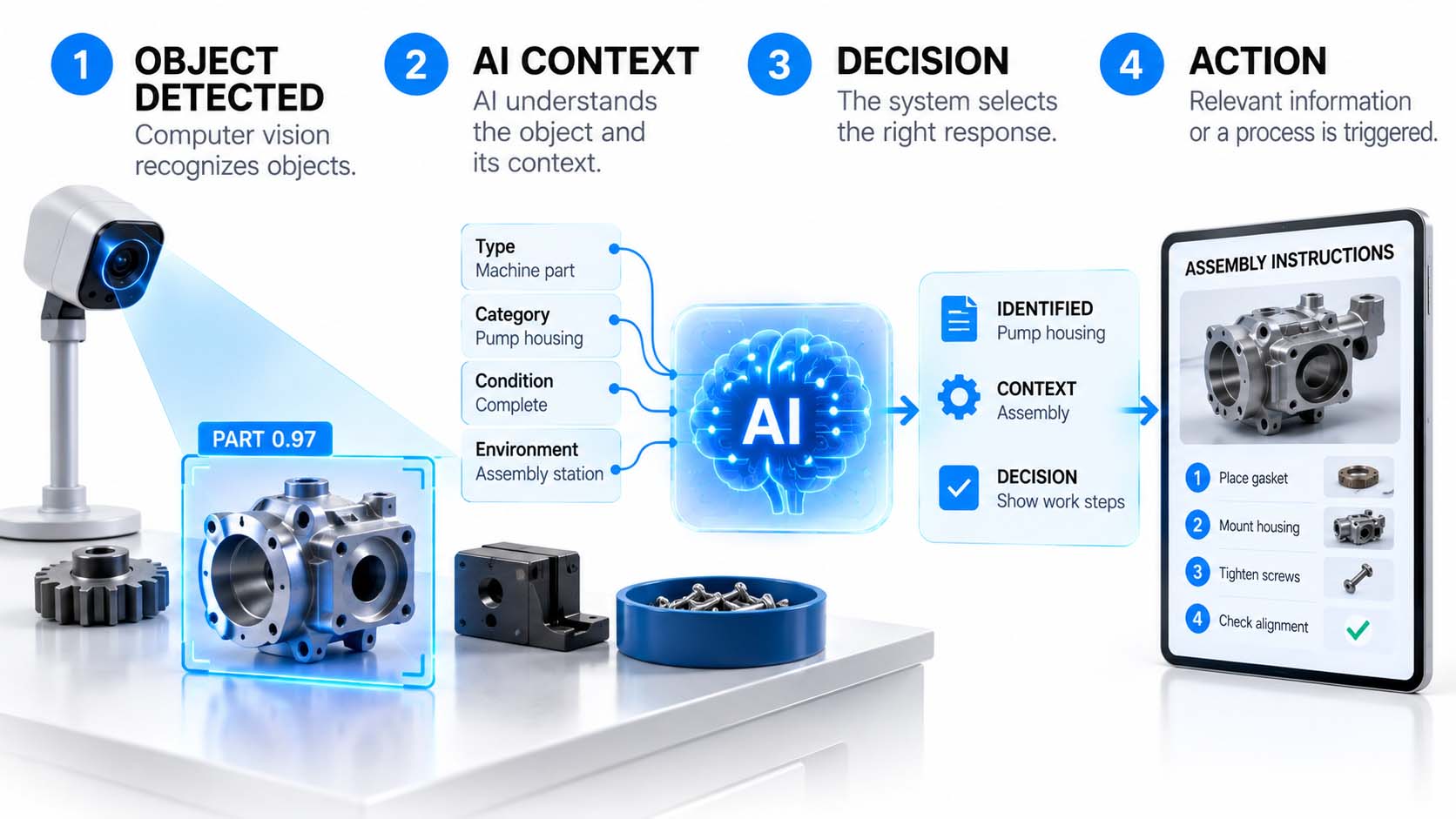
From pixels through detected objects to understood context.
Infographic: Only in the interplay of detection and understanding does observation become a meaningful action | Graphic: © Ulrich Buckenlei | XR Stager Online Magazine | VISORIC GmbH
- Computer vision locates and classifies objects within the camera image.
- AI assigns meaning, context, and a fitting action to the result.
- Modern models process this chain in milliseconds today.
- Agentic AI systems increasingly act on their own, without human input.
- Detection quality depends heavily on training data and conditions.
Reliable detection and contextual understanding alone, however, are not enough. For a targeted digital action to emerge, the system additionally needs an understanding of where in space an object is located and when it enters a specific area. That is what the next chapter shows.
From Detection to Digital Action: Zones and Anchors
A practical implementation of this principle is shown by a scientific project on location-based theater: Several clearly defined content zones were placed along a path through a room. When a person entered one of these zones, the system automatically triggered a matching digital performance, without the person having to touch or operate anything.[5] The basic principle can be applied directly to objects instead of locations.
For such a zone to reliably stay in the right place, digital content must be tied to fixed real-world coordinates. This is exactly what so-called spatial anchors achieve: They link a digital element to a specific point or object in the physical world and ensure that this link persists even as the camera perspective changes.[6] If the physical environment changes, for instance because an object is moved, this anchor must be re-aligned accordingly.
For practical implementation, this means: A zone can be placed not only around a fixed location in a room, but just as precisely around a single, movable object. This makes the object itself the trigger, not the location, regardless of where the object currently happens to be.
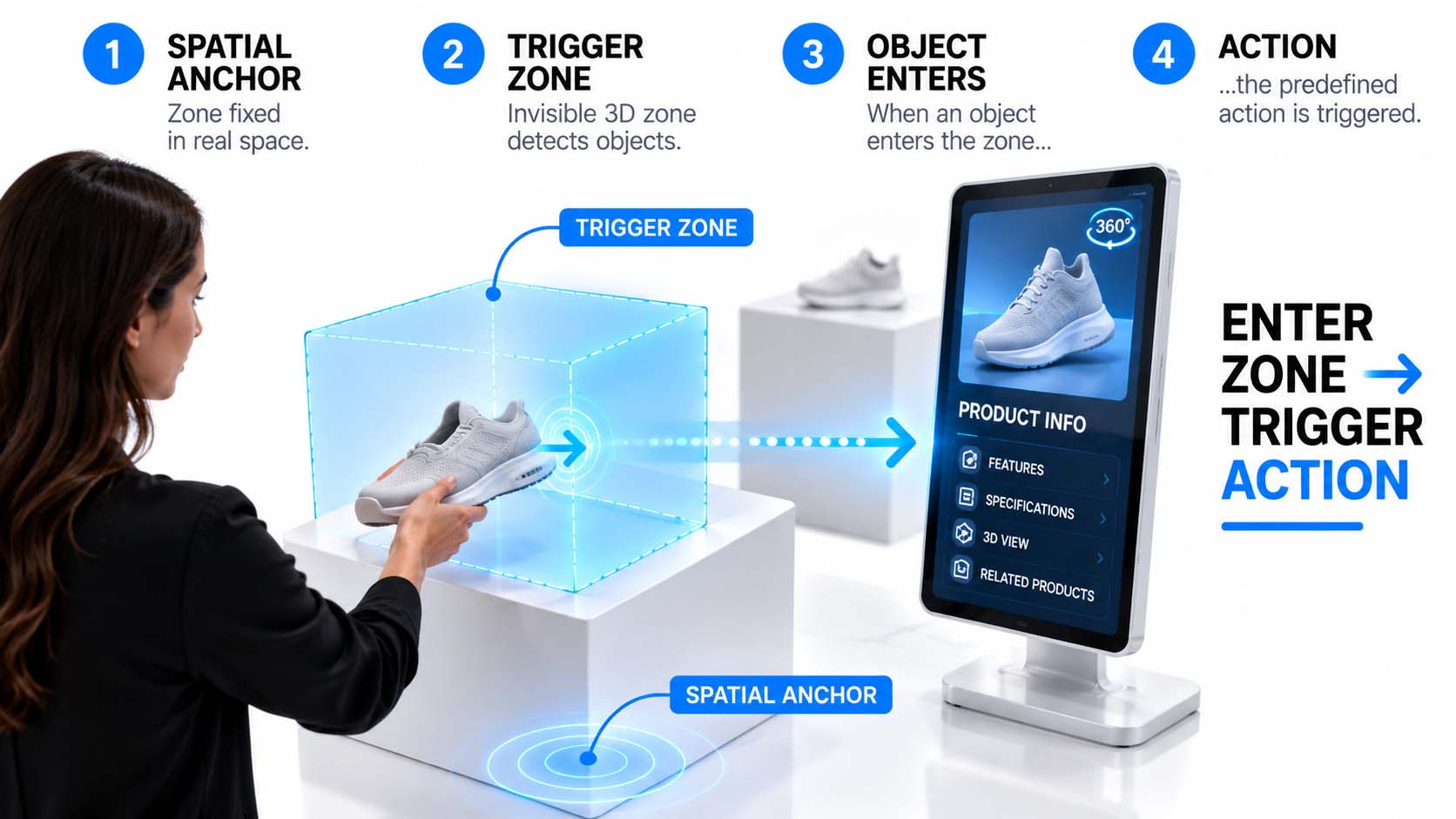
One zone, one entry, one triggered action.
Infographic: A defined area is enough to turn physical presence into a digital action | Graphic: © Ulrich Buckenlei | XR Stager Online Magazine | VISORIC GmbH
- Spatial zones can be defined along a path or around objects.
- A trigger fires as soon as a tracked element enters a zone.
- Spatial anchors link digital content to fixed real-world coordinates.
- These anchors must be re-aligned whenever the environment changes.
- The principle works for individual objects as well as for entire areas.
Objects are not the only things that can become triggers in this way. People and their movement through a space can also serve as triggers, without having to touch or carry anything. That is what the next chapter shows.
When Spaces Recognize Visitors, Not Just Objects
A documented example from practice shows how this principle can be applied to visitor flows: In a museum, a 3D sensor system captured the position and movement of visitors within an interactive area, without capturing faces, clothing, or any other personal features at all, relying exclusively on anonymous spatial position data.[7] This data then automatically controlled sound, light, and further content of the exhibit.
The idea of using object and person detection together is not new. Early museum research projects already combined visitor camera tracking with object detection to adapt exhibition content contextually and to give curators a better balance between entertainment and education.[8] Visitors needed neither a device of their own nor conscious interaction.
The decisive advantage of such an approach lies in the fact that the interaction happens incidentally: The environment reacts because someone is present or moving, not because a button was consciously pressed or an app was opened. The very same principle can also be applied outside museums, for example in training and maintenance environments.
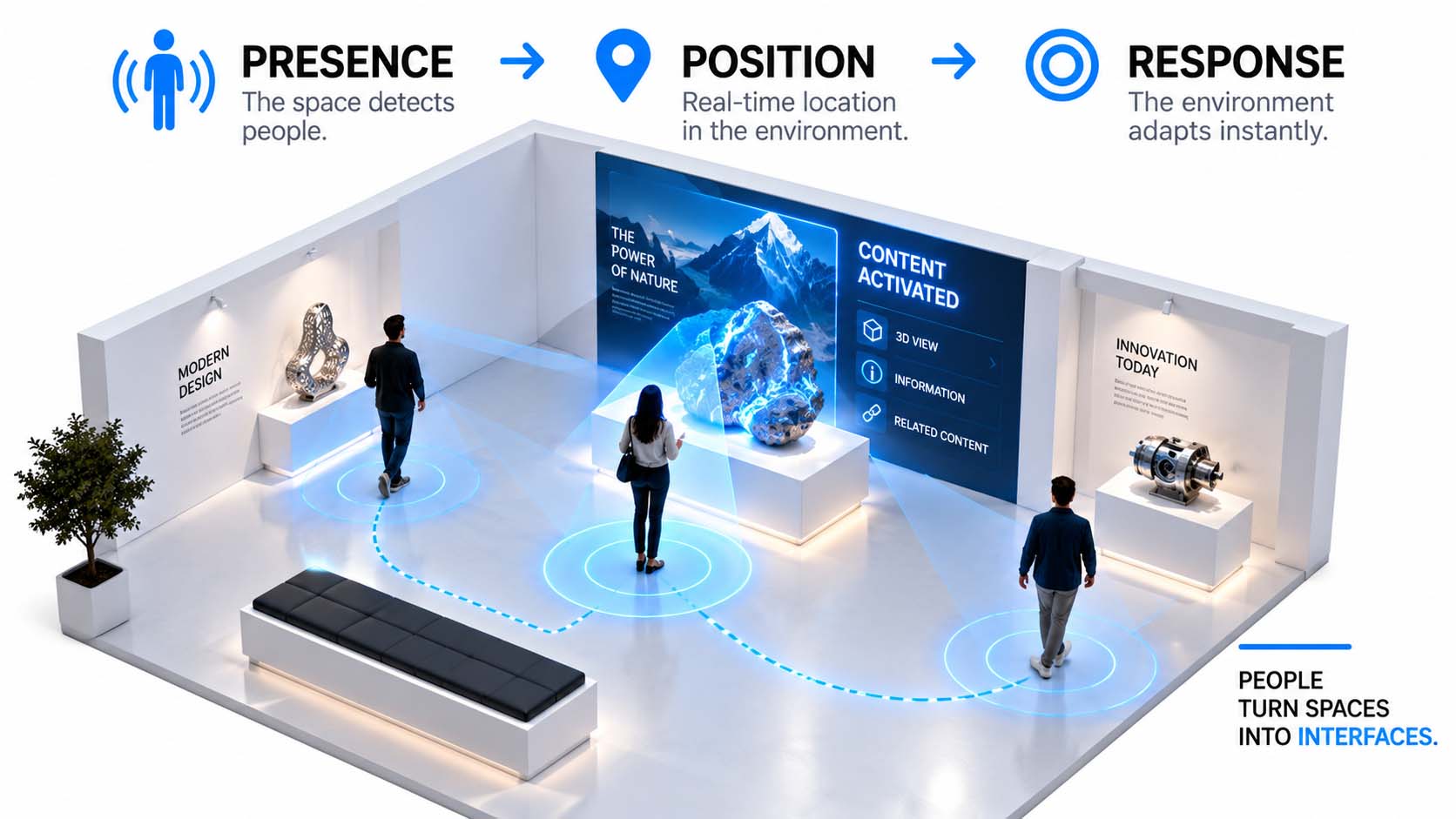
Presence alone can already be a trigger.
Infographic: Presence alone can already be enough for an environment to respond | Graphic: © Ulrich Buckenlei | XR Stager Online Magazine | VISORIC GmbH
- Sensors can anonymously capture visitors’ presence and movement.
- Captured movement patterns can trigger content, light, or sound.
- Early systems already combined object and person tracking.
- Visitors need neither a screen nor a device of their own for this.
- The principle can be transferred from museums to many other spaces.
The same logic of using objects and presence as triggers can also be applied to a completely different field: training and maintenance in industrial companies. There, it is no longer about incidental visitor experiences, but about measurable efficiency in everyday work. That is what the next chapter shows.
Application Field Training and Maintenance: Components as Triggers
In industrial maintenance, this principle is already in use: A camera recognizes a specific component, for example through object detection or image matching, and automatically displays the matching work instructions, instead of requiring technicians to look them up in a manual.[9] A documented example from the automotive industry shows both a noticeably shorter processing time and a significantly reduced error rate compared to paper-based instructions.[9]
The advantage lies above all in the contextual nature of the information: The instructions appear specifically for the component currently being worked on, in the correct sequence, without the technician having to take their eyes or hands off the workpiece.[10] For manufacturing companies, this translates into a concrete, measurable benefit, especially for complex, rare, or frequently changing maintenance steps.
This approach is particularly valuable for onboarding new employees. Instead of following an experienced colleague step by step, the system guides the process itself and automatically marks which component comes next. However, how reliably such a system actually performs depends heavily on the real conditions at the deployment site.
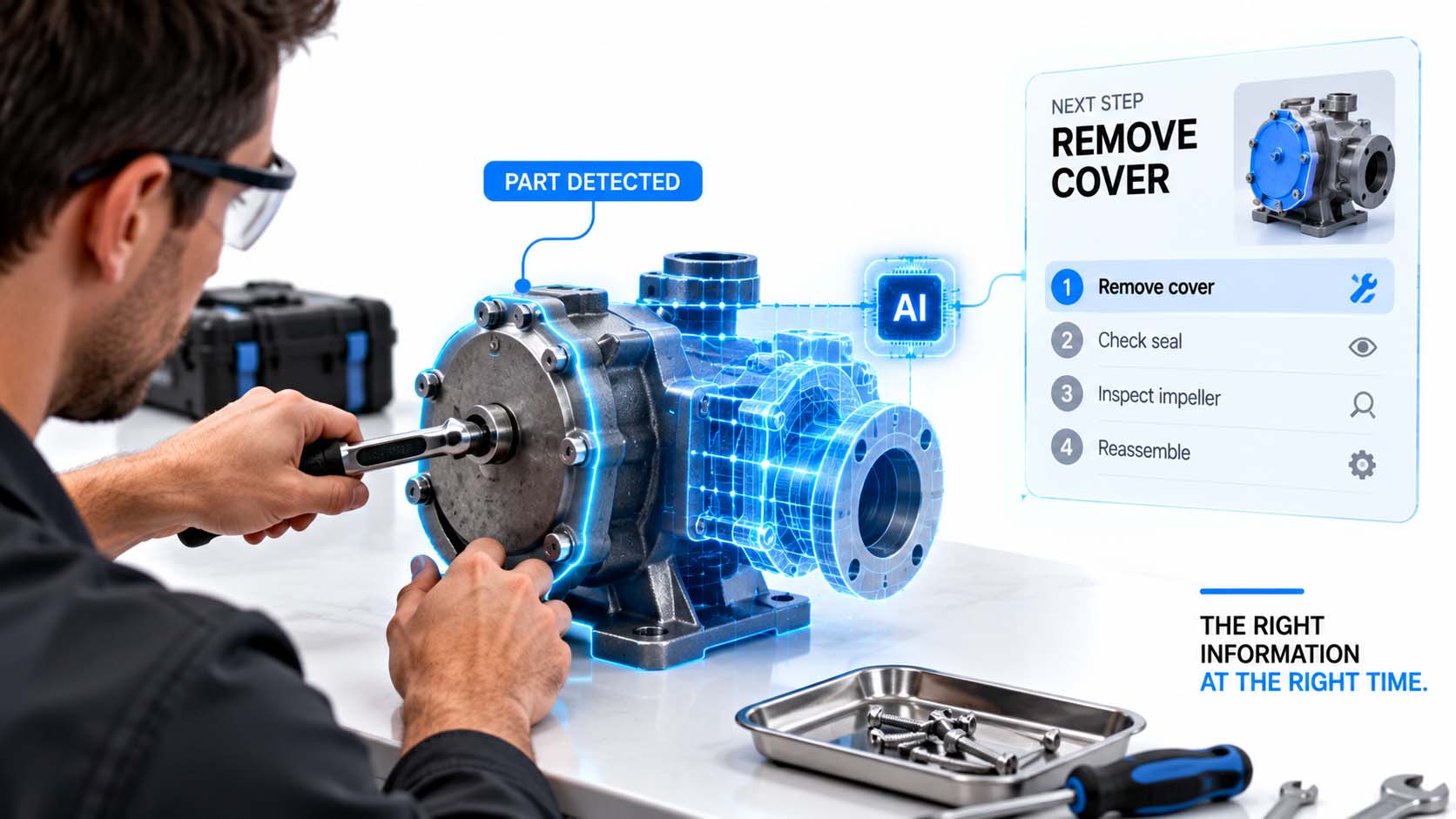
One recognized component, one matching instruction.
Infographic: Having the right component in view is enough to receive the matching instructions, with no manual required | Graphic: © Ulrich Buckenlei | XR Stager Online Magazine | VISORIC GmbH
- Cameras recognize components and trigger the matching work instructions.
- Technicians receive information without taking hands or eyes off the component.
- Practical examples show measurable reductions in errors and processing time.
- Newly onboarded employees especially benefit from contextual guidance.
- The principle works for maintenance just as well as for initial training.
As convincing as this principle looks in practice, it does not work equally reliably under all conditions. Lighting, viewing angle, and the clutter of the actual deployment site play a decisive role in whether detection remains reliable in everyday use. Where the technical limits lie is shown in the next chapter.
Limits of the Technology: Light, Occlusion, and False Alarms
A documented case from the restaurant industry shows how clearly laboratory conditions can differ from real-world deployment conditions: A system for detecting table occupancy worked flawlessly in tests, but initially failed in actual operation due to blind spots from hard-to-see corner tables, changing light throughout the day, and partial occlusion by guests and furniture.[11] Only targeted retraining with real, cluttered image data solved the problem.
These challenges are not an isolated case but structurally well known: Changed object perspectives, occlusions, and cluttered image backgrounds are among the most frequently documented causes of false alarms and missed objects in object detection.[12] A system developed exclusively with clean, well-lit training images does not automatically transfer that reliability to a cluttered, inconsistently lit production or exhibition space.
For companies, this is not a reason to forgo object-reactive interfaces, but it is an important planning factor: Such a system must be tested under the actual conditions of its later deployment site and, if necessary, retrained with real data, rather than relying solely on results from controlled test environments.
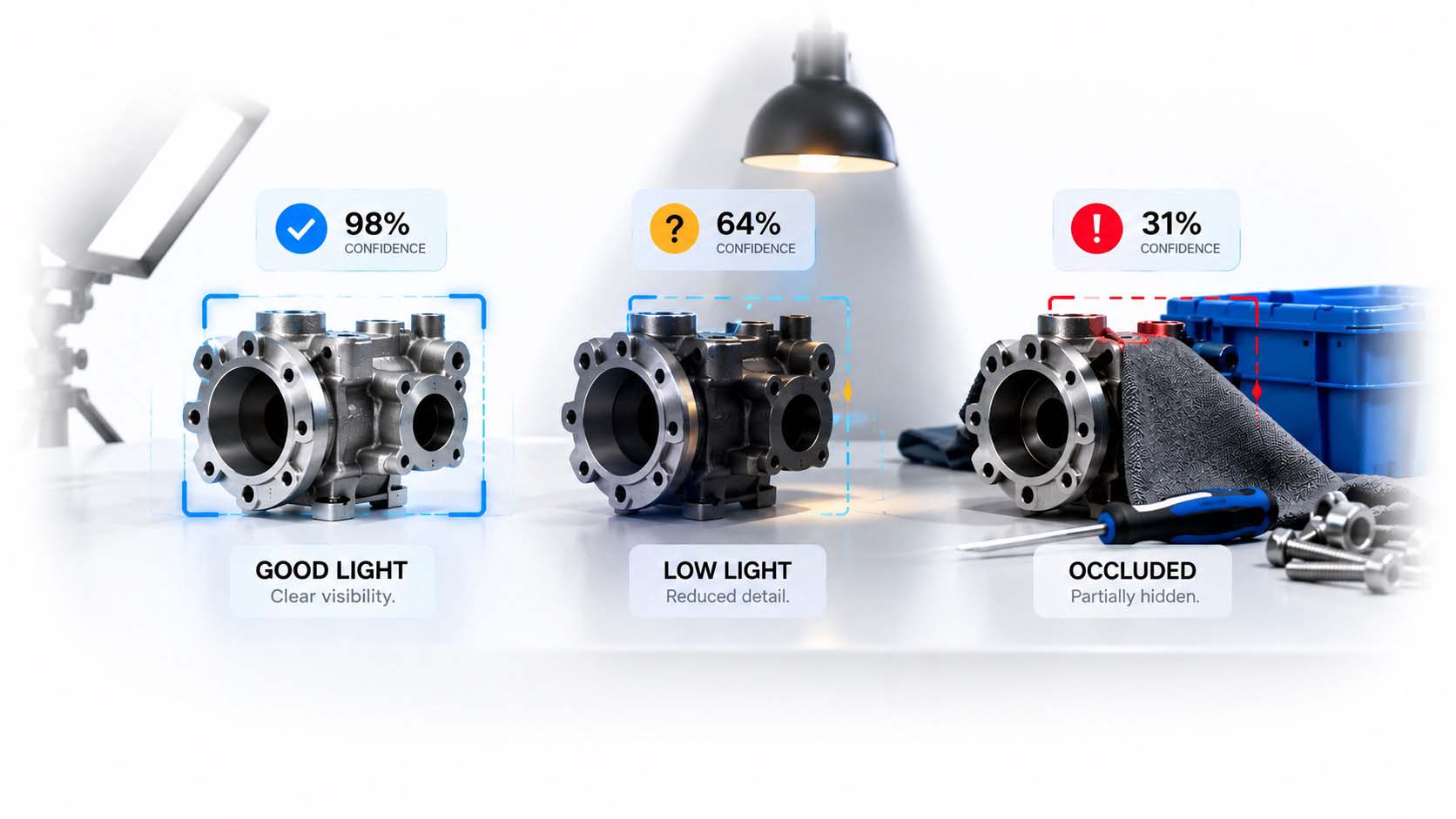
Not every detection is equally reliable under all conditions.
Infographic: Not every environment is equally well suited for reliable detection | Graphic: © Ulrich Buckenlei | XR Stager Online Magazine | VISORIC GmbH
- Changing light and occlusions degrade detection accuracy.
- Models tested under lab conditions often fail in real-world deployment.
- False alarms and missed objects are known, well-documented risks.
- Robust systems are specifically trained with real, cluttered data.
- These limits are a planning factor, not a reason to rule out deployment.
Despite these limits, a larger trend becomes visible that reaches far beyond individual use cases: The way people fundamentally interact with digital systems is changing, and object-reactive interfaces are only one visible part of this development. What this larger shift looks like is shown in the next chapter.
The Bigger Trend: When the Environment Itself Becomes the Interface
For decades, the graphical user interface, with icons, windows, and a pointer controlled by mouse and keyboard, was the dominant interaction model of the computing world.[13] Current developments in human-computer interaction are increasingly moving away from this screen-centric model, toward forms of interaction that are more deeply embedded in physical space and involve the whole body rather than just a mouse cursor.[13]
The decisive conceptual shift here: Digital information can be placed directly onto real objects and surfaces, instead of being displayed on a separate screen. In principle, any surface can become an interactive surface, and any recognized gesture or object can become a command, making computing noticeably more physical and immediate.[14]
Object-reactive interfaces, as described in the previous chapters, are therefore not an isolated niche phenomenon, but an already concretely implementable slice of this larger shift.
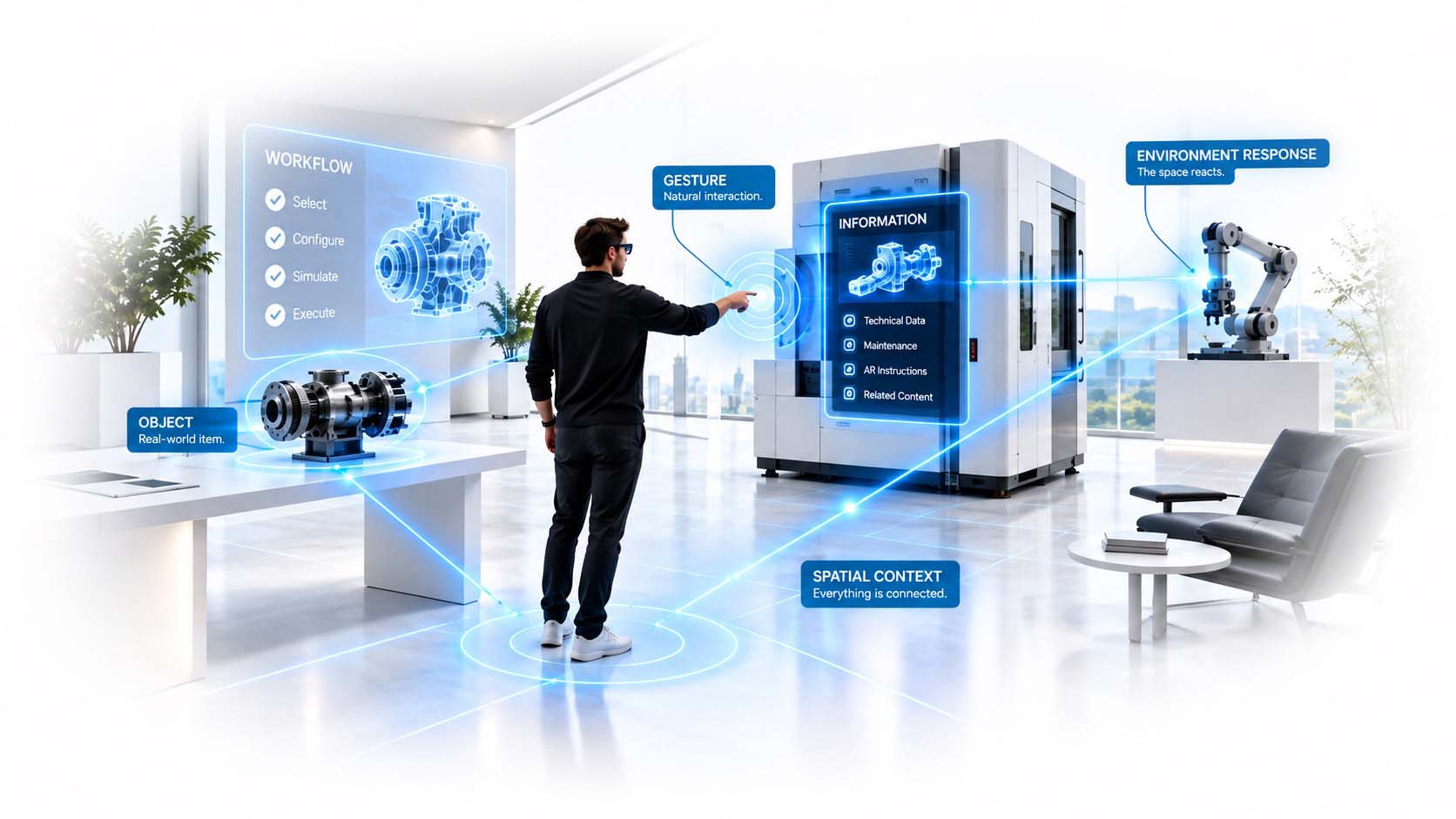
Every surface can potentially become an interface.
Infographic: The user interface does not disappear, it spreads out onto the things themselves | Graphic: © Ulrich Buckenlei | XR Stager Online Magazine | VISORIC GmbH
- For decades, the graphical user interface was the dominant interaction standard.
- New interfaces are increasingly shifting interaction into physical space.
- Digital information can be placed directly onto real objects.
- Any surface and any object can potentially become a trigger.
- Object-reactive systems are a concrete slice of this larger shift.
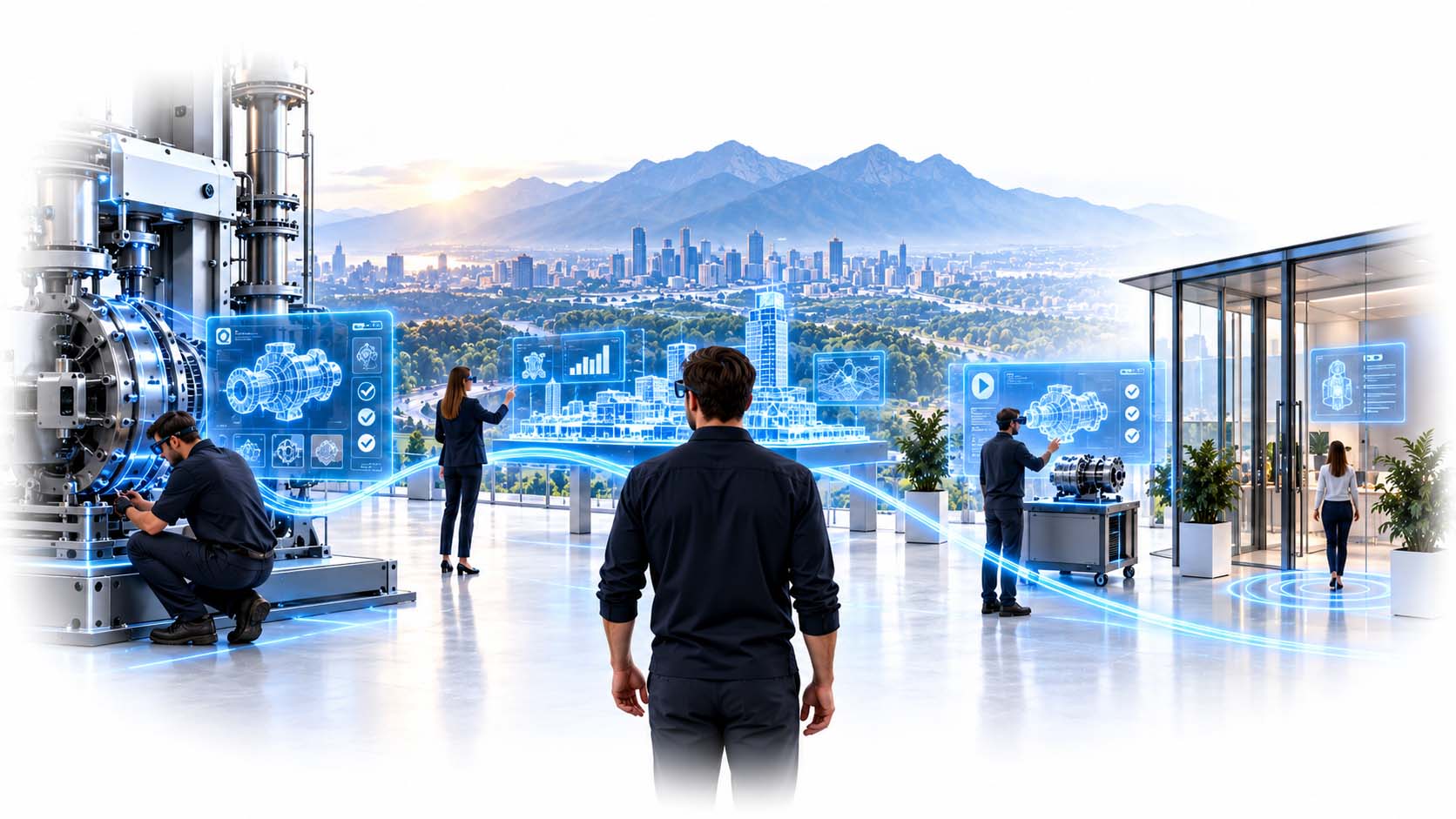
Object-reactive systems are therefore not a technical byproduct, but the practical entry point into this larger shift for any company that wants to prepare for it today. Exactly where this entry point pays off economically is shown in the closing chapter.
What Companies Should Examine Now
Current market figures show that this is not a niche topic: The global market for spatial computing is forecast to grow at double-digit annual rates in the coming years, driven in part by increasing investment in AI-powered, camera-based detection systems across manufacturing, retail, and healthcare.[15] Object-reactive interfaces are a concrete, comparatively easy-to-budget slice of this growth field.
For companies weighing a first step, it is worth looking at a clearly scoped use case rather than an enterprise-wide solution: Many modern, no-code-capable platforms for industrial object detection can be layered onto existing camera infrastructure, without every adjustment requiring a dedicated development team.[16] What remains decisive is testing the system under the actual deployment conditions, as the previous chapter showed.
This makes clear: The path from a single creative experiment to an enterprise-relevant application is shorter than it initially appears.
| Application area | Typical trigger | Benefit |
|---|---|---|
| Training / Onboarding | Tool or component | Contextual instructions with no manual required |
| Maintenance | Machine part | Faster, less error-prone execution |
| Trade shows / Showrooms | Exhibit or product | Information with no touchscreen or app required |
| Retail | Product or shelf area | Automated contextual information at the point of sale |
Four application fields, one shared principle.
Table: A single, clearly scoped use case is often already enough to make the economic benefit visible | Source: own analysis based on current market research, as of summer 2026 | © Ulrich Buckenlei | XR Stager Online Magazine | VISORIC GmbH
- The spatial computing market is forecast to grow at double-digit rates annually.
- Object-reactive interfaces are a concrete, budgetable first use case.
- A single use case can usually be tested without a large upfront investment.
- Existing camera infrastructure can often be reused.
- What matters most is a realistic test under actual deployment conditions.
The leap from a single idea to a productive use case is therefore smaller than it appears at first glance. How convincing this principle already looks in practice today is shown in the following video.
When a Hand Reaches Through a Picture Frame
The previous chapters have shown how computer vision recognizes objects, how spatial triggers emerge from this, where the limits lie, and why this principle is economically relevant for companies. How convincing this looks in a concrete, individual case is shown most vividly by the example mentioned at the outset.
Embedded here is the original experiment by @buildwbrendan, in which a camera captures a hand in front of a picture frame and a projector mirrors it in real time as a glowing silhouette on the opposite side, creating the impression that the hand is physically reaching through the frame.[1]
Video: Portal experiment with computer-vision-powered real-time mirroring | Visuals by @buildwbrendan | Analysis, script, editing, and video production: © Ulrich Buckenlei | XR Stager Online Magazine | VISORIC GmbH
The video makes clear how directly physical presence can be translated into a digital response, with no screen, keyboard, or remote control required. For companies working with training, maintenance, trade show appearances, or showrooms, this example makes tangible how the same underlying principle can be applied to much more concrete use cases.
At the same time, the video makes the decisive point from the previous chapters visible: The real innovation lies not in the visual effect itself, but in the fact that a physical object, here a hand, is reliably recognized, isolated, and translated into a digital event. This exact principle can be applied to tools, components, products, and entire spaces.
- The video shows the original portal experiment by @buildwbrendan.
- A camera captures and isolates the hand in real time.
- A projector mirrors the result onto the opposite side.
- The underlying principle can be applied to objects of all kinds.
- Not the effect itself, but the recognition principle is relevant to business.
This example makes tangible why object-reactive interfaces are becoming a core competency for data-driven companies, far beyond a single viral video.
From Idea to Object-Reactive Application
A convincing interaction is not created by a single visual effect, but by reliable detection, well-thought-out spatial logic, and clean technical implementation, exactly the combination that lies at the core of VISORIC’s work.
The expert team at VISORIC GmbH in Munich combines over 15 years of experience in 3D, AI, and XR with hands-on experience in spatial computing, computer vision, and real-time 3D, exactly the foundation that is also essential for developing object-reactive interfaces, whether the focus is on training environments, maintenance support, trade show appearances, or interactive showrooms. VISORIC helps companies turn a single, clearly scoped use case into a reliable, everyday-ready solution.

15 years of experience in 3D, AI, and XR: the VISORIC expert team from Munich.
Image: © Ulrich Buckenlei | XR Stager Online Magazine | VISORIC GmbH
A well-thought-out, clearly scoped first use case, a single exhibit, a single maintenance process, a single training station, can often be realized considerably faster and more cost-effectively than many companies expect. VISORIC accompanies this path from the first concept idea through technical implementation to a ready-to-use, reliable application.
- Consulting on object- and space-reactive computer vision applications.
- Development of reliable, practical spatial computing solutions.
- From pilot application to an enterprise-wide, object-reactive environment.
This is exactly the starting point for a conversation: not with the big, enterprise-wide vision, but with a clearly scoped, quickly implementable first step that shows how physical objects and spaces can be reliably turned into digital triggers.
Would you like to find out how object-reactive interfaces can be applied concretely in your company?
Talk to the VISORIC expert team in Munich about AI, computer vision, spatial computing, and practical, object-reactive applications. Together, we will turn your requirements into a precise, everyday-ready solution, with a tangible benefit for efficiency, training, and customer experience.
Contact:
Email: info@visoric.com
Phone: +49 89 21552678
Sources and References
- Ulrich Buckenlei. “Real Objects Become Triggers.” LinkedIn, 2026.
- @buildwbrendan. Original concept, development, and footage of the portal experiment. Instagram/X, 2026.
- Ultralytics. Vision AI Enables Touch-Free Gesture Recognition Technology. ultralytics.com, May 2026.
- Manobharathi M. Embracing the Touchless Interface: A Leap Forward in Human-Computer Interaction. Medium, 2024.
- Flowygo. Computer Vision 2026 (Part 1/3): YOLO and Real-Time Object Detection. flowygo.com, February 2026.
- AI Monk. Top 10 Computer Vision Projects: The 2026 Definitive Guide. aimonk.com, June 2026.
- Dynamic Theater: Location-Based Immersive Dance Theater, Investigating User Guidance and Experience. arXiv, 2026.
- EmergentMind. Geo-referenced Digital Twin. emergentmind.com.
- Quanergy Solutions. Interactive Museum Exhibit Case Study. quanergy.com, August 2026.
- MIT Media Lab. Technologies and Methods for Interactive Exhibit Design. ic.media.mit.edu.
- Roundtable Learning. 3 Examples of Augmented Reality for Industrial Maintenance. roundtablelearning.com, May 2026.
- PTC. Augmented Reality in Maintenance. ptc.com, November 2025.
- Sciforce. Why Your Computer Vision Model Struggles in the Real World. Medium, January 2026.
- Challenges of Object Detection and Localization. Springer Nature Link, 2026.
- Inairspace. Future Trends in Human-Computer Interaction: Beyond the Screen and Into the World. inairspace.com, January 2026.
- Techupgradenow. Beyond the Screen: The Evolution of Human-Computer Interaction. techupgradenow.com, September 2025.
- Fortune Business Insights. Spatial Computing Market Size, Share & Forecast. fortunebusinessinsights.com, July 2026.
- Matroid. No-Code Computer Vision for Industry. matroid.com, October 2025.
- VISORIC practical projects in computer vision, real-time 3D, and spatial computing.
- XR Stager platform for real-time 3D, digital twins, knowledge AI, and industrial spatial computing applications.
Contact Persons:
Ulrich Buckenlei (Creative Director)
Mobile: +49 152 53532871
Email: ulrich.buckenlei@visoric.com
Nataliya Daniltseva (Project Manager)
Mobile: +49 176 72805705
Email: nataliya.daniltseva@visoric.com
Address:
VISORIC GmbH
Bayerstraße 13
D-80335 Munich