

A space you can actually change.
Visualization: A real dining and living area captured as a 3D Gaussian Splat, deformed directly inside editing software instead of merely being viewed | Image: © Ulrich Buckenlei | XR Stager Online Magazine | VISORIC GmbH
For many architects, surveyors, and planners, a 3D scan has long meant a familiar trade-off: within minutes, a stunning, photorealistic capture of a real place appears, yet the moment something actually needs to change, that speed advantage disappears. Anyone wanting to remove a wall, expose a view, or combine the scan with a new design has typically had to go back into CAD and rebuild large parts by hand. Fast to create, but hard to actually use, this contradiction has shaped 3D capture for years.
A recent example shows exactly how this contradiction is now being resolved: On LinkedIn, XR Stager editor-in-chief Ulrich Buckenlei published a video in which a real, scanned dining and living area is folded completely inward, with the table, chairs, and floor pattern clearly visible on the inside of a sphere.[1] This effect is made possible by a new, free extension for Adobe After Effects that no longer just displays a captured 3D space, but makes it directly editable, without the detour of remodeling it from scratch.[2]
This article deliberately looks beyond this single example to the underlying question that affects every company working with 3D capture, digital twins, or visual communication: what separates a scan meant only for viewing from a genuinely editable, reusable spatial tool. This distinction increasingly determines how much value a single capture can actually deliver.
What at first looks like a striking creative effect is, in truth, the most visible demonstration of a far more practical development: a 3D scan no longer just needs to be created quickly, it can now actually be edited too, with the same tools, in the same software, without remodeling.
- 3D scans were traditionally fast to create but rarely truly editable.
- A recent example is an Invert Sphere video from XR Stager.
- A new, free extension makes Gaussian Splat scans directly editable.
- Relevant for every company working with 3D capture or digital twins.
- What matters now is the distinction between a static image and an actively usable tool.
This article explains why classic 3D scans were previously hard to work with further, how 3D Gaussian Splatting changes that technically, which tool now makes this editing accessible to anyone, and why the same technology has already arrived in industry.
The Old Trade-Off and Its Counterexample
It starts with an ordinary moment: a dining table, several chairs, a floor pattern, a ceiling lamp. A perfectly normal interior, the kind found in countless homes. This space was captured as a 3D Gaussian Splat, a technique that reconstructs real environments from photos or video footage as a spatial dataset, in minutes rather than weeks. Up to this point, that is simply the well-known advantage of fast 3D capture, one that has already become routine in real estate, heritage preservation, and product visualization.
The equally well-known downside used to follow immediately after: such a scan could be viewed and flown through, but rarely changed. Anyone wanting to remove a wall, expose a view, or combine the space with new elements was usually left with only one option, going back into CAD, with the full effort of manual remodeling.
This is exactly where the following example picks up. Instead of merely being viewed, the scanned space is directly edited within an effect called Invert Sphere and folded completely inward: walls, floor, and ceiling fold into a closed spherical shell, while the table and chairs remain clearly visible resting on its inner surface. A virtual camera can then fly freely through this deformed sphere, no new model, no new capture, just a direct edit of the existing scan.
What sets this effect apart from a simple visual trick is decisive: this is not a two-dimensional panorama image merely projected onto a sphere, as seen in so-called little planets. The entire captured 3D space, complete with depth and perspective, is actually transformed. Moving the camera therefore reveals a genuine spatial deformation, not a flat illusion, and above all, no recreation, but an edit of the existing scan.
The same scan, edited directly instead of remodeled.
Video & Gaussian Splatting plugin: KIRI Engine / KIRI Innovations | Invert Sphere effect inspired by VoxelKei’s Inversphere | Commentary & analysis: Ulrich Buckenlei | XR Stager Online Magazine | VISORIC GmbH
For viewers, the first striking impression is one of recognition: a familiar space that feels completely unfamiliar at the same time. For professionals, however, the real message lies underneath: this space was not rebuilt, it was edited.
- Classic 3D scans could previously be viewed, but rarely edited directly.
- Changes usually required a complete remodel in CAD.
- The effect shown here directly folds an existing scan, with no recreation involved.
- Unlike a 2D panorama, genuine spatial depth is preserved.
- The effect marks the shift from pure viewing to actual editing.
To understand why this kind of editing is technically possible at all, it is worth first looking at what sets 3D Gaussian Splatting apart from classic 3D scans. That is the subject of the next chapter.
What 3D Gaussian Splatting Really Is
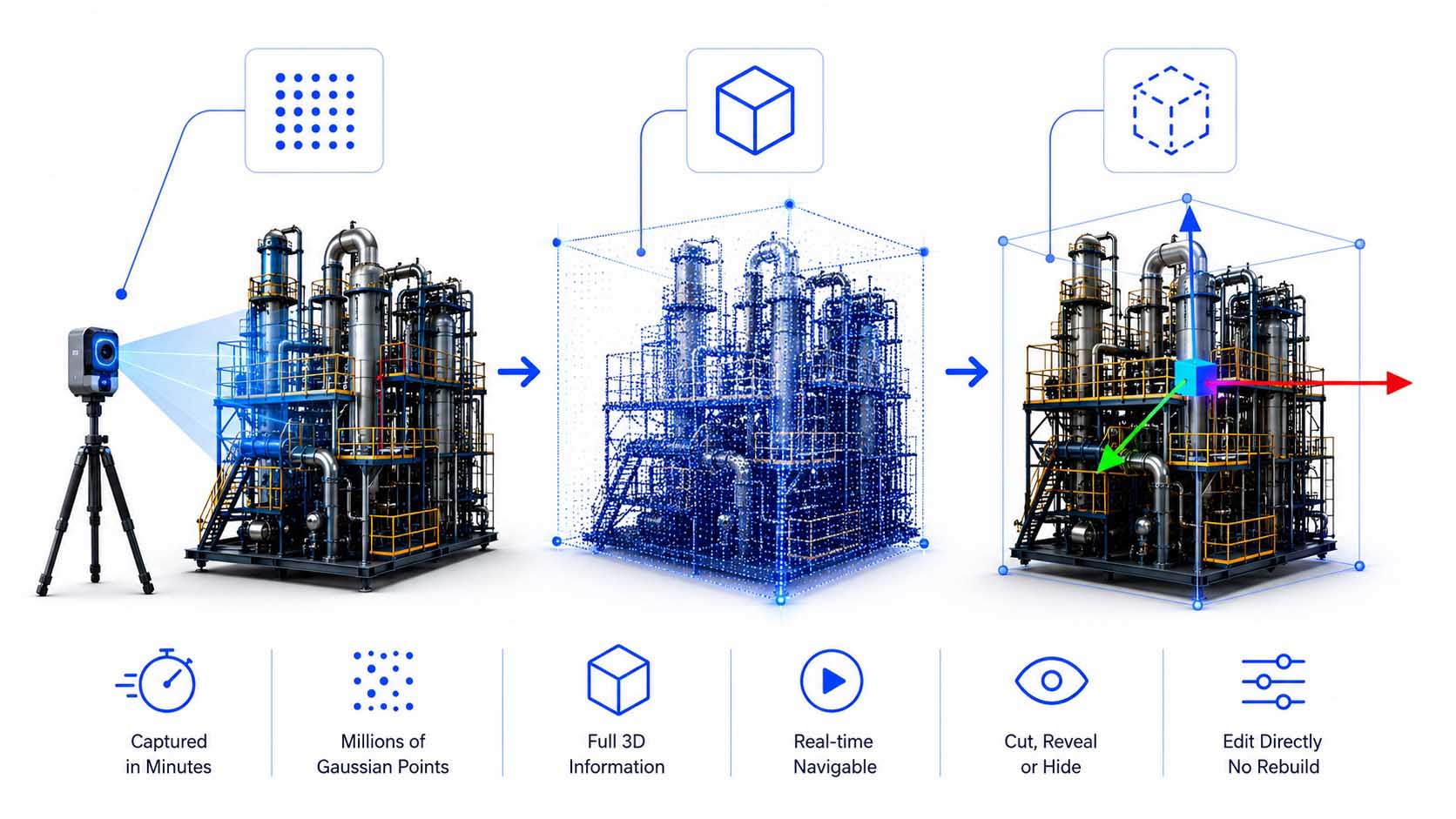
The term Gaussian refers to the Gaussian distribution, the mathematical, bell-shaped function named after Carl Friedrich Gauss. In classic image editing, it is best known as Gaussian Blur, the softening effect that determines how strongly neighboring pixels are weighted when an image is blurred. 3D Gaussian Splatting carries the same mathematical idea into the third dimension: a real scene is not described as a rigid polygon mesh or a collection of isolated measurement points, but as a cloud of millions of small, soft 3D primitives.
Each of these Gaussian primitives carries its own properties: a position in space, a size, an orientation, a color, and a transparency value. Together, millions of such primitives reconstruct the appearance of a real environment, without every single object and material needing to be modeled by hand. The foundation for this is a technique introduced in 2023 for real-time radiance field rendering, which first demonstrated how this representation could achieve photorealistic quality while maintaining high frame rates.[5]
For editability, this is not a side effect, it is the actual cause: because each individual primitive carries its own changeable properties, a Gaussian Splat scene can be manipulated with precision, individual areas can be hidden, shifted, or recolored, without rebuilding the rest of the scene. A classic point cloud, by contrast, primarily describes sampled geometry, individual, isolated measurement points in space, which makes comparably targeted editing considerably harder to achieve.[6]
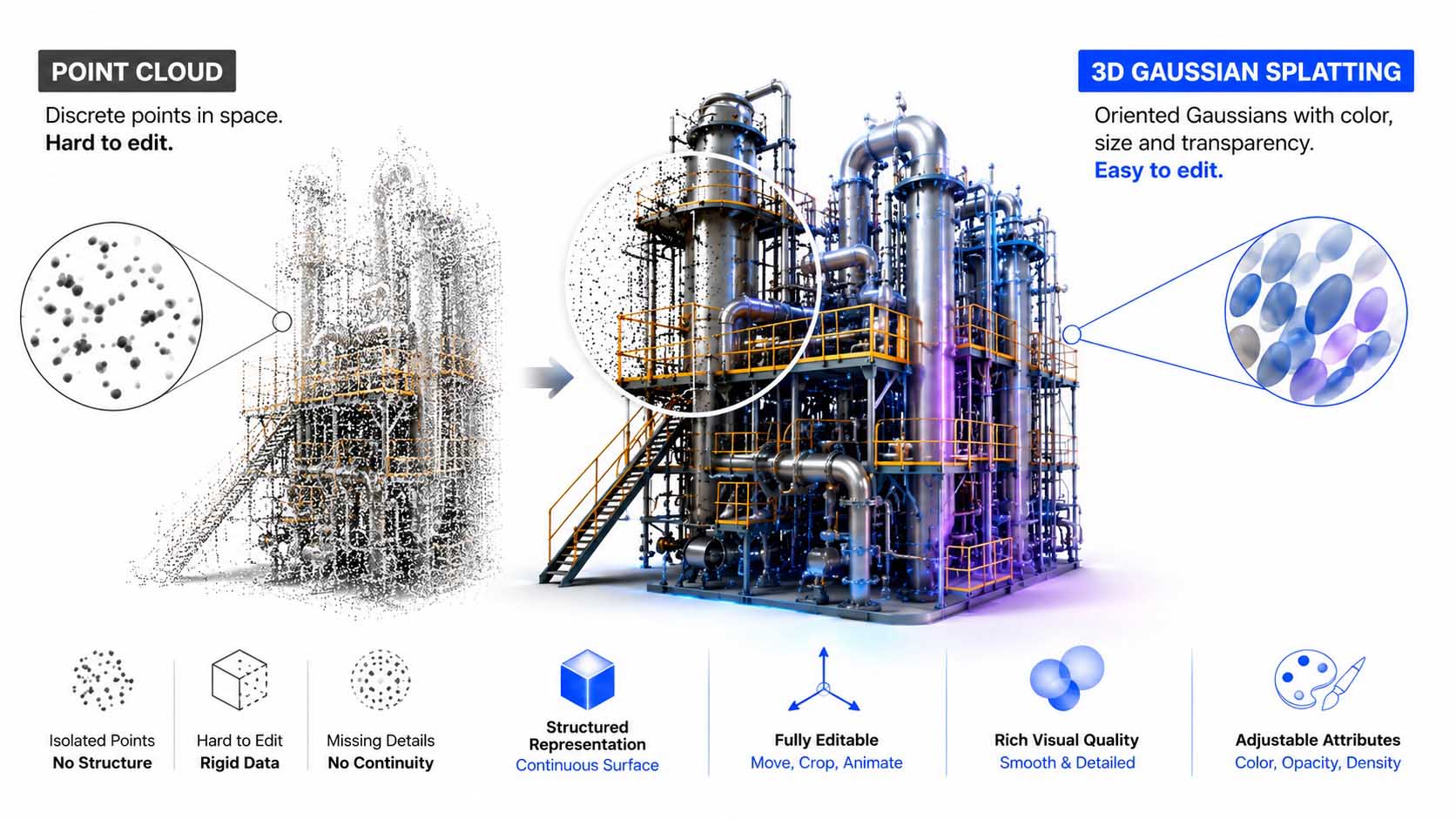
From individual measurement point to editable 3D surface.
Infographic: The structural difference between a classic point cloud and a collection of 3D Gaussian primitives | Graphic: © Ulrich Buckenlei | XR Stager Online Magazine | VISORIC GmbH
This underlying principle explains not only why Gaussian Splats look visually denser than classic point clouds, but above all why targeted editing is possible on them at all.
- Gaussian refers to the Gaussian distribution, known from Gaussian Blur in image editing.
- 3D Gaussian Splatting carries this principle into the third dimension.
- Each primitive carries its own changeable properties such as position, color, and transparency.
- The foundation is a technique introduced in 2023 for real-time radiance field rendering.[5]
- This exact structure is what makes targeted editing of individual areas possible.[6]
This underlying principle explains why targeted editing is possible on Gaussian Splats at all. How such a dataset becomes a genuinely practical, everyday tool is the subject of the next chapter.
From Viewing Scan to Workable Space
For the practical capture of real places, Gaussian Splatting has evolved within a few years from an academic novelty into an everyday capture technique. Unlike earlier reconstruction methods, which required extensive processing time and specialized hardware, a Gaussian Splat scan can now be created with ordinary photos, video footage, or drone flights, and processed in comparatively little time. Speed was never the real bottleneck of 3D capture, it was already fast before.
The real bottleneck lay in what came after capture. At major extended reality trade events, Gaussian Splatting is now one of the central themes in reality capture, the technologies used to digitally document real environments.[7] Where creating a high-resolution digital replica of a complex site once required weeks of processing time and significant computing power, such a place can today be captured with striking detail and viewed in real time on ordinary hardware.[7] Leading providers in the digital twin space now offer their own processing pipelines for Gaussian Splatting, from local desktop processing to automated cloud production for large volumes of data.[8]
This fundamentally shifts what is expected of such a capture. A Gaussian Splat scan is no longer just a static image for viewing, it is a dataset that can be captured once and then genuinely reworked for a wide range of purposes. This very editability of a single captured space is the precondition for effects such as the Inversphere shown in the first chapter to exist at all, and for a scan to actually become a tool in day-to-day project work, rather than remaining purely a presentation piece.
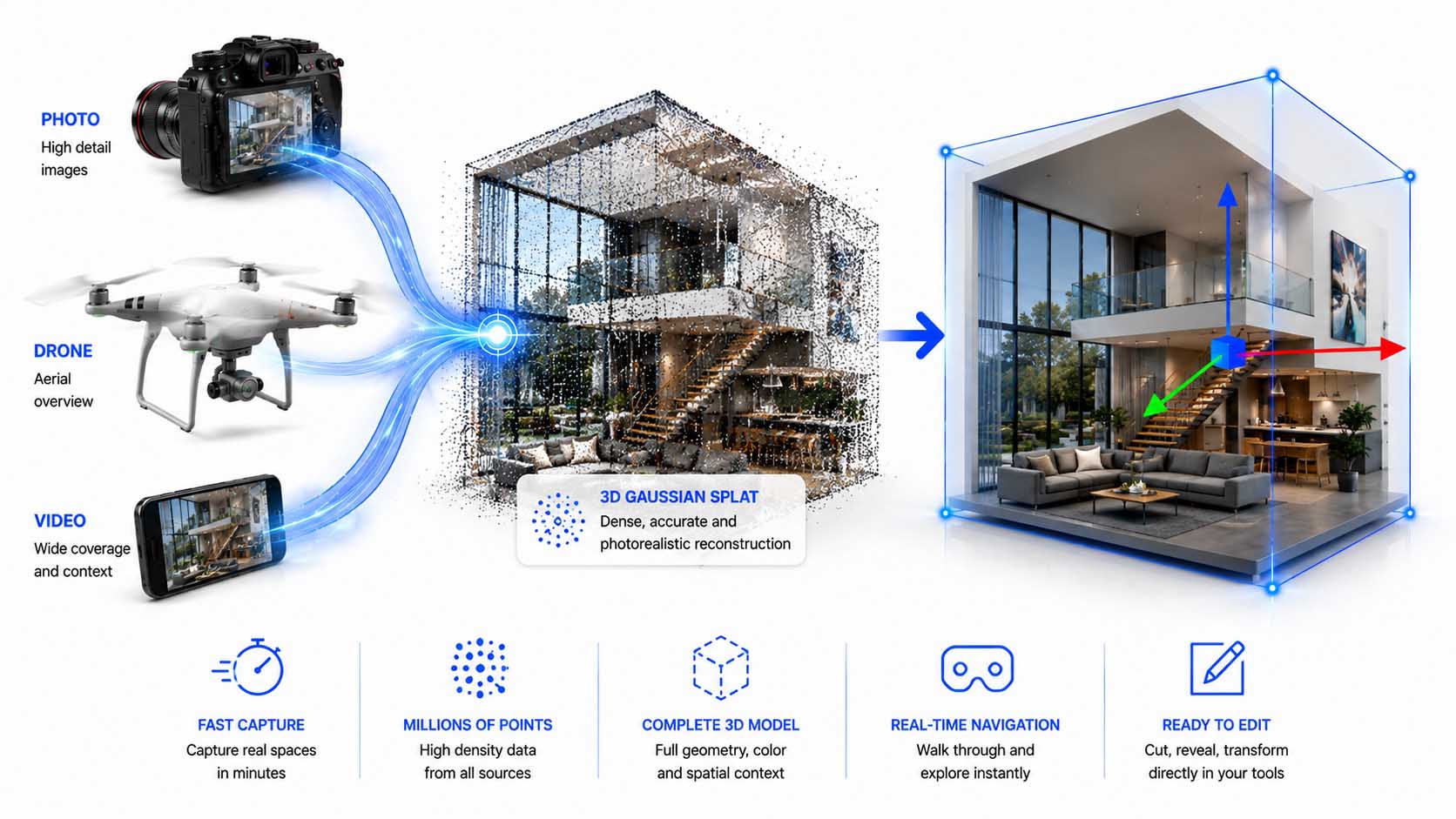
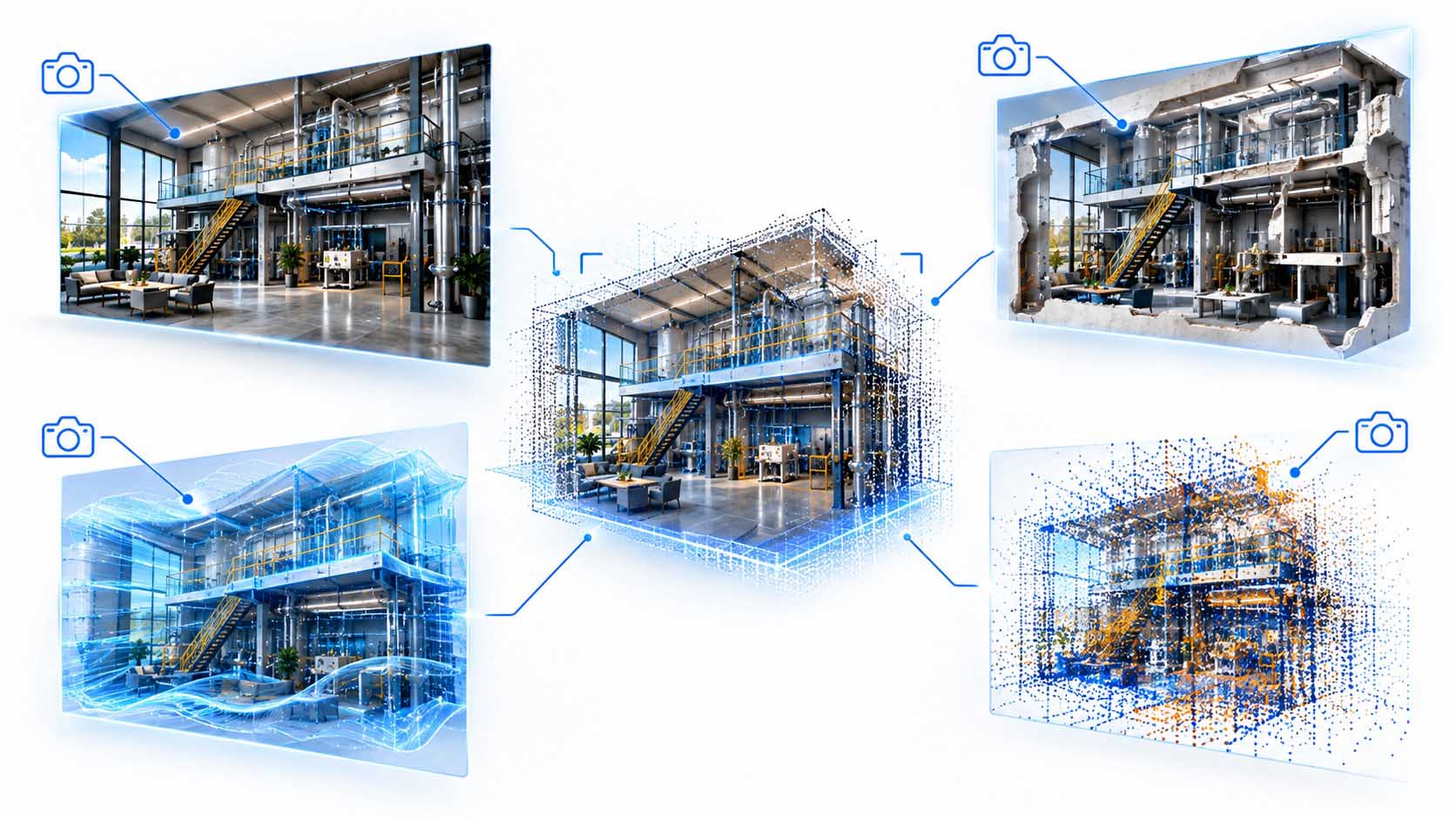
Three paths to one shared, editable dataset.
Infographic: How different capture methods converge into a shared, navigable Gaussian Splat model | Graphic: © Ulrich Buckenlei | XR Stager Online Magazine | VISORIC GmbH
This growing accessibility is the precondition for everything that follows. How such a captured space can actually be folded inward from a purely geometric standpoint is explained in the next chapter.
- Gaussian Splat scans can now be created using ordinary photos, video, or drone flights.
- Fast capture was already possible before, the bottleneck lay in further processing.[7]
- Reality capture is one of the central growth topics at XR trade events.[7]
- Providers in the digital twin space offer their own Gaussian Splatting pipelines.[8]
- A captured space can now genuinely be reworked, not just viewed.
This growing accessibility is the precondition for everything that follows. How such a captured space can actually be folded inward from a purely geometric standpoint is explained in the next chapter.
The Inversphere: When Space Folds Inward
The effect shown in the first chapter has its own name: Inversphere. It was developed by 3D artist VoxelKei, who introduced it as a new way of presenting Gaussian Splat captures. Unlike the familiar little planets, in which a two-dimensional panorama image is simply projected onto a spherical surface, the Inversphere actually folds the entire captured space inward: instead of cutting the scene off at the sphere’s surface, it is folded completely into the sphere, so the full 360-degree space remains experienceable in three dimensions.[9]
Mathematically, this effect rests on a much older geometric principle: the so-called sphere inversion, a construction already studied in the 19th century by mathematicians such as Jakob Steiner. The developer himself has openly confirmed this origin, naming the underlying function in his tool Sphere Inversion accordingly, while Inversphere is simply the name for the resulting object, not a claim to a new mathematical discovery.[9] His actual motivation was less mathematical than aesthetic, an additional control lets users balance the density distribution of distant image areas that would otherwise pile up at the center.[10]
What matters for the practical effect is that this transformation works on a real 3D dataset, not on a flat image, and that it is a direct edit of the existing scan, not a new capture or a new model. This is precisely why spatial depth is preserved as the camera flies through the resulting sphere. When an initial public post about this effect appeared, the professional community responded immediately with lively discussion of its geometric foundation.[10]
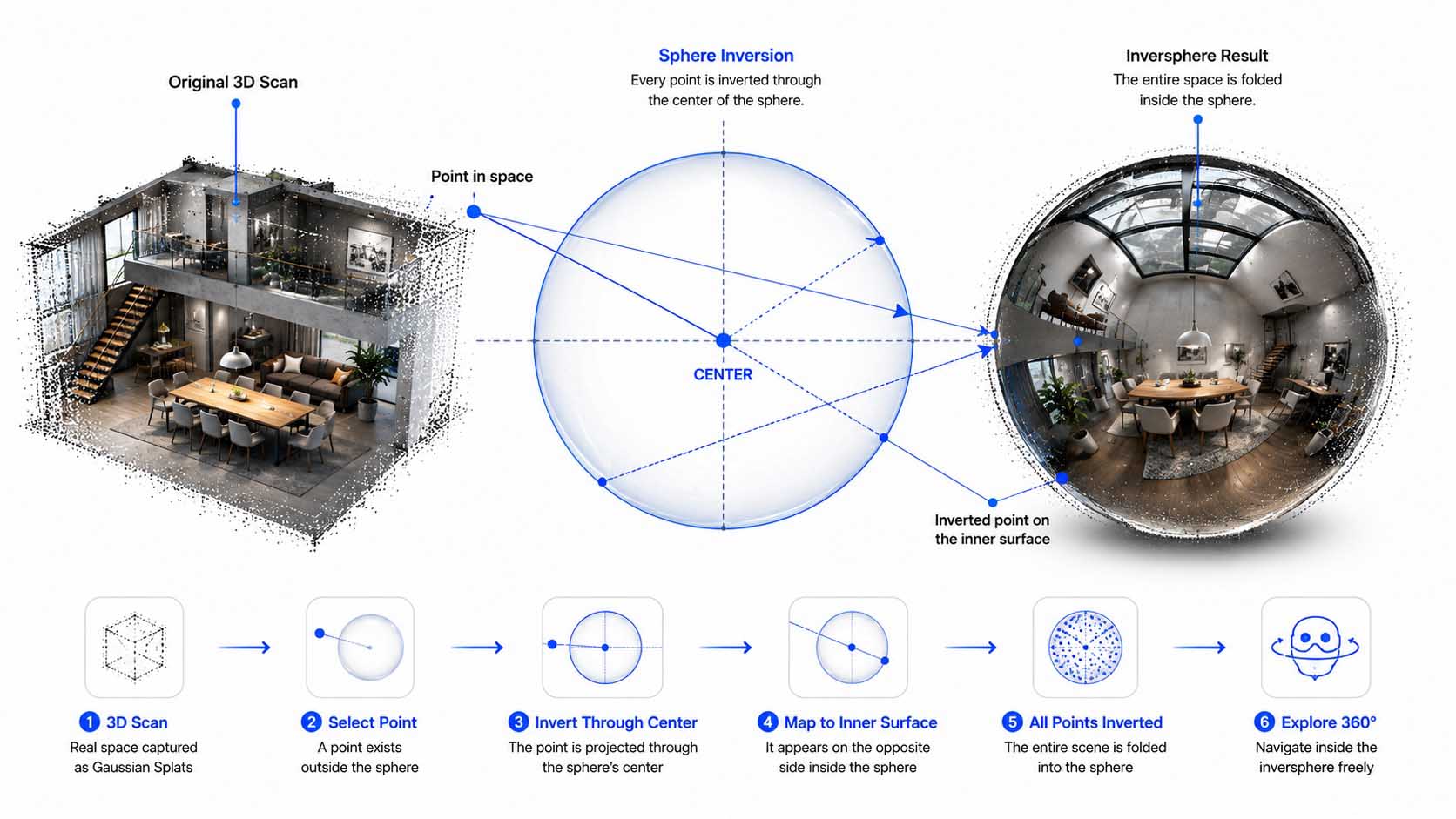
How an existing scan is geometrically reshaped.
Infographic: The principle of classic sphere inversion, applied according to VoxelKei’s Inversphere concept | Graphic: © Ulrich Buckenlei | XR Stager Online Magazine | VISORIC GmbH
A geometric principle alone, however, does not yet explain why this kind of editing is accessible to virtually anyone today.
- The effect is called Inversphere and comes from 3D artist VoxelKei.[9]
- It folds the entire captured space inward instead of cutting it off at the sphere.[9]
- Its foundation is the classic, geometric sphere inversion from the 19th century.[9]
- A control balances the density distribution of distant image areas at the center.[10]
- Because it deforms a real 3D dataset, it is a direct edit rather than a recreation.
Which tool actually makes this shift, from viewing to actively editing captured spaces, accessible to everyone is the subject of the next chapter.
The Tool That Resolves the Old Trade-Off
The practical implementation of such edits is made possible by a new, free extension for Adobe After Effects. KIRI Innovations, known for its mobile 3D scanning app KIRI Engine, has released an open-source plugin that brings Gaussian Splat captures directly into a familiar compositing environment.[11] Instead of rendering a Splat scene externally and importing it into a production as a finished video, it can now be treated like an ordinary 3D layer, viewed through a native After Effects camera and animated directly over time. This is exactly where the trade-off described at the outset dissolves: the scan remains a scan, but no longer needs to be remodeled for changes to be made.
The range of functions goes well beyond simple playback. A crop function defines a three-dimensional region that hides or reveals parts of the scene, while an invert control determines which side of that region remains visible, precisely the mechanism underlying the room inversion shown in the first chapter. Additional tools for noise, displacement, opacity, density, and color gradients allow a captured scene to be deliberately distorted, dissolved, or stylistically altered.[12]
The following overview summarizes the plugin’s key editing tools and shows the spatial effect each one achieves, along with its typical use.
| Function | Spatial effect | Typical use |
|---|---|---|
| Crop & Invert | Defines a 3D region and reverses its visibility | Reveals, room inversion, set separation |
| Noise | Adds controlled, randomized distortion | Dissolve effects, digital glitches |
| Displacement | Shifts gaussians along a vector | Organic deformation, room inversion |
| Opacity & Density | Controls transparency and the number of visible primitives | Thinning, ghostly dissolves |
| Color Gradient | Colors areas based on position or depth | Stylized looks, brand colors |
A toolkit for a scan that already exists.
Table: The KIRI Engine plugin’s key editing tools at a glance | Source: own compilation based on the published feature overview[11][12], as of summer 2026 | © Ulrich Buckenlei | XR Stager Online Magazine | VISORIC GmbH
For motion designers, but equally for planning offices, this means above all one thing: fewer application switches, and a scan that stays part of the same working environment as typography, CAD integration, and every other layer of a project, rather than only being viewed at the end of the chain.
- KIRI Innovations has released a free, open-source Gaussian Splatting plugin for After Effects.[11]
- Splat scenes can now be viewed and animated directly through a native 3D camera.
- Crop, invert control, noise, displacement, opacity, and density enable targeted editing.[12]
- These tools edit the existing scan, they require no remodeling.
- The scan stays part of the same working environment as every other project layer.
This explains the central advance in technical terms: fast to create, and now genuinely editable. What that means for image production overall is the subject of the next chapter.
Why Editable Reality Is Changing Visual Production
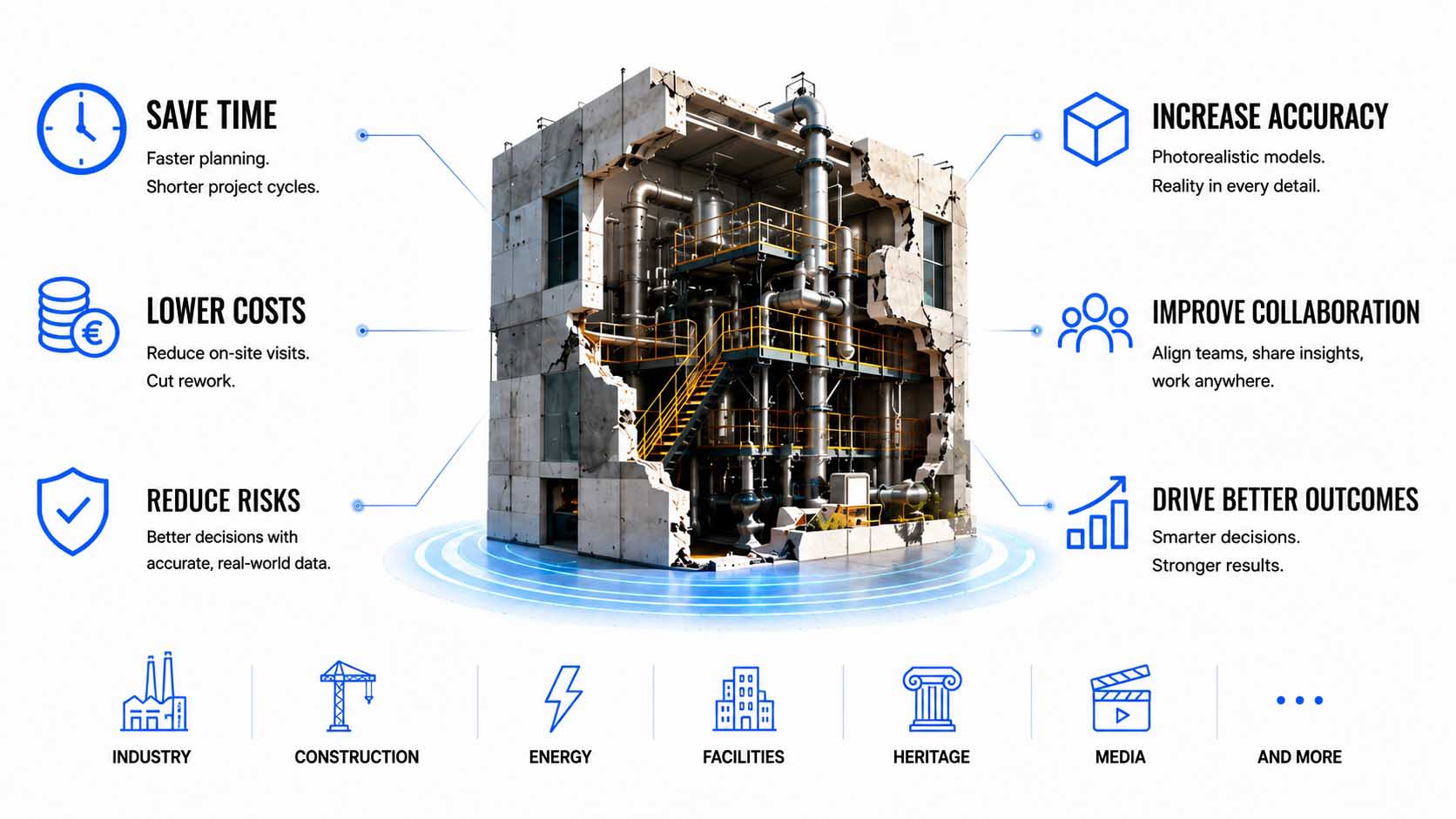
As long as a scanned place could only be viewed, its role remained limited: a realistic backdrop against which something else takes place, but unchangeable itself. Once the same place can be directly deformed, animated, and deliberately shaped, its role shifts fundamentally. A pure backdrop becomes shapeable material.
For immersive storytelling in virtual and augmented reality, this represents a noticeable leap in quality. Instead of using a real place only as a static background, stories can now work directly with the spatial structure of a place itself.[13] A product presentation can literally open up around the product it showcases, a documentary spatial narrative can make change over time visible by having the same captured place deform itself as the story unfolds.[14]
For companies working in visual communication, marketing teams, product design, exhibition concepts, or corporate communication, the same technical foundation opens new creative possibilities, without a completely new 3D scan or laborious manual 3D modeling being required for every single project. A showroom captured once, or a production site scanned once, can become a reusable, editable foundation for a wide range of visual formats.
Four editing states of the same captured place.
Infographic: Possible editing states of a Gaussian Splat scene compared | Graphic: © Ulrich Buckenlei | XR Stager Online Magazine | VISORIC GmbH
The underlying raw data always remains intact, only its presentation changes, with no new capture required.
- An editable place turns from a static background into shapeable material.
- Immersive narratives can work directly with a place’s spatial structure.[13]
- Change over time can be told through the deformation of the same place.[14]
- A place captured once becomes a reusable, editable foundation.
- The underlying raw data remains intact, only its presentation changes.
This creative opening, however, is only one side of the development. The same technical foundation has long since found its way into entirely different fields of application, far beyond the creative industry. That is the subject of the next chapter.
From the Creative Industry to Industrial Practice
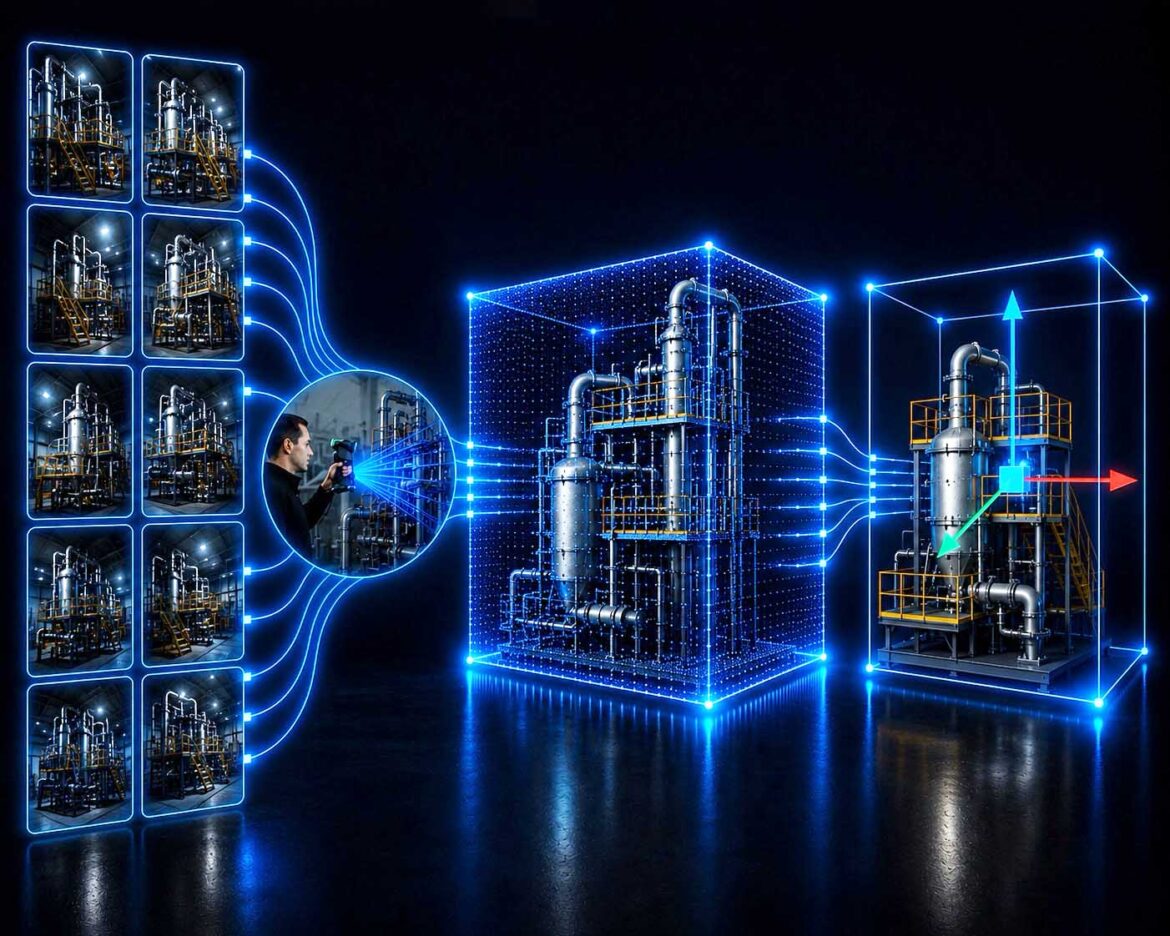
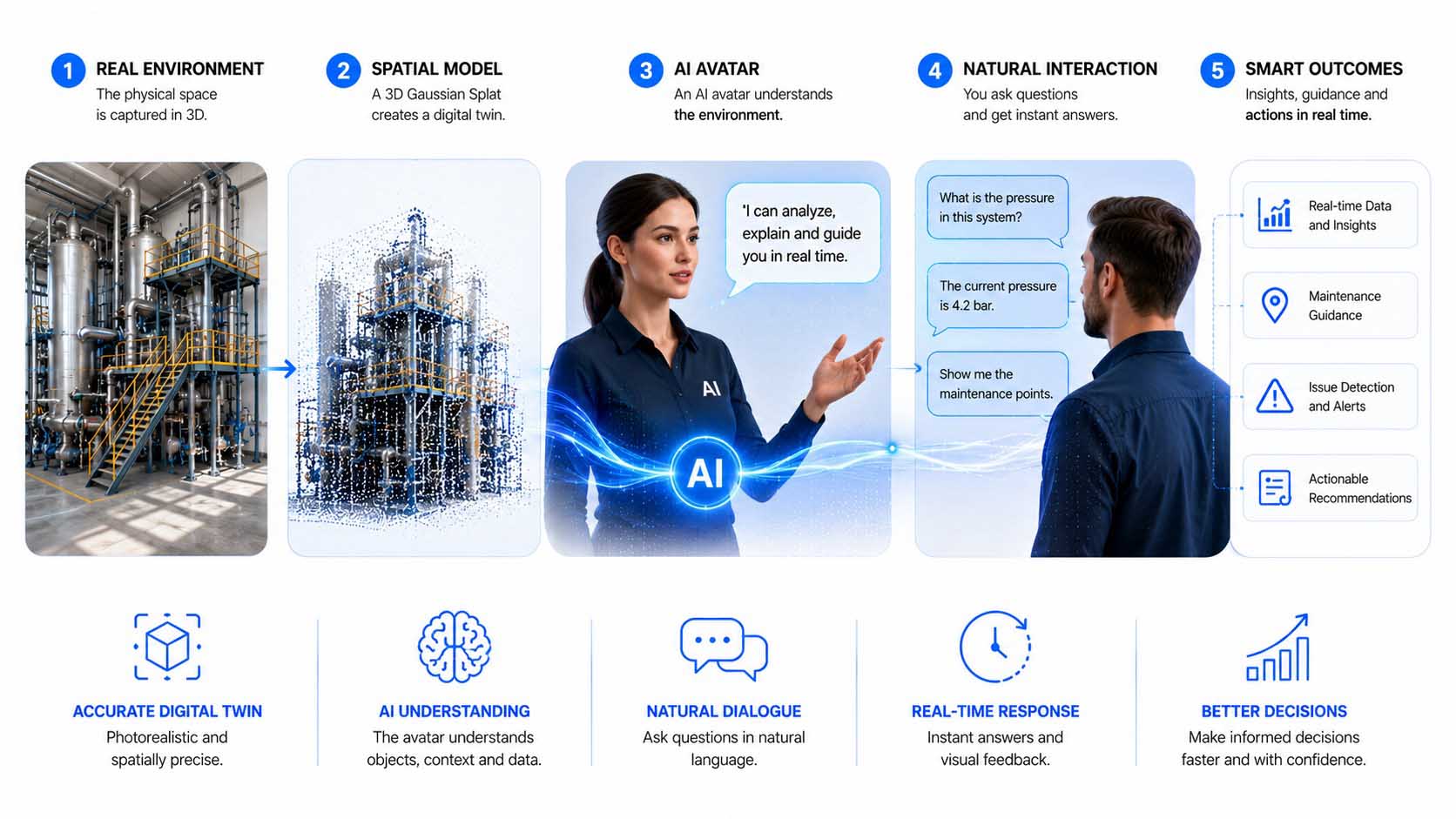
What stands out as a visual effect in the creative industry is, in the background, already working on an entirely different front: the digital twin of real production environments. At major European XR trade events, this development is already visible in concrete projects. One example: a multi-camera capture rig that digitizes industrial environments at around 25 million Gaussian primitives per scene, combined with a custom-built level-of-detail system so that such dense scenes can be displayed smoothly in virtual reality headsets.[15]
In a further demonstrator, a real robotic arm within a scanned space is virtually replaced by its CAD model and can then be controlled directly within the virtual environment through hand movement, a combination of real-world capture and precise construction data within one shared, editable space.[15] Academic research is also now specifically examining how Gaussian Splatting can be combined with computer vision models to continuously digitally represent and evaluate production lines.[16]
At the same time, established digital twin providers are building their own processing pipelines for Gaussian Splatting, offering different levels of accuracy for local processing as well as scalable cloud services for large, company-wide volumes of data. It is exactly the same property that makes a creative effect possible that, in industry, makes the difference between a static image and a genuinely workable digital twin linked to real CAD data.
From creative effect to editable digital twin.
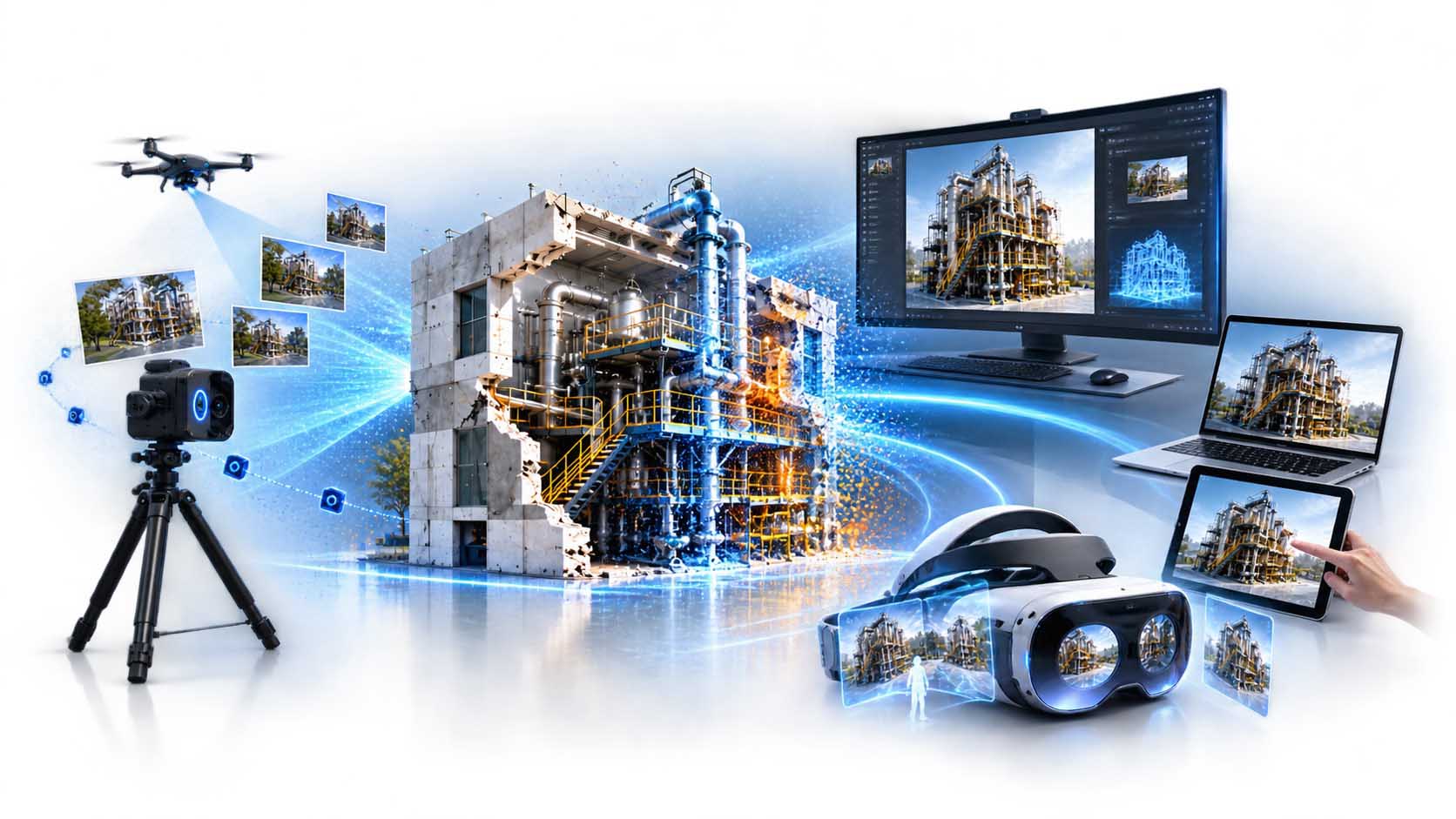
Infographic: Documented industrial applications of Gaussian Splatting in a digital twin context | Graphic: © Ulrich Buckenlei | XR Stager Online Magazine | VISORIC GmbH
This shows that one and the same technical foundation can give rise to both a viral creative effect and a robust industrial tool.
- Industrial capture rigs already digitize real environments at around 25 million primitives per scene.[15]
- Real spaces can be combined with precise CAD models of individual machines.[15]
- Research is examining the combination of Gaussian Splatting and computer vision for production lines.[16]
- Digital twin providers are integrating their own Gaussian Splatting processing pipelines.
- Editability determines, in industry, the difference between a static image and a working tool.
This dual role raises one final, fundamental question that every company should address before deploying such editable spaces itself. That is the subject of the closing chapter.
Provenance, Trust, and the Next Challenge
When a captured space can no longer only be viewed, but actively deformed, animated, and reused, the question that must be asked of such a dataset inevitably changes as well. It is no longer enough to know that a place was captured once, what matters now is also which part of a shown result corresponds to the original capture, and which part was creatively altered afterward.
For a viral creative effect such as the Inversphere shown in the first chapter, this distinction is unproblematic, its creative nature is obvious. But once the same editability is used in a digital twin of a factory hall, a building, or critical infrastructure, it becomes a matter of trust. International reference frameworks for digital twins already describe, as a basic principle, that such a virtual representation must be continuously matched against its real-world basis in order to remain reliable.[17] Market analyses likewise confirm that Gaussian Splatting will increasingly help companies keep digital twins of buildings, factories, and physical infrastructure continuously up to date.[18]
For companies working with Gaussian Splat capture, editable spatial representations, or digital twins themselves, this leads to a clear conclusion: a traceable separation between the original capture and later creative editing should be built in from the start, not reconstructed after the fact.
From raw capture to traceable provenance.
Infographic: The basic principle of a traceable provenance chain, based on international digital twin reference frameworks[17] | Graphic: © Ulrich Buckenlei | XR Stager Online Magazine | VISORIC GmbH
Whoever invests in editable 3D reality today is, at the same time, laying the foundation for how much trust the resulting output will actually deserve tomorrow.
- Editable spaces require a clear separation between capture and later editing.
- For viral creative effects, this separation is usually obvious and unproblematic.
- For digital twins of critical infrastructure, it becomes a genuine matter of trust.[17]
- Gaussian Splatting is expected to keep digital twins continuously up to date.[18]
- Traceable provenance should be built in from the start, not added afterward.
This brings the article full circle: from the old trade-off between fast capture and difficult usability to a fundamental question that concerns every company now using real places as editable, digital assets. How convincing this principle already looks in practice is shown in the video below.
When a Scan Proves It Can Actually Be Edited
The preceding chapters have shown why classic 3D scans were previously hard to work with further, how 3D Gaussian Splatting changes that technically, and which tool makes this kind of editing accessible to anyone today. Just how convincing this interplay looks in motion is most striking in the video itself.
Embedded here is the example from Ulrich Buckenlei’s original LinkedIn post, in which an ordinary dining and living area is visibly deformed into a sphere folded completely inward.[1] What appears first is a view from slightly above into a dark, spherical structure, in the lower part of which the original space, complete with table, chairs, and a brightly lit area, remains clearly recognizable on the inside of the sphere. The camera then moves through this folded scene, making it visible that this is not a flat panorama image, but an actually deformed, three-dimensional space, edited directly from the original scan.
Video: Invert Sphere transformation of a real, scanned interior space, AI-assisted 3D Gaussian Splat reconstruction | Video & Gaussian Splatting plugin: KIRI Engine / KIRI Innovations | Invert Sphere effect inspired by VoxelKei’s Inversphere | Commentary, editing, and video production: © Ulrich Buckenlei | XR Stager Online Magazine | VISORIC GmbH
This moment, recognizing a familiar space while simultaneously experiencing it in a completely new, spherical arrangement, illustrates what the previous chapters described: a Gaussian Splat scan provides the spatial foundation, the Inversphere transformation deforms that foundation according to the principle of classic sphere inversion, and KIRI Engine’s free After Effects plugin makes that deformation accessible for editing within a familiar production environment.[2]
At the same time, the video makes the key point from Chapter 1 visible: the original space remains recognizable at all times, even though its entire geometry has actually been edited, with no new capture, no new modeling. It is precisely this contrast between recognition and editing that gives the effect its impact.
- The video shows the Inversphere transformation of a real, scanned interior space.[1]
- The original space remains clearly recognizable on the inside of the sphere.
- The camera move makes the actual three-dimensional editing visible.
- Gaussian Splat capture, the Inversphere principle, and the KIRI Engine plugin work together here.[2]
- The video condenses every previous chapter into a single, vivid example.
This example makes tangible why editable 3D reality is far more than a short-lived visual trend, it is a foundation on which both creative formats and robust business solutions can be built.
From Fast Capture to a Genuinely Usable Tool
A reliable, editable 3D system is not created by a single impressive effect alone, but by a traceable, unbroken chain from actual capture through to the final application, exactly the combination at the core of VISORIC’s work.
The expert team at VISORIC GmbH in Munich combines over 15 years of experience in 3D, AI, and XR with hands-on expertise in spatial computing, real-time 3D, and digital twins. This exact combination of fast capture and genuine editability is what matters for the responsible use of editable 3D visualization in business, whether the goal is product visualization, exhibition concepts, or the spatial representation of real locations. VISORIC helps companies keep Gaussian Splat capture and creative editing cleanly separated, and bring both together into one robust, durable application.[19]

15 years of experience in 3D, AI, and XR: the VISORIC expert team in Munich.
Image: © Ulrich Buckenlei | XR Stager Online Magazine | VISORIC GmbH
A well-thought-out pilot project, a single use case, a clearly scoped visualization solution, can often be realized far faster and more cost-effectively than many companies expect. VISORIC accompanies this path from the first concept through technical implementation to a deployable, genuinely editable application.[20]
- Advice on cleanly separating capture, editing, and publication.
- Development of editable, trustworthy spatial computing applications.
- From pilot application to company-wide digital twin solution.
That is exactly where a conversation should begin: not with the big, company-wide vision, but with a clearly scoped, quickly achievable first step that shows how fast capture and genuine editability can be combined cleanly and traceably.
Want to find out how fast, genuinely editable 3D capture could be used in your company?
Talk to the VISORIC expert team in Munich about spatial computing, Gaussian Splatting, and trustworthy digital twins. Together, we will turn your requirements into a precise, traceable application, with a noticeable advantage in visual impact, efficiency, and trust.
Contact:
Email: info@visoric.com
Phone: +49 89 21552678
Sources and References
- LinkedIn post by Ulrich Buckenlei / XR Stager. Gaussian Splatting Grows Up. LinkedIn, August 2026.
- Kiri-Innovation. Gaussian-Splatting-plugin-by-KIRI-Engine, GitHub repository and project description.
- 80 Level. This Sphere Holds Entire 3D Gaussian Splatting World. 80.lv, July 2026.
- 80 Level. Check Out This Unusual Japanese Park 3D Gaussian Splat. 80.lv, December 2025.
- Kerbl, B., Kopanas, G., Leimkühler, T., Drettakis, G. 3D Gaussian Splatting for Real-Time Radiance Field Rendering. ACM Transactions on Graphics, 42(4), July 2023.
- Voxel51. Gaussian Splatting: From Research to Reality. voxel51.com, May 2025.
- AWE XR. The Spatial Enterprise: Digital Twins and Reality Capture at AWE USA 2026. awexr.com, March 2026.
- Bentley Systems. Gaussian Splatting Reality Capture for Digital Twins. blog.bentley.com, March 2026.
- VoxelKei (@VoxelKei). Post on the mathematical origin of the Sphere Inversion function. X, July 2026.
- Deniz + (@derfunsei). Response and discussion on VoxelKei’s Inversphere post. X, July 2026.
- Kiri-Innovation. Gaussian-Splatting-plugin-by-KIRI-Engine, GitHub repository and project description.
- Radiance Fields. KIRI Engine Ships Free MIT Splat Plugin for After Effects. radiancefields.com, July 2026.
- DIGITAL PRODUCTION. KIRI Brings Gaussian Splats to After Effects. digitalproduction.com, August 2026.
- KIRI Engine. 3D Gaussian Splatting in After Effects: How to Import, Animate, and Style 3D Splats. kiriengine.app/blog, 2026.
- 3DVF. Laval Virtual: an XR industry in transition, with Gaussian splats in the spotlight. 3dvf.com, April 2026.
- Gokan Khan, M. et al. PerfCam: Digital Twinning for Production Lines Using 3D Gaussian Splatting and Vision Models. arXiv, 2025.
- ISO 23247. Reference framework for digital twins, general definition and core principle.
- TechTarget. What is Gaussian splatting? Definition and business outlook. techtarget.com/searchcio.
- VISORIC field projects in digital twins, real-time 3D, and spatial computing.
- XR Stager platform for real-time 3D, digital twins, knowledge AI, and industrial spatial computing applications.
Contact Persons:
Ulrich Buckenlei (Creative Director)
Mobile: +49 152 53532871
Email: ulrich.buckenlei@visoric.com
Nataliya Daniltseva (Project Manager)
Mobile: +49 176 72805705
Email: nataliya.daniltseva@visoric.com
Address:
VISORIC GmbH
Bayerstraße 13
D-80335 Munich