

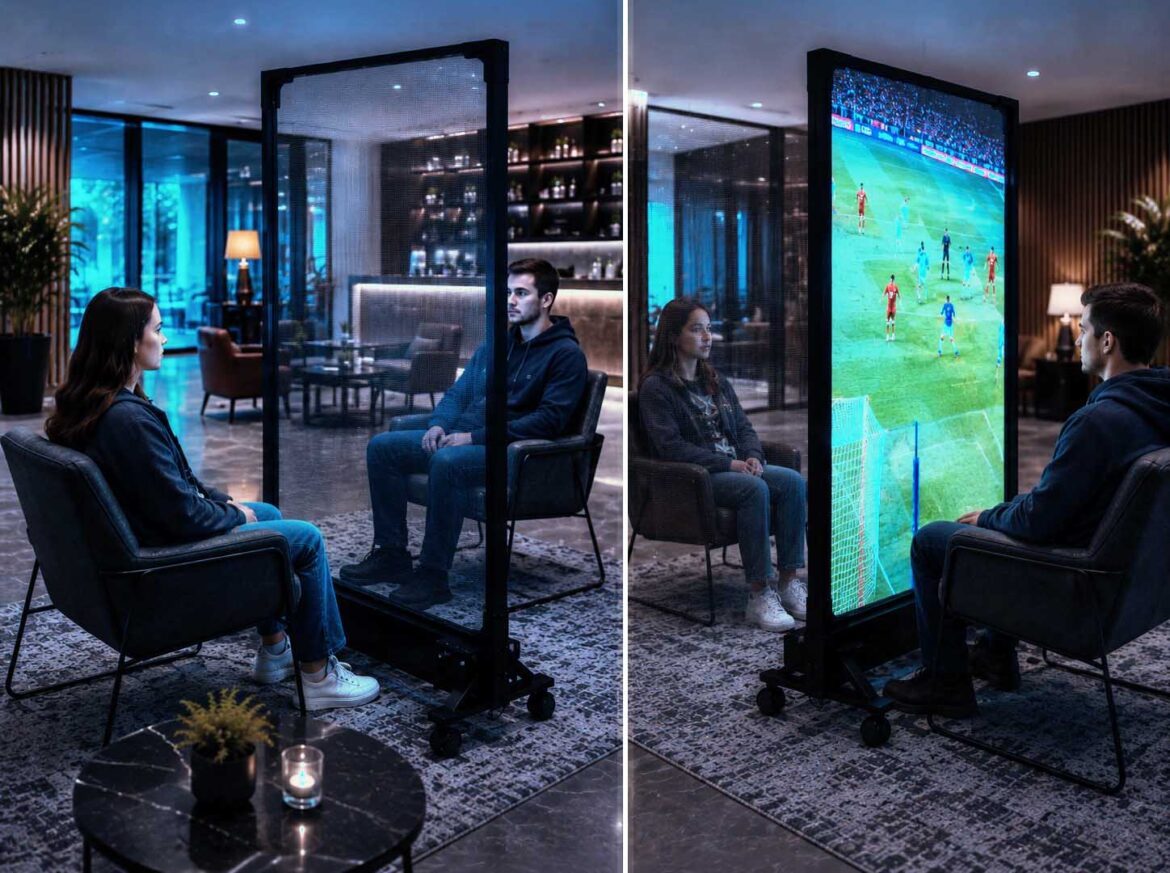
Bidirectional displays could simultaneously present different content to different viewers, creating new possibilities for entertainment, collaboration, and communication in shared spaces.
Visualization of a bidirectional display that could simultaneously present different content to different viewers and redefine shared spaces. | Image: © Ulrich Buckenlei | XR Stager Online Magazine | VISORIC GmbH
Screens have been among the most important interfaces of the digital world for decades. Whether televisions, computer monitors, information displays, or digital billboards – nearly all of them follow the same basic principle. They present the same content to all viewers at the same time. This concept has proven itself in many areas, but is increasingly reaching its limits. In a world where information is being delivered in an ever more personalized, context-aware, and situation-dependent manner, people often need different content even though they are in the same room.[1]
This is precisely where a new generation of intelligent displays comes in. Bidirectional displays follow a fundamentally different approach than classic screens. While one side can remain almost transparent, the opposite side is simultaneously able to display digital information or media. This creates entirely new possibilities for delivering information individually, without spatially separating people from one another. Early scientific work already shows that different representations for different viewing directions can be technically realized and could enable new forms of human-machine interaction in the future.[2]
This development extends far beyond a new display technology. It opens up the possibility of making shared spaces more intelligent and adapting digital information much more closely to the respective user, their viewing direction, and their current context. Hotels, offices, airports, vehicles, waiting areas, museums, or healthcare facilities could in the future provide information in a significantly more individualized way, without requiring multiple screens or personal devices.
At the same time, the screen itself continues to evolve. Instead of merely displaying information, it could become an intelligent communication interface that delivers digital content depending on the situation, thereby combining entertainment, collaboration, orientation, and privacy. Supported by modern display technologies, computer vision, and artificial intelligence, new possibilities are emerging to adapt digital information directly to the respective viewer.
This development is still at an early stage. Nevertheless, current research already shows the potential bidirectional displays could hold for future information systems. Similar to how touchscreens or smartphones fundamentally changed the way we interact with digital information, bidirectional displays could enable a new generation of shared, yet individually usable, information spaces.
- Bidirectional displays follow a completely new approach compared to classic screens.
- Different viewers could simultaneously perceive different information on the same display surface.
- Shared spaces can thereby become more intelligent, more personal, and more efficient.
- Hotels, offices, vehicles, and public facilities are among the most exciting future fields of application.
- Modern display technologies, computer vision, and artificial intelligence form the basis of this development.
In this article, we show how bidirectional displays work, which technological developments enable them, which fields of application are already recognizable today, and why this new display generation has the potential to fundamentally change communication, collaboration, and digital information systems.
Why screens are reaching their limits today
Since the first computer monitors, the basic principle of digital screens has barely changed. A display generates image content that is equally visible to all viewers. Whether a television in the living room, an information display at the airport, or a presentation screen in a conference room – everyone sees the same content at the same time. This principle is simple, reliable, and ideally suited for many applications. However, as soon as different users need different information, compromises inevitably arise.[3]
This becomes particularly clear in shared spaces. In a hotel lobby, one guest might want to follow the latest news, while another person is looking for their next appointment or needs navigation instructions. In an office, different employees are interested in different project data. In vehicles, drivers and passengers often need completely different information. Yet today, multiple screens usually have to be used, or content has to be displayed sequentially.
Bidirectional displays follow a fundamentally new approach. Instead of emitting information evenly in all directions, they can display content differently depending on the respective viewing side. This preserves the shared space while simultaneously providing individual information for different people.[4]
The following infographic illustrates this difference. On the left side, the classic principle of a conventional screen is shown. All viewers see the same content, regardless of their personal interests or tasks. On the right, the graphic shows the concept of a bidirectional display. While one person is, for example, watching a sports broadcast, the person on the opposite side simultaneously receives individual information such as appointments, navigation instructions, or other digital content. Both sit facing each other in the same room and look at the same display surface – yet experience different digital information.
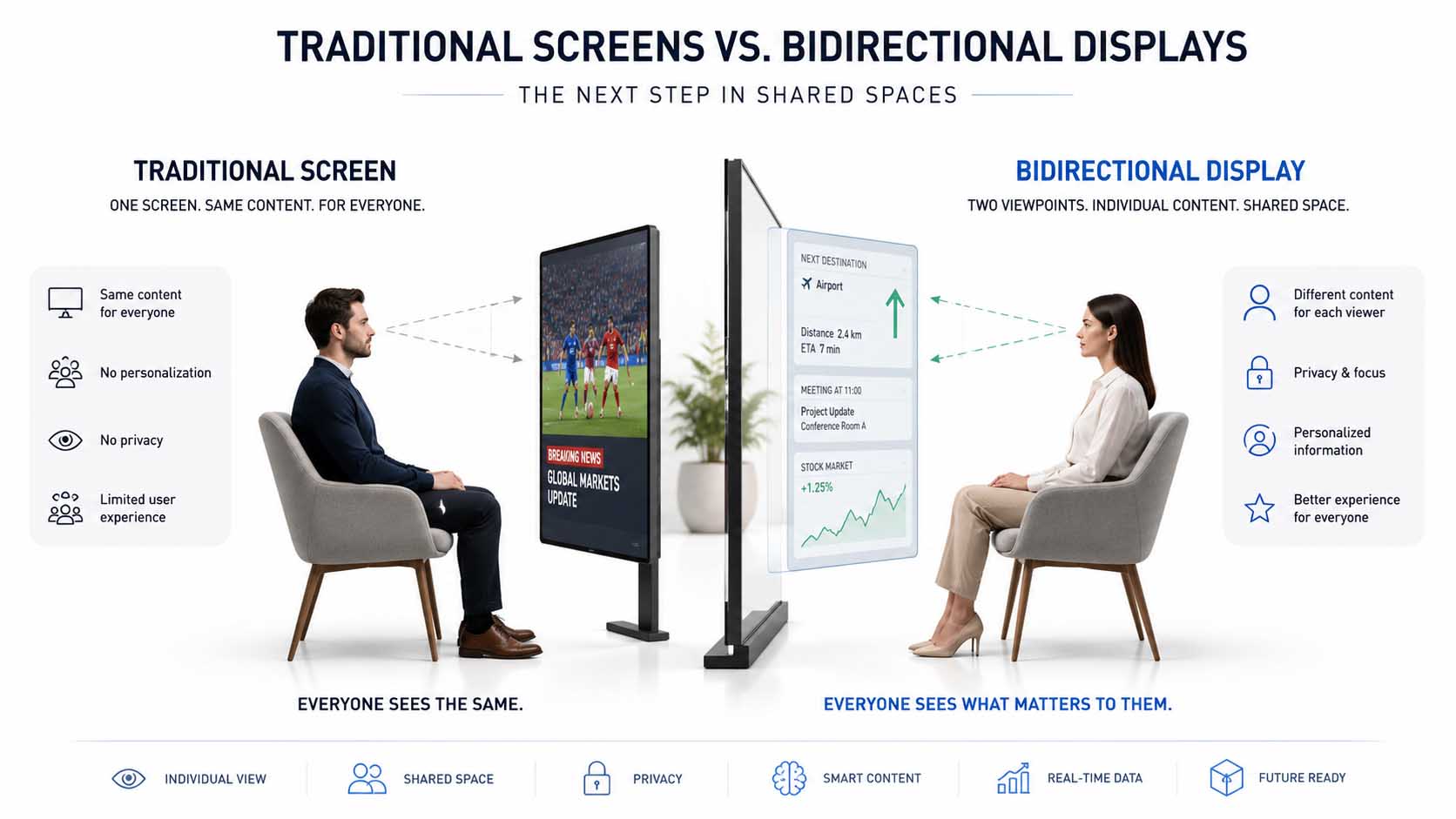
The infographic compares classic screens with bidirectional displays. While conventional displays show the same content to all viewers, future bidirectional displays could simultaneously provide different information for different people, thereby making shared spaces more intelligent and personal.
Infographic: Comparison between classic screens and bidirectional displays | Graphic: © Ulrich Buckenlei | XR Stager Online Magazine | VISORIC GmbH
The actual innovation, however, does not lie solely in the display technology. Rather, the role of the screen itself is changing. A shared display surface is evolving into an intelligent information interface that can adapt content individually to different users. Entertainment, collaboration, orientation, and privacy can thus be combined for the first time, without people having to be spatially separated.
Supported by computer vision, artificial intelligence, and future display technologies, bidirectional displays could mark the next stage of development for digital information systems. They create the foundation for personalized information in shared spaces and open up new possibilities for hotels, offices, airports, vehicles, and numerous other fields of application.
- Conventional screens show the same content to all viewers.
- Bidirectional displays could simultaneously provide different information for different people.
- Shared spaces are preserved while still enabling personalized digital experiences.
- New applications are emerging for hotels, offices, vehicles, and public facilities.
- The next generation of intelligent displays combines individualization with shared use.
In the next chapter, we look at how bidirectional displays technically differ from transparent displays, privacy filters, and classic digital signage solutions, and why these differences in particular could open up entirely new fields of application.
What sets bidirectional displays apart
At first glance, bidirectional displays barely differ from conventional screens. The actual difference lies not in the design, but in the way light and information are distributed. While classic displays emit the same image content as evenly as possible in all viewing directions, bidirectional displays follow a fundamentally different approach. They can specifically assign digital content to different viewing directions, thereby displaying different information simultaneously on the same display surface.[5]
This changes the basic principle of digital screens for the first time since their introduction. The focus is no longer on a shared representation for all viewers. Instead, the individual perception of each user moves into focus. Different people can be in the same room, look at the same display surface, and still receive different information. This creates entirely new possibilities for communication, collaboration, and personalized information systems.
This is made possible by modern methods of light control and display technology. Current research deals with optical structures that can specifically direct light in different directions. Other approaches combine transparent displays with intelligent liquid crystals or novel pixel architectures, so that different content becomes visible depending on the respective viewing side. The goal of all these developments is to adapt digital information much more precisely to different users, without requiring additional screens or personal devices.[6]
The following infographic illustrates this principle. At the center is a bidirectional display that simultaneously provides two different information worlds. While one side shows, for example, sports broadcasts or media content, the person on the opposite side receives individual information such as appointments, navigation, weather, or project information. Both users share the same space and the same display surface, yet experience different digital content. The icons on the side illustrate, as examples, the properties this new display generation could enable – from personalized information and increased privacy to context-aware content and intelligent control.
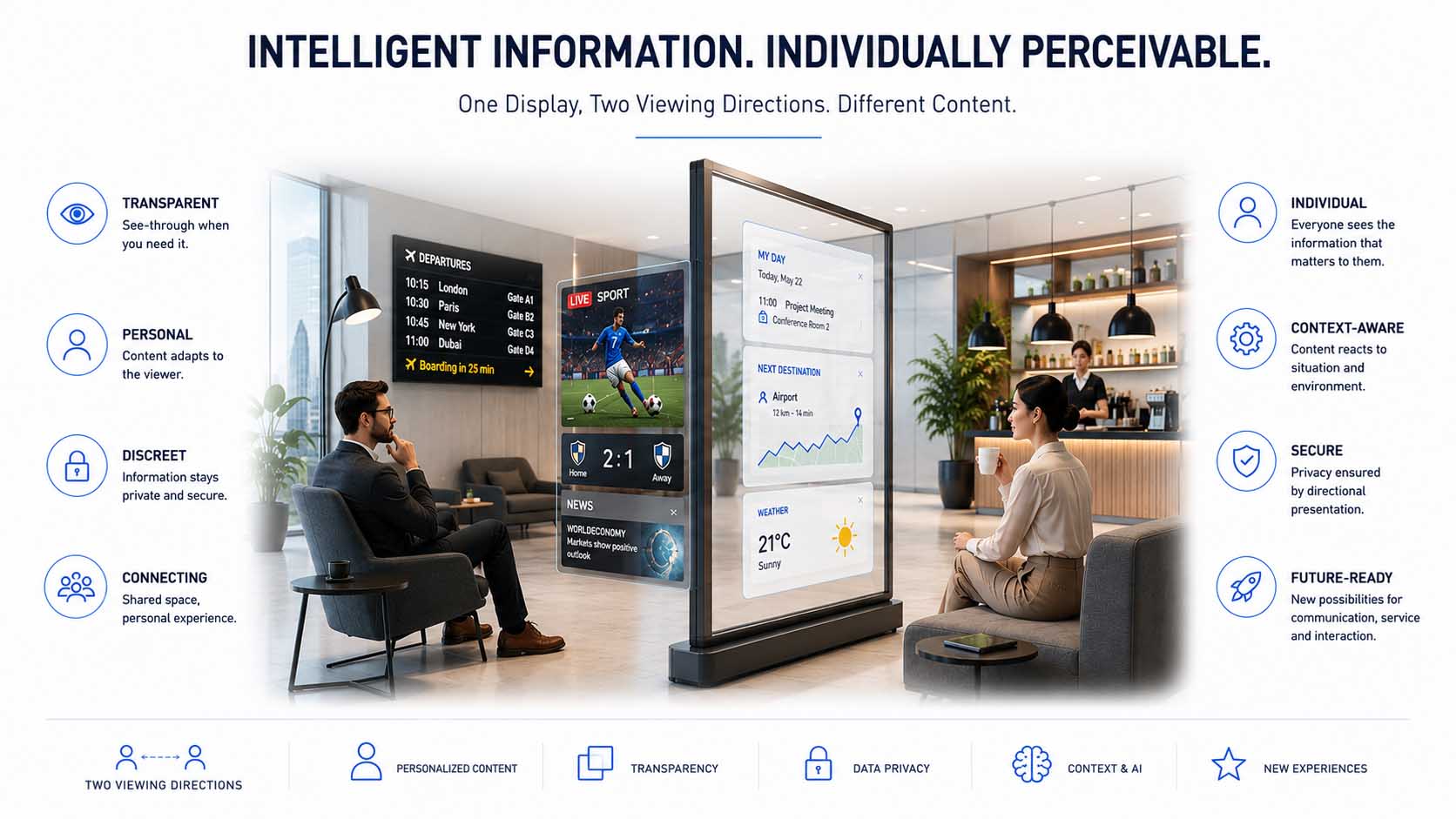
The infographic shows the basic principle of bidirectional displays. Different information is simultaneously provided for different viewing directions. This creates personalized information spaces, without shared spaces or direct communication between people being lost.
Infographic: Functional principle of bidirectional displays with directed light control and personalized information areas | Graphic: © Ulrich Buckenlei | XR Stager Online Magazine | VISORIC GmbH
The significance of this development extends far beyond new display technologies. Hotels could simultaneously provide guests with individual information, without changing the open character of a lobby. Offices gain new possibilities for confidential collaboration at shared workspaces. Vehicles could provide drivers and passengers with different information, while airports or train stations could display personalized route guidance directly on shared information surfaces for travelers.
At the same time, a new form of human-machine interaction is opening up. Future displays could recognize the direction from which a person is looking at the screen and which information is relevant in the respective situation. Supported by computer vision and artificial intelligence, intelligent information systems are emerging that no longer display content statically, but provide it based on the situation and the user. The screen thereby evolves from a passive display surface into an active communication interface.
- Bidirectional displays can simultaneously provide different information for different viewing directions.
- Directed light control forms the basis of future personalized display technologies.
- Shared spaces are preserved while still enabling individual digital information.
- Hotels, offices, vehicles, and public facilities are among the most promising fields of application.
- Computer vision and artificial intelligence could control future displays in a context-aware and intelligent manner.
In the next chapter, we look at the technological foundations of this development. Modern light-field technologies, MicroLEDs, transparent display architectures, computer vision, and artificial intelligence together form the basis for the next generation of intelligent information systems.
Which technologies make this development possible
At first glance, bidirectional displays seem remarkably simple. In fact, however, behind their surface lies a highly complex interplay of modern display technologies, optical systems, and intelligent software. Unlike conventional screens, they do not just generate a single image for all viewers, but can specifically direct light in different directions, thereby providing different information simultaneously for different people. Only the interaction of several technological layers makes this principle possible at all.[7]
The starting point is the actual display unit. Modern transparent OLED, MicroLED, or future light-field technologies first generate the digital image information. In addition, however, additional optical layers are required that specifically influence the emitted light rays. New research approaches deal with directed light control, Fourier pixels, and multidimensional light fields, which can output digital content differently depending on the respective viewing direction.[8]
In addition, powerful graphics processors, rendering systems, and artificial intelligence are needed. They calculate in real time which information is relevant for which person and generate individual image content from this. Computer vision can additionally recognize the direction from which users are looking at the display, while sensors, cameras, or future eye-tracking systems analyze the respective usage context. Only this creates an intelligent display platform that no longer displays information statically, but could adapt it dynamically to different situations.
The following infographic illustrates this technical structure. At the center is an exploded view of a future bidirectional display. The individual layers are shown separately and illustrate the step-by-step structure of the technology – from the outer protective pane through transparent display and light-control layers to optical structures, AI-supported image processing, rendering systems, and the final output of individual content. The icons on the side additionally illustrate the most important functional areas such as viewing direction, directed light control, computer vision, context analysis, and real-time processing.
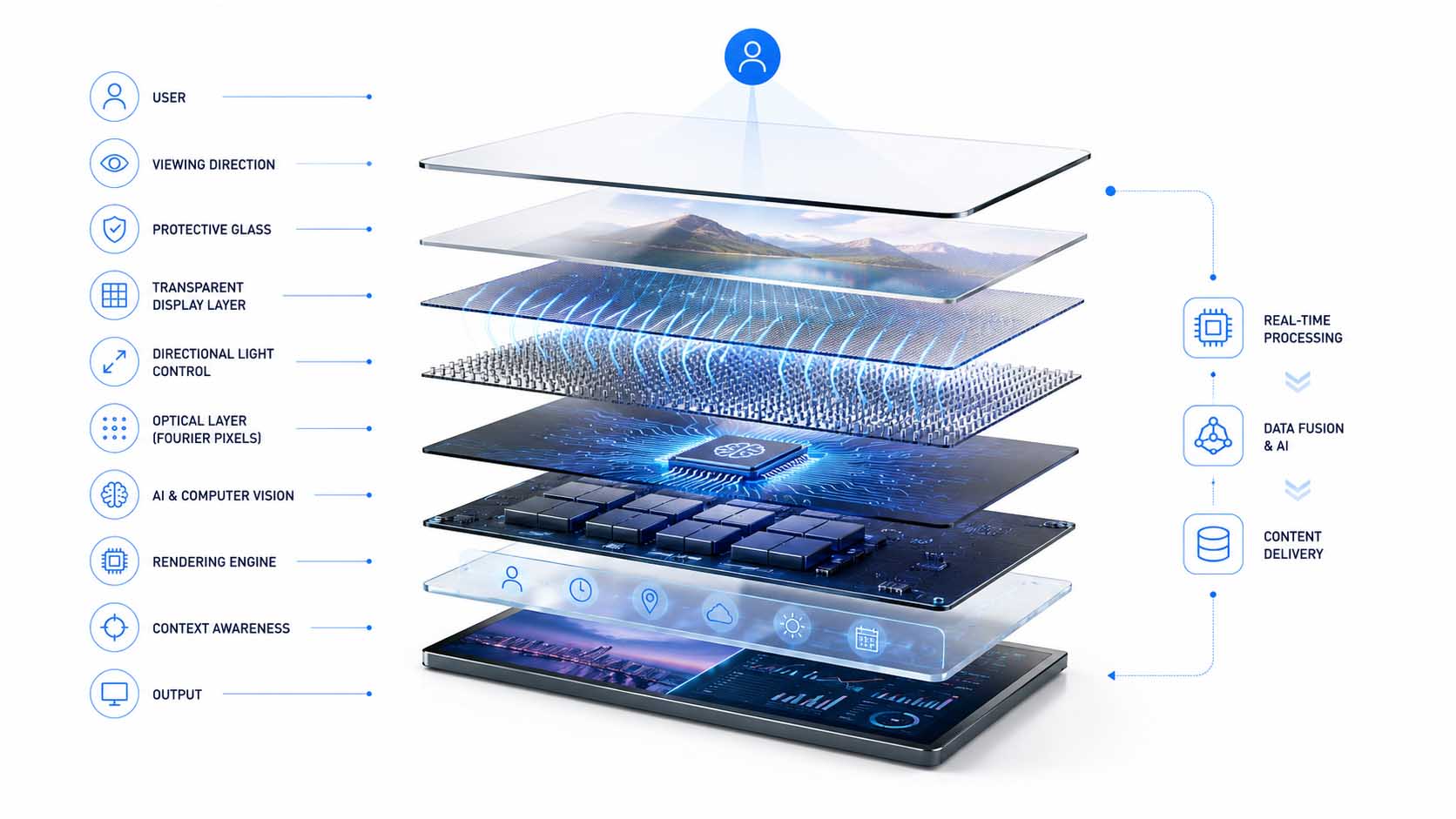
The infographic shows the possible technical structure of future bidirectional displays. Several transparent functional layers, directed light control, modern display technologies, and AI-supported image processing work together to simultaneously provide different content for different viewing directions.
Infographic: Technology stack of future bidirectional displays with transparent display architecture, directed light control, AI, and rendering | Graphic: © Ulrich Buckenlei | XR Stager Online Magazine | VISORIC GmbH
It is notable that no single technology enables this development on its own. Only the combination of modern display technology, nanophotonics, light-field computation, computer vision, real-time graphics, and artificial intelligence creates the conditions for individual digital information spaces. At the same time, all the technologies involved are currently developing at high speed. Advances in one area have a direct impact on the performance of the overall system.
This also changes the role of the screen in the long term. It evolves from a passive display surface into an intelligent information platform that can individually provide digital content depending on viewing direction, usage situation, and context. Future displays could thereby no longer just display information, but actively decide which content is relevant for which person at the respective moment.
- Bidirectional displays are based on several intelligently interacting technology layers.
- Directed light control and multidimensional light fields enable different content for different viewing directions.
- Computer vision, sensor technology, and artificial intelligence support the context-aware calculation of personalized information.
- Rendering systems generate individual image content in real time and continuously adapt it.
- Only the interplay of modern display technologies, optics, and AI makes future bidirectional information systems possible.
In the next chapter, we leave the technical level and look at concrete fields of application. Hotels, offices, vehicles, airports, and public facilities serve as examples of how bidirectional displays could make shared spaces more intelligent, personal, and efficient in the future.
New possibilities for hotels, offices, and public spaces
Technological innovations only reveal their true value once they solve concrete problems. This is precisely where the potential of bidirectional displays lies. They not only enable a new way of presenting information, but could fundamentally change shared spaces. Instead of providing identical information to all people, different individuals receive exactly the content that is relevant to their respective situation. This creates new possibilities for communication, collaboration, service, and orientation, without requiring additional screens or personal devices.[9]
It is particularly interesting that this concept can be applied to numerous industries. Hotels, offices, vehicles, airports, healthcare facilities, museums, or retail stores pursue completely different tasks, yet share one thing in common: multiple people use the same space but need different information. Bidirectional displays could combine these requirements within a shared display surface for the first time.[10]
The following infographic shows six example fields of application. Each of the numbered fields illustrates how individual information can be provided within shared spaces, without separating people from one another or requiring multiple screens.
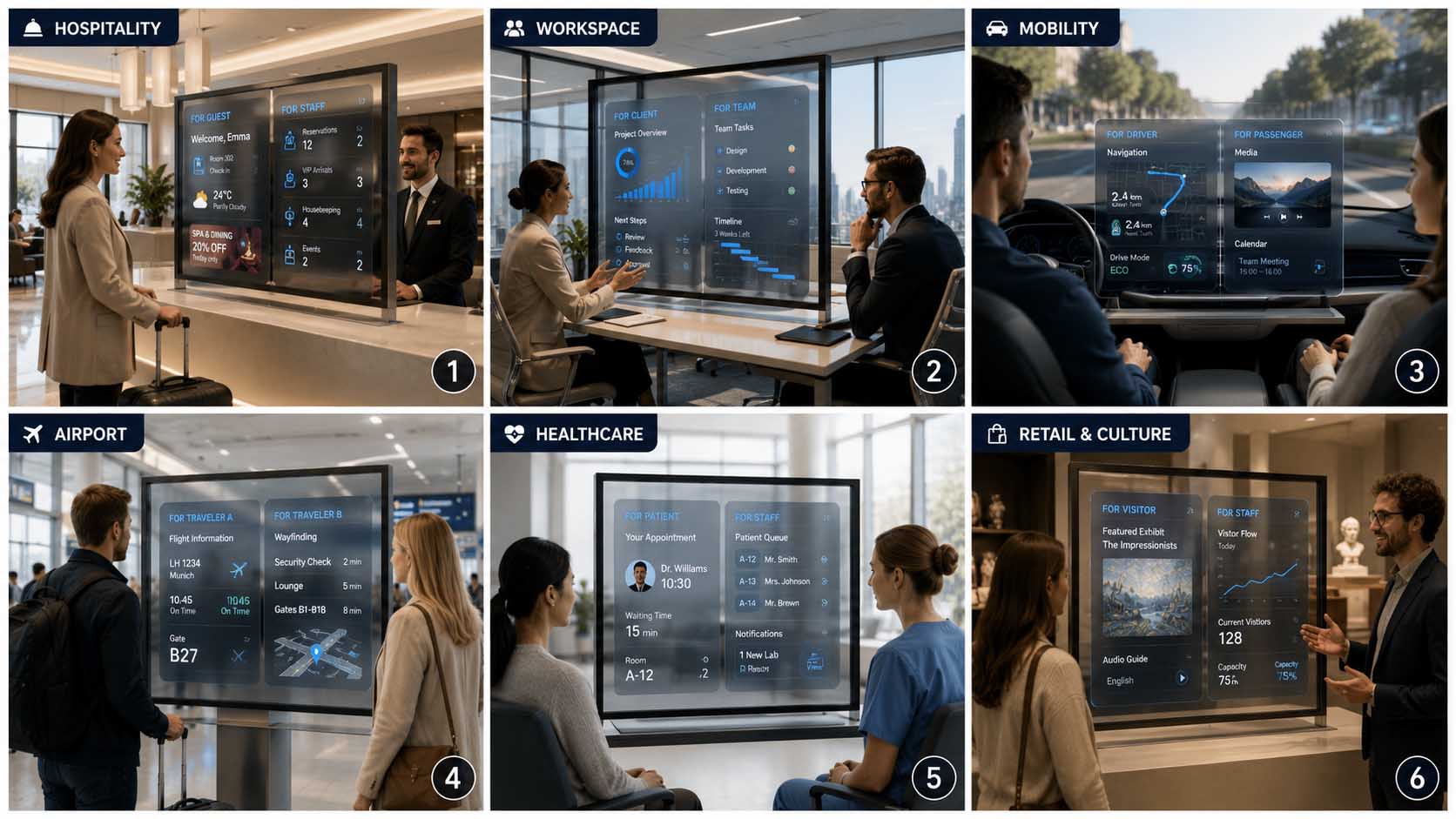
The infographic shows six possible fields of application for future bidirectional displays. Hotels, offices, vehicles, airports, healthcare facilities, as well as museums and retail benefit from individual information within shared spaces.
Infographic: Potential fields of application for bidirectional displays for Hospitality, Workspace, Mobility, Airport, Healthcare, and Retail & Culture | Graphic: © Ulrich Buckenlei | XR Stager Online Magazine | VISORIC GmbH
1. Hospitality
In hotels, guests could receive check-in information, room details, or local recommendations on the same display surface, while staff simultaneously see reservations, housekeeping status, or internal service information. The open design of a lobby is preserved, yet each person receives exactly the information they need.
2. Workspace
Modern workplaces are increasingly developing into collaborative work environments. Project teams, clients, and employees often work at shared displays but need different information. Bidirectional displays could simultaneously provide presentations, project data, or internal work information, thereby making collaboration more efficient.
3. Mobility
Vehicles also offer interesting possibilities. While the driver receives navigation instructions, vehicle status, or safety information, the passenger could simultaneously use media content, appointments, or communication functions. Both people use the same display surface, yet experience different user interfaces.
4. Airport
At airports or train stations, travelers could receive individual route guidance, connecting flight information, or departure information. At the same time, service information or operational notices for staff can be displayed on the same display surface. This creates personalized information systems within shared waiting and transit areas.
5. Healthcare
Hospitals and medical facilities particularly benefit from a clear separation of different information. Patients receive appointments, route guidance, or call information, while medical staff can simultaneously use occupancy data, work lists, or organizational notices. Shared spaces remain open and friendly, while sensitive information is still provided in a targeted manner.
6. Retail & Culture
Museums, exhibitions, and retail could offer visitors personalized content, language versions, or additional product information. Staff simultaneously receive information about visitor flows, capacity, or service processes. This creates interactive information spaces that enable individual experiences while also supporting operational processes.
The six examples illustrate that bidirectional displays are far more than a new display technology. They change the way people perceive digital information within shared spaces. Instead of general information for everyone, an intelligent information space emerges that provides content based on the situation and individually, without restricting communication between people.
With the increasing availability of powerful display technologies, computer vision, and artificial intelligence, such applications could in the future become part of many everyday environments. The boundaries between information, service, and interaction are beginning to dissolve. Shared spaces are evolving into intelligent communication platforms that flexibly adapt to different users and usage situations.
- Bidirectional displays open up new possibilities for Hospitality, Workspace, Mobility, Airport, Healthcare, and Retail & Culture.
- Different users receive individual information within the same shared display surface.
- Service, orientation, and collaboration can be made more efficient without using additional screens.
- Shared spaces remain open while information is specifically provided to different people.
- Personalized information spaces could become an important foundation for future human-machine interaction.
In the next chapter, we look at how computer vision and artificial intelligence support these personalized information spaces, and why intelligent systems could in the future decide which information is relevant for which person at the respective moment.
Personalized information without spatial separation
Bidirectional displays alone do not yet create intelligent information systems. It is artificial intelligence that decides which content is actually relevant for which person in a particular situation. While classic screens display the same information to all viewers, future systems could analyze the respective usage context and compile content individually. A static display surface thereby evolves into an intelligent information platform that continuously adapts to people, environment, and situation.[11]
This fundamentally changes the role of artificial intelligence. It no longer serves exclusively to analyze large amounts of data or answer individual questions. Rather, it develops into an intelligent decision-making instance between user and display. Calendar, location, viewing direction, time of day, sensor information, or personal preferences can be jointly evaluated to provide exactly the information that offers the greatest added value at the respective moment. This creates a significantly more natural and, at the same time, more individual form of digital communication.[12]
Modern computer vision systems can additionally recognize the direction from which people are looking at a display and what situation currently applies. At the same time, language models, sensors, and context-aware AI systems analyze further sources of information. From numerous individual data points, a comprehensive understanding of the situation emerges that goes far beyond a classic user interface. Instead of manually selecting information, future displays could decide for themselves which content is simultaneously relevant for different people.
The following infographic illustrates this decision-making process. On the left side, various pieces of contextual information such as user identity, viewing direction, location, time of day, calendar, sensors, or personal preferences flow into a central AI engine. At the center, computer vision, context models, and intelligent decision algorithms analyze all information in real time. On the right side, this results in personalized content such as navigation, entertainment, meetings, hotel services, health information, or notifications, which are displayed on the screen depending on the situation. The toolbar below summarizes the most important properties of this approach: relevant information, real-time processing, privacy, and personalization.
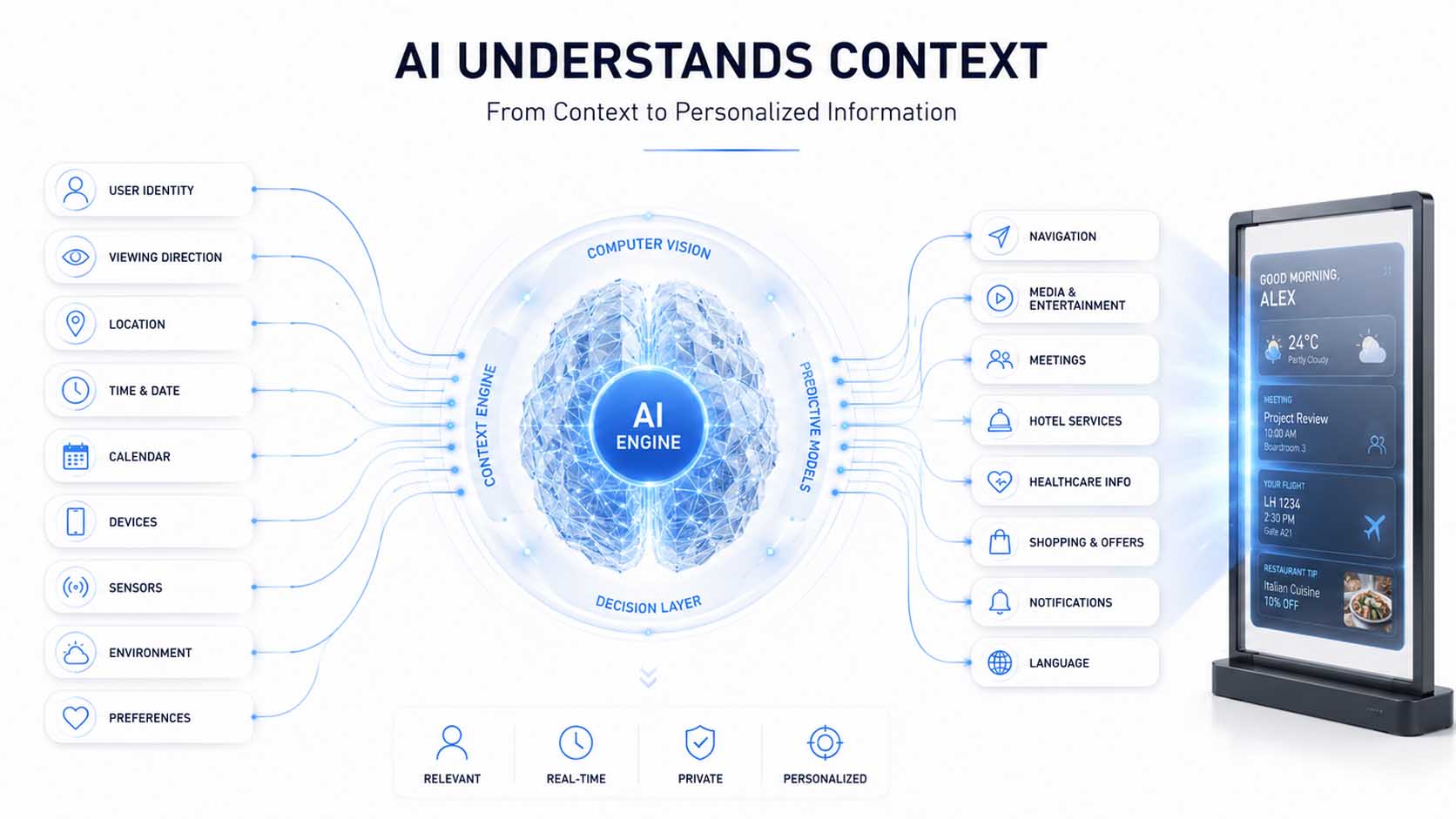
The infographic shows how artificial intelligence analyzes various pieces of contextual information and uses them to generate personalized content for different users. From user identity, viewing direction, location, sensor technology, and further data, an intelligent decision-making platform emerges for future bidirectional displays.
Infographic: AI-supported context analysis for personalized information display on bidirectional displays | Graphic: © Ulrich Buckenlei | XR Stager Online Magazine | VISORIC GmbH
This approach becomes particularly interesting in shared spaces. Two people can sit facing each other, look at the same display surface, and yet receive completely different information. While a hotel guest sees their reservation or next appointment, the person on the opposite side simultaneously receives messages, weather information, or navigation instructions. The actual intelligence lies not in the display itself, but in the AI’s ability to select content based on the situation and provide it individually.
The more contextual information a system takes into account, the more precisely information can be adapted to the respective user. At the same time, data protection and transparency gain in importance. Users must be able to understand which data is being processed and why certain content is displayed. Only when personalization and privacy are equally taken into account does trust in this new generation of intelligent information systems develop in the long term.
In the long term, bidirectional displays could thereby become far more than digital display boards. They evolve into intelligent communication platforms that connect people, information, and artificial intelligence. Instead of merely displaying content, they recognize the respective usage context and support people with exactly the information they actually need at that moment.
- Artificial intelligence decides which information is relevant for which person.
- User identity, viewing direction, location, and context jointly inform the decision-making process.
- Computer vision and AI enable personalized information within shared spaces.
- Data protection, privacy, and transparency become central components of future display platforms.
- Bidirectional displays are evolving into intelligent communication systems with context-aware personalization.
In the next chapter, we look at the technical challenges that still need to be solved on the way to bidirectional displays. Transparency, brightness, energy efficiency, viewing angle, and production costs determine when this technology can find its way from research into everyday life.
Which challenges still need to be solved
The vision of bidirectional displays is compelling. Individual information within shared spaces could fundamentally change communication, collaboration, and digital user interfaces. However, numerous technological challenges still lie between the first research results and widespread everyday use. Only once display technology, optics, energy efficiency, and artificial intelligence are equally further developed can this new generation of intelligent information systems reach its full potential.[13]
One of the biggest challenges lies in light control. While conventional screens emit their image as evenly as possible in all directions, bidirectional displays must specifically assign light to different viewing directions. At the same time, the display is meant to remain brilliant, high-contrast, and easily readable even in bright ambient light. Research institutions are therefore working on new pixel architectures, optical structures, and nanophotonics that can control light much more precisely than today’s display technologies.[14]
Further technical requirements are added to this. Transparency and image quality no longer need to be mutually exclusive in the future. Displays should remain as transparent as possible while still offering vivid colors, high resolutions, and sufficient brightness. At the same time, energy consumption, response speed, and the economical production of large-format displays play a decisive role in enabling this technology to become established outside of research laboratories.
The following infographic summarizes the most important development areas. At the center is a future bidirectional display surrounded by eight technological challenges. High luminosity, wide viewing angles, energy efficiency, transparency, precise light control, minimal latencies, AI-supported real-time processing, and scalable production processes together form the basis for future display generations. Only once all areas are sufficiently mature can powerful and economically viable systems be realized.
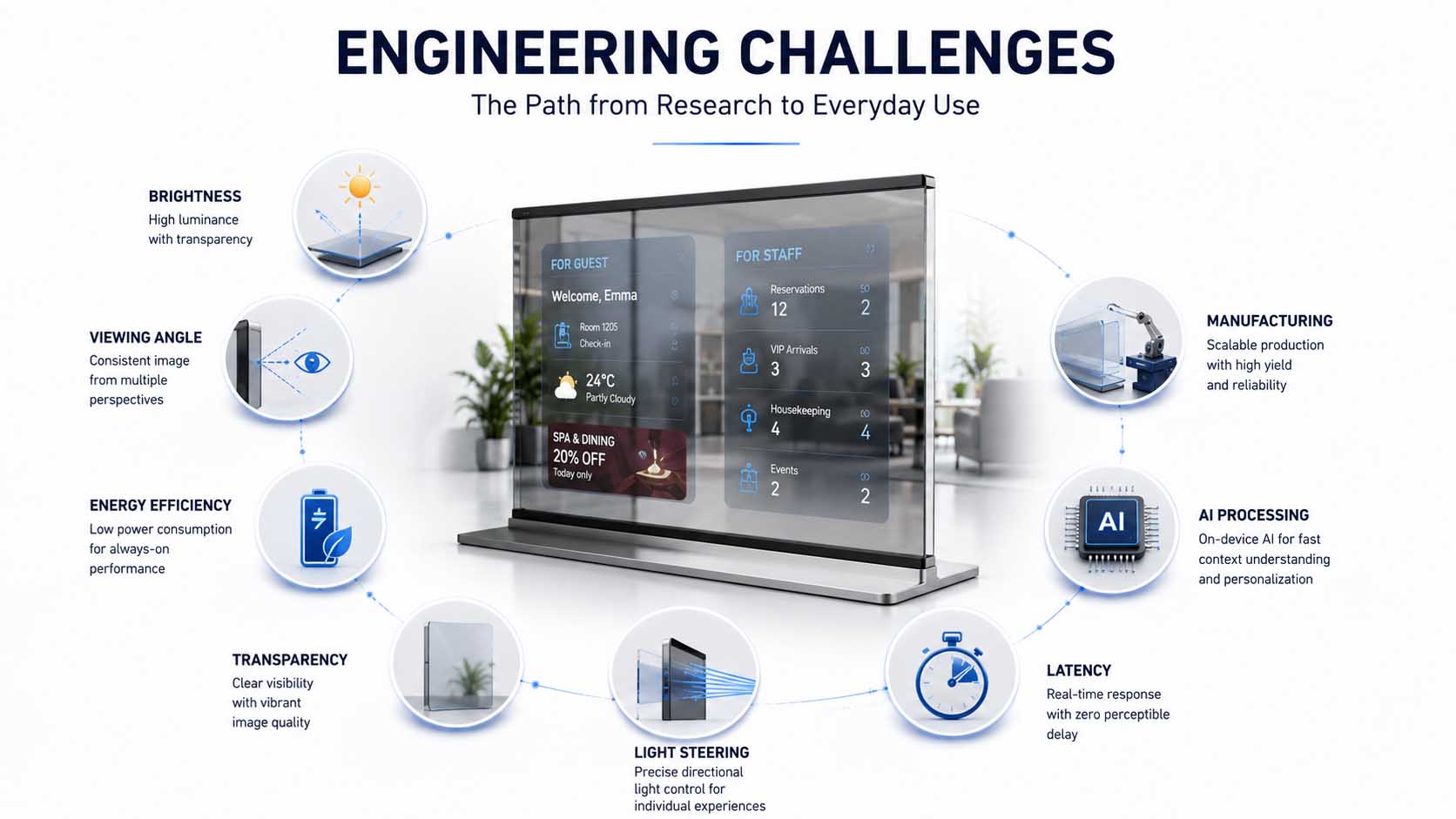
The infographic shows the most important technical challenges of future bidirectional displays. Brightness, transparency, viewing angle, directed light control, energy efficiency, AI processing, low latencies, and economical manufacturing largely determine the path from research to market readiness.
Infographic: Technological challenges of future bidirectional displays on the path from research to industrial application | Graphic: © Ulrich Buckenlei | XR Stager Online Magazine | VISORIC GmbH
It becomes particularly clear that no single innovation is sufficient. Improvements in display technology alone solve the challenge just as little as more powerful AI or new optical materials. Only the interplay of all technologies determines whether future displays can be produced sufficiently bright, energy-efficient, precise, and economical. Each individual component influences the performance of the overall system.
Artificial intelligence also plays an important role here. It analyzes usage situations in real time, optimizes the display for different viewers, and supports the efficient control of complex display architectures. At the same time, data protection, response times, and local processing must be designed so that personalized information can be provided without noticeable delay.
The development of bidirectional displays is thus similar to the introduction of modern smartphones or high-resolution OLED screens. Many of the required technologies already exist today but achieve their greatest benefit only through their intelligent combination. The faster progress is made in the fields of nanophotonics, display manufacturing, computer vision, and artificial intelligence, the more realistic the transition from experimental prototypes to market-ready products becomes.
- Directed light control is among the biggest technical challenges of future display generations.
- Brightness, transparency, and image quality must be simultaneously optimized in the future.
- Energy efficiency, low latencies, and local AI processing are decisive for practical use.
- Scalable manufacturing processes determine the economic availability of bidirectional displays.
- Only the interplay of modern display technology, nanophotonics, and artificial intelligence creates the foundation for market-ready systems.
In the next chapter, we take a look into the future. What developments are realistic in the coming years, which applications could become established first, and how could bidirectional displays change our daily communication in the long term?
Why artificial intelligence is becoming a key technology
Bidirectional displays will only reach their full potential once they understand their environment and can intelligently adapt information to different people. The real innovation therefore lies not solely in the display technology, but in the ability of artificial intelligence to analyze situations, recognize connections, and derive personalized information from them. A passive screen evolves into an intelligent information platform that continuously takes the respective usage context into account.[15]
Computer vision plays a central role here. Cameras and sensors capture people, viewing directions, and movements within shared spaces. At the same time, AI systems analyze the current context, take into account time of day, location, appointments, or other available information, and decide which content is relevant for which person. The display thereby becomes an intelligent communication interface that no longer displays information generally, but provides it individually.
With increasing computing power, many of these decisions are shifting directly to the end device. Modern AI accelerators make it possible to perform context analysis and computer vision locally, without having to permanently transmit all data to cloud systems. This can shorten response times, improve data protection, and generate personalized information in near real time.[16]
The following visualization shows a possible future of shared information spaces. Several bidirectional displays are distributed within a modern airport lounge or hotel lobby. Although everyone shares the same environment, each individual receives exactly the information that corresponds to their current situation. Air travelers see boarding information and gate changes, business travelers receive meeting appointments and room information, visitors access an interactive city guide, while others use individual offers or concierge services. In the background, an AI continuously supports the selection of the respective relevant content, without the users having to actively switch between applications.
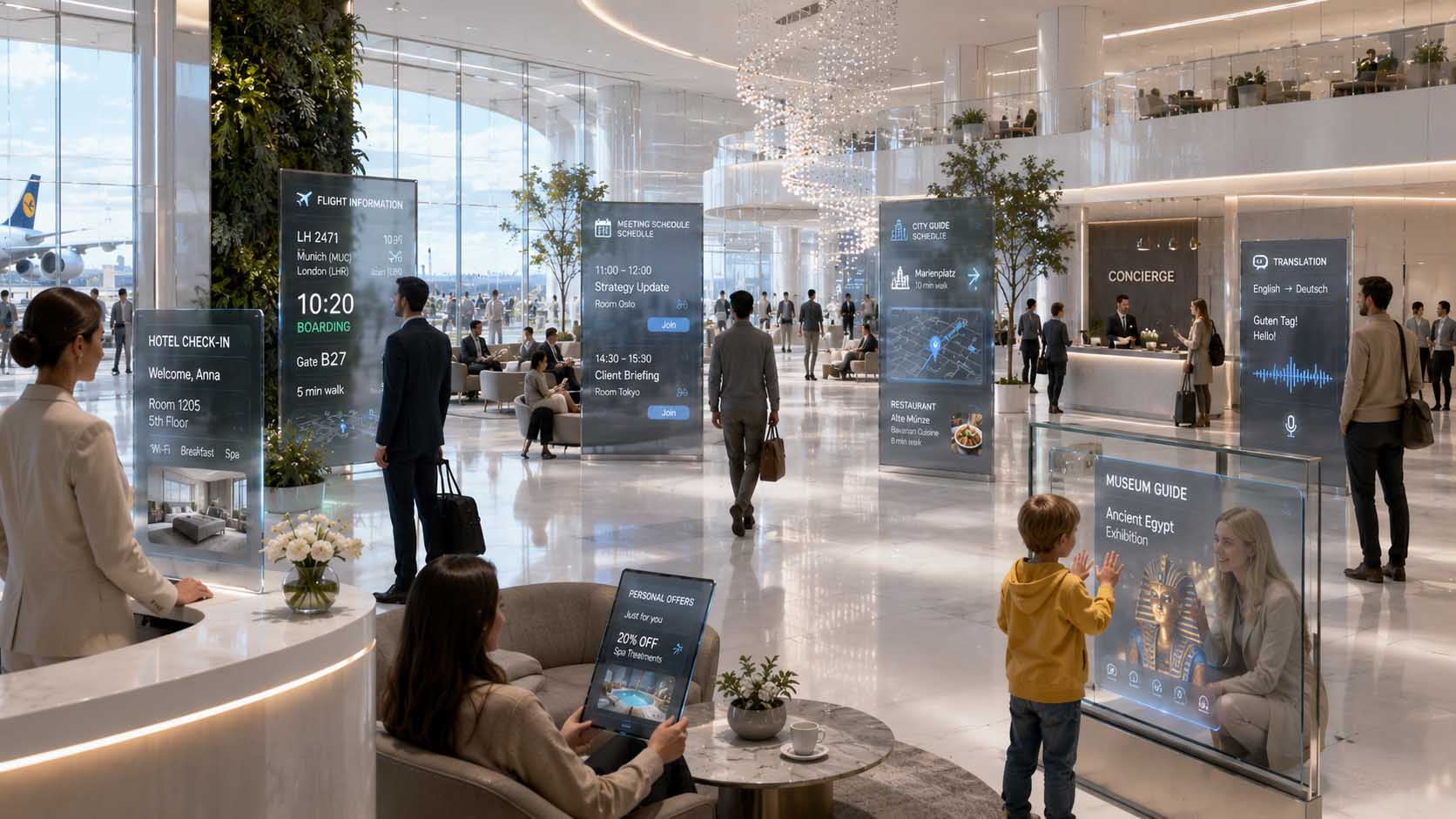
The visualization shows a possible future of shared information spaces. Artificial intelligence analyzes the usage context and simultaneously provides different information for different people on bidirectional displays – from navigation and meetings to concierge services and personalized offers.
Visualization: AI-supported bidirectional displays in future hotels, airports, and public spaces | Graphic: © Ulrich Buckenlei | XR Stager Online Magazine | VISORIC GmbH
It is particularly interesting that the technology operates almost invisibly. Users do not need to search through menus or switch between different applications. The information automatically appears where it is needed and is oriented toward the respective situation. This makes digital content less intrusive and, at the same time, considerably more helpful.
In the long term, this could lead to entirely new forms of shared spaces. Hotels, airports, office buildings, hospitals, or museums would no longer provide static information for all visitors. Instead, adaptive information environments emerge that continuously adapt to different people while still preserving their openness as a shared space. Artificial intelligence takes on the role of an invisible mediator between people, environment, and digital information.
This also changes the relationship between humans and technology. It is not the user who adapts to the information system, but the information system that responds to the person. Bidirectional displays, computer vision, and local AI could together create a new generation of intelligent user interfaces that provide information more intuitively, more relevantly, and more personally than today’s display solutions.
- Artificial intelligence analyzes context, viewing direction, and usage situation in real time.
- Computer vision enables personalized information within shared spaces.
- Local AI processing reduces response times and strengthens data protection.
- Shared information spaces are evolving into adaptive, intelligent communication platforms.
- Bidirectional displays combine personalization, comfort, and collaboration in one shared user interface.
In the final chapter, we take a look into the future. We examine how bidirectional displays, together with artificial intelligence, new display technologies, and intelligent information systems, could develop in the coming years, and what role they will play in the long term for communication, collaboration, and digital spaces.
From screen to intelligent information space
For decades, the task of a screen was to make digital information visible. Future display generations, however, could achieve far more. Bidirectional displays, computer vision, and artificial intelligence open up the possibility of no longer displaying digital content statically, but providing it individually, contextually, and based on the situation. The screen thereby evolves from a passive display surface into an intelligent information space that actively supports people in communication, orientation, and collaboration.[17]
At the center of this development is not the technology itself, but the person. In the future, information should no longer need to be searched for, but should appear exactly where it is needed. Hotels, airports, companies, hospitals, or public facilities could thereby function much more intuitively. Visitors automatically receive relevant information, employees access work-related content, and shared spaces remain open, transparent, and communicative, even though different people simultaneously perceive different information.
At the same time, the role of artificial intelligence is changing. It not only analyzes data but develops an understanding of situations, connections, and individual requirements. Computer vision recognizes people and viewing directions, intelligent algorithms evaluate the current usage context, and modern display technologies provide the appropriate content precisely for the respective viewing direction. This creates a new form of digital communication that unobtrusively integrates into everyday life and supports people without unnecessarily demanding their attention.[18]
The following visualization shows a possible future of intelligent information spaces. People move naturally through a modern architecture that combines elements of a hotel, airport, business campus, and public meeting spaces. Bidirectional displays are harmoniously integrated into the environment and accompany different usage situations without dominating the space. Business travelers receive meeting information, travelers see flight data, visitors access city information or translations, and concierge systems assist with service requests. The technology deliberately recedes into the background. At the center is an environment that provides information intelligently, based on the situation, and centered on people.
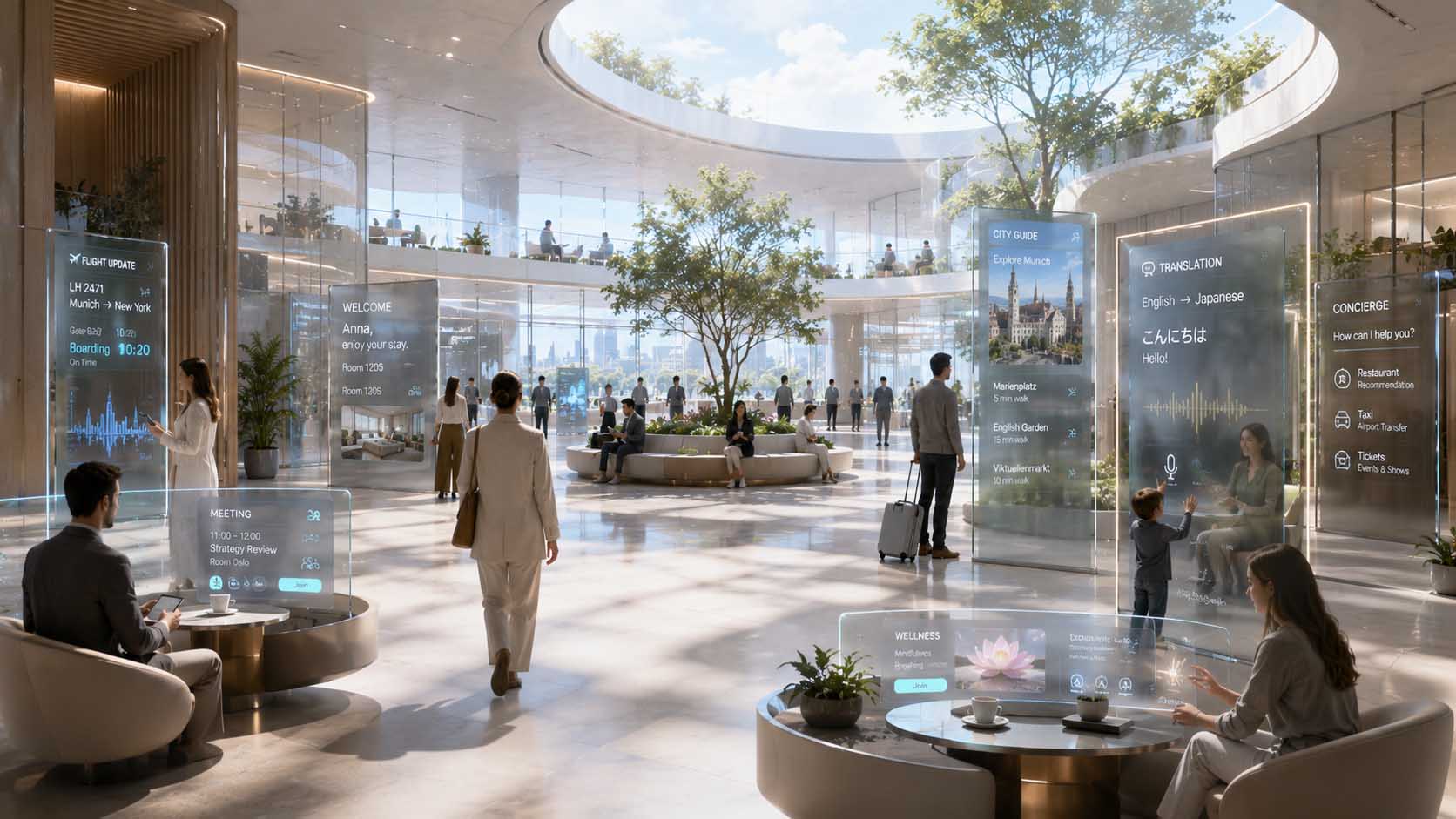
The visualization shows a possible future of human-centered information spaces. Bidirectional displays, computer vision, and artificial intelligence merge into an intelligent infrastructure that provides personalized information and makes shared spaces more open, more intuitive, and more efficient.
Visualization: Future of intelligent information spaces with bidirectional displays, computer vision, and artificial intelligence | Graphic: © Ulrich Buckenlei | XR Stager Online Magazine | VISORIC GmbH
This development extends far beyond new display technologies. It describes a fundamental shift in how we handle digital information. Instead of generating more and more screens, applications, and notifications, information will in the future be provided in a more targeted, relevant, and unobtrusive way. Digital content orients itself more toward the person rather than the other way around. This creates information systems that facilitate collaboration, improve orientation, and at the same time respect privacy.
This shift also opens up new perspectives for companies. Workplaces are evolving into intelligent information spaces in which employees, customers, and visitors can use different content within the same environment. Hotels improve their service, airports facilitate orientation, offices foster collaboration, and public facilities create more accessible and individualized information offerings. The real innovation lies not in the individual display, but in the intelligent connection of architecture, information, and artificial intelligence.
For the VISORIC team of experts, this development is precisely the focus. The combination of computer vision, real-time 3D, artificial intelligence, and innovative display technologies opens up new possibilities for providing digital information in a way that is more understandable, more intuitive, and closer to people. The goal is not to make more technology visible, but to deploy technology so intelligently that it meaningfully supports everyday life while remaining almost invisible.
Whether bidirectional displays will become established in exactly this form cannot yet be predicted with certainty today. However, the underlying research and technological developments already clearly show the direction in which digital user interfaces could develop. Intelligent information spaces, personalized communication, and adaptive display technologies have the potential to usher in the next stage of evolution in human-machine interaction and fundamentally reshape shared spaces.
- Bidirectional displays could develop the classic screen into an intelligent information space.
- Computer vision and artificial intelligence enable context-aware and personalized information display.
- Human-centered information spaces support communication, orientation, and collaboration within shared environments.
- Hotels, airports, companies, and public facilities are among the most promising fields of application.
- The future of digital communication lies not in more screens, but in more intelligent information systems oriented toward people.
The future of digital communication will therefore not be determined solely by more powerful displays, but by their intelligent connection with artificial intelligence, computer vision, and human-centered design. Only once information becomes visible at the right time, in the right place, and for the right person does a screen become an intelligent information space – and this may be precisely where one of the most exciting developments of the next generation of digital technologies lies.
When transparent displays become suitable for everyday use
Many technologies initially seem futuristic until they reach a level of maturity that enables their practical use. This is precisely the impression conveyed by the following demonstration. Transparent LED displays have already existed for several years, but continue to develop in terms of brightness, transparency, and energy efficiency. As a result, applications in hotels, airports, office buildings, museums, or public spaces are increasingly coming within reach. The technology shown illustrates that digital information could in the future be integrated into architecture without completely obscuring the view of the real environment.[17]
The underlying principle is surprisingly simple. Thousands of tiny LEDs are mounted on narrow transparent carrier structures. Sufficient free space remains between the individual LED strips, allowing light to continue passing through the display surface. For the viewer, this creates the impression of an almost transparent glass surface on which digital content appears to float freely in space.
Another special feature lies in the directed light emission. The LEDs send most of their light specifically toward the viewers. This makes the image appear high-contrast and bright from the front, while the back remains largely transparent. This property also forms an important foundation for future bidirectional display concepts, in which different viewing directions could receive different information.[18]
Original video: Shenzhen MileStrong Technology Co., Ltd. | Technological analysis, narration, editorial classification, and video editing: © Ulrich Buckenlei | XR Stager Online Magazine | VISORIC GmbH
This development is particularly interesting in connection with the research previously presented. The video does not yet show bidirectional displays, but it does make clear that large-format transparent displays have now reached a level of technical maturity that makes their use outside of laboratories increasingly realistic. Improvements in light output, transparency, resolution, and energy consumption create the foundation for future display generations with significantly expanded functions.
In combination with computer vision, artificial intelligence, and directed light control, such systems could in the future achieve far more than merely displaying digital content. They could provide different information for different people, take the usage context into account, and intelligently adapt to their environment. The transparent display thereby evolves from an impressive visualization into a potential platform for human-centered information spaces.
Architecture in particular opens up especially exciting perspectives here. Shop windows, glass facades, room dividers, or reception areas could make digital information visible without losing their openness. Information would no longer be outsourced to separate screens, but would become an immediate part of the built environment. Digital and physical architecture thereby begin to merge.
The video shown therefore illustrates more than just an interesting display technology. It marks a possible transition from classic screens to intelligent information surfaces that could in the future more closely connect architecture, communication, and digital services. Many of the concepts described in the article are still in the research stage, but the continuous development of transparent LED technologies shows that the first building blocks of this development are already available today.
- Transparent LED displays are increasingly reaching a level of maturity for practical applications.
- Sufficient free space remains between the LED structures for a view of the real environment.
- Directed light emission produces high image brightness combined with high transparency.
- Advances in brightness, efficiency, and transparency create the foundation for future display generations.
- Combined with AI and computer vision, this could give rise to intelligent, human-centered information spaces.
The future of digital communication may not begin with ever-larger screens, but with displays that become almost invisible and provide information exactly where people actually need it.
From vision to intelligent information platform
Bidirectional displays, computer vision, and artificial intelligence are still at the beginning of their development. Even today, however, it is becoming apparent that they could change the way people interact with digital information in the future. The greatest added value arises not from individual technologies, but from their intelligent connection into a shared information platform. Successful projects therefore do not begin with a new display technology, but with a concrete use case and a clear digitalization strategy.
Companies can already lay the groundwork for this development today. Digital twins, computer vision, real-time 3D, modern web technologies, and artificial intelligence form a technological basis that can be expanded step by step. As soon as future display generations become market-ready, they can build on existing data platforms and digital processes, allowing them to be used productively much more quickly.
The future of intelligent information spaces emerges from combining computer vision, real-time 3D, digital twins, artificial intelligence, and innovative display technologies into a shared information platform.
Visualization: Intelligent information platforms with computer vision, digital twins, real-time 3D, and artificial intelligence | Image: © Ulrich Buckenlei | VISORIC GmbH
How to get started successfully:
- Identify a concrete use case with measurable added value.
- Bring together computer vision, real-time 3D, digital twins, and artificial intelligence on a shared platform.
- Validate the solution as a pilot project and then gradually expand it to further processes and locations.
The future of intelligent information spaces does not begin with new display technologies. It begins with a scalable data and software architecture that structures digital information, makes it context-aware, and usable for future user interfaces.
The Munich-based VISORIC team of experts supports companies in laying these foundations today:
- Strategy, consulting, and conceptual design for computer vision, digital twins, and artificial intelligence.
- Development of interactive real-time 3D applications for web, desktop, mobile, as well as augmented, virtual, and mixed reality platforms.
- Building intelligent information platforms for engineering, service, sales, and technical communication.
- Integration of reality capture, 3D scanning, computer vision, and modern visualization technologies into existing business processes.
- Development of scalable pilot projects as a foundation for future human-centered information spaces.
Would you like to provide digital information more intelligently?
Whether digital twins, computer vision, interactive 3D visualization, real-time 3D, artificial intelligence, or the development of future information spaces – the Munich-based VISORIC team of experts supports you in turning innovative technologies into practical solutions with measurable added value. Together, we develop scalable platforms that already lay the foundation today for the next generation of digital user interfaces.
Contact:
Email: info@visoric.com
Phone: +49 89 21552678
Sources and references
- Nature Communications. Dual-sided transparent display enabled by polymer stabilized liquid crystals for augmented reality. Research on transparent displays with different representations for both sides and future applications in human-machine interaction.
- Nature. Fourier Pixels for Bidirectional Light Control. Research on the targeted control of light in different directions as a foundation for future bidirectional display technologies.
- International Journal of Human-Computer Studies. A Two-Sided Collaborative Transparent Display Supporting Workspace Awareness. Study of transparent displays for improving shared work environments and collaboration.
- Nature Communications. Dual-sided transparent display enabled by polymer stabilized liquid crystals for augmented reality. Foundations of bidirectional representations for different viewers.
- Nature. Fourier Pixels for Bidirectional Light Control. Bidirectional light control as a foundation for future display concepts.
- Nature Communications. Dual-sided transparent display enabled by polymer stabilized liquid crystals for augmented reality. Different content on opposite display sides.
- ACM Transactions on Graphics. Tensor Displays. Research on multidimensional light fields and future display architectures.
- Nature. Fourier Pixels for Bidirectional Light Control. Advances in nanophotonics and directed light control for future display generations.
- Adobe Research. Project Glasswing. Concept of a transparent interactive display for collaborative work environments.
- International Journal of Human-Computer Studies. A Two-Sided Collaborative Transparent Display Supporting Workspace Awareness. Use of transparent displays for communication and collaboration.
- Nature Communications. Dual-sided transparent display enabled by polymer stabilized liquid crystals for augmented reality. Personalized information display for different users.
- International Journal of Human-Computer Studies. Collaborative Transparent Displays. Possibilities for personalized interaction within shared spaces.
- PubMed. Review of Transparent Display Technologies. Overview of transparency, brightness, energy consumption, and technical challenges of modern display technologies.
- Nature. Fourier Pixels for Bidirectional Light Control. Challenges in scaling, viewing angles, and optical efficiency of future display systems.
- NVIDIA. AI, Computer Vision and Perception Technologies. AI-supported recognition of people, viewing directions, and contextual information for intelligent user interfaces.
- Qualcomm Snapdragon XR Platforms. On-Device Artificial Intelligence, Computer Vision, and Spatial Computing for personalized spatial applications.
- World Economic Forum. The Future of Human-Centred Technologies. Human-centered digital technologies for future work and living spaces.
- European Commission. Industry 5.0. Human-centered innovations, intelligent technologies, and digital transformation of future working worlds.
Contact Persons:
Ulrich Buckenlei (Creative Director)
Mobile: +49 152 53532871
Email: ulrich.buckenlei@visoric.com
Nataliya Daniltseva (Project Manager)
Mobile: +49 176 72805705
Email: nataliya.daniltseva@visoric.com
Address:
VISORIC GmbH
Bayerstraße 13
D-80335 Munich