
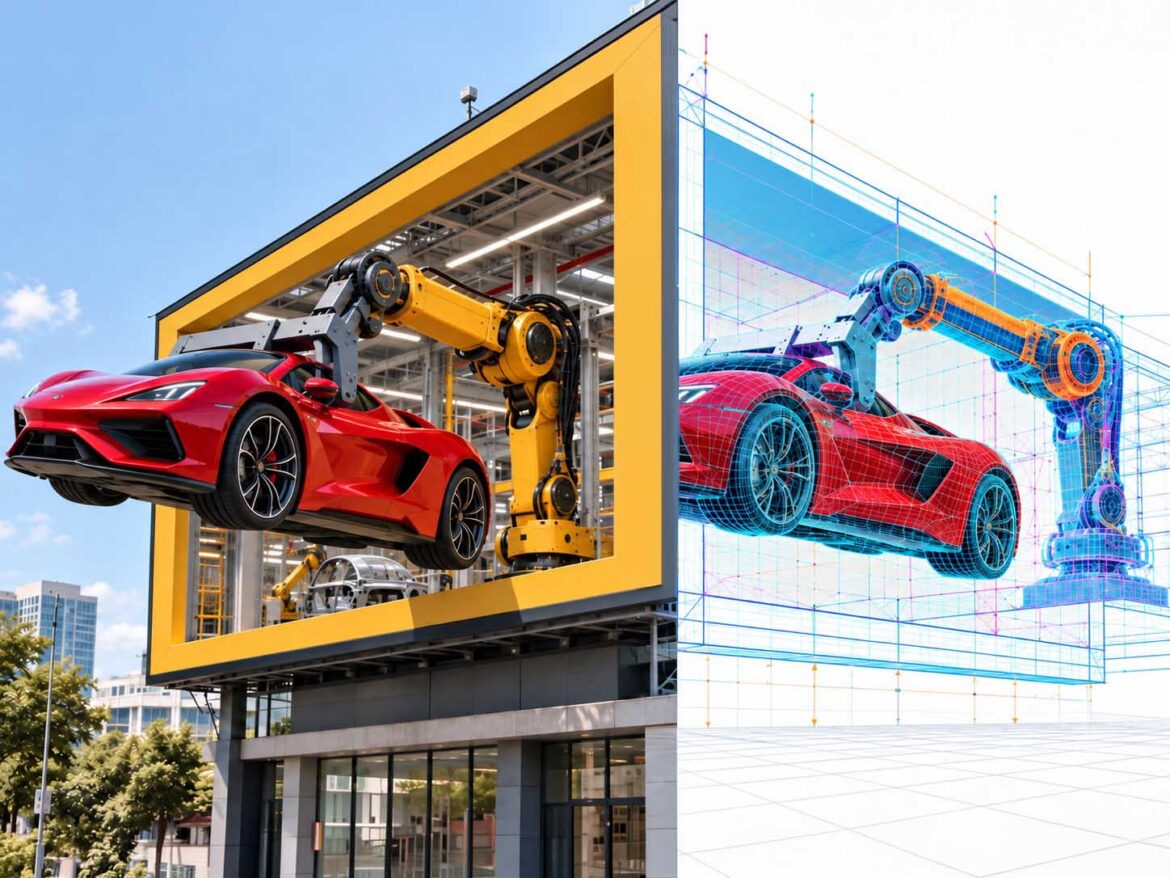
Real or virtual, both at once in this image.
Visualization: A sports car breaks through a billboard, half photorealistic, half open wireframe model | Image: © Ulrich Buckenlei | XR Stager Online Magazine | VISORIC GmbH
A sports car that appears to break through a billboard mid-motion exists, in that very moment, only halfway in reality, the other half is pure computation. This exact shot stands in for a principle that has long outgrown individual advertising images: a giant mascara wand gliding over the London Underground. A handbag the size of a small car rolling through the streets of Paris. None of these installations was ever built, none cost a single cent in steel, permits, or insurance, and yet together they reached far more people than most classic advertising campaigns with real, million-dollar budgets.[1]
What looks like a clever social media trick is actually the most visible part of a much larger economic shift. The industry calls these videos FOOH, short for Faux Out-of-Home, fake outdoor advertising that is never actually built. Companies today increasingly test concepts, campaigns, and even entire investment decisions virtually before putting a single cent into physical execution. In 2025 alone, industry estimates put the number of such FOOH videos worldwide at around 1,872, with an average organic reach of about 184,000 views per campaign, without any media budget at all.[2]
- FOOH campaigns reach millions without anything being physically built.
- Around 1,872 such videos were produced worldwide in 2025.
- An average campaign reaches 184,000 views purely organically.
- The same principle is increasingly used to test real industrial investments.
- Regulators in the US and the EU are already responding to the trend.
This article explains how an impossible installation is technically created, what happens when companies try to actually build it, why the same principle is reshaping billion-dollar investment decisions far beyond marketing, and where the line runs between clever validation and deliberate deception.
The billion-dollar illusion. What FOOH really is
FOOH, pronounced like the English word for fake, stands for Faux Out-of-Home. It refers to videos that fake a physical advertising installation in public space so convincingly that millions of people believe it is real, even though the installation is never built and never meant to be.
The term was coined by digital artist Ian Padgham, who became globally known in 2023 for a Maybelline campaign: giant, digitally rendered mascara wands appeared to sweep over real London Underground trains and buses, and within hours half the city was arguing over whether it had really been installed.[3] Padgham himself stressed that the intent was never to deliberately deceive people, but to answer a simple question: what would the ideal version of this idea look like, without the cost and hassle of real outdoor advertising?
Within a few years, that single campaign grew into its own production genre. Brands such as Jacquemus, Burberry, Gucci, Fenty, Mercedes-Benz, Coca-Cola, and Pepsi now regularly rely on FOOH, spanning fashion, cosmetics, automotive, and food.[2] What unites these campaigns isn’t the industry, it’s a shared economic calculation: maximum attention at minimum financial and legal risk.
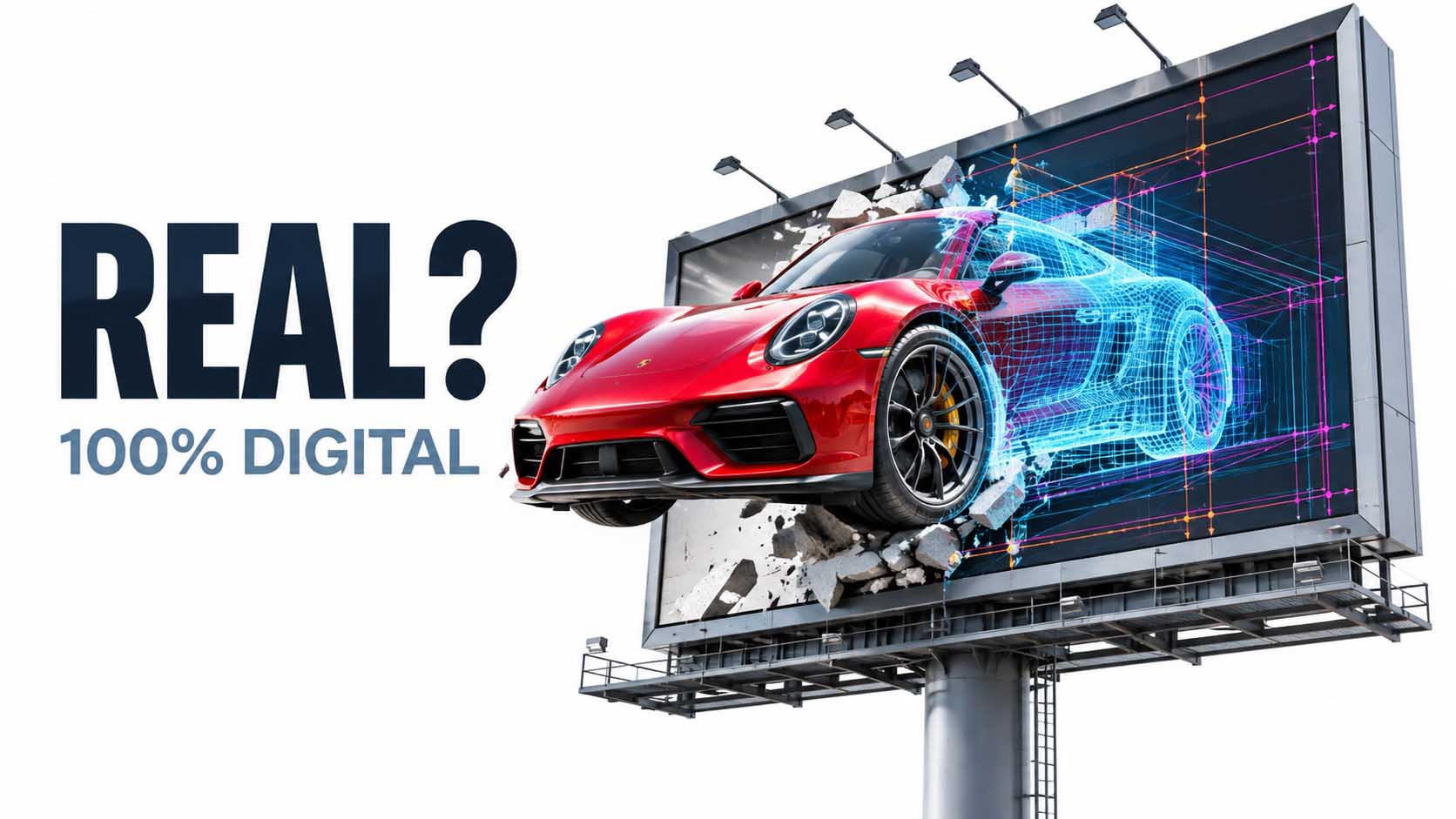
An advertising installation that never existed, and still reached millions.
Infographic: Visualization of the principle behind FOOH campaigns using an oversized advertising installation | Graphic: © Ulrich Buckenlei | XR Stager Online Magazine | VISORIC GmbH
This already makes clear why FOOH isn’t just an advertising trick but the most visible evidence of a far bigger principle: before capital flows into something physical, its impact can today be almost fully anticipated virtually, and convincingly enough that the line between real and computed blurs for the audience.
- FOOH stands for Faux Out-of-Home, fake physical advertising.
- The term traces back to digital artist Ian Padgham.
- Maybelline’s 2023 Underground campaign kicked off the trend.
- Major brands across every industry now use the format.
- The goal is maximum impact at minimum financial risk.
How exactly this calculation looks in numbers, and why two particular campaigns became the reference point for the entire industry, is the subject of the next chapter.
Maybelline, Jacquemus, and the proof before the build
Two campaigns are still considered the industry’s benchmark today, because they were the first to prove in hard numbers just how large the gap between virtual and physical advertising impact can be.
In 2023, Jacquemus had oversized Le Bambino handbags roll through the streets of Paris like small cars, a single video that racked up nearly 49 million views.[2] Maybelline’s Underground campaign, according to the team behind it, generated an estimated earned media value of more than 23 million US dollars in the first quarter of 2023 alone, without booking any ad space or actually building a single installation.[4] For comparison: a single premium physical advertising space in a prime city location often costs a five-figure sum in booking fees alone, before any production even begins.[2]
This cost comparison is the real core of the business model. Marketing leaders consistently describe FOOH as a tool to fully test an idea first, observe public reaction, and only then decide whether a physical build is worth it, rather than building first and finding out afterward whether the idea works.[1]
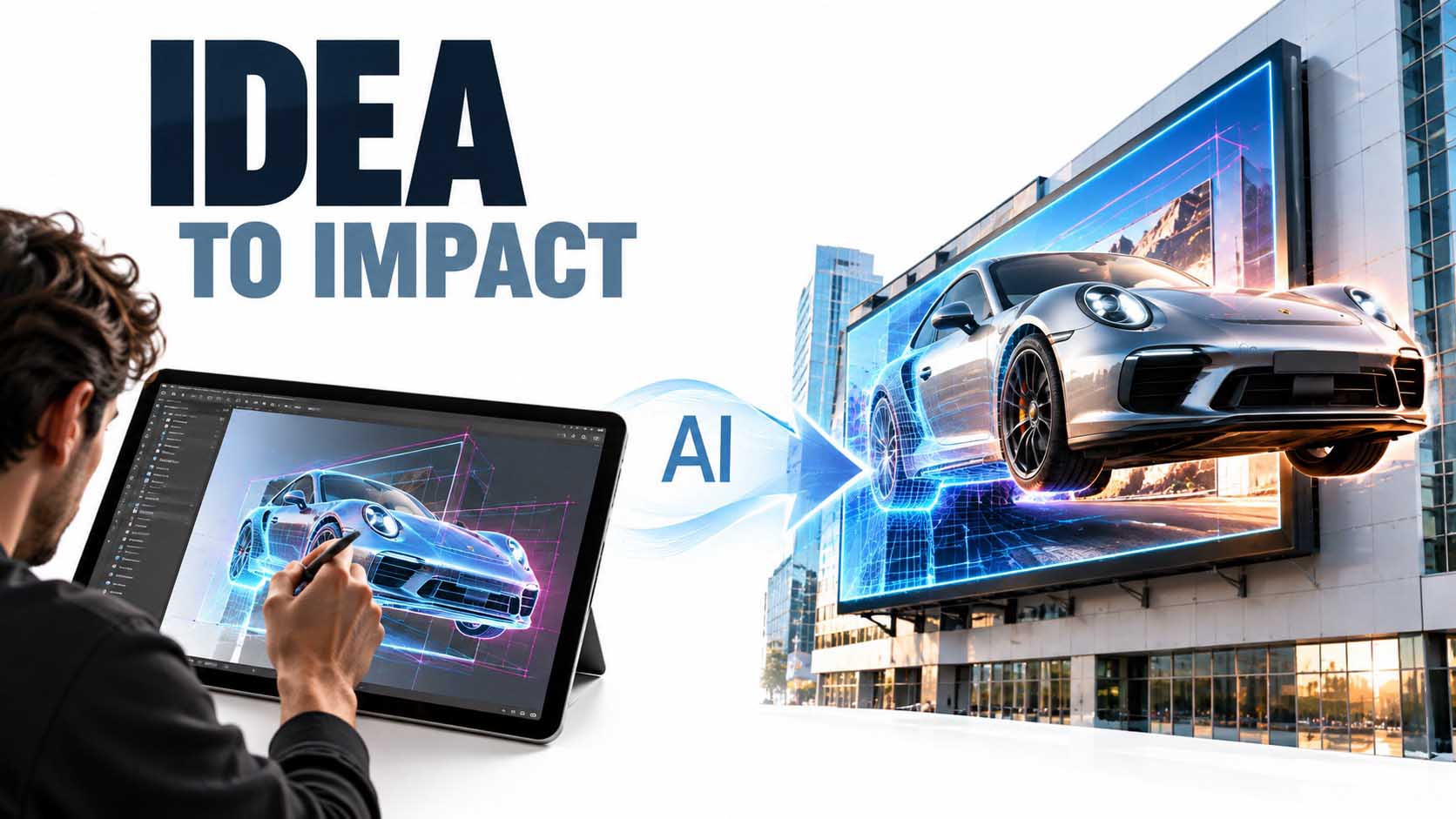
From tablet sketch to billboard, idea and impact just one step apart.
Visualization: A designer sketches a sports car as a wireframe model on a graphics tablet, next to the label Idea to Impact. An AI icon connects the sketch to the finished result, a photorealistic vehicle that appears to drive out of a huge billboard integrated into a building facade, with a visible transition from wireframe to fully rendered car | Image: © Ulrich Buckenlei | XR Stager Online Magazine | VISORIC GmbH
What’s notable is that neither brand kept up the illusion for long. Both publicly confirmed it was computer-generated imagery, without reach suffering, if anything the reveal itself became part of the viral story.[1]
- Jacquemus’ handbag video reached nearly 49 million views.
- Maybelline’s campaign generated over 23 million US dollars in earned media.
- A single physical ad space often costs a five-figure sum on its own.
- FOOH tests the idea before anything is actually built.
- The later reveal as CGI didn’t diminish the reach.
These impressive numbers immediately raise the obvious question of how such an illusion is technically created in the first place, and what it actually takes. That’s exactly what the next chapter covers.
How an impossible installation is made
For a virtual object to look completely convincing in real footage, it takes a precise technical choreography of several steps that nobody notices individually in the finished video.
It starts with real, camera-tracked footage from the actual location, a street, a subway station, a billboard. Specialized software calculates the exact camera movement and perspective of the shot, pixel by pixel. Only then is the actual 3D object, the handbag, the mascara wand, a fully animated vehicle, placed into that calculated perspective, with lighting, shadows, and reflections that match the real environment exactly.[1] Depending on the concept, the technical effort varies considerably: a single, static 3D object can be composited relatively quickly, while a complex, multi-part choreography of several animated elements demands a noticeably more elaborate production.
This technique is explicitly not generative AI in the sense of image generators that produce finished scenes at the push of a button. Industry professionals describe it as handcrafted CGI, every frame is individually modeled, animated, and composited into the real footage by experienced 3D artists, a process that takes days to weeks depending on complexity.[1] Artificial intelligence is used today mainly in a supporting role, for instance to optimize motion sequences or simulate in advance how an audience might react to a scene.
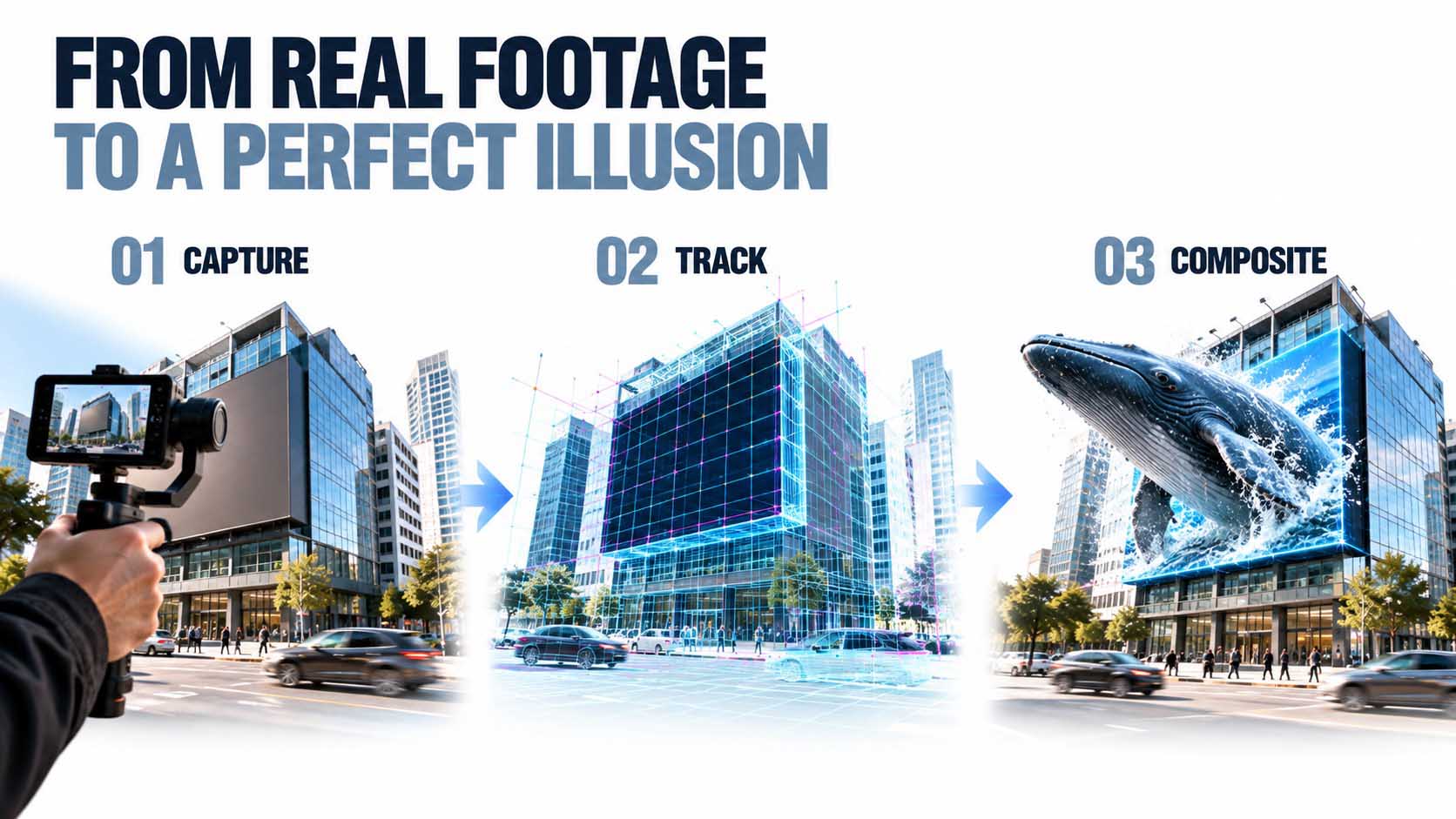
From real footage to perfect illusion, in three steps.
Infographic: Technical production process of a FOOH installation from raw footage to the finished composite | Graphic: © Ulrich Buckenlei | XR Stager Online Magazine | VISORIC GmbH
For clients, this brings a decisive advantage over a real installation: every detail, the object’s size, the time of day, the camera angle, the music, can be changed as often as needed before a single euro flows into final production, a degree of freedom no physical construction site could ever offer.
- Camera tracking calculates the perspective and motion of the real footage.
- 3D objects are inserted with matching light and shadow.
- This is handcrafted CGI, not generative AI.
- Production takes days to weeks depending on complexity.
- Every detail can be adjusted freely before the final version.
This technical freedom immediately raises the next, far more practical question: what happens when a company actually tries to build such a virtual idea physically? That’s exactly where the real limits of the technology show up.
When virtual is supposed to become real
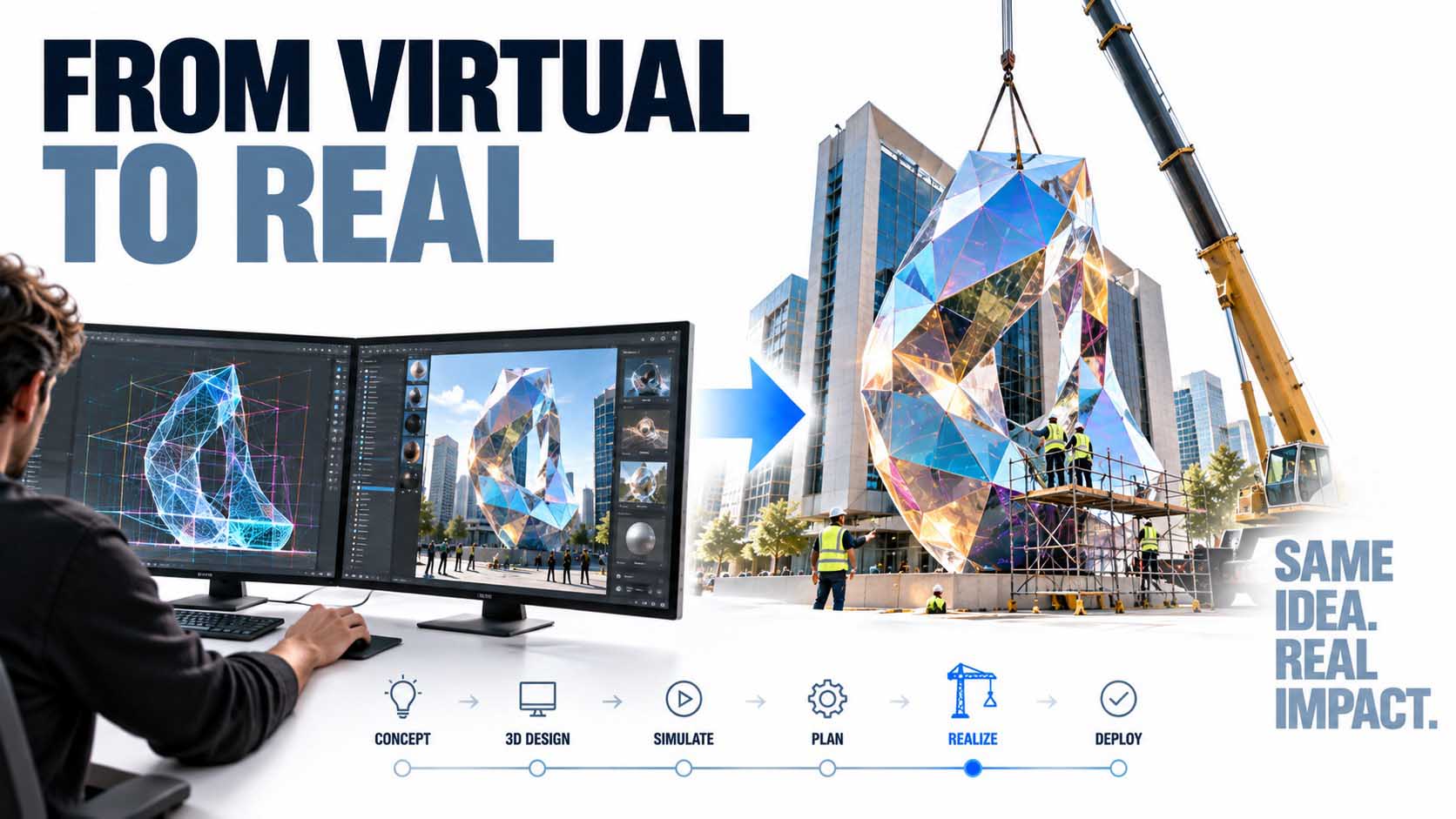
Staging a virtual illusion convincingly is one thing, actually getting the same idea off the ground as an engineer is something else entirely. This is exactly where the line between marketing spectacle and physical feasibility becomes visible.
A look at the concrete technical reference makes this tangible: Festo’s BionicFlyingFox, a research robot modeled on a flying fox bat, achieves a wingspan of 2.28 meters at a weight of just 580 grams, an impressive result of years of development work. Yet even this highly advanced robot flies only as a single unit in controlled, monitored airspace, tracked by ground cameras, not as a coordinated swarm over an open, publicly used highway.[5] A synchronously flapping swarm of hundreds of units over real traffic thus remains, as of today, pure technical fiction.
What is already industrial reality, however, are precisely positioned formations of simpler, coordinated multicopter drones. In February 2026, Chinese company EHang had exactly 22,580 drones controlled simultaneously from a single computer, setting an official Guinness World Record, verified by independent record adjudicators.[6] Of the fleet originally prepared, only around 20 drones failed to take off, a remarkably low failure rate given the sheer scale.[7]
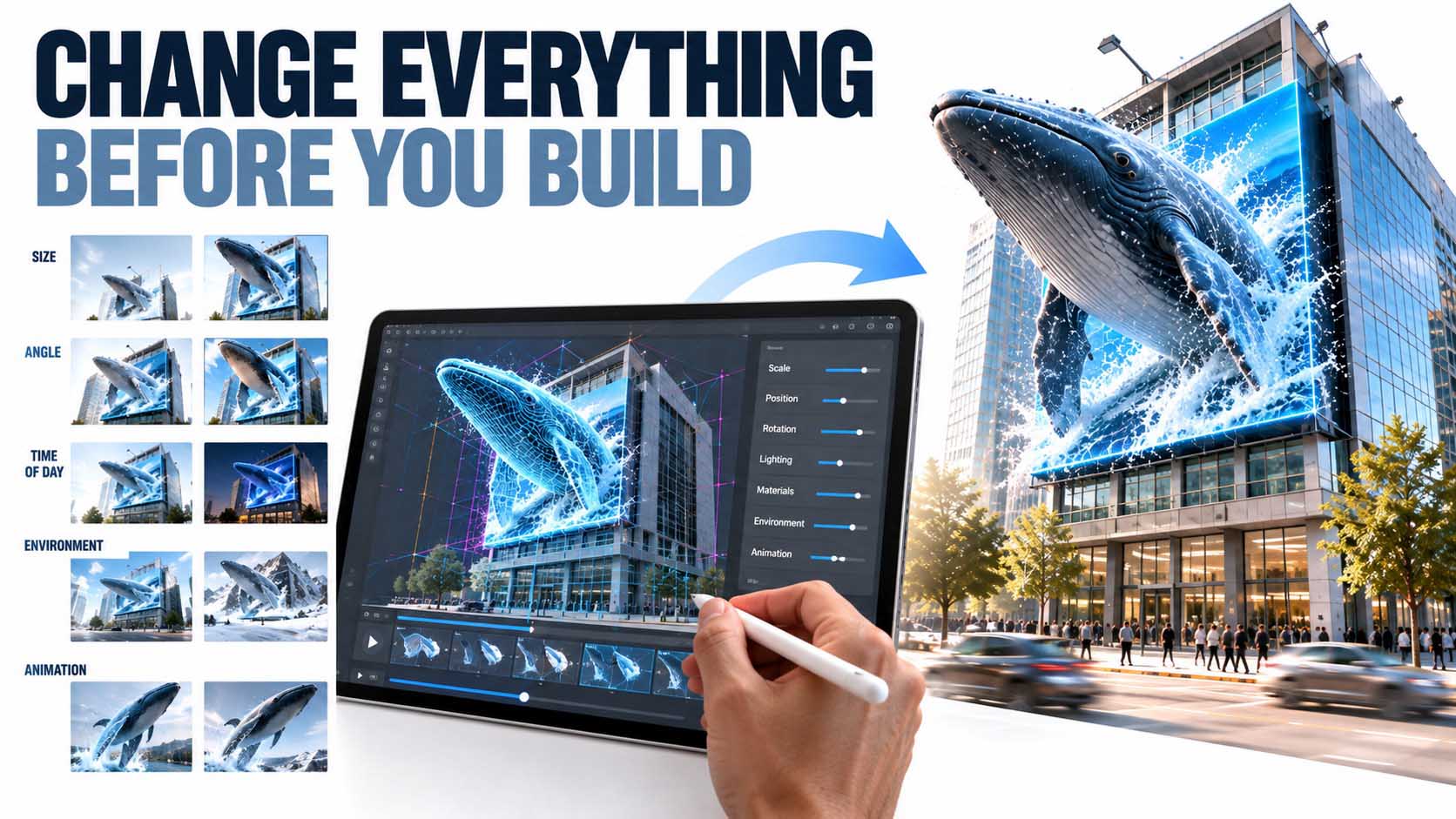
Size, angle, time of day, environment, animation, all changeable before a euro is spent.
Visualization: A comparison grid panel titled Change Everything Before You Build shows five parameters, Size, Angle, Time of Day, Environment, and Animation, each in two variants applied to a whale motif on a building facade. Next to it a tablet with a wireframe design and sliders for Scale, Position, Rotation, Lighting, Materials, Environment, and Animation, on the right the finished, photorealistic result, a whale that appears to leap out of a huge facade screen in the middle of a city street | Image: © Ulrich Buckenlei | XR Stager Online Magazine | VISORIC GmbH
The decisive difference between these two examples lies not in creativity but in physical complexity. Rigid, pre-programmed light-point formations like EHang’s can already be coordinated reliably at large scale. A biomechanically flapping, organically moving swarm like the CGI bat-swarm concept, by contrast, demands a level of aerodynamic and regulatory complexity that currently remains far beyond what’s technically feasible.
- Festo’s BionicFlyingFox only flies solo in controlled airspace.
- A swarm over open traffic remains technical fiction.
- EHang coordinated 22,580 real drones simultaneously in February 2026.
- Only about 20 units of the prepared fleet failed to launch.
- Rigid formations are feasible, organic swarms are not, yet.
This reality check, though, is no reason to dismiss the principle, quite the opposite. It shows exactly where virtual testing is most valuable, precisely where physical execution is expensive, risky, or simply not yet possible. How that value can be quantified economically is the subject of the next chapter.
The economics of virtual prototyping
What looks like a viral side effect in FOOH campaigns can be expressed in solid business metrics once you widen the view from advertising to product development as a whole.
According to McKinsey analyses, digital twins cut product development times by 20 to 50 percent, while current 2026 industry data shows that 92 percent of companies using such virtual pre-tests achieve a return on investment above 10 percent.[8] Virtual prototyping, according to vendor data, reduces the number of physical test samples needed by three to five times, while cutting development costs by up to 50 percent and shortening time to market by 30 percent.[9]
A concrete example from the consumer goods industry makes this tangible: a coffee company cut its packaging waste by 40 percent by fully simulating and optimizing a new, paper-based capsule design virtually before producing a single physical unit.[10] This exact principle, iterating digitally instead of building and discarding physically, is what FOOH campaigns demonstrate on a small scale and industrial digital twins implement at large scale.
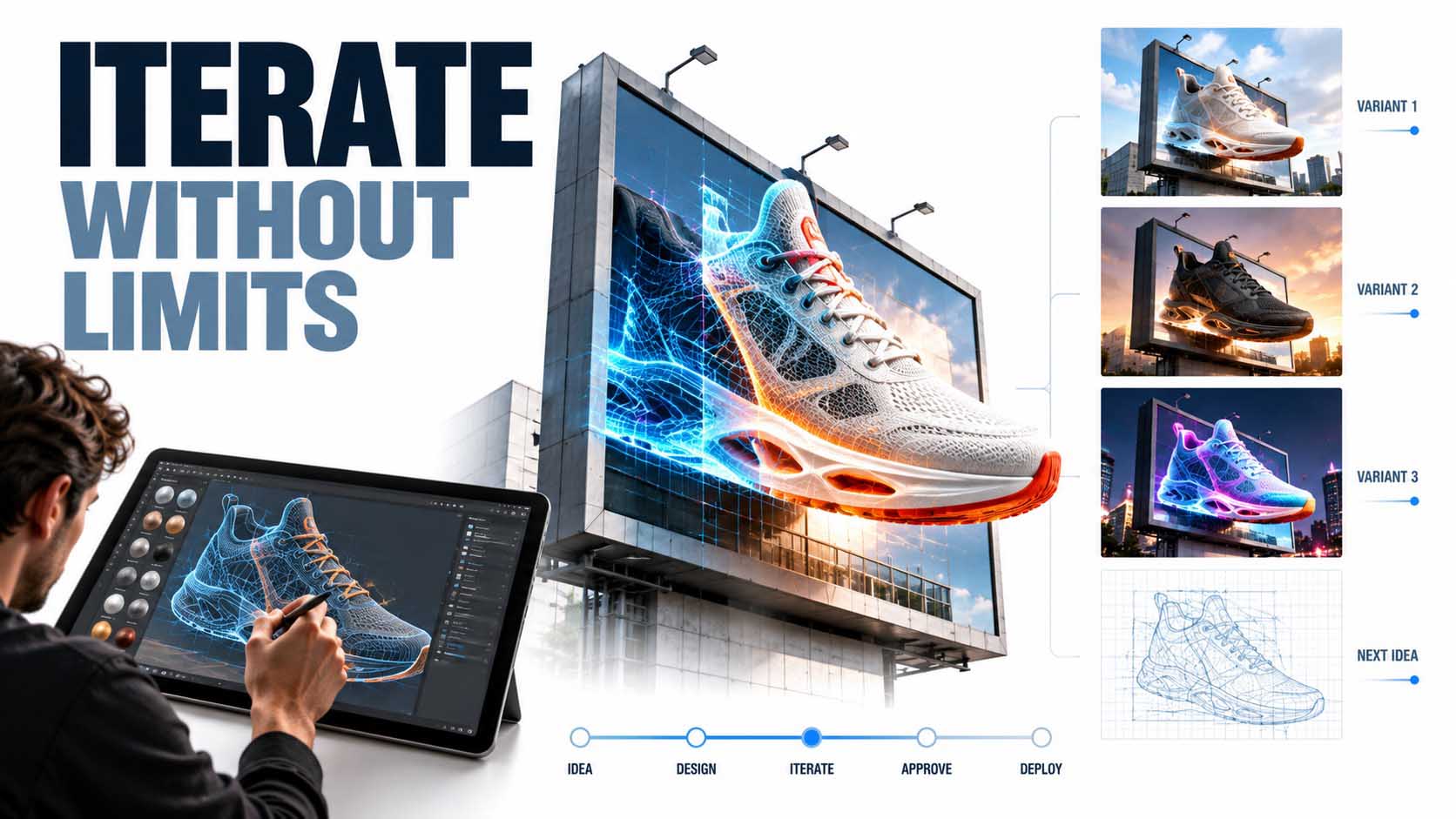
Five times fewer physical prototypes, half the development time.
Visualization: A designer sketches a sneaker as a wireframe model on a graphics tablet, next to the label Iterate Without Limits. In the middle, the sketch merges into the finished, photorealistic shoe on a large billboard, on the right three finished color variants plus a field for the next idea. At the bottom a process bar with the stages Idea, Design, Iterate, Approve, and Deploy | Graphic: © Ulrich Buckenlei | XR Stager Online Magazine | VISORIC GmbH
This makes it visible that FOOH and industrial virtual prototyping, while technically different tools, follow the same underlying economic principle: an error caught virtually costs almost nothing. The same error, caught only after physical construction, costs many times more.
- Digital twins shorten development times by 20 to 50 percent.
- 92 percent of users achieve a return above 10 percent.
- Virtual prototyping saves up to 50 percent of development costs.
- One example saved 40 percent packaging waste through virtual testing.
- An error caught virtually costs a fraction of a physical one.
These figures deliberately come not from the advertising industry but from manufacturing and consumer goods. That alone shows how far the principle has already moved beyond its origins in marketing. Where else it reaches is the subject of the next chapter.
Where this method goes beyond marketing
Detach the principle from its advertising origins, and an application field emerges that touches practically every major physical investment decision a company makes.
In industrial manufacturing, companies validate entire plant layouts and production lines virtually before a single machine is ordered. A beverage bottler, for instance, used a highly precise, AI-driven digital twin of its filling process to simulate every drop and every turbulence in the plant, cutting commissioning time for new plant configurations by 30 to 50 percent.[11] B2B showrooms and trade show appearances, a field VISORIC itself has worked in for years, can today be fully rehearsed virtually as well, from visitor flow to lighting mood, before a single component of the real booth is fabricated.
Even in urban planning and public infrastructure, the same principle holds: visualization first decides the basic direction of a project, artificial intelligence then helps optimize the experience for later use, and only the actual engineering work determines the final, built version. This sequence, virtual first, real after, repeats across nearly every industry, from an advertising installation on a billboard to an entire factory floor.
One principle, six industries, a shared idea.
Visualization: A person wearing AR glasses stands in front of six floating image tiles titled One Idea. Many Real Opportunities, each tile showing a real city scene with an overlaid, semi-transparent 3D object, a sneaker in retail, a statue in culture, a globe in education, a building model in real estate, the Brandenburg Gate in tourism, and a brand figure on a facade, on the right the label Virtual First. Real Impact | Graphic: © Ulrich Buckenlei | XR Stager Online Magazine | VISORIC GmbH
What all these applications share is a central advantage: capital is committed only after an idea has been validated, not before. For companies with high investment sums and long planning cycles, that is a substantial strategic edge over the classic approach of building first and finding out afterward whether the idea works.
The more industries discover this principle for themselves, the more urgent one critical question becomes: where does legitimate validation end, and where does deliberate deception of the public begin? That’s exactly what the next chapter addresses.
- Industrial plant layouts are fully validated virtually beforehand.
- A bottling plant cut commissioning time by up to 50 percent.
- B2B showrooms can be fully rehearsed virtually before the build.
- Urban planning follows the same order, virtual first, real after.
- Capital is committed only after validation, not before.
This growing range of applications makes the principle economically attractive, but it also makes the question of accountability and transparency more urgent. That’s where the next chapter picks up.
The critical side, deception, regulation, trust
As economically sound as virtual testing is, it inevitably operates close to a line that regulators are now watching very closely, the line between creative illusion and misleading advertising.
Not every brand handles that line the same way. While Maybelline publicly confirmed the CGI origin of its campaign with a wink, British Airways came under fire because an image appeared to show an ad panel at the Glastonbury Festival, a venue where outdoor advertising is actually strictly limited, without it being immediately clear that it was pure computer graphics.[1] Cases like this are exactly what’s now pushing regulators to act.
The legal framework is tightening noticeably in 2026. The US state of New York has legally required advertisers, since June 9, 2026, to visibly disclose the use of AI-generated synthetic performers in ads, with fines of up to 5,000 US dollars per violation.[12] Starting August 2, 2026, Article 50 of the EU AI Act requires that realistic, AI-generated or AI-altered depictions of people, objects, places, or events that falsely appear authentic be clearly labeled in a machine-readable way, a rule that explicitly covers advertising, PR, and corporate communications and applies even to companies outside the EU once their content is shown there.[13] In the US, the Federal Trade Commission is additionally pursuing unfair, misleading AI advertising under existing law, with fines that have recently exceeded 51,000 US dollars per case.[14]
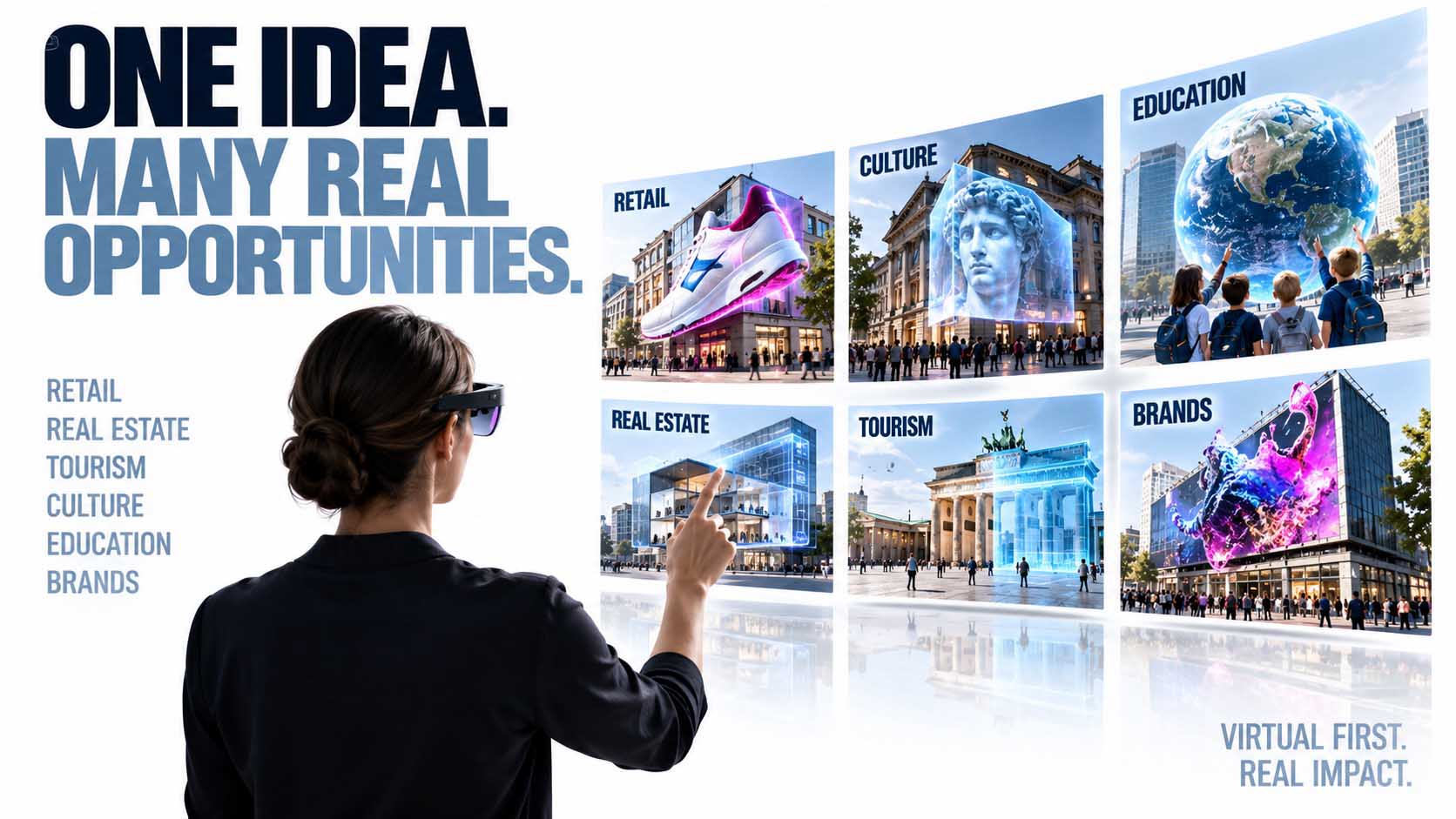
One idea, six industries, one shared principle.
Visualization: A person wearing AR glasses stands in front of six floating image tiles titled One Idea. Many Real Opportunities, each tile showing a real city scene with an overlaid, semi-transparent 3D object, a sneaker in retail, a statue in culture, a globe in education, a building model in real estate, the Brandenburg Gate in tourism, and a brand figure on a facade, on the right the label Virtual First. Real Impact | Graphic: © Ulrich Buckenlei | XR Stager Online Magazine | VISORIC GmbH
For companies, that has a clear practical consequence: anyone using virtual staging as a testing tool or marketing format can barely avoid clear, timely labeling anymore, no matter how convincing the result looks. In the end, that’s exactly what protects the credibility of your own brand.
- Not every brand is equally open about the CGI origin of its content.
- New York has required visible AI labeling in ads since June 2026.
- The EU AI Act requires machine-readable labeling starting August 2026.
- The rule also applies to companies based outside the EU.
- The US FTC is already issuing fines above 51,000 dollars.
Anyone who knows these regulatory guardrails can use virtual testing safely and responsibly, instead of walking into a legal or reputational trap. How companies can put this principle to work concretely and compliantly for their own investment decisions is the subject of the final chapter.
A guide, how companies can use virtual prototyping themselves
Zoom out from the individual examples, and a clear, repeatable process emerges that any company, regardless of industry, can apply to its own next major investment.
The first step is an honest choice of test subject: virtual prototyping pays off most where a physical build would be expensive, slow, or risky, a new trade show booth, a production line, a packaging change, an advertising installation. The second step is choosing the right technique, from handcrafted CGI compositing for one-off campaign visuals to a full, data-driven digital twin for recurring operational decisions. The third step is planning labeling requirements from Chapter 7 in early, not as an afterthought but from the start of the concept.
The fourth step is defining clear success criteria before the test, not after, such as a minimum reach, a maximum error rate, or a concrete cost threshold above which physical execution is actually worthwhile. The fifth and final step is the deliberate decision of what follows the virtual test, often not the full physical build, but a reduced, specifically adapted version that carries over exactly what proved effective virtually.
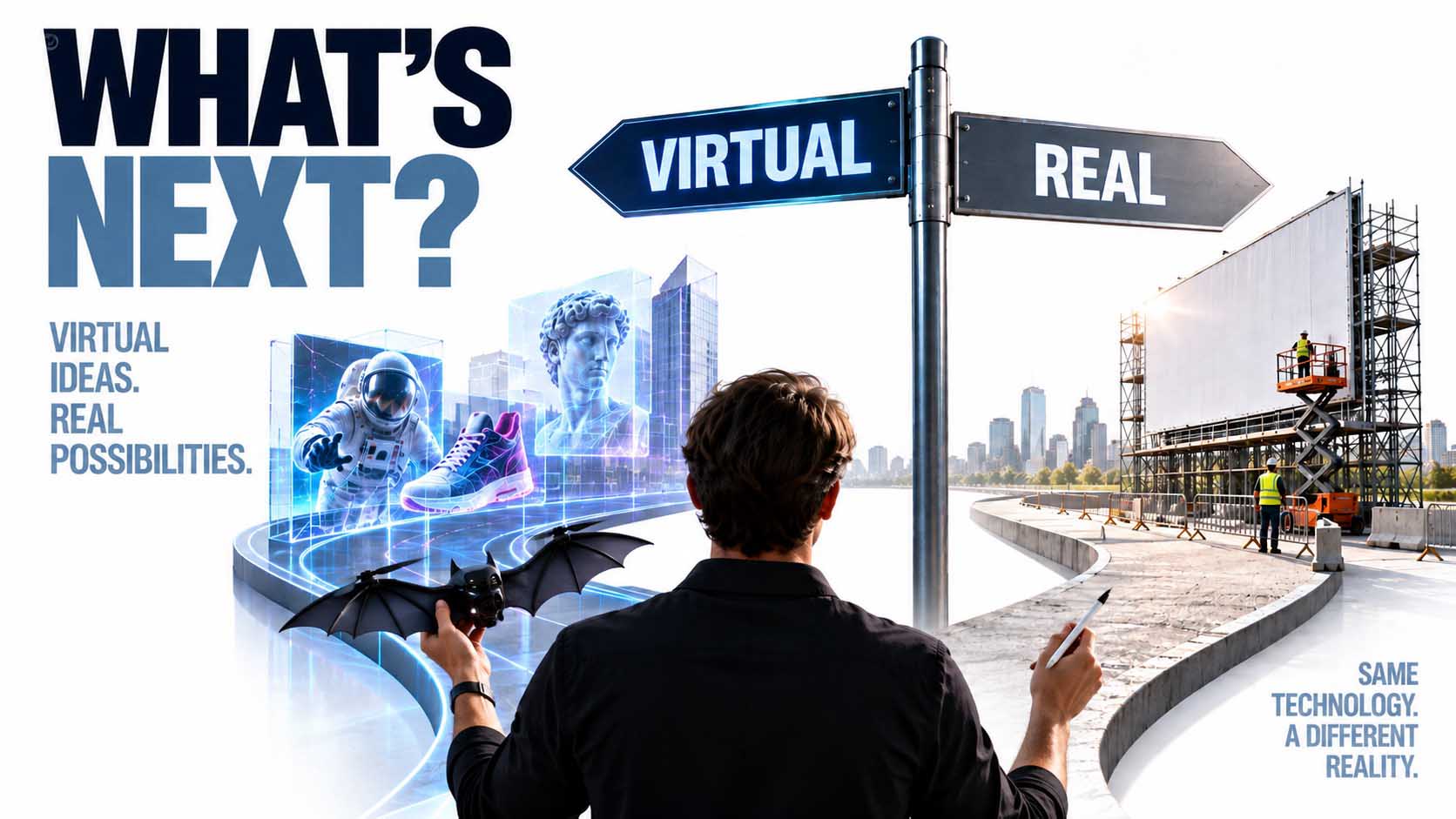
Deciding virtual or real doesn’t happen at the drawing board, it happens in your head.
Visualization: A person stands at a signpost labeled Virtual and Real, holding several floating, semi-transparent 3D objects in one hand and a small physical model in the other. The left path leads to a virtual idea scene labeled Virtual Ideas. Real Possibilities, the right path to a real construction site with a billboard under construction, on the right the label Same Technology. A Different Reality, above it the question What’s Next | Graphic: © Ulrich Buckenlei | XR Stager Online Magazine | VISORIC GmbH
Companies that follow this process consistently push the point of greatest financial commitment noticeably later, right to where the idea has already been solidly validated, instead of into the earliest, most uncertain phase of a project.
- Testing pays off most where the physical version is expensive or risky.
- Technique choice ranges from CGI compositing to a full digital twin.
- Labeling requirements belong in the concept from the very start.
- Success criteria should be set before the test, not after.
- The test often leads to a reduced, specifically adapted build.
This exact principle, test virtually first, then build real in a targeted way, is also what underlies the video that originally sparked this article.
When a logo made of bats rises above the highway
The chapters so far have shown how an impossible installation is technically created, where the physical limits of execution lie, what economic value virtual testing offers beyond advertising, and what companies need to watch for around regulation and labeling. How convincing this principle already is in practice shows most vividly in a direct look at the video that sparked this article.
Embedded here is the original video by digital artist @chakliart, a CGI concept created for Batman Day, in which hundreds of virtual bats rise above a real highway and assemble into a glowing logo.[15] Technically, the concept draws on two real reference points, Festo’s BionicFlyingFox as proof of feasibility for individual, biomechanical flying objects, and EHang’s drone world record as evidence of what coordinated swarm technology can already achieve in real flight today.
This moment, a logo that exists only on camera and yet feels like a physical installation, sums up in one glance what the previous chapters explained technically and economically: virtual anticipation can today be more convincing, cheaper, and faster than any physical execution, as long as it stays clear where the illusion ends and real feasibility begins.
Video: Batman Day CGI concept with a virtual bat swarm above a highway | Original CGI concept: @chakliart, Batman and related elements © DC | Technical references: Festo BionicFlyingFox, EHang drone record | Commentary and analysis: Ulrich Buckenlei | XR Stager Online Magazine | VISORIC GmbH
The video makes clear that virtual prototyping is not some distant future concept, it already works today with handcrafted CGI technique, long before any physical version exists. For companies thinking about their own virtual validation of their next investment, this example shows just how convincing such anticipation can already look today.
At the same time, the video makes visible the key caveat from Chapter 4: a single, convincing CGI clip proves that an idea works, it does not prove that it can actually be built in that form. That exact distinction separates smart virtual validation from mere illusion.
- The video shows the original CGI concept by @chakliart for Batman Day.
- Hundreds of virtual bats form a logo above a real highway.
- Festo’s BionicFlyingFox and EHang serve as technical reality checks.
- The illusion is convincing even though nothing physically exists.
- A demo clip proves the impact, not automatically the buildability.
This example makes tangible where virtual prototyping is heading, from a single, viral campaign clip to a fixed part of every major corporate investment decision.
From virtual idea to your own investment decision
A solid decision on whether an investment is worthwhile doesn’t come from a single viral clip, but from the thoughtful interplay of realistic 3D visualization, clean economic calculation, and a clearly scoped virtual test run, exactly the combination at the core of VISORIC’s work.
The expert team at VISORIC GmbH in Munich combines over 15 years of experience in 3D, AI, and spatial computing with practical experience visualizing industrial investment decisions, exactly the building blocks that also matter for your own virtual prototyping, whether it’s a trade show booth, a production facility, or an entire product launch. VISORIC helps companies fully validate an idea virtually before capital flows into physical execution.
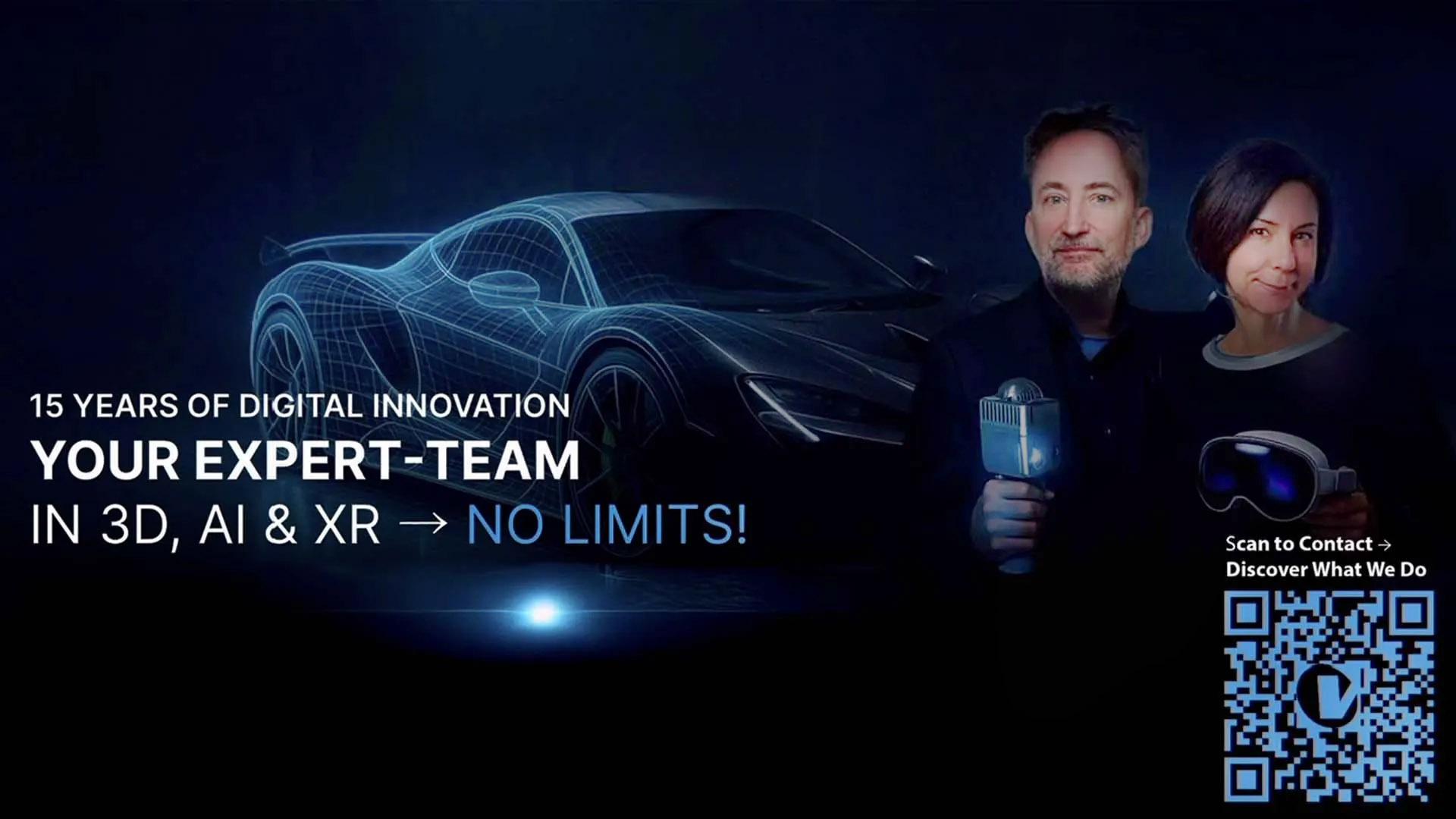
15 years of experience in 3D, AI, and XR, the VISORIC expert team from Munich.
Image: © Ulrich Buckenlei | XR Stager Online Magazine | VISORIC GmbH
A well-thought-out virtual test run, a single product, a single trade show appearance, a single plant configuration, can often be realized much faster and more cost-effectively than many companies expect. VISORIC accompanies this path from the first concept idea through realistic visualization to a solid decision brief for management.
- Virtual validation of campaigns, facilities, and investment decisions.
- 3D visualization with AI-supported impact optimization.
- From the first idea to a solid, virtually tested decision brief.
That’s exactly where a conversation should start: not with the big, company-wide vision, but with a clearly scoped, quickly achievable first virtual test that shows whether an idea is actually worth the physical investment.
Which impossible installation would you test virtually first?
Talk to the VISORIC expert team in Munich about 3D visualization, virtual prototyping, and digital twins. Together, we’ll turn your idea into a precise, virtually tested decision basis, before you invest a single cent in physical execution.
Contact:
Email: info@visoric.com
Phone: +49 89 21552678
Sources and references
- Marketing Brew. Why some brands are embracing ‘fake out-of-home’.
- madcgi.com. What Is FOOH Advertising and Why Every Brand Needs It in 2026.
- Campaign Asia. Fake OOH ads have the power to amaze but we must proceed with caution.
- Digiday. What Maybelline’s ‘faux OOH’ ads say about the future of advertising in augmented reality.
- Festo. Official technical specifications for the BionicFlyingFox, festo.com.
- EHang Holdings. EHang Dazzle at China’s Spring Festival Gala, Setting New Guinness World Record with 22,580 UAVs, February 2026.
- UAS Vision / Guinness World Records. Record-Breaking Drone Show, official record confirmation.
- framesixty.com, Azilen 2026 Cost Guide. Digital Twin Product Development, Cost & Build Guide.
- warpdriven.ai. How AI Design Cuts Sample Costs With Virtual Prototyping.
- PlasticsToday / Dassault Systèmes. Virtual Testing Replaces Year-Long Prototyping in Packaging.
- SoftServe. How Digital Twins Reduce Cost & Downtime for Manufacturers, Krones case study.
- Governor Kathy Hochul / billo.app. New York Synthetic Performer Law, in effect since June 9, 2026.
- Davis+Gilbert LLP. EU AI Act Guidance Expands AI Disclosure Rules for Advertisers and PR Teams.
- allaboutadvertisinglaw.com, thestacc.com. FTC enforcement against misleading AI advertising under Section 5.
- Original CGI concept: @chakliart, Batman and related elements © DC. Commentary and analysis: Ulrich Buckenlei.
- VISORIC practical projects in 3D visualization, digital twins, and virtual prototyping.
- XR Stager platform for real-time 3D, digital twins, and industrial spatial computing applications.
Contact Persons:
Ulrich Buckenlei (Creative Director)
Mobile: +49 152 53532871
Email: ulrich.buckenlei@visoric.com
Nataliya Daniltseva (Project Manager)
Mobile: +49 176 72805705
Email: nataliya.daniltseva@visoric.com
Address:
VISORIC GmbH
Bayerstraße 13
D-80335 Munich