

Intelligent Simulation Is Transforming Product Development
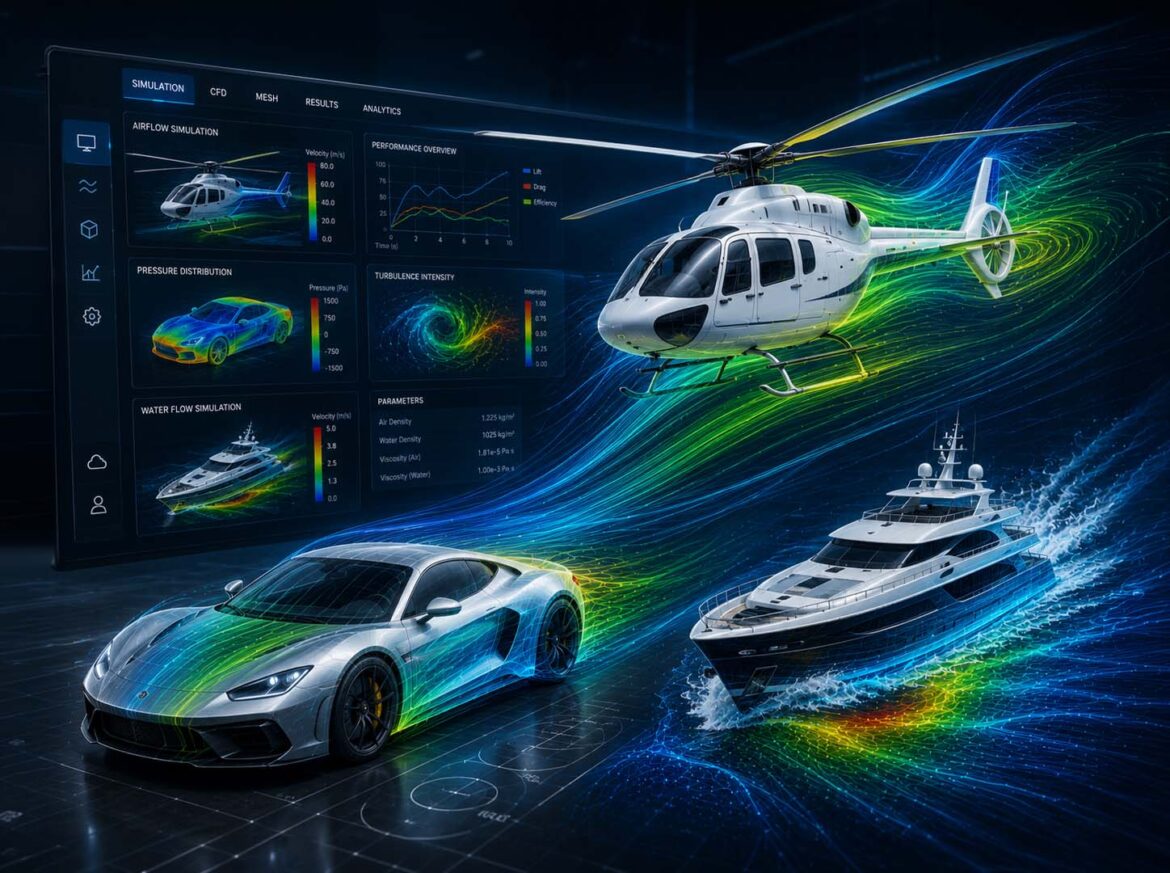
Visualization: AI combines simulation, digital twins, and engineering into an intelligent decision-making platform for the next generation of product development | Image: © Ulrich Buckenlei | VISORIC GmbH
Why are some products developed faster, more efficiently, and with significantly less engineering effort than others? Today, the answer increasingly lies not only in better engineers or more powerful computers. The real transformation begins where artificial intelligence, physics-based simulation, and digital twins converge into a unified engineering platform.[1]
For decades, simulations primarily served to validate existing designs. Engineers developed a product, simulated individual characteristics, and optimized the design step by step. Modern AI fundamentally changes this process. Instead of analyzing only a handful of design alternatives, thousands—or even millions—of possible solutions can now be evaluated before the first physical prototype is built.[2]
The title image of this article illustrates exactly this transformation. Digital twins, artificial intelligence, simulation, and engineering merge into a unified digital ecosystem. Products, machines, and entire systems are no longer developed as isolated entities but as connected information models whose behavior can already be predicted within a virtual environment.
As a result, not only does product development become faster, but engineering decisions become more reliable, development cycles become shorter, and innovation can progress much more rapidly. AI does not replace engineers. Instead, it expands their capabilities by enabling them to evaluate significantly more design alternatives and make better decisions based on physics-driven simulations.[2]
- AI evaluates thousands of design alternatives within minutes.
- Simulation evolves into an intelligent decision-making system.
- Digital twins connect development, testing, and operation.
- Physical prototypes are required much later in the development process.
- Better engineering decisions are made in the virtual environment.
Simulation is therefore evolving from a traditional computational tool into a strategic competitive advantage for companies.
Why Intelligent Simulation Becomes a Competitive Advantage
Simulation has been one of the most important tools in modern product development for decades. Computational Fluid Dynamics (CFD), structural mechanics, thermodynamics, and multiphysics simulations help engineers optimize products before they are built. Yet the primary bottleneck has rarely been computational performance—it has been the limited number of design alternatives that could realistically be evaluated. Every additional simulation required more time and restricted the available innovation space.[3]
This is precisely where artificial intelligence changes the rules. Modern engineering platforms can automatically prepare, compare, evaluate, and prioritize simulations. Instead of optimizing only a handful of concepts, thousands of digital design variants can be generated and automatically ranked according to their potential. Engineers gain not only speed but, more importantly, a dramatically broader foundation for making informed decisions.[4]
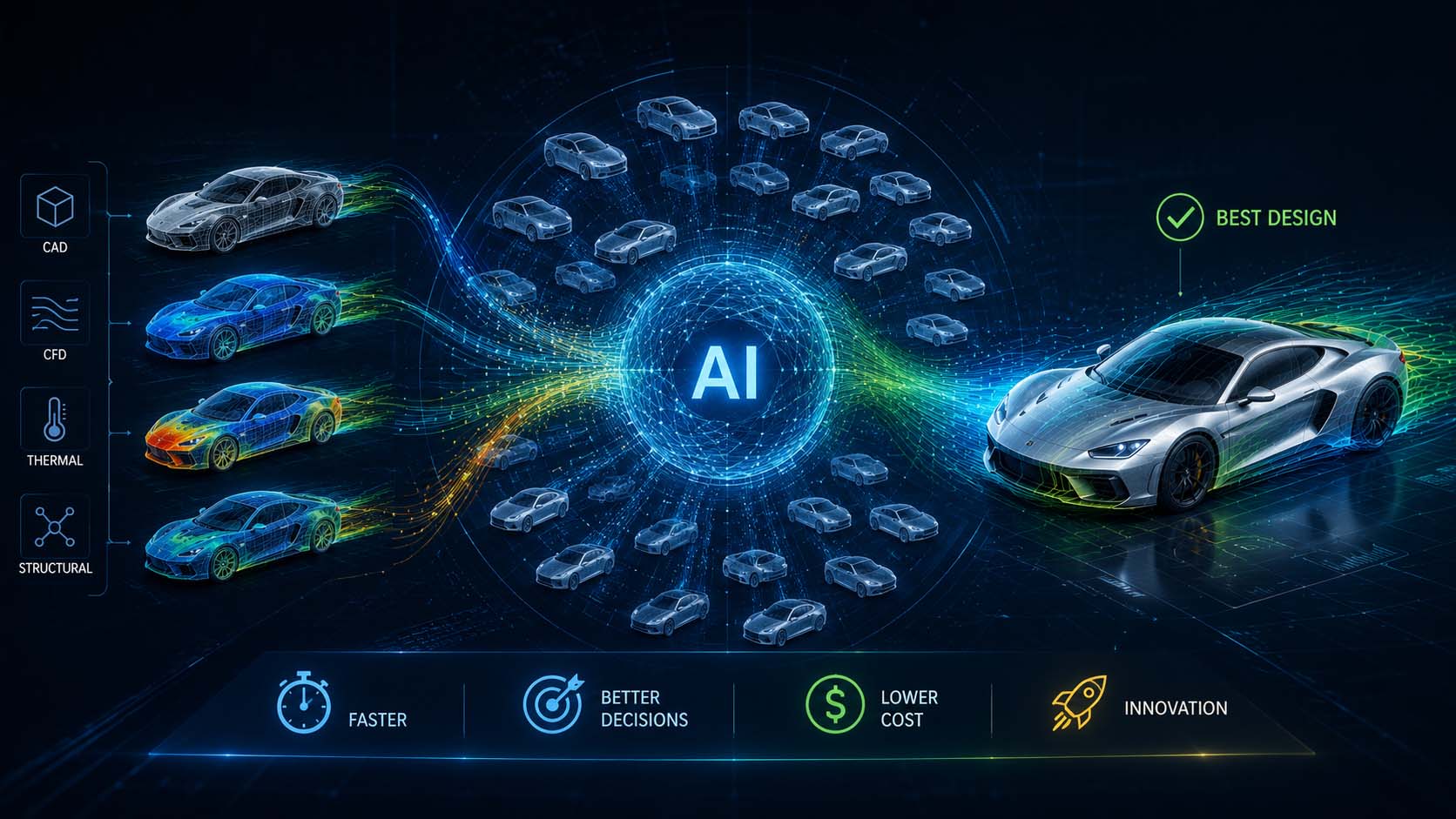
AI analyzes thousands of simulations and supports engineers in selecting the optimal solution.
Visualization: AI-powered simulation combines CAD, CFD, thermal analysis, and structural simulation into an intelligent engineering decision platform | Image: © Ulrich Buckenlei | VISORIC GmbH
This development became particularly evident at CES 2026. Siemens and NVIDIA demonstrated how artificial intelligence, digital twins, and accelerated simulation are increasingly merging into a unified engineering infrastructure. The objective is not to automate human decision-making but to support it with significantly more physics-based knowledge in a much shorter time.
This evolution creates entirely new opportunities for manufacturing, mechanical engineering, energy, mobility, and aerospace. Simulation is no longer viewed as an isolated development step but as a continuous component of the entire product lifecycle—from the initial concept to the operation of the physical product.
- More simulations lead to better engineering decisions.
- AI accelerates engineering instead of replacing engineers.
- Digital twins connect product development and operations.
- Development time and the need for physical prototypes are significantly reduced.
- Simulation is becoming a strategic competitive advantage.
At this point, the next stage of engineering begins: simulation will no longer merely evaluate products—it will become the foundation for intelligent, data-driven engineering decisions.
Why Intelligent Simulation Becomes a Competitive Advantage
Products are no longer simply designed—they are increasingly developed, tested, and optimized virtually before the first physical prototype even exists. Modern simulation technologies make it possible to realistically model fluid flow, temperatures, material stresses, vibrations, and countless other physical phenomena during development. This allows engineers to identify problems earlier, compare design alternatives more efficiently, and significantly shorten development cycles.[5]
With the growing adoption of artificial intelligence, this process is undergoing a fundamental transformation. While engineers previously prepared and evaluated individual simulation runs manually, modern AI-powered systems can automatically generate, analyze, and compare thousands of design variants. As a result, the focus shifts from pure numerical computation toward intelligent engineering decision support.[6]
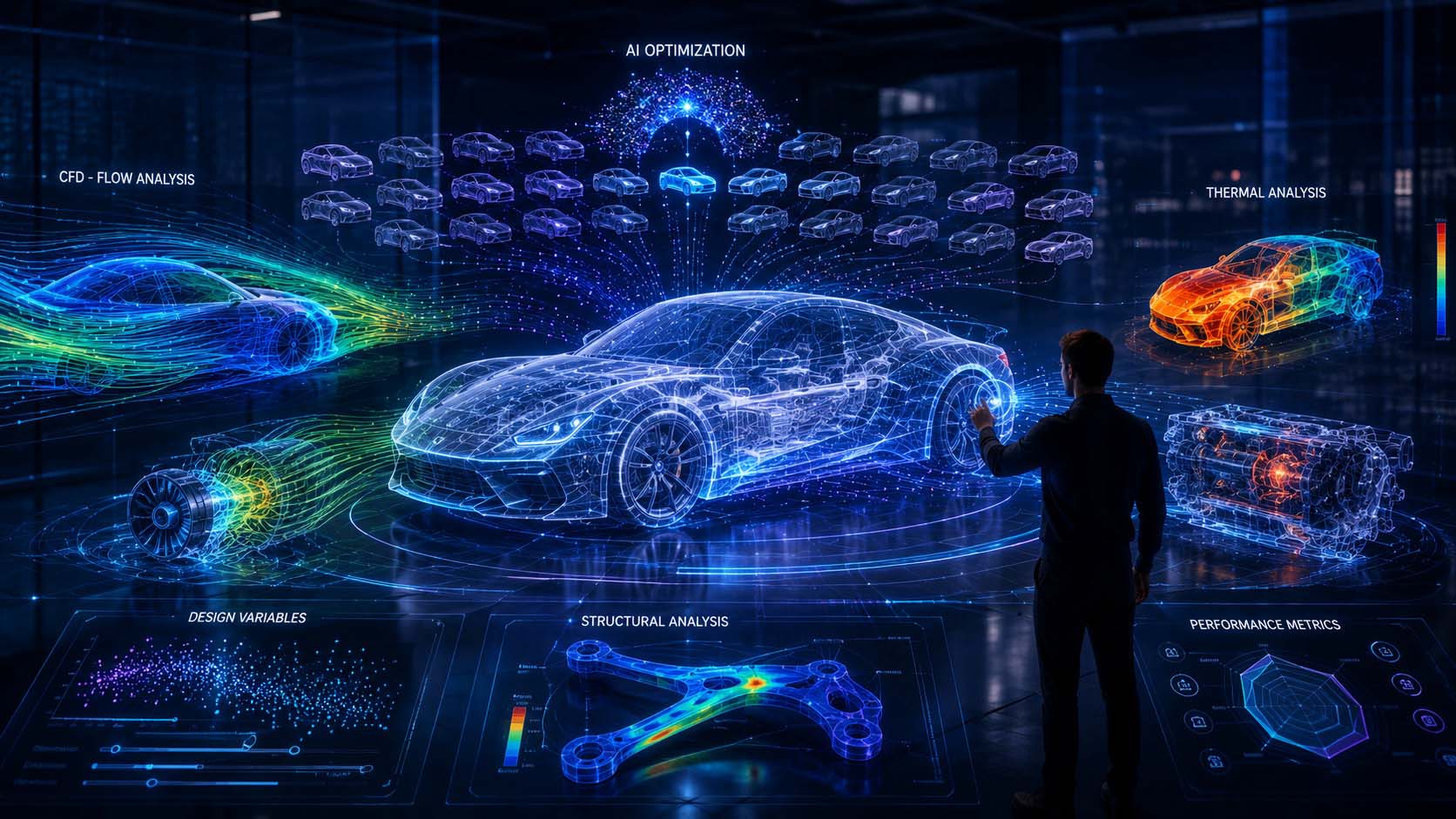
Intelligent simulation combines digital twins, multiphysics simulation, and artificial intelligence into a unified engineering platform.
Visualization: Digital twin, Computational Fluid Dynamics (CFD), structural analysis, thermal simulation, simulation-driven product development, and AI-based optimization | Image: © Ulrich Buckenlei | VISORIC GmbH
The visualization in this chapter illustrates exactly this transformation. At its center is the digital twin of a product undergoing multiple physical simulations simultaneously. Fluid dynamics, thermal distributions, structural stresses, and numerous additional analyses converge within a single digital model. Artificial intelligence automatically evaluates thousands of design alternatives and helps engineers identify optimal solutions far more quickly than conventional engineering workflows.
This combination of simulation, digital twins, and AI is increasingly becoming a strategic competitive advantage. Companies can evaluate significantly more design alternatives, identify engineering risks much earlier, and comprehensively validate products before manufacturing even begins. At the same time, development time, material consumption, and the cost of physical prototypes are substantially reduced.[5]
- Simulation replaces expensive engineering mistakes with early insights.
- AI evaluates thousands of design alternatives within a very short time.
- Digital twins consolidate all physics-based analyses into a single model.
- More design iterations lead to better products and faster decisions.
- Virtual validation reduces development time, costs, and physical prototypes.
Even the most advanced simulation, however, can only answer questions that have already been asked. The next stage of engineering begins where artificial intelligence itself identifies new solution strategies, generates alternative designs, and actively supports engineers in making complex decisions.
How AI Transforms Millions of Simulations into Better Products
The true strength of artificial intelligence is not that it replaces the laws of physics. Its real advantage lies in exploring far more possibilities than traditional simulation processes could ever handle. While engineers previously calculated individual design variants one after another, modern AI models can now analyze, compare, and evaluate millions of potential design combinations. As a result, simulation evolves from a pure computational tool into an intelligent engineering decision platform.[7]
This transformation is particularly evident in aerodynamics. Computational Fluid Dynamics (CFD) is among the most computationally intensive tasks in product development. Even minor changes in geometry, material properties, or component positioning can significantly influence the behavior of a vehicle, aircraft, or turbine. Modern AI models learn from extensive simulation datasets and can identify the most promising design alternatives with remarkable efficiency. Engineers therefore obtain reliable results much faster while evaluating significantly more design options than ever before.[8]
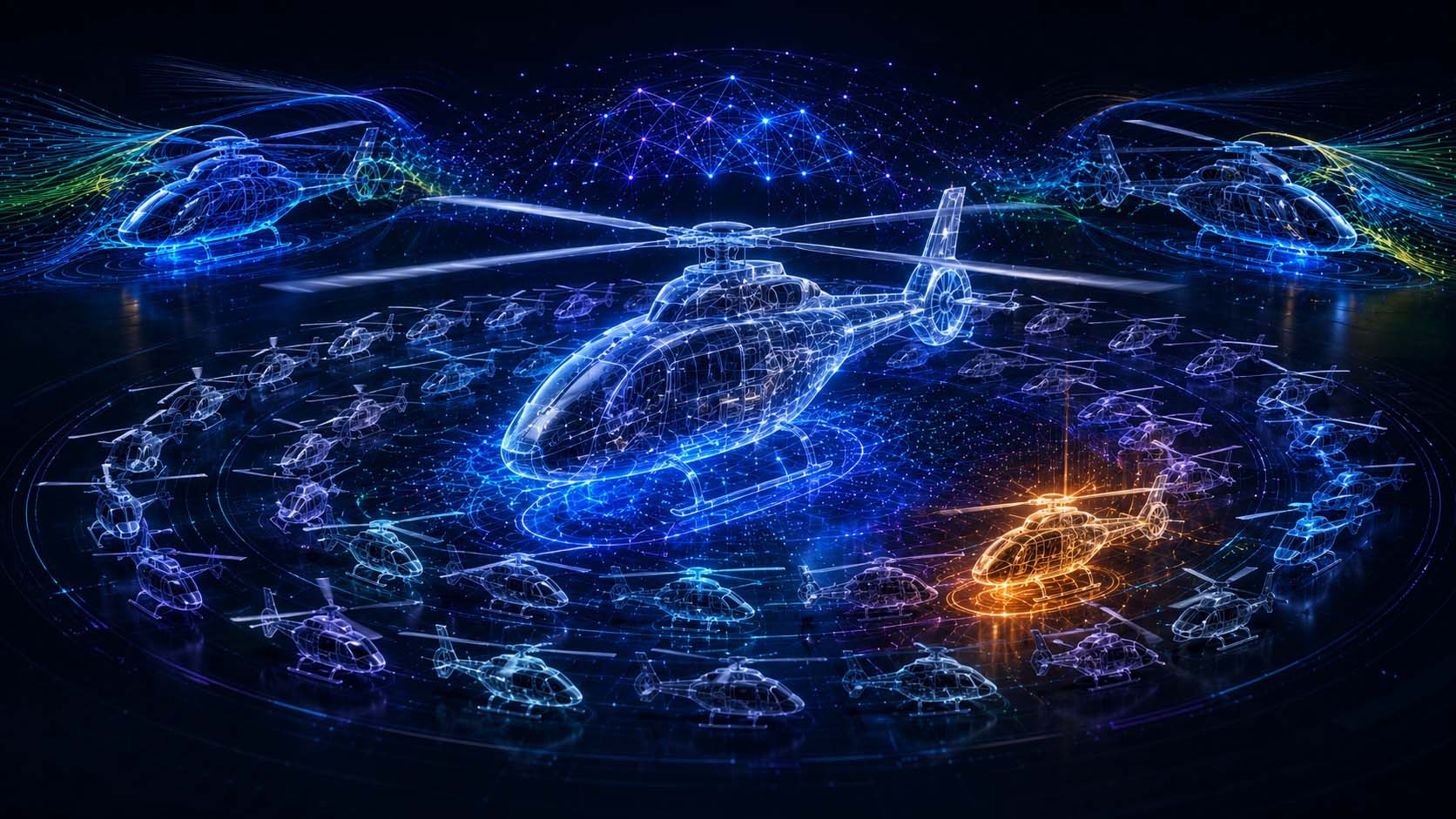
AI analyzes thousands of simulation variants and helps engineers identify better solutions much faster.
Visualization: Generative AI, Digital Twin, CFD, aerodynamics, simulation-driven optimization, and intelligent product development | Image: © Ulrich Buckenlei | VISORIC GmbH
The visualization in this chapter illustrates exactly this process. At its center is a digital twin that is simultaneously simulated across countless design variants. Flow patterns, rotor geometries, and engineering parameters continuously evolve while artificial intelligence evaluates the results and highlights the highest-performing solutions. Instead of optimizing a single design, the process becomes a continuous search for the physically optimal solution.
This also transforms the role of engineers. They spend less time manually preparing individual simulation runs and can focus more on interpreting results and developing innovative ideas. AI replaces neither physics nor engineering expertise—it expands engineers’ capabilities by enabling better decisions based on vastly larger amounts of simulation data.
- AI evaluates thousands to millions of simulation variants.
- CFD analyses are completed significantly faster.
- Digital twins evolve into intelligent optimization platforms.
- More design iterations result in better products and shorter development cycles.
- Engineers make more informed decisions based on physics-driven data.
This development is only the beginning. The next generation of industrial systems will no longer simply evaluate simulations—they will combine them with real-time data and continuously improve through ongoing learning. The result will be intelligent digital twins capable of continuously optimizing products, machines, and entire production environments.
Digital Twins Become Intelligent Decision Systems
Today, AI already accelerates the simulation of complex physical processes. Its true value, however, emerges when simulations are no longer treated as isolated analyses but are directly connected to the digital twin of a product or even an entire production facility. Individual simulation results evolve into an intelligent decision system that continuously links product development, manufacturing, and operations.[9]
Where digital twins once primarily served visualization purposes, they are now evolving into active engineering platforms. Geometry, material properties, sensor data, simulation results, and operational information converge within a unified digital model. This allows products not only to be visualized realistically but also to be analyzed and optimized under real-world operating conditions long before the first physical prototype is built.[10]
The illustration in this chapter demonstrates exactly this transformation. A digital model first evolves into a simulation-driven digital twin that is continuously enhanced through physics-based calculations. AI analyzes countless design alternatives, identifies optimization opportunities, and supports engineers in making better decisions much earlier in the development process. As a result, the digital twin evolves from a static representation into a continuously learning system.
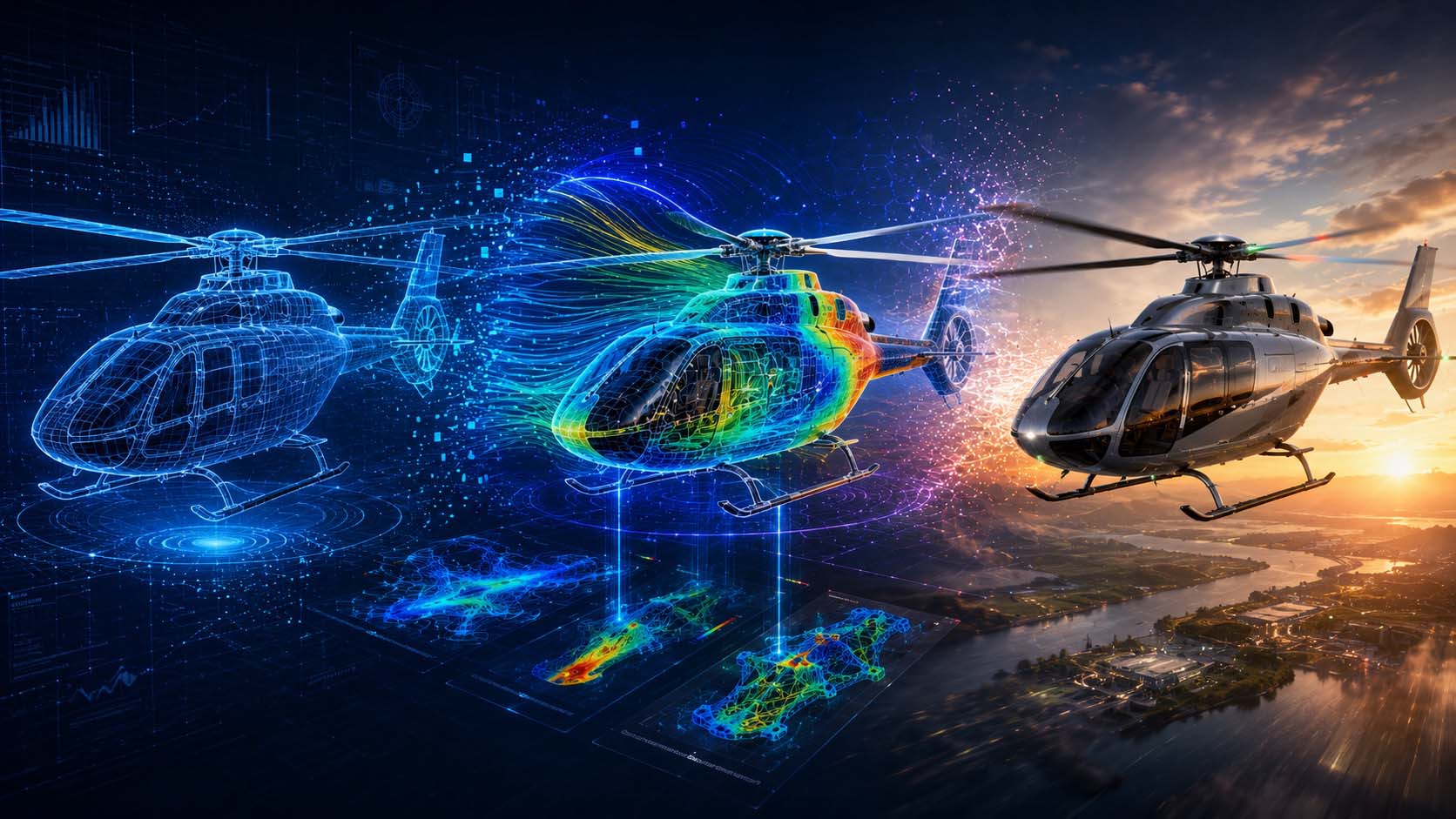
Digital twins combine simulation, AI, and real-time data into intelligent decision systems.
Visualization: Digital twin, AI-powered simulation, engineering, real-time data, and simulation-based decision support | Image: © Ulrich Buckenlei | VISORIC GmbH
This also fundamentally changes the role of simulation. It is no longer limited to validating individual designs but accompanies the entire product lifecycle. Manufacturing processes can be tested virtually during development, production parameters optimized, and future operating conditions predicted with remarkable accuracy. Decisions become faster, more reliable, and increasingly data-driven.[10]
- Digital twins connect engineering, simulation, and real-time data.
- AI analyzes millions of potential product variants.
- Virtual testing significantly reduces the need for physical prototypes.
- Engineering decisions are based on physics-driven simulations rather than assumptions.
- The digital twin accompanies the entire product lifecycle.
The next stage of development goes even further. In the future, digital twins will not only optimize existing products but, together with generative AI, will generate, evaluate, and continuously improve entirely new design concepts. This marks the transition from simulation-driven engineering to intelligent product development.
The Next Generation of Product Development
Artificial intelligence is no longer transforming only individual simulation processes—it is reshaping the entire engineering workflow. What once consisted of many isolated calculations is rapidly evolving into a unified platform where digital twins, physics-based simulations, real-time data, and AI continuously work together. This creates entirely new opportunities to develop products faster, automatically evaluate design alternatives, and make well-informed decisions at a very early stage of development.[11]
This evolution was also one of the central themes at CES 2026. Siemens presented its Industrial AI Operating System together with the Digital Twin Composer, demonstrating how digital twins are evolving into intelligent engineering platforms. NVIDIA simultaneously showcased how accelerated simulation, Physical AI, Omniverse, and CUDA enable millions of physics calculations within an extremely short time. The true innovation lies not in a single technology but in the interaction between them.[12]
The image in this chapter visualizes exactly this next stage of development. At its center is the digital twin of a helicopter. Around the model, fluid dynamics, structural, thermal, acoustic, and real-time simulations are executed simultaneously. All results converge within a central AI system that identifies optimization opportunities, evaluates alternative concepts, and assists engineers throughout the development process. The result is a comprehensive digital engineering platform that seamlessly integrates simulation, analysis, and product development.
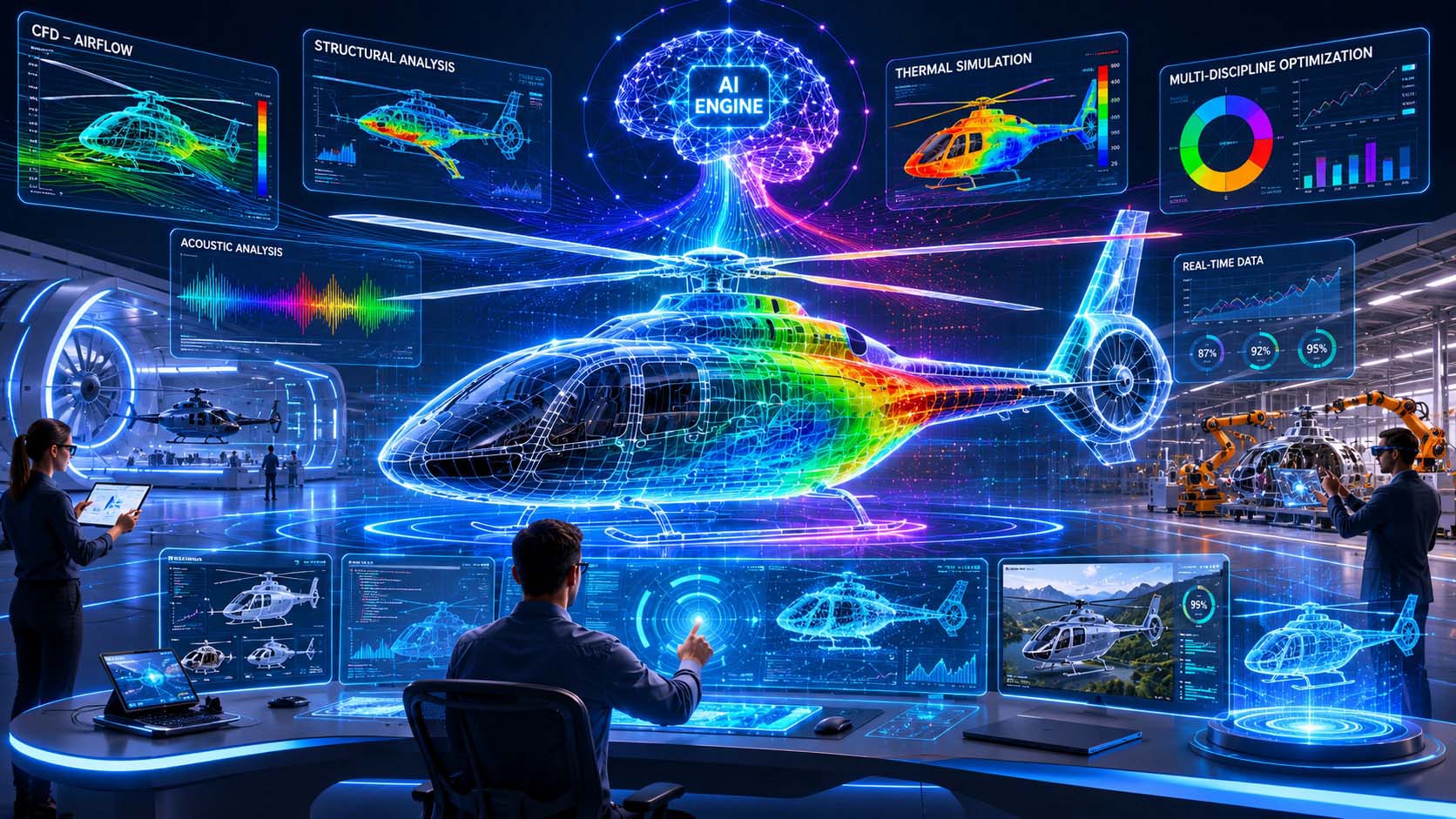
AI connects digital twins, simulations, and engineering into an intelligent development platform.
Visualization: AI-powered engineering platform featuring Digital Twin, CFD, structural, thermal, and real-time simulation for the next generation of product development | Image: © Ulrich Buckenlei | VISORIC GmbH
This also transforms the role of engineers. AI replaces neither physical understanding nor engineering expertise. Instead, it takes over time-consuming calculations, analyzes millions of potential design alternatives, and provides reliable decision support. This gives engineers significantly more time to focus on creativity, innovation, and the development of better products. Simulation evolves from a validation tool into a continuous component of the entire engineering process.[12]
- Digital twins integrate every simulation discipline on a single platform.
- AI evaluates millions of possible design alternatives.
- Simulation accompanies the entire product lifecycle.
- Physics-based calculations are massively accelerated.
- Engineers make better decisions based on reliable, data-driven insights.
This development is only just beginning. In the coming years, AI, digital twins, and Physical AI will no longer simply optimize existing products. They will simulate complete production systems, support autonomous factories, and increasingly dissolve the boundaries between virtual product development and real-world manufacturing.
From Simulation to a Unified Engineering Platform
Simulation delivers its greatest value not in isolation, but when everyone involved can work simultaneously within the same digital environment. This is precisely the direction in which industry is evolving. Design, simulation, manufacturing, quality assurance, and service increasingly collaborate on a shared platform. As a result, the digital twin becomes not only the technical representation of a product but also the common workspace for the entire engineering process.[13]
Only a few years ago, engineering tools were typically separated from one another. CAD systems, simulation software, production planning, and quality management all worked with different datasets and independent models. Modern platforms follow a fundamentally different approach. They connect every discipline within a shared digital ecosystem, where every change becomes immediately visible to all stakeholders.[14]
This fundamentally changes the role of simulation as well. Rather than taking place only at the end of the development process, simulation now accompanies every phase of product development. Engineers can immediately evaluate new design variants, simulation specialists deliver results almost in real time, and manufacturing planners identify potential impacts on production, quality, and costs at an early stage.
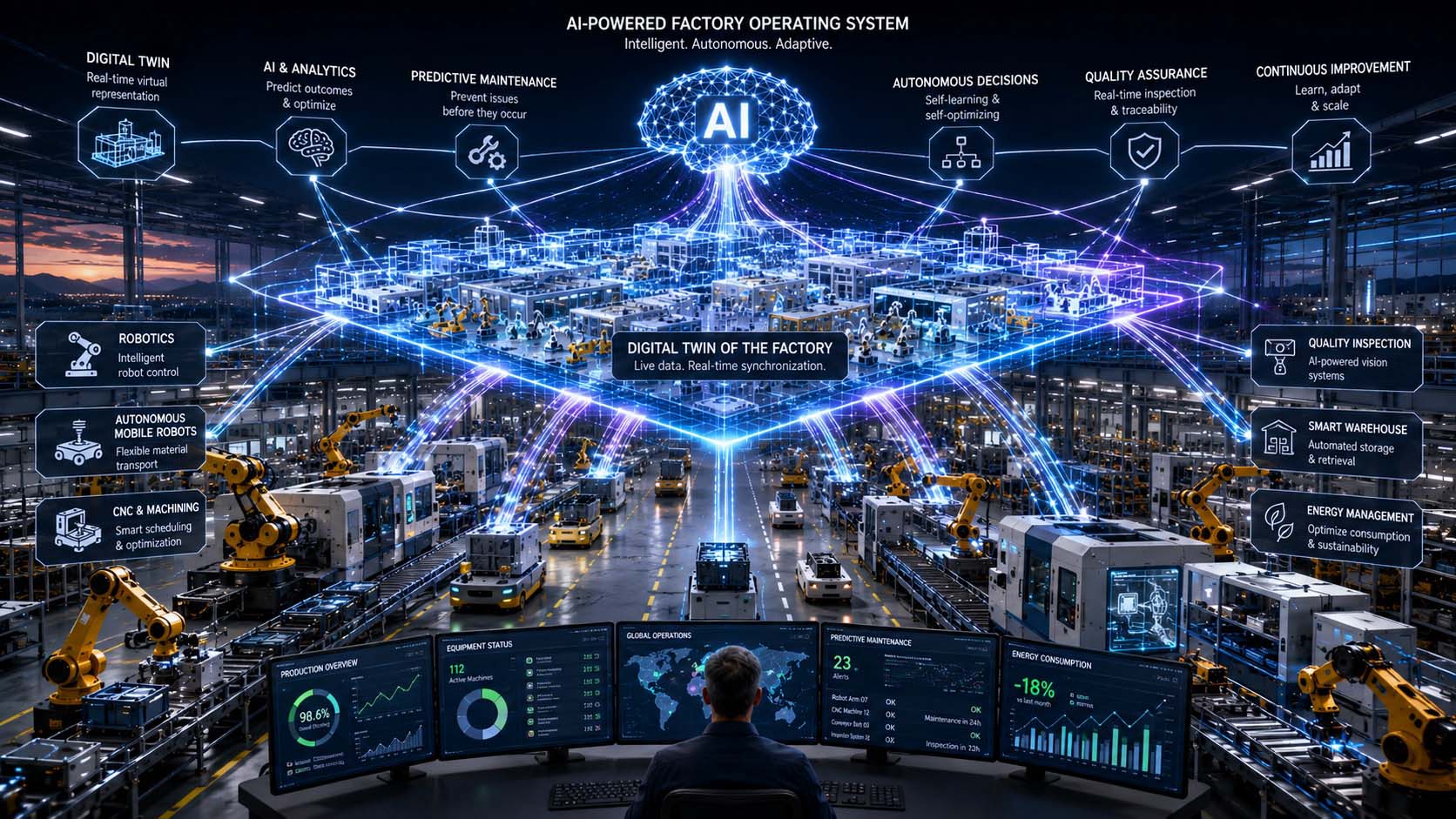
A shared engineering platform connects people, simulations, AI, and digital twins in real time.
Visualization: Collaborative engineering platform with digital twins, real-time simulation, artificial intelligence, and a shared data foundation for product development, manufacturing, and operations | Image: © Ulrich Buckenlei | VISORIC GmbH
The illustration in this chapter highlights this transformation. Multiple experts work simultaneously on the same digital factory. Simulations, real-time data, and AI-driven analyses converge instantly to create a common basis for decision-making. The digital twin becomes the central engineering workspace where ideas are developed, design alternatives evaluated, and decisions made long before physical changes are implemented.
For companies, this represents a fundamental paradigm shift. Information no longer needs to be synchronized between separate systems. Everyone works from the same data foundation and can collaborate simultaneously on products, manufacturing systems, or complete production lines. This shortens development cycles, reduces coordination effort, and significantly improves the quality of engineering decisions.[13][14]
- Simulation becomes an integral part of the daily engineering workflow.
- All disciplines collaborate using a shared data foundation.
- Digital twins connect product development, manufacturing, and operations.
- AI supports teams with real-time analytics and actionable recommendations.
- Engineering decisions become faster and better informed.
The digital twin is therefore evolving from a technical model into a collaborative engineering platform where people, simulation, and artificial intelligence work together in real time. This development is expected to define the next generation of industrial product development.
The Intelligent Factory Begins with the Digital Twin
The future of industrial product development does not end with faster simulation. The real transformation begins where digital twins, artificial intelligence, and real-time data merge into an intelligent overall system. Instead of viewing individual machines or production lines in isolation, a comprehensive digital representation of the entire factory emerges. Planning, manufacturing, quality assurance, logistics, and operations all access the same information foundation and continuously interact with one another.[21]
Only a few years ago, production facilities were primarily planned sequentially. Design, simulation, manufacturing, and operations were organizationally and technically separated. Modern Industrial AI platforms take a fundamentally different approach. Every process is integrated into a shared digital twin where it can be analyzed, simulated, and optimized simultaneously. The result is a manufacturing environment that continuously adapts to changing requirements.[22]
The image in this chapter illustrates exactly this evolution. On the left, the physical factory operates with robots, CNC machines, autonomous transport systems, and automated production lines. On the right, its digital twin evolves simultaneously. Both worlds remain permanently synchronized. Production data, quality information, and sensor data flow continuously between the physical and virtual factory, creating a shared foundation for well-informed engineering decisions.
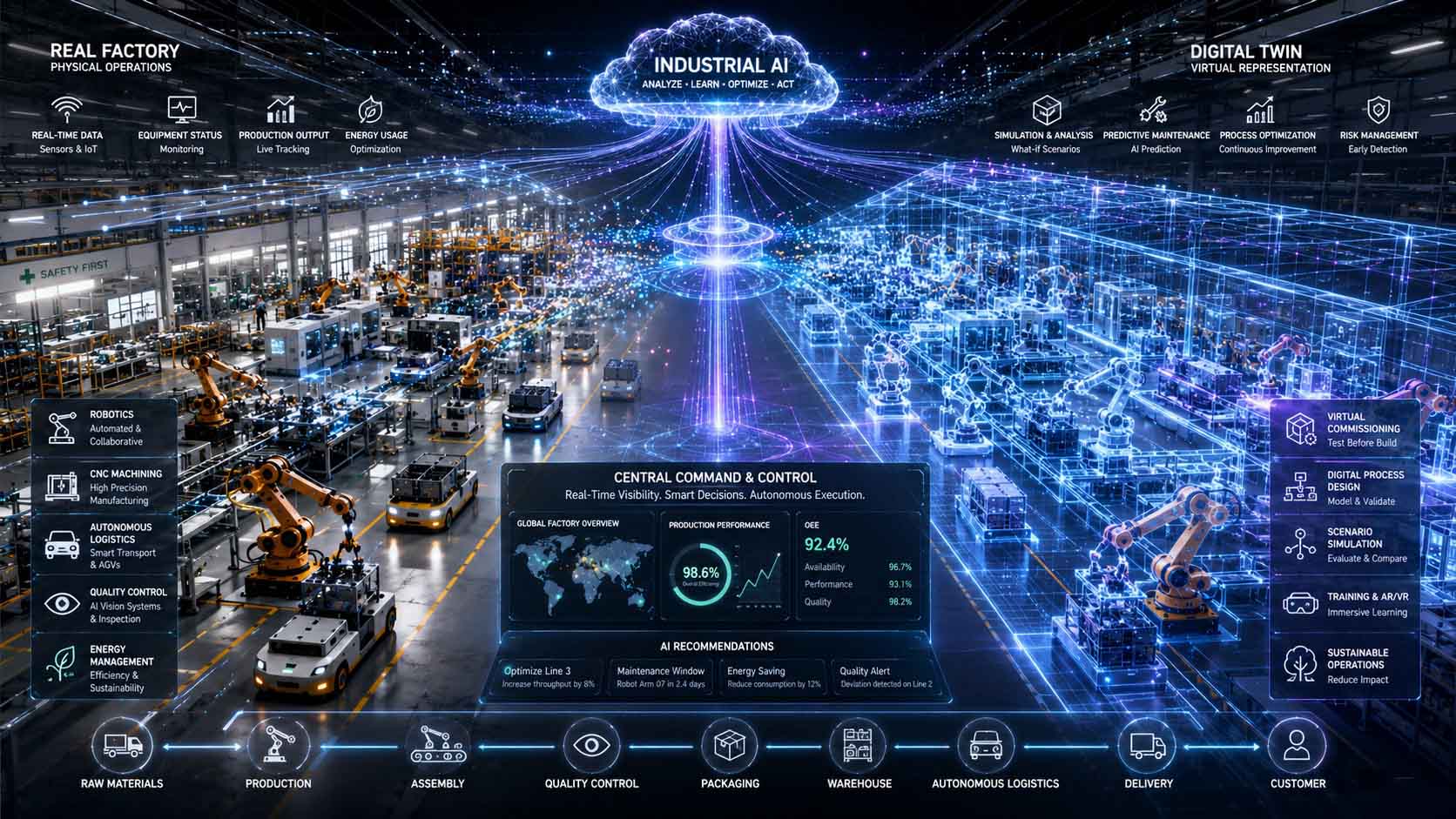
Industrial AI connects physical factories and digital twins into an intelligent production platform.
Visualization: Industrial AI, digital twin, smart factory, autonomous logistics, robotics, quality management, and real-time data converge into a unified industrial decision platform | Image: © Ulrich Buckenlei | VISORIC GmbH
The real innovation lies not in automating individual machines but in the intelligent networking of the entire production system. Artificial intelligence identifies relationships between engineering, manufacturing, quality, energy consumption, and logistics, evaluates alternative scenarios, and continuously helps companies improve their operations. Decisions are therefore no longer based solely on historical data but increasingly on current operating conditions and simulation-driven predictions.
This opens entirely new possibilities for industrial companies. Products can be developed faster, production lines can be adapted more flexibly, and quality issues can be detected before they occur in real manufacturing. At the same time, energy consumption, material usage, and maintenance strategies can be continuously optimized. The intelligent factory therefore evolves from an automated production facility into a continuously learning system that constantly improves itself.[21][22]
- Physical factories and digital twins remain continuously synchronized.
- Industrial AI connects engineering, manufacturing, quality, and logistics.
- Real-time data enables simulation-driven decision-making.
- Production systems continuously learn from operational data.
- The smart factory becomes the foundation of the next industrial generation.
This completes the overall vision presented in this article. Intelligent simulation not only accelerates the development of individual products—it provides the foundation for a new generation of connected factories in which digital twins, artificial intelligence, and Physical AI work together to create a more efficient, flexible, and resilient industry.
The Future of Intelligent Product Development
The developments of recent years clearly demonstrate that artificial intelligence is far more than another software technology. It is fundamentally changing the way products are designed, simulated, manufactured, and continuously improved. Individual engineering tools are increasingly evolving into an integrated digital innovation platform where design, simulation, digital twins, and Industrial AI seamlessly converge. Product development is transforming from a linear process into a continuously learning engineering system.[17]
The visualization in this chapter summarizes this evolution in a single overview. The timeline at the top illustrates the technological maturity of modern engineering platforms. The journey begins with traditional CAD models and progresses through simulation-driven development, AI-assisted engineering, digital twins, and Industrial AI to autonomous engineering. With every stage of development, not only computational performance increases, but also the ability to make better engineering decisions much earlier in the product development process.
The central section of the diagram demonstrates how engineering workflows are changing. Traditional CAD systems primarily generate geometric models, while modern simulations provide a deeper understanding of physical behavior. Artificial intelligence then expands this process through automatic design generation, intelligent optimization, and data-driven recommendations. Digital twins subsequently connect simulations with real-time operational data. Industrial AI integrates all information into a unified platform, creating the foundation for self-optimizing engineering processes.
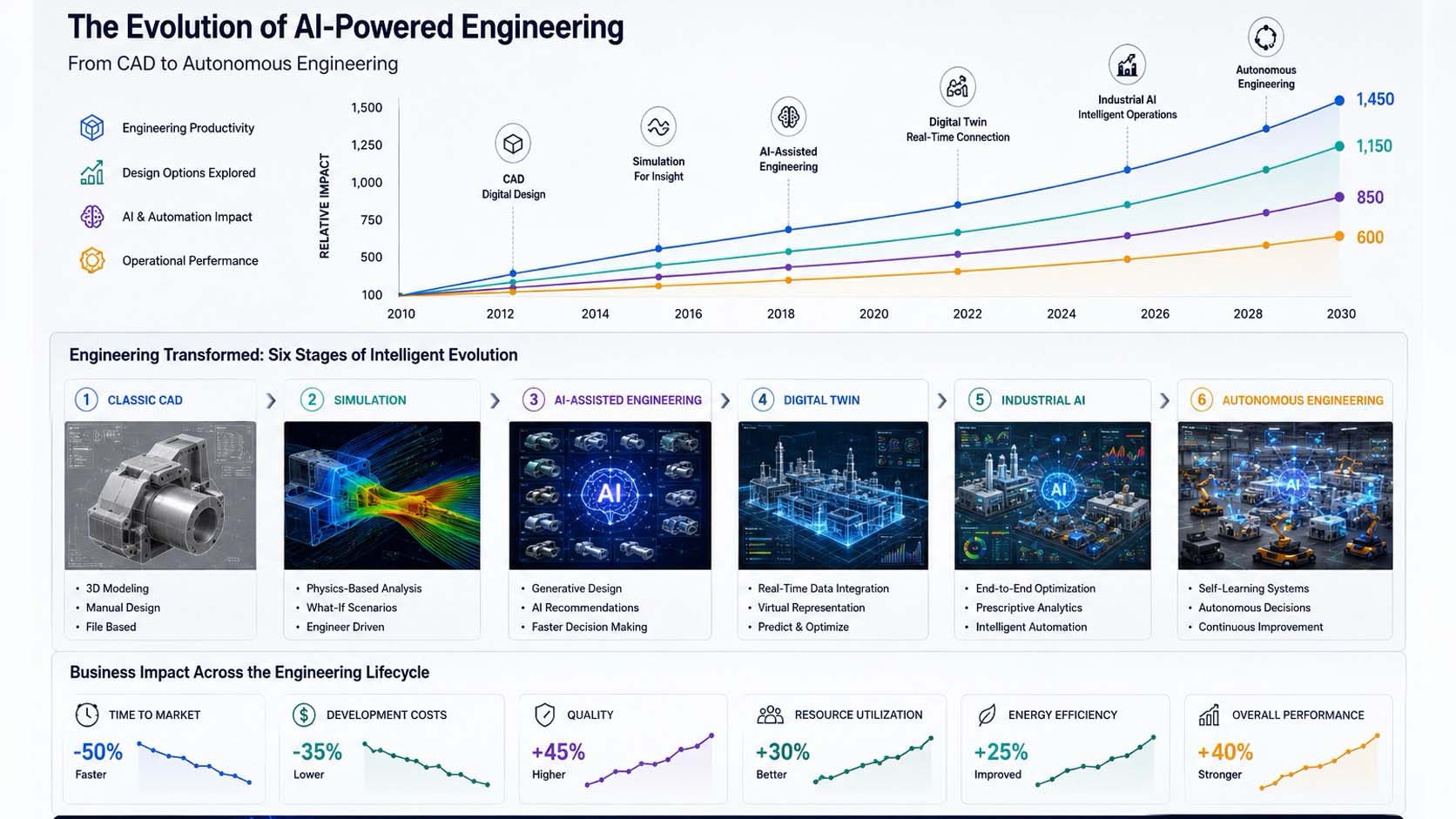
The visualization illustrates the evolution from traditional CAD through simulation and digital twins to AI-powered autonomous engineering platforms.
Visualization: CAD, Computational Fluid Dynamics (CFD), AI-powered simulation, digital twins, Industrial AI, and autonomous engineering | Image: © Ulrich Buckenlei | VISORIC GmbH
The lower section of the illustration highlights why this transformation is economically so significant. With every stage of development, engineering cycles become shorter, the number of possible design alternatives increases, decisions become more reliable, and resources can be used more efficiently. Companies gain the ability to evaluate significantly more concepts virtually before building the first physical prototype. This represents one of the greatest competitive advantages of modern AI-powered product development.[18]
Artificial intelligence does not replace engineering expertise or physics-based simulation. Instead, it takes over time-consuming analysis and optimization tasks, enabling engineering teams to evaluate significantly more design alternatives within a much shorter period. The quality of engineering decisions improves because substantially more knowledge can be incorporated into the development process than would be economically feasible using traditional methods.
For companies, this evolution opens far-reaching opportunities. Products can be developed faster, manufacturing processes planned more efficiently, and innovations validated much earlier. Digital twins accompany the entire product lifecycle—from the initial concept through design and manufacturing to operation, maintenance, and continuous optimization. The result is a continuously learning engineering platform that becomes more capable with every project.
The Munich-based VISORIC expert team also sees this as the next stage of industrial digitalization. The future belongs not to isolated software solutions but to intelligently connected platforms where artificial intelligence, simulation, digital twins, spatial computing, and real-time data work together seamlessly. Individual engineering tools evolve into a comprehensive digital engineering ecosystem that enables companies to develop better products faster, more sustainably, and more economically.[17][18]
- AI extends simulation through intelligent analysis and optimization.
- Digital twins connect product development, manufacturing, and operations.
- Engineering evolves into a continuously learning process.
- More virtual design alternatives result in better real-world products.
- Intelligent simulation is becoming a decisive competitive advantage.
The future of product development therefore begins long before the factory floor or the first physical prototype. It begins within the digital model—where artificial intelligence, physics-based simulation, and digital twins together create the foundation for the next generation of industrial innovation.
From Simulation to Intelligent Product Development
The rapid advancement of artificial intelligence is transforming not only individual engineering tools but the entire product development process. Modern simulation technologies already enable engineers to analyze fluid flow, temperature distribution, material behavior, and mechanical stresses long before the first physical prototype is built. By combining artificial intelligence, Computational Fluid Dynamics (CFD), digital twins, and real-time computation, a new generation of intelligent engineering platforms is emerging.
The objective is not to replace the laws of physics. Instead, artificial intelligence enables engineers to calculate physical phenomena much faster, compare significantly more design alternatives, and make better decisions at much earlier stages of product development. Traditional simulation tools are evolving into intelligent decision platforms that seamlessly integrate design, simulation, and optimization into a continuous engineering workflow.
The following video illustrates this transformation. The colorful flow fields are not animations—they represent a physics-based CFD simulation generated from a digital twin. Airflow, turbulence, and aerodynamic interactions become visible and can already be analyzed during product development. Artificial intelligence then evaluates thousands of possible design alternatives, enabling engineers to identify the most effective solutions much faster.
Video source: Original video discovered via @ashancduk | Analysis, technological assessment, narration, and editorial content: © Ulrich Buckenlei | XR Stager Online Magazine | VISORIC GmbH
A particularly exciting development, highlighted repeatedly by Siemens and NVIDIA during CES 2026, is that artificial intelligence replaces neither engineering expertise nor physics-based simulation. Its true value lies in dramatically accelerating engineering workflows. Instead of evaluating only a limited number of economically feasible design alternatives, engineers can now simulate, compare, and optimize hundreds or even thousands of options. This significantly increases the likelihood of discovering entirely new and higher-performing solutions.
For companies, this represents a fundamental transformation. Products can be developed faster, the number of physical prototypes can be reduced, and innovations can be evaluated much earlier. Digital twins are evolving from visualization models into intelligent engineering platforms where simulation, artificial intelligence, and real-world operational data continuously work together. Today, this convergence is regarded as one of the most important technological drivers of the next industrial generation.
- CFD makes invisible physical processes visible.
- AI accelerates simulations and evaluates significantly more design alternatives.
- Digital twins connect development, simulation, and operations.
- Fewer physical prototypes shorten development cycles and reduce costs.
- Intelligent simulation is becoming a decisive competitive advantage.
The future of product development therefore begins long before manufacturing starts. It begins within the digital twin, where artificial intelligence and physics-based simulation work together to create better products before the first physical component is ever built.
From Intelligent Simulation to Better Products
Artificial intelligence, Computational Fluid Dynamics (CFD), digital twins, and modern simulation platforms are fundamentally transforming the way products are developed. The real progress is not driven by individual technologies alone, but by their intelligent integration. Engineering data, physics-based simulations, real-time information, and AI are converging into a unified development platform where better engineering decisions can be made before the first physical prototype exists.
For companies, this creates substantial economic potential. Development cycles become shorter, physical prototypes are reduced, engineering risks can be identified earlier, and significantly more product variants can be evaluated within the same timeframe. Intelligent simulation is therefore becoming a decisive competitive advantage for industrial enterprises.
Digital twins, artificial intelligence, and real-time simulation combine engineering, analytics, and collaboration into a unified platform for the next generation of product development.
Visualization: XR Stager combines digital twins, AI, simulation, real-time 3D, and spatial computing into a unified engineering platform | Image: © Ulrich Buckenlei | VISORIC GmbH
The Munich-based VISORIC expert team helps companies transform complex engineering data into interactive digital twins and intelligent simulation platforms.
Whether digital twins, AI-powered simulation, CFD visualization, immersive engineering applications, spatial computing, or interactive 3D platforms, our goal is to make technical information easier to understand, accelerate development processes, and support better engineering decisions. The result is a new generation of digital tools that supports the entire product lifecycle—from the initial concept through operation and maintenance.
- Digital twins for products, machines, and industrial facilities
- Interactive 3D visualization of simulations and engineering data
- XR, web, and spatial computing platforms for collaboration and training
- AI-powered engineering and decision-support platforms
- Custom development for manufacturing, energy, automotive, and mechanical engineering
Contact the Munich-based VISORIC expert team and discover how digital twins, artificial intelligence, interactive 3D technologies, and intelligent simulation can accelerate your product development and create sustainable competitive advantages.
Contact:
E-mail: info@visoric.com
Phone: +49 89 21552678
Sources and References
- Siemens AG, CES 2026 – Industrial AI Operating System, Digital Twin Composer, and AI-powered engineering platforms for industrial product development.
- NVIDIA, CES 2026 – Physical AI, Omniverse, and Accelerated Computing for simulation, engineering, and industrial applications.
- McKinsey & Company – The State of AI, current analyses on the use of artificial intelligence in engineering, research, and industrial product development.
- Boston Consulting Group – AI in Engineering and Product Development, research on accelerating innovation and product development through artificial intelligence.
- Siemens Digital Industries Software – Simcenter Portfolio, Computational Fluid Dynamics (CFD), multiphysics simulation, and simulation-driven product development.
- Ansys – Computational Fluid Dynamics and multiphysics simulation, fundamentals of industrial fluid flow, structural, thermal, and multiphysics simulation.
- NVIDIA PhysicsNeMo and SimNet – AI-powered physics simulation, deep learning for CFD, and accelerated numerical computation.
- NVIDIA Research – AI Models for Automotive Aerodynamics and GPU-accelerated simulation for vehicle development and industrial optimization.
- Siemens Digital Twin Portfolio – Digital twins for engineering, manufacturing, production, operations, and industrial optimization.
- Ansys Digital Twin Technologies – Virtual commissioning, real-time analysis, predictive engineering, and simulation-driven decision support.
- Siemens AG – CES 2026 keynote by Roland Busch, Industrial AI Operating System, Digital Twin Composer, and intelligent engineering workflows.
- NVIDIA – CES 2026 keynote by Jensen Huang, Physical AI, Omniverse, CUDA, and accelerated industrial simulation.
- NVIDIA Omniverse – Collaborative digital twins, industrial real-time visualization, and simulation-driven collaboration.
- Siemens Xcelerator – Open platform for digital twins, simulation, engineering, and industrial software ecosystems.
- IDC – Worldwide Engineering Software and Industrial AI Forecasts, market analyses covering simulation, engineering software, and artificial intelligence.
- Gartner – Emerging Technologies Impact Radar, Artificial Intelligence, Digital Engineering, Spatial Computing, and future engineering platforms.
- World Economic Forum – Future of Manufacturing, intelligent value creation, industrial transformation, and data-driven production.
- Accenture – Technology Vision and Engineering the Future, Artificial Intelligence, Digital Twins, and simulation-driven innovation platforms.
- Video source: Original video discovered via @ashancduk. The video serves as an illustrative practical example of AI-powered Computational Fluid Dynamics (CFD), digital twins, and simulation-driven product development.
- Analysis, technological assessment, narration, and editorial context: © Ulrich Buckenlei | XR Stager Online Magazine | VISORIC GmbH.
- See references [1], [5], [7], [9], [11], [13], and [17] regarding the convergence of artificial intelligence, Computational Fluid Dynamics (CFD), digital twins, Physical AI, and intelligent product development.
- Based on current publications and technology presentations from Siemens, NVIDIA, Ansys, the World Economic Forum, McKinsey & Company, Boston Consulting Group, and Accenture covering Artificial Intelligence, Digital Engineering, Digital Twins, and simulation-driven product development.
- VISORIC practical projects in Artificial Intelligence, Digital Twins, simulation, Spatial Computing, XR, real-time 3D, and industrial digitalization.
- XR Stager platform for digital twins, interactive 3D communication, engineering, simulation, Spatial Computing, and AI-powered enterprise applications.
Contact Persons:
Ulrich Buckenlei (Creative Director)
Mobile: +49 152 53532871
Email: ulrich.buckenlei@visoric.com
Nataliya Daniltseva (Project Manager)
Mobile: +49 176 72805705
Email: nataliya.daniltseva@visoric.com
Address:
VISORIC GmbH
Bayerstraße 13
D-80335 Munich