

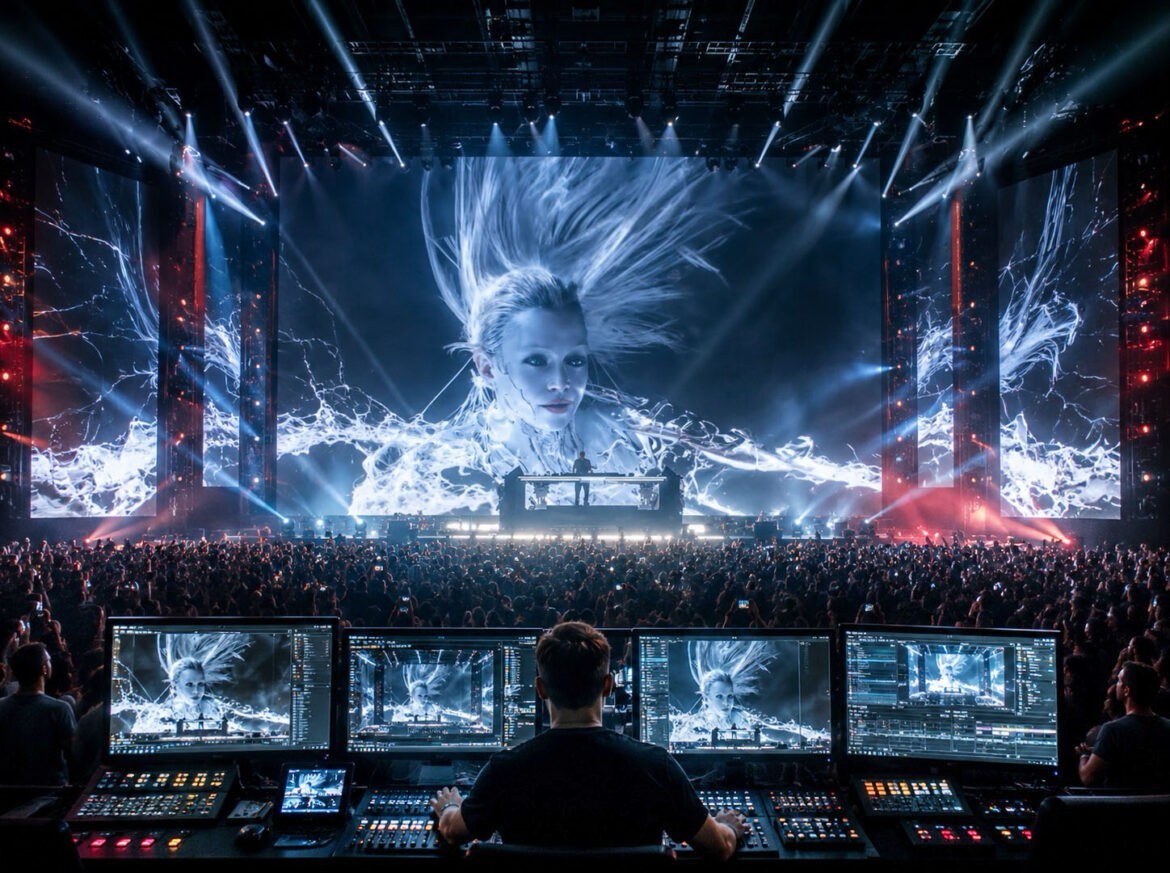
The concept illustration visualizes a futuristic live performance in which artificial intelligence, real-time rendering, immersive LED architectures, and digital creative systems converge into a programmable experience world.
Visualization: Artificial intelligence, real-time graphics, virtual production, immersive LED technologies, spatial computing, and programmable live experiences | Image: © Ulrich Buckenlei | VISORIC GmbH
The entertainment industry is currently undergoing a technological transformation that extends far beyond new special effects or increasingly elaborate stage productions. Artificial intelligence, real-time graphics, virtual production, and immersive display technologies are fundamentally changing how live experiences are conceived, produced, and experienced. What has traditionally been understood as concerts, shows, or events is increasingly evolving into a new form of programmable experience worlds.[1]
This transformation is not merely about spectacular visual effects. Artificial intelligence is already reshaping creative workflows, accelerating the development of visual content, and enabling complex experience environments to be designed far more quickly and flexibly than was possible just a few years ago. At the same time, new production pipelines are emerging in which human creativity and AI systems work closely together.[2]
The cover image of this article visualizes exactly this transformation. A live performance is no longer understood solely as a physical stage. Instead, digital worlds, real-time graphics, artificial intelligence, immersive LED architectures, and spatial interaction merge into a shared experience platform. The stage itself increasingly becomes a programmable environment that can dynamically evolve and respond to creative decisions.
This development is particularly relevant for the creative industries, entertainment companies, event organizers, brands, and technology providers. The boundaries between concerts, film production, gaming, XR, virtual production, and interactive media design are becoming increasingly blurred. As a result, entirely new forms of digital value creation and completely new experience formats are emerging.[3]
This development is also gaining economic significance. The global entertainment industry is increasingly investing in immersive technologies, real-time platforms, and artificial intelligence to produce content more rapidly, engage audiences more effectively, and unlock new business models. Immersive experience worlds are therefore evolving from individual show productions into scalable digital platforms.[4]
From the perspective of the Munich-based VISORIC expert team, it is already becoming clear that the true innovation does not lie solely in larger displays or more powerful graphics hardware. Instead, the decisive factor will be the intelligent integration of artificial intelligence, real-time 3D, virtual production, spatial computing, and immersive experience architectures.
The key question is therefore no longer simply how impressive a show can look. Much more important is how flexible, interactive, and intelligent future experience worlds can become.
- Artificial intelligence is transforming creative production processes
- Real-time graphics make live experiences dynamic and adaptive
- Virtual production and entertainment are converging
- Immersive technologies are creating entirely new forms of experiences
- Programmable experience worlds are evolving into new business models
This development becomes particularly evident wherever live shows are no longer understood as static events, but rather as intelligent and programmable experience environments.
When Live Shows Become Programmable Experience Worlds
Traditional live shows were based for decades on fixed stage designs, pre-produced content, and clearly defined workflows. Modern technologies are increasingly dissolving this fundamental principle. Artificial intelligence, real-time rendering, and immersive display architectures now enable experience worlds that can be dynamically generated, modified, and expanded.[5]
This development becomes particularly visible in new large-scale productions that combine high-resolution LED architectures, spatial audio systems, real-time graphics, and generative AI. Content is no longer created exclusively before the event but can be continuously adapted, expanded, and optimized throughout creative processes.[6]
The illustration in this chapter depicts a futuristic live performance within a fully immersive experience architecture. The traditional stage almost completely disappears behind a digital environment consisting of real-time graphics, artificial intelligence, and spatial staging. The audience no longer observes a performance but instead becomes part of a programmable experience world.
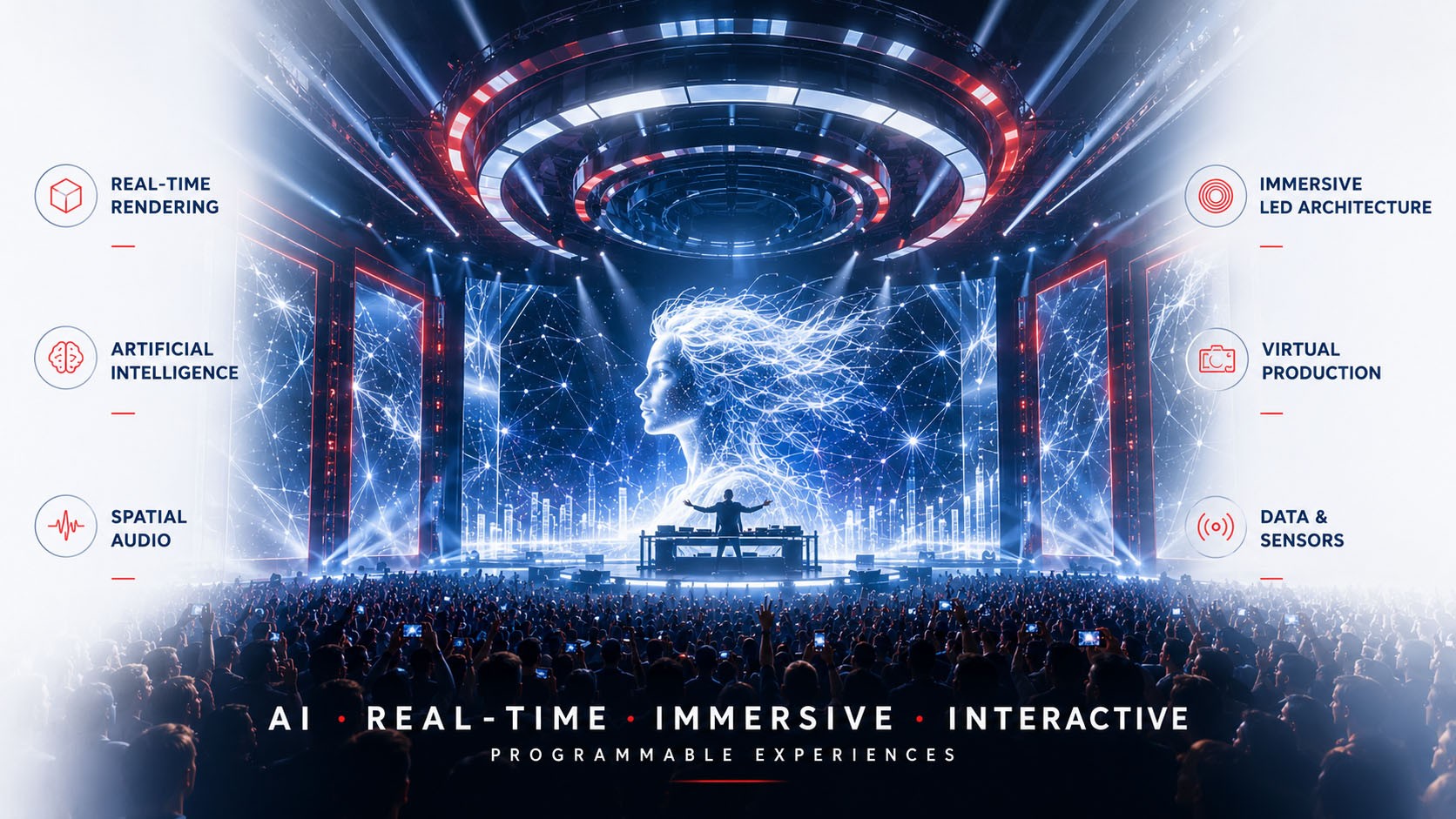
The concept illustration visualizes an immersive live performance in which artificial intelligence, real-time graphics, and large-scale display architectures converge into a programmable experience world.
Visualization: AI live entertainment, real-time rendering, immersive LED architectures, virtual production, spatial computing, and programmable experience environments | Image: © Ulrich Buckenlei | VISORIC GmbH
This development is changing not only the production of live shows but also their economic foundations. Once developed, digital content can be reused, adapted, and expanded multiple times. This provides artists, event organizers, and brands with entirely new opportunities to continuously develop immersive experiences and distribute them across different platforms.[7]
At the same time, new creative workflows are emerging. Artificial intelligence generates variations, real-time engines visualize ideas instantly, and human creatives maintain curatorial and artistic control. As a result, experience worlds become not only more sophisticated but, above all, more flexible and experimental.
The Munich-based VISORIC expert team is also observing this development with great interest. The most exciting change is not that artificial intelligence replaces humans. Rather, entirely new production models are emerging in which artificial intelligence, real-time graphics, and human creativity together enable completely new forms of immersive experiences.
- Live shows are evolving into programmable experience platforms
- Real-time graphics enable dynamic and adaptive content
- Artificial intelligence accelerates creative processes
- Immersive display technologies are redefining the role of the stage
- Entertainment, gaming, film, and XR are converging technologically
The true revolution begins where artificial intelligence no longer merely generates content but itself becomes a creative tool within the production process.
Artificial Intelligence Becomes a Creative Accelerator
The real revolution of modern live entertainment does not begin on stage but already during the creative development process. Artificial intelligence is transforming numerous workflows that were previously carried out exclusively by human creative teams. Concepts, characters, visual worlds, animations, and even complete storyboards can now be generated, varied, and further developed within a very short period of time. This creates entirely new creative production processes.[8]
This transformation is not about replacing human creativity. Rather, artificial intelligence is evolving into a creative accelerator that enables artists, designers, directors, and production studios to explore significantly more ideas in a much shorter timeframe. Modern multimodal AI systems can jointly analyze images, videos, text, movements, and spatial scenarios and generate entirely new creative concepts from them.[9]
The illustration in this chapter visualizes exactly this new workflow. At the center is a creative team working together with artificial intelligence. While AI generates thousands of variations of characters, stage designs, animations, and visual styles, human creatives continue to make the decisive artistic and dramaturgical decisions. Creative control remains in human hands, while artificial intelligence dramatically increases the speed and diversity of idea generation.
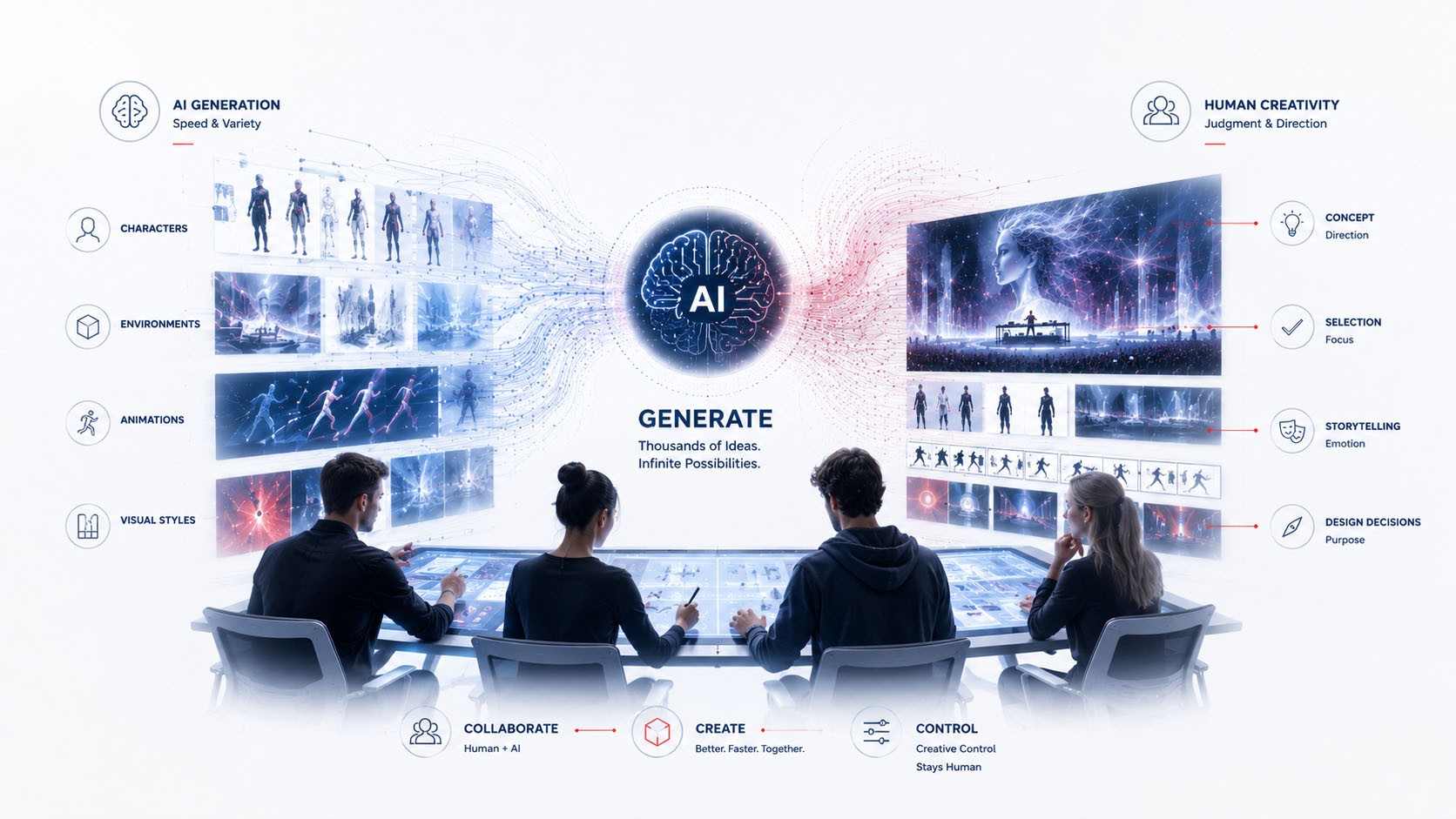
The concept illustration visualizes the collaboration between human creatives and artificial intelligence in the development of immersive experience worlds, digital characters, and programmable live performances.
Visualization: Generative AI, multimodal creative workflows, digital characters, real-time graphics, virtual production, and immersive experience architectures | Image: © Ulrich Buckenlei | VISORIC GmbH
The economic impact of this development is substantial. Production cycles can be shortened, creative iterations accelerated, and entirely new experience worlds developed much more cost-effectively. At the same time, new creative roles are emerging in which humans and artificial intelligence jointly create and curate content.[10]
This is particularly evident in large-scale immersive productions. What previously required months of concept development, large design teams, and extensive production budgets can now be prepared, visualized, and tested much more rapidly using generative AI. As a result, experimental ideas become economically more feasible and creative risks more manageable.
The Munich-based VISORIC expert team is observing this development with great interest. The most exciting change is not that artificial intelligence takes over creative work. Rather, entirely new creative production models are emerging in which human imagination and machine-generated creativity can collaborate in real time for the first time.
- Artificial intelligence accelerates creative development processes
- Multimodal AI generates images, animations, and experience worlds
- Human creativity remains essential for artistic direction and storytelling
- Production times and development costs can be significantly reduced
- New creative workflows are emerging between humans and machines
The key question is therefore no longer whether artificial intelligence will transform creative processes. Much more interesting is the question of what role humans will play within these new creative production ecosystems.
Why Humans Will Retain Creative Control
The more powerful artificial intelligence becomes in generating visual content, the more frequently the question arises as to what role human creativity will play in the future. However, projects such as immersive productions for the Sphere in Las Vegas or AI-supported live experience worlds reveal a surprising picture: artificial intelligence does not replace creative professionals. Instead, it significantly expands their capabilities.[11]
Today, generative AI can create thousands of image variations, character designs, visual styles, animations, and narrative concepts within minutes. Nevertheless, the decisive creative contribution remains firmly in human hands. Artists define the emotional impact, visual language, dramaturgy, and ultimately the cultural significance of a production. Artificial intelligence provides possibilities. Humans make decisions.[12]
The visualization in this chapter illustrates precisely this relationship. At its center stands a human creative director working together with an AI system to develop an immersive experience world. While artificial intelligence generates countless visual variations, movement sequences, and scenarios, humans retain curatorial, aesthetic, and dramaturgical control. Creativity itself emerges not despite, but through the collaboration of both systems.
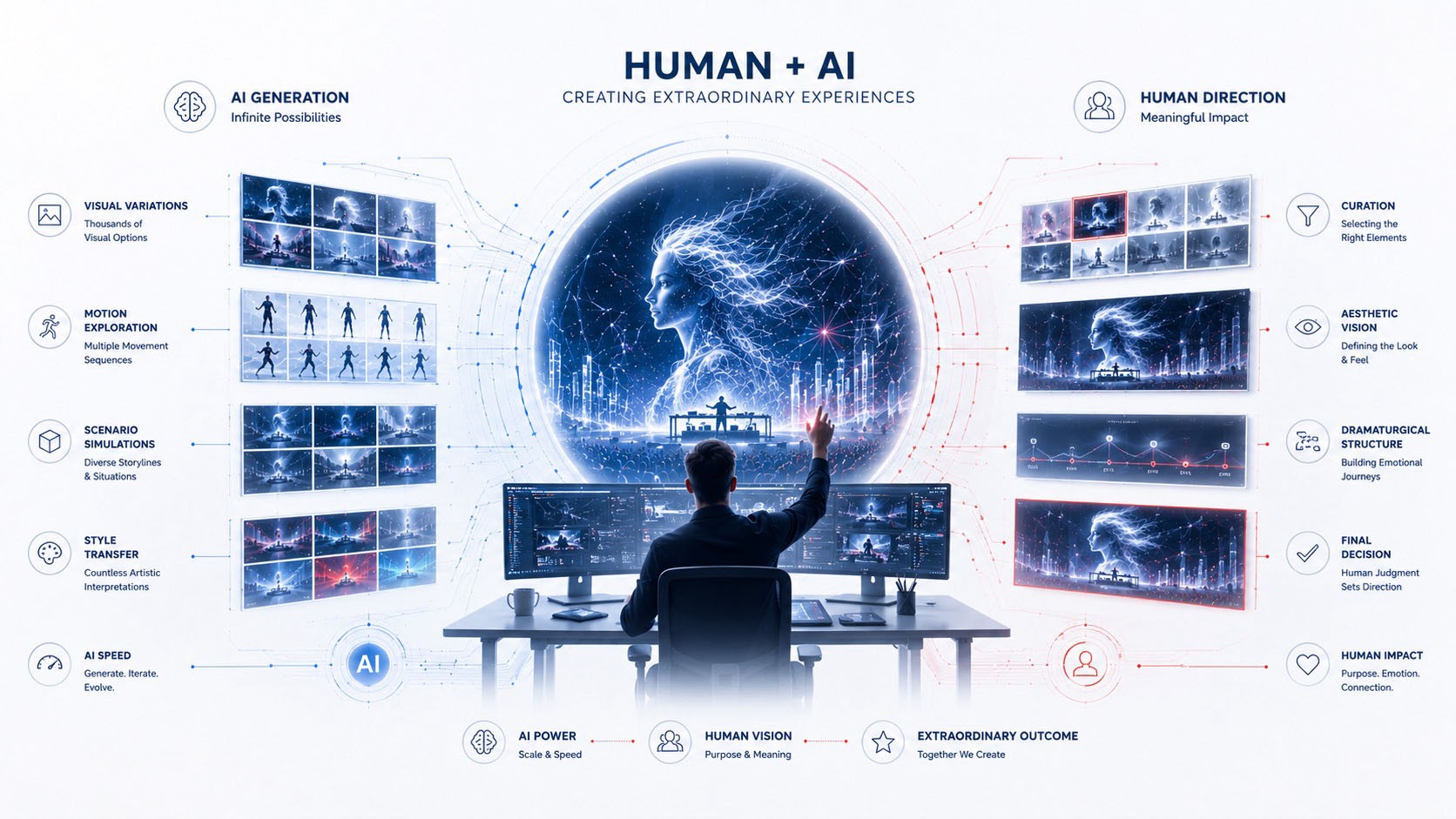
The concept illustration visualizes the collaboration between human creatives and artificial intelligence in the development of immersive experience worlds and programmable live performances.
Visualization: Human-centered AI, creative direction, generative AI, immersive experience worlds, virtual production, and collaborative creative processes | Image: © Ulrich Buckenlei | VISORIC GmbH
Large-scale immersive productions clearly demonstrate why human creativity remains indispensable. Emotions, cultural references, dramatic tension, and aesthetic decisions do not emerge automatically from data or algorithms. They require experience, intuition, and a deep understanding of human perception.[13]
At the same time, however, the role of creative professions is fundamentally changing. Creatives are increasingly evolving from producers of individual content into curators of complex AI-supported production processes. The ability to strategically use artificial intelligence, evaluate variations, and transform them into compelling experience worlds is becoming a core competency of future creative work.
The Munich-based VISORIC expert team is also closely observing this development. The most interesting change is not that machines are becoming creative. Rather, entirely new forms of human creativity are emerging that become possible only through artificial intelligence. The true innovation therefore lies not in the automation of creativity, but in its expansion.
- Artificial intelligence generates creative possibilities; humans make the decisions
- Emotion and dramaturgy remain core human competencies
- Creative direction becomes more important than pure production
- New collaborative working models between humans and AI are emerging
- The future of creative work lies in intelligent collaboration
The next major transformation begins where artificial intelligence meets real-time graphics and digital experience worlds become immediately visible during their creation.
Real-Time Rendering Is Transforming the Stage
One of the most important technological developments in modern live entertainment is currently taking place in the field of real-time rendering. Whereas visual content was previously produced in advance and simply played back during a performance, modern real-time engines now enable dynamic, interactive, and instantly adaptable experience worlds. This is fundamentally transforming not only the production of live shows but also the very concept of stage and performance.[14]
In particular, real-time platforms such as Unreal Engine have demonstrated in recent years how virtual production methods from film, gaming, and XR are increasingly converging with live entertainment. Stage environments, characters, effects, and entire worlds can now be generated, modified, and projected onto large-scale display architectures in real time. This creates experience spaces that can dynamically evolve during a performance.[15]
The illustration in this chapter visualizes exactly this transformation. A futuristic concert stage is no longer understood as a static structure but rather as a real-time computing system. LED walls, virtual scenes, particle systems, digital characters, and interactive effects are controlled by powerful GPUs and real-time engines. As a result, the physical stage increasingly becomes the interface of a programmable experience world.
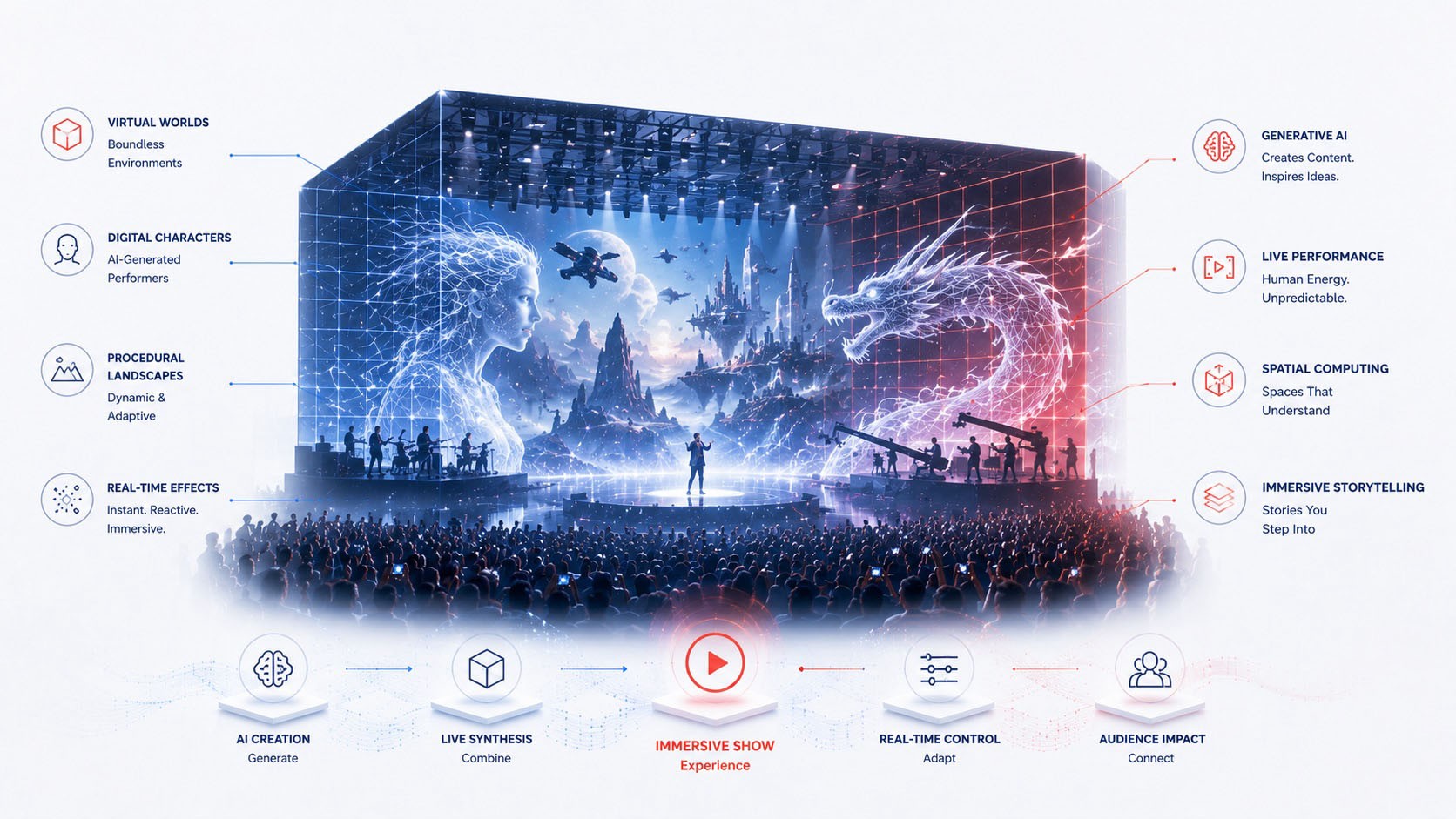
The concept illustration visualizes an immersive live performance in which real-time rendering, virtual production, and large-scale LED architectures converge into a dynamic experience world.
Visualization: Real-time rendering, Unreal Engine, virtual production, LED architectures, immersive stage environments, and interactive live experiences | Image: © Ulrich Buckenlei | VISORIC GmbH
The impact of this development extends far beyond the entertainment industry. Technologies originally developed for games and film production are increasingly being used for concerts, brand experiences, trade fairs, sporting events, and immersive environments. As a result, common technological platforms are emerging that connect a wide range of industries.[16]
Particularly interesting is the ability to make creative decisions immediately visible. Changes to lighting, environments, camera movements, visual effects, or virtual objects can be made and evaluated in real time. This not only accelerates production processes but also opens entirely new creative workflows.
The Munich-based VISORIC expert team also considers real-time rendering to be one of the key technologies of future experience worlds. The real innovation lies not only in photorealistic graphics but in the ability to create virtual worlds that are dynamic, interactive, and scalable. This is what enables experience spaces that can continuously adapt to content, users, and situations.
- Real-time rendering is increasingly replacing static media production
- Virtual production and live entertainment are converging technologically
- Immersive experience worlds can be dynamically adapted
- Creative decisions become immediately visible
- The stage is evolving into a programmable real-time platform
This development becomes particularly exciting where real-time graphics, artificial intelligence, and virtual production methods converge into entirely new forms of digital experience worlds.
From Live Shows to Virtual Production
The boundaries between live entertainment, film production, gaming, and digital art are increasingly beginning to disappear. What originally started as traditional stage productions is now evolving into a fully digital production pipeline in which real-time graphics, artificial intelligence, and virtual worlds together enable entirely new forms of storytelling. This transformation is changing not only how content is produced, but also how audiences perceive experiences.[17]
This shift is particularly visible in modern immersive live productions. Artistic performances are increasingly complemented by virtual characters, digital landscapes, real-time simulations, and AI-generated content. Productions such as the works of Anyma or experimental visualizations by international creative studios demonstrate how physical stages are transforming into hybrid experience worlds that continuously transition between reality and digital staging.[18]
The image in this chapter visualizes exactly this development. A live performance merges with a fully digital environment. Virtual characters, procedurally generated landscapes, real-time effects, and AI-generated elements together create a new form of audiovisual storytelling. The stage thus becomes not merely a place of performance, but itself a dynamic digital medium.
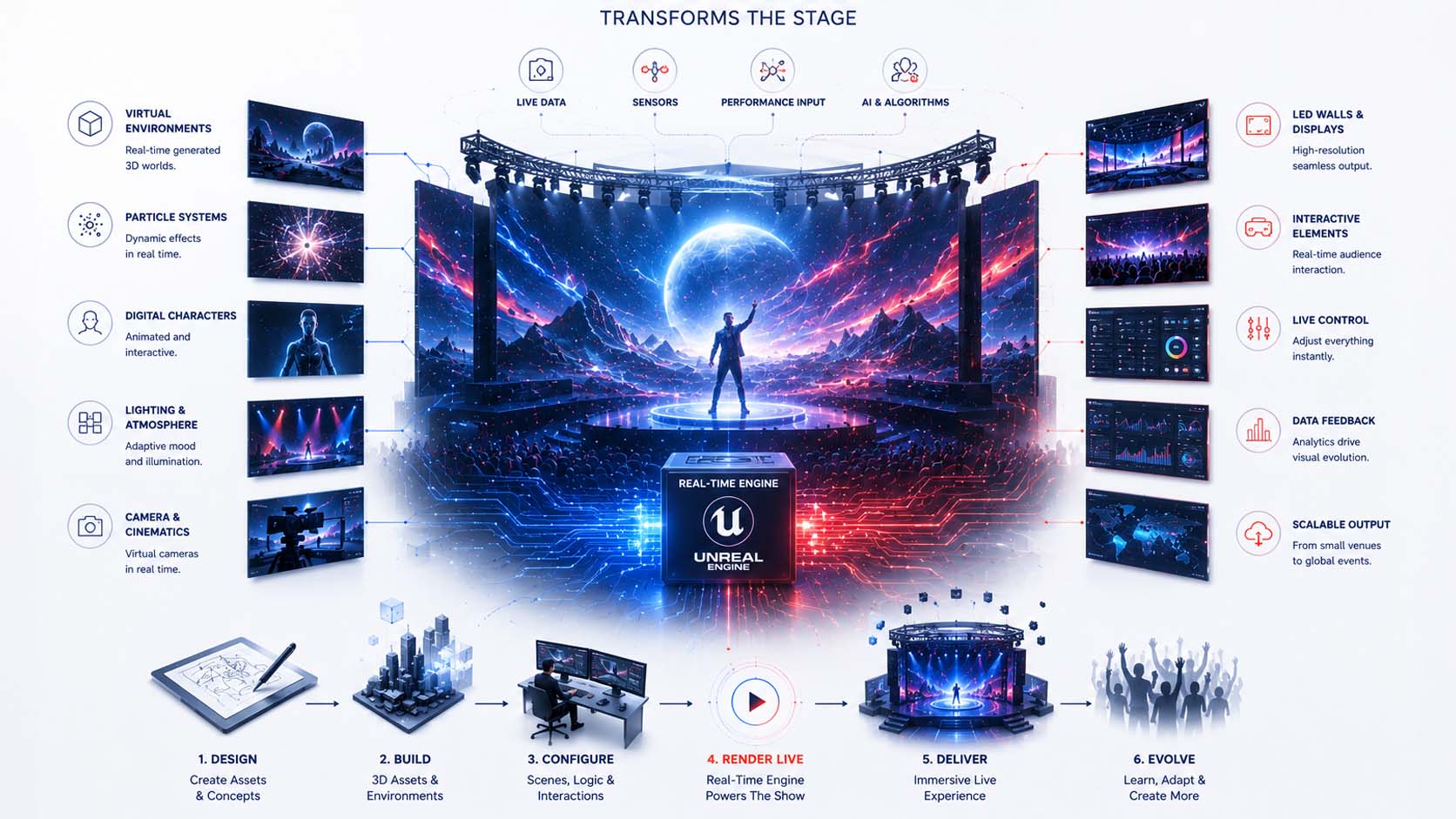
The concept illustration visualizes the convergence of live performance, virtual production, real-time graphics, and AI-generated experience worlds into a new form of immersive entertainment.
Visualization: Virtual production, real-time rendering, digital characters, generative AI, immersive stage worlds, and experimental audiovisual experiences | Image: © Ulrich Buckenlei | VISORIC GmbH
The technological foundation of this development often originates from fields that initially had little connection to live entertainment. Virtual production pipelines from the film industry, real-time rendering from game development, and generative AI from research and the creative industries are now converging into common production platforms. This creates entirely new creative tools that connect previously separate disciplines.[19]
For creatives, this opens up new freedoms. Scenes can be modified in real time, digital characters can be interactively controlled, and visual worlds can be dynamically adapted. At the same time, production times and iteration cycles are significantly reduced. Creative work is therefore increasingly shifting from manual production toward the curated orchestration of intelligent tools.
The Munich-based VISORIC expert team is observing this development with great interest. The most exciting innovations are currently emerging precisely at the intersection of real-time 3D, artificial intelligence, virtual production, and immersive experience worlds. This is where production environments are emerging that no longer distinguish between stage, film, simulation, and digital art, but instead connect all these domains within a shared technological platform.
- Live entertainment and virtual production are converging
- Digital characters and AI expand traditional stage productions
- Real-time graphics enable dynamic audiovisual experience worlds
- Production pipelines from film, gaming, and XR are merging
- Creative processes are accelerated through AI and real-time 3D
The more real and digital experience worlds converge, the more important the question becomes of how audiences will not only observe but actively participate in immersive experiences in the future.
Spatial Computing and Immersive Displays Create New Experience Spaces
The future of live entertainment will not be defined solely by artificial intelligence or real-time graphics. Equally important are new forms of spatial media experiences. Large-scale LED architectures, spatial computing, immersive audio systems, and interactive displays are fundamentally changing how people perceive and experience digital content.[20]
Projects such as the Sphere in Las Vegas demonstrate impressively how physical architecture and digital content are converging into a shared experience platform. High-resolution 16K displays, spatial audio systems, beamforming technologies, and sensory effects create environments that extend far beyond traditional cinema, concert, or stage experiences. As a result, the boundaries between space, media, and staging are increasingly dissolving.[21]
The illustration in this chapter visualizes exactly this development. A futuristic experience environment combines large-scale display surfaces, holographic content, spatial audio, and interactive digital objects into a shared immersive space. Visitors are no longer positioned in front of a screen but instead become part of a programmable experience architecture that can dynamically adapt to content and interactions.
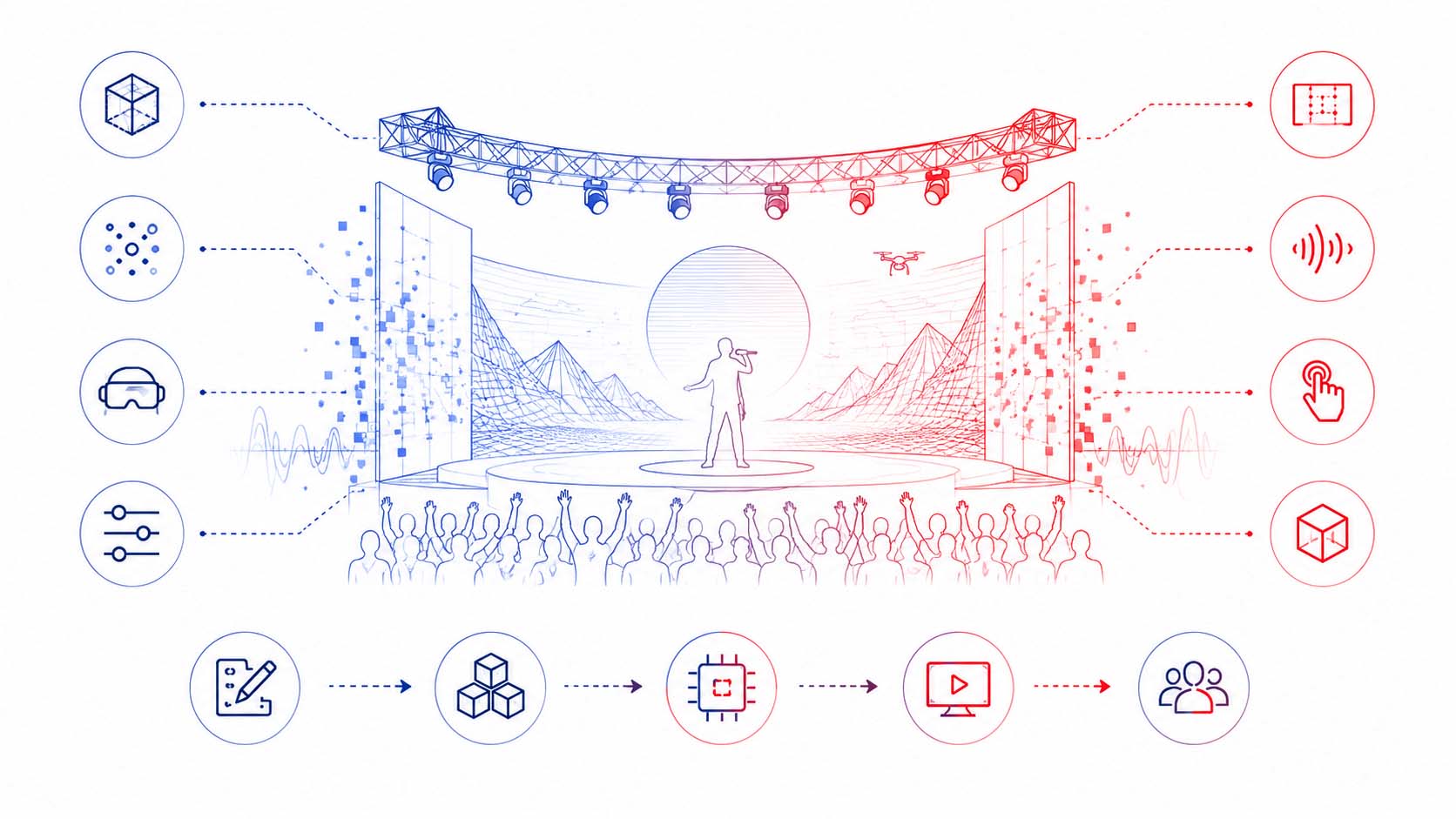
The concept illustration visualizes how spatial computing, immersive displays, spatial audio, and real-time graphics converge into a new generation of programmable experience spaces.
Visualization: Spatial computing, immersive displays, spatial audio, real-time rendering, holographic content, and interactive experience architectures | Image: © Ulrich Buckenlei | VISORIC GmbH
This development becomes particularly interesting through the increasing convergence of different technologies. Spatial computing systems, such as those currently being developed for next-generation headsets and immersive platforms, fundamentally expand the traditional understanding of stage and audience. In the future, content will be able to adapt individually to specific visitors, groups, or spatial situations.[22]
This creates entirely new forms of interaction. Audiences are no longer merely observers of a performance but increasingly become active participants within a dynamic experience world. Artificial intelligence can personalize content, interpret interactions, and modify spatial environments in real time.
The Munich-based VISORIC expert team also considers spatial computing and immersive displays to be essential building blocks of future experience platforms. The true innovation lies not merely in larger displays or higher resolutions, but in the intelligent integration of space, interaction, real-time data, and artificial intelligence. This is precisely what enables experience worlds to become simultaneously personalized, adaptive, and immersive.
- Immersive displays transform architecture into experience spaces
- Spatial computing expands traditional stage concepts
- Spatial audio enhances immersion and perception
- Artificial intelligence enables adaptive experience worlds
- Visitors increasingly become part of interactive productions
As spaces themselves become digital media, the next question inevitably arises: How will this transform business models, the creative industries, and the future of live entertainment as a whole?
New Business Models for Brands, Artists, and Event Organizers
The technological transformation of live entertainment is changing not only the production of experiences but also their economic foundations. Artificial intelligence, real-time graphics, spatial computing, and immersive platforms are creating new business models that extend far beyond traditional ticket sales, stage productions, or event formats. The live show is increasingly evolving into a digital platform with its own ecosystems, data streams, and interaction models.[23]
This development becomes particularly evident in immersive experience formats that combine physical and digital components. Visitors no longer purchase access solely to an event, but rather to an individual, interactive, and often extended experience world. Digital content, virtual goods, personalized experiences, real-time interactions, and hybrid events create entirely new revenue models for artists, brands, and event organizers.[24]
The illustration in this chapter visualizes this new experience economy. An immersive live event combines physical visitors, virtual participants, AI-generated content, digital goods, real-time interactions, and data-driven services within a shared experience platform. Value creation no longer occurs solely on stage, but within a connected digital ecosystem.
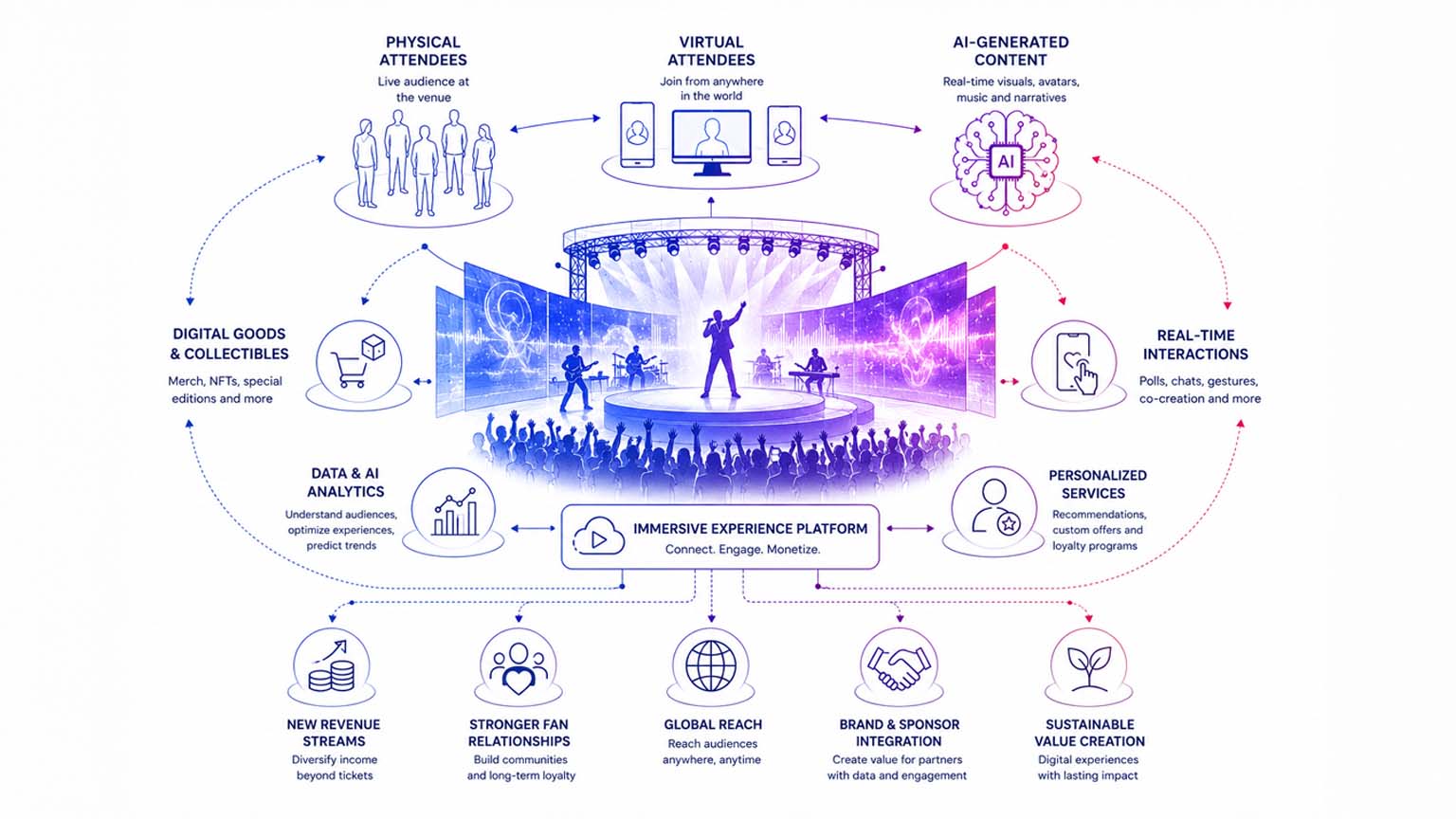
The concept illustration visualizes how artificial intelligence, immersive technologies, and digital platforms enable new business models for artists, brands, and event organizers.
Visualization: Experience economy, generative AI, immersive platforms, digital goods, fan engagement, and data-driven experience economies | Image: © Ulrich Buckenlei | VISORIC GmbH
This creates new opportunities for monetization and audience engagement for artists. Performances can take place simultaneously on-site, virtually, or as personalized experience worlds. Brands gain new forms of emotional customer interaction, while event organizers can expand their offerings through digital services, data-driven experiences, and recurring experience formats.[25]
The role of artificial intelligence is particularly interesting. AI can personalize content, analyze audiences, dynamically adapt experience worlds, and enable individualized interactions. This creates platforms that are no longer identical for every visitor but can continuously adapt to individual user groups and situations.
The Munich-based VISORIC expert team is also closely observing this development. The most exciting economic opportunities are currently emerging where real-time 3D, artificial intelligence, spatial computing, and immersive media converge into shared experience platforms. The real innovation lies not only in new technologies but in the emergence of entirely new forms of digital value creation.
- Live experiences are evolving into digital platform ecosystems
- Artists and event organizers gain new revenue models
- Brands create personalized and immersive customer experiences
- Artificial intelligence enables adaptive experience worlds
- The experience economy is becoming increasingly data-driven
The key question is therefore no longer whether artificial intelligence will transform live entertainment. Far more important is the role humans will play within these new intelligent experience worlds.
Is a New Experience Industry Emerging?
Developments over recent years suggest that we are not merely witnessing the technological evolution of existing entertainment formats. Instead, an entirely new industry may currently be emerging in which artificial intelligence, real-time graphics, spatial computing, and immersive media converge into a shared economic platform. Entertainment is increasingly evolving into a programmable, data-driven, and adaptive experience economy.[26]
While traditional media primarily produces and distributes linear content, artificial intelligence enables entirely new forms of dynamic experience spaces. Content can be generated in real time, adapted to individual audiences, and continuously evolved. As a result, not only production processes are changing, but also the relationships between creatives, businesses, and audiences.[27]
The diagram in this chapter visualizes this potential future of a new experience industry. At its center is an intelligent experience ecosystem that connects artificial intelligence, real-time rendering, spatial computing, immersive architecture, digital identities, and interactive platforms. People no longer move between separate media formats but instead exist within a shared programmable experience world.
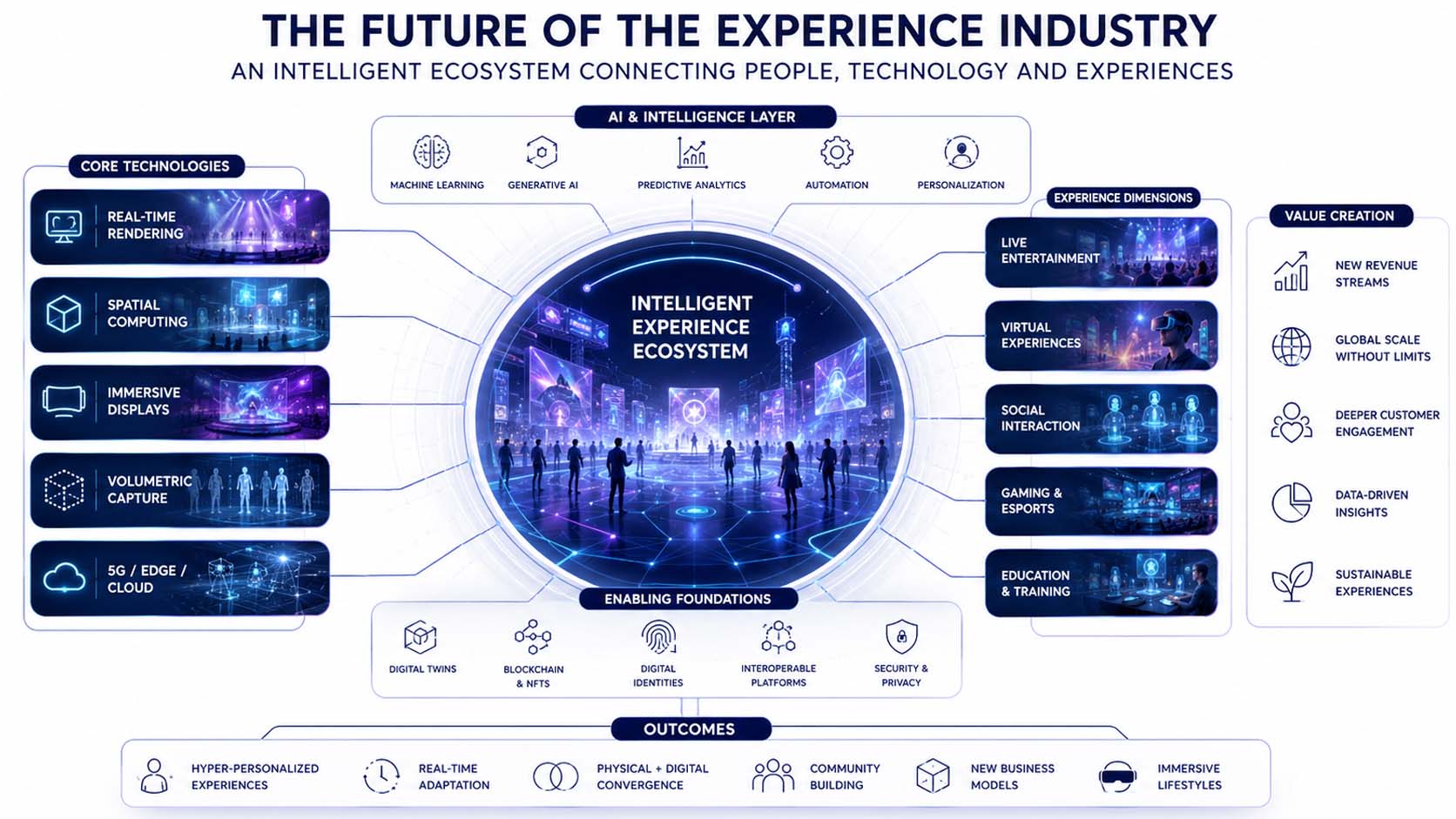
The concept illustration visualizes the potential evolution of artificial intelligence, real-time graphics, spatial computing, and immersive media into a new global experience industry.
Visualization: Experience economy, artificial intelligence, spatial computing, real-time rendering, immersive media, digital platforms, and future experience ecosystems | Image: © Ulrich Buckenlei | VISORIC GmbH
The economic implications of this development could be substantial. New markets for immersive events, virtual experience spaces, interactive media platforms, digital goods, and AI-powered entertainment formats are already emerging today. At the same time, the boundaries between entertainment, education, brand communication, tourism, culture, and the digital economy are increasingly converging.[28]
The role of artificial intelligence is particularly significant. AI is evolving not only into a production tool but increasingly into an active component of the experience world itself. Systems can generate content, analyze behavior, interpret interactions, and dynamically adapt experiences to individual users or entire groups. This creates media formats that continuously evolve and are never truly finished.
The Munich-based VISORIC expert team also considers this development to be one of the most exciting technology trends of the coming years. The true innovation lies not in individual technologies but in their convergence. Only through the interaction of artificial intelligence, real-time 3D, spatial computing, immersive displays, and interactive platforms does a new form of digital value creation and human experience emerge.
- Artificial intelligence is transforming the economic foundations of the entertainment industry
- Immersive experience worlds are evolving into digital platform ecosystems
- Entertainment, education, and brand communication are converging
- Experiences are becoming personalized, interactive, and adaptive
- A new global experience industry may emerge
The key question is therefore no longer whether artificial intelligence will transform live entertainment. Much more important is what entirely new forms of human experience, creativity, and economic value creation may become possible as a result.
How Artificial Intelligence Is Dissolving the Boundaries Between Reality and Staging
Current developments in live entertainment demonstrate impressively how artificial intelligence, real-time graphics, virtual production, and immersive media technologies are increasingly converging into a shared creative platform. What were once considered separate disciplines—film production, stage design, computer graphics, sound design, and interactive media—are now evolving into an integrated digital production ecosystem.[29]
Artificial intelligence does not assume creative control but rather expands creative possibilities. It accelerates ideation processes, generates visual variations, supports storytelling, optimizes production workflows, and enables new forms of interactive experiences. At the same time, real-time rendering, spatial computing, and immersive displays allow these contents to be implemented directly within physical experience environments.[30]
The following video illustrates this development particularly well. The works of Anyma, MRAK, and Future Deluxe demonstrate how artificial intelligence, virtual character worlds, real-time graphics, and immersive stage architectures are converging into a new form of digital live experience. The stage is no longer understood as a static backdrop but as a programmable experience platform.[29][31]
Video source: Anyma, MRAK, Future Deluxe | Analysis, voiceover script, technological classification, and editorial work: © Ulrich Buckenlei | XR Stager Online Magazine | VISORIC GmbH
The real innovation lies not merely in impressive graphics or spectacular effects. What matters is the ability to generate, adapt, and connect digital content with physical experience environments in real time. This creates new forms of audiovisual communication that can continuously evolve and adapt individually to audiences, spaces, and situations.[30][31]
For artists, this creates entirely new creative freedoms. Event organizers gain access to scalable experience platforms. Brands acquire new opportunities for emotional interaction. And for visitors, entertainment increasingly evolves from passive consumption into active, immersive participation.
The Munich-based VISORIC expert team has been observing this development for many years. Particularly exciting are the intersections between artificial intelligence, real-time 3D, virtual production, spatial computing, and immersive experience worlds. This is precisely where new forms of digital communication are emerging that extend far beyond traditional entertainment formats.[32]
- Artificial intelligence expands creative production processes
- Real-time rendering makes experience worlds dynamic and interactive
- Virtual production and live entertainment are converging
- Spatial computing creates new forms of immersive interaction
- The boundaries between reality, stage, and digital worlds are beginning to dissolve
The future of live entertainment will therefore not be defined solely by better displays or more powerful computers. The decisive factor will be the interplay between artificial intelligence, real-time graphics, immersive technologies, and human creativity. From this, a new global experience industry may emerge.[30][31]
When Artificial Intelligence, Real-Time Graphics, and Immersive Technologies Converge into New Experience Worlds
The most exciting development in modern live entertainment is not merely better displays, more powerful computers, or increasingly impressive visual effects. The real transformation occurs where artificial intelligence, real-time rendering, virtual production, spatial computing, and immersive media technologies converge into a shared creative and technological platform.[33][34]
This creates entirely new opportunities for businesses, brands, event organizers, museums, educational institutions, artists, and operators of immersive experience environments. Digital content is no longer merely produced and played back. It can be generated, modified, personalized, and experienced spatially in real time. As a result, experience worlds are evolving from static productions into intelligent, programmable platforms.[33]
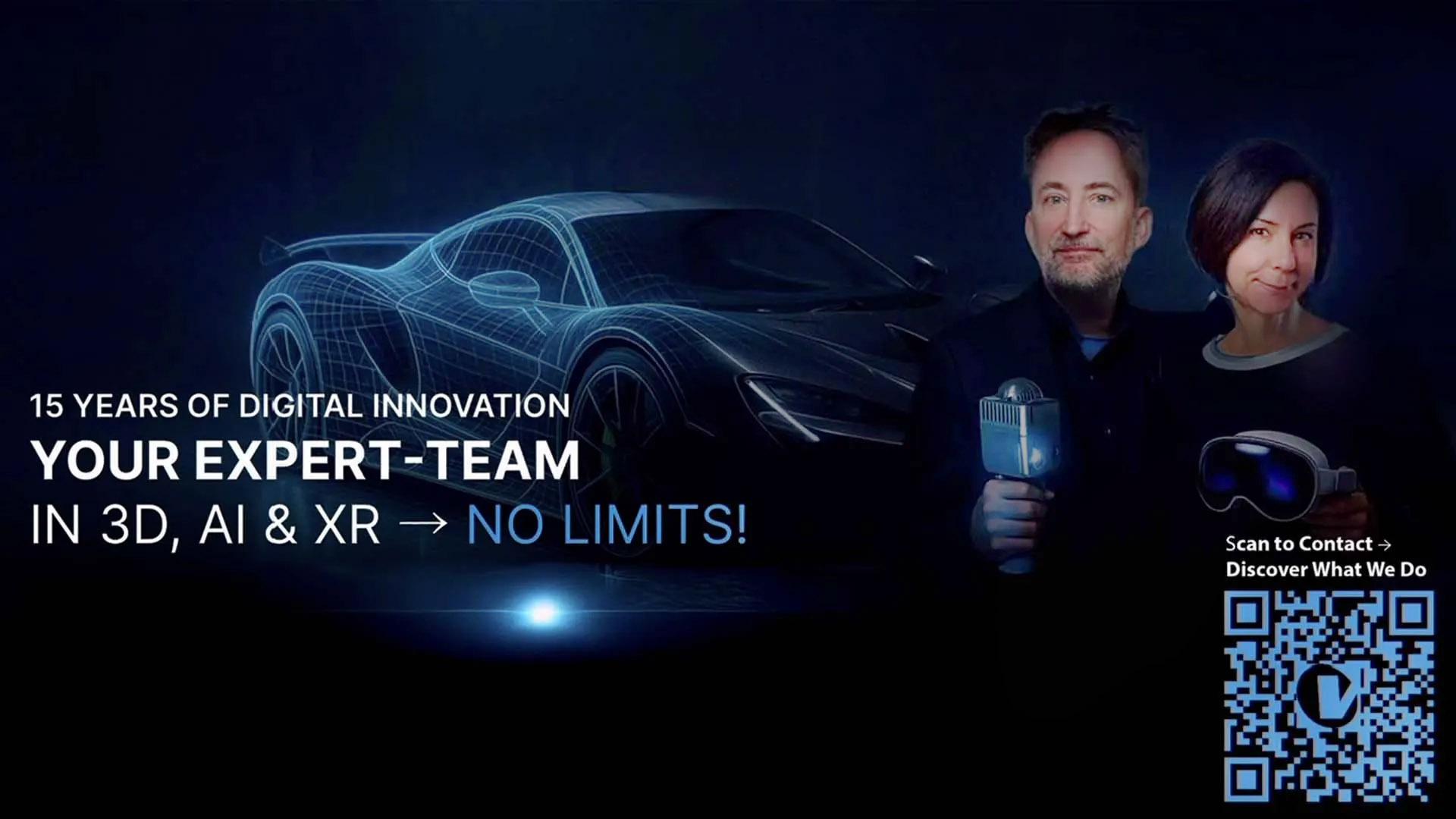
The convergence of artificial intelligence, real-time graphics, spatial computing, and immersive media opens new opportunities for entertainment, brand communication, and digital experience worlds.
Visualization: Artificial intelligence, real-time 3D, virtual production, spatial computing, immersive media, and programmable experience platforms | © VISORIC GmbH | Munich
The resulting applications extend far beyond traditional stage productions. Companies are developing immersive brand worlds, museums are creating interactive experience spaces, event organizers are producing hybrid live events, and artists are creating entirely new forms of audiovisual performances. At the same time, real-time platforms and artificial intelligence enable entirely new possibilities for personalization, interaction, and scalability.[33][34]
The Munich-based VISORIC expert team has been working for many years at the intersection of real-time 3D, XR technologies, virtual production, spatial computing, and artificial intelligence. Together with companies, creatives, and institutions, they develop concepts, prototypes, and productive platforms for the next generation of digital experience worlds.[32][33]
Sources and References
- World Economic Forum – Artificial intelligence, the creative economy, and digital transformation.
- McKinsey & Company – Generative AI and its economic impact on creative industries.
- Deloitte – Digital media trends and new forms of immersive entertainment.
- PwC – Global Entertainment & Media Outlook.
- Sphere Entertainment – Immersive live entertainment infrastructure and Sphere experiences.
- U2:UV Achtung Baby Live at Sphere – Use of 16K LED displays, immersive audio, and large-scale visualization.
- AV Network – Immersive entertainment, Sphere Las Vegas, and new live show technologies.
- Google DeepMind – Gemini, generative AI, and multimodal creative processes.
- Google Cloud – Generative AI for media production and immersive content.
- BCG – Generative AI in creative, design, and engineering workflows.
- Reuters – AI applications in immersive Sphere productions and human creative control.
- The Verge – Google, Sphere, and AI-supported enhancement of traditional visual content.
- Stanford Human-Centered AI Institute – Human-centered AI and creative responsibility.
- Epic Games – Unreal Engine for live events, virtual production, and real-time visualization.
- Unreal Engine – In-camera VFX, virtual stages, and real-time 3D workflows.
- Disguise – Real-time visual experiences, projection mapping, and live show server technologies.
- Future Deluxe – Design, motion, CGI, and experimental digital visual worlds.
- MRAK / Anyma – Digital stage aesthetics, character worlds, and immersive live visuals.
- Industrial Light & Magic – Virtual production and new production pipelines for immersive media.
- Sphere Las Vegas – 16K wraparound LED screen, immersive audio architecture, and 4D effects.
- HOLOPLOT – Beamforming, wave field synthesis, and immersive audio systems.
- Apple Vision Pro – Spatial computing and spatial media experiences.
- PwC – Global Entertainment & Media Outlook and the growth of digital experience formats.
- Deloitte – Immersive media, fan engagement, and new platform economies.
- Accenture – Generative AI, experience platforms, and digital customer interaction.
- McKinsey & Company – Experience economy, AI, and new forms of digital value creation.
- World Economic Forum – The future of the creative economy and AI-powered business models.
- MIT Media Lab – Interactive media, AI, and new forms of human experience.
-
- Original video material: Anyma / MRAK / Future Deluxe.
- Analysis, voiceover script, and technological assessment: Ulrich Buckenlei.
- Google Gemini – AI-supported concept development and creative iteration.
- VISORIC practical projects in XR, real-time 3D, virtual production, and immersive media.
- XR Stager – Spatial computing, 3D asset management, and immersive presentation platforms.
- Unreal Engine – Real-time 3D as the technological foundation for immersive experience worlds.
Contact Persons:
Ulrich Buckenlei (Creative Director)
Mobile: +49 152 53532871
Email: ulrich.buckenlei@visoric.com
Nataliya Daniltseva (Project Manager)
Mobile: +49 176 72805705
Email: nataliya.daniltseva@visoric.com
Address:
VISORIC GmbH
Bayerstraße 13
D-80335 Munich