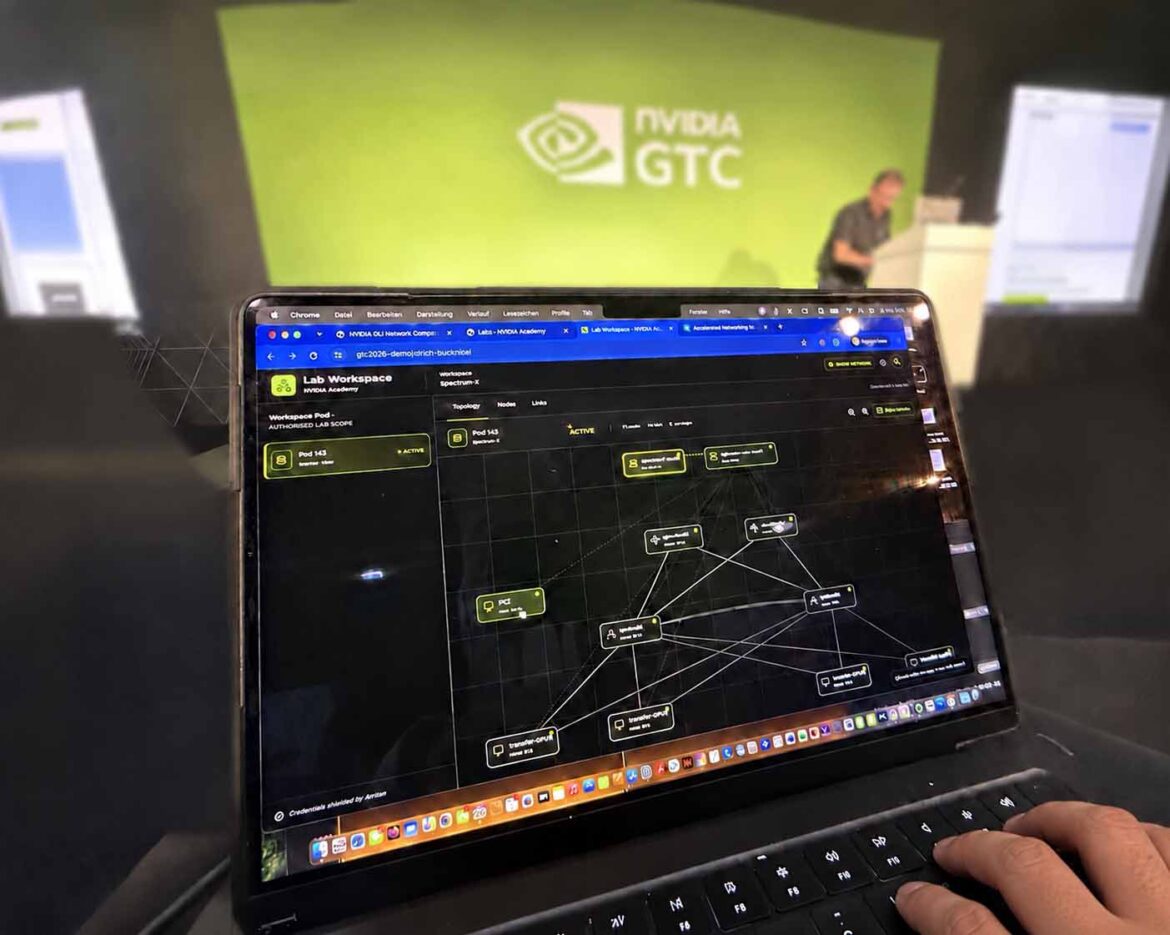
Those who practice in a digital twin are allowed to make mistakes that would be expensive in real operations.
Photo: In the hands-on workshop at NVIDIA GTC Berlin, an AI data center becomes a practice space without operational risk | Photo: © Ulrich Buckenlei | XR Stager Online Magazin | VISORIC GmbH
Berlin, October 20, 2026, workshop day at NVIDIA GTC. A network topology glows on the laptop: switches, servers and GPU nodes, connected by fine lines. Workstation Pod 143 reports “Active”. On stage, the trainer explains the architecture of a data center network for artificial intelligence, while exactly this architecture is ready on one’s own screen as an operable system. Participants log in to switches, enter commands, check connections and deliberately trigger faults. None of these servers is in the room. The entire data center exists as a digital twin.
The method behind it is older than any AI. Pilots have trained in flight simulators for decades before flying a real aircraft. What is new is that this principle can now be applied to almost any technology: to networks, machines, entire factories and to collaboration with robots and AI assistants. A link in the browser is all it takes, and each person works in their own complete environment.
For companies, this becomes a key question. AI systems and robots are moving into factory halls, data centers and offices faster than conventional training concepts can keep up. Anyone who wants to prepare employees for this collaboration needs learning spaces where real tasks can be practiced without endangering ongoing operations. These very learning spaces are emerging right now, and they are changing how companies build competence.
For HR managers, innovation departments and technical leaders, this is an investment question. This article follows the path step by step: from the data center in the browser via the limits of conventional training, the question of what defines a learning twin and the findings of learning research to the factory hall, the collaboration between humans and machines, the measurement of learning success and the first pilot project.
- A complete AI data center can now be trained virtually.
- Learning twins combine real system behavior with zero operational risk.
- Learning research confirms the advantage of active practice.
- The same principle extends to the factory hall and the robot.
- A small, measurable pilot is the best way to start.
The following article shows how a learning twin works, why it complements conventional training, how it prepares people to work with AI and robots and how companies can prove its benefits.
A Data Center That Exists Only in the Browser
The workshop begins with a browser window. It opens a workspace with the topology of a data center network: spine and leaf switches, servers, GPU nodes for different tenants. Behind every icon is a running system with a real operating system. Clicking on a node opens a console where participants work with the same commands as in a real data center. NVIDIA describes this principle with NVIDIA Air as a platform that replicates data center networks as a digital twin, using the same network operating systems and configurations as in production.[1]
The reason for this effort lies in the technology itself. The workshop covers NVIDIA Spectrum-X, an Ethernet platform developed specifically for networking large AI data centers.[2] Such systems connect thousands of graphics processors, which only compute efficiently if the network is precisely configured. No company makes a running AI cluster available for training, and hardly any company can provide a dedicated test environment made of real hardware for every specialist.
The digital twin solves both problems at once. Each participant receives their own complete network. A wrong command takes down a connection, and in the twin this has no consequences. In real operations, hundreds of graphics processors might be at a standstill at this point. Here, restarting the exercise is enough. The mistake becomes a learning experience, the cause becomes visible, and the correction can be tried out immediately.
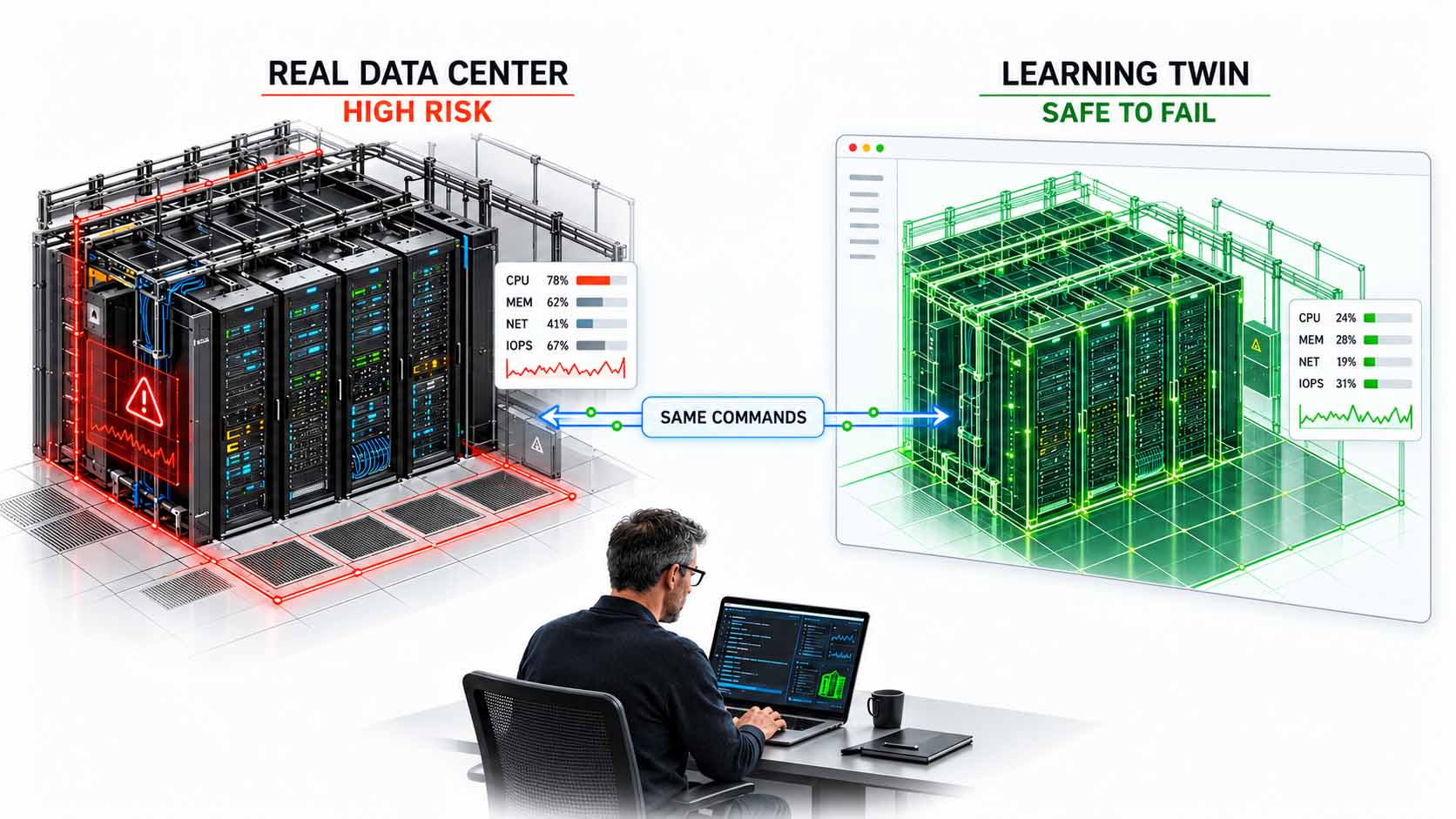
The exercise is virtual, the commands are real.
Infographic: A learning twin responds like the real technology, but mistakes have no consequences for operations | Graphic: © Ulrich Buckenlei | XR Stager Online Magazin | VISORIC GmbH
For companies, the example shows a decisive difference from many previous forms of training. Those who learn in the twin operate the same interface and experience the same system behavior as later on the job. What has been learned does not first have to be translated, it can be transferred directly. Scaling is another factor: at a conference, dozens of people work simultaneously in identical environments, each with the same initial state. A trainer can introduce a fault for everyone at once and then compare how differently the group resolves it. This comparability is hardly achievable in real installations, because no two machines, networks or shifts are exactly the same.
It was also remarkable how natural it all felt. Nobody had to install software, nobody waited for hardware. After a few minutes, everyone was working on the same task. The next chapter shows why conventional training reaches its limits with AI and robotics.
- The workshop ran in a virtual data center network in the browser.
- Behind every icon, a real system works with real commands.
- Spectrum-X networks AI data centers with thousands of graphics processors.
- Mistakes in the twin cost nothing and explain a lot.
- Identical environments make learning progress comparable.
A data center in the browser is therefore more than a technical gimmick. It shows what learning looks like when practice and real operations speak the same language.
Why Conventional Training Reaches Its Limits with AI
The pace of change is measurable. According to the World Economic Forum’s Future of Jobs Report 2025, employers expect around 39 percent of today’s core skills to change by 2030. Accordingly, 59 out of 100 workers will need upskilling or reskilling by 2030.[3] AI and information technology are among the strongest drivers of this development.
Many training programs nevertheless follow a familiar pattern: presentation, learning video, knowledge test, then back to the workplace. A gap remains between knowing and being able to do. Those who have only listened have to make their first real moves later in operations, often under time pressure. Forgetting adds to this. A replication of Hermann Ebbinghaus’ classic forgetting curve by Murre and Dros confirmed that a large proportion of newly learned material is lost within the first hours and days if it is not repeated and applied.[4]
With AI and robotics, three factors aggravate this problem. The hardware is expensive and scarce, and practice equipment is rarely available. Mistakes in ongoing operations are risky because systems are tightly interlinked. And the cycles are short: a software update can change interfaces, workflows and capabilities within a few weeks. A training manual is then outdated before it is printed.
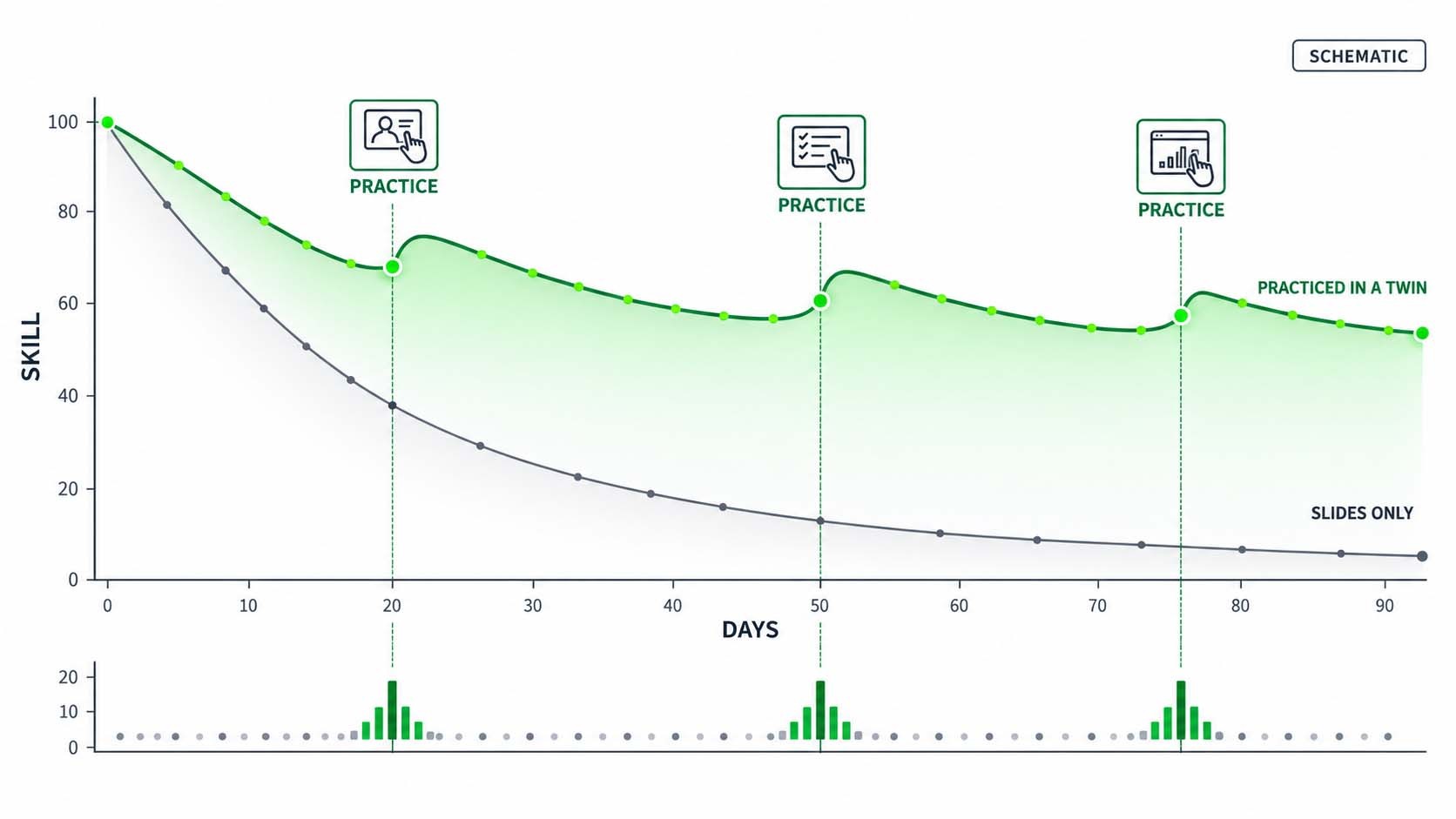
Technology changes faster than any curriculum.
Infographic: Knowledge that is not applied fades quickly, regular practice in the twin keeps skills alive (schematic representation) | Graphic: © Ulrich Buckenlei | XR Stager Online Magazin | VISORIC GmbH
For companies, this shifts the question. More training hours hardly solve the problem. What matters is where people can practice. Practice needs a place where mistakes are allowed, and the running data center or the producing line is not that place. Nobody wants the first contact with a collaborative robot or an AI assistant to happen on the night shift when no expert is available. At the same time, short innovation cycles demand forms of learning that can be updated quickly. A digital twin can be adapted as soon as the real system changes. It grows with the technology instead of lagging behind it.
Conventional formats retain their place, for example for fundamentals, safety briefings and background knowledge. But they need a complement in which knowledge turns into action. The next chapter shows what defines such a learning space.
- Around 39 percent of core skills will change by 2030.
- 59 out of 100 workers will need training by then.
- Unpracticed knowledge is largely lost within the first days.
- Expensive hardware and operational risks prevent real practice.
- Learning spaces must adapt as quickly as the technology.
The limit of conventional training therefore lies less in the content than in the missing practice space.
What Distinguishes a Learning Twin from a Simulation
The term digital twin goes back to Michael Grieves. He described the concept as a connection between the physical product, the virtual product and the data flow between the two. The aim was to detect and understand unexpected behavior of complex systems earlier.[5] This very understanding is also at the core of learning.
A learning twin is a digital twin that is used to train people. It behaves like the real system and uses the same user interfaces and commands. At the same time, it is deliberately decoupled from ongoing operations, can be reset at any time and can be specifically injected with faults. Madni, Madni and Lucero distinguish several maturity levels of digital twins, from the simple pre-digital twin via the synchronized twin to adaptive and intelligent variants that learn from data.[6] For training, this classification is helpful: initial fundamentals often succeed with a simple level, while complex fault patterns require a more accurate replica.
The most important benchmark is behavioral fidelity. A photorealistically designed space is of little help if the machine in it reacts incorrectly. Conversely, a simple representation can be very effective as long as cause and effect are right. In the GTC workshop, the topology was graphically simple, but the behavior of every node was fully realistic.
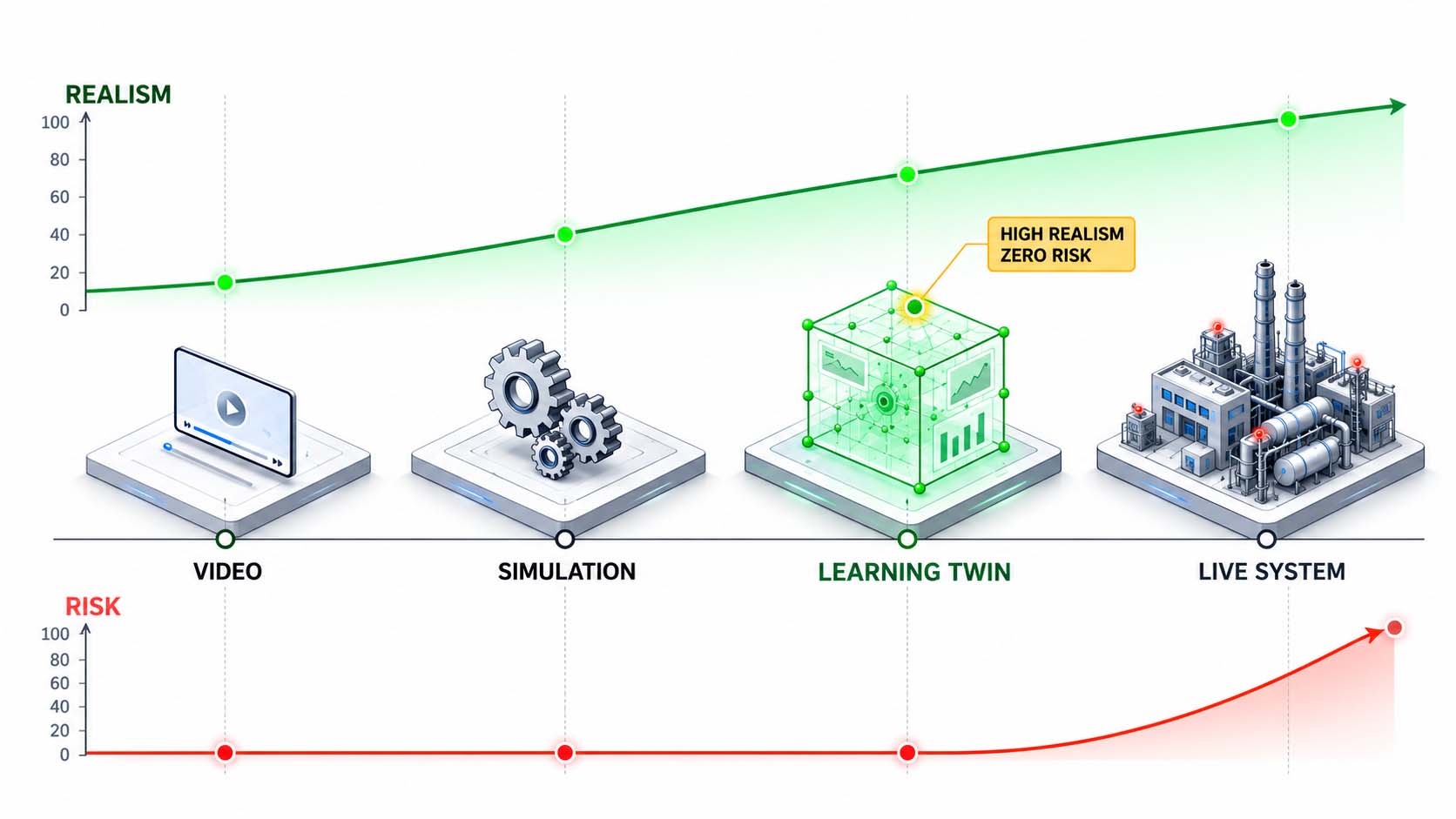
A learning twin behaves like the real system, just without its risks.
Infographic: The learning twin combines high realism with zero risk, closing the gap between simulation and real operations | Graphic: © Ulrich Buckenlei | XR Stager Online Magazin | VISORIC GmbH
| Format | What is learned | Realism | Consequences of a mistake | Typical use |
|---|---|---|---|---|
| Learning video | Knowledge of procedures | Low | None | Introduction and fundamentals |
| Simulation | Principles and relationships | Medium | None | Understanding variants |
| Learning twin | Real tasks on real system behavior | High | None, the exercise can be reset | Training critical tasks |
| Production system | Routine in real operations | Complete | High, up to a standstill | Supervised work |
Overview: Learning formats compared, own classification based on the cited work on digital twins | Table: © Ulrich Buckenlei | XR Stager Online Magazin | VISORIC GmbH
For companies, this results in a simple decision rule. The more expensive a mistake is in real operations, the more the practice belongs in the learning twin. Rare but critical situations benefit in particular: a network outage, a fault in a robot cell, a restart after an emergency stop. Many specialists rarely experience such situations in everyday work, but must master them reliably when they occur. In the twin, they can be repeated as often as needed. Another advantage lies in the defined initial state. A trainer sets up a scenario such as “Link three faulty”, and all learners start from exactly the same situation. This makes it possible to compare, discuss and improve approaches to a solution.
The learning twin therefore replaces neither basic training nor onboarding at the real workplace. It closes the gap in between. The next chapter shows why this active practice is so effective.
- Grieves described the twin as object, replica and data combined.
- A learning twin uses this replica specifically to train people.
- Maturity levels help to choose the right level of accuracy.
- Behavioral fidelity matters more than photorealism.
- The more expensive a mistake, the more practice belongs in the twin.
A learning twin is thus the place where understanding turns into confident ability.
Learning by Doing, Mistakes Without Consequences
Educational theorist David Kolb described learning as a cycle of four phases: concrete experience, reflection, generalization into a concept and active experimentation.[8] In the classroom, such a cycle often takes weeks. In the learning twin, it can be run through several times within an hour: enter a command, observe the effect, understand the cause, test a better solution.
A widely cited meta-analysis by Scott Freeman and colleagues shows how powerful active learning is. The team evaluated 225 studies on science and engineering courses. In traditional lectures, students were around one and a half times more likely to fail than in courses with active learning formats. With active learning, exam performance was on average about six percent higher.[7]
A particular lever is the deliberate handling of mistakes. In real operations, mistakes are avoided, and rightly so. For learning, however, this means that many people only know faults from theory. In the twin, a trainer can deliberately inject faults, such as a misconfigured interface or a failed sensor. The learners have to find the cause themselves. This creates an understanding of relationships that no manual can convey.
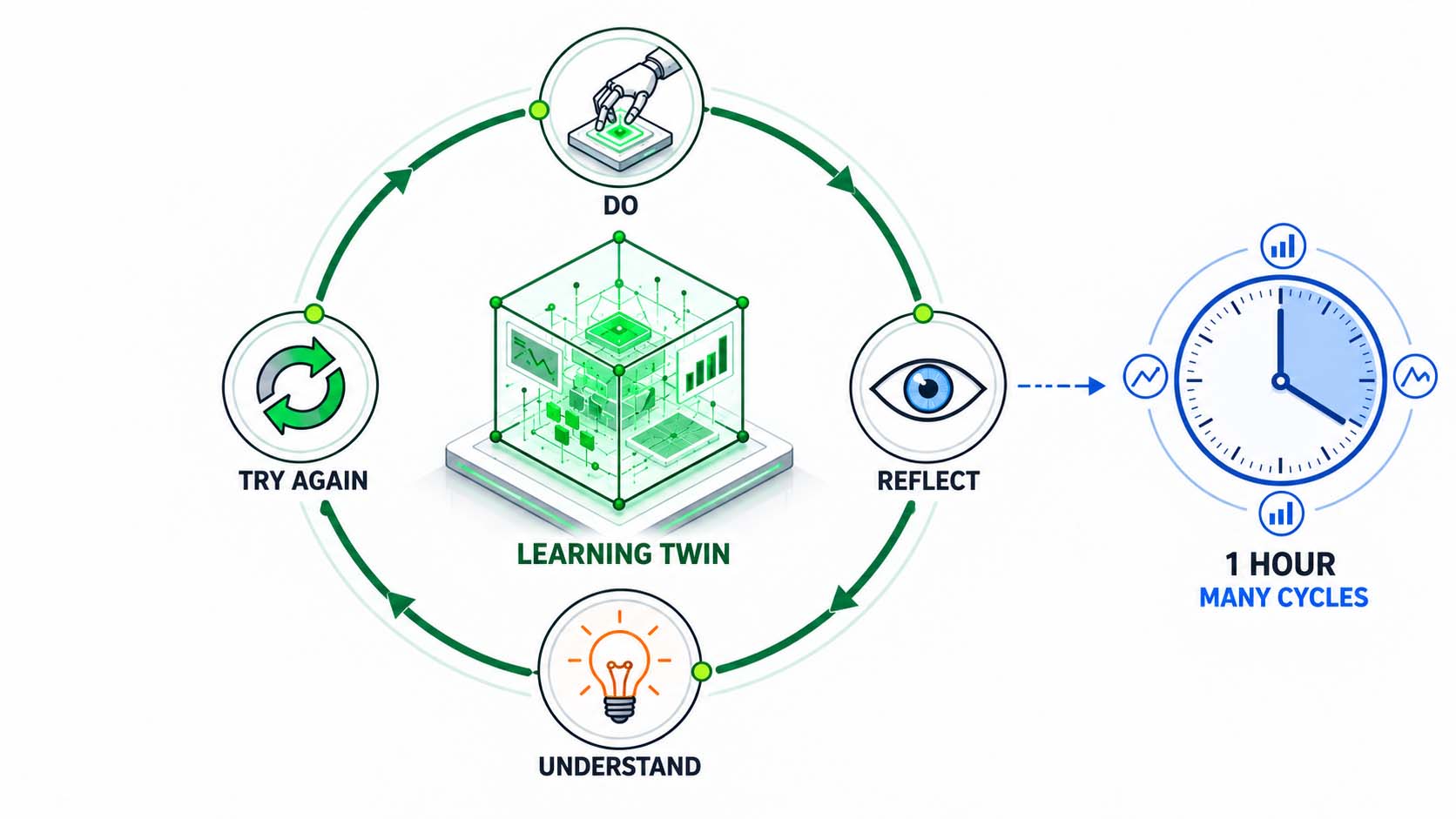
Understanding comes from doing, not from watching.
Infographic: In the learning twin, the learning cycle of doing, reflecting, understanding and trying again is run through several times in a short period | Graphic: © Ulrich Buckenlei | XR Stager Online Magazin | VISORIC GmbH
For companies, this means: the quality of a learning twin is determined less by its graphics than by the design of its exercises. A good learning scenario has a clear task, a realistic fault, immediate feedback and a debriefing in which approaches to a solution are compared. It starts with manageable situations and increases the difficulty step by step. Help is offered but not imposed. An honest classification of the research is also important. Freeman and colleagues studied university courses. Transferring the findings to professional training is plausible but should be verified with the company’s own measurements.
This is where the real conceptual work lies. Technology makes the twin possible, didactics make it effective. The next chapter shows how this principle finds its way from the data center to the factory hall.
- Kolb’s learning cycle combines experience, reflection, concept and experiment.
- In the twin, this cycle can be run several times per hour.
- Active learning significantly reduced the failure rate.
- Deliberately injected faults create real understanding.
- Good exercises matter more than elaborate graphics.
Active practice is therefore the core of every effective learning twin, and its design is a discipline in its own right.
From the Network Exercise to the Factory Hall
What works in the data center is currently spreading in industry. Robots learn and are tested before they enter a real hall. NVIDIA Isaac Sim is a simulation environment in which robots are developed, trained and tested in physically accurate virtual worlds.[9] Camera images, sensor data, gripping movements and travel paths are created there digitally first.
The concept of using entire facilities as a digital twin for robot fleets goes one step further. With the Omniverse Blueprint Mega, NVIDIA has presented a reference architecture that enables companies to test entire fleets of robots in a digital twin of their factory or warehouse before deploying them in the real facility.[10] As a result, more and more companies now have a detailed, behaviorally accurate replica of their own production.
This leads to an obvious idea. If the robot makes its first movements in the twin, people can also have their first encounters with it there. Employees experience how a mobile robot moves through the hall, where protective zones are, how a gripper reacts and how an AI assistant classifies a fault. All of this happens before the real facility goes into operation.

What applies to servers also applies to robots.
Infographic: The learning twin method extends from the data center to the factory hall, where humans and robots practice in the same virtual space before go-live | Graphic: © Ulrich Buckenlei | XR Stager Online Magazin | VISORIC GmbH
For companies, this creates a twofold benefit. A twin that is built anyway for layout planning, robot programming or commissioning can become a training environment with manageable additional effort. Training then does not begin after the facility starts up, but weeks beforehand. However, a planning tool is not automatically a learning space. Planners need level of detail and parameters, while learners need tasks, orientation, feedback and simplified views. A learning twin therefore requires its own didactic layer: scenarios, roles, difficulty levels and a language that specialists without prior knowledge can understand.
This layer determines whether a digital twin is used only by specialists or whether it reaches the entire workforce. The next chapter shows why people retain the central role in this collaboration.
- Robots are now trained and tested in simulations first.
- Isaac Sim replicates robots and environments with physical accuracy.
- Mega tests entire robot fleets in the factory twin.
- The same twin can prepare people for go-live.
- A planning tool only becomes a learning space through didactics.
The factory of the future will therefore be commissioned twice, first virtually with humans and robots together, then in reality.
People Remain Part of the System
Collaboration with AI and robots creates new roles. People monitor processes, intervene when deviations occur, take over tasks from machines and hand them back. Legislators have explicitly addressed this responsibility. Since February 2, 2025, Article 4 of the European AI Act has required providers and deployers of AI systems to ensure a sufficient level of AI literacy among their staff.[11]
In robotics, too, people are an integral part of the safety assessment. The revised standard ISO 10218-2:2025 specifies safety requirements for robot applications and robot cells and also takes into account collaborative applications in which humans and robots share a workspace.[12] Technical protective measures work best when the people in the cell understand the robot’s behavior and respond to it correctly.
A third aspect is trust. Employees must learn when to follow a recommendation from an AI assistant and when to challenge it. This calibrated trust develops through experience, and that includes situations in which the system is wrong. In the learning twin, a trainer can deliberately introduce a faulty AI recommendation and observe whether the team recognizes it.
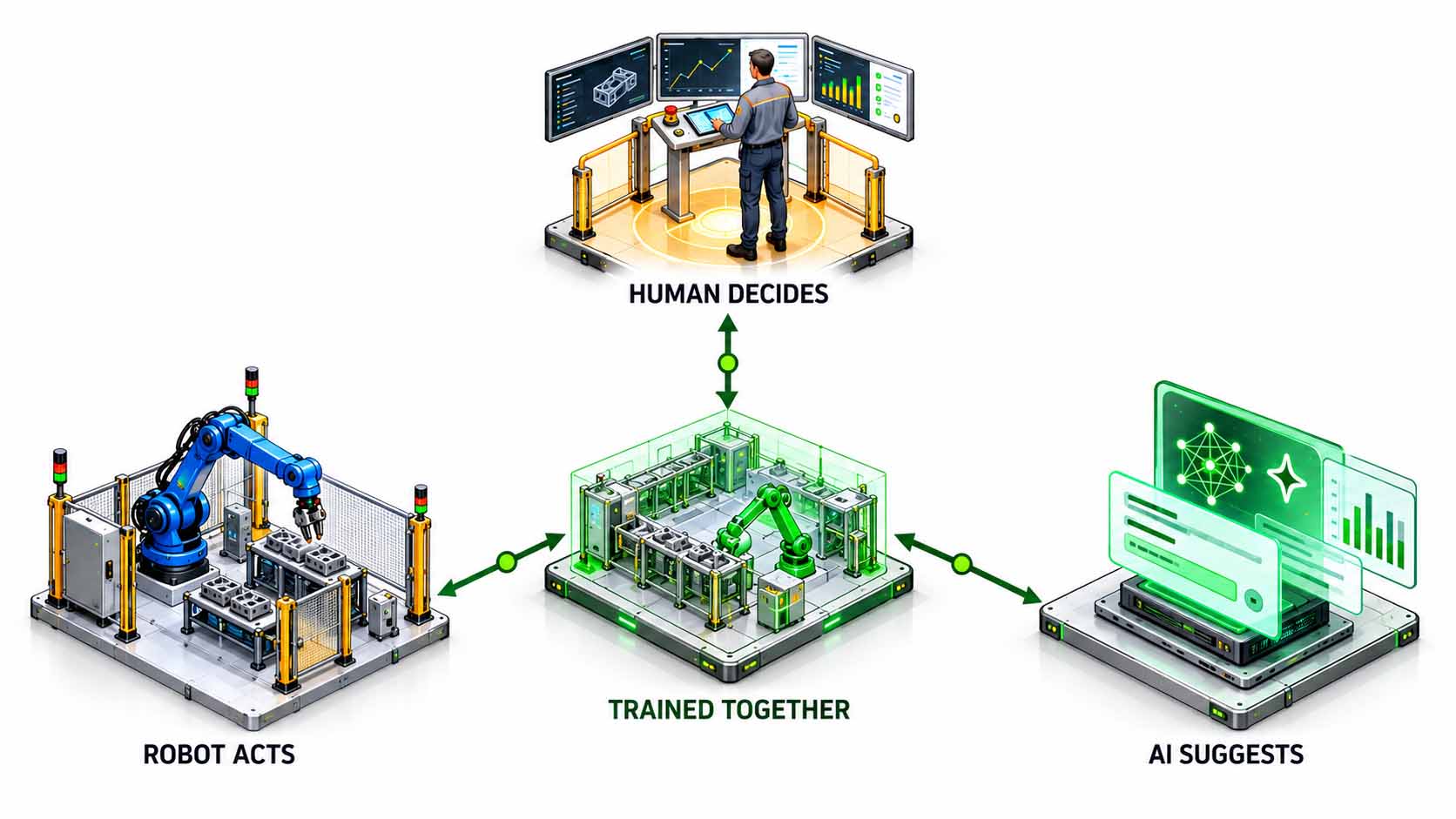
Collaboration has to be practiced before it happens in operations.
Infographic: Human, robot and AI assistant form a team that practices its roles in the learning twin before working together in real operations | Graphic: © Ulrich Buckenlei | XR Stager Online Magazin | VISORIC GmbH
For companies, concrete training scenarios can be derived from this. A robot stops unexpectedly in the middle of a process. An AI assistant suggests a cause that is not correct. At a shift handover, a half-completed process must be taken over correctly. A sensor delivers contradictory values, and the team must decide which source to trust. Such situations are rare in real operations and at the same time decisive. In the twin, they become repeatable exercises. A side effect is traceability: those who document which scenarios employees have practiced and mastered are better able to demonstrate how the company builds AI literacy. This does not replace a legal review, but it provides a solid basis.
People are therefore not pushed to the margins, they become the decisive authority that understands the overall system. The next chapter shows how companies measure whether this preparation works.
- Since February 2025, the AI Act has required AI literacy among staff.
- ISO 10218-2:2025 governs the safety of robot applications.
- Calibrated trust in AI only develops through experience.
- Rare incidents become repeatable exercises in the twin.
- Documented exercises make competence building traceable.
Collaboration with AI and robots thus becomes a skill that can be trained in a targeted way.
How Companies Measure Learning Success
Donald Kirkpatrick’s model has become established for evaluating training. It distinguishes four levels: the participants’ reaction, learning success, changed behavior at the workplace and results for the company.[13] In practice, evaluation often stops at the first level, the feedback form at the end of the course.
A learning twin changes this starting point because every exercise generates data. Which commands were entered in which order? How long did troubleshooting take? When was help requested? For capturing such learning experiences, there is a standard, the Experience API, xAPI for short, which has since been adopted as IEEE 9274.1.1-2023. It describes learning activities as simple statements following the pattern “actor, verb, object” and makes them exchangeable between systems.[14]
This also makes it possible to reach the upper levels of the Kirkpatrick model. Meaningful metrics include the time to a correct diagnosis, the number of attempts until a solution, the type of errors and the development over several exercises. When these values are linked to operational figures, such as downtime or queries to experts, the contribution of training to business success becomes visible.
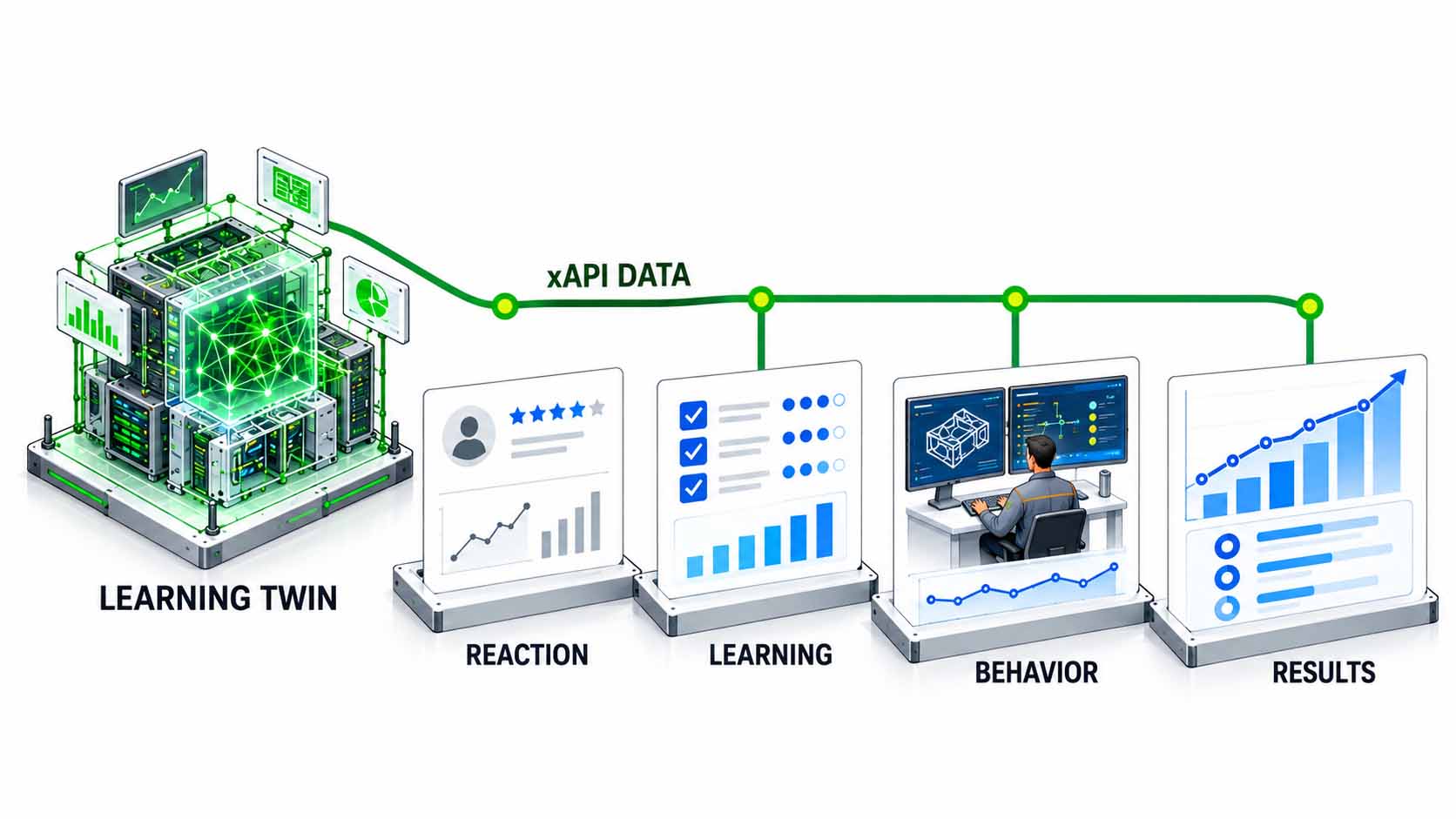
Every exercise leaves data behind.
Infographic: A learning twin provides data that can prove learning success and behavioral change, far beyond the feedback form | Graphic: © Ulrich Buckenlei | XR Stager Online Magazin | VISORIC GmbH
For companies, the rule is: measuring requires a comparison. Before the pilot project, it should be clear how long a typical troubleshooting process takes today and how often queries occur. Only then can it be shown what the learning twin changes. Equally important is the responsible handling of data. Learning data is personal data. The purpose of its evaluation must be clearly defined, the works council should be involved at an early stage, and for evaluating the training, aggregated values are sufficient in many cases instead of individual profiles. A learning twin should empower people, not monitor them. Those who regulate this clearly from the outset gain acceptance and honest data.
Good measurement is therefore not a bureaucratic add-on. It makes visible whether the training fulfills its purpose. The next chapter shows what a first step looks like.
- Kirkpatrick distinguishes reaction, learning, behavior and results.
- Many training programs are only evaluated at the first level.
- A learning twin generates analyzable data with every exercise.
- xAPI makes learning data exchangeable as an IEEE standard.
- Data protection and co-determination belong from the start.
Learning success thus becomes measurable, and training becomes an investment with demonstrable impact.
The First Step Toward Your Own Learning Twin
The effectiveness of computer-based simulations is well researched. In a meta-analysis, Traci Sitzmann evaluated 65 samples. Compared with other groups, participants who had learned with simulation games showed 20 percent higher self-efficacy, 11 percent more declarative knowledge and 14 percent more procedural knowledge, and retained what they had learned 9 percent better. The effects were strongest when learners worked actively and could use the simulation as often as they wanted.[15]
Whether what has been learned reaches everyday work, however, does not depend on the training alone. In their review on the transfer of training, Grossman and Salas show that three areas interact: the learners themselves, the design of the training and the work environment. Realistic training environments, a deliberate approach to errors, support from supervisors and the opportunity to apply what has been learned significantly increase transfer.[16]
This results in a clear starting point. A pilot project begins with a single task that is rare, critical or expensive: troubleshooting a network segment, restarting a robot cell, commissioning a machine. For exactly this task, a learning twin is created with a few well-designed scenarios and one metric that proves success.
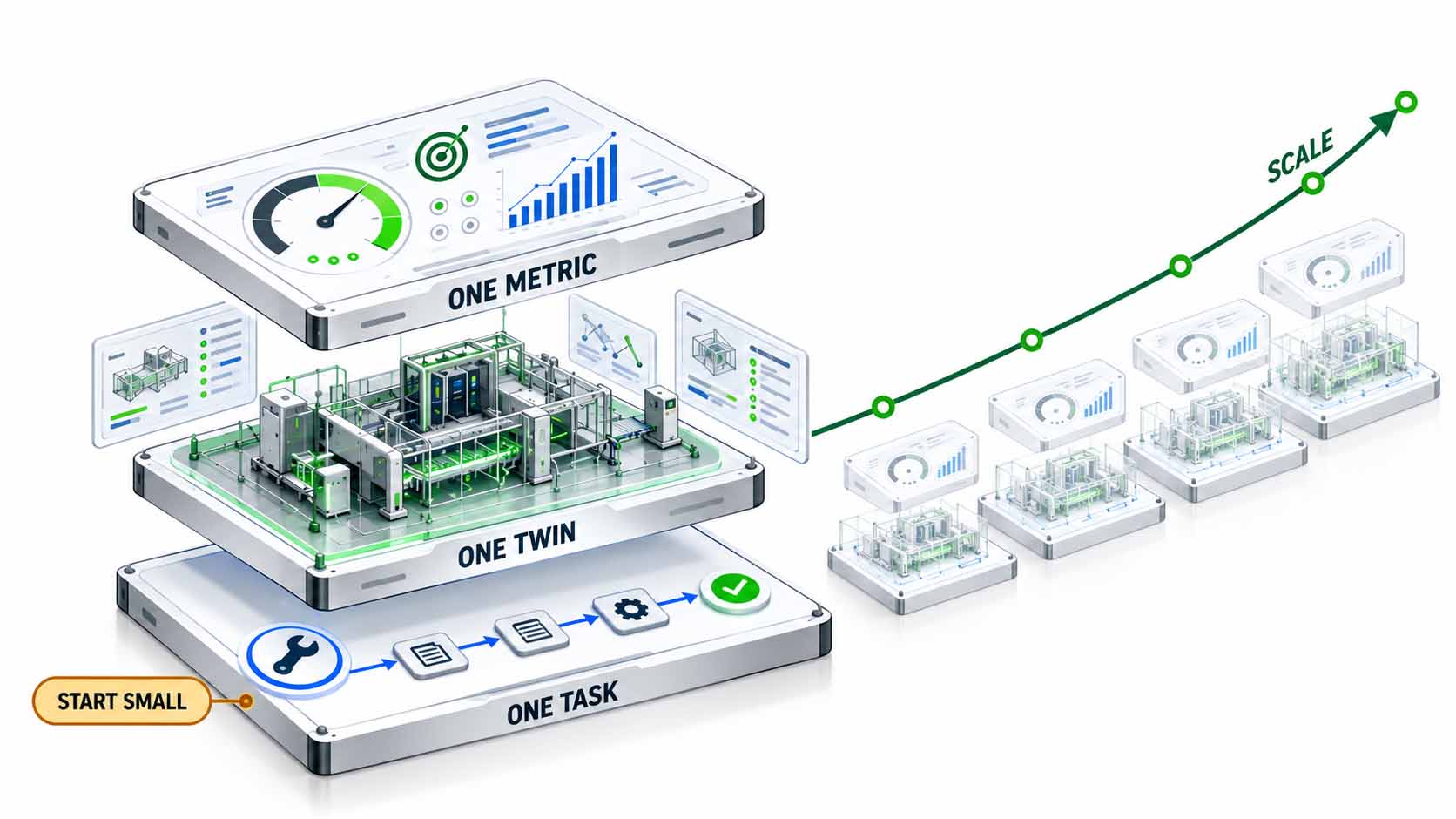
Start small, with one critical task.
Infographic: One task, one twin and one metric form the foundation on which a learning twin with demonstrable benefits can grow | Graphic: © Ulrich Buckenlei | XR Stager Online Magazin | VISORIC GmbH
For companies, it is worth taking a look at their own knowledge holders. Long-standing specialists know which faults really occur, which mistakes newcomers typically make and which tasks are not described in any manual. If they are involved as co-authors of the scenarios, their knowledge flows directly into the learning twin. Especially in view of upcoming retirements, this secures know-how that would otherwise be lost. The pilot is carried out with a real learning group and compared with the previous training. Only when this small cycle works is it worth expanding to further tasks, locations and target groups.
Such a start requires manageable effort and quickly delivers reliable results. The following chapter shows the GTC Berlin workshop on video.
- Simulations measurably increase knowledge, skills and self-confidence.
- Active and repeatable practice strengthens the effect.
- Transfer succeeds when training and work environment fit together.
- A pilot begins with a rare, critical task.
- Experienced specialists become authors of the scenarios.
The path to your own learning twin therefore begins not with technology, but with the question of which task most urgently needs to be practiced.
Learning in the Digital Twin at GTC Berlin on Video
The video was recorded during the hands-on workshop on the workshop day of NVIDIA GTC Berlin on October 20, 2026.[17] Ulrich Buckenlei attended the workshop himself and captured the atmosphere in the room: the stage with the trainer, the rows of participants and the working environment on his own laptop with the topology of an AI data center network.
The strongest impression arises from the interplay of stage and screen. At the front, the architecture is explained, and on one’s own device the same architecture is ready as an operable twin. Listening and trying out merge into a single activity. This very connection is what makes the difference from a conventional lecture.
The framework for this is well established. The NVIDIA Deep Learning Institute offers hands-on workshops worldwide in which participants work in fully equipped cloud environments.[18] What is new is how naturally such environments now replicate entire data centers.
Video: In the NVIDIA GTC Berlin 2026 workshop, each participant works in their own virtual data center | Recording, editing and analysis: © Ulrich Buckenlei | XR Stager Online Magazin | VISORIC GmbH
It is remarkable how little of the complexity behind it becomes visible. Hundreds of virtual systems run in parallel, and for the participants it feels like an ordinary browser window.
Equally important for the assessment: the video shows a training environment for network specialists, not a factory and not a robot. But it makes visible the principle that can be transferred to any complex technology. The real question points to the next level: which task in a company could be practiced in exactly this way?
- The video was recorded at the GTC Berlin 2026 hands-on workshop.
- Stage and screen show the same architecture.
- Each participant works in their own twin.
- The complexity remains hidden behind a simple interface.
- The principle can be transferred to any complex technology.
The video thus shows what the chapters describe: learning becomes effective when people operate real technology without taking real risks.
Effective Learning Starts with the Right Concept
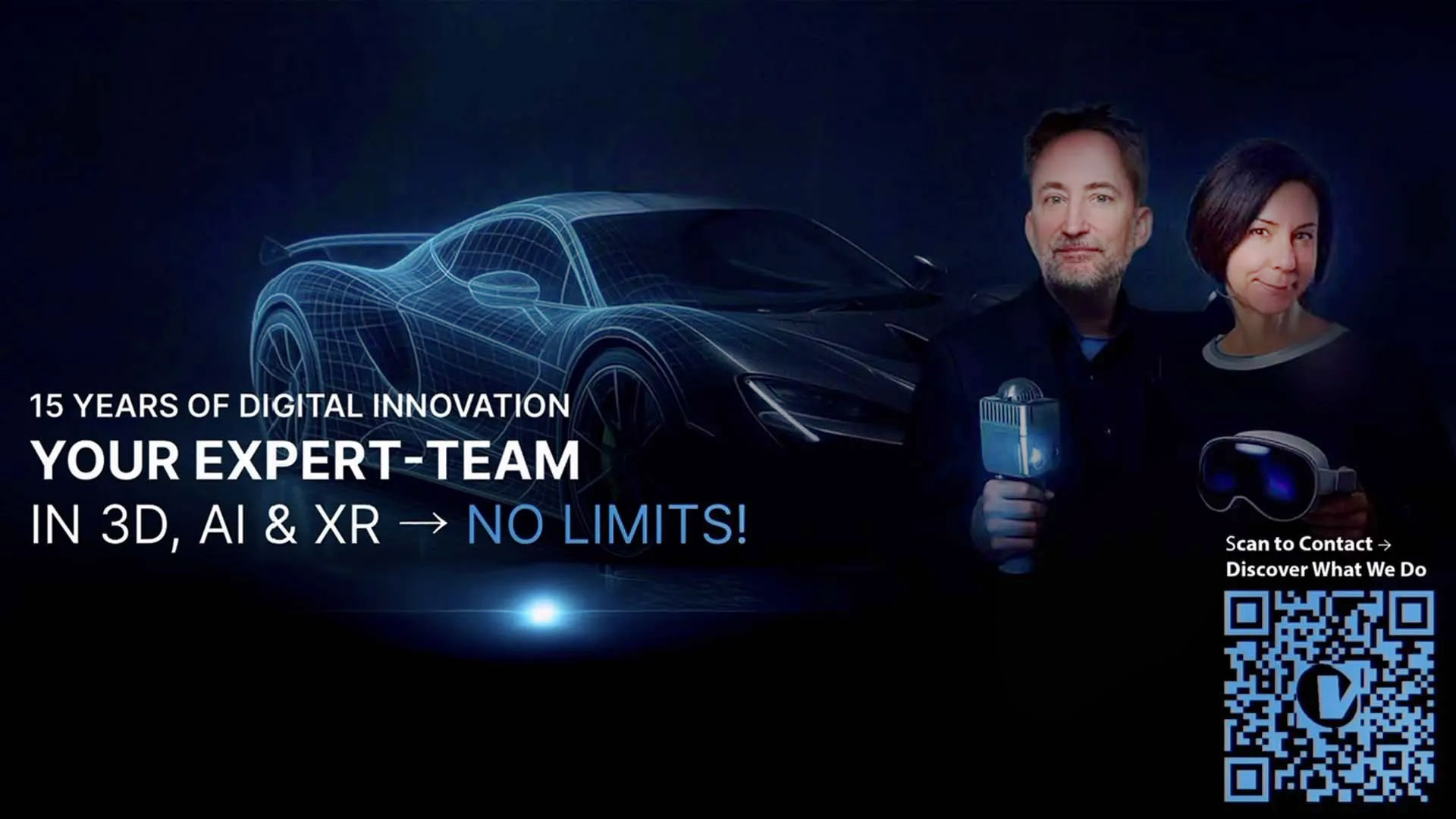
An effective learning twin is created from two kinds of knowledge. The company knows its tasks, its risks and the people who are to work with new technology. Implementation requires experience in didactics, 3D worlds, AI and user interfaces that specialists can understand without lengthy onboarding. This combination is at the heart of Ulrich Buckenlei’s work.
For more than 25 years, the graduate technical writer (Diplom-Technikredakteur) has been developing computer-based training and designing learning environments, training platforms and digital twins for industry and mid-sized companies. His focus is on making complex technology understandable, tangible and learnable. His concepts are implemented together with the team of VISORIC GmbH in Munich on the XR Stager platform, in the browser, on large displays or in XR.
Knowledge of the task and knowledge of didactics together create an effective learning twin.
Photo: The company contributes task, risk and experience, and the concept turns them into a learning space with measurable impact | © Ulrich Buckenlei | XR Stager Online Magazin | VISORIC GmbH
Getting started does not have to be big. A compact concept workshop is a good first step, in which a critical task is selected, the existing data and models are reviewed and a first learning scenario is outlined. It also defines which metric proves success and how knowledge holders from the company will be involved. On this basis, a pilot is created that is tested with a real learning group and compared with the previous training.
- Select a critical task that is difficult to practice today.
- A learning scenario with realistic faults and clear feedback.
- A pilot with a real learning group, measured against previous training.
Precisely because AI and robots are now arriving in companies, now is the right time to prepare people for them in a targeted way.
Which task should your employees practice first in the digital twin?
Talk to Ulrich Buckenlei. Together, we can clarify which task is suitable for a learning twin, which data already exists and what a first pilot could look like.
Contact:
Email: info@visoric.com
Phone: +49 89 21552678
Sources and References
- NVIDIA. NVIDIA Air, platform for simulating data center networks as a digital twin. air.nvidia.com.
- NVIDIA. Spectrum-X Ethernet platform for AI data centers. nvidia.com/en-us/networking/spectrumx.
- World Economic Forum. The Future of Jobs Report 2025. Geneva, January 2025. weforum.org/publications/the-future-of-jobs-report-2025.
- Murre, J. M. J., Dros, J. Replication and Analysis of Ebbinghaus’ Forgetting Curve. PLOS ONE 10(7), e0120644, 2015. doi.org/10.1371/journal.pone.0120644.
- Grieves, M., Vickers, J. Digital Twin: Mitigating Unpredictable, Undesirable Emergent Behavior in Complex Systems. In: Transdisciplinary Perspectives on Complex Systems, Springer, 2017, pp. 85 to 113. doi.org/10.1007/978-3-319-38756-7_4.
- Madni, A. M., Madni, C. C., Lucero, S. D. Leveraging Digital Twin Technology in Model-Based Systems Engineering. Systems 7(1), 7, 2019. doi.org/10.3390/systems7010007.
- Freeman, S., Eddy, S. L., McDonough, M. et al. Active learning increases student performance in science, engineering, and mathematics. PNAS 111(23), 8410 to 8415, 2014. doi.org/10.1073/pnas.1319030111.
- Kolb, D. A. Experiential Learning. Experience as the Source of Learning and Development. 2nd edition, Pearson, 2015.
- NVIDIA. Isaac Sim, reference application for robotics simulation based on Omniverse. developer.nvidia.com/isaac/sim.
- NVIDIA. Mega, Omniverse Blueprint for testing robot fleets in digital twins of industrial facilities, presented in January 2025. nvidianews.nvidia.com.
- Regulation (EU) 2024/1689 laying down harmonised rules on artificial intelligence (AI Act), Article 4 AI literacy, applicable since February 2, 2025. eur-lex.europa.eu/eli/reg/2024/1689/oj.
- ISO 10218-2:2025. Robotics, Safety requirements, Part 2, Industrial robot applications and robot cells. iso.org.
- Kirkpatrick, J. D., Kirkpatrick, W. K. Kirkpatrick’s Four Levels of Training Evaluation. ATD Press, 2016.
- IEEE 9274.1.1-2023. IEEE Standard for Learning Technology, JSON Data Model Format and RESTful Web Service for Learner Experience Data Tracking and Access (xAPI). standards.ieee.org.
- Sitzmann, T. A meta-analytic examination of the instructional effectiveness of computer-based simulation games. Personnel Psychology 64(2), 489 to 528, 2011. doi.org/10.1111/j.1744-6570.2011.01190.x.
- Grossman, R., Salas, E. The transfer of training: what really matters. International Journal of Training and Development 15(2), 103 to 120, 2011. doi.org/10.1111/j.1468-2419.2011.00373.x.
- NVIDIA. GTC Berlin 2026, conference and workshop program, October 20 to 22, 2026. nvidia.com/gtc.
- NVIDIA Deep Learning Institute. Hands-on workshops and courses with cloud lab environments. nvidia.com/en-us/training.
- More than 25 years of practical experience by Ulrich Buckenlei in designing computer-based training, learning environments and digital twins.
- XR Stager platform for real-time 3D, digital twins and training applications in the browser, on large displays and in XR.
Contact Persons:
Ulrich Buckenlei (Creative Director)
Mobile: +49 152 53532871
Email: ulrich.buckenlei@visoric.com
Nataliya Daniltseva (Project Manager)
Mobile: +49 176 72805705
Email: nataliya.daniltseva@visoric.com
Address:
VISORIC GmbH
Bayerstraße 13
D-80335 Munich