

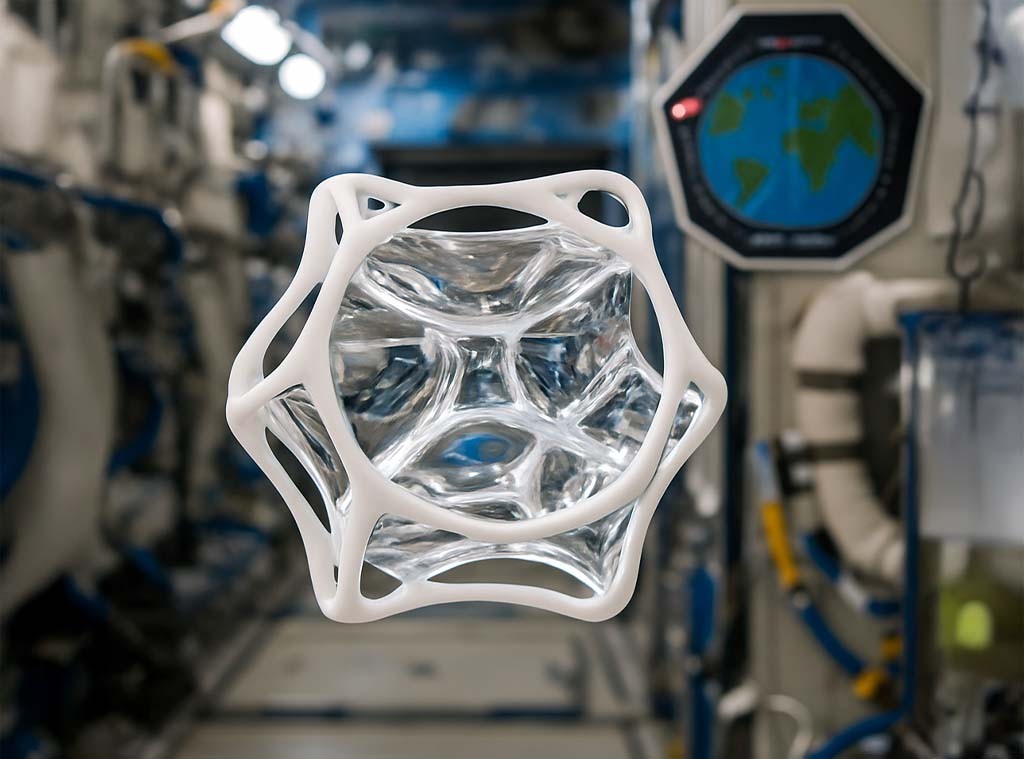
The first spatial form with negative surface curvature as 3D modeling from outer space
Image: Visualization of a fluid experiment in the microgravity laboratory of the ISS, compositing by Ulrich Buckenlei | Visoric 2025
Water shapes in microgravity reveal new geometries
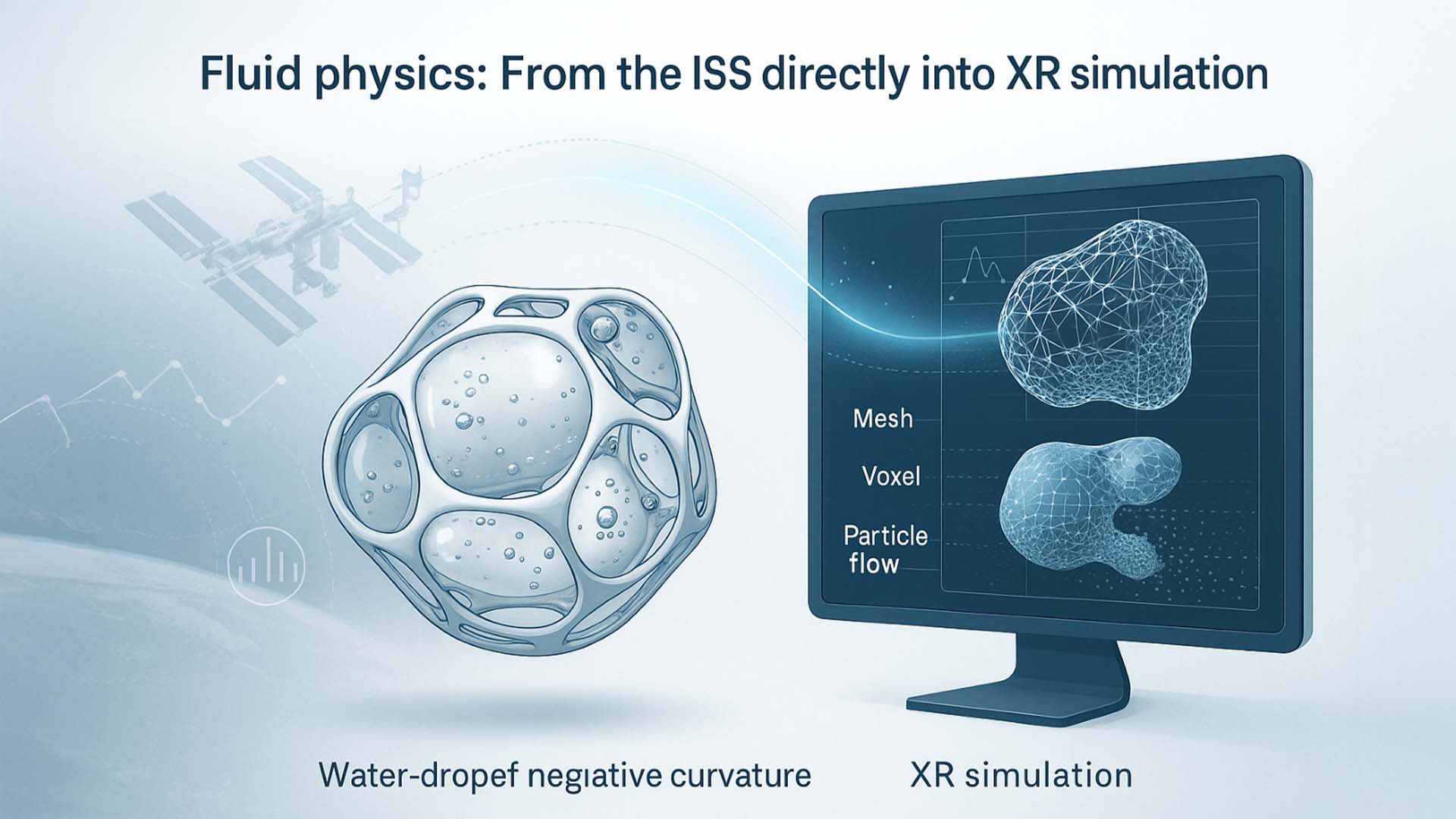
In the microgravity of the International Space Station ISS, water forms a spatial structure with negative surface curvature, held only by surface tension.
These rare conditions generate data that can hardly be captured on Earth. The Visoric expert team in Munich uses such experiments as a foundation to translate the physics behind them into precise 3D models as well as VR and mixed reality simulations, opening new possibilities for research and industry.
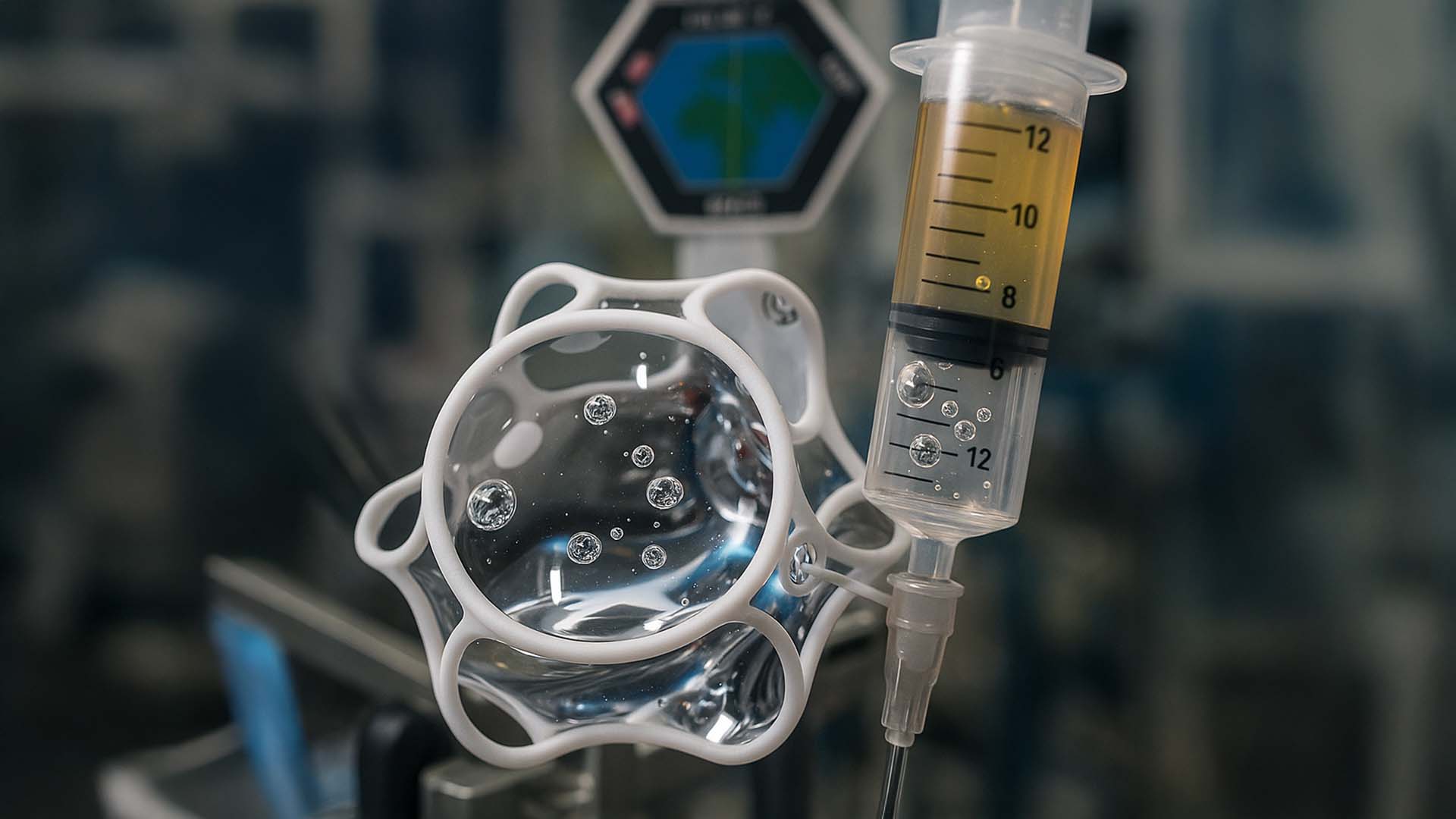
Liquid geometry in orbit: Water stretches into a three-dimensional form with negative surface curvature inside the printed frame.
Image: Visualization and compositing by Ulrich Buckenlei | Visoric 2025, inspired by ISS Soft Cell experiments
When water in space becomes pure geometry
On Earth, water behaves intuitively. Droplets fall downward, liquid fills containers from the bottom up, and surfaces sag under their own weight. On the International Space Station ISS, different rules apply. There, water floats freely in space and forms structures that we usually only see in mathematical visualizations.
In the Soft Cell experiment, a finely structured frame with negative curvature is gradually filled with water. In microgravity, the liquid can spread freely along the edges and openings.
A continuous membrane emerges that closes and eventually forms a three-dimensional water sculpture. This shape is held together solely by surface tension and the geometry of the frame.
- Water as a 3D structure → Liquid forms a stable shape within a defined frame
- Microgravity as a laboratory → Gravity fades into the background, surface tension governs behavior
- Bridge to the digital world → The observed shapes provide reference data for simulations and XR visualizations
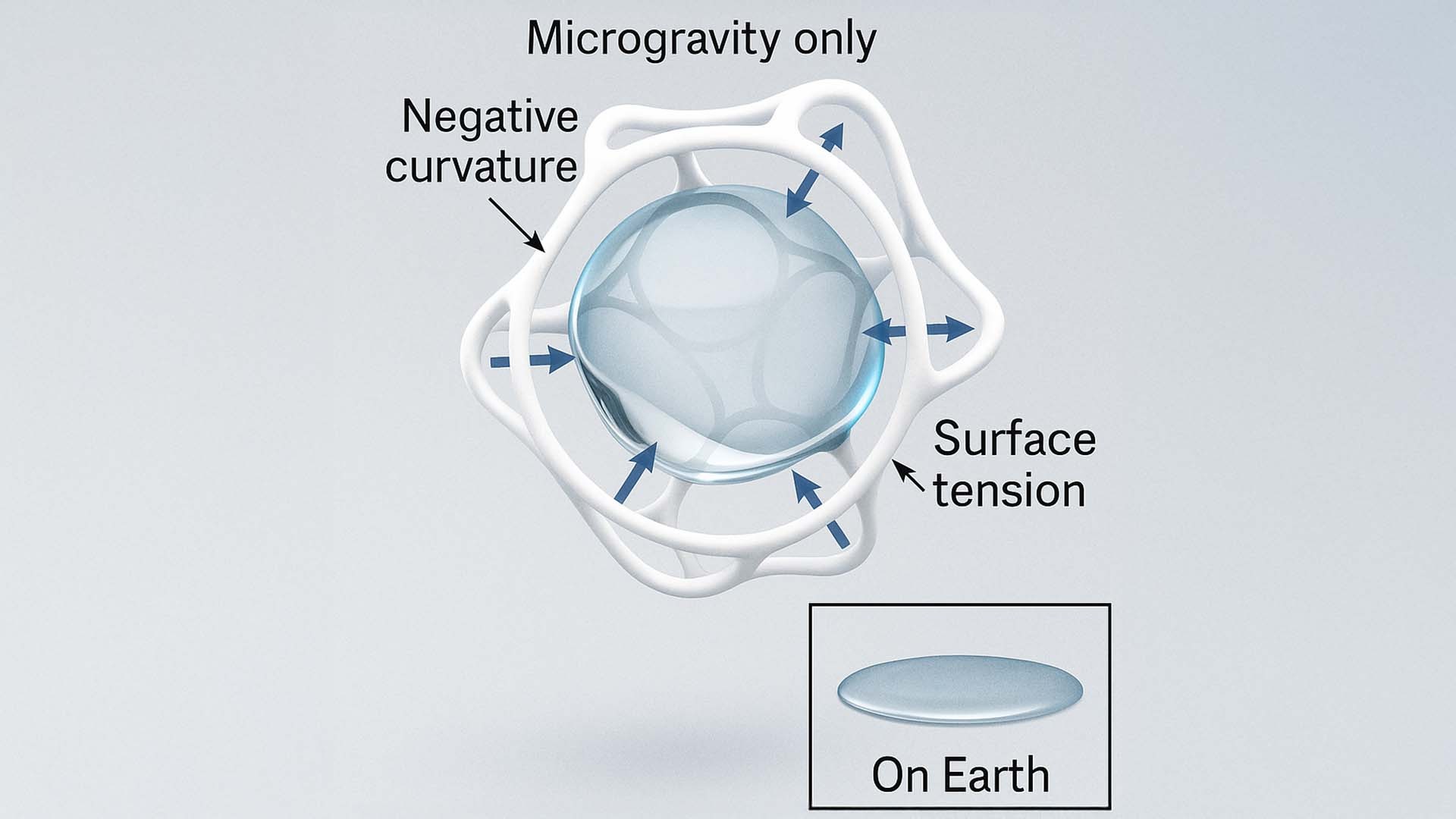
Soft Cell experiment on the ISS: A water membrane with negative curvature is altered through the addition of fluid and air via a syringe.
Image: Visualization by Ulrich Buckenlei | Visoric 2025
At the moment shown, the water sculpture is already fully developed. A syringe introduces additional liquid and tiny air bubbles.
The membrane reacts immediately, shifts, forms new bubbles, and then stabilizes again. This exact dynamic makes the experiment so valuable. Researchers can observe how interfaces organize themselves, how bubbles migrate through the structure, and how the entire system repeatedly finds a new equilibrium.
The resulting data forms the basis for realistic models of fluids, soft materials, and surfaces in digital environments.
The physics behind the floating water sculpture
At first glance, the water shape in the Soft Cell frame looks like a futuristic sculpture. In reality, it clearly demonstrates which forces dominate in microgravity. While on Earth gravity pulls practically any liquid downward, in orbit surface tension becomes the primary force.
Molecules attract each other and attempt to minimize the surface area. In the printed structure, the water therefore distributes itself across all openings and forms a closed surface that closely aligns with the frame.
The areas of negative curvature are particularly interesting. There the surface curves in two opposing directions. Saddle-like zones emerge, similar to mathematical minimal surfaces. On Earth, such surfaces would quickly transition into other forms under the influence of gravity. In space, they remain stable enough for systematic observation and measurement.
- Gravity and surface tension → On Earth gravity dominates, in space surface tension does
- Negative curvature → The water membrane forms saddle regions curving in opposite directions
- Frame as geometry constraint → The Soft Cell structure forces the water into a defined topology
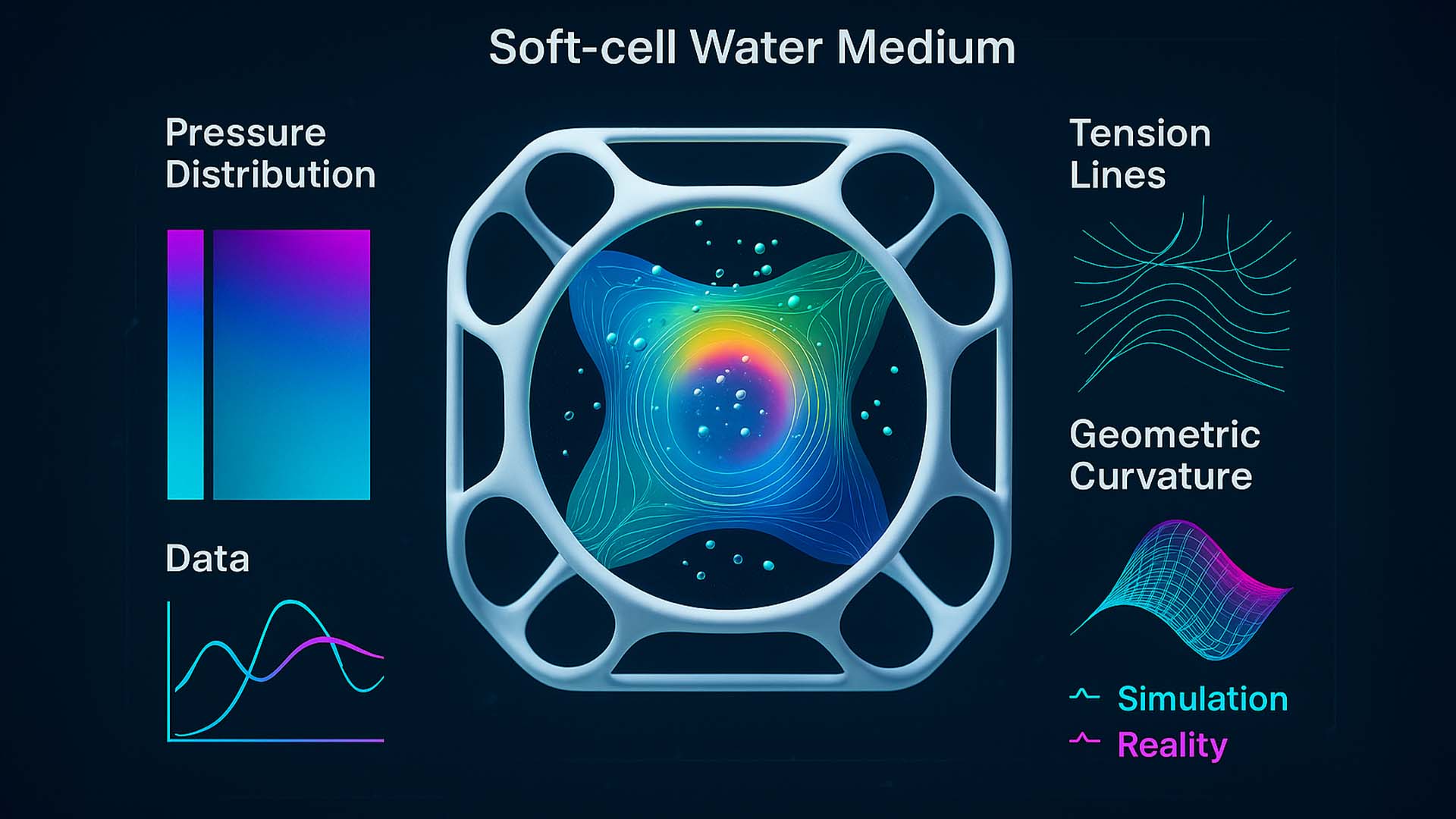
Water shape with and without gravity: On the left, gravity pulls the liquid downward; on the right, surface tension in space forms a closed surface with areas of negative curvature.
Graphic: Scientific illustration by Ulrich Buckenlei | Visoric 2025
The graphic shows the difference in a simplified comparison. On the left is a water shape on Earth. The droplets sag downward, with only a small portion adhering to the frame. Arrows indicate the direction of gravitational force.
On the right is the counterpart in orbit.
The water forms a transparent shell over the entire Soft Cell frame, creating a continuous surface and displaying clearly visible saddle regions between the openings. Color-coded lines and markers highlight zones of high curvature and the effect of surface tension. This creates an illustrative bridge between physical theory and real observation.
How measurement data becomes digital models
Once the water sculpture in orbit is stable and has passed through its dynamic phases, the second part of the work begins. Cameras, sensors, and evaluation algorithms capture every deformation, every bubble movement, and every change in the surface. The measurements flow into multidimensional datasets in which physical relationships can be precisely analyzed. This raw material forms the basis for digital twins used on Earth in simulations and visualizations.
Microgravity acts like a physical amplifier. Many effects that would be masked by gravity on Earth become much clearer in space. This clarity is reflected in the data. It shows how fluids organize themselves within defined geometries, how stable certain forms are, and under which conditions transitions between different states occur.
- Multidimensional measurement spaces → Parameters such as curvature, tension, membrane formation, and bubble dynamics
- High precision data streams → Sensors and analytics operate with high spatial and temporal resolution
- Foundation for digital twins → The datasets serve as reference for simulations in XR, robotics, and AI
Microgravity data cube: Measurement points for surface tension, membrane formation, and fluid behavior are combined into a multidimensional parameter space.
Graphic: Data visualization by Ulrich Buckenlei | Visoric 2025
The figure shows a data cluster in the form of a three-dimensional data cube. Each point represents a single measurement from the experiment, such as a change in surface curvature, the stability of a fluid film, or the movement of an enclosed gas bubble.
Color coding highlights stable areas with clearly pronounced negative curvature, while other colors identify transition zones. This allows patterns to be recognized that later reappear in numerical models and AI training data. Microgravity thus becomes a reference laboratory for realistic simulations.
From orbit to the XR lab: real data as a basis for immersive simulations
The water experiments of the ISS provide not only scientific insights but also a concrete foundation for digital experiments on Earth. The recorded shapes and dynamics can be transferred into simulation software until a digital twin of the water sculpture is created.
This twin can be integrated into 3D engines, physical solvers, and XR environments. In this way, a unique orbital experiment becomes a flexible tool for research, education, and industrial applications.
Especially where real experiments are costly or barely repeatable, this opens up new possibilities. Instead of planning another flight into space or building complex laboratories, teams can use available data to test variations and design new scenarios. This reduces costs, shortens development times, and makes advanced physics available anytime in a digital environment.
- Calibrated simulations → Real measurement data sharpens models for numerical physics and AI
- Immersive experiments → Researchers can observe the behavior of the water sculpture in VR and XR
- Transferable scenarios → Insights from microgravity flow into digital twins

From orbit into mixed reality simulation. The visualization shows a possible digital twin in a real environment enhanced through 3D.
Image: Conceptual representation by Ulrich Buckenlei | Visoric 2025
Simulation instead of parabolic flight: making space physics accessible on Earth
Experiments like the water sculpture shown are feasible in orbit but require great effort on Earth. A parabolic flight could briefly recreate similar conditions, but the available time per parabola is very limited and the overall effort would be significant. Precise observations, repetitions, and variations are hardly possible at the desired depth.
Modern simulations and immersive technologies address exactly this challenge. Based on real microgravity measurements, a team like Visoric can build physically accurate models in which gravity can be weakened or fully suppressed. In the virtual laboratory, the effects can then be repeated, adjusted, and expanded as often as needed without requiring a new physical experiment.
This becomes especially impactful in mixed reality. The real environment remains visible and perceivable while the water sculpture appears as a freely floating three-dimensional object in the space. Users can move around the object, zoom in on details, toggle layers, or make flow paths visible. This creates a learning and research space that combines physical precision with spatial presence.
- Virtual laboratories → Complex experiments become accessible without parabolic flights
- Physics simulations → Gravity can be selectively varied or completely switched off
- Mixed reality → Real workspaces and floating experiments share the same space
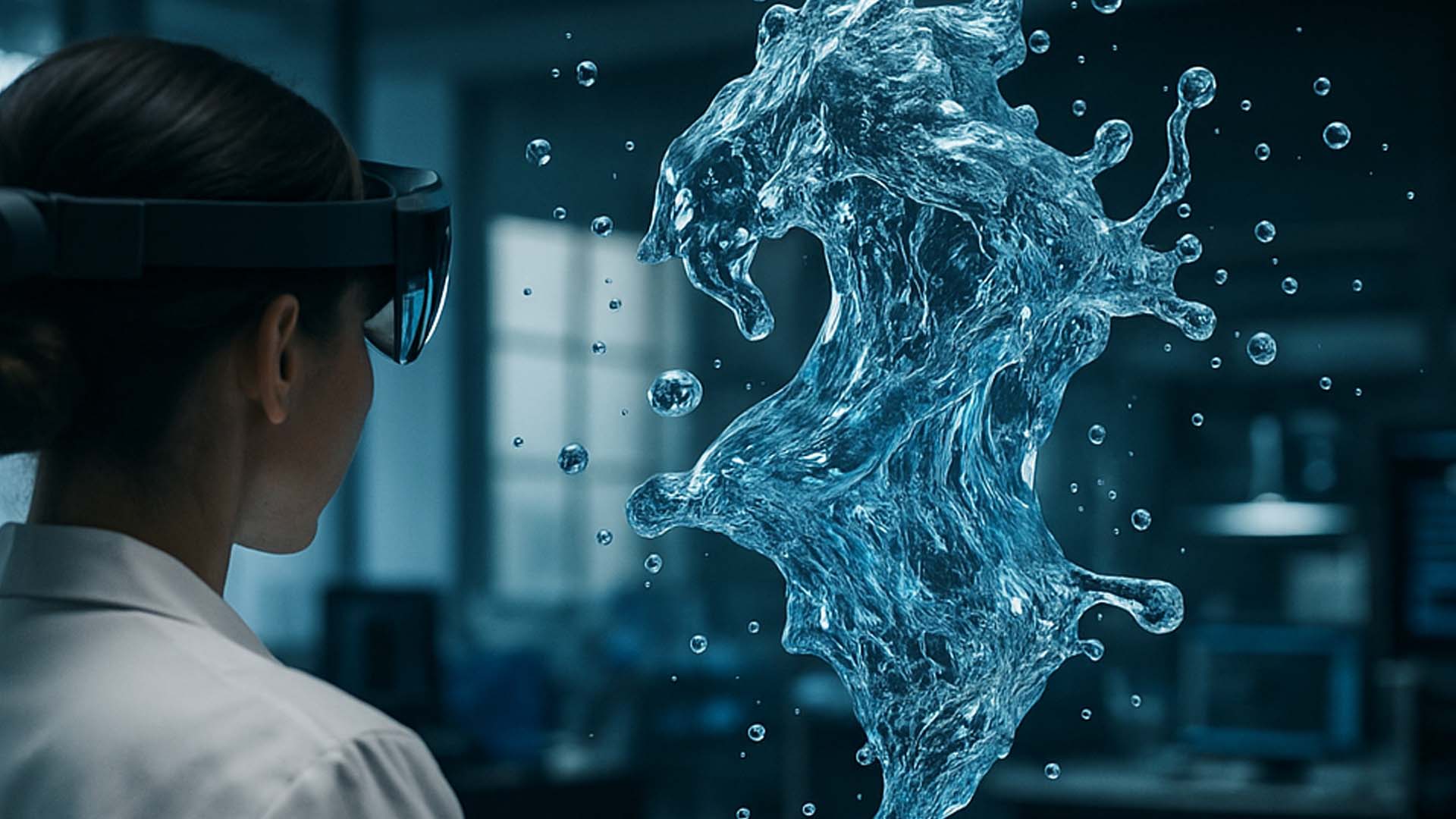
Mixed reality as a research laboratory: The real environment remains visible while the physical object floats freely in space and can be explored interactively.
Image: Concept illustration by Ulrich Buckenlei | Visoric 2025
The digital environment thus becomes a research laboratory that removes physical limitations. Phenomena that are difficult to access in real space or parabolic flight can be safely and reproducibly studied. Teams from science, industry, and education can repeatedly revisit the same scenes, examine them together, and immediately apply their insights to projects.
The ISS fluid sculpture on video
The accompanying video documents the complete sequence of the experiment in microgravity. It shows how water initially gathers in the form of individual droplets, then merges into membranes, and eventually forms a complex three-dimensional structure.
With each addition of fluid or air, the surface changes until a new stable state is reached. These processes can be analyzed over time and form the basis for the described digital models.
For viewers, it becomes immediately visible how matter behaves when gravity is removed from the system. The movements seem both unusual and logical. This combination makes the video a powerful starting point for visualization, education, and inspiration in academic teaching, research, or innovation projects.
Soft Cell fluid experiment on the ISS: Documentation of a water system with negative surface curvature in microgravity.
Video: Visual documentation Tibor Kapu, recorded aboard the International Space Station during the Soft Cell microgravity experiment. Scientific context: Oxford Mathematics (Art of Science initiative). Edit and voice-over text: Ulrich Buckenlei. Created for educational and inspirational purposes under Fair Use. All rights belong to the original creators.
From the ISS to the simulator with the Visoric expert team
The experiments shown here illustrate the potential of combining space physics, data analysis, and immersive visualization. To ensure such insights do not remain confined to orbit, teams are needed that translate scientific data into comprehensible simulations and visual representations. The Visoric expert team in Munich works exactly at this intersection, combining physical precision with modern 3D technology.
Based on real measurement data, physical models, and current 3D engines, the team develops interactive applications in which complex effects like those in the ISS Soft Cell experiment are recreated in virtual or mixed reality. Decision-makers, engineers, students, and stakeholders can safely and repeatedly explore critical phenomena without the need for expensive experimental setups or elaborate flight campaigns.
- Consulting and conception → From scientific idea to structured simulation scenario
- 3D visualization and XR experiences → Clear, immersive visuals for training, communication, and research
- Technical implementation → Physically based simulations, mixed reality experiences, and integration into existing systems

The Visoric Expert Team: Ulrich Buckenlei & Nataliya Daniltseva
Source: Visoric GmbH | Munich 2025
Anyone who wants to make the next generation of scientific experiments, training environments, and decision-making foundations not just calculable but experienceable will find in the Visoric expert team a partner who combines technology, scientific accuracy, and clear communication. Often a single conversation is enough to reveal new possibilities and define a concrete path from idea to immersive simulation.
Contact Persons:
Ulrich Buckenlei (Creative Director)
Mobile: +49 152 53532871
Email: ulrich.buckenlei@visoric.com
Nataliya Daniltseva (Project Manager)
Mobile: +49 176 72805705
Email: nataliya.daniltseva@visoric.com
Address:
VISORIC GmbH
Bayerstraße 13
D-80335 Munich