

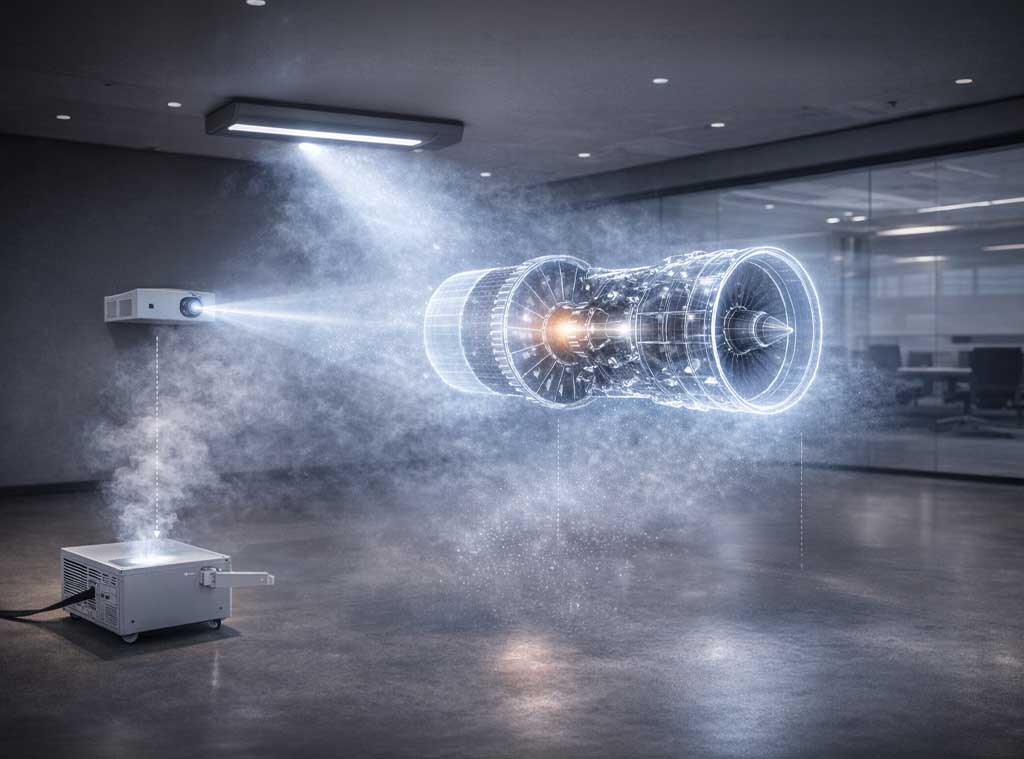
When Content Leaves the Screen and Appears in Space
Editorial concept image | Motif: Spatial projection of a turbine in an industrial showroom | Visualization: © Ulrich Buckenlei | Visoric GmbH | This representation serves analytical classification and does not claim technical completeness
The representation of digital content was tied to fixed surfaces for decades. Monitors, displays, and projection surfaces determined where information became visible and how it could be perceived. Content was shown, but it always remained coupled to a surface.
This logic was not accidental, but technically necessary. A screen provides a controlled environment. Light can be rendered precisely, regardless of space, air, or movement. Perception was therefore stable, but also clearly limited.
Today, an additional layer is emerging within this architecture. Content can no longer only be displayed on surfaces, but made visible directly in space. Whether product, machine, or information, it appears seemingly free in space and can be viewed together. [15][17]
The decisive shift does not lie in replacing traditional displays, but in the location of representation. When content is no longer bound to a surface, but becomes part of the environment, the way it is understood and used changes.
Technically, this development is based on an interplay of light source, projection system, and a medium in the air that makes the light visible. Only through this combination does the impression of a floating object emerge. [5][6]
Costs and complexity do not disappear in the process. They shift. While traditional display technology is standardized and robust, new requirements arise in spatial control, lighting conditions, and system integration.
Representation thus evolves from a pure display instrument into a spatial system. And this is exactly where a new phase of digital communication begins, which is made concretely tangible in the following chapter.
From Screen to Space, How the Representation of Digital Content Is Changing
Early digital applications rarely fail because of the idea, but because of the way they are represented. Information may be available, but it is often difficult to access, difficult to understand, or not intuitively graspable. A screen always separates content from space.
Spatial projection shifts exactly this point. Not because it replaces existing technologies, but because it creates an additional layer. Content is no longer merely displayed, but integrated into space.
What was previously visible only on a surface can now appear as an object in space. The real difference emerges in perception. A spatial object can be walked around, viewed together, and understood more directly. [11]
- Previous bottleneck, content is bound to displays and spatially separated from the user
- New approach, content appears directly in space and becomes part of the environment
- New use, multiple people can access the same object at the same time and experience it together
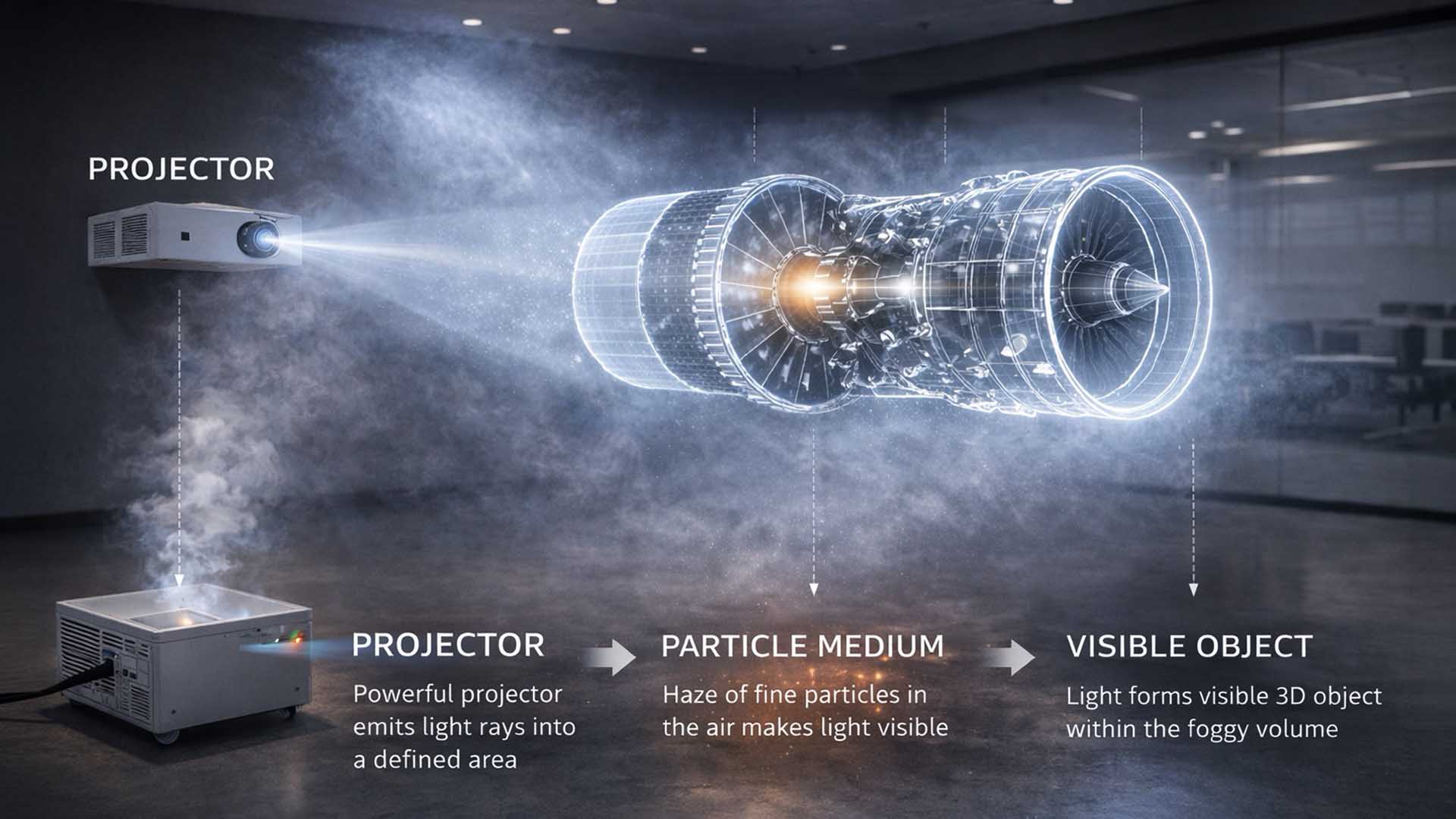
Spatial representation of a technical system, the turbine becomes visible in space through projection onto a fine medium
Motif: Editorial concept image | Concept: Combination of projector, particle medium, and spatial visualization of a technical object | Visualization: © Ulrich Buckenlei | Visoric GmbH | This representation serves analytical classification
The image makes the operating principle visible. A projector directs light into a defined area in space. There, the light encounters a fine medium of particles distributed in the air. Only through these particles does the light become visible. [5]
The turbine therefore appears to float freely in space. In reality, it is a precisely controlled projection whose effect depends heavily on perspective, lighting conditions, and the stability of the medium. [7]
This interplay is decisive. Without the medium, the light remains invisible. Without a controlled environment, the image loses clarity. And without suitable content, the effect remains purely visual.
As soon as these systems are used in a targeted way, a new type of representation emerges. Content is no longer only viewed, but spatially experienced and jointly used.
The next chapter therefore analyzes in which specific application fields this form of representation offers real added value and where its practical limits lie.
Where Spatial Representation Creates Real Added Value and Where Its Limits Lie
The first chapter showed how the place of representation is shifting. Content leaves the screen and appears directly in space. The second chapter deals with the practical consequence of this development. What matters is not the technology itself, but the question of in which situations it actually creates added value.
Studies on spatial computing and immersive technologies show that advantages arise especially where complex content must be understood, jointly assessed, or explained.[15][17] This is exactly where spatial representation differs fundamentally from traditional displays.
- Complex systems can be grasped spatially more quickly and understood more intuitively
- Multiple people can access the same object at the same time and discuss it together
- Changes of perspective and movement become part of information intake
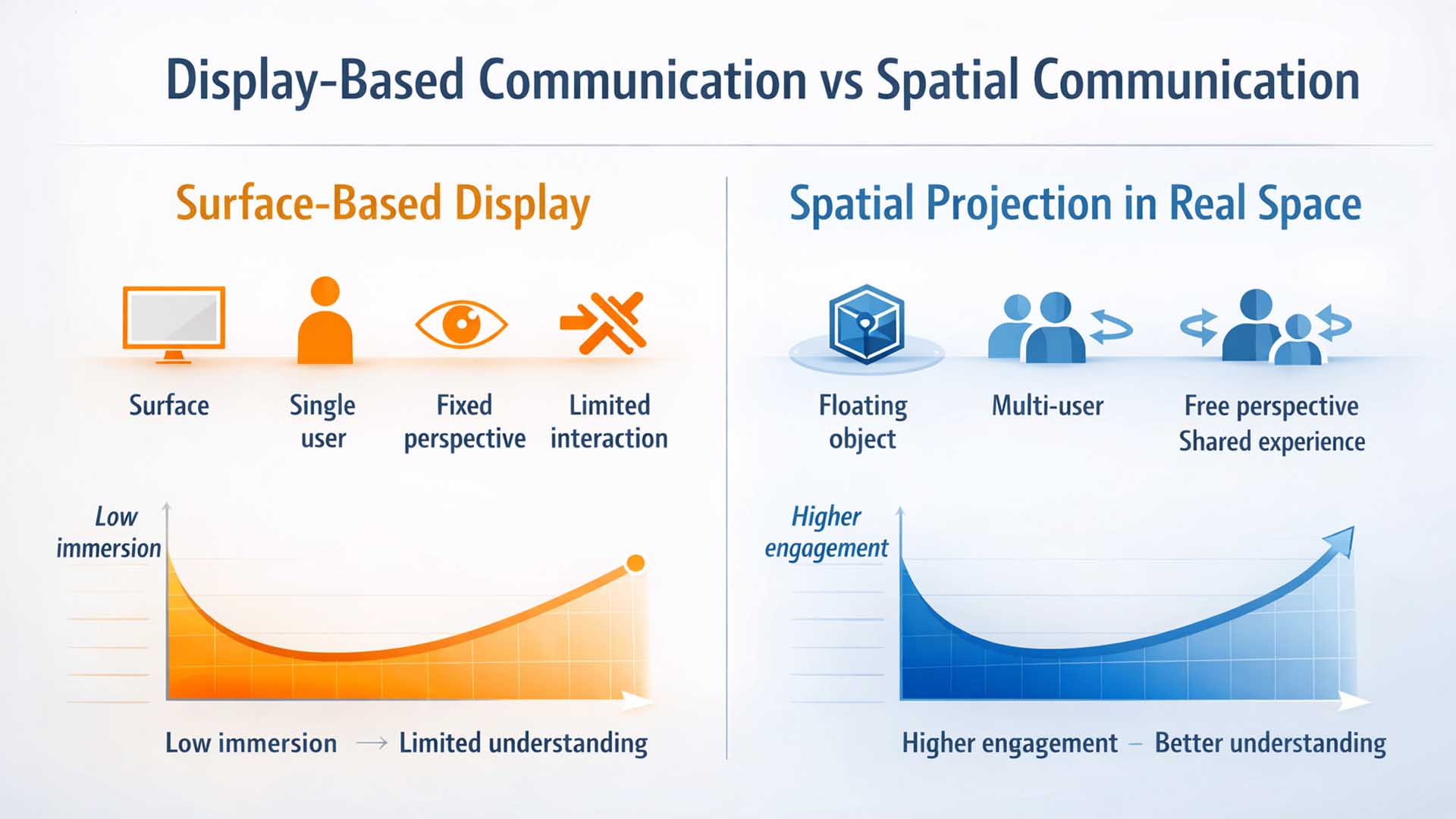
Display-Based Communication vs Spatial Communication, comparison between surface-based representation and spatial projection in a shared usage context
Graphic: Editorial analysis | Visualization: © Ulrich Buckenlei | Visoric GmbH | This representation serves analytical classification
The left side of the graphic shows the traditional logic of digital representation. Content appears on a surface, is viewed from a fixed perspective, and is generally designed for a single user interaction. Perception is stable, but limited. Understanding emerges sequentially and often abstractly.
The right side describes a different approach. Content becomes visible in space and can be viewed by multiple people at the same time. Perspectives change through movement in space. Information is no longer only read, but directly experienced.
The difference lies not only in representation, but in the way of use. Spatial systems create a shared reference in space. Decisions, coordination, or explanations are no longer based on individual screens, but on a shared visual context.
Technologically, this effect is enabled by volumetric or particle-based projection, in which light is made visible in space.[5][11] At the same time, new requirements arise from this. Lighting conditions, medium stability, and spatial integration directly influence the quality of the representation.
This is also where the limits lie. Spatial projection is not a replacement for every form of visualization. It is particularly useful where understanding, attention, and shared experience are central. For precise detail work, mobile use, or standardized interfaces, traditional displays remain superior.
The real strength therefore does not arise from maximum technical complexity, but from targeted use in the right context. Companies that understand this differentiation can use spatial systems where they create real added value while avoiding unnecessary complexity.
The next chapter therefore analyzes how these systems are technically structured and which conditions must be fulfilled so that an impressive demonstration becomes a stable, operable installation.
The Architecture Behind It, How Spatial Projection Works Technically
When content appears in space, it initially looks like a visual effect. In reality, however, it is a clearly structured technical system. The difference is crucial. It is not about an illusion, but about the precise interaction of several components that together enable a stable representation.
At its core, this system consists of three layers: a light source, a carrier medium, and the actual visual information. Only when these elements work together synchronously does the impression of an object floating freely in space emerge.[5]
The projector takes on the role of the active light source. It does not create the image on a surface, but projects it precisely into a defined area in space. Without a surface, however, this light remains invisible.
This is exactly where the second element comes into play. A fine medium made of particles, often referred to as fog or haze, is distributed in a controlled way in space. These particles scatter the light and make it visible. Without this medium, the projected image would not be perceptible in space.[6]
The visible object emerges only through the interaction of these two components. Light hits the medium and forms an image with spatial impact. It is not a real physical object, but a precisely controlled projection within a defined volume.
- Projector → generates directed light and defines the image information
- Particle medium → makes the light visible in space and shapes the volume
- Spatial representation → only emerges through the interaction of both systems
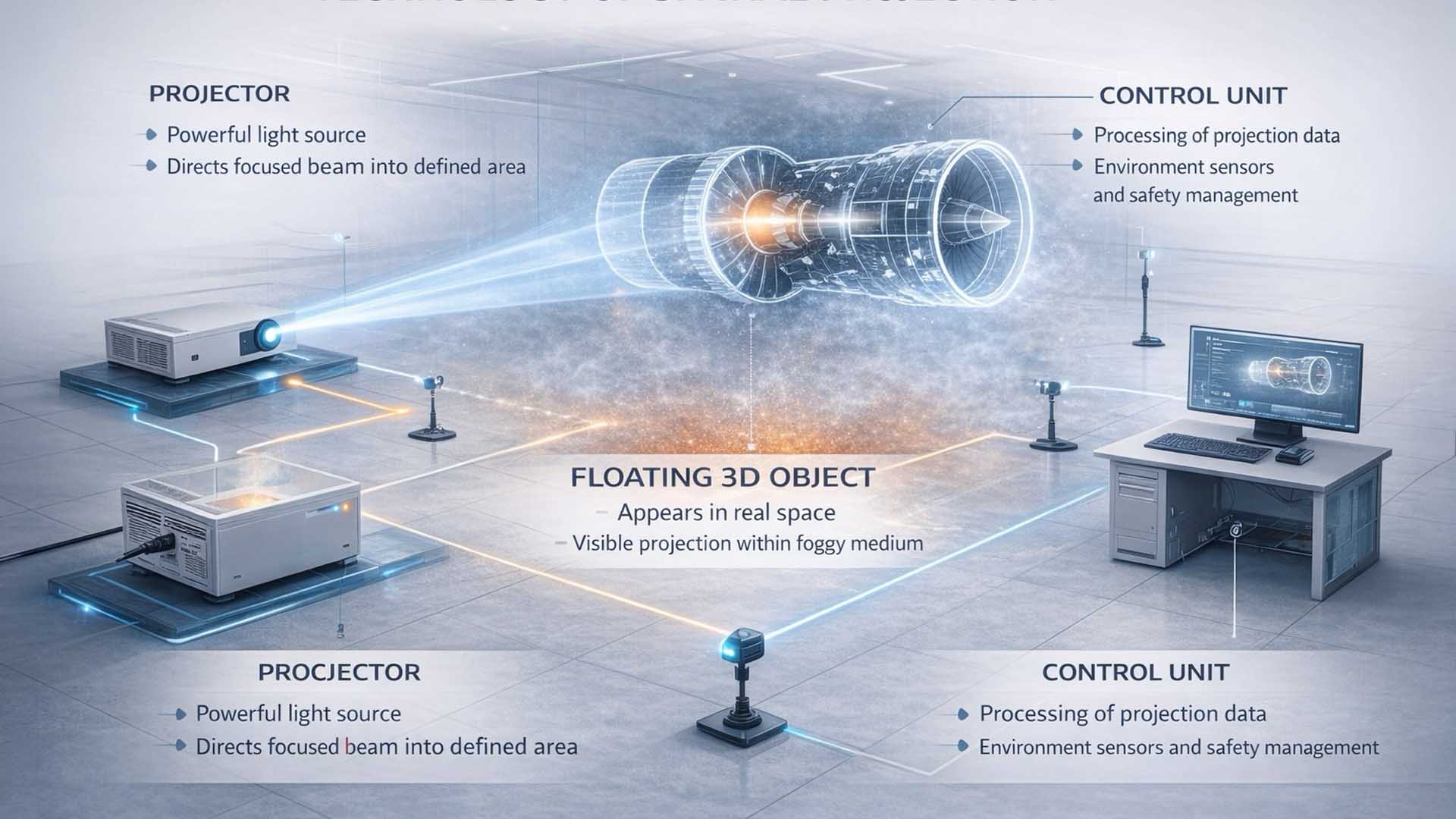
Technical structure of a spatial projection, interaction of light source, medium, and visible object
Graphic: Editorial system illustration | Visualization: © Ulrich Buckenlei | Visoric GmbH | This representation serves analytical classification
The graphic shows the system as a technical architecture. On the left is the projector, which generates the image and projects it into space. In the middle, a clearly defined area of fine particles is created, serving as the carrier medium. Within this volume, the light becomes visible and shapes the object.
On the right, the result becomes visible. A turbine appears to float freely in space. What matters here is not only the projection itself, but the stability of the medium. Air movement, lighting conditions, and room structure directly influence the quality of the representation.[7]
It also becomes clear that such systems do not function in isolation. Sensors, control systems, and calibration ensure that the image remains stable and correctly positioned in space. Only through this integration does a demonstration become an operable system.
Safety and operational aspects also play a central role. The use of fog or haze is subject to clear guidelines, especially in public or industrial environments. Visibility, air quality, and movement zones must be taken into account to ensure safe use.[19]
This makes it clear that spatial projection is not a purely visualization-related issue. It is a system architecture that requires planning, integration, and operation. This exact difference determines whether an application impresses only in the short term or functions in the long term.
The next chapter therefore analyzes which specific application areas arise from this technology and where it is already delivering real added value today.
Where Spatial Projection Creates Real Added Value and Where It Can Be Used Meaningfully Today
The previous chapter showed how these systems are technically structured. Projector, particle medium, and spatial projection together create a representation that is no longer bound to a fixed surface. The next step therefore raises the decisive question of in which specific situations this form of representation achieves more than a traditional screen.
This is exactly where the practical benefit begins. Spatial projection is especially strong when several people are looking at the same content at the same time, when complex relationships must be explained clearly, or when an object has a stronger impact in space than on a flat surface. Studies on spatial computing and industrial XR applications show that the added value arises above all where perception, orientation, and shared understanding are central.[15]
- Training and technical instruction → Complex systems become clearer and easier to grasp spatially
- Showroom and sales → Products can be presented even when no physical prototype is available
- Events, architecture, and brand spaces → Digital content becomes part of a real environment rather than just part of a display
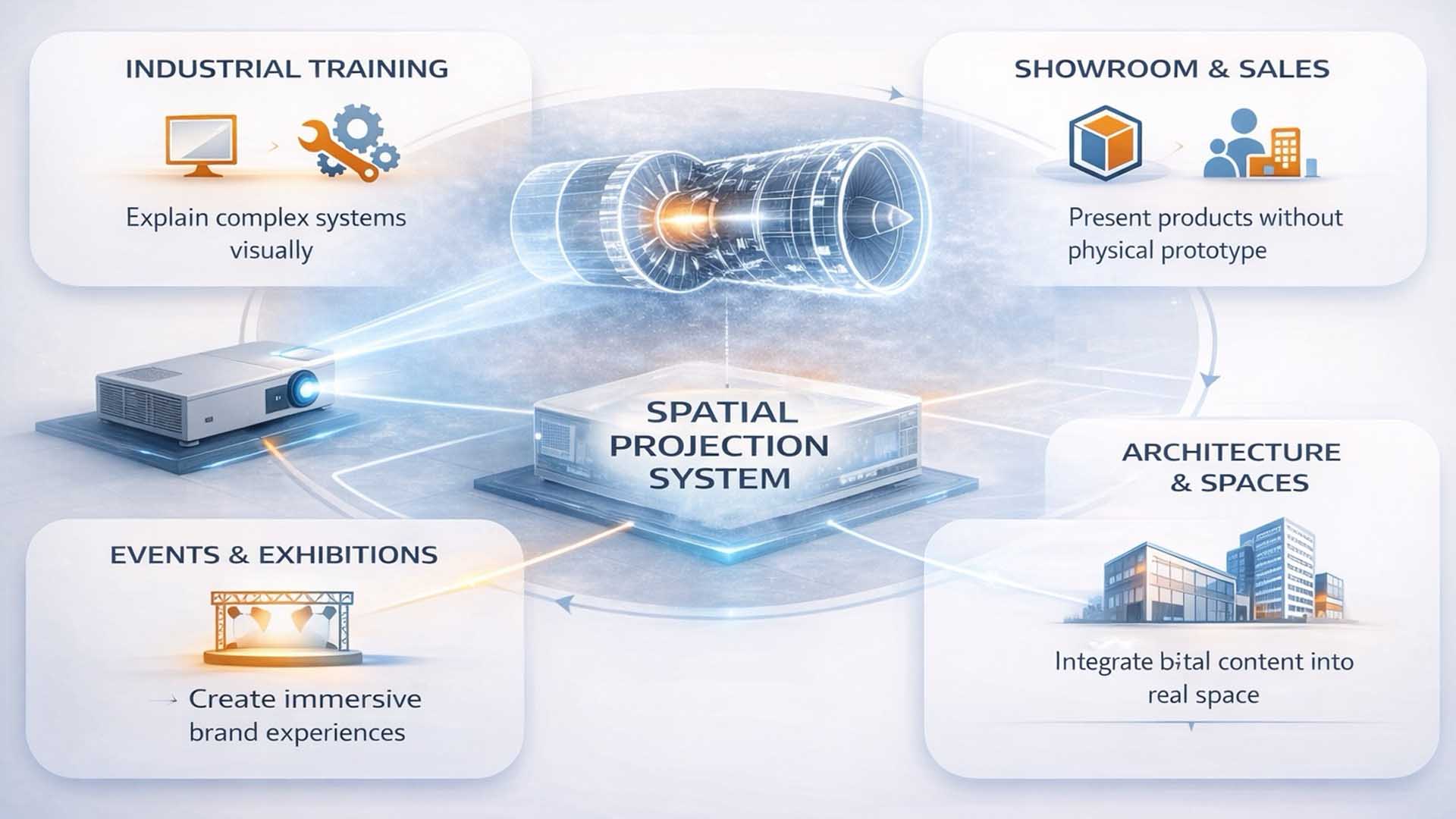
Spatial Projection Use Cases, fields of application for spatial projection between training, sales, event communication, and architectural integration
Graphic: Editorial analysis | Visualization: © Ulrich Buckenlei | Visoric GmbH | This representation serves analytical classification
The graphic condenses these application fields into a clear logic. At the center is the spatial projection system. Around it are four contexts in which the benefits become particularly evident. Industrial Training describes the situation in which technical content is not only explained, but made visible in space. This shortens paths to understanding and improves shared orientation during training and instruction. [17]
Showroom and Sales marks a second field. Products, machines, or components can be presented spatially, even if they are large, expensive, or not yet physically available. Especially in early sales phases or with systems that require explanation, this creates an advantage because a spatial representation has a more immediate impact than a brochure or a single screen.
Events and Exhibitions reveal a third benefit. Here, the focus is less on technical precision than on attention, experience, and comprehensibility. Spatial content creates presence. It brings people to a shared visual reference point and creates a different form of communication than traditional screens or projections on walls.
The fourth field concerns Architecture and Spaces. As soon as digital content is not only shown temporarily but permanently integrated into reception areas, showrooms, or visitor centers, its role changes. It is no longer perceived as an additional medium, but as part of the built space. This is exactly the point at which the technology moves from effect to infrastructure. [18]
At the same time, the graphic also shows its limits. Not every information task needs spatial projection. For precise detail work, mobile use, or standardized user interfaces, traditional displays remain more efficient. Spatial systems deliver their added value primarily where shared experience, orientation, and impact are decisive. That is exactly why the right application context is more important than maximum technical complexity. [20]
The next chapter therefore analyzes which organizational, safety-related, and regulatory requirements arise when a spatial demonstration becomes a permanently operated installation.
From Prototype to Platform, Which Requirements Determine Operation
After the technological foundations and fields of application have been described, the focus of this chapter shifts to an often underestimated dimension. The real challenge does not begin with the demonstration, but with permanent operation.
A spatial projection can appear impressive as a single setup. But as soon as it is integrated into architecture, trade fair concepts, or industrial environments, requirements arise that go beyond pure visualization. Systems must run stably, be operated safely, and be embedded organizationally.
It is exactly at this point that the perspective changes. A visual effect becomes an infrastructural system that must be planned, operated, and secured. Studies on the integration of new technologies show that operational reliability and organizational clarity in particular are decisive for sustainable use.[15]
- From demonstration to operation → Systems must function stably and reproducibly over the long term
- From effect to responsibility → Safety, maintenance, and access become part of the solution
- From individual installation to structure → Organization and processes determine scalability
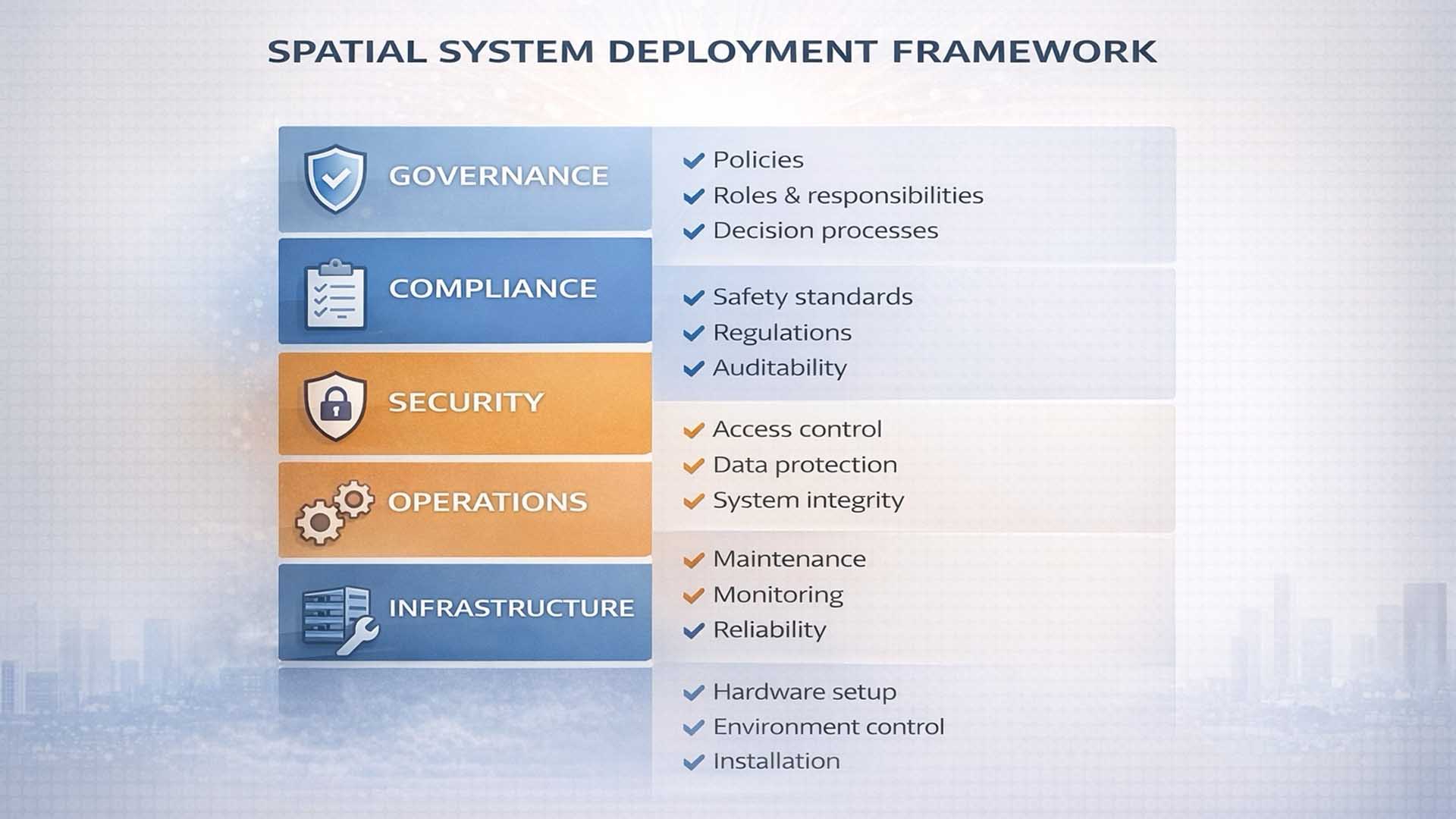
Spatial System Deployment Framework, structured representation of the organizational and technical requirements for operating spatial systems
Graphic: Editorial framework analysis | Visualization: © Ulrich Buckenlei | Visoric GmbH | Labels in English for international classification
The graphic deliberately reduces the topic to a clear, understandable structure. It does not show technology in detail, but the layers that are necessary for a system to function in the long term.
At the top is “Governance.” This refers to clear rules, roles, and decision-making processes. Who is allowed to change content. Who is responsible for operation. Which approvals are necessary. Without this structure, uncertainties arise in operation.[18]
Below this lies “Compliance.” This is about standards, safety requirements, and traceability. Especially in publicly accessible installations or industrial applications, systems must be auditable and compliant. Guidelines for fog and atmospheric effects show that safety is not optional, but part of the system architecture.[19]
The “Security” layer addresses the protection of the systems themselves. Access controls, data integrity, and secure interfaces are necessary as soon as content or control systems are networked. This becomes a critical factor especially where company-relevant data is involved.[4]
“Operations” describes ongoing operation. Maintenance, monitoring, and performance supervision ensure that the system is not only installed, but remains usable over time. This is where it becomes clear whether an installation is robust or only impressive in the short term.
The lowest layer, “Infrastructure,” forms the physical foundation. Spatial design, lighting conditions, and technical installation determine whether the projection remains stably visible. Unlike traditional displays, the environment here is an active part of the system.[5]
The key insight of this chapter is clear. The success of spatial systems depends not primarily on visualization, but on the ability to operate them as an overall structure. Technology alone is not enough. Only the interplay of organization, safety, and infrastructure turns an idea into a reliable solution.
The next chapter therefore analyzes which strategic implications arise from this for companies and why spatial systems are increasingly understood as part of digital core infrastructure.
Strategic Infrastructure, Why Spatial Systems Are Becoming a Core Competence
With the technical architecture and the operational conditions, the functional structure has been described. The decisive shift, however, takes place on the strategic level. Spatial representation systems are not just a new form of visualization, but are developing into a component of digital core infrastructure.
Studies on digital transformation show that technologies become strategically relevant when they are not used in isolation, but structurally integrated into processes, data flows, and decision logics.[15] This exact point has been reached with spatial systems.
- Spatial systems are evolving from demonstration tools into operational platforms
- Integration into data and IT architectures becomes a prerequisite for scaling
- Strategic added value arises from connecting visualization, data, and decision-making processes
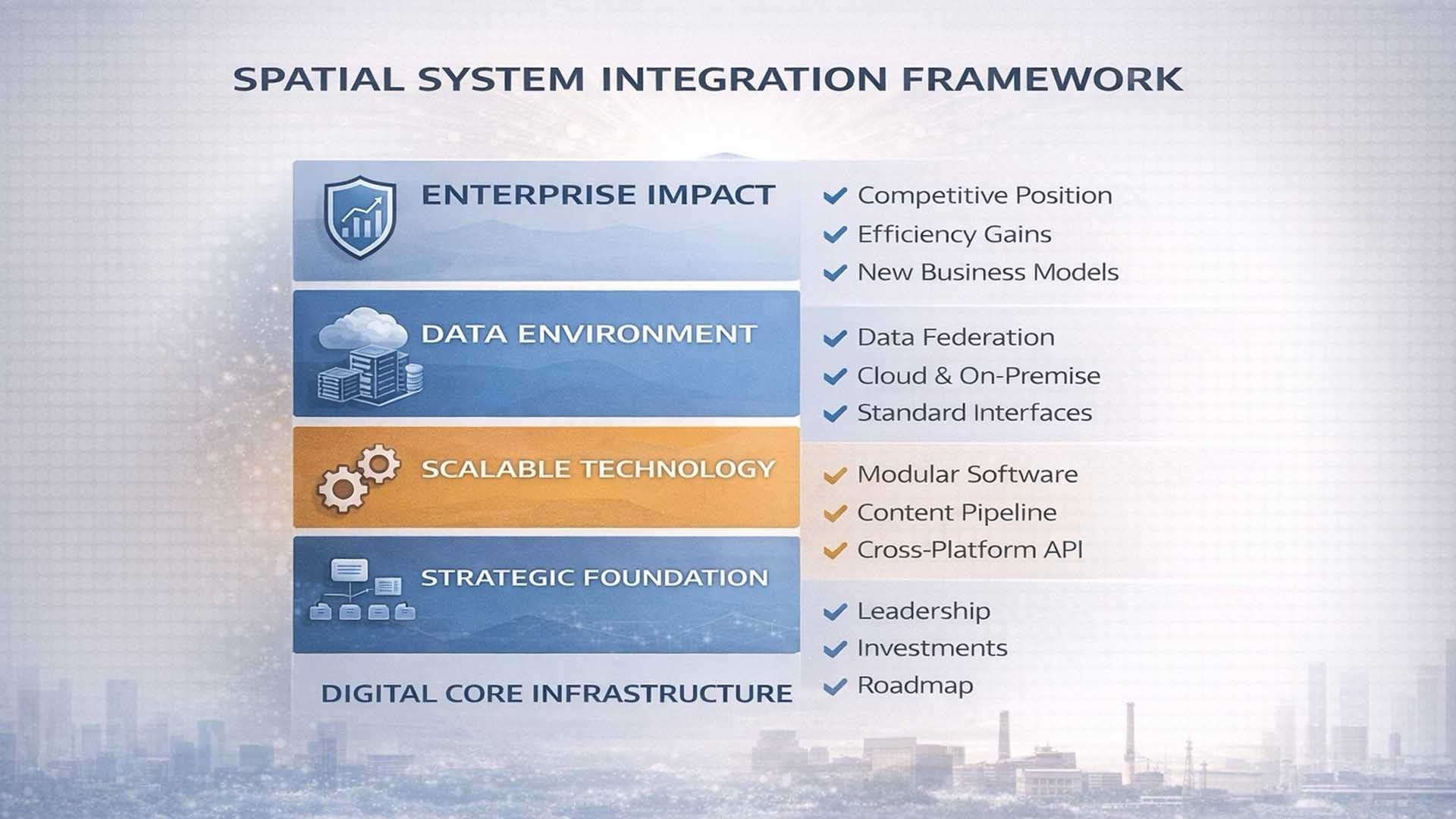
Spatial System Integration Framework, classification of spatial systems as a component of digital core infrastructure
Graphic: Editorial strategy illustration | Visualization: © Ulrich Buckenlei | Visoric GmbH | Labels in English for international classification
The graphic is deliberately not structured as a technical representation, but as a strategic model. It shows how spatial systems can be embedded into a corporate architecture and which layers interlock in the process.
At the top is “Enterprise Impact.” This layer describes the visible effect within the company. Spatial systems influence competitive position, efficiency, and the development of new business models. Visualization becomes a tool for better decisions and faster coordination.
Below this lies the “Data Environment.” This layer makes it clear that spatial representation is not scalable without data integration. Terms such as Data Federation, Cloud, and standardized interfaces indicate that content is not created in isolation, but fed from existing systems. Industry 4.0 studies emphasize exactly this interoperability as a decisive success factor.[17]
The third layer, “Scalable Technology,” describes technical feasibility. Modular software architectures, content pipelines, and cross-platform interfaces make it possible not only to create content once, but to reproduce and further develop it systematically. This is exactly where the difference between an individual installation and a scalable solution emerges.[18]
Below this lies the “Strategic Foundation.” This layer is often underestimated. Leadership, investment, and clear roadmaps determine whether a technology has long-term impact or ends as an isolated project. Strategic anchoring is therefore not an addition, but a prerequisite.
At the lower edge, everything condenses into “Digital Core Infrastructure.” This term describes the actual transformation. Spatial systems are no longer understood as an add-on, but as an integral part of digital value creation. This is exactly where the infrastructural character begins.
Analyses of technological development show that companies that integrate such systems early do not only improve their visualization, but also accelerate their decision-making processes and establish new forms of interaction.[16]
The central insight of this chapter is therefore unambiguous. The added value of spatial systems does not arise in the individual image or the individual installation. It arises in the structural integration into data, processes, and organization.
With that, the strategic level has been fully described. In the next chapter, this abstract framework becomes concrete again. Based on a real demonstration, it becomes visible how these systems work in practice and how light, medium, and content become a spatial experience.
Video Analysis – When Content Truly Reaches the Space
The following video does not show a theoretical representation, but a real demonstration of a spatial projection effect. A small dog appears to float freely in space. It moves, reacts, and appears almost alive to the viewer.
What becomes visible here is a decisive difference from traditional displays. There is no screen, no visible surface, and no clearly recognizable technical boundary. The object exists visually in space and is perceived as part of the environment.
Technically, this effect is based on an interaction between a light source and a controlled particle medium in the air. The projector directs light into a defined area. There, the light rays encounter finely distributed particles that reflect the light and make it visible. Only through this medium does the impression of a three-dimensional object in space emerge.[5]
Each of these particles acts like a tiny pixel in space. In research, this principle is described as volumetric or particle-based representation. The quality of the result depends heavily on the stability, density, and control of this medium.[6]
The special effect, however, arises not only from the technology, but from perception. Since there is no visible surface, the traditional separation between content and environment disappears. Studies on spatial representation show that this exact effect leads to a significantly stronger perception of presence.[11]
At the same time, the video also reveals the limits of this technology. The stability of the image depends on lighting conditions, air movement, and precise calibration. What appears as a playful demonstration is in practice a finely tuned system that requires controlled conditions.[18]
Spatial projection of an animated dog – Visible light projection onto a particle medium creates the impression of an object floating freely in space
Source: hazedisplay | Demonstration of spatial projection technology based on fog or particle media |
Analytical classification: Ulrich Buckenlei
This example makes tangible what the entire article is about. The technology is no longer limited to screens. Content leaves the surface and becomes part of space.
At the same time, it becomes clear that the step from demonstration to stable application is not automatic. Only through the combination of technical control, a suitable environment, and clearly defined content does a system emerge that can be operated permanently.
This is exactly where the concluding section begins. It shows how companies can use such technologies strategically to create new forms of interaction, question existing processes, and differentiate themselves sustainably.
Sources and References
- European Union, AI Act (EU) 2024/1689, regulatory framework for artificial intelligence and transparency obligations, 2024–2026. [1]
- EU AI Act Service Desk, timeline and implementation guides for the introduction of the AI Regulation, accessed 2024–2026. [2]
- C2PA (Coalition for Content Provenance and Authenticity), “Content Credentials Specification,” standard for digital provenance records, accessed 2024–2026. [3]
- Federal Office for Information Security (BSI), analyses of the opportunities and risks of generative AI systems, 2023–2026. [4]
- FogScreen Inc., “FogScreen eMotion User Manual,” technical documentation on fog projection, installation, and operation, accessed 2024–2026. [5]
- ACM SIGGRAPH, “The Interactive FogScreen,” scientific publication on projection in air and interaction systems, 2005. [6]
- IEEE / HRI Conference, research on fog screen systems and robotic interaction in volumetric media, 2025. [7]
- Looking Glass Factory, technical documentation on light-field displays and spatial representation without a headset, accessed 2024–2026. [8]
- Sony, “Spatial Reality Display (ELF-SR2),” product and developer documentation on autostereoscopic displays, accessed 2024–2026. [9]
- Voxon Photonics, technical description of volumetric displays (“true volumetric imaging”), accessed 2024–2026. [10]
- Optica / OPN, “Volumetric Displays: Turning 3D Inside-Out,” specialist article on volumetric imaging, 2018. [11]
- NVIDIA, “ACE (Avatar Cloud Engine),” platform for real-time AI avatars and digital humans, accessed 2024–2026. [12]
- Proto Inc., documentation on AI-supported holographic avatars and enterprise applications, accessed 2024–2026. [13]
- Holoconnects, “Holobox,” technical and conceptual description of holographic telepresence, accessed 2024–2026. [14]
- Deloitte, “Tech Trends 2025,” analyses on spatial computing, XR, and industrial transformation, 2025. [15]
- McKinsey & Company, “Technology Trends Outlook,” economic classification of AI, XR, and digital platforms, 2024–2025. [16]
- Bitkom, “Metaverse and Spatial Computing in Industry,” studies on digital transformation, 2024–2025. [17]
- AVIXA, standards and guidelines for audiovisual system integration and installation, accessed 2024–2026. [18]
- ANSI, safety guidelines for fog, haze, and atmospheric effects in public and industrial environments, accessed 2024–2026. [19]
- MIT Technology Review, analyses of generative AI, spatial interfaces, and future interaction models, 2024–2026. [20]
Use Spatial Systems Strategically Now
The development of spatial projection technologies clearly shows where digital communication and industrial visualization are heading. Content is leaving the screen and becoming part of real environments. What still appears today as a demonstration is increasingly developing into a new infrastructural layer for presentation, planning, and interaction.
For companies, the question is no longer only whether these technologies are relevant. What matters is how concrete applications can be derived from them. Where does real added value arise. Which content is suitable for spatial representation. Which environments need to be adapted. And how can stable, operable systems be built.
This is exactly where practical implementation begins. Many companies are not looking for visual effects, but for robust concepts that meaningfully connect technology, space, and content. These include above all:
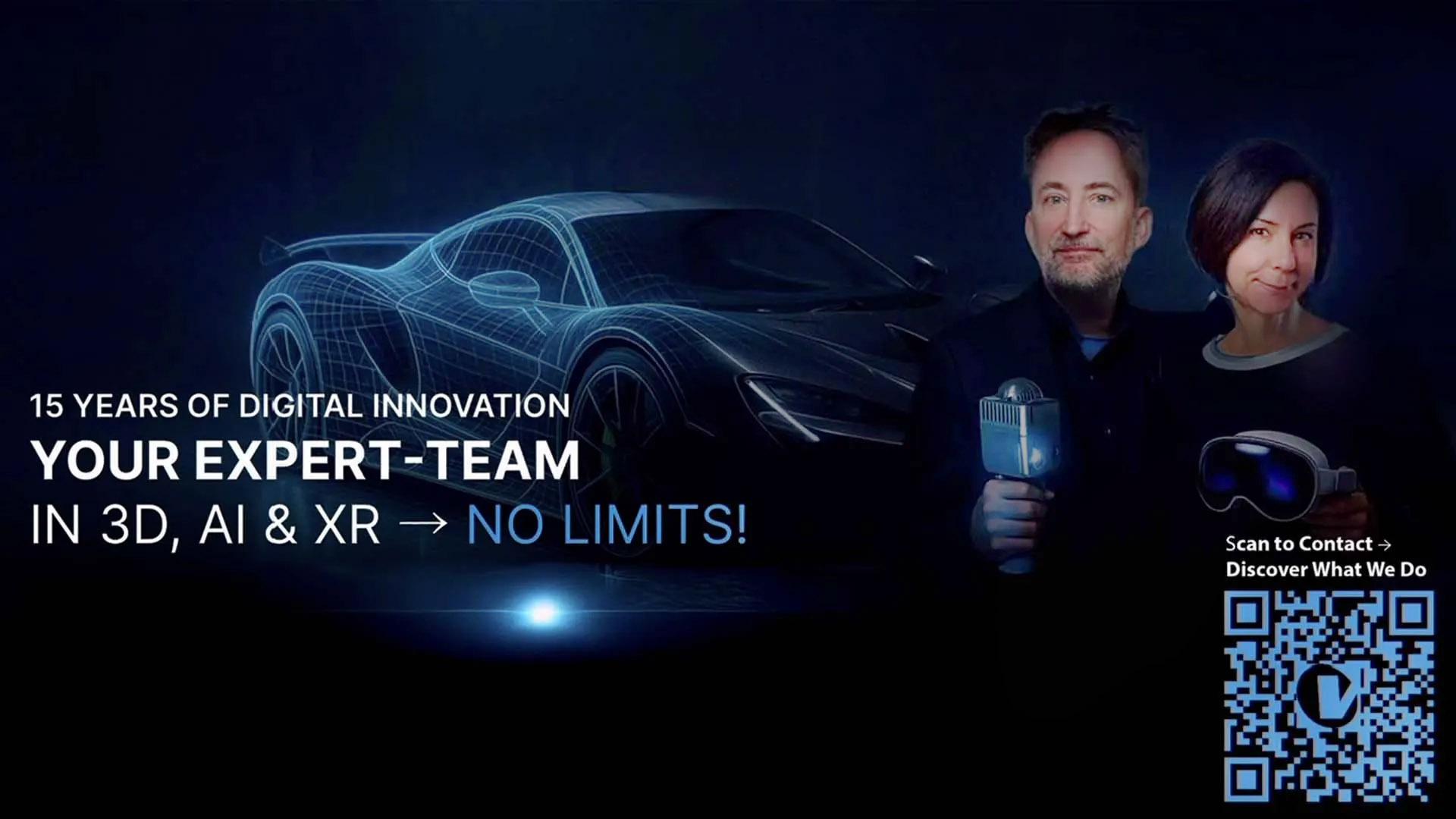
The VISORIC expert team develops spatial projections, immersive showrooms, and spatial experiences for industry, architecture, and events
Source: VISORIC GmbH | Munich
- Spatial Experience Consulting → From idea to feasible spatial application
- Holographic & Projection Systems → Development and integration of projection and particle media
- Showroom & Event Installations → Designing spaces that make content tangible
- Content & 3D Pipelines → Optimizing digital content for spatial representation
- System Architecture & Integration → Reliably connecting technology, space, and infrastructure
- Real-Time & Interactive Systems → Making content dynamically controllable and interactive
- Proof of Concept → Validating feasibility quickly and soundly
- High-End Demonstrators → Presenting complex technologies clearly and convincingly
VISORIC works exactly at the intersection of technology, space, and application. We develop systems that do not only impress, but function stably and deliver real added value.
If you would like to find out how spatial representation can be meaningfully used in your company, speak with the VISORIC expert team in Munich.
Not a show effect, but a clearly structured path from idea to functioning solution.
Contact Persons:
Ulrich Buckenlei (Creative Director)
Mobile: +49 152 53532871
Email: ulrich.buckenlei@visoric.com
Nataliya Daniltseva (Project Manager)
Mobile: +49 176 72805705
Email: nataliya.daniltseva@visoric.com
Address:
VISORIC GmbH
Bayerstraße 13
D-80335 Munich