
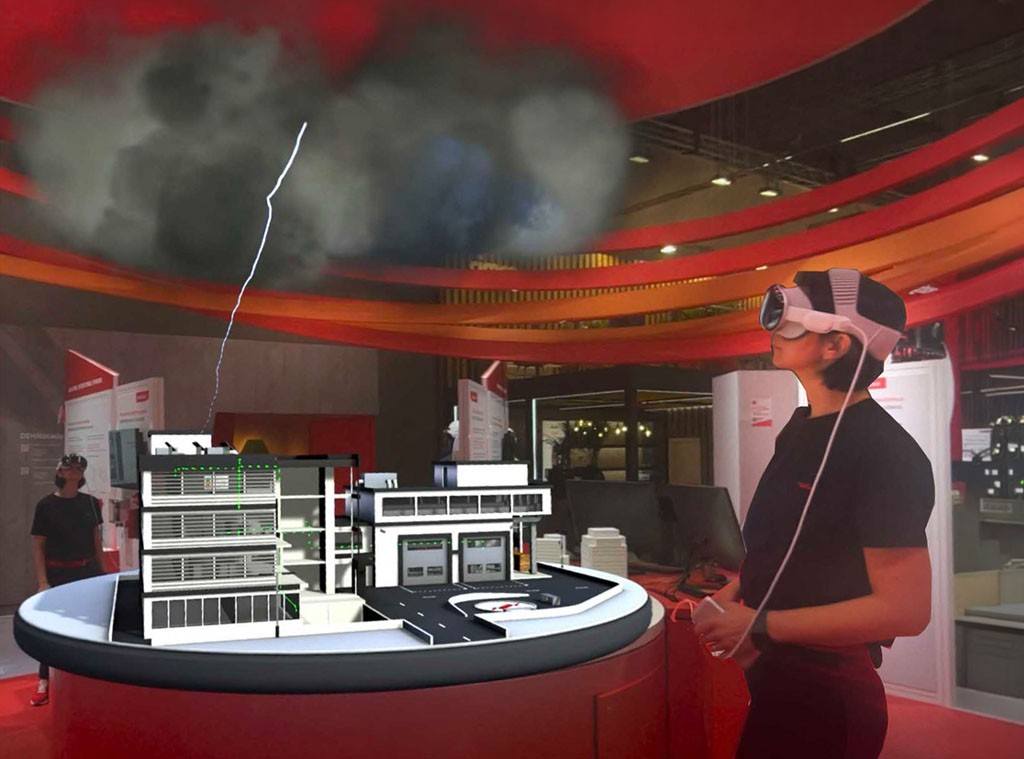
Impressions from the DEHN SE trade show booth at Light + Building 2026 in Frankfurt
Photo: © Ulrich Buckenlei | VISORIC GmbH expert team for immersive media
Trade fairs have long been places where products are presented and technical solutions are explained. In many industries, however, this form of communication is currently undergoing a fundamental transformation. Instead of static presentations, immersive experiences are increasingly emerging, allowing visitors to experience complex technologies directly.
Extended Reality and spatial interfaces open up new possibilities for communicating technical relationships intuitively. Systems that were previously explained mainly through technical documentation, product brochures, or diagrams can suddenly be presented spatially and explored interactively. This not only changes the perception of technology but also the quality of knowledge transfer.
A particularly vivid example of this could be seen at Light + Building 2026 in Frankfurt, which ends tomorrow. There, DEHN SE presented an immersive experience focused on lightning protection. Using the Apple Vision Pro, visitors were able to experience a realistic lightning scenario in spatial form and understand how modern protection systems secure buildings and infrastructure.
The application was developed by VISORIC and was a central component of the trade fair booth. It demonstrates how immersive technologies are increasingly becoming a new tool for industrial communication. Complex engineering topics become not only more visual but also more emotional, understandable, and memorable.
From product presentation to immersive knowledge transfer
For many years, trade fair communication followed a familiar logic. Products were displayed, technical features explained, and fields of application illustrated through display panels, exhibits, or personal conversations. This model still works today. However, it reaches its limits when complex physical processes, invisible mechanisms, or consulting-intensive technologies need to be communicated.
Especially in technical industries, it is often not enough to simply show a product. What matters is that visitors understand why a solution is relevant, how it works, and what difference it makes in real situations. This is exactly where immersive formats gain importance. They create a form of communication in which content is not only described but can be experienced spatially.
This creates several advantages for communicating technical content. These benefits become particularly clear in three central aspects:
- Complex technologies become easier to understand and more accessible
- Invisible processes can be explained spatially and intuitively
- The trade fair booth becomes a place of experience and understanding
These effects fundamentally change the role of a trade fair booth. It is no longer just a place of presentation but becomes an environment where visitors can actively understand technical relationships. Especially for products that require explanation, this creates a significantly deeper level of understanding.
Immersive technology as a new gateway to complex industrial knowledge transfer
Source: © Ulrich Buckenlei | VISORIC GmbH expert team for immersive media
At Light + Building, this development is particularly visible. The trade fair has traditionally stood for lighting, building technology, electrical systems, and intelligent infrastructure. However, with the growing influence of digital tools, spatial interfaces, and new experience formats, the way presentations are created is also changing. Knowledge is no longer only shown but deliberately staged and made experiential.
This shift is not only interesting from a design perspective. Above all, it demonstrates that industrial communication requires new formats to convey technical content clearly, credibly, and memorably.
Apple Vision Pro as a spatial interface for technical understanding
At the center of the exhibit is the Apple Vision Pro. In the trade fair context, it is not only a new device but a new type of user interface. Content no longer appears on a flat display but in relation to the visitor’s field of view, body position, and spatial environment. This fundamentally changes how technical content is perceived.
For industrial applications, this difference is particularly relevant. Anyone who experiences a system spatially understands technical relationships differently than through a traditional presentation. Protection zones, energy flows, or critical points can be grasped far more intuitively when they become visible in space.
Spatial computing therefore opens a new dimension of knowledge transfer. Three characteristics play a particularly important role here:
- Spatial interfaces promote deeper technical understanding
- Visitors experience content from their own perspective
- Complex systems become easier to comprehend intuitively
It is precisely this combination of spatial representation and personal perspective that changes the way visitors absorb technical information. Instead of merely observing information, they actively move within an explanatory scenario. This creates a much more lasting understanding of technical relationships.
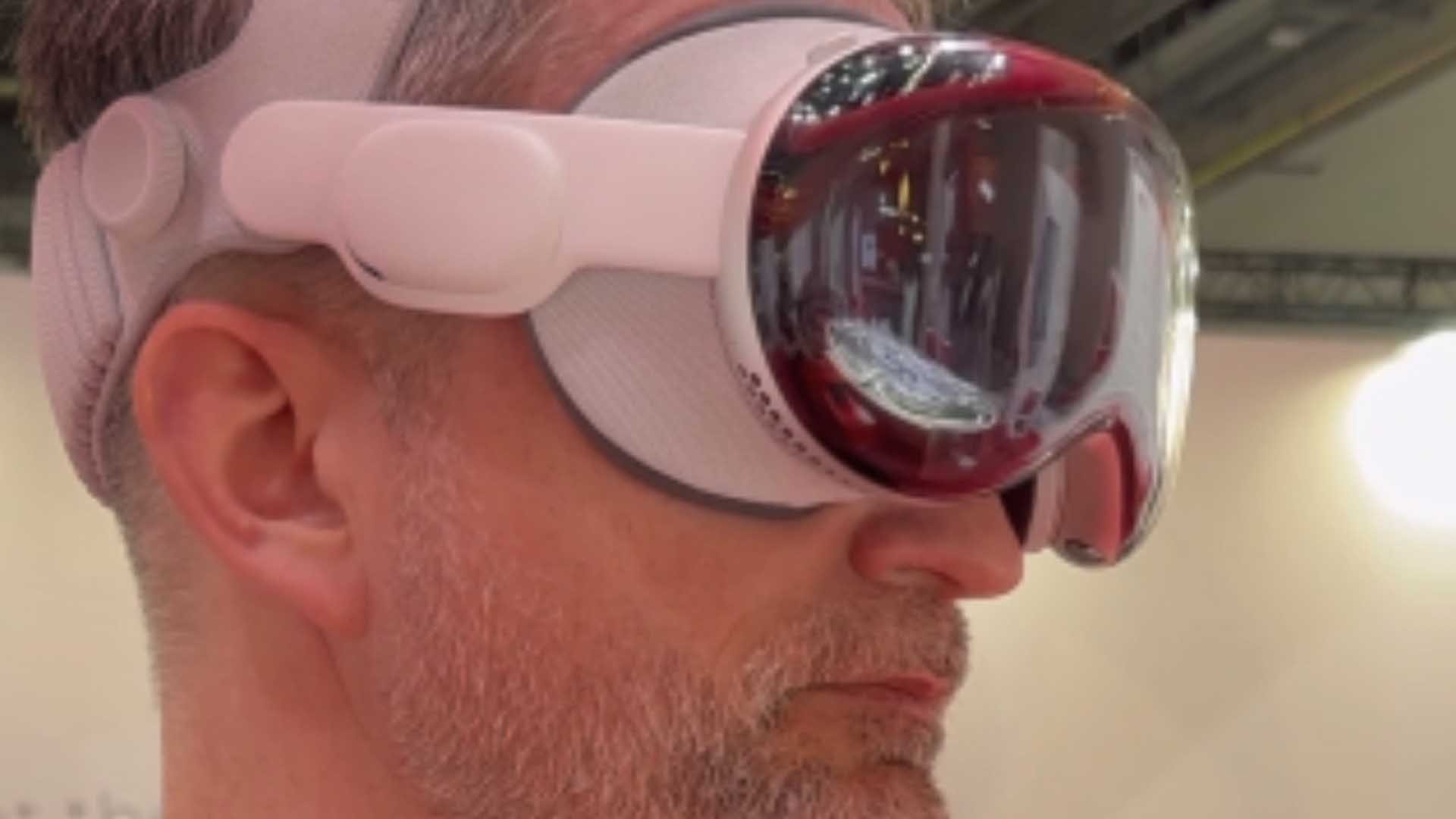
The Apple Vision Pro becomes a spatial interface for technical understanding within the exhibit
Visualization: © Ulrich Buckenlei | VISORIC GmbH expert team for immersive media
This approach is particularly effective for a topic such as lightning protection. Many technical processes remain invisible in everyday life. Individual components can be seen, but the underlying protection logic often only becomes clear through spatial representation. Spatial computing can make exactly these invisible relationships visible and thus build a bridge between engineering and user understanding.
Light + Building 2026 clearly shows that spatial computing is far more than a technology for entertainment or design. It is increasingly evolving into a tool for industrial communication, knowledge transfer, and technical brand storytelling.
When lightning protection becomes a spatial experience
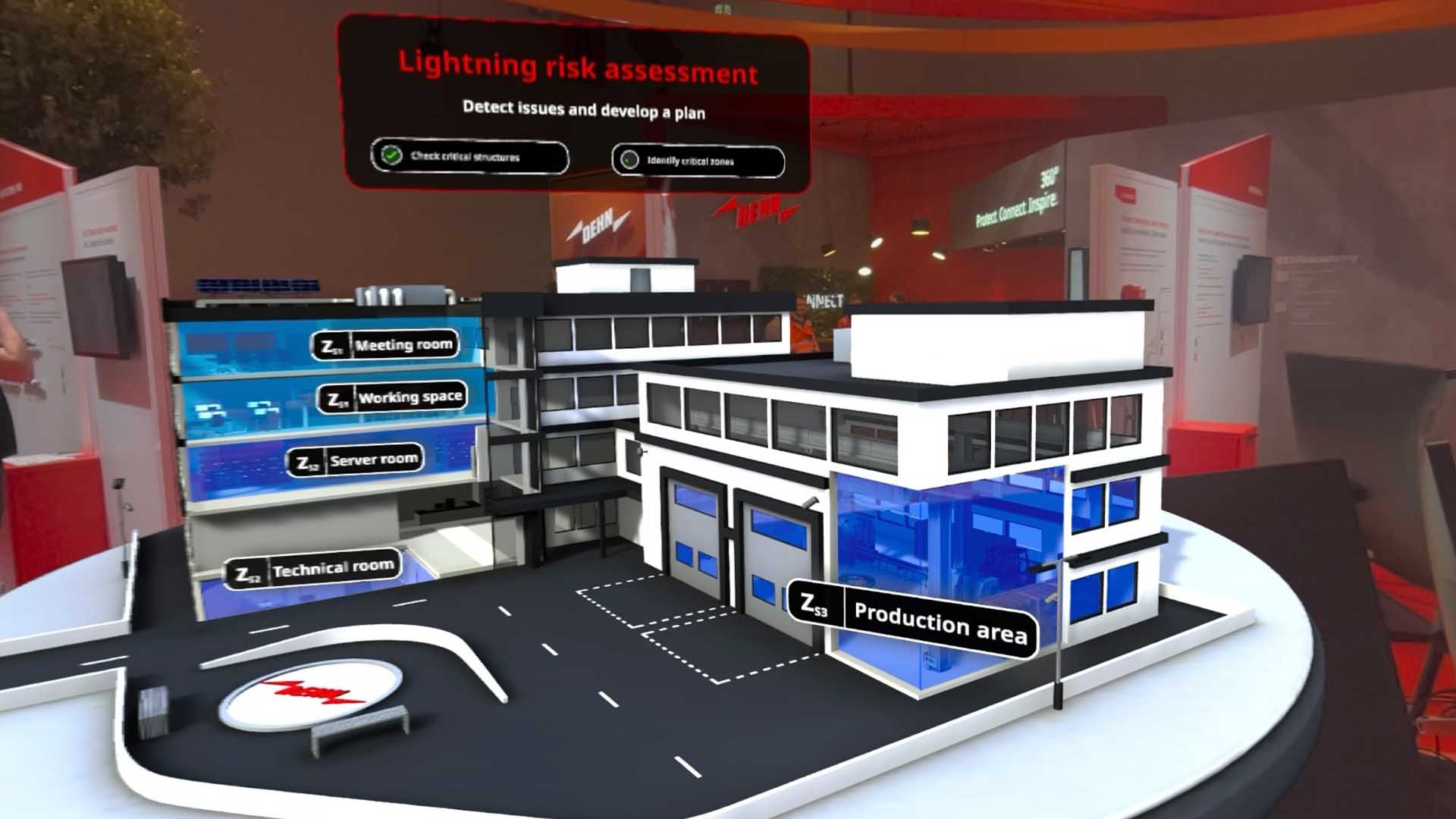
The true strength of the exhibit lies in translating an abstract technical topic into an understandable spatial experience. Visitors do not only learn that lightning protection systems exist. They experience why they are necessary, which physical forces occur during a lightning event, and how modern protection systems safely channel this energy.
Especially for safety-related technologies, this relationship is crucial. Many systems operate in the background and are only noticed when they fail. Lightning protection belongs exactly to this category. Components are visible, but their functional logic often remains abstract for outsiders.
A spatial scenario can make these invisible processes visible. Visitors can see how lightning discharges, what forces act on a building, and how protection systems absorb and redirect this energy. This creates an understanding of technical relationships that goes far beyond a traditional explanation.
The spatial representation enables several important insights:
- Hazard, cause, and protective effect become visible as a connected scenario
- Physical processes can be understood spatially and intuitively
- Technical relationships remain more memorable
This combination of visual representation and personal experience creates a powerful learning effect. Visitors understand not only individual components of a system but also the protective logic behind them. This is particularly valuable for products that require explanation.
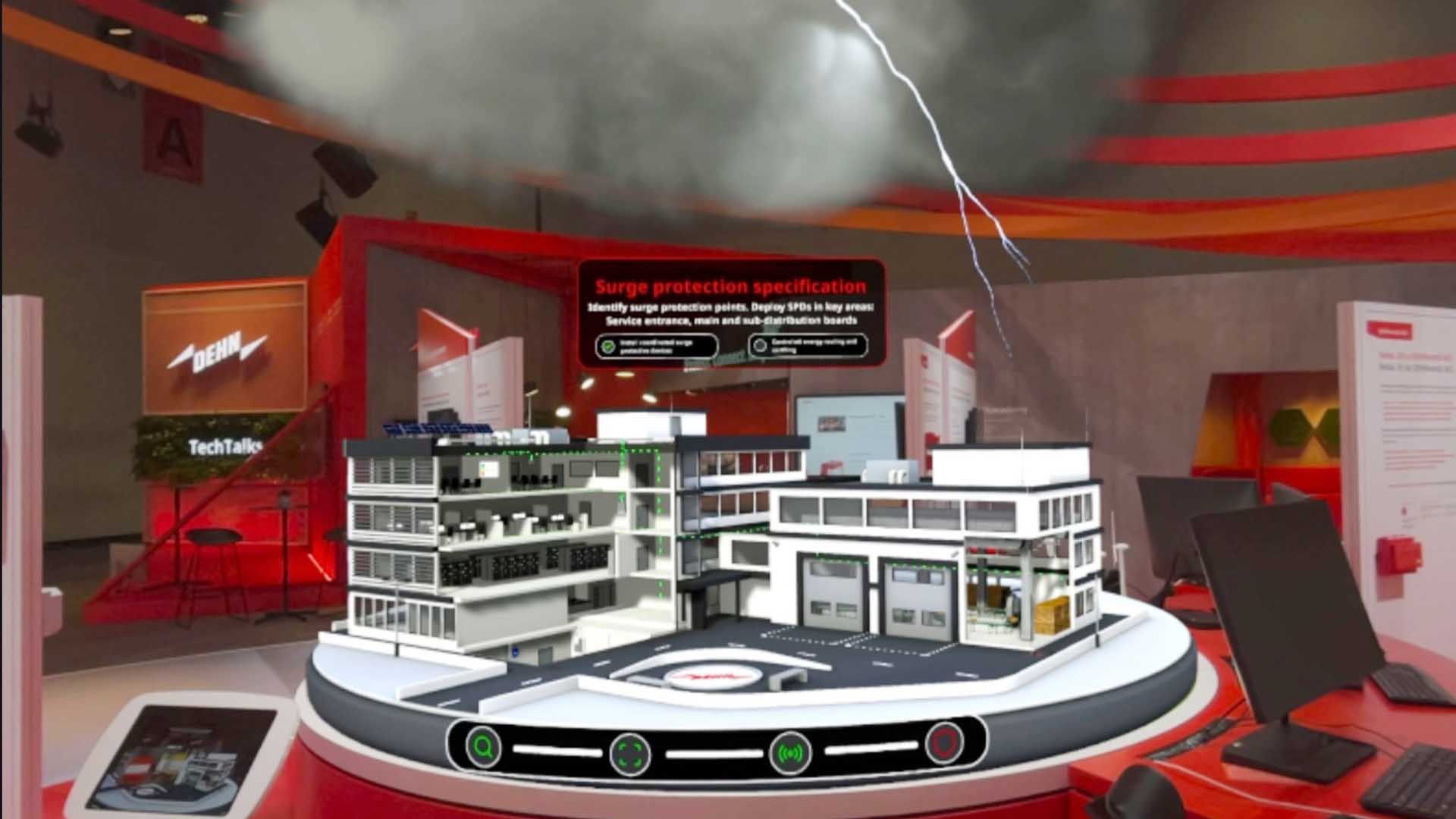
The exhibit translates complex lightning protection technology into a spatial learning experience
Visualization: © Ulrich Buckenlei | VISORIC GmbH expert team for immersive media
At its core, this is about more than visualization. It is about trust in technology. Once visitors can understand the protection logic spatially, their confidence in the technical precision behind the system grows. This form of insight strengthens both product understanding and appreciation of the engineering expertise behind it.
A central component of the DEHN brand environment
What is particularly interesting is the context in which this experience was used. The project did not stand isolated next to the rest of the trade fair presentation. Instead, it was part of a comprehensive brand environment that DEHN designed as a holistic live experience.
This also changes the role of the application. It is not perceived merely as a standalone XR highlight but as part of a larger narrative. Visitors move between products, conversations, technical demonstrations, and spatial experiences. All these elements interact and create a consistent overall impression.
This connection is particularly important at international trade fairs. Visitors encounter many innovations and technical solutions within a short time. A clear and experiential presentation can therefore be crucial for attracting attention and communicating content effectively.
Integrating an immersive experience can fulfill several functions:
- It becomes a thematic anchor within the trade fair presentation
- Technology, brand, and engineering appear as a shared story
- Visitors experience products in the context of real applications
When immersive applications are embedded in this way, they unfold much greater impact. They are not perceived as isolated effects but as part of a well considered communication strategy.

The immersive experience was designed as part of a holistic brand environment
Visualization: © Ulrich Buckenlei | VISORIC GmbH expert team for immersive media
For VISORIC, this connection is a central benchmark when developing such projects. Spatial applications create the greatest value when they are not perceived as a technical effect but as part of a larger story that connects technology, brand, and real world value.
What this project reveals about the future of industrial communication
The exhibit represents a broader development in industrial communication. Products are becoming more complex, systems more interconnected, and technical relationships more demanding. At the same time, companies must communicate these topics clearly to customers, partners, and decision makers.
Traditional media will remain important. Presentations, brochures, and videos will continue to play a central role. However, in many cases they are no longer sufficient on their own to make complex relationships understandable quickly.
Immersive technologies close exactly this gap. They combine technical precision with spatial experience and therefore enable a more intuitive communication of complex content.
Several developments are already becoming visible:
- Immersive communication is becoming a tool for technologies that require explanation
- Spatial computing opens new pathways for training, sales, and presentation
- Technical knowledge can be communicated more clearly and sustainably
In technically driven industries, this creates a new communication space. Visitors do not only learn about a product. They experience how it works and what impact it has.
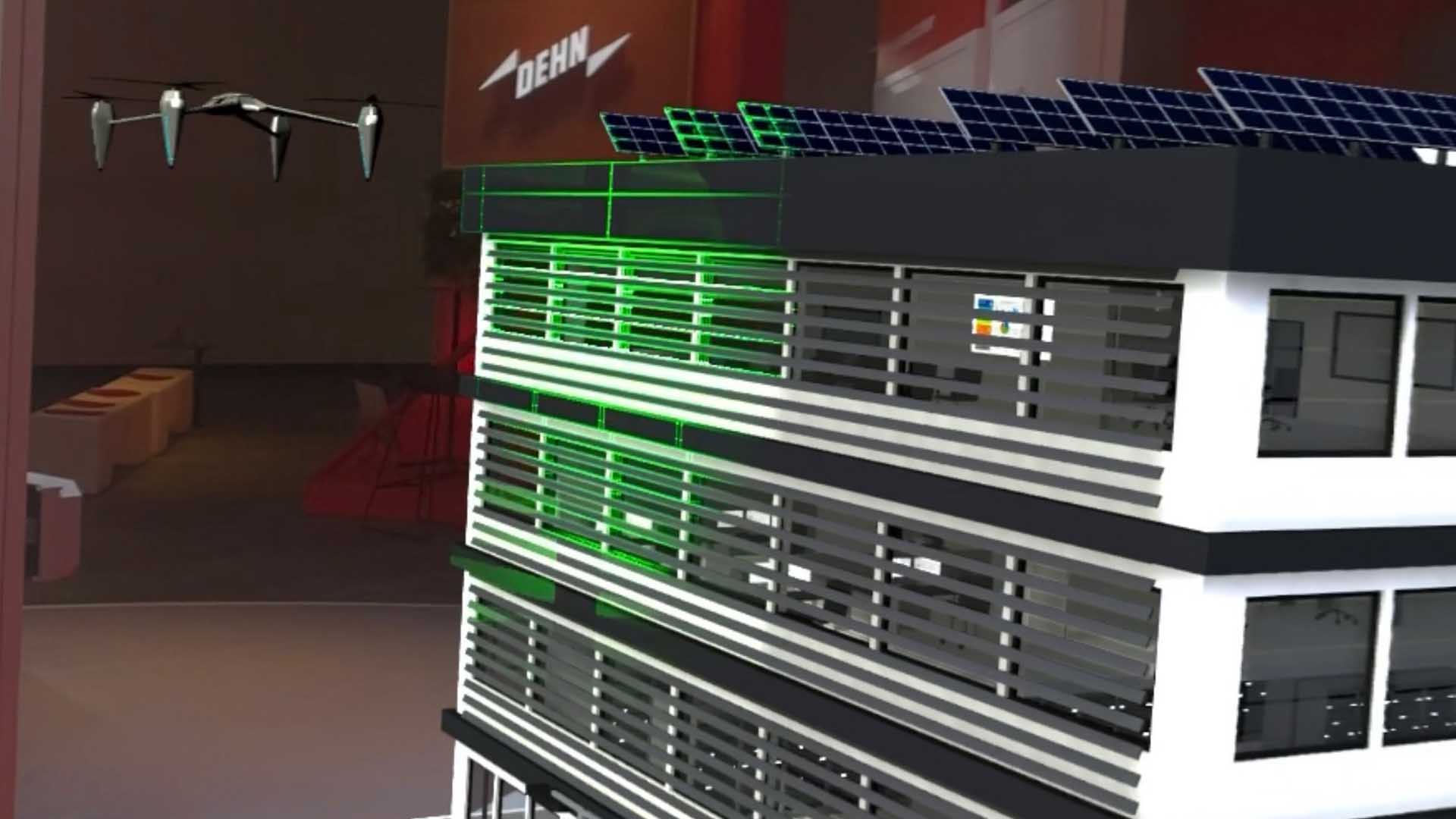
Spatial computing opens new possibilities for industrial knowledge transfer
Visualization: © Ulrich Buckenlei | VISORIC GmbH expert team for immersive media
The project by VISORIC for DEHN SE clearly shows how this development can look in practice. It demonstrates how spatial experiences function within a real trade fair environment and how they influence the understanding of complex technologies. This is precisely where the real strength of such applications lies.
Impressions from the immersive exhibit at Light + Building 2026
Light + Building in Frankfurt is one of the most important international meeting points for lighting, building technology, electrical infrastructure, and intelligent networking. In this environment, it becomes particularly visible how strongly digital tools and spatial interfaces are gaining importance.
The lightning protection exhibit demonstrates how spatial computing can make complex technical content easier to understand. Visitors do not only experience individual components of a system but the entire relationship between energy, building, and protection system.
The following footage shows impressions from the experience in use at the trade fair booth in Frankfurt.
Impressions from the immersive exhibit at Light + Building 2026 in Frankfurt
Video footage: © Ulrich Buckenlei | VISORIC GmbH expert team for immersive media
The experience shows how spatial interfaces can make technical relationships intuitively understandable. Especially for technologies that require explanation, this creates a form of knowledge transfer that meaningfully complements traditional presentations.
From trade fair experience to real business value
The experience at Light + Building demonstrates how powerful immersive technologies can be when complex content becomes understandable and experiential. Spatial computing opens new possibilities for companies to communicate products, processes, and innovations clearly and vividly at trade fairs, in showrooms, in sales environments, or in training scenarios.
Many of these applications begin as a trade fair installation. When they are strategically developed, they can later be used in many other contexts. Experiences can support sales conversations, training programs, showrooms, or internal knowledge platforms and therefore create long term value.
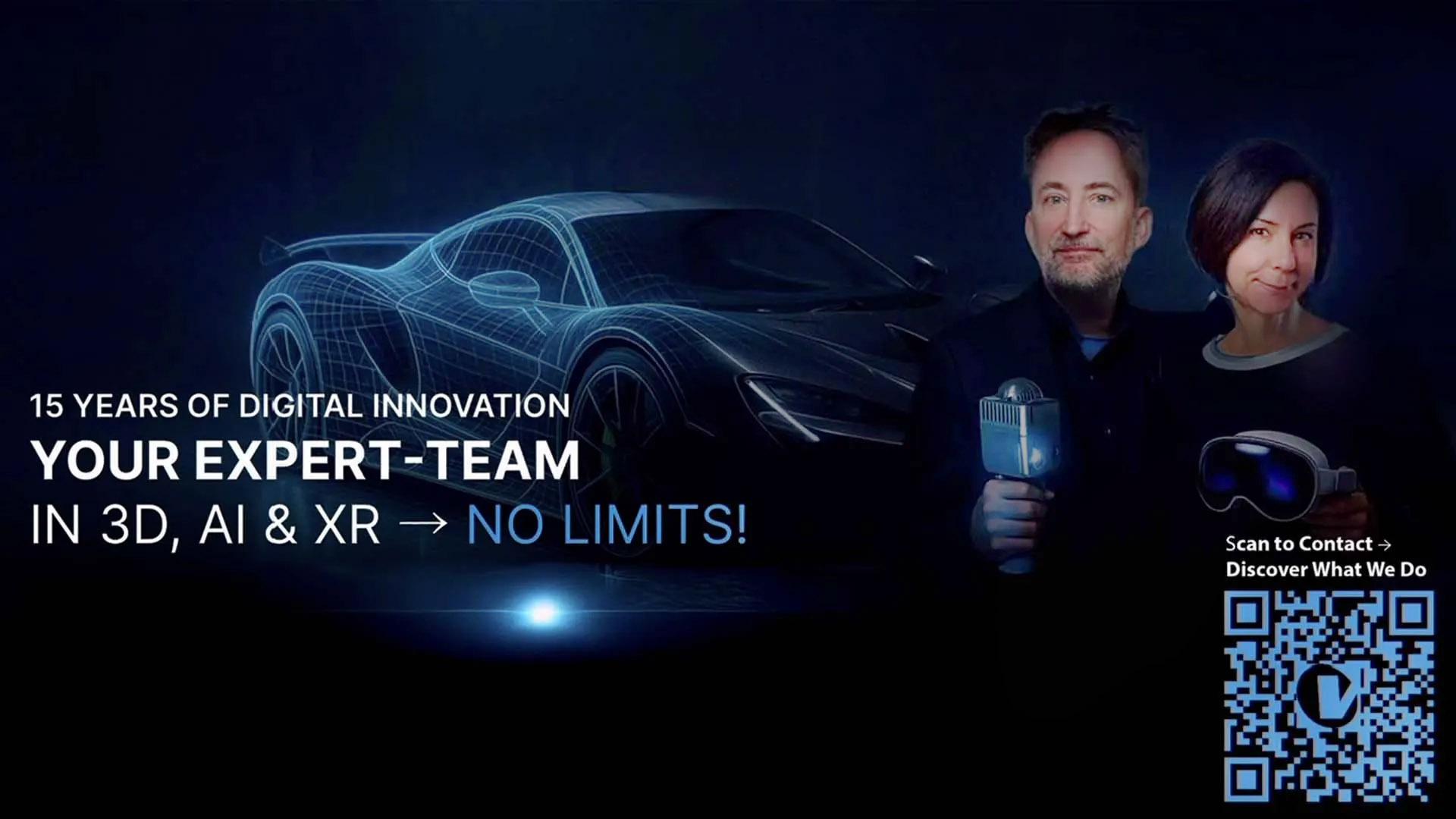
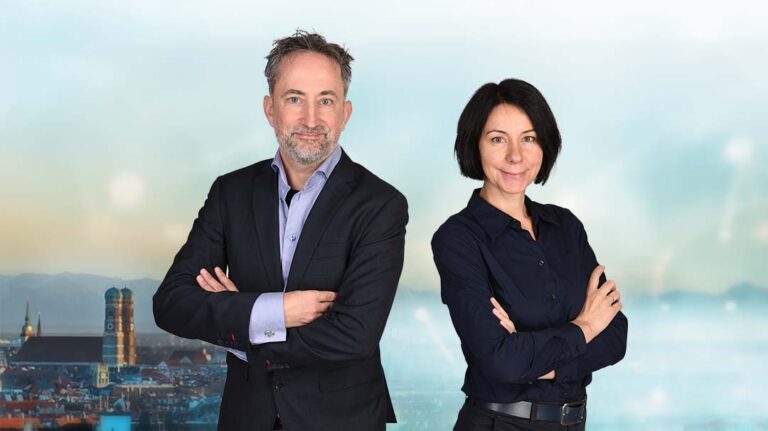
The VISORIC expert team develops immersive spatial computing experiences for industrial companies
Source: VISORIC GmbH | Munich
VISORIC supports companies throughout the entire project lifecycle:
- Concept → Development of spatial experience storylines
- Design and development → Creation of interactive XR applications
- Prototypes → Demonstrators for products and innovations
- Trade fair operations → On site support of the experience
- Further development → Reuse for sales, training, and showrooms
This results in applications that do not only work at trade fairs but can be used long term within the company.
If you are considering how immersive technologies could be meaningfully used in your organization, feel free to contact the VISORIC expert team in Munich.
Contact Persons:
Ulrich Buckenlei (Creative Director)
Mobile: +49 152 53532871
Email: ulrich.buckenlei@visoric.com
Nataliya Daniltseva (Project Manager)
Mobile: +49 176 72805705
Email: nataliya.daniltseva@visoric.com
Address:
VISORIC GmbH
Bayerstraße 13
D-80335 Munich