

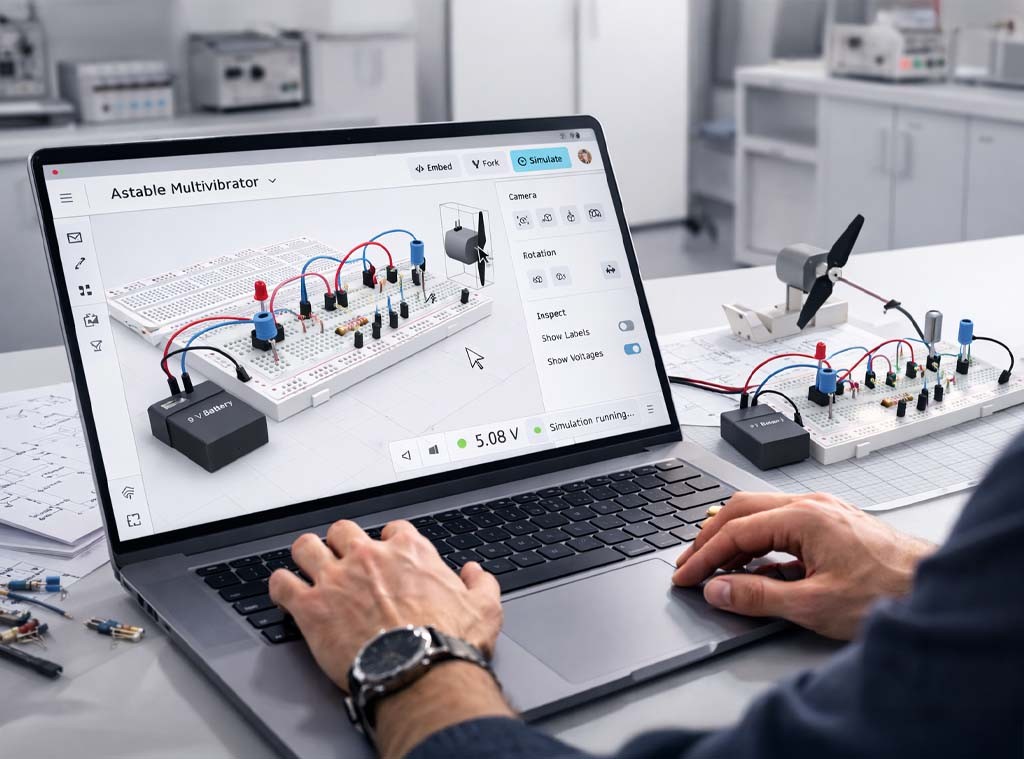
When the Laboratory Moves into the Browser
Editorial concept image | Motif: Browser-based circuit simulation as a digital test bench | Visualization: © Ulrich Buckenlei | Visoric GmbH | This illustration serves analytical classification and does not claim technical completeness
Engineering was tied to physical locations for decades. Workbenches, laboratories, test rigs, and prototype rooms defined the pace of development. Anyone who wanted to validate a system needed materials, infrastructure, and time. Every iteration meant assembly, measurement, modification, and retesting.
This logic was not inefficient. It was materially organized. Speed depended on availability. On components, machinery, and qualified personnel. Development was always a matter of physical coordination.
Today, an additional layer is emerging within this architecture. Mechanical motion sequences, electrical circuits, or entire process chains can be modeled and executed directly inside the browser. Parameters can be adjusted, variants generated, and results compared instantly. Not as static visualizations, but as functional behavior of a digital system.
The decisive shift does not lie in replacing physical development. It lies in relocating early validation. When initial testing and optimization no longer require a physical object, but instead take place inside a web-based simulation environment, the structural bottleneck of engineering changes.
According to ISO 23247 Part 1, a Digital Twin is not merely a 3D model, but a system composed of a physical object, its virtual representation, and bidirectional data flow. This logic is now extending from large-scale industrial systems into smaller, browser-based contexts. [3]
Costs do not disappear. They change composition. As physical infrastructure loses relative weight, model architecture, computational performance, and iteration speed gain importance. Competitive advantage shifts from access to laboratory space and machinery to the ability to formulate and systematically refine precise digital models.
The browser evolves from a display instrument into an operational platform. At this point, a new phase of engineering begins, which becomes tangible in the following chapter.
From Laboratory to Browser Architecture, How the Development Bottleneck Shifts
Early development phases rarely fail because of ideas. They fail because testing them quickly enough is difficult. Validating a hypothesis requires assembling components, wiring systems, measuring signals, rebuilding, and measuring again. This routine is valuable, but it consumes time and resources, making iteration expensive.
Browser-based simulation shifts precisely this bottleneck. Not by replacing physical reality, but by advancing the validation moment. What previously could only be tested after physical assembly can now be evaluated within a digital execution layer. The true gain lies in the number of meaningful iterations achievable per working day.
- Former bottleneck → Assembly time and material availability determine iteration speed
- New bottleneck → Model quality and simulation performance determine validity
- New routine → Variant comparison becomes standard rather than exception
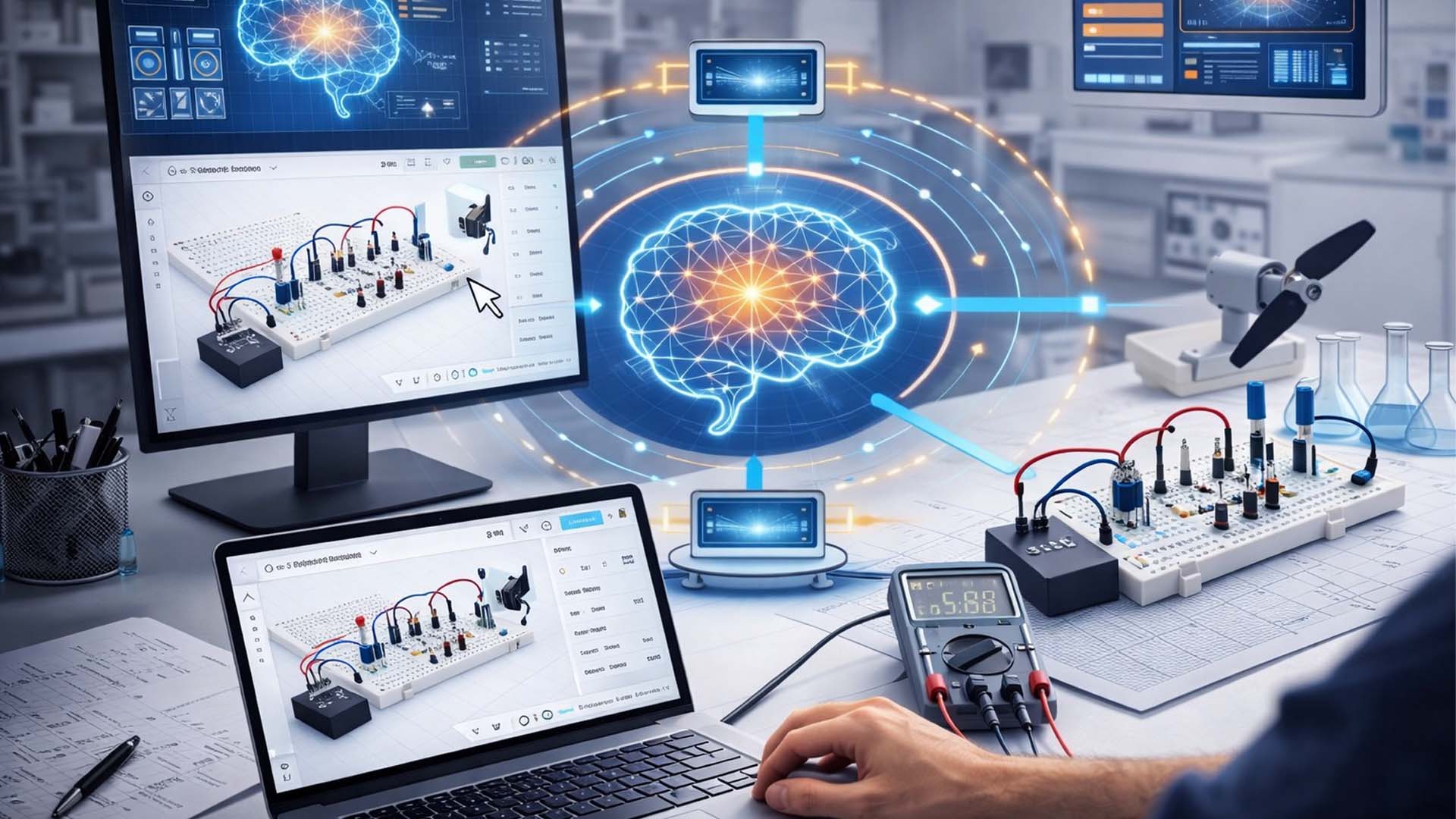
Digital test bench in the browser, simulation on the left, physical setup on the right for comparison
Motif: Editorial demonstration image | Concept: Comparison between browser-based real-time simulation and physical breadboard setup | Visualization: © Ulrich Buckenlei | Visoric GmbH | Analytical classification
The image makes the core idea visible. On the laptop, an interactive circuit simulation runs inside the browser. The breadboard, connection cables, electronic components, and small motor unit are digitally modeled. The visible cursor indicates active interaction. Parameters are modified, connections tested, and system states evaluated in real time.
To the right, the same setup exists physically on the table. Cables, components, and motor are tangible. This side-by-side configuration clarifies the principle. The simulation is not an illustration. It is a functional test bench that can be validated against real-world behavior. The browser becomes a development environment.
Once simulation is available as a web-based runtime, the hurdle shifts from installation and infrastructure to performance, interoperability, and precise modeling. [1]
The next chapter analyzes the conditions under which this shift is not only technically feasible but also economically sound.
The Economics of Iteration, Why Simulation Reshapes Cost Structures
The first chapter demonstrated how the location of validation shifts. Digital Twins allow development decisions to be made earlier and based on data. [7] The second chapter addresses the economic consequences. Development is not only a technical process. It is a cost architecture.
Analyses of Digital Twin economics show that iteration costs, error prevention, and risk reduction are central effects. [4] This is where the structural difference between physical infrastructure and browser-based simulation becomes evident.
- Infrastructure-bound development depends heavily on hardware, materials, and setup
- Browser-based simulation shifts costs toward modeling and computational power
- Economic advantage emerges through lower cost per iteration
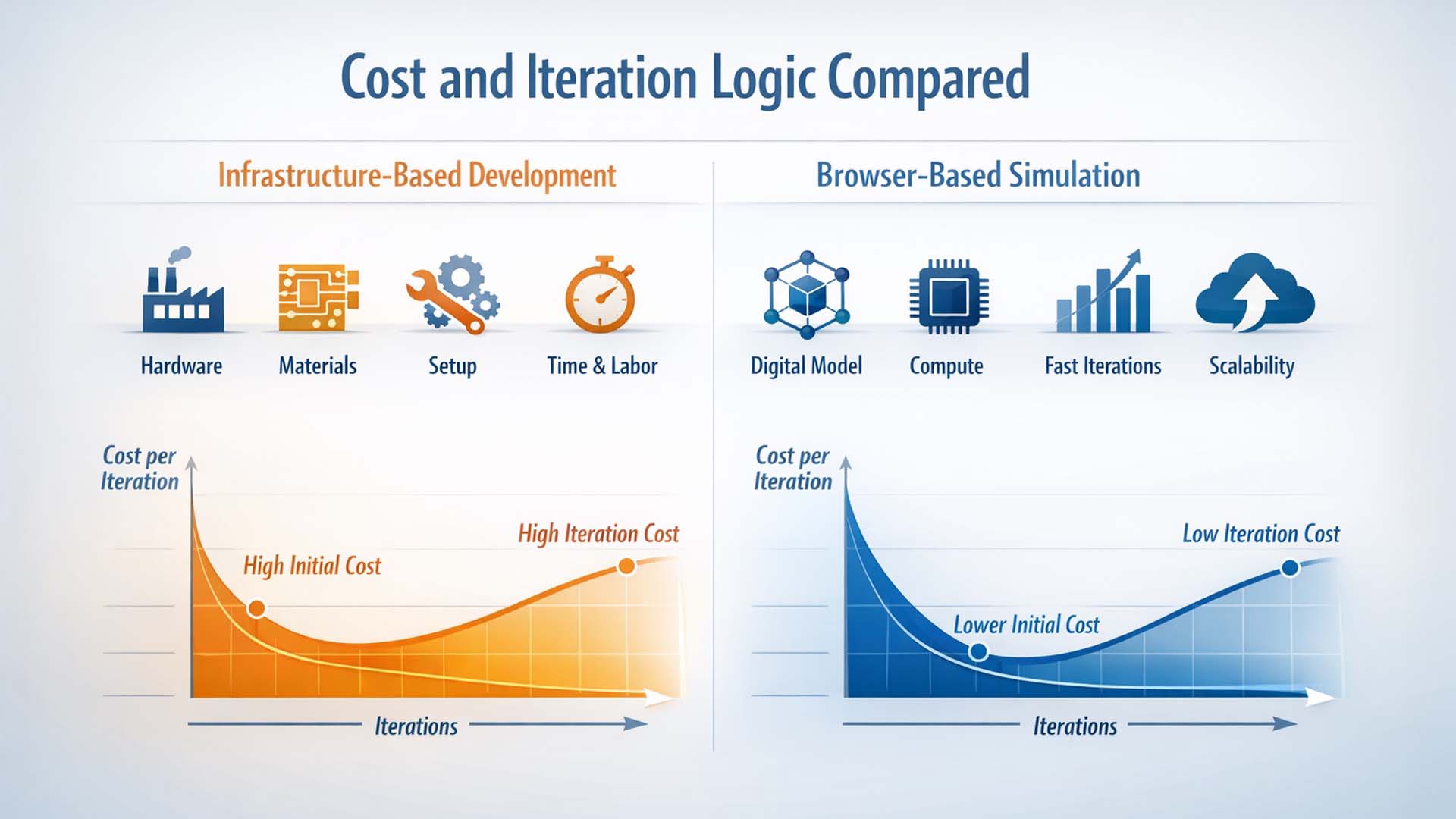
Cost and Iteration Logic Compared, structural comparison between infrastructure-based development and browser-based simulation
Graphic: Editorial analysis | Visualization: © Ulrich Buckenlei | Visoric GmbH
The right side of the graphic shows more than an alternative cost curve. It visualizes a structural transformation. On the left, each additional test immediately consumes materials, setup time, and personnel. On the right, iterations primarily arise from parameter changes and computational execution. The decisive difference lies not in eliminating costs, but in decoupling them from physical infrastructure.
Web-based Digital Twin frameworks demonstrate that iteration cycles can scale on the software level without proportional growth in laboratory space or equipment. [9] Once a model is consistently defined, additional variants emerge through calculation rather than reconstruction.
GPU-accelerated web technologies such as WebGPU extend the browser’s performance limits. Complex physical states, signal flows, or three-dimensional scenarios can be computed and visualized in real time without requiring local specialized software. [1][5]
The economic consequence is subtle yet profound. Validation shifts forward. Errors become visible earlier. Decision options become comparable. Studies indicate that this forward shift can lead to significant efficiency gains and risk reduction. [4]
Physical development does not disappear. Its timing changes. Real prototypes are built later, but with greater confidence. Organizations capable of performing more valid iterations per unit of time reduce failed attempts, shorten learning cycles, and make more precise investment decisions.
The Underlying Architecture, How the Browser Becomes an Engineering Runtime
When the browser becomes a development environment, it does not represent a simplified interface. It becomes a full execution layer. The distinction is crucial. A runtime is not merely a place where results are displayed. It is where computation, logic, and visualization occur simultaneously.
This transformation is enabled by standardized web technologies. WebGPU provides a modern GPU and compute interface capable of executing parallel shader programs and numerical calculations directly within the browser. [1] Computational power shifts from local installations into a scalable web environment.
However, computational performance alone does not constitute an engineering platform. Only the integration of interaction, simulation logic, and physical consistency creates an operational architecture.
- User interface as interaction layer → Parameters, variants, and states become controllable
- Simulation engine as operational core → States are calculated and dependencies resolved
- Physics and Digital Twin logic as validation layer → Models behave consistently with real-world principles [3]
These layers operate synchronously. A parameter changes, the simulation recalculates states, physics responds, and visualization updates in real time. This synchrony differentiates an animated interface from an engineering runtime.
A new development environment emerges. Neither traditional desktop software nor simple frontend. It is an integrated execution layer built on open standards, scalable, interoperable, and industrially compatible. [8]
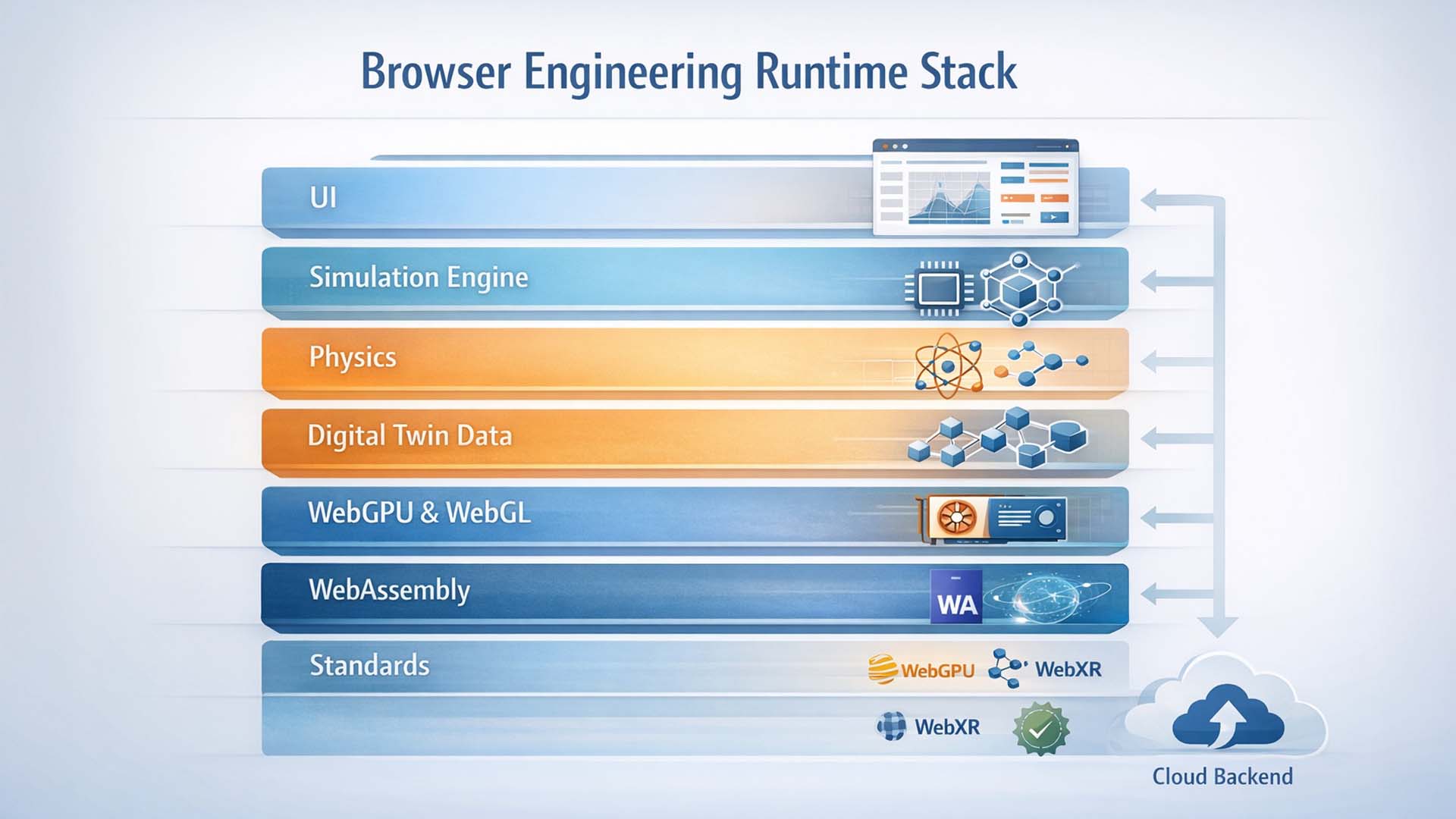
Browser Engineering Runtime Stack, layered model of a web-based simulation architecture
Graphic: Editorial system representation | Visualization: © Ulrich Buckenlei | Visoric GmbH
The graphic depicts an operational architecture. Each layer fulfills a clearly defined function within a browser-based engineering runtime. At the top lies the user interface. Below it operates the simulation engine. The physics layer ensures realistic behavior. WebAssembly enables near-native performance within the browser. [6] The Digital Twin data layer connects models to real parameters in accordance with ISO 23247. [3] WebGPU and modern rendering pipelines guarantee real-time visualization. [1] The foundation consists of standards and cloud connectivity, ensuring scalability and interoperability. [8]
The paradigm shift becomes evident. The browser evolves from a display tool into an execution environment where rendering, physics, logic, and data models converge in a unified runtime.
“`
Governance and Security, When the Laboratory Becomes a Connected Platform
Once Digital Twins represent real systems, the change is not only technical. It becomes a responsibility shift. A browser-based simulation environment is no longer an isolated tool. It becomes part of a connected platform architecture. Models can reflect real production parameters. Simulations can influence investment decisions. Variants can flow into series processes. This is where organizational and regulatory requirements emerge.
ISO 23247 does not describe Digital Twins as simple visualization, but as an integrated system of physical object, virtual representation, and data flow. [3] As soon as this data flow becomes bidirectional, governance becomes an infrastructural necessity.
- Governance as structuring framework → Versioning, role models, traceability of model changes
- Security as integral component → Encryption, access control, and secured interfaces enable industrial usage
- Compliance as strategic safeguard → Standards, documentation obligations, and auditability ensure long-term viability
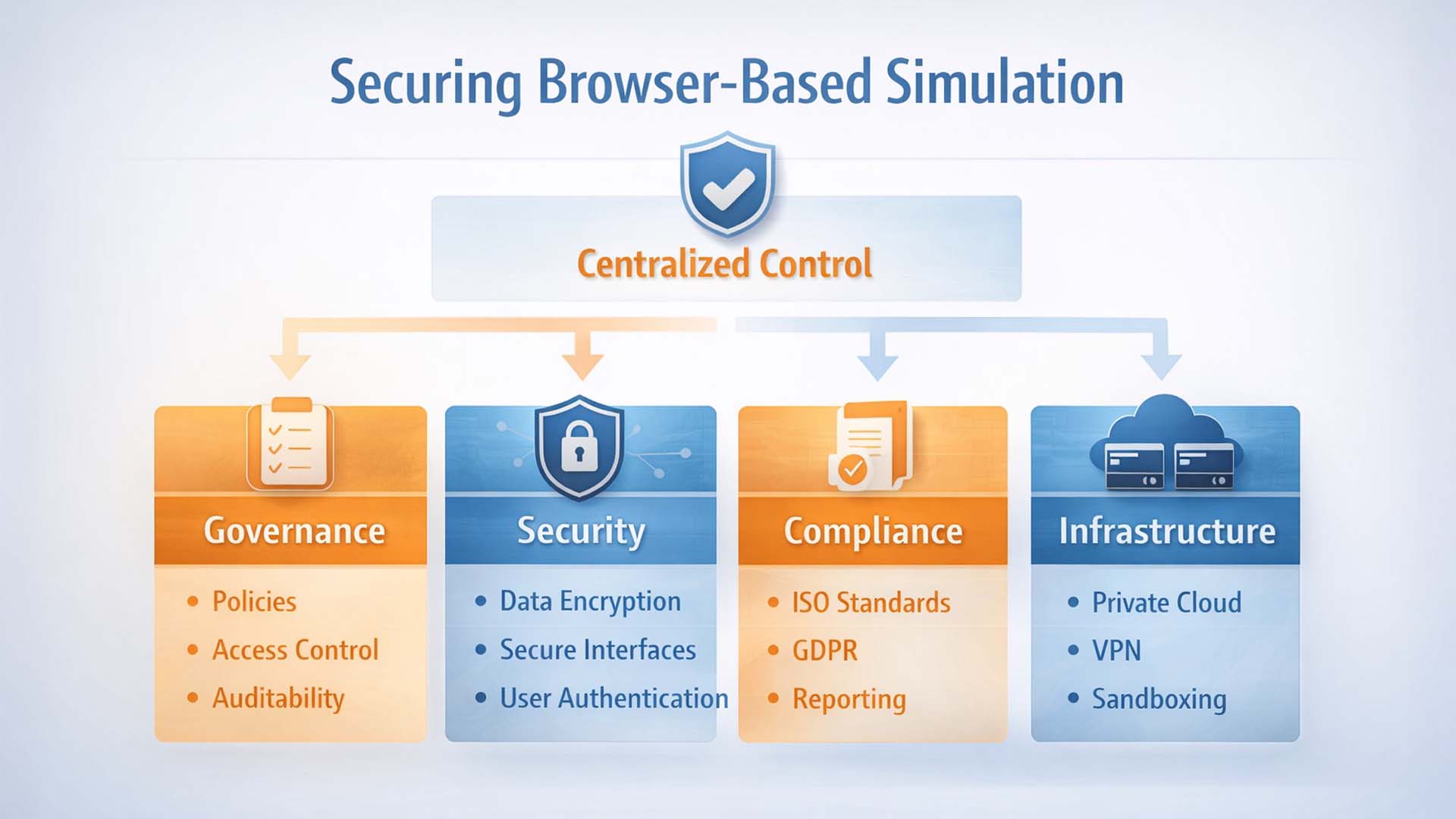
Securing Browser Based Simulation, governance and security architecture for browser-based engineering platforms
Graphic: Editorial system representation | Visualization: © Ulrich Buckenlei | Visoric GmbH
The graphic is intentionally designed as a layered model with centralized control. At its core is “Centralized Control.” This does not symbolize surveillance. It symbolizes orchestration. Roles, permissions, and approval workflows are managed in a structured way.
Below it, four functional blocks are arranged. “Governance” stands for policies, version logic, and auditability. Every model change must remain traceable. “Security” addresses encryption, secure APIs, and authentication. If real production data or proprietary designs are represented, data protection is not optional. “Compliance” points to ISO standards, privacy, and regulatory documentation duties. “Infrastructure” describes the technical foundation of cloud architectures, VPN structures, and isolated execution environments.
Industry 4.0 frameworks emphasize that interoperability and standardized integration are prerequisites for sustainable implementation. [8] Studies on Digital Twin economics also indicate that missing governance structures can create higher long-term risks and costs than the technology itself. [4]
The core insight of this chapter is therefore: when the laboratory moves into the browser, it does not become more informal. It becomes more structured. Responsibility shifts from physical rooms to digital architectures. Security, transparency, and organizational clarity determine whether browser-based simulation remains an experiment or becomes an industrial platform.
With the technical and regulatory foundation established, the next chapter analyzes strategic consequences for innovation speed, competitive dynamics, and business models.
Strategic Implications, When Simulation Becomes Infrastructure
With the technical architecture and governance framework established, the decisive question becomes strategic. What changes for organizations when browser-based simulation is not just a tool, but an infrastructural foundation of development.
Digital Twins are increasingly considered a central element of modern production and innovation systems. Their economic relevance lies less in a single project than in long-term acceleration of learning cycles and decision processes. [4]
- Innovation speed becomes a competitive factor
- Product decisions shift earlier and become data driven
- Digital services complement physical products

Strategic Impact of Browser Based Simulation, interaction between innovation speed, competitive position, and business models
Graphic: Editorial strategy representation | Visualization: © Ulrich Buckenlei | Visoric GmbH | English labels for international context
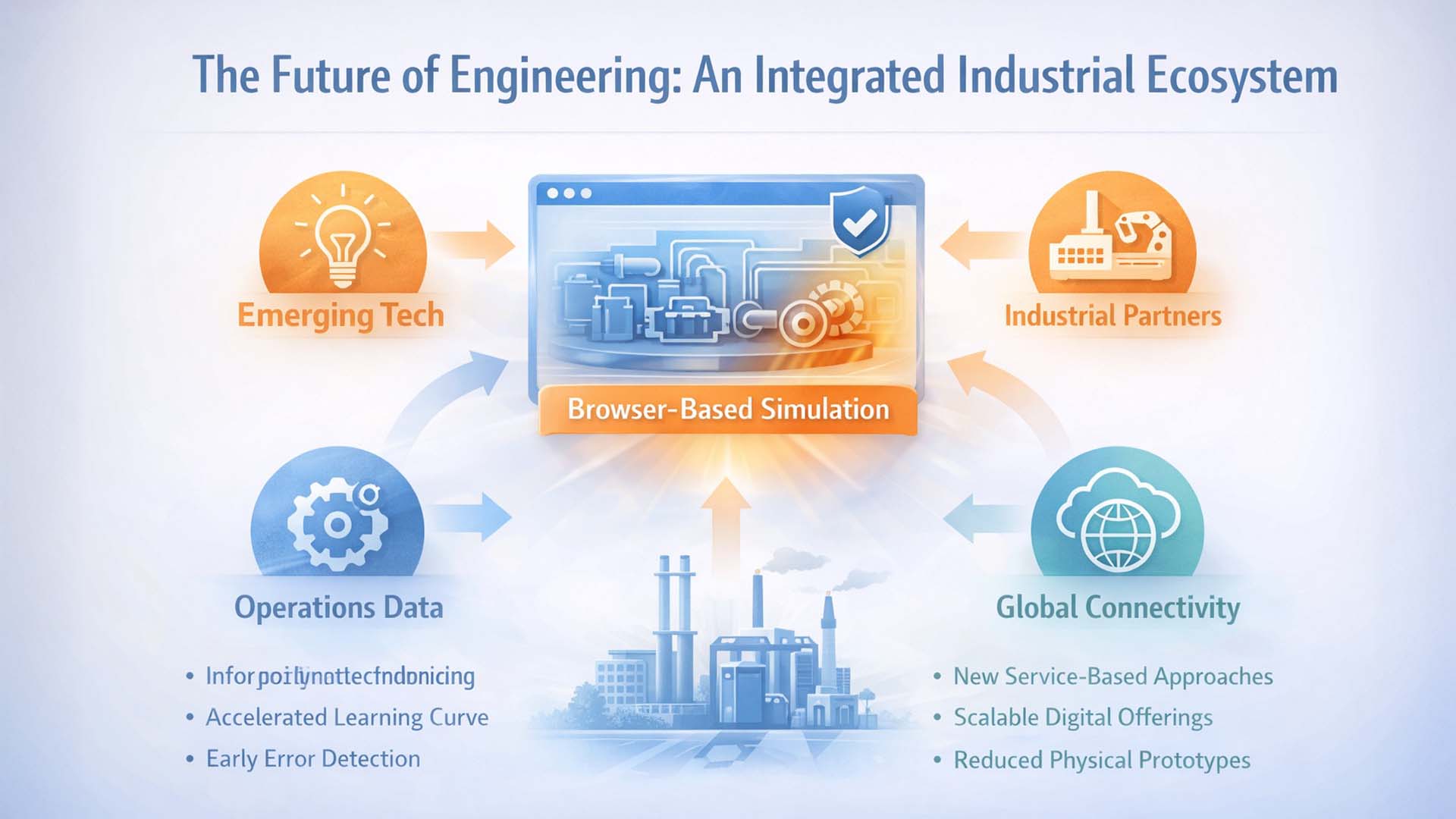
At the center of the graphic is “Innovation.” It is depicted as a gear with an integrated light bulb, symbolizing the core effect of browser-based simulation. Innovation is not presented as an isolated creative act, but as the result of systematic iteration.
On the left, “R&D Speed” is positioned. The points “More Iterations per Time,” “Accelerated Learning Curve,” and “Early Error Detection” show that speed emerges from the density of valid iterations. Browser-based simulation increases this iteration density and shifts an organization’s learning curve.
On the right, “Competitive Position” is highlighted. Faster validation enables smarter product decisions, reduces time to market, and strengthens value positioning. Competitive advantage arises not only from product quality, but from structural decision capability.
At the bottom, “Business Models” is anchored. The points “New Service-Based Approaches,” “Scalable Digital Offerings,” and “Reduced Physical Prototypes” demonstrate that simulation changes not only development processes, but also offerings. Digital Twins and browser-based platforms enable service expansion, remote validation, and new revenue models. [8]
The gears are intentionally connected. Speed influences competitiveness. Competitiveness shapes business models. Business models expand investment capacity for innovation. A strategic cycle emerges.
Studies on web-based Digital Twin frameworks show that client-free deployment and centralized platform architectures can generate scaling effects far beyond individual projects. [9] This is where simulation becomes infrastructure.
The key insight of this chapter is not that the browser is a new tool. It becomes an operational layer within the value chain. Organizations that integrate this layer strategically increase innovation frequency, shorten decision cycles, and expand their business logic.
This completes the arc of the article. From the physical laboratory to economic shifts, technical architecture, governance structures, and strategic dimensions, it becomes visible that engineering does not dissolve. It reorganizes.
The final chapter consolidates this development once more, summarizing the overall trajectory and placing it in a broader industrial context.
From Strategy to Real Application, The Laboratory in the Browser in Action
After the strategic framing, the argument becomes concrete. This chapter no longer focuses on architecture, governance, or market logic. It focuses on application. A real browser-based simulation environment where physical logic, code, and visualization operate in real time.
- The browser as an operational engineering environment
- Digital representation of physical components
- Real-time synchronization of logic, physics, and visualization
Browser-based real-time simulation of an electronic circuit with a digital motor as synchronized visualization
Demo environment: Web-based circuit simulation | Motif: Interactive breadboard with analog logic and 3D visualization | Editorial classification
The scene shows an interactive circuit simulation in the browser. On the left, a component library is visible, allowing selection of parts such as LED, motor, 555 timer, transistors, and breadboard. In the center, the digital assembly contains resistors, capacitors, transistors, and a power source. On the right, a three-dimensional motor visualization is embedded, driven by the simulated logic.
The decisive aspect is simultaneity. Analog components are not only displayed. Their electrical properties are computed. Signal flows emerge in real time. The motor does not rotate as a simple animation, but as a visualization of calculated system states.
This environment exemplifies how a Digital Twin behaves in the browser. It is not a static model. It is an interactive system where code, physics, and visualization are synchronized. Web technologies such as GPU acceleration and performant simulation cores enable this execution directly within the browser runtime. [1]
Such platforms already exist in different forms, from browser-based circuit simulators to more comprehensive engineering frameworks. [11] The critical point is not the individual tool. It is the principle. The browser becomes an execution layer for real logic.
This closes the loop back to the strategic perspective. What was described earlier as infrastructure becomes tangible here. Simulation does not replace the physical laboratory. It extends it with a programmable, scalable layer.
The following section consolidates this development once more. The concluding video chapter compresses the core message and translates the analysis into a clear vision.
Video Analysis, When the Physical Laboratory Moves into the Browser
The following video does not show a vision. It shows an already functional development environment. An electronic circuit is built entirely in the browser, configured, and executed in real time. Components are placed with a mouse click, signals are computed, and physical states are visualized synchronously.
What becomes visible here is more than a graphical simulation. Analog components are modeled mathematically, signal flows are computed dynamically, and three-dimensional objects are synchronized in real time with the underlying logic. Rendering, physics, and executable code converge within the same web environment. [1]
This advances early validation. Tests that previously required physical assembly can now be performed in the browser. This does not replace the laboratory. It expands it. Digital Twins begin here not as abstract industry architecture, but as an operational development environment. [3]
Strategic relevance lies in iteration capability. When simulation, code execution, and visualization are directly coupled, a new engineering routine emerges. Variants can be tested faster, errors recognized earlier, and optimization performed based on data. AI can contribute in this context through analysis, debugging assistance, and signal optimization. [4]
Web Native Simulation, Interactive circuit simulation with synchronized 3D visualization in the browser
Demo environment: Browser-based real-time simulation of electronic circuits | Analytical framing: Ulrich Buckenlei
This example stands for the transition from hardware-bound validation to model-based iteration on the web. It does not mark the end of physical development, but the beginning of a programmable, intelligent infrastructure where laboratory work, code, and AI increasingly overlap.
The final section consolidates the overall development and places it into a broader industrial context.
Sources and References
- W3C, “WebGPU Specification”, Editor’s Draft and Working Materials, accessed 2024–2026. [1]
- Khronos Group, “WebGL and Real Time Graphics Standards”, technical documentation, accessed 2024–2026. [2]
- ISO, ISO 23247 1: Digital Twin Framework for Manufacturing, Part 1: Overview and General Principles, International Organization for Standardization, 2021. [3]
- McKinsey & Company, analyses on the value potential of Digital Twins in industry and operations, 2023–2025. [4]
- Google Chrome for Developers, technical documentation on WebGPU, browser compute pipelines, and high performance web rendering, accessed 2024–2026. [5]
- WebAssembly Community Group, “WebAssembly Core Specifications and Implementation Resources”, accessed 2024–2026. [6]
- Deloitte, studies on Digital Twins, simulation driven engineering, and industrial efficiency gains, 2023–2025. [7]
- Plattform Industrie 4.0, publications on interoperability, digital industrial architectures, and connected production systems, 2023–2025. [8]
- IEEE Access, research articles on web based Digital Twin systems, simulation environments, and real time engineering platforms, 2022–2025. [9]
- Fraunhofer, applied research on Digital Twins, industrial simulation, and smart manufacturing environments, 2023–2025. [10]
- Autodesk Research, publications on simulation workflows, virtual prototyping, and engineering validation, 2022–2025. [11]
- European Commission, policy and industrial strategy materials on digitalization, industrial data spaces, and advanced manufacturing, 2023–2025. [12]
- ENISA, guidance on cybersecurity for connected industrial systems and cloud based environments, 2023–2025. [13]
- NIST, publications on digital engineering, model based systems engineering, and trustworthy simulation infrastructures, 2022–2025. [14]
- Three.js Documentation, rendering architecture and browser based 3D implementation resources, accessed 2024–2026. [15]
When the Real Laboratory Is Digitally Extended, It Takes More Than a Tool
Browser-based simulation is not an isolated feature. It is an infrastructural decision. Once physical processes, circuits, machines, or entire production chains are modeled and validated as Digital Twins on the web, development logic, responsibilities, and investment decisions change.
The central question is no longer whether simulation is technically possible. What matters is how it is integrated strategically. Which systems should be mirrored digitally. Which data sources will be connected. How performance, security, and governance are ensured. And how this creates real value for product development, service, or operations.
Anyone aiming to transfer a real laboratory into a browser-based engineering environment needs more than individual tools. A clean end-to-end architecture is required. From analyzing suitable use cases and designing simulation logic, to selecting the right web technologies, building performant Digital Twins, and integrating real machines, sensors, and data streams.
This is exactly where the Visoric expert team in Munich operates. We support organizations in strategic framing, design browser-based simulation environments, develop interactive engineering platforms, and connect digital models to real systems. Not as showpieces, but as reliable infrastructure.

VISORIC concept team working on browser-based engineering and Digital Twin architectures
Source: VISORIC GmbH | Munich
- Strategic analysis → Identifying relevant use cases for browser-based simulation
- Architecture and concept → Designing Digital Twin and web engineering stacks
- Proof of concept → Validating technical and economic feasibility
- Implementation → Developing interactive simulation environments in the browser
- Integration → Coupling digital models with real machines and data sources
- Scaling → Governance, security, and high-performance platform architecture
If you want to assess how your laboratory, machines, or development processes can be transferred into a scalable web-based simulation environment, a structured conversation is worthwhile.
Not as a sales presentation, but as a joint analysis of where digital extension creates genuine strategic value.
Contact Persons:
Ulrich Buckenlei (Creative Director)
Mobile: +49 152 53532871
Email: ulrich.buckenlei@visoric.com
Nataliya Daniltseva (Project Manager)
Mobile: +49 176 72805705
Email: nataliya.daniltseva@visoric.com
Address:
VISORIC GmbH
Bayerstraße 13
D-80335 Munich