


Image: AI avatars as the new service interface in everyday life. Visualization: Visoric GmbH 2025
At the center of the next service revolution are artificial intelligence, sensors, and real-time interaction. Digital assistants are evolving into dynamic partners that understand, respond, and act alongside us. What used to be isolated software is now becoming part of our daily lives—visible, audible, and tangible in spaces, devices, and services.
Through the use of edge computing, precise motion detection, and semantic analysis, AI avatars respond to human gestures, speech, and emotions. They translate data into actions, visualize progress, and build trust through immediate feedback. This marks the beginning of a new era in human-technology relations—one where artificial intelligence does not replace but enhances human capability.
The new generation of digital services: AI avatars as coaches, doctors, and advisors
Technology is moving from the lab into everyday life. AI avatars are becoming interactive interfaces that advise, train, and support. They appear in gyms, medical practices, sports clubs, and at home—on smartphones, as holograms, or in mixed reality. This is made possible by the combination of real-time 3D, multimodal AI, sensor fusion, and ever-lower latency. Companies are investing in fast mobile networks and edge infrastructure, creating systems that react instantly to speech, gestures, and movement.
This development gives rise to a new service model for companies. Consulting becomes visual and proactive. Training becomes safe, scalable, and measurable. Medical pre-assessments and rehabilitation programs can be personalized. The key is consistency in interaction. What works reliably in games delivers precision, repeatability, and millisecond feedback in service processes.
Infrastructure is the metronome of this evolution. NVIDIA and its partners are driving edge-optimized AI pipelines and investments in fast mobile networks. The closer the computation takes place to the user, the more natural the interaction feels. Thus, a futuristic vision becomes a reliable service standard.
- Service becomes spatial: avatars appear where questions and tasks arise
- Edge AI and fast networks reduce latency and increase reliability
- Real-time 3D makes consulting, training, and diagnostics visual and measurable
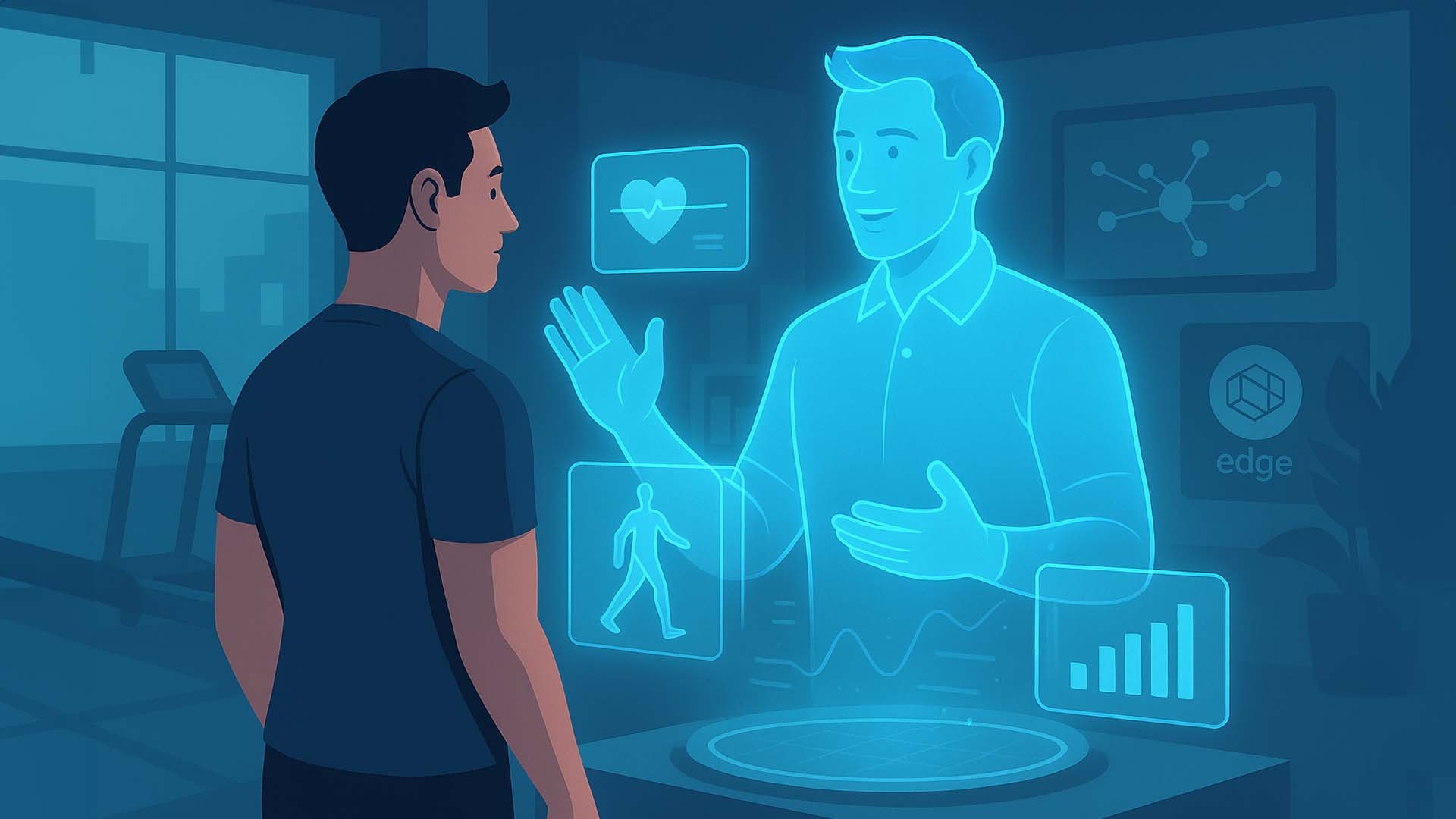
Image: Digital companions become visible services in everyday life. Visualization: Visoric GmbH 2025
This development marks the transition from technical assistance to genuine interaction. Systems are not only learning to automate tasks but also to understand the individual dynamics of human behavior. They detect movements, listen to tone, and recognize patterns in speech and body language. Communication is no longer mediated through keyboards or menus but emerges naturally—intuitive, situational, and context-dependent.
As a result, physical action and digital reaction merge into a seamless experience. AI avatars no longer respond to commands but to behavior. They react to posture, pace, and rhythm, adapting in real time. A new form of communication emerges—one that feels familiar, even though it’s built on the most complex technology.
The next question is how humans will interact with these systems. The answer begins with a natural form of control: movement becomes the language between human and machine.
When movement becomes the interface
Our posture, gestures, and position in space become control signals. Systems detect direction, speed, and intent, deriving commands from them. This reduces cognitive load, as action and goal align. In fitness and rehabilitation, avatars demonstrate exercises, read execution, and provide instant feedback. In healthcare, they assist with anamnesis and explanations, adjusting pace and depth of information.
In practice, hybrid control concepts emerge. Hand tracking, 3D pose, and gaze direction merge with speech input and tactile feedback. The user remains in control while still receiving precise assistance. Errors are detected before they take effect. Posture corrections and safety rules appear as spatial overlays directly within the field of view.
The more natural the interaction, the higher the retention rate. Movement links motor skills, perception, and cognition, making it ideal for training, coaching, and service processes. Operation becomes dialogue.
- Gestures, gaze, and voice replace menus and buttons
- Adaptive systems recognize intentions and respond contextually
- Movement as an interface increases learning speed and safety

Image: Physical action becomes the control language of the digital coach. Visualization: Visoric Research 2025
When machines understand our gestures, trust is built—and trust is the foundation of every learning process. People understand connections best when they can act actively rather than follow abstract instructions. This is where motion-based interfaces unfold their full potential: they connect physical experience with digital feedback.
What used to be taught through manuals or monitors is now experienced. Every movement generates a reaction, every mistake becomes a learning moment. AI systems observe, analyze, and assist without breaking the user’s flow. Learning becomes immediate, precise, and motivating.
When interaction becomes intuitive, learning becomes experiential. The next section shows how immersive training turns theory into applicable skill.
Learning through experience instead of instruction
Knowledge sticks when it is experienced. Immersive training with avatars simulates processes realistically, without risk to humans or machines. Learners stand within the process, see cause and effect, and receive individualized feedback. Mistakes are allowed—and from them competence grows. Those who master movement patterns in digital form execute them more safely in reality.
Companies shorten onboarding and standardize quality. Training becomes location-independent and scalable. Rehabilitation and athletic programs automatically adapt to progress and daily condition. The system detects uncertainty, offers assistance, and transparently documents learning progress.
The combination of movement, real-time feedback, and AI analysis creates measurable learning gains. Abstract theory becomes experience. Experience becomes applicable skill. This forms the basis for data that is not only collected but understood.
- Virtual training makes processes tangible and safe
- Error analysis becomes a learning opportunity with instant feedback
- Adaptive scenarios motivate and accelerate skill development
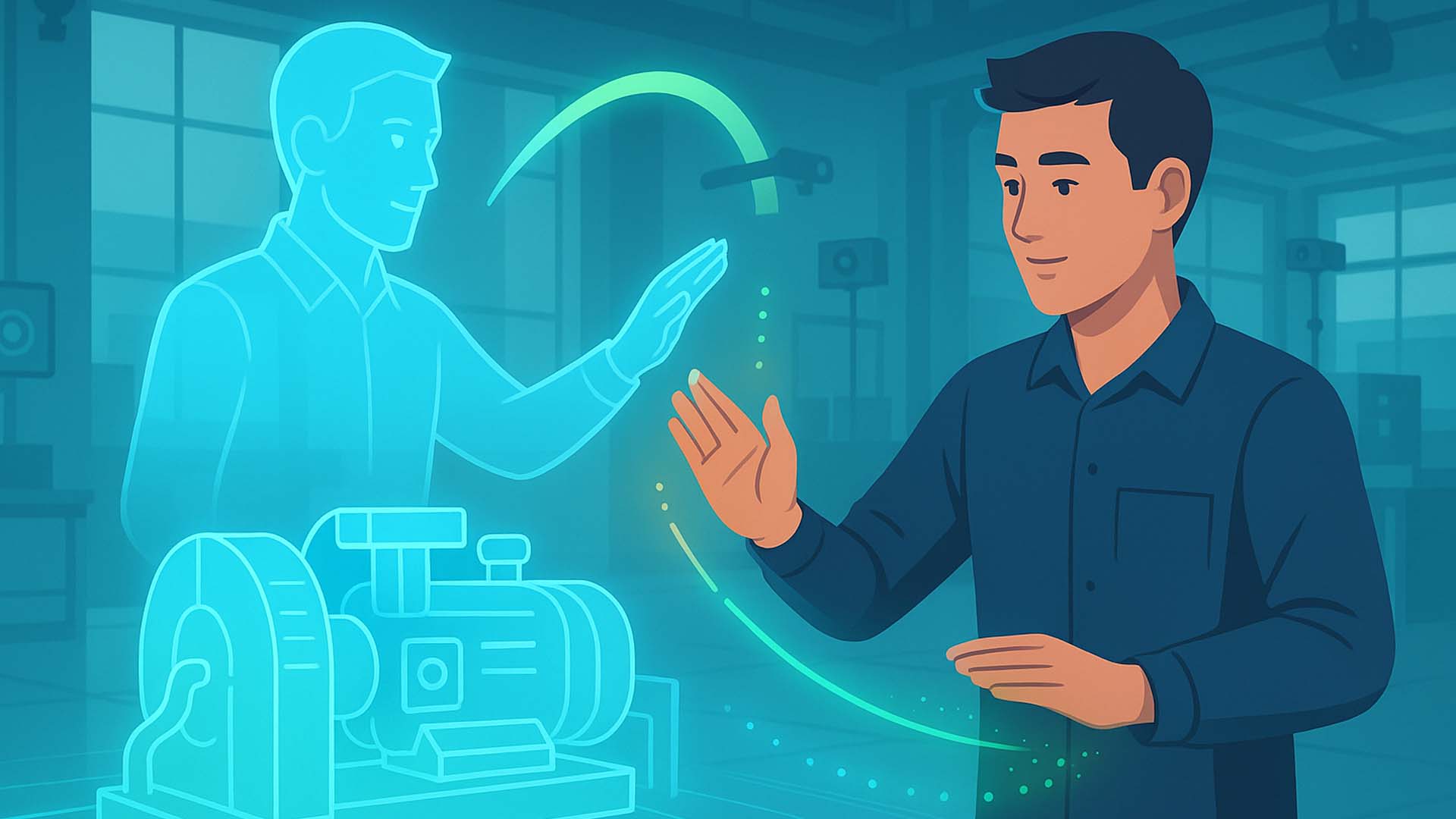
Image: Simulation replaces theory and makes progress visible. Concept visualization: Visoric XR Lab 2025
For this form of learning to remain effective, it needs more than simulation—it needs a link to real working environments. Only when digital training systems are directly connected to real-time data, sensor values, and environmental information does lasting value emerge. AI recognizes progress, evaluates precision, and provides situational feedback based on real processes.
Thus, digital learning grows beyond virtual space. It becomes part of real workflows and delivers insights that directly transfer into practice. Employees see the immediate impact of their actions, and trainers or systems can adjust accordingly. The boundary between training and application dissolves—learning becomes continuous, dynamic, and data-driven.
For training and service to function seamlessly, data must appear where it has the most impact. The next section brings information into the space where action happens.
When data understands behavior
Next-generation avatars capture not only body movements but also moods, effort, and attention. Sensors on skin, clothing, or devices measure pulse, muscle tension, and micro-gestures. AI systems interpret this data in real time to detect human states—motivated, tired, or overwhelmed.
This perception changes how feedback is generated. Instead of static training programs, avatars respond situationally: they adjust pace, language, and intensity, gently correct movements, or provide encouragement upon progress. Learning becomes individualized, training becomes empathetic.
The challenge lies in precisely combining biological and visual signals. Emotion recognition via facial expression or voice alone is unreliable. Only sensor fusion with heart rate variability and movement context creates a valid picture. Avatars thus learn not only to observe behavior but to understand it.
- Sensor fusion of movement, voice, and physiology detects emotional states
- Real-time interpretation enables adaptive motivation and rest management
- Avatars adjust learning curves and feedback intensity individually

Diagram 1: Emotion recognition accuracy versus reaction latency across different system types.
Source: Stanford HAI 2025, ETH Zurich Adaptive Systems Lab 2024, Visoric Research 2025
Systems with low latency—based on edge or near-cloud architectures—achieve the closest human proximity. Delays over 150 milliseconds make emotional responses feel artificial. The future lies in locally trained models that interpret data on the device before reaching the cloud.
When machines understand emotional feedback, trust formation changes. The next section shows how avatars become companions that truly grasp human dynamics through contextual learning and dialogic feedback.
Context learning and adaptive communication
To be truly helpful, AI avatars must understand situations. Context learning connects spatial data, history, and social dynamics. A virtual coach recognizes not only movements but also when a user is training in a new environment or reacting differently to feedback.
This situational understanding emerges from multimodal analysis: camera, microphone, motion sensors, and interaction history build a semantic model of the situation. From this, the avatar learns when to assist, when to remain silent, and when to ask questions. The result is not simulated empathy but functional attentiveness.
Especially interesting: adaptive communication models can be measured. Studies show that users achieve up to 35% higher motivation and 27% longer training duration when feedback is emotional and context-aware. This applies to sports, medical rehabilitation, and industrial learning alike.
- Context learning connects spatial, emotional, and historical data
- Avatars learn communication styles through observation and feedback
- Adaptive systems increase motivation, trust, and learning success

Diagram 2: Effect of adaptive feedback models on learning success and user trust.
Source: Fraunhofer IIS 2025, MIT Media Lab 2024, Visoric Analysis 2025
Context-sensitive behavior makes the difference between a reactive avatar and a true coach. Systems that know when to lead and when to accompany create sustainable trust.
For such systems to function in everyday life, they must be reliable, data-secure, and scalable. The next section explains how this research translates into real-world application projects—from concept to productive implementation.
What the viral video shows and what’s possible today
In the linked clip, an avatar visibly reacts to a person standing in front of the screen. The person sets the movement rhythm. The avatar mirrors and adds accents. The setup comes from an earlier development phase. For live performance with complex interaction, the latency of classic AI pipelines was once too high. This is exactly where today’s infrastructure trend comes in. Edge inference, optimized render paths, and investments in fast mobile networks are gradually reducing delay times.
Today’s systems not only detect movement—they interpret intent. They give corrective cues, adjust exercise sequences, and contextually integrate health data. The role shifts from reactive mirror to active coach. The illusion arises not from showmanship but from reliable real-time response. Whether the market embraces this pace depends on tangible value. The technology is ready.
- The clip shows imitation; modern systems deliver interpretation and coaching
- Relevance comes from low latency and stable prediction models
- Adoption follows when benefit is tangible and data handling transparent
Video: Avatar interaction in context. Production.
© Video: @tugrulonur, @Nateolos / EA Sports FC 24 (AI Haaland Experience) ·
Text Ulrich Buckenlei · Fair Use – Commentary & Education
The video illustrates how closely research and practice have now converged. What once seemed like a concept study has become a tangible interaction between humans and AI. Yet there remains a crucial gap between technical feasibility and everyday reliability: the consistent realization of functional, scalable systems.
For a vision to have lasting impact, it needs structure, experience, and a clear understanding of real-world conditions. This is where professional implementation begins—with design, technology, and strategy working in harmony.
To turn a demo into real impact, you need a solid concept. The final section shows how the Visoric expert team supports projects from idea to operation.
Expertise for implementation
The fusion of AI, XR, and service is not a distant trend—it is happening now. Companies that start early secure efficiency while building strategic competence. Success comes to those who integrate technological maturity, processes, and people. It takes experience in system design, clean data flows, clear responsibilities, and a focus on practical value.
The Munich-based Visoric team supports this journey—from analysis to prototypes to rollout. We combine real-time 3D, sensor technology, AI models, and collaboration processes into robust solutions. The results are productive, secure, and scalable. They improve training, service, and care where it matters most—with people.
- Consulting and implementation for XR, AI, and real-time visualization
- Integration of avatar-based services in training, service, and healthcare
- Design of showcases, pilot operations, and scalable platforms
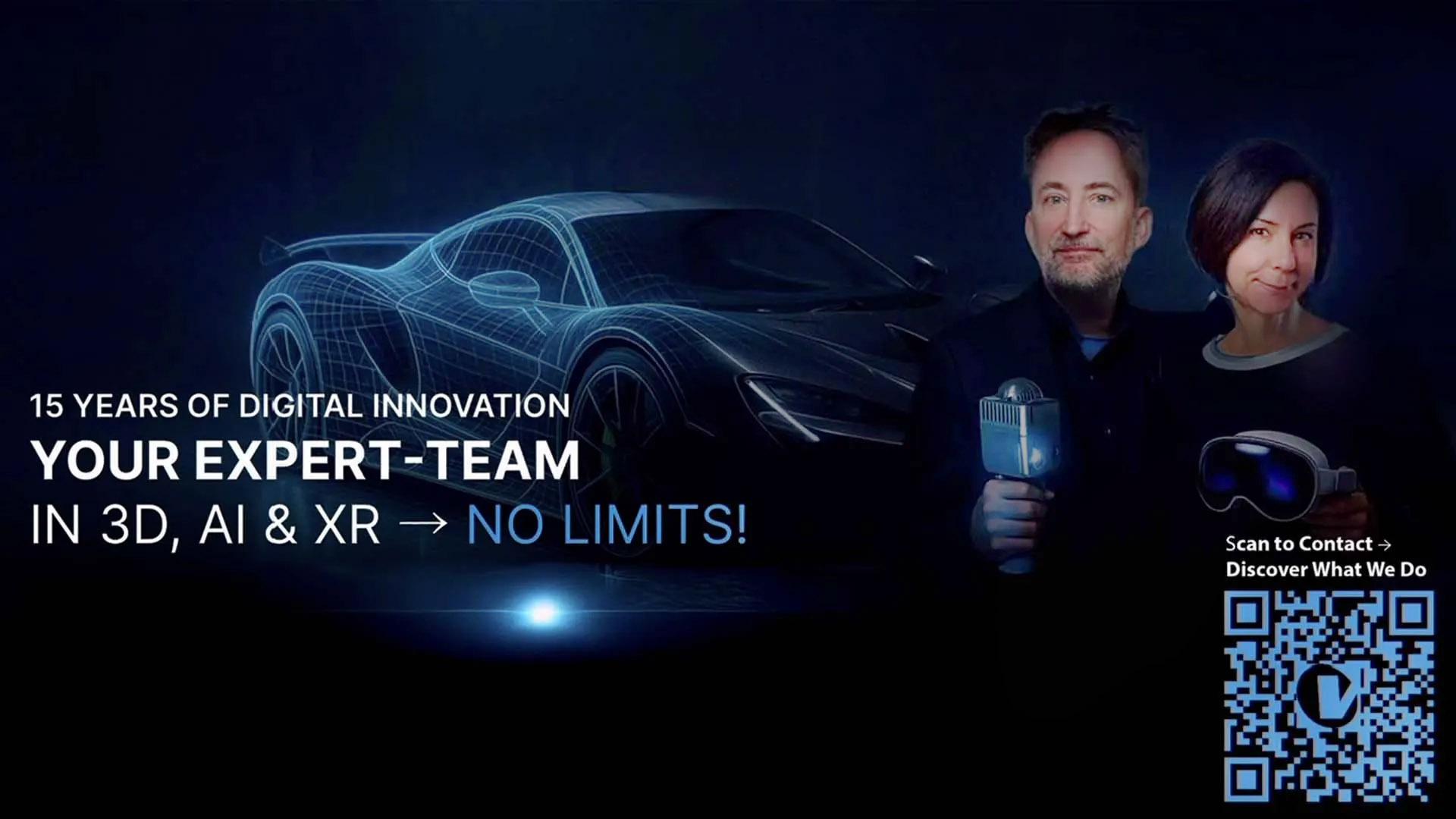
Image: The Visoric expert team combines AI, XR, and service into productive solutions. © Visoric GmbH 2025
Source: Visoric GmbH | Munich 2025
If you would like to explore how AI avatars can improve consulting, training, or care in your organization, contact the Visoric expert team. We’ll show what’s possible today—and help bring it into operation.
Contact Persons:
Ulrich Buckenlei (Creative Director)
Mobile: +49 152 53532871
Email: ulrich.buckenlei@visoric.com
Nataliya Daniltseva (Project Manager)
Mobile: +49 176 72805705
Email: nataliya.daniltseva@visoric.com
Address:
VISORIC GmbH
Bayerstraße 13
D-80335 Munich