

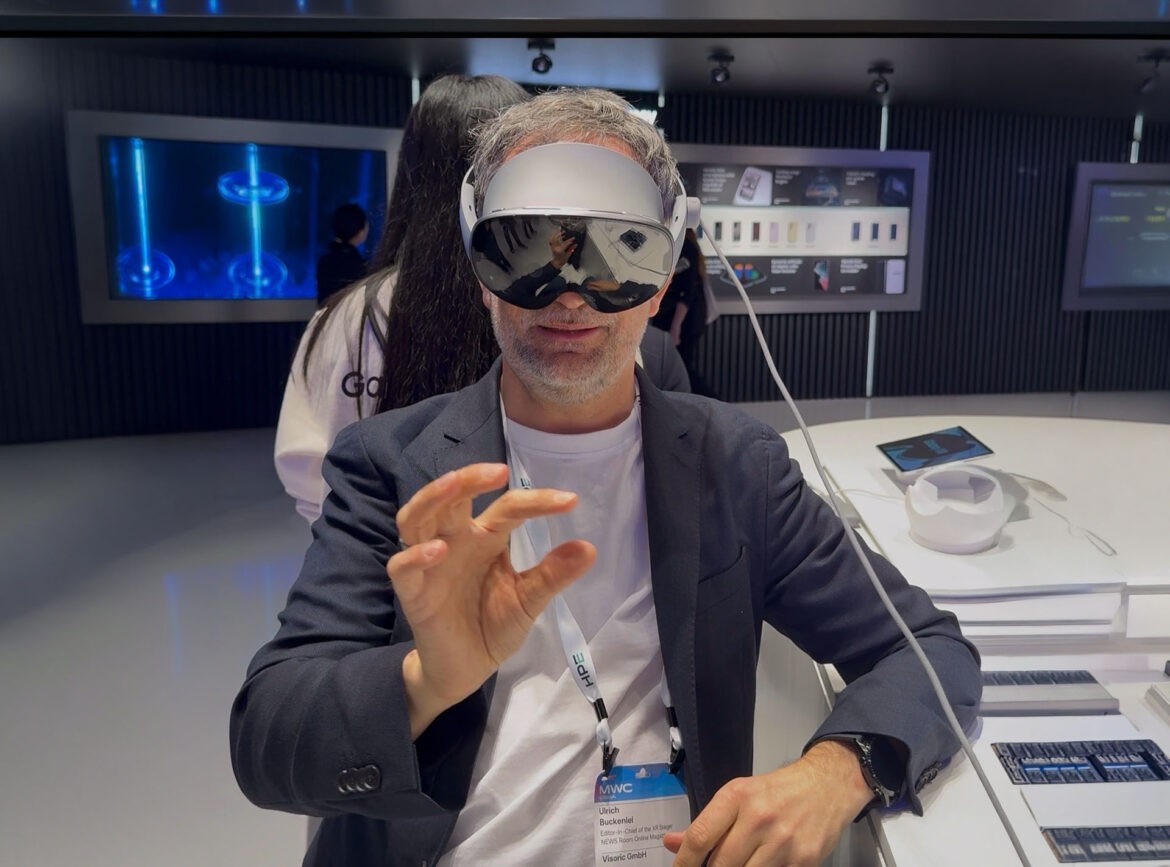
When interfaces leave the screen and respond directly
Editorial image | Motif: Ulrich Buckenlei testing a spatially responsive interface with a next generation headset at the Mobile World Congress in Barcelona | Context: Analysis of new interface models in spatial computing, AI and 3D interaction | Source: © Ulrich Buckenlei | Visoric GmbH
Digital systems were bound to fixed surfaces for decades. Monitors, displays and touch interfaces defined how information was presented and how it was used. Content was visible, but always tied to a surface.
This logic was not accidental, but technically necessary. A screen creates a stable environment in which content can be reliably displayed regardless of space and movement. Perception was clearly structured, but at the same time limited. [16]
Today, this exact framework is shifting. Interfaces are increasingly detaching from fixed surfaces. Content responds to movement, position and context. It no longer appears only on a screen, but behaves dynamically in space or in relation to the user. [15]
The key change is not the replacement of existing systems, but the way interaction works. When interfaces begin to adapt instead of just being displayed, usage fundamentally changes.
Technically, this development emerges from the combination of real time processing, sensor systems and visual engines that translate inputs directly into spatial reactions. Only this interplay makes interfaces dynamic and context aware. [12]
Complexity does not disappear. It shifts into the architecture. While traditional interfaces are standardized, new requirements arise for data processing, real time logic and system integration.
Interfaces thus evolve from static display elements into reactive systems. This is exactly where a new phase of digital interaction begins, which becomes tangible in the following chapter.
From static interface to reactive system
Digital applications rarely fail due to missing features, but rather because of their interaction logic. Information is available, but often difficult to access or not intuitively understandable. Traditional interfaces strictly separate user and content.
Reactive interfaces shift this exact point. They no longer respond only to active inputs, but continuously to the user itself. Movement, position or gaze direction become part of the interaction.
What was previously displayed statically on a surface is now dynamically adjusted. The decisive difference lies in perception. Content no longer feels like a representation, but like a system that reacts directly. [11]
- Previous limitation, interfaces are static and only respond to direct inputs
- New approach, systems continuously adapt to user behavior
- New usage, interaction emerges through presence rather than just operation
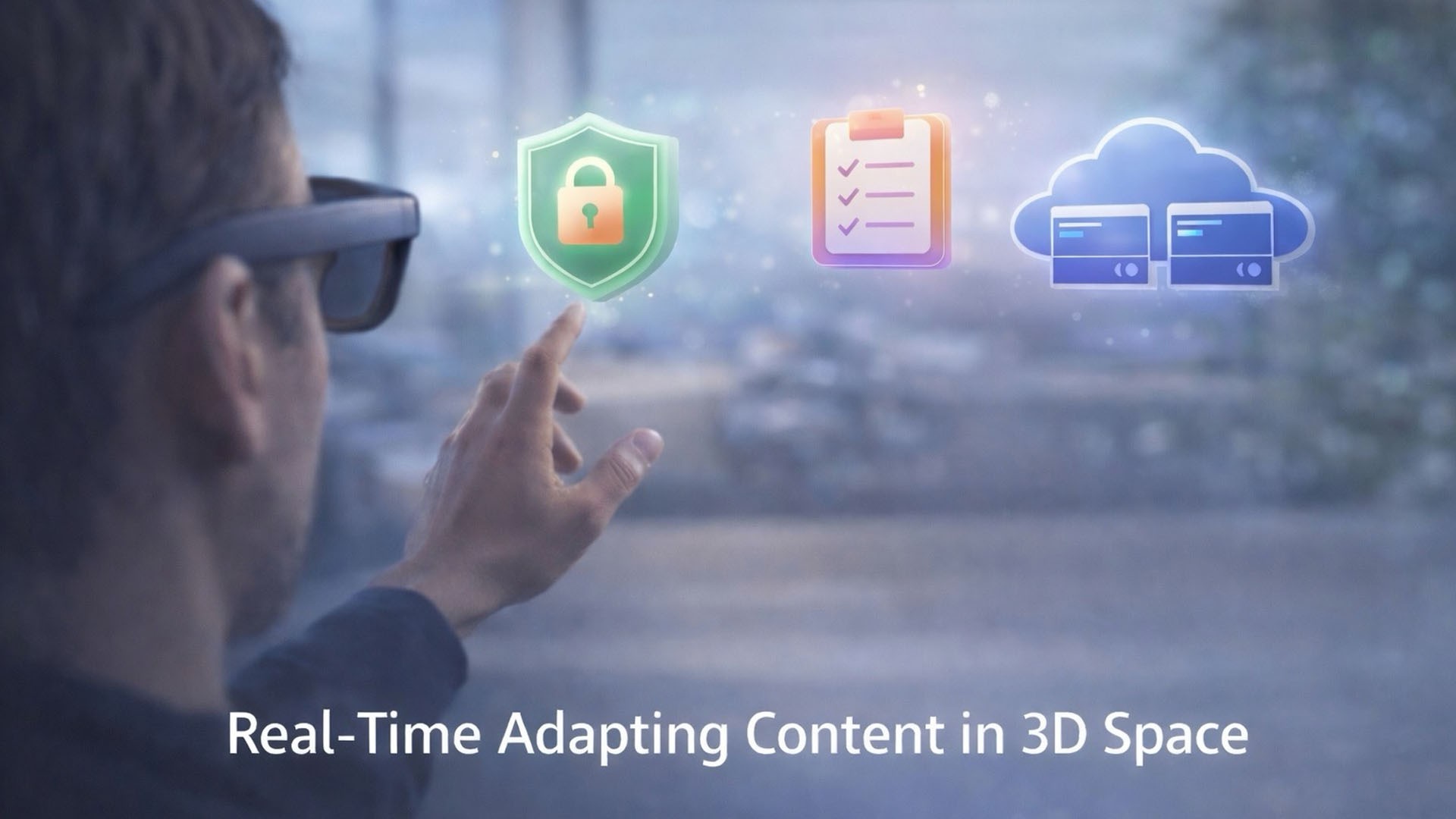
Reactive interface in space, digital content adapts to the user’s perspective
Motif: Editorial concept image | Visualization: © Ulrich Buckenlei | Visoric GmbH | The depiction serves analytical classification
The image makes this transition visible. A digital object no longer appears as a projection, but as an element that integrates into space and reacts to perspective.
Technically, this effect is created through continuous real time adjustment of the rendering. Systems constantly calculate the user’s position and modify the visual output accordingly. [12]
This creates the impression of depth and physical presence, even though the rendering still takes place on a surface. The effect strongly depends on accuracy, latency and processing stability. [7]
This interplay is crucial. Without real time processing, the interface remains static. Without precise interpretation, the rendering loses credibility.
Once these systems are used deliberately, a new type of interface emerges. Content is no longer just operated, but experienced and understood.
The next chapter therefore analyzes in which situations this form of interaction provides real value and where its limitations lie.
Where reactive interfaces create real value and where their limits lie
The first chapter showed how interfaces are changing. They respond to the user and detach from static interaction patterns. The second chapter focuses on the practical relevance of this development.
Studies on spatial computing and new interface models show that the greatest value emerges where complex content must be quickly understood and jointly interpreted. [15]
This is exactly where the difference to traditional interfaces lies. Instead of merely displaying information, reactive systems enable immediate understanding through interaction.
- Complex content becomes easier to grasp and more intuitive to understand
- Multiple users can react to the same information simultaneously
- Movement and perspective become part of information perception
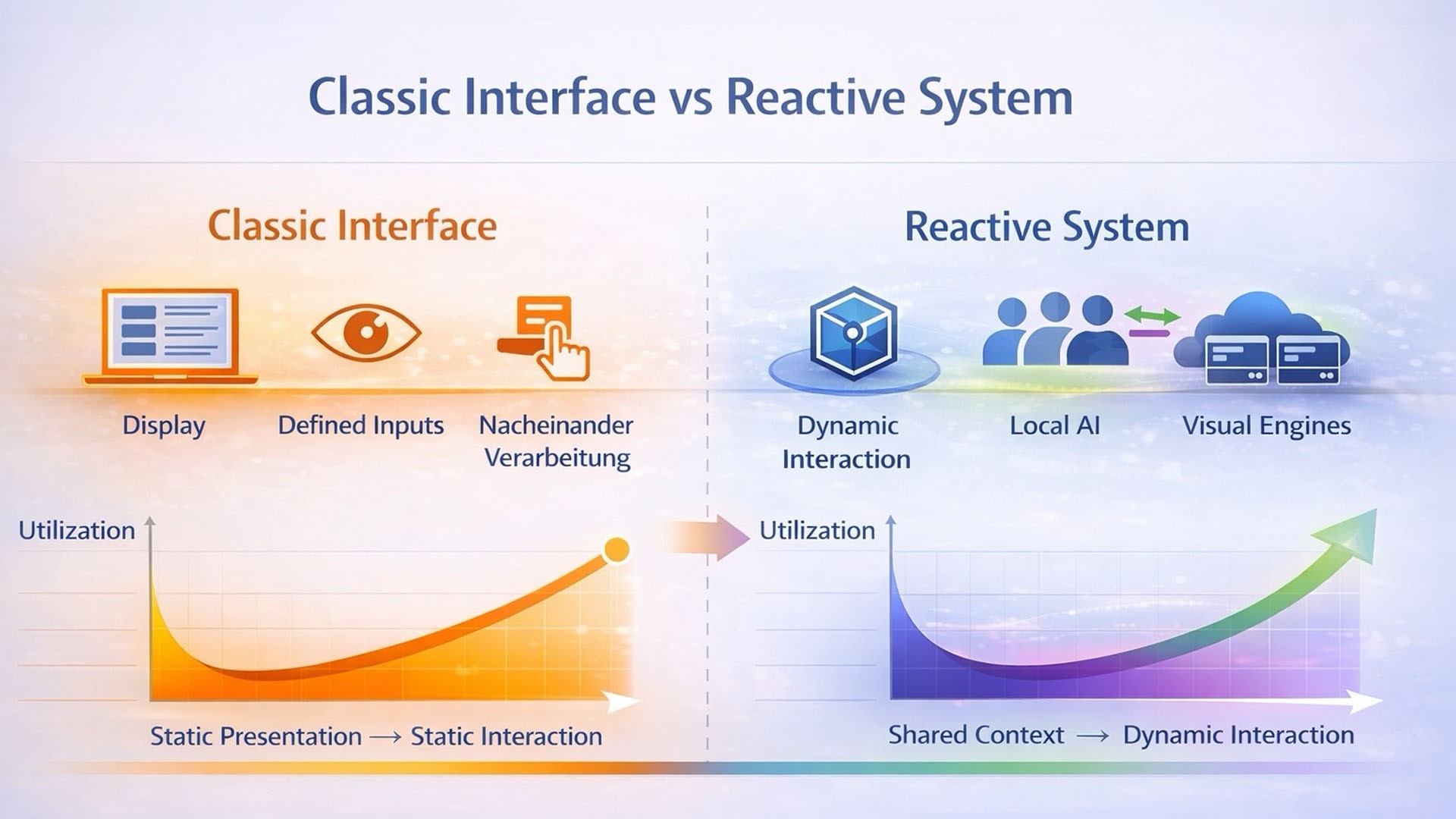
Classic interface vs reactive system, difference between static display and dynamic interaction
Graphic: Editorial analysis | Visualization: © Ulrich Buckenlei | Visoric GmbH
The left side shows the familiar logic. Content is displayed and processed sequentially. Interaction takes place through clearly defined inputs.
The right side describes a different approach. Systems respond continuously. Content changes depending on the user and creates a shared, dynamic reference.
The difference lies less in the display than in the usage. Decisions are no longer based on individual screens, but on a shared, interactive context.
Technologically, this effect is enabled by real time processing, local AI and visual engines that immediately interpret and execute inputs. [12]
At the same time, new limitations arise. Reactive interfaces are not suitable for every task. For precise detail work or standardized processes, traditional interfaces often remain more efficient.
The value therefore does not come from maximum innovation, but from targeted use in the right context. Companies that understand this differentiation can rethink interfaces where they truly create impact.
The next chapter therefore analyzes how these systems are technically structured and what conditions are required for stable operation.
The architecture behind it, how reactive interfaces technically work
When interfaces respond to movement and context, it initially appears like a visual effect. In reality, however, it is a clearly structured technical system. The difference is crucial. It is not about an illusion, but about the precise interaction of multiple components that together enable stable interaction.
At its core, this system consists of three layers: sensing, processing and visual output. Only when these elements work synchronously does the impression of a system that reacts directly to the user emerge. [12]
The sensing layer acts as input. Cameras or other sensors continuously capture the user’s position and movement. Without this data, the interface remains static and cannot respond to context.
This is where the second layer comes in. Processing takes place in real time, often directly in the browser or locally on the device. AI models interpret the data and translate it into usable information. Without this processing, movement would be captured but not meaningfully used. [16]
The visual output only emerges through the combination of these two layers. An engine like Three.js continuously adjusts perspective, camera and rendering, creating the impression of depth and spatial presence. This is not real physical depth, but a precisely calculated visual simulation. [11]
- Sensing → captures user movement and position in real time
- Processing → interprets data locally and translates it into interaction logic
- Visual output → dynamically adjusts rendering and creates spatial perception
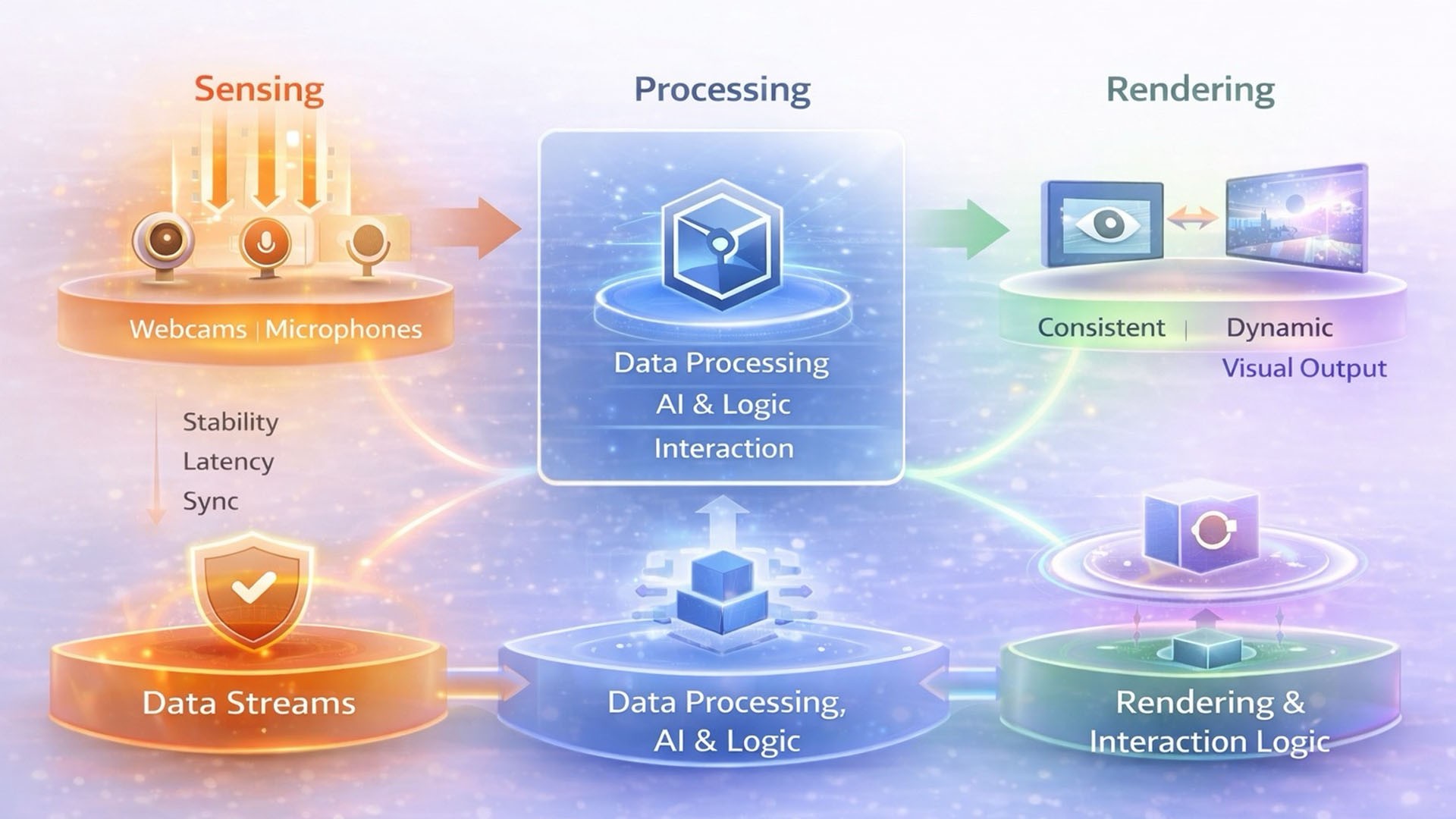
Technical architecture of reactive interfaces, interaction between sensing, real time processing and dynamic rendering
Graphic: Editorial system visualization | Visualization: © Ulrich Buckenlei | Visoric GmbH
The graphic shows the system as a coherent architecture. On the left is the sensing layer, continuously capturing data. In the center is processing, interpreting this data and translating it into control logic. On the right is the visual output, which dynamically adapts.
What matters is not only the technology itself, but its stability. Latency, accuracy and synchronization determine whether the system feels convincing or not. Even small delays can significantly affect perception. [7]
It also becomes clear that such systems do not function in isolation. Data streams, rendering and interaction logic must be precisely aligned. Only through this integration does a consistent and reliable interface emerge.
Security and operational aspects also play a role. Once camera data is processed, requirements arise for privacy, access control and system governance, which must be part of the architecture. [4]
This makes it clear that reactive interfaces are not just a frontend topic. They represent a system architecture that connects data, logic and visualization. This difference determines whether an interface merely impresses or actually works.
The next chapter therefore analyzes in which concrete application areas these systems deliver real value.
Where reactive interfaces create real value and where they can be meaningfully applied
The previous chapter showed how these systems are technically structured. Sensing, processing and visual adaptation together create an interface that is no longer static. The next step is therefore the key question of in which situations this approach is actually superior.
This is where practical value begins. Reactive interfaces are particularly strong when information must not only be read, but understood. As soon as movement, perspective and context play a role, a clear advantage over traditional interfaces emerges. [15]
- Training and simulation → content becomes easier to understand through interaction
- Product presentation → systems respond to users and become more tangible
- Communication and decision making → shared interaction creates better understanding
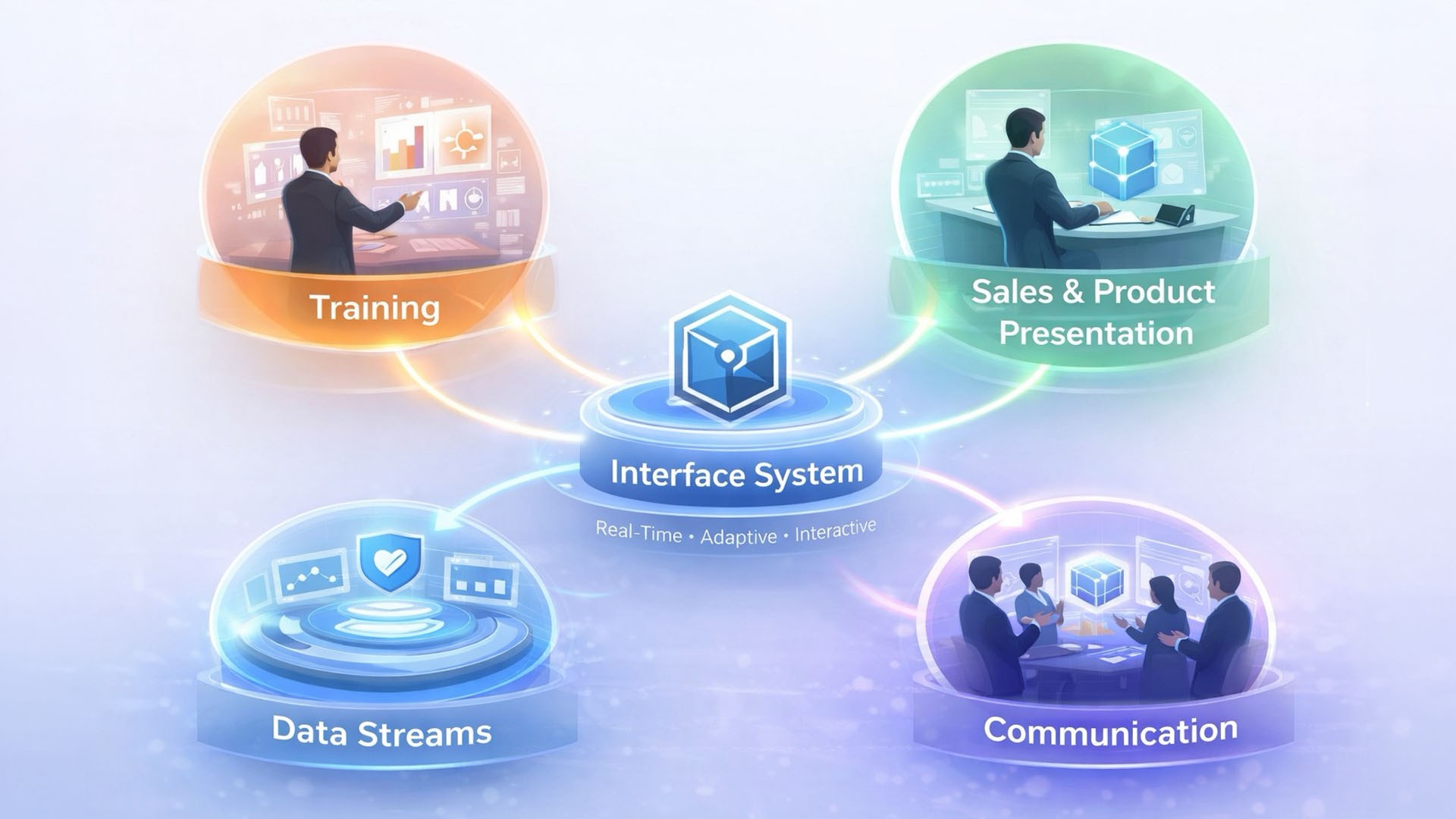
Reactive interface use cases, application areas between training, communication and interactive product presentation
Graphic: Editorial analysis | Visualization: © Ulrich Buckenlei | Visoric GmbH
The graphic condenses these use cases into a clear structure. At the center is the interface system. Around it, contexts emerge where value becomes particularly evident.
In training, dynamic adaptation enables faster understanding of complex content. Users interact directly with the system instead of just consuming information. [17]
In sales and product presentation, another advantage emerges. Systems respond to the user, creating a stronger perception of quality and functionality.
In communication, a third effect appears. When multiple people interact with a system, a shared reference point is created. Decisions are no longer based on individual screens, but on shared interaction.
At the same time, limitations become visible. Not every application benefits from reactive interfaces. For standardized processes or precise data entry, traditional interfaces remain more efficient. [20]
The value therefore does not come from technology alone, but from the right context of use. Companies that understand this differentiation can apply interfaces where they create real impact.
The next chapter therefore analyzes the requirements that arise when a demo becomes a permanently operated system.
From prototype to platform, what requirements define operation
After describing the technological foundations and application areas, the focus now shifts to a frequently underestimated dimension. The real challenge does not begin with demonstration, but with operation.
A reactive interface can be convincing as a standalone setup. But once it is integrated into real processes, requirements arise that go beyond visualization. Systems must run reliably, be securely operated and be embedded into organizational structures.
At this point, the perspective changes. An interface becomes a system that must be planned, operated and continuously optimized. Studies on technology integration show that structure and operation are critical for sustainable use. [15]
- From demo to operation → systems must function reliably over time
- From effect to structure → organization and processes become part of the solution
- From single application to platform → scalability becomes critical
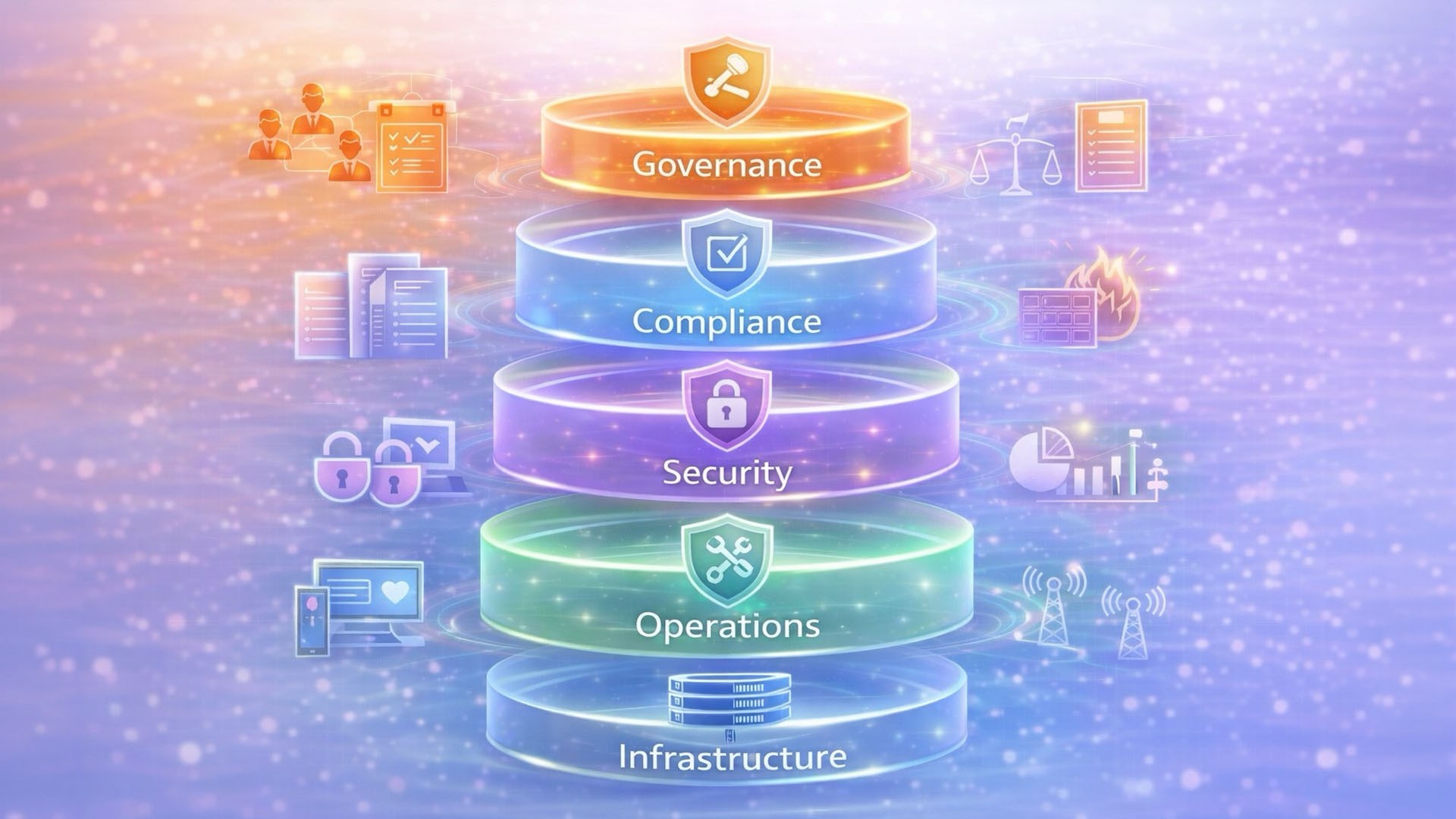
Interface system deployment framework, organizational and technical requirements for stable operation
Graphic: Editorial framework analysis | Visualization: © Ulrich Buckenlei | Visoric GmbH
The graphic shows the necessary layers for operating such systems. It deliberately reduces the topic to a clear structure.
“Governance” describes control. Roles, responsibilities and decision processes must be clearly defined so systems can be operated reliably. [18]
“Compliance” covers regulatory requirements and standards. Especially when processing user data, clear rules must be followed. [4]
“Security” addresses system protection. Data, access and interfaces must be secured, particularly in connected environments.
“Operations” describes ongoing operation. Monitoring, maintenance and performance determine whether a system remains usable over time.
The bottom layer “Infrastructure” forms the technical foundation. Hardware, network and runtime environment determine whether the system functions reliably.
The key insight is clear. The success of such systems depends not on visualization, but on the ability to operate them as a platform. Technology alone is not enough.
The next chapter therefore analyzes the strategic implications for companies.
Strategic infrastructure, why new interfaces become a core capability
With the technical architecture and operational framework described, the functional structure is clear. The decisive shift, however, takes place on a strategic level. Reactive interfaces are not just a new form of interaction, but are becoming part of core digital infrastructure.
Studies on digital transformation show that technologies become strategically relevant when they are not used in isolation, but structurally integrated into processes, data flows and decision logic. [15] This point has now been reached with new interface systems.
- Reactive interfaces evolve from demonstration tools into operational platforms
- Integration into data and IT architectures becomes a prerequisite for scalability
- Strategic value arises from combining interaction, data and decision processes
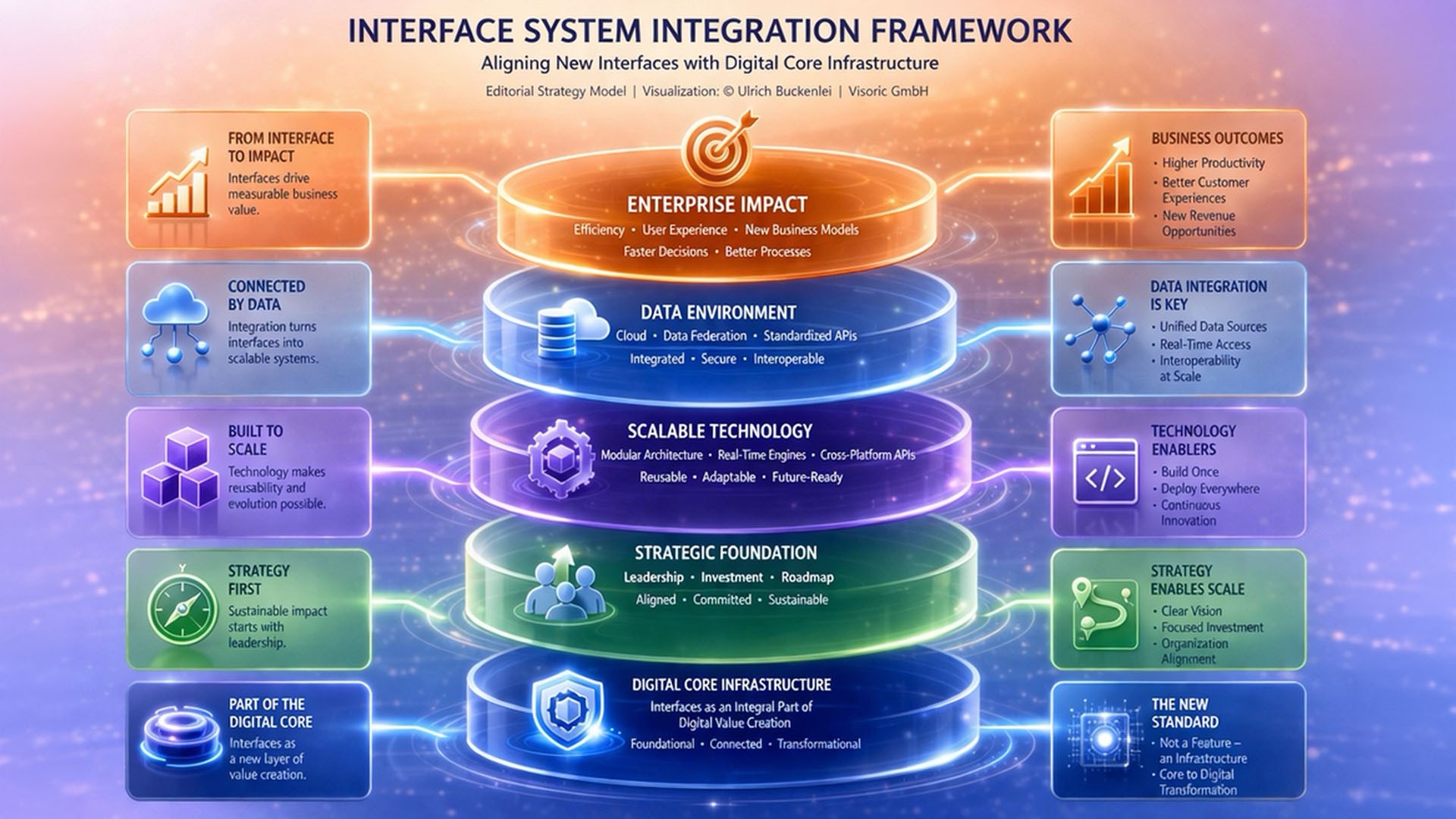
Interface system integration framework, positioning new interfaces as part of core digital infrastructure
Graphic: Editorial strategy visualization | Visualization: © Ulrich Buckenlei | Visoric GmbH | Labels in English for international classification
The graphic is intentionally not designed as a technical diagram, but as a strategic model. It shows not only the layers themselves, but also their interdependencies and application logic.
At the top is “Enterprise Impact”. This layer describes direct business impact. New interfaces increase efficiency, improve user experience and enable new business models.
Below lies the “Data Environment”. This layer shows that reactive interfaces are not scalable without data integration. Cloud systems, data federation and standardized interfaces ensure real time usability. [14]
The third layer “Scalable Technology” describes the technical basis for growth. Modular architectures and real time engines enable continuous expansion. [5]
Below that is the “Strategic Foundation”. This layer connects technology with organization. Leadership, investment and clear roadmaps determine long term success.
At the bottom is the “Digital Core Infrastructure”. Interfaces are no longer isolated applications, but part of value creation.
The key insight is clear. The value of new interfaces does not arise from isolated effects, but from integration into architecture, data and strategy.
Video analysis – When interfaces respond spatially
The following video does not show a classic projection, but a new form of interface. A 3D scene reacts directly to the movement of the user. Perspective and depth change in real time, creating the impression of a spatial system, even though only a standard screen is used.
What becomes visible here is a fundamental difference compared to previous interfaces. There is no headset, no additional hardware and no installation. A browser and a webcam are enough to transform a static surface into a dynamic, spatially responsive system.
Technically, this behavior is based on three central components. Browser based AI enables real time processing directly on the device. The movement of the user is interpreted locally, without external infrastructure. [12][16]
The visual implementation is handled through Three.js. The camera is continuously adjusted to the position of the user. This creates an asymmetric perspective that simulates convincing depth on a flat screen. [11]
The webcam acts as the only sensing system. It captures movement and transfers it directly into the scene. Complex hardware setups are replaced by a simple, available input source.
Browser based spatial interaction – A 3D scene adapts in real time to the user’s position and creates depth without additional hardware
Credits: Demo by Xiao Hai (@xiaowo1800) using browser based AI, Three.js and webcam tracking |
Analytical classification: Ulrich Buckenlei
This example shows a decisive shift. Interfaces no longer respond only to inputs, but to presence. The user becomes part of the interaction, not just of the operation.
At the same time, it becomes clear that the focus is not on a visual effect, but on a new interface model. Systems become responsive in space, even without physical depth.
The actual difference does not lie in the image, but in the logic behind it. When interfaces begin to adapt to the user, the way digital systems are designed, understood and used changes.
This is exactly where the transition emerges from static interfaces to dynamic, spatially responsive systems that simplify processes and redefine interaction.
Sources and references
- MIT Technology Review, analyses of future interfaces, spatial computing and human machine interaction, 2024–2026. [1]
- McKinsey & Company, “Technology Trends Outlook”, economic classification of AI, XR and new interaction models, 2024–2025. [2]
- Deloitte, “Tech Trends 2025”, developments in spatial computing, human interface shift and digital platforms, 2025. [3]
- Google TensorFlow Team, “TensorFlow.js Documentation”, browser based AI models and real time inference on the web, accessed 2024–2026. [4]
- Three.js Foundation, documentation on real time 3D visualization in the browser and WebGL based interfaces, accessed 2024–2026. [5]
- WebXR Device API (W3C), specification for immersive web applications and spatial interaction in the browser, accessed 2024–2026. [6]
- Stanford University HCI Group, research on human computer interaction and natural interfaces, 2023–2025. [7]
- ACM SIGGRAPH, publications on real time rendering, spatial interaction and visual interfaces, accessed 2024–2026. [8]
- Apple, developer documentation on spatial computing and natural interaction models, accessed 2024–2026. [9]
- Meta Reality Labs, studies on presence, spatial interfaces and user behavior in immersive systems, 2024–2026. [10]
- Microsoft Research, research on computer vision, gesture tracking and real time interaction, accessed 2024–2026. [11]
- NVIDIA, publications on AI, real time simulation and visual interfaces in digital systems, accessed 2024–2026. [12]
- IEEE, studies on computer vision, human tracking and interaction systems, accessed 2024–2026. [13]
- Bitkom, “Artificial Intelligence and Digital Transformation”, studies on the use of AI in companies, 2024–2025. [14]
- Gartner, analyses of emerging technologies and the future of user interfaces, 2024–2026. [15]
- World Economic Forum, reports on the transformation of work and technology through AI and new interfaces, 2024–2025. [16]
Use new interfaces strategically now
The development of browser based AI, spatial interaction and new interface models shows where digital systems are heading. User interfaces are becoming more intuitive, more direct and closer to people. What still looks like an experiment today is increasingly developing into a new operational layer for training, simulation, product communication and digital processes.
For companies, the question is therefore no longer only whether this development is relevant. What matters is how concrete applications can be derived from it. Where do real efficiency gains emerge. Which processes can be simplified. Which content is suitable for new forms of interaction. And how can such systems be integrated into existing structures in a stable, scalable and economically viable way.
This is exactly where practical implementation begins. Many companies are not looking for technical demos, but for robust concepts that meaningfully connect interface innovation, AI and real business processes. This mainly includes:

The VISORIC expert team develops new interfaces, interactive simulations and AI supported systems for industry, communication and digital processes
Source: VISORIC GmbH | Munich
- Interface Innovation Consulting → From idea to a feasible interaction solution
- Browser Based AI Systems → Making AI directly usable and scalable on the web
- Spatial Interfaces → Developing new forms of interaction for products, spaces and processes
- Simulation & Training → Communicating complex content in an understandable, interactive and effective way
- 3D Content Pipelines → Technically preparing digital content for new interface models
- System Integration → Embedding AI, data and interface logic into real processes
- Proof of Concept → Validating feasibility quickly and reliably
- High End Demonstrators → Making innovation visible and convincing decision makers
VISORIC works exactly at the intersection of AI, interaction and application. We develop systems that do not just fascinate, but simplify processes, make them easier to understand and create real value.
If you would like to find out how new interfaces can be meaningfully used in your company, speak with the VISORIC expert team in Munich.
Not a technology promise, but a clearly structured path from idea to a working solution.
Kontaktpersonen:
Ulrich Buckenlei (Kreativdirektor)
Mobil: +49 152 53532871
E-Mail: ulrich.buckenlei@visoric.com
Nataliya Daniltseva (Projektleiterin)
Mobil: + 49 176 72805705
E-Mail: nataliya.daniltseva@visoric.com
Adresse:
VISORIC GmbH
Bayerstraße 13
D-80335 München