
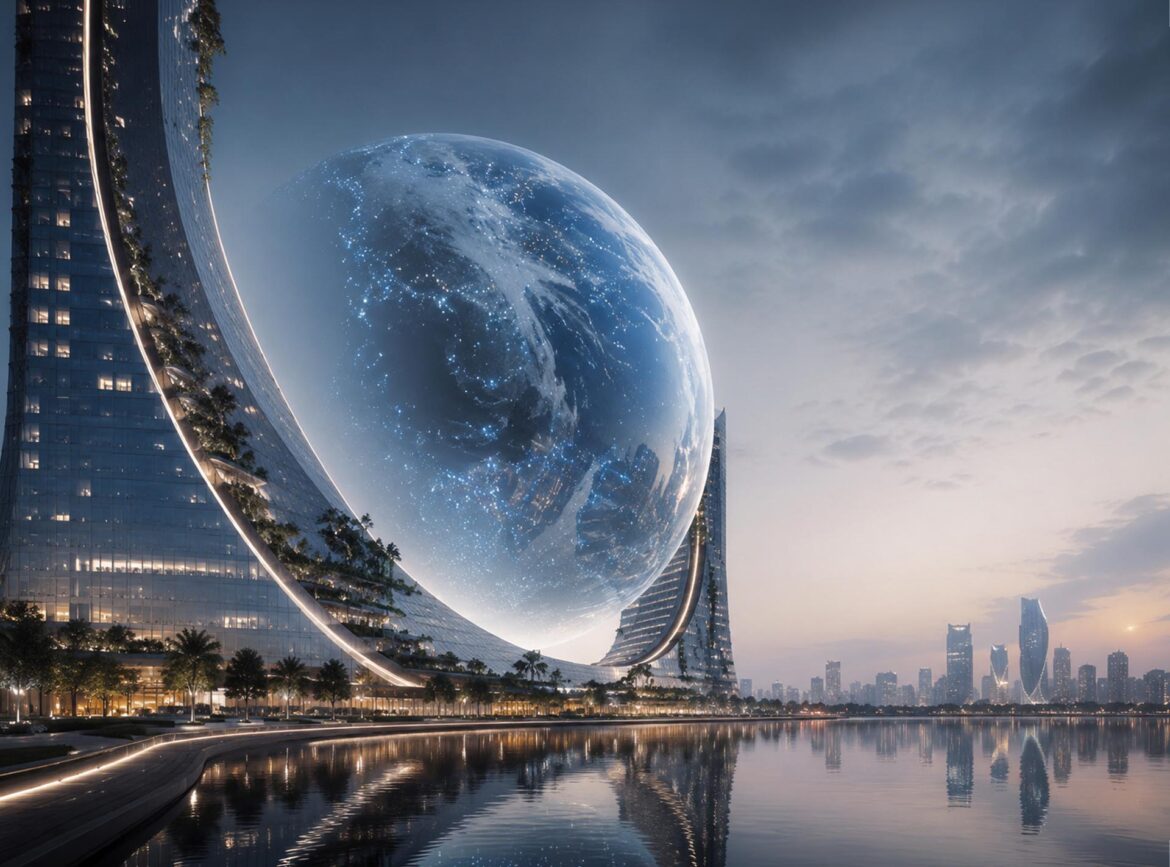
Immersive urban media architecture connects digital experience spaces, iconic architecture, and global city communication into a new form of hybrid urban spaces
Visualization: Atmospheric future city with immersive media spaces, spatial computing layers, and digital urban infrastructure as a new form of international city communication | © VISORIC GmbH | Munich
Cities have communicated through architecture, public spaces, and cultural symbols for centuries. Historical boulevards, monumental buildings, and iconic skylines have always been used to make identity, economic strength, and social visions visible. With the increasing digitalization of urban spaces, however, a new layer of urban communication is now emerging, in which architecture itself is increasingly becoming part of immersive media and experience worlds. [1][2]
At the same time, social media, global platform logics, and digital experience formats are fundamentally changing the international perception of cities. Visibility today is no longer created solely through physical presence, but increasingly through digital reach, visual staging, and viral urban experiences. As a result, cities are competing more strongly as global media spaces for attention, investment, tourism, and cultural relevance. [2]
Mixed reality, spatial computing, and immersive media architecture in particular are opening up new possibilities for city communication and digital urban branding. Buildings, squares, and public infrastructures are increasingly evolving from static objects into interactive experience spaces that can connect real architecture with digital layers, holographic content, and immersive information systems. [3]
At the same time, urban digital twins and data based city models are becoming increasingly important. Cities are increasingly not only planned physically, but also analyzed, simulated, and used communicatively as digital systems. This creates new forms of intelligent urban infrastructure that connect planning, communication, experience spaces, and digital services. [4]
International technology analyses also show that immersive experience spaces and spatial computing could become a relevant component of modern corporate, city, and media strategies in the coming years. As a result, the boundaries between architecture, communication, digital experience, and intelligent platform structures are beginning to blur more and more. [5]
The following developments show why immersive urban media architecture is currently becoming increasingly important:
- Immersive urban spaces → architecture evolves into interactive experience and communication spaces
- Urban branding → cities increasingly compete through digital visibility and media presence
- Spatial computing → digital content merges with real urban infrastructures
- Urban digital twins → cities also become usable as intelligent digital systems
- Global platform logic → viral media formats change the international perception of urban spaces
This development becomes especially interesting through the increasing connection between architecture, real time visualization, artificial intelligence, and immersive platform technologies. In the long term, cities are therefore evolving not only into physical living spaces, but also into programmable digital experience and communication systems.
The expert team of VISORIC GmbH from Munich analyzes, together with international industry, architecture, and technology trends, how immersive media architecture, spatial computing, and digital experience platforms could change urban communication, city development, and interactive brand spaces in the future.
The following chapter therefore analyzes why the city itself is increasingly becoming a medium and why architecture, digital illusions, and immersive media formats could play an increasingly important role in city development, location communication, and brand building in the future.
The city becomes the medium
With the increasing fusion of architecture, digital platforms, and immersive media technologies, the role of urban spaces is currently changing fundamentally. Cities are no longer perceived exclusively as physical infrastructure, but increasingly as global communication systems that connect digital visibility, cultural identity, and media based experience spaces. [1]
Social media and digital platform logics in particular are accelerating this development significantly. Iconic architecture, public squares, and urban landmarks are increasingly becoming part of global visual communication strategies. As a result, cities are competing more strongly for digital attention, international reach, and global perception within social media ecosystems. [2]
At the same time, new forms of immersive city communication are emerging. Mixed reality, CGI staging, FOOH campaigns, anamorphic displays, and spatial computing technologies expand urban spaces with digital experience and interaction layers. Buildings are therefore no longer merely viewed, but increasingly staged, extended, and made emotionally experienceable through media. [3]
At the same time, intelligent city models and urban digital twins are gaining strategic importance. Cities are also modeled, analyzed, and simulated as data based systems. These digital infrastructures have long since served not only urban planning, but increasingly also communication, visualization, and the international positioning of modern metropolises. [4]
International market analyses and technology studies also show that immersive experience spaces and spatial computing platforms could become a central component of modern urban communication strategies in the long term. In particular, the connection of real time data, digital architecture, and immersive interfaces opens up new possibilities for tourism, investment communication, and cultural visibility. [5]
The following developments show why cities are increasingly evolving into hybrid media and experience spaces:
- Digital experience spaces → architecture becomes part of immersive communication systems
- Viral city communication → urban spaces develop global visibility through social media
- Mixed reality and FOOH → digital illusions expand real urban spaces with new layers of experience
- Urban digital twins → real cities also become usable as intelligent data models
- Spatial computing → digital content merges with real urban environments
In the international context, new forms of urban media architecture are currently emerging, in which physical infrastructure, digital platforms, and immersive communication spaces increasingly merge. In the long term, cities are therefore evolving from static physical spaces into dynamic hybrid media ecosystems.
This development is becoming particularly visible in international metropolises such as London, Doha, Seoul, and Dubai. There, immersive city stagings, interactive media façades, and digital experience spaces are increasingly emerging, strategically connecting architecture, branding, and technology.
The expert team of VISORIC GmbH from Munich analyzes these developments in the context of spatial computing, urban experience design, and immersive communication platforms. The goal is to better understand how digital experience spaces, intelligent platform structures, and immersive media architecture could become part of modern city and brand communication in the future.
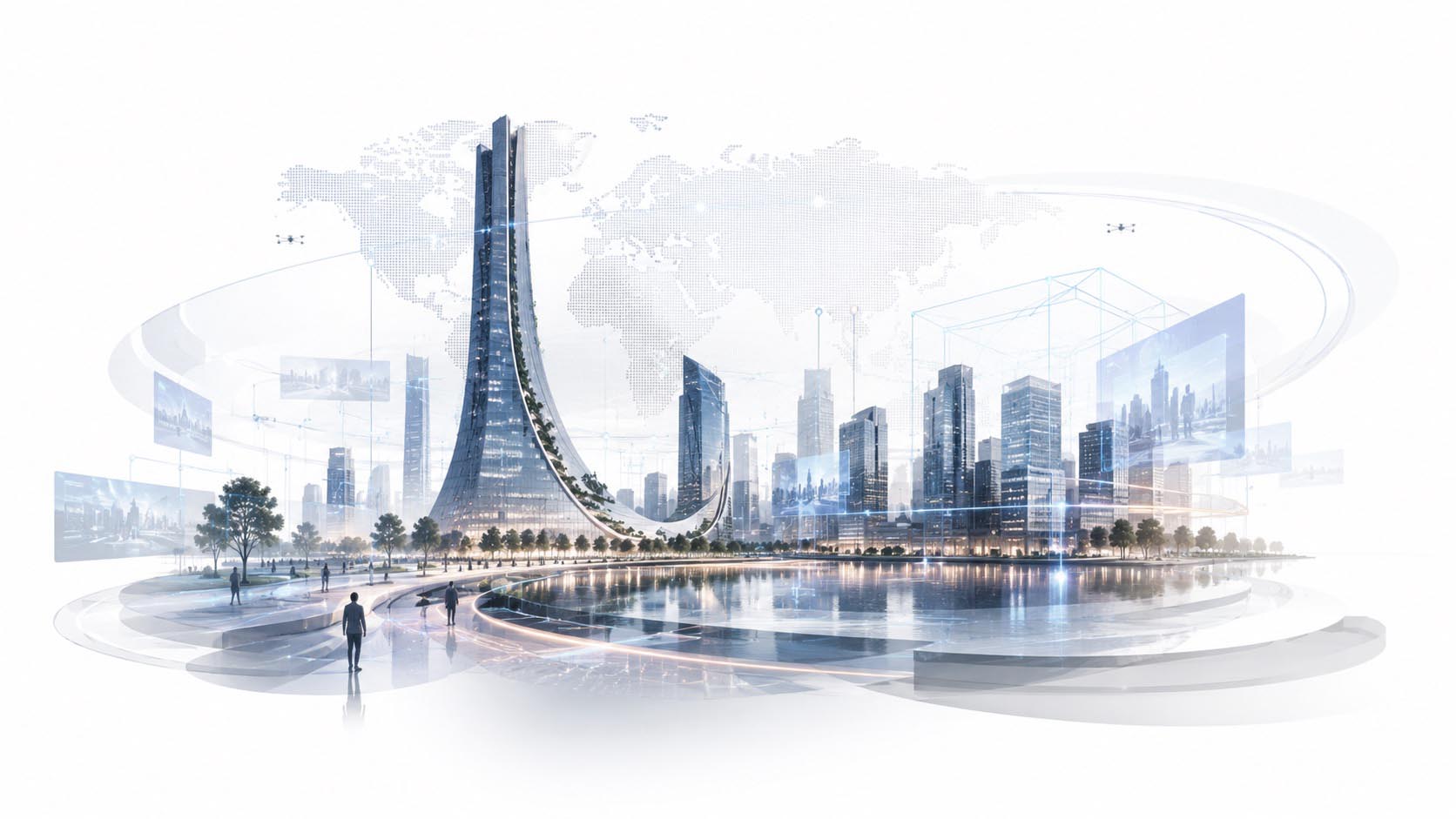
Immersive media architecture expands real cities with digital experience spaces, holographic layers, and global communication structures
Visualization: Hybrid urban experience space with immersive media architecture, spatial computing layers, digital city projections, and atmospheric real time visualization as a possible future of urban communication | © VISORIC GmbH | Munich
The graphic illustrates how urban spaces could increasingly evolve into hybrid communication and experience landscapes. Real architecture remains physically visible, while at the same time being expanded through digital layers, immersive projections, and spatial information systems.
The fusion of architecture, real time visualization, and global platform logics becomes particularly relevant here. Buildings, public squares, and urban landmarks are increasingly evolving into media interfaces that no longer merely display digital content, but make it spatially experienceable.
The calm visual design of the scene deliberately does not represent a futuristic science fiction approach, but rather a possible evolutionary development of modern cities. Spatial computing, mixed reality, and data based city models are increasingly integrating subtly into existing urban infrastructures and thereby changing the way cities are perceived, used, and communicated in the long term.
At the same time, it becomes clear that immersive media architecture is not only relevant for advertising or entertainment. Cities are increasingly evolving into strategic communication spaces for tourism, culture, investment, and international visibility.
The next chapter therefore analyzes how Qatar is already using immersive city stagings, iconic architecture, and digital experience spaces as instruments of modern nation branding strategies.
Qatar shows how mixed reality becomes state branding
With the increasing digitalization of urban communication, the way states and metropolises shape their international perception is also changing. Architecture, public spaces, and digital experience formats are increasingly becoming strategic tools of modern nation branding strategies. Countries such as Qatar in particular are strategically investing in iconic architecture, immersive experience spaces, and global media staging in order to make cultural identity, innovative strength, and international visibility emotionally experienceable. [6]
This is no longer solely about classic advertising or tourism campaigns. Cities and states are increasingly competing within global platform ecosystems for attention, reach, and digital visibility. Urban spaces are therefore increasingly being conceived as media based experience landscapes that connect physical architecture with digital communication strategies. [7][8]
Immersive technologies in particular are opening up new possibilities. Mixed reality, spatial computing, CGI staging, and so called FOOH campaigns expand real cities with digital layers, holographic projections, and emotionally charged experience spaces. Architecture is therefore increasingly no longer merely viewed, but staged through media, interactively expanded, and globally distributed. [9]
At the same time, smart cities are increasingly evolving into data based communication platforms. Public spaces, real time data, digital services, and immersive interfaces are increasingly merging into intelligent urban experience infrastructures. This creates new forms of digital city communication that go far beyond classic urban planning. [10]
The following developments show why immersive city stagings are increasingly becoming part of modern nation branding strategies:
- Iconic architecture → cities create globally recognizable visual identities
- Mixed reality and CGI → real urban spaces are digitally expanded and emotionally staged
- Viral platform logic → immersive city experiences generate global reach through social media
- Digital experience spaces → architecture evolves into interactive communication platforms
- Smart city strategies → urban infrastructure connects physical and digital experience worlds
This development becomes especially interesting in the interplay of architecture, lighting design, real time visualization, and immersive platform technologies. Cities are therefore increasingly evolving into spatial media formats that integrate digital communication directly into urban environments.
International metropolises such as Doha, Dubai, Singapore, and Seoul already show today how strongly architecture, digital staging, and global visibility are merging. Urban spaces are strategically designed in such a way that they appear both physically impressive and maximally shareable, immersive, and media effective.
The expert team of VISORIC GmbH from Munich analyzes these developments in the context of spatial computing, immersive experience platforms, and digital media architecture. The goal is to better understand how urban spaces could become intelligent communication systems in the long term, in which architecture, digital content, and global platform logics increasingly grow together.
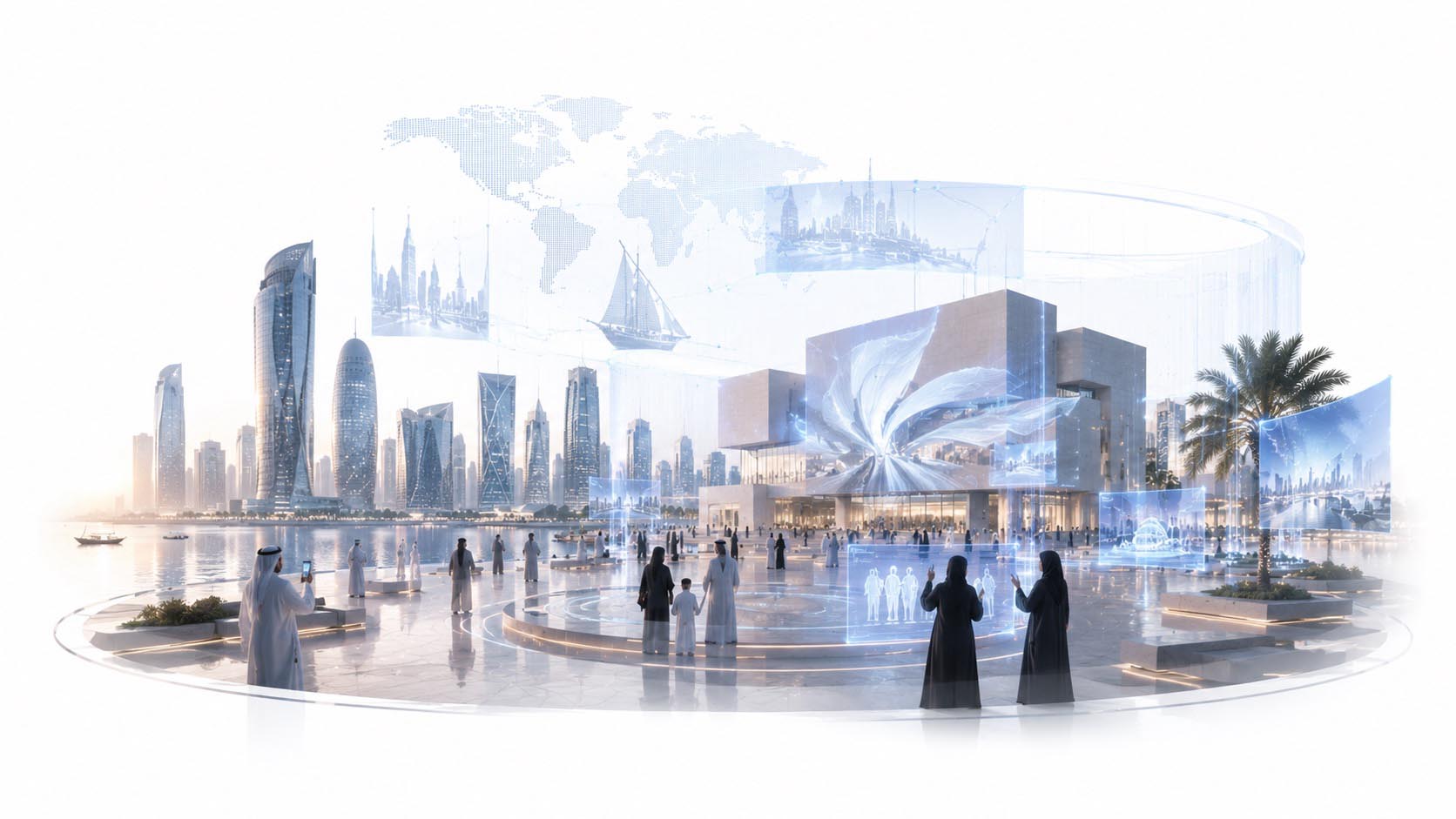
Immersive city stagings connect iconic architecture, digital experience spaces, and global media communication into a new form of urban nation branding
Visualization: Atmospheric urban experience architecture with holographic city projections, immersive lighting stagings, and digitally expanded landmarks as a possible future of international city and brand communication | © VISORIC GmbH | Munich
The graphic illustrates how cities and states could increasingly use immersive experience spaces to build international attention, cultural visibility, and global brand identity. Architecture is no longer developing only into physical infrastructure, but also into an emotional communication medium within digital platform ecosystems.
The connection between iconic architecture, immersive lighting stagings, and viral media formats becomes particularly relevant here. Buildings, skylines, and public spaces are increasingly designed to appear both physically impressive and digitally maximally visible and shareable.
The calm visual design of the scene deliberately does not show a classic advertising staging, but rather a strategically curated experience architecture. Digital projections, holographic layers, and atmospheric media spaces integrate subtly into the urban environment and thereby create new forms of spatial brand communication.
At the same time, the graphic illustrates that immersive city communication could go far beyond tourism marketing in the long term. Cities are increasingly evolving into intelligent experience platforms that connect architecture, digital services, real time data, and global communication strategies.
The next chapter therefore analyzes how CGI, FOOH campaigns, and artificially generated urban illusions change the perception of real cities and why digital experience architecture is increasingly becoming part of modern media strategies.
FOOH as an invisible advertising space in the urban environment
Fake Out of Home campaigns are currently changing the logic of urban advertising fundamentally. Real city footage is combined with CGI, 3D animation, and visual effects, creating hyper realistic scenes that have never physically existed. To viewers, however, they still appear as if they actually took place in public space. [11]
The decisive difference from classic outdoor advertising is that the advertising space no longer has to be built, rented, or approved. It is created digitally. A street in Paris, a bus in London, a façade in Berlin, or a square in Doha can therefore become the stage of a campaign without any real installation being present on site. [11][12]
FOOH becomes particularly powerful through the platform logic of social media. The campaigns are not designed for passersby on site, but for short, visually surprising videos that are shared on TikTok, Instagram Reels, LinkedIn, or YouTube Shorts. The urban environment is therefore not only used, but strategically staged as a visual trigger element for global attention. [13]
Psychologically, these formats often work through a brief moment of irritation. The eye recognizes a familiar place, but the scene contradicts reality. Precisely this break creates curiosity, repetition, comments, and shares. People wonder whether the scene is real, and this is exactly how the campaign begins to circulate.
The following developments show why FOOH campaigns are currently becoming so important:
- Invisible advertising spaces → campaigns are created digitally, without physical installation in the urban space
- Viral irritation → familiar places are emotionally charged through impossible scenes
- Global reach → local architecture becomes internationally visible content through social media
- Lower entry barriers → CGI productions can be implemented faster and more flexibly than classic outdoor advertising
- New city perception → real places are communicatively expanded through digital staging
This creates a new form of urban media strategy. Brands no longer necessarily have to be physically present in order to become visible in a city. They can create digital illusions that refer to real places and thereby use cultural meaning, recognizability, and emotional closeness.
European metropolises in particular show how strongly this mechanism can work. Paris stands for fashion, London for urban energy, Berlin for openness and digital culture, Vienna for classical contrast, and Madrid for strong public squares. FOOH campaigns use these semantic qualities and transform cities into narrative media spaces.
At the same time, this development raises new questions. When digital stagings can visibly change real places globally, a new layer of urban responsibility emerges. Cities, brands, and agencies will need to consider more carefully in the future how far digital interventions in public perception should go and how credible such formats can remain.
In the context of spatial computing and immersive platforms, FOOH could merge even more strongly with real urban spaces in the long term. What today appears as a short CGI video on social media could become visible in the future as a spatial experience through AR glasses, mobile devices, or immersive city interfaces. [14]
The expert team of VISORIC GmbH from Munich analyzes this development in connection with immersive media architecture, spatial storytelling, and digital experience platforms. The question of how FOOH, real time 3D, AI, and spatial computing could combine into new forms of urban communication in the future becomes particularly relevant. [15]
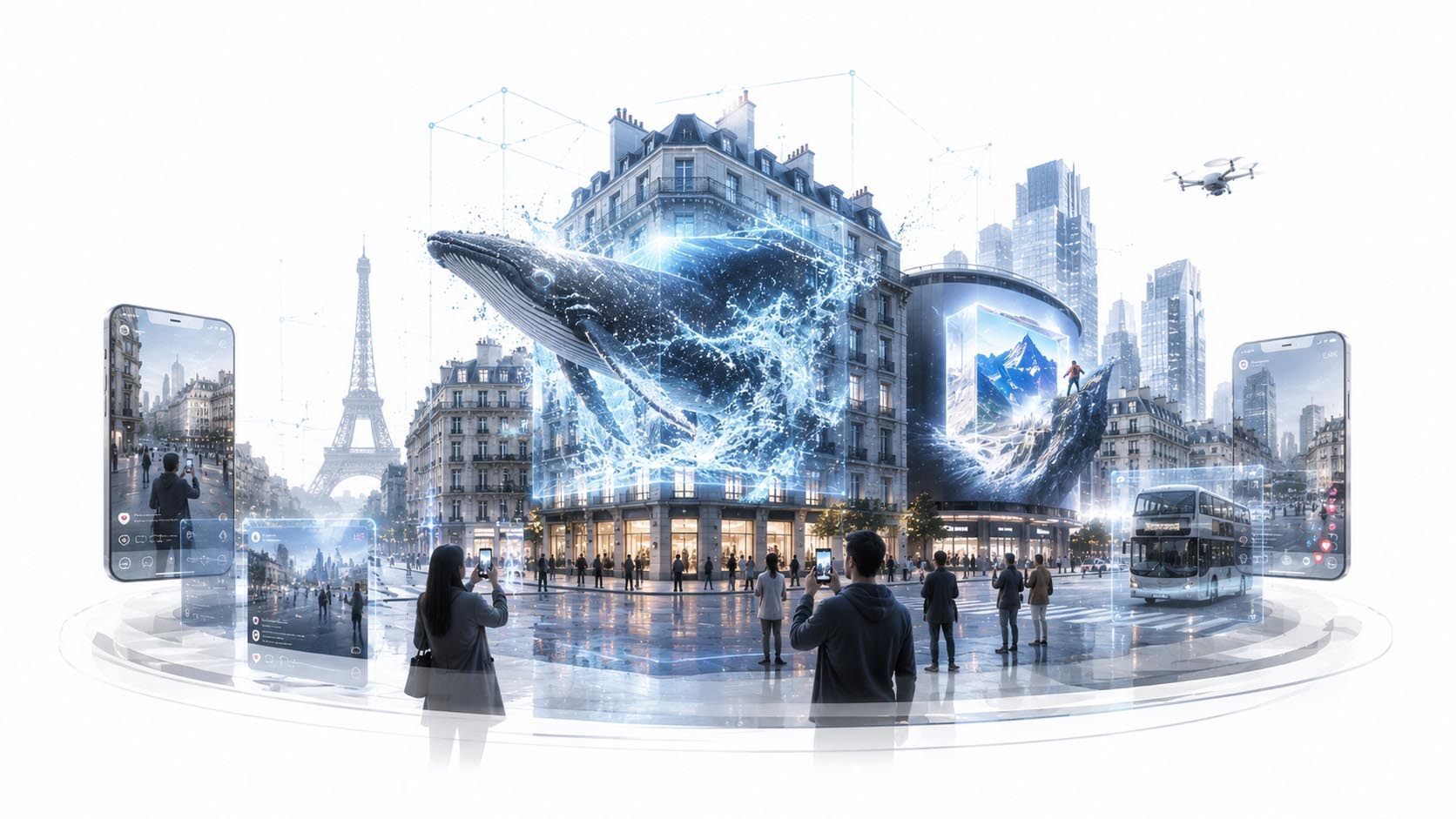
FOOH campaigns transform real cities into digital experience spaces, where architecture, CGI, and social media merge into global attention
Visualization: Calm urban CGI scene with digitally expanded façades, holographic objects, social media perspectives, and immersive city communication as an example of modern Fake Out of Home strategies | © VISORIC GmbH | Munich
The graphic shows how real architecture can become a new form of urban stage through digital stagings. Buildings, squares, and streets remain physically recognizable, but are communicatively expanded through CGI elements, light structures, and immersive projections.
The connection between familiar urban space and impossible event is particularly relevant here. This contrast is exactly what makes FOOH campaigns so effective. The scene appears real enough to be credible, but unusual enough to trigger attention, discussion, and viral distribution.
The visual design of the graphic is deliberately not intended to look like classic advertising. Instead, it shows a calm, high quality, and almost architectural interpretation of digital city staging. This makes clear that FOOH should not only be understood as a short term effect, but as an indication of a new layer of spatial media communication.
At the same time, the graphic illustrates that cities are increasingly becoming digital narrative spaces. Brands use urban landmarks not only as a background, but as semantic amplifiers of their message. The city thereby becomes stage, context, and media multiplier at the same time.
The next chapter therefore analyzes how physical 3D anamorphic displays, digital media façades, and large scale DOOH installations are permanently changing real urban spaces and why the screen is increasingly becoming the façade.
When façades become immersive media platforms
Digital media façades are currently visibly changing the perception of modern cities. Buildings are increasingly no longer understood exclusively as static architecture, but also as dynamic communication surfaces that can display content, brands, data, and visual experiences in real time. Large scale 3D displays and anamorphic media installations in particular create new forms of urban attention. [16]
Unlike classic billboards, modern media façades are increasingly merging with the architecture itself. Façades, glass surfaces, and building structures are strategically designed so that digital content appears spatially, immersively, and physically integrated. This creates urban experience spaces in which architecture and media communication can hardly be separated anymore. [17]
This development becomes particularly striking in metropolises such as Seoul, Tokyo, Shanghai, New York, and Dubai. Giant 3D displays create seemingly physical illusions in public space. Animals appear to break out of façades, virtual rooms open in the middle of the skyline, or digital objects seem to protrude over streets and squares. The city is therefore increasingly evolving into a permanent visual stage. [18][19]
This is no longer only about advertising. Cities are increasingly beginning to understand that digital media architecture can also become part of cultural identity, international visibility, and urban experience quality. Media façades are therefore developing from isolated screens into strategic components of future city design.
The following developments show why immersive media façades are increasingly becoming part of modern urban infrastructure:
- 3D anamorphic displays → digital content appears spatially and physically integrated
- Architecture as media surface → buildings evolve into dynamic communication platforms
- Real time rendering → content can be adapted flexibly and data based
- Global visibility → urban installations generate international media reach
- Experience oriented cities → public spaces are designed to be more immersive and emotional
The connection between real time technologies, artificial intelligence, and data based platforms becomes particularly relevant here. Future media façades could no longer merely display content statically, but dynamically respond to time of day, weather, events, user flows, or public data. Cities are therefore increasingly evolving into intelligent visual interfaces. [20]
At the same time, new requirements for urban media architecture are emerging. Energy consumption, sustainability, light pollution, and the visual balance between information and overstimulation will play an increasingly important role in the future. Cities must therefore increasingly decide how visible, interactive, and digital public spaces should become in the long term.
The expert team of VISORIC GmbH from Munich analyzes these developments in connection with real time rendering, immersive spatial interfaces, and future urban platform technologies. The question of how physical architecture, digital experience spaces, and intelligent data platforms could connect into new forms of urban communication in the future becomes particularly interesting.
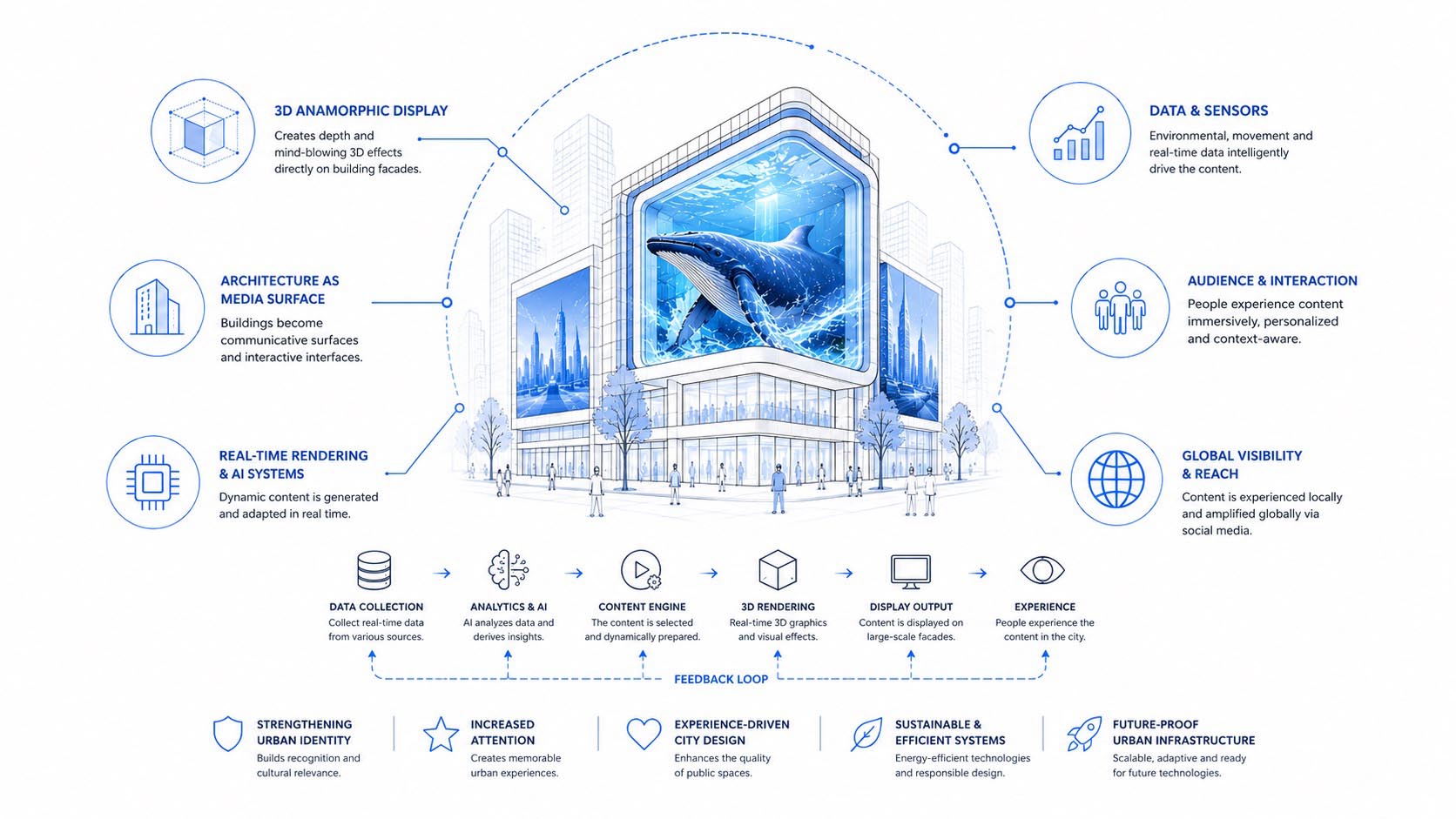
The graphic shows how architecture, real time rendering, AI systems, and immersive media façades could merge into intelligent urban communication platforms in the future
Visualization: Analytical diagram of 3D media façades, AI controlled display systems, urban real time communication, and immersive city interfaces based on modern media architecture | © VISORIC GmbH | Munich
The graphic visualizes the structural setup of future urban media platforms. At the center is an intelligent building architecture with integrated 3D media façades that no longer merely display digital content, but expand it spatially and immersively into the urban space.
Around the central architecture, schematic pictograms and analytical connection lines illustrate the different technological layers of such systems. These include real time rendering, AI supported data analysis, sensor technology, content engines, user interaction, and global platform distribution through digital networks and social media.
The representation of the process logic is particularly relevant. The graphic does not show only a single media façade, but a networked urban communication system. Data is collected, analyzed, visually processed, and then dynamically displayed on façades and public interfaces. Cities are therefore increasingly evolving into intelligent real time platforms.
The calm visual design with a light background, reduced color palette, and clear geometric structures deliberately follows professional architecture and strategy diagrams. This makes the representation appear less like advertising and more like an analytical future visualization of urban media infrastructure.
At the same time, the graphic makes visible that immersive media façades should not be viewed in isolation in the future. They are increasingly becoming interfaces between architecture, public space, AI systems, data platforms, and global communication.
The next chapter therefore analyzes how spatial computing, real time data, and artificial intelligence could personalize urban experience spaces in the future and why cities could become intelligent spatial interfaces in the long term.
When cities become intelligent spatial interfaces
With the increasing connection between artificial intelligence, real time data, and spatial computing, urban spaces are currently changing fundamentally. Cities are increasingly evolving not only into digital information spaces, but into intelligent, adaptive environments that could dynamically respond to people, situations, and contextual data. [21]
While today’s media façades usually display content statically or time controlled, systems are increasingly emerging that can adapt information situationally. In the future, content could be dynamically changed depending on weather, time of day, traffic volume, events, or individual usage scenarios. This creates urban experience spaces that are no longer merely visible, but contextually interactive. [22]
This development becomes especially interesting through the connection of different technologies. Real time rendering, AI systems, sensor technology, cloud infrastructures, and spatial interfaces are increasingly merging into intelligent urban platforms that connect physical architecture with digital information layers. In the long term, cities could therefore function similarly to adaptive digital operating systems. [23]
At the same time, the role of public spaces is also changing. Squares, façades, traffic systems, or urban information surfaces could dynamically adapt to different situations in the future. Navigation, safety, public communication, cultural content, or tourist information would thereby become significantly more personalized and immersive to experience. [24]
The following developments show why intelligent spatial interfaces could increasingly become part of urban infrastructure in the future:
- Adaptive real time environments → urban content responds dynamically to situations and data
- Spatial computing → digital information is spatially integrated into the urban environment
- AI controlled systems → intelligent platforms analyze usage, behavior, and context
- Personalized city experiences → content adapts to people and usage scenarios
- Networked infrastructures → architecture, data, and communication increasingly merge
The question of how visible digital systems should become in public space in the future is particularly relevant. While some concepts focus on maximally immersive experience spaces, other approaches are emerging in parallel that aim to present digital information as subtly, calmly, and architecturally integrated as possible.
This is giving rise to a new form of urban design, in which technology increasingly works invisibly in the background and digital content merges harmoniously with physical architecture. In the long term, spatial computing could therefore feel less like classic screen technology and more like a natural component of urban perception.
The expert team of VISORIC GmbH from Munich analyzes these developments in connection with spatial interfaces, real time rendering, and intelligent urban platform structures. The question of how immersive real time environments could be meaningfully connected with architecture, public space, and digital information systems without visually overloading cities becomes particularly interesting. [25]
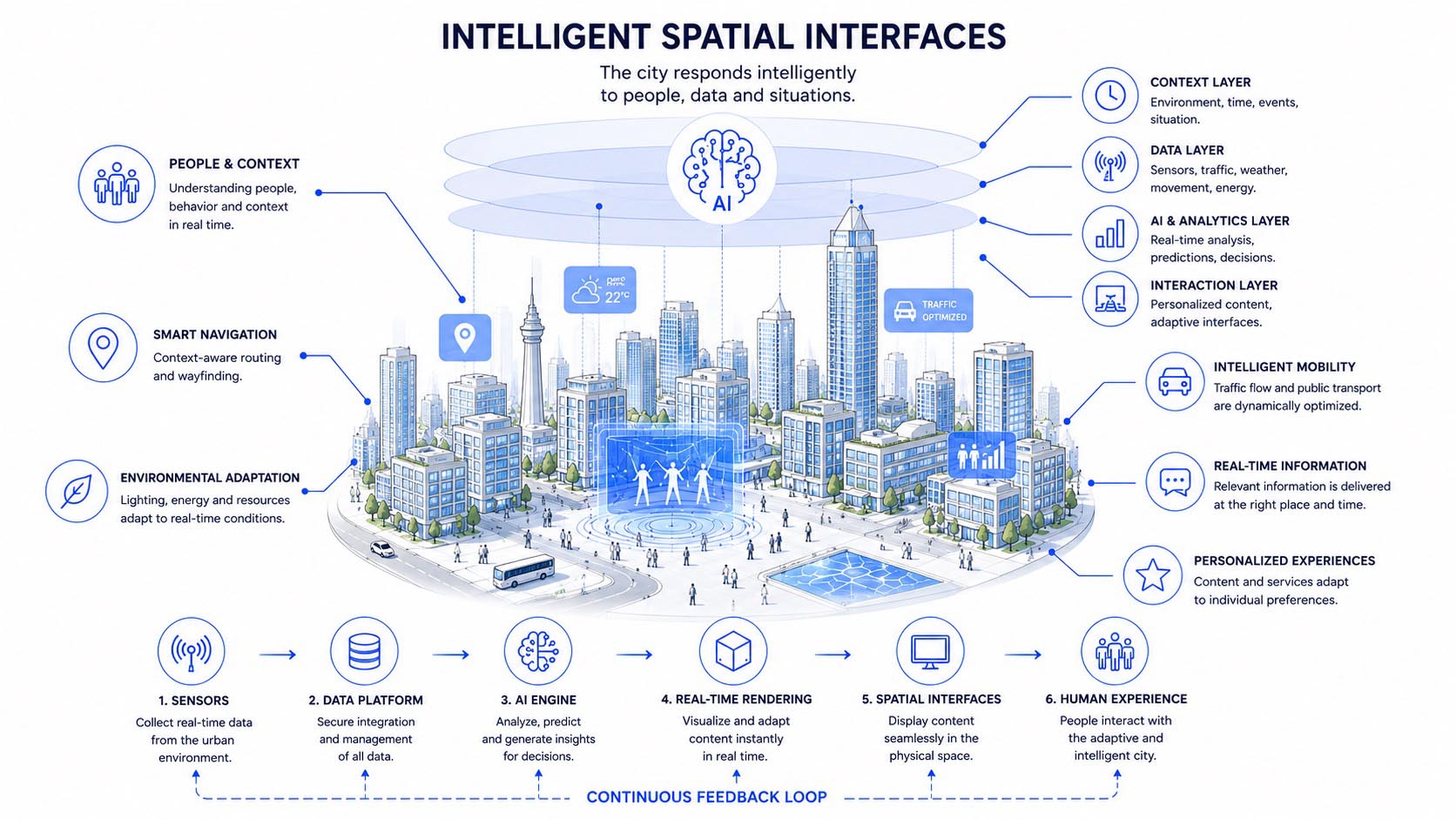
Spatial computing, real time data, and artificial intelligence could turn cities into adaptive spatial interfaces in the future
Visualization: Intelligent urban real time environment with adaptive spatial interfaces, AI controlled information systems, and contextual digital layers within modern city architecture | © VISORIC GmbH | Munich
The graphic visualizes a possible future of intelligent urban experience spaces, in which spatial computing, real time data, and artificial intelligence dynamically integrate digital information into physical urban space. Architecture, infrastructure, and digital interfaces merge into adaptive spatial systems.
The calm and architecturally integrated representation of digital content is particularly striking. Information no longer appears as dominant advertising surfaces, but as subtle spatial layers that blend harmoniously into the urban environment and respond contextually to situations.
The holographic information layers shown illustrate how cities could enable personalized navigation, real time communication, intelligent traffic control, or situational experience spaces in the future. Public spaces are therefore increasingly evolving into dynamic digital interfaces.
At the same time, the graphic makes visible that future urban systems could function in a strongly data driven way. Sensor technology, AI analysis, real time rendering, and cloud platforms connect into intelligent real time environments that continuously respond to change.
The bright, reduced, and futuristically calm design of the visualization is deliberately not intended to show a dystopian science fiction approach, but rather a possible realistic evolution of modern urban infrastructures.
The next chapter therefore analyzes what role immersive urban experience spaces could play in the future for tourism, global brand communication, and international city identity, and why emotional city experiences are increasingly becoming part of digital location strategies.
Immersive city experiences as a new location strategy
With the increasing connection between spatial computing, digital experience spaces, and interactive city communication, the role of tourism is also changing. Cities are no longer just visited, photographed, and remembered, but increasingly perceived as immersive experience spaces that connect physical places with digital stories, real time information, and emotional media formats. [26]
Smart destinations in particular show how strongly tourism communication is currently changing. Digital platforms, mobile interfaces, immersive guides, and data based services enable new forms of visitor interaction. Tourism is therefore becoming increasingly contextual, personalized, and spatially experienceable. [26][27]
At the same time, cities are increasingly developing into global brands. Architecture, culture, public spaces, and digital experience quality are becoming factors that generate international attention and can contribute to city identity in the long term. Immersive media architecture amplifies this effect because it emotionally charges places and enables digital shareability. [28]
The experience economy is therefore also changing the strategic significance of urban spaces. People increasingly expect places that are not only functional, but enable emotional experiences, visual moments, and digital interaction. Cities that credibly design such experience spaces can position themselves more strongly in the competition for tourism, talent, investment, and cultural visibility. [29]
The following developments show why immersive city experiences will become more important in the future:
- Emotional city communication → places become more memorable through digital experiences
- Smart tourism → visitors receive contextual information and immersive orientation
- Spatial storytelling → city history, culture, and brand communication become spatially experienceable
- Digital shareability → immersive city experiences generate global visibility through social media
- Experience economy → cities are increasingly perceived through quality, atmosphere, and interaction
The balance between technological staging and authentic city identity becomes particularly relevant here. Immersive experiences unfold their strongest impact when they do not appear like added effects, but meaningfully extend cultural places, architecture, and existing urban spaces.
This creates a new form of urban location strategy. Cities can communicate their identity not only through classic campaigns, but through digital experience spaces that people use on site, share, and emotionally connect with a city.
The expert team of VISORIC GmbH from Munich analyzes this development in the context of spatial storytelling, real time experience design, and immersive platform structures. The focus is on the question of how digital city experiences can be designed in such a way that they connect experience quality, orientation, cultural identity, and long term communication impact. [30]
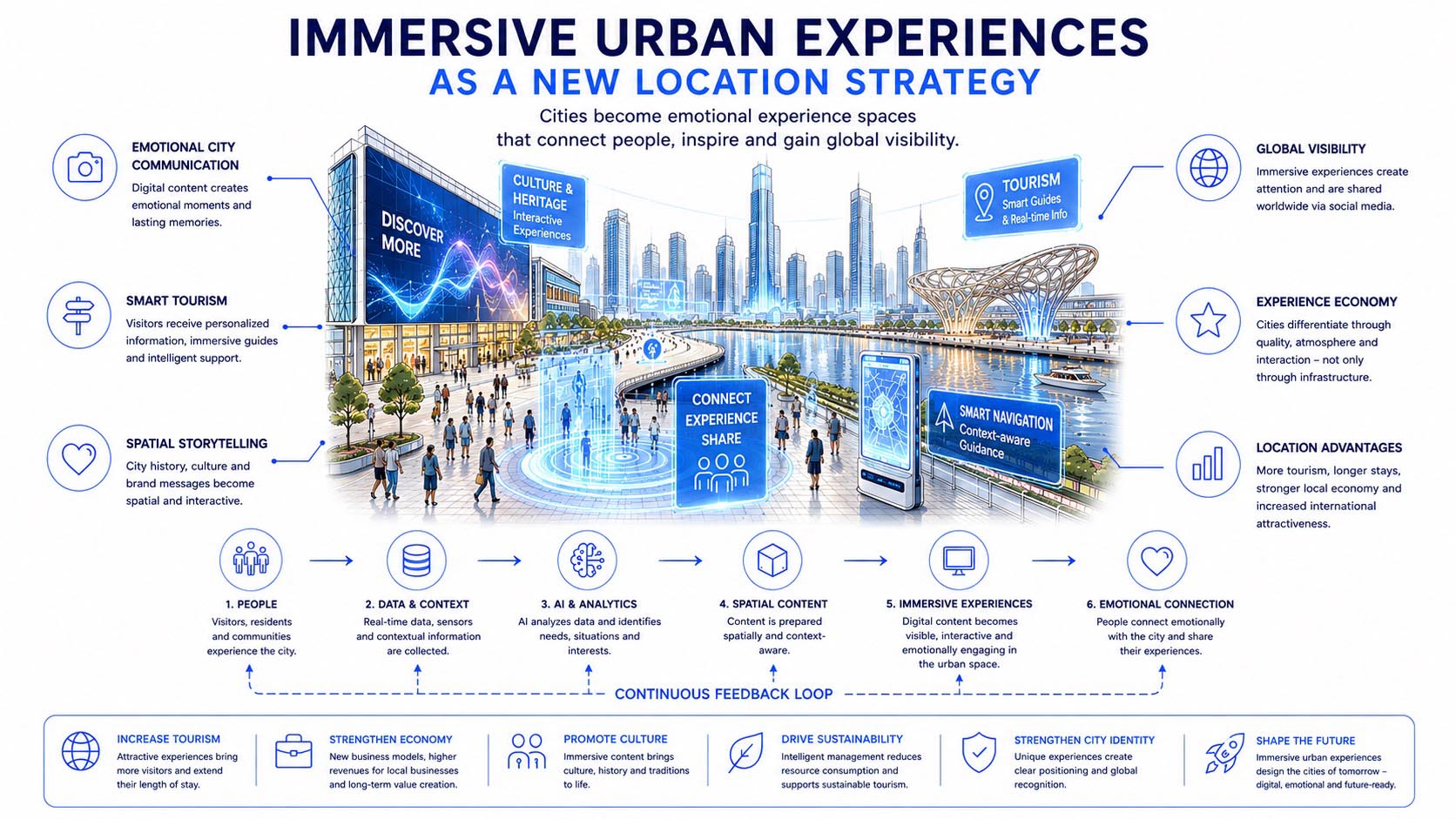
Immersive city experiences connect architecture, digital content, and spatial interfaces into emotional platforms for tourism, communication, and city identity
Visualization: Futuristic urban promenade with immersive spatial interfaces, holographic city communication, digital experience spaces, and emotional urban lighting architecture | © VISORIC GmbH | Munich
The graphic visualizes a possible future of urban experience spaces, in which architecture, digital content, and immersive spatial interfaces create emotional city experiences. Public spaces are increasingly evolving into interactive platforms for tourism, communication, and cultural identity.
The connection between spatial atmosphere and digital information is particularly relevant. Visitors no longer experience a city only through landmarks, routes, and classic information systems, but through contextual digital layers that connect orientation, history, culture, and experience quality.
The calm, bright, and atmospheric design of the graphic deliberately avoids an overloaded technology vision. Instead, it depicts a possible urban future in which digital experience spaces are subtly integrated into architecture, water surfaces, lighting moods, and public squares.
At the same time, the graphic makes visible that immersive city experiences are not only relevant for tourism. They can also become part of location communication, cultural mediation, brand staging, and international visibility.
The next chapter therefore analyzes the challenges immersive urban media architecture could bring in the future and why data protection, sustainability, visual overstimulation, and digital control could increasingly become central topics of future city development.
Between immersive experience city and digital overstimulation
With the increasing spread of immersive media architecture, not only new possibilities for communication, orientation, and experience spaces are emerging, but also new challenges for cities, public spaces, and human perception. The question is increasingly no longer only what is technologically possible, but which form of urban digitalization remains socially meaningful in the long term. [31]
The increasing visibility of digital systems in public space becomes particularly relevant here. Media façades, holographic information surfaces, AI controlled interfaces, and adaptive real time communication permanently create new visual layers within urban environments. Without clear design concepts, this could lead in the long term to a form of digital overstimulation that increasingly fragments and visually overloads public spaces. [32]
At the same time, urban data systems are becoming more important. Intelligent cities are increasingly based on sensor technology, real time data, AI analyses, and networked platforms. This raises new questions around data protection, transparency, control, and digital responsibility. Cities are increasingly evolving into data driven infrastructures whose impact goes far beyond classic architecture. [33]
At the same time, immersive urban systems must also be conceived sustainably. Large scale displays, real time rendering, data processing, and intelligent platform architectures require significant technical resources. Energy consumption, maintenance, hardware cycles, and long term infrastructure costs are therefore increasingly becoming part of future urban planning. [34]
The following developments show the central areas of tension in future urban media spaces:
- Digital overstimulation → too many visual stimuli can overload public spaces
- Data protection and control → intelligent cities generate large amounts of sensitive real time data
- Sustainability → immersive infrastructure requires energy, maintenance, and long term planning
- AI controlled communication → content could increasingly be controlled algorithmically
- Human centered design → digital systems must create orientation instead of overload
The decisive question will therefore be how cities can create a balance between technological innovation and human perception in the future. Immersive urban spaces do not achieve their greatest impact through maximum visual dominance, but through intelligent integration, calmness, context, and architectural quality.
This gives rise to a new design responsibility. In the future, cities must plan not only physical infrastructure, but also digital perception spaces. Public spaces are therefore increasingly developing into hybrid environments in which architecture, data, and visual communication are permanently connected.
The expert team of VISORIC GmbH from Munich examines these developments in connection with human centered spatial computing, immersive perception, and visual balance within urban real time environments. The question of how digital city spaces can be designed in the long term without permanently overloading people with information, interfaces, and visual stimuli becomes particularly relevant. [35]
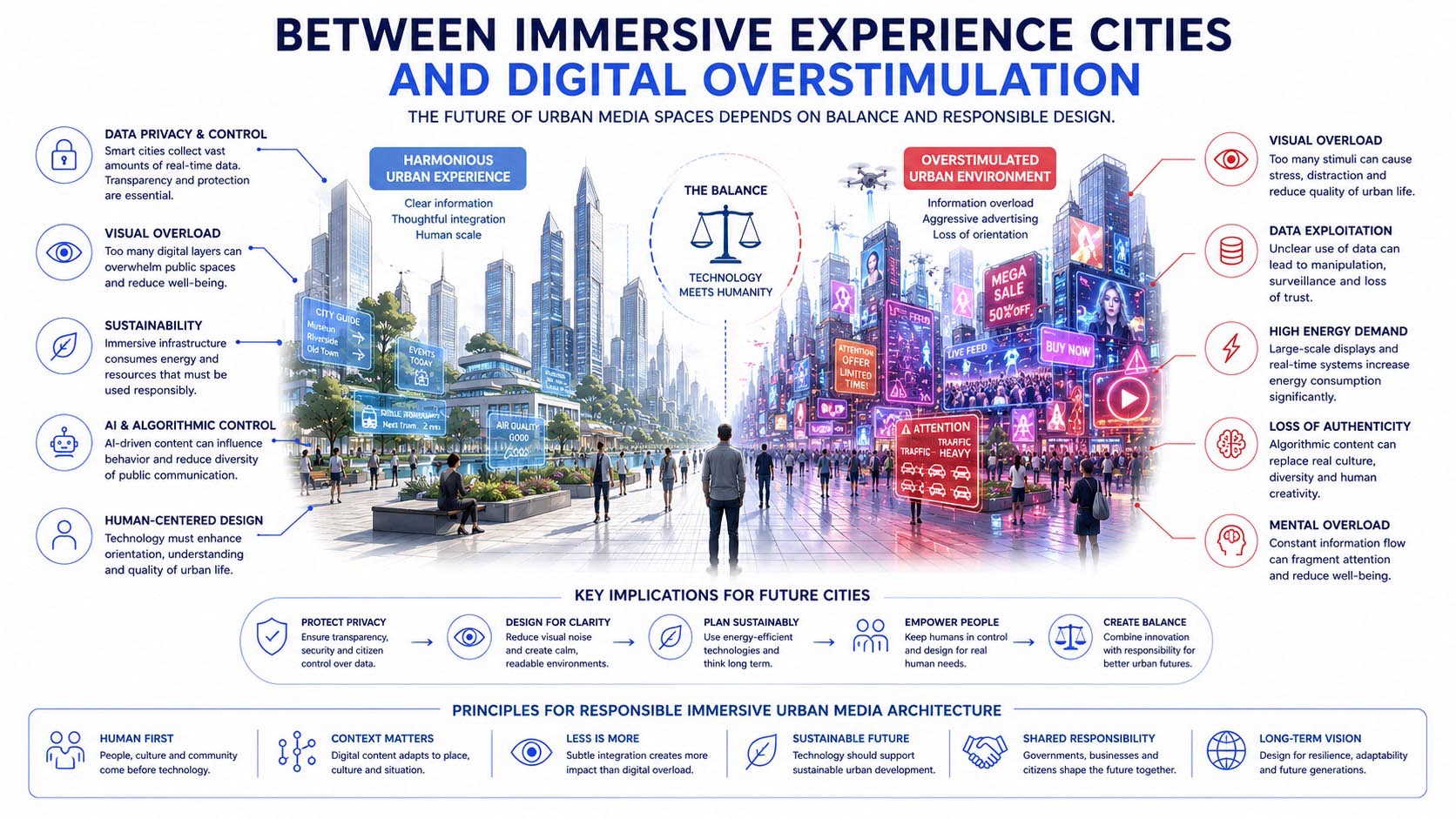
The future of urban media spaces increasingly depends on the balance between technological innovation, human perception, and sustainable design
Visualization: Analytical comparison of harmonious spatial interfaces and visually overloaded urban media spaces with AI controlled real time communication and immersive city infrastructure | © VISORIC GmbH | Munich
The graphic visualizes the growing challenge of designing immersive urban media spaces in a technologically innovative, yet human, sustainable, and visually balanced way. It shows the areas of tension between intelligent real time communication, public perception, and digital overstimulation.
The deliberate juxtaposition of two urban scenarios is particularly striking. While one side shows calm, harmoniously integrated spatial interfaces and subtle digital information systems, the other side illustrates a possible overload of public spaces through aggressive media surfaces, permanent sensory overload, and visual fragmentation.
The graphic thereby makes visible that future urban media architecture should not only be evaluated technologically, but also in terms of perception, quality of stay, and social impact.
The reduced visual design with a light background, clear structures, and analytical composition deliberately follows professional architecture and future diagrams. This creates not a dystopian vision of the future, but a reflective representation of possible urban developments.
The next chapter finally presents the conclusion of the article. It analyzes why immersive urban media architecture could be not only a technological trend in the long term, but a possible new component of future city development, global communication, and digital identity.
Conclusion: when cities become global media spaces
The video impressively illustrates the central thesis of this article. An athlete seemingly jumps over a bar at the Aspire Zone Ring in Doha. An iconic building becomes not only a backdrop, but the spatial stage of a digital illusion. This is exactly where the real transformation lies.
Mixed reality in this context is not a single special effect. It is increasingly becoming a strategic tool of urban communication. Buildings, public spaces, and landmarks are evolving into media carriers that connect physical architecture with digital reach.
Qatar shows exemplarily how powerful such stagings can be. A building sized globe at the Raffles Hotel, floating dhow boats above Katara Harbor, or a sports moment at the Aspire Zone Ring show how architecture becomes the stage of spatial storytelling.
The city itself thereby becomes content. Architecture becomes a distribution channel. Public spaces no longer generate only local perception, but digital reach on a global level.
The following developments summarize the central importance of immersive urban media architecture:
- Architecture as media space → buildings become stages of spatial communication
- Mixed reality as infrastructure → digital experiences strategically expand real urban spaces
- Algorithmic visibility → cities must not only impress in reality, but also perform digitally
- Global reach → physical places generate international media impact through social media
- Responsible design → immersive city communication needs balance, context, and cultural substance
The real business case therefore lies not only in the visual effect. What matters is that physical spaces can generate digital attention. A city, a building, or a public square thereby becomes a scalable communication system.
At the same time, the central question is shifting. In the future, it will no longer only be about how a city looks in reality. It will increasingly also matter how it works in digital platforms, social media, and algorithmic feeds.
The expert team of VISORIC GmbH from Munich analyzes this development in the context of spatial computing, immersive real time visualization, and urban media platforms. The focus is on the question of how physical architecture and digital experience spaces could merge into intelligent, responsibly designed city interfaces in the future.
Mixed reality transforms urban landmarks into spatial media events with global digital reach
Visualization: Mixed reality staging at the Aspire Zone Ring in Doha as an example of urban media architecture, algorithmic visibility, and global city communication | Analysis: Ulrich Buckenlei | © VISORIC GmbH | Munich
Credits: vertex.cgi © All rights belong to their respective owners.
The video sequence shows how a real urban landmark becomes a globally shareable media event through digital staging. The architectural sign remains recognizable, but is transformed by mixed reality into a new spatial narrative.
The connection between place, movement, and digital illusion is particularly relevant here. The Aspire Zone Ring functions not only as a building, but as a visual interface for an event whose impact unfolds primarily through social media.
The video therefore shows where urban media architecture could develop. Cities are no longer perceived only through buildings, squares, and infrastructure, but increasingly through the experiences these places can digitally create and distribute.
The next section contains the bibliography with the scientific, technological, and strategic references for the individual chapters of the article.
From Urban Experience Spaces to Intelligent Media Platforms
The evolution of immersive urban media architecture demonstrates that cities could become far more than physical infrastructures in the future. Realtime rendering, spatial computing, artificial intelligence, and immersive realtime communication are increasingly evolving into new components of modern urban design, digital experience spaces, and global visibility.
What truly matters, however, is not the individual technology itself, but the intelligent combination of architecture, data, media logic, and human perception. Many cities, brands, and institutions are currently experimenting with digital façades, immersive installations, or smart city platforms. Yet the real potential only emerges when physical spaces, digital content, and realtime communication work together strategically.
This is precisely where new opportunities are currently emerging for cities, tourism organizations, cultural institutions, real estate developers, and global brands. Immersive experience spaces enable entirely new forms of public communication, emotional urban perception, and international digital reach.
This becomes especially relevant for organizations seeking to evaluate:
- how immersive media architecture could transform public spaces
- how spatial computing and realtime data may influence future urban experiences
- how architecture can become a digital communication channel
- how physical locations can generate global algorithmic visibility
- how immersive experience spaces can be designed responsibly and sustainably
The expert team at VISORIC GmbH in Munich analyzes these developments together with technology partners, industrial companies, and public sector stakeholders in the context of spatial computing, realtime experience design, and immersive platform structures.
The primary focus lies on intelligent realtime environments, digital experience spaces, urban media platforms, and the question of how physical architecture and digital communication could increasingly merge in the future.
Immersive realtime platforms connect architecture, spatial computing, and digital communication into new urban experience spaces
Visualization: Future oriented platform architecture for immersive urban experience spaces featuring realtime rendering, AI powered spatial interfaces, and globally scalable media environments | © VISORIC GmbH | Munich
Particularly interesting is the question of how cities, architecture, and digital experience spaces can be conceived together in the future. Immersive urban communication is increasingly evolving from isolated media installations into intelligently connected realtime platforms with global visibility.
Even an initial structured conversation can often provide valuable first insights into which technological developments, platform strategies, and spatial communication approaches may become relevant for various urban, cultural, or economic application areas in the future.
Bibliography
- Briana et al., “Sustainable Urban Branding: The Nexus Between Digital Marketing and Smart Cities”, analysis of sustainable urban branding, digital city communication, and smart city strategies. [1]
- Wan & Li, “City Branding in the Era of Social Media and Digital Transformation”, research on city brands, digital platforms, and social media logic in urban competition. [2]
- BrandXR, “Mixed Reality Marketing: The 342 Billion Dollar Strategic Imperative”, classification of mixed reality as a strategic marketing and communication tool. [3]
- Dataintelo, “Smart City Digital Twin Market Report 2033”, market data on smart city digital twins and long term growth perspectives. [4]
- Gartner, “Spatial Computing: How Businesses Can Deliver on Immersive Experiences”, forecast on the spread of immersive experiences and spatial technologies. [5]
- Qatar Tourism, “Digital Destination Experiences and National Branding”, strategies of immersive city and tourism communication in Qatar. [6]
- Brand Finance, “Nation Brands Report”, analysis of international location brands and emotional perception of states. [7]
- Accenture, “Spatial Computing and Experience Transformation”, study of immersive technologies in public space and the experience economy. [8]
- Deloitte, “Future of Cities and Digital Urban Experiences”, analysis of digital experience spaces and urban communication strategies. [9]
- McKinsey & Company, “The Future of Smart Urban Infrastructure”, study on intelligent urban platforms and global visibility. [10]
- Apple, “Apple Vision Pro and Spatial Computing”, analysis of spatial interfaces and immersive user experiences. [11]
- MIT Media Lab, “Responsive Urban Interfaces”, research on interactive spatial information systems. [12]
- NVIDIA, “Realtime Simulation and Spatial Interfaces”, technologies for real time visualization and digital experience spaces. [13]
- Gartner, “Emerging Technologies and Spatial Experiences”, forecasts on the development of immersive digital platforms. [14]
- Visoric Research, “Realtime Spatial Communication in Urban Environments”, study of immersive real time communication in urban space. [15]
- Samsung, “The Future of Digital Signage and 3D Displays”, analysis of large scale immersive display technologies. [16]
- LG Business Solutions, “Media Facades and Urban Communication”, study of digital façades as urban communication platforms. [17]
- Seoul Metropolitan Government, “Public Media Art and Urban Screens”, strategies for public immersive media installations. [18]
- Times Square Alliance, “Immersive Advertising and Urban Spectacle”, analysis of urban experience spaces and digital visibility. [19]
- Gartner, “AI Powered Urban Communication Systems”, forecast on intelligent real time communication in public space. [20]
- Gartner, “Spatial Computing and Adaptive Digital Experiences”, analysis of personalized immersive experience spaces and context based interfaces. [21]
- MIT Media Lab, “Responsive Urban Interfaces and Intelligent Environments”, research on intelligent real time environments and adaptive city systems. [22]
- NVIDIA, “AI Powered Realtime Simulation and Digital Worlds”, technologies for real time visualization, AI simulation, and dynamic digital environments. [23]
- McKinsey & Company, “The Future of Smart Cities and Urban Intelligence”, analysis of data based urban systems and intelligent city infrastructures. [24]
- Visoric Research, “Spatial Interfaces and Adaptive Urban Media Systems”, study of immersive city interfaces and AI supported real time communication. [25]
- UN Tourism, “Digital Transformation in Tourism and Smart Destinations”, analysis of digital tourism platforms and immersive visitor experiences. [26]
- Deloitte, “The Future of Experience Driven Cities”, study of emotional city experiences and digital experience economies. [27]
- Accenture, “Spatial Computing and the Future of Consumer Experiences”, analysis of immersive experience spaces and personalized digital interaction. [28]
- McKinsey & Company, “The Experience Economy and Urban Innovation”, study on the experience economy and future city development. [29]
- Visoric Research, “Immersive Urban Experiences and Spatial Storytelling”, analysis of immersive city communication and spatial experience platforms. [30]
- UNESCO, “Culture, Urban Identity and Digital Public Space”, analysis of digital urban spaces and cultural identity. [31]
- World Economic Forum, “Responsible Smart Cities and Ethical Urban Technology”, study of ethical challenges in intelligent cities. [32]
- MIT Senseable City Lab, “Data Driven Urbanism and Public Space”, research on urban data spaces and intelligent infrastructures. [33]
- Deloitte, “Sustainable Smart Cities and Urban Infrastructure”, analysis of sustainable urban development and energy efficiency. [34]
- Visoric Research, “Human Centered Spatial Computing and Urban Experience Design”, study of human centered immersive urban spaces and visual balance. [35]
Contact Persons:
Ulrich Buckenlei (Creative Director)
Mobile: +49 152 53532871
Email: ulrich.buckenlei@visoric.com
Nataliya Daniltseva (Project Manager)
Mobile: +49 176 72805705
Email: nataliya.daniltseva@visoric.com
Address:
VISORIC GmbH
Bayerstraße 13
D-80335 Munich