

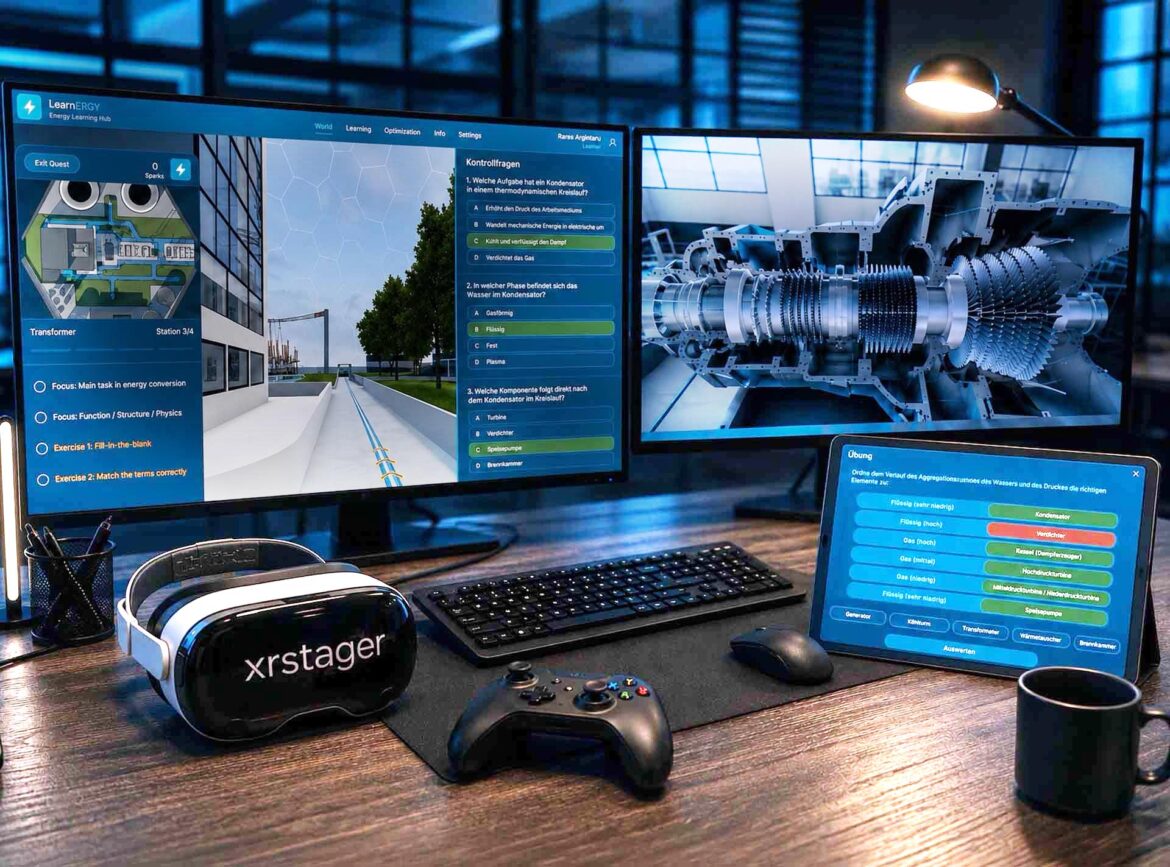
Virtual 3D learning spaces and immersive training platforms are currently transforming industrial knowledge transfer
Visualization: Digital immersive learning environment for industrial training processes with interactive 3D spaces, realtime simulation and collaborative training systems | Image: © Ulrich Buckenlei | VISORIC GmbH
Industrial companies are currently facing a fundamental transformation of their knowledge and training processes. New technologies, more complex production systems, global teams and the growing shortage of skilled workers are significantly changing the requirements for industrial training structures. At the same time, the pressure is increasing to make knowledge available faster, more efficiently and at international scale. [1][2]
Traditional training systems are increasingly reaching their limits. Documentation, presentations or linear e learning systems are often no longer sufficient to communicate complex technical processes in a clear, interactive and sustainable way. Especially in international rollouts, safety critical procedures or complex machines, this creates a growing need for new forms of learning. [3]
At the same time, a new generation of digital learning environments is emerging. Virtual 3D spaces, industrial gaming, interactive simulations and immersive training platforms increasingly enable a form of learning that is more closely aligned with real work processes. Knowledge is no longer only consumed, but actively experienced, trained and applied together. [4]
Various industrial projects already show that immersive learning systems are becoming relevant not only for internal training, but increasingly also for customer qualification, knowledge retention and international training strategies. The combination of realtime 3D, artificial intelligence, digital twins and interactive learning spaces is particularly interesting.
This is precisely where new industrial training platforms are currently emerging, combining traditional e learning concepts with gaming technologies, simulation and intelligent learning pipelines.
The next chapter therefore analyzes why traditional training systems are increasingly reaching their limits in many areas and why immersive learning spaces are becoming more relevant for industrial companies.
Why traditional training systems are increasingly reaching their limits
In many companies, industrial training processes are still based on traditional documentation, presentations, video formats or linear e learning systems. While these approaches enable standardized knowledge transfer, they increasingly reach their limits when complex technical processes, international teams or interactive workflows need to be communicated. [5]
Especially in industrial environments, a fundamental problem often arises. Technical systems are becoming increasingly complex, while the time pressure for training, onboarding and knowledge retention is growing at the same time. Traditional training methods can often represent real work processes only to a limited extent. Knowledge remains abstract, spatial relationships are difficult to understand and interactive experiences are completely missing. [6]
At the same time, the requirements for modern learning systems are changing significantly. Companies increasingly need platforms that can make content flexibly available across different devices, locations and learning environments. Training content should no longer only be consumed, but actively experienced, analyzed and worked on collaboratively. [7]
The following developments illustrate why immersive learning systems are currently becoming increasingly important:
- Interactivity → complex processes become spatially and visually understandable
- Flexibility → content can be used across desktop systems, mobile devices and XR platforms
- Scalability → global teams and international training programs can be managed centrally
At the same time, modern learning platforms are increasingly developing into intelligent data and content structures. Realtime 3D, digital twins, artificial intelligence and sensor based systems now enable training environments that operate much closer to real industrial processes than traditional training systems. [8]
This is precisely where new technological platform approaches are currently emerging. Various industrial projects increasingly show that modern training environments are no longer just individual VR applications, but complex infrastructures made up of backend systems, interactive 3D spaces and intelligent learning pipelines.
The expert team at VISORIC GmbH in Munich develops scalable platform solutions for immersive training, simulation and knowledge systems together with industrial partners. Depending on project requirements, different technology and infrastructure approaches are used, including the internally developed XR Stager Industrial Metaverse and Spatial Computing Platform as well as established realtime and AI technologies such as NVIDIA Omniverse, Unity and Unreal Engine.
The goal is to make industrial content such as CAD data, technical processes, digital twins, realtime 3D and artificial intelligence flexibly available for different training and learning environments, from traditional desktop workstations to mobile devices and large format displays through to spatial computing platforms such as Apple Vision Pro, Meta Quest or Magic Leap.
At the same time, central platform structures are becoming increasingly important. Content can be managed, analyzed and dynamically adapted through backend systems. AI agents, sensor data and intelligent assistance systems enable adaptive learning environments that can flexibly adjust to different usage scenarios and training requirements. This creates training, simulation and knowledge platforms that can be used over the long term and combine interactive learning processes, collaborative training scenarios and modern industrial knowledge transfer.
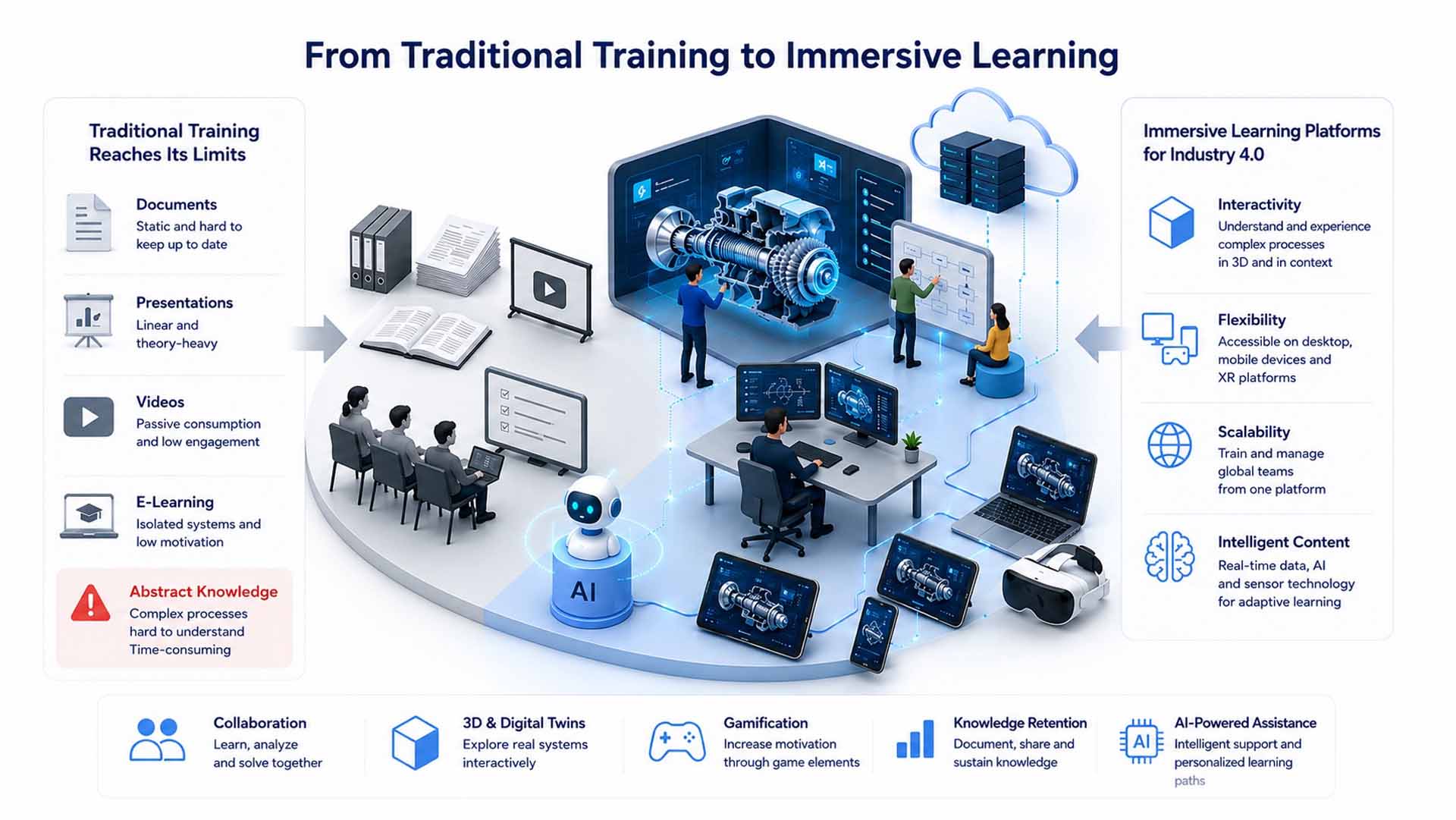
Immersive learning platforms combine industrial knowledge transfer, realtime 3D visualization and intelligent training systems
Visualization: Interactive industrial training environment with virtual learning spaces, CAD visualization, spatial computing and centrally managed learning systems | © VISORIC GmbH | Munich
The image illustrates how industrial training systems are currently changing. Instead of isolated learning content, connected training platforms are increasingly emerging, combining real processes, interactive 3D content and different end devices.
The ability to not only display complex technical systems, but to make them actively experienceable, is becoming particularly relevant. Learners can analyze processes together, explore machines interactively and understand content much more intuitively than in traditional training scenarios.
At the same time, modern learning platforms are increasingly adopting elements from gaming, simulation and collaborative virtual environments. This is giving rise to a new form of industrial knowledge transfer in which playful interaction and active learning are moving increasingly into focus.
The next chapter therefore analyzes why industrial gaming and serious games are increasingly becoming part of modern industrial training strategies and what role game based learning systems could play for companies in the future.
Industrial gaming and serious games as a new learning logic
As industrial processes become increasingly digital, not only the technology itself is changing, but also the way knowledge is transferred. Interactive learning systems are currently gaining particular importance because they can communicate complex technical content much more intuitively and practically than traditional training formats. [9]
An approach that was long primarily associated with the games industry is increasingly coming into focus. In the industrial context, however, this is not about entertainment, but about active interaction, spatial understanding and collaborative learning in realistic scenarios. [10]
Studies show that game based learning environments can significantly improve motivation, attention and long term knowledge retention. Especially in technical training situations, a decisive advantage emerges when learners do not merely observe processes, but actively experience and influence them.
The following characteristics show why industrial gaming and serious games are increasingly becoming part of modern training systems:
- Interaction → technical workflows are actively experienced instead of merely viewed
- Motivation → playful mechanics increase attention and learning engagement
- Collaboration → teams can train and analyze processes together
These developments are currently fundamentally changing the structure of modern industrial learning systems. Training platforms are increasingly evolving from linear knowledge systems into interactive experience spaces where learning, simulation and collaboration merge. [11][12]
This development becomes particularly interesting through modern realtime 3D technologies and spatial computing platforms. Virtual learning environments can now be used flexibly across desktop systems, mobile devices, large format displays or XR headsets, enabling significantly more dynamic training processes.
The expert team at VISORIC GmbH in Munich develops immersive learning platforms for this purpose together with industrial partners, based on the XR Stager Industrial Metaverse and Spatial Computing infrastructure. The goal is not only to visually represent complex technical content, but to make it interactive, experienceable and collaboratively usable.
Increasingly, this results in hybrid training systems that combine CAD data, digital twins, realtime simulation, artificial intelligence and different end devices. Training content can therefore be used flexibly across different learning spaces and devices and managed centrally.
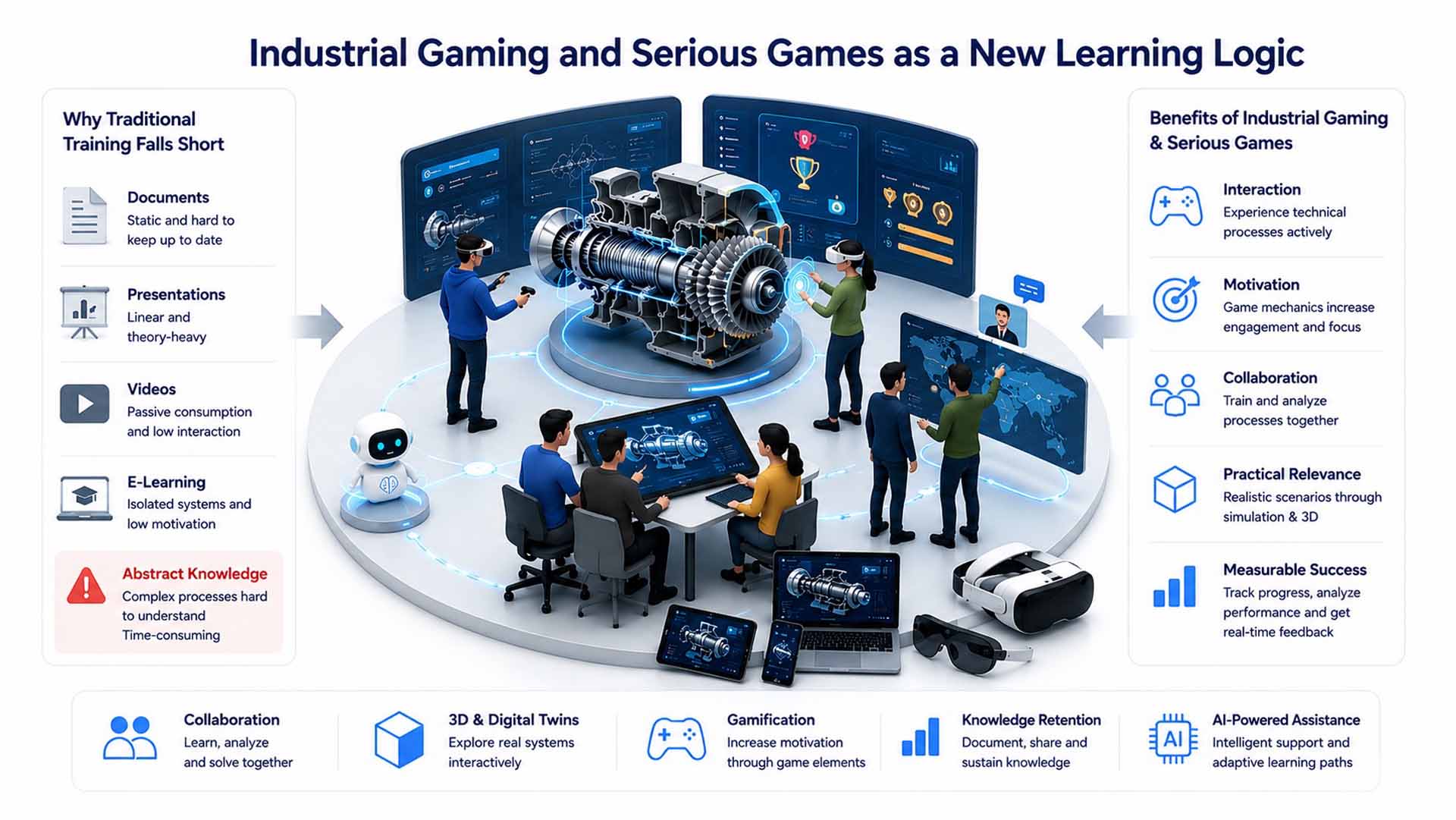
Industrial gaming and immersive learning platforms combine interactive knowledge transfer with realtime 3D and collaborative training systems
Visualization: Virtual industrial learning environment with interactive training processes, realtime 3D visualization and collaborative spatial computing technologies | © VISORIC GmbH | Munich
The image illustrates how industrial training systems are currently changing. Instead of static learning content, interactive experience spaces are increasingly emerging in which technical processes can be jointly analyzed, simulated and trained.
The ability to make complex systems not only theoretically understandable, but actively experienceable, is becoming particularly relevant. Learners can directly influence workflows, understand spatial relationships more intuitively and grasp content in a much more practice oriented way.
At the same time, modern training platforms are increasingly integrating elements from realtime simulation, gaming and collaborative virtual spaces. This is giving rise to a new generation of industrial learning environments that increasingly extend or replace traditional training systems.
The next chapter therefore analyzes how virtual 3D learning spaces and the industrial learning metaverse are emerging and why immersive platforms are becoming increasingly strategically important for industrial companies.
Virtual 3D learning spaces and the industrial learning metaverse
With the increasing combination of realtime 3D, artificial intelligence, digital twins and collaborative platform technologies, a new generation of industrial learning environments is currently emerging. Training systems are increasingly developing from individual applications into connected digital spaces where knowledge can be transferred interactively, experienced collaboratively and scaled flexibly. [13]
Realtime 3D technologies in particular are fundamentally changing the possibilities of industrial knowledge transfer. Virtual learning spaces make it possible to represent complex machines, processes and production environments spatially and make them interactively usable. Learners can therefore work with technical content much more intuitively than in traditional training systems. [14]
At the same time, collaborative learning environments are increasingly emerging, where teams can train, analyze and interact together regardless of location. Virtual spaces are thereby developing into a new form of digital infrastructure for industrial training processes.
The following developments illustrate why virtual learning spaces and immersive platforms are currently gaining strong importance:
- Realtime 3D → complex technical systems become interactive and spatially experienceable
- Collaboration → teams can train together worldwide and analyze processes
- Multi device use → content can be flexibly provided across desktop, mobile and XR systems
In the international technology context, this development is often described as the industrial metaverse or learning metaverse. This does not refer to isolated VR applications, but to connected platform structures that combine realtime 3D, data management, artificial intelligence, simulation and different end devices. [15][16]
This is precisely where new platform architectures for industrial knowledge transfer are currently emerging. Today, content must be flexibly available between desktop systems, mobile devices, large format displays and spatial computing environments. At the same time, central backend systems are becoming increasingly important in order to efficiently manage content, user structures, training data and interactive processes.
The expert team at VISORIC GmbH in Munich develops immersive learning and visualization platforms for this purpose together with industrial partners, based on the XR Stager Industrial Metaverse and Spatial Computing infrastructure. The goal is to make industrial content such as CAD data, digital twins and interactive training scenarios flexibly accessible across different devices and learning environments.
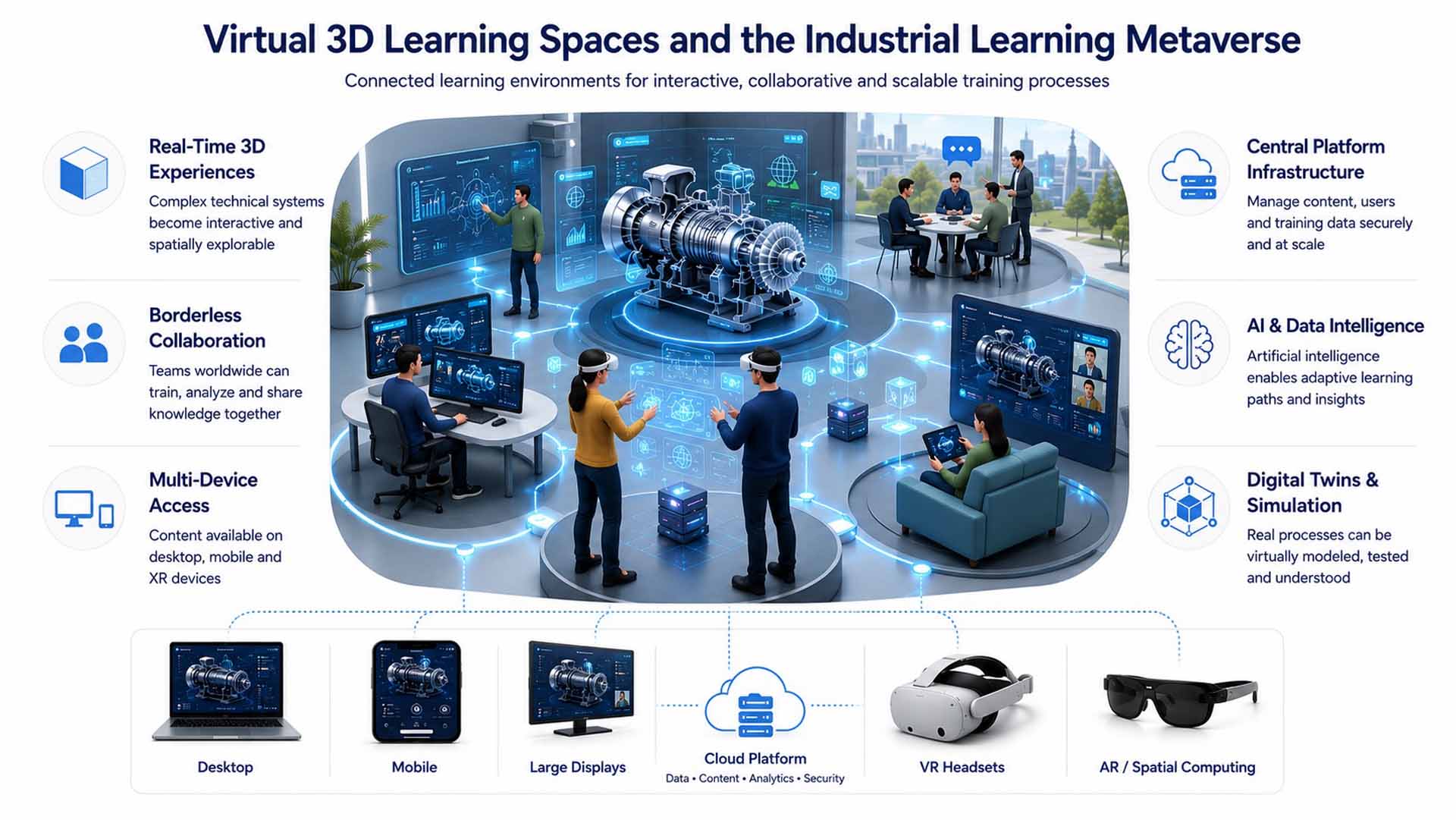
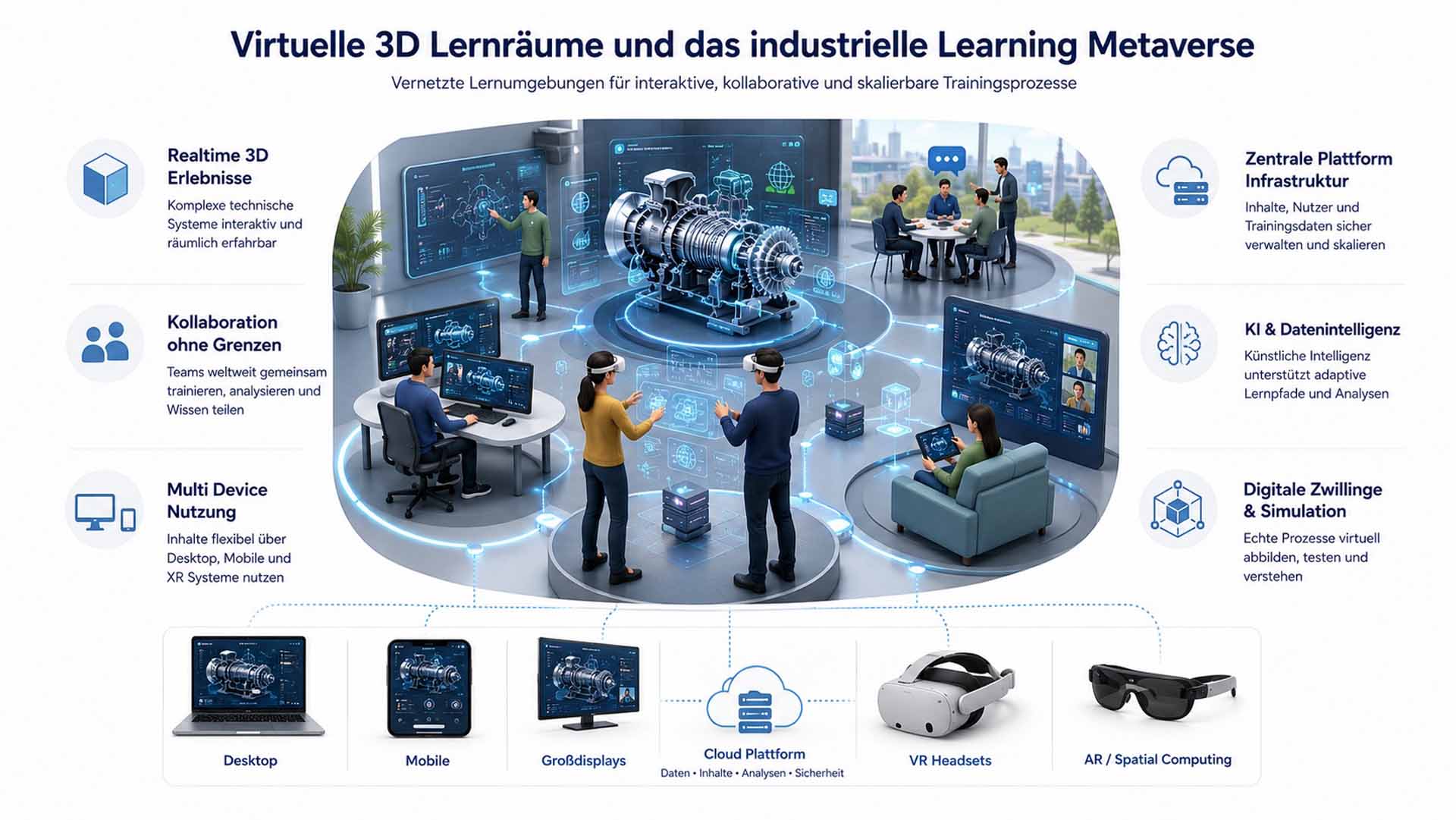
Virtual 3D learning spaces combine realtime simulation, collaborative training processes and industrial knowledge transfer
Visualization: Immersive industrial learning environment with collaborative 3D spaces, digital twins and spatial computing technologies for modern training processes | © VISORIC GmbH | Munich
The image illustrates how industrial learning platforms are increasingly developing into connected digital spaces. Instead of isolated training systems, immersive environments are emerging in which technical processes can be interactively visualized, analyzed and trained together.
The ability to provide content flexibly across different devices and learning environments is becoming particularly relevant. Training systems can now be used simultaneously on traditional desktop workstations, mobile devices, large format displays or spatial computing headsets.
At the same time, central platform structures are becoming increasingly important. Virtual learning spaces are increasingly developing into intelligent infrastructures that combine realtime 3D, backend systems, data management and interactive processes.
This is creating the technological foundation for a new generation of industrial training platforms in which artificial intelligence, adaptive learning systems and automated content processes are playing an increasingly central role.
The next chapter therefore analyzes how artificial intelligence is fundamentally changing e learning systems, training pipelines and industrial knowledge transfer today.
How artificial intelligence is changing e learning and training pipelines
With the increasing integration of artificial intelligence, not only traditional e learning systems are changing, but the entire structure of industrial knowledge transfer. Training platforms are increasingly evolving from static content systems into intelligent learning environments that can dynamically adapt, analyze and expand content depending on the situation. [17]
Generative AI technologies in particular are opening up new possibilities for industrial training processes. Learning content can now be created, updated and adapted to different target groups much faster. At the same time, adaptive learning systems are emerging that analyze user behavior and align content individually with learning progress, interaction and usage context. [18]
At the same time, artificial intelligence is increasingly changing the role of interactive learning platforms. Training systems are becoming intelligent knowledge spaces in which content is no longer controlled exclusively manually, but can be dynamically expanded and optimized through AI processes.
The following developments illustrate why artificial intelligence is increasingly becoming part of modern industrial learning systems:
- Adaptive learning processes → content dynamically adapts to users and scenarios
- AI supported content generation → training content can be created and updated faster
- Intelligent assistance systems → users receive context based support and analysis functions
At the same time, hybrid platform structures are increasingly emerging that combine artificial intelligence with realtime 3D, spatial computing and collaborative learning environments. AI is therefore no longer merely part of individual software functions, but is increasingly developing into an infrastructural layer of modern training systems. [19][20]
This development becomes particularly interesting in combination with interactive 3D platforms and digital learning spaces. Virtual training environments can now not only display content, but react to user interactions, analyze processes and expand content depending on context.
The expert team at VISORIC GmbH in Munich develops immersive learning platforms for this purpose together with industrial partners, based on the XR Stager Industrial Metaverse and Spatial Computing infrastructure. The goal is to combine artificial intelligence, realtime 3D and industrial knowledge systems in such a way that adaptive training environments can be created for different industrial fields of application.
Central backend systems and intelligent data pipelines are becoming particularly important in this context. Training platforms are increasingly developing into dynamic infrastructures in which AI agents, sensors, user analytics and automated content processes can be combined.
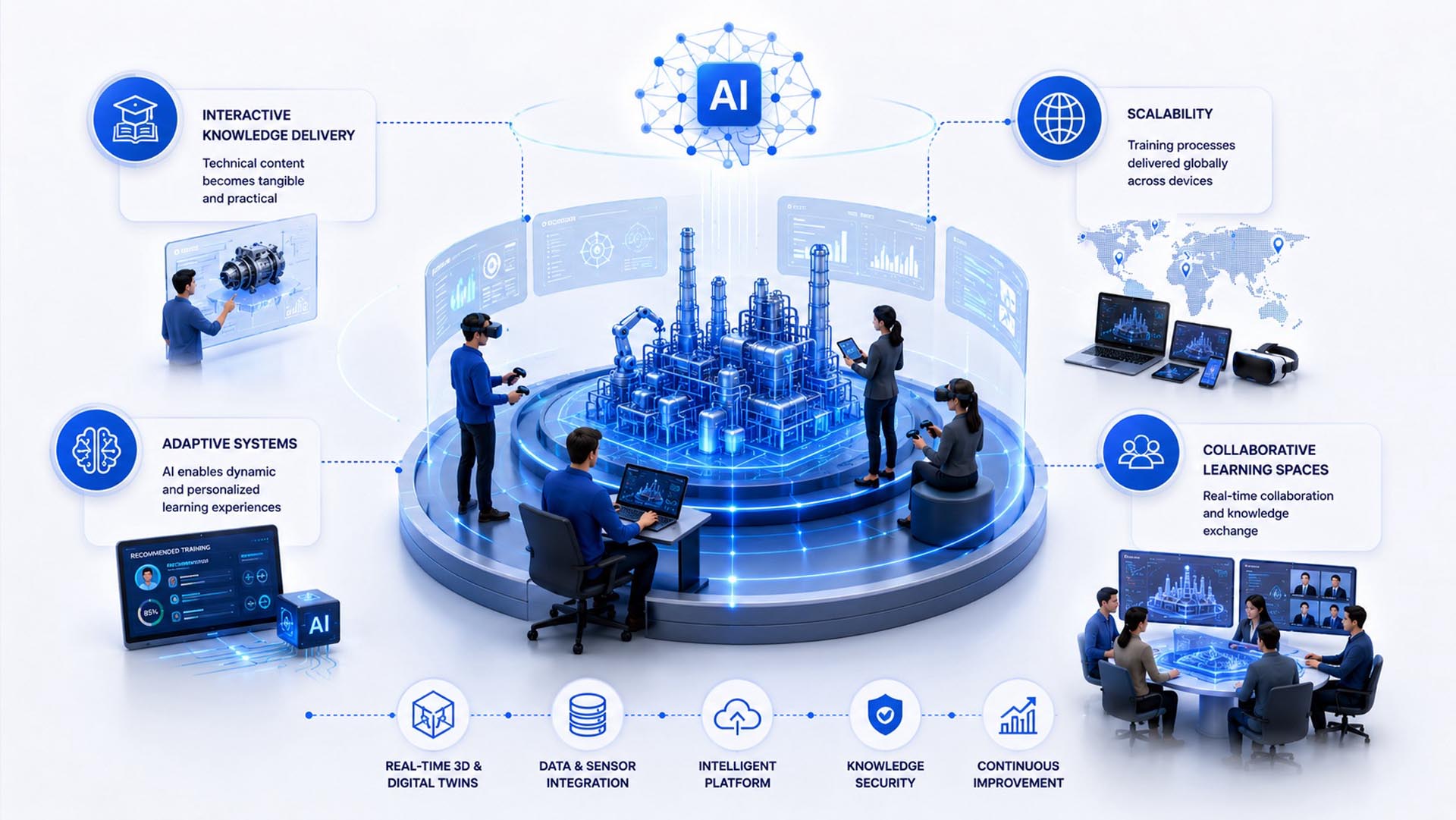
Artificial intelligence expands industrial learning platforms with adaptive training processes and intelligent knowledge systems
Visualization: AI supported industrial learning environment with interactive training spaces, intelligent assistance systems and realtime 3D platform technologies | © VISORIC GmbH | Munich
The image illustrates how artificial intelligence is increasingly becoming part of modern industrial learning platforms. Training systems are evolving from static knowledge structures into dynamic environments that can analyze, expand and adapt content depending on the situation.
The combination of AI, realtime 3D and interactive learning spaces is becoming particularly relevant. Learners can not only experience processes visually, but increasingly receive intelligent support, adaptive content and context based information within the training environment.
At the same time, modern learning platforms are increasingly integrating real data sources, machine information and digital models. This is giving rise to intelligent training systems that increasingly connect real industrial processes with virtual learning environments.
The next chapter therefore analyzes what role digital twins, realtime data and industrial interfaces will play in the future for interactive training platforms and immersive learning systems.
Digital twins, real data and intelligent training systems
With the increasing digitalization of industrial processes, digital twins and data based simulation systems are currently gaining strong importance. This creates not only virtual representations of individual machines or plants, but increasingly intelligent systems that can connect real processes, sensor data and interactive learning environments. [21]
Digital twins allow companies not only to visually represent technical systems, but to dynamically analyze, simulate and use them in different application scenarios. Especially in training environments, this creates the opportunity to represent real industrial workflows in a much more practical and interactive way. [22]
At the same time, this fundamentally changes the requirements for modern learning platforms. Training systems are increasingly evolving from isolated knowledge spaces into intelligent infrastructures that connect realtime data, machine information and interactive processes.
The following developments illustrate why digital twins and realtime data are increasingly becoming part of modern training systems:
- Realtime data → training environments can dynamically respond to real process states
- Simulation → complex industrial workflows can be interactively analyzed and trained
- Digital twins → real systems become usable as intelligent virtual models
This development becomes particularly interesting through the combination of realtime 3D, artificial intelligence and collaborative learning platforms. Digital twins are increasingly evolving from static models into interactive knowledge and simulation spaces in which technical processes can be jointly analyzed and trained. [23][24]
This is precisely where new platform architectures for industrial knowledge transfer and intelligent training systems are currently emerging. Real data sources, machine states and digital models must now be made flexibly available between different applications, devices and learning environments.
The expert team at VISORIC GmbH in Munich develops immersive platform solutions for this purpose together with industrial partners, based on the XR Stager Industrial Metaverse and Spatial Computing infrastructure. The goal is to combine digital twins, CAD data, realtime visualization and interactive training processes within scalable learning environments.
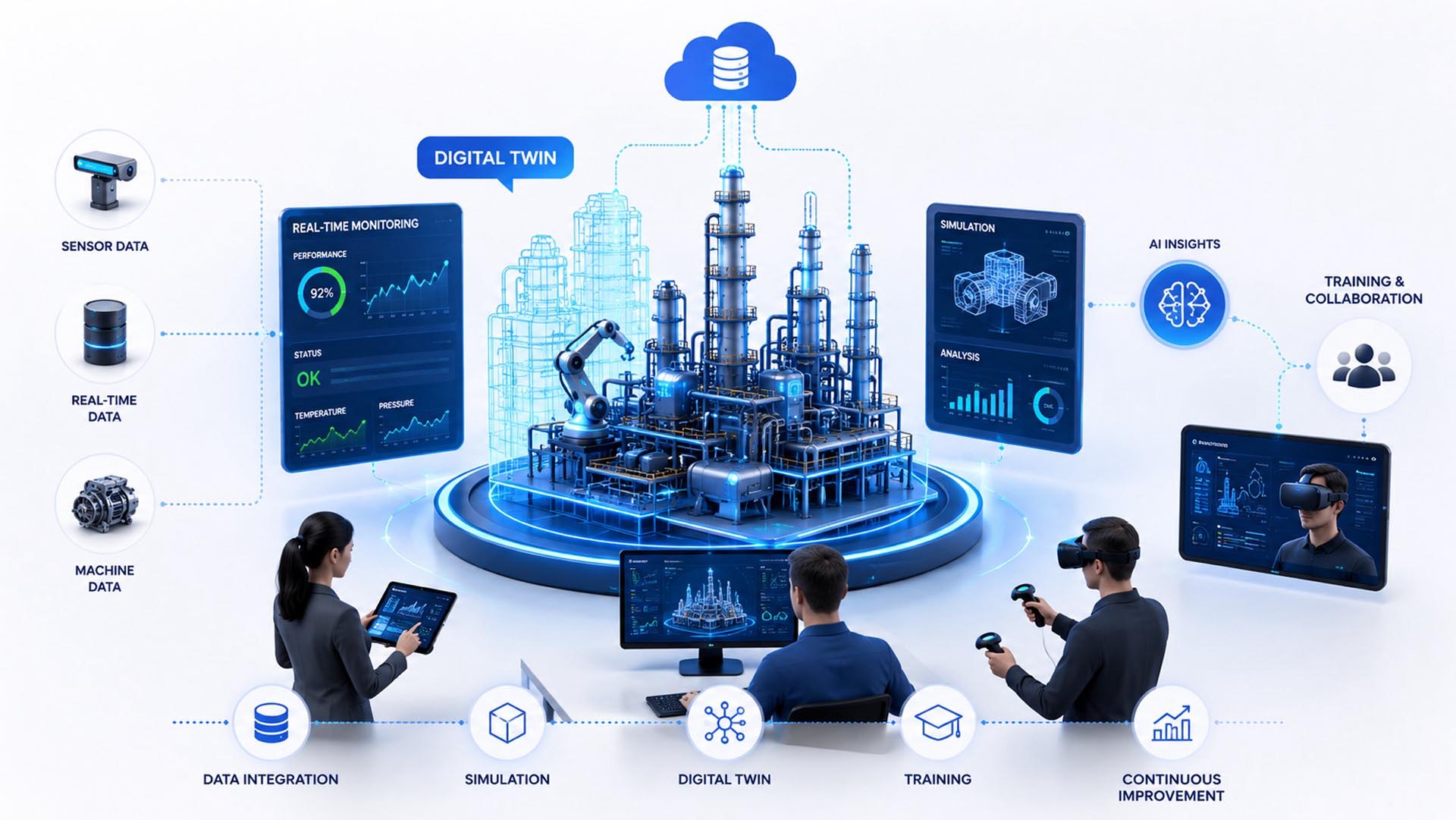
Digital twins and realtime data connect industrial processes with interactive training and simulation systems
Visualization: Immersive training environment with digital twins, realtime simulation and intelligent industrial processes based on connected platform technologies | © VISORIC GmbH | Munich
The image illustrates how digital twins are increasingly becoming part of modern industrial learning and simulation environments. Real processes, sensor data and technical systems can be transferred into interactive virtual spaces and analyzed together.
The ability to not only visually represent complex industrial workflows, but to dynamically connect them with data, simulation and user interaction, is becoming particularly relevant. Training platforms are therefore increasingly developing into intelligent experience spaces that can communicate real industrial relationships in a much more practical way.
At the same time, modern learning platforms increasingly need to connect central data structures, backend systems and different end devices. This is giving rise to complex technological infrastructures that go far beyond traditional training systems.
From the first idea to global rollout
The development of modern industrial learning platforms does not end with visualization, realtime 3D or interactive training spaces. The real value only emerges when individual applications become systems that can be used over the long term, scaled, managed and deployed internationally. [25]
In practice, it becomes clear that the greatest challenge is not the technology itself, but its integration into existing corporate structures, processes and platform landscapes. Today, training systems must be able to flexibly connect content, users, data structures and different devices.
At the same time, immersive learning platforms are increasingly developing into complex infrastructures that go far beyond traditional training systems. Realtime 3D, artificial intelligence, backend systems, data management, user administration and international deployment processes must be considered as one coherent overall system. [26]
The following factors are crucial for the long term scalability of modern training platforms:
- Platform architecture → central management of content, users and training processes
- Multi device infrastructure → flexible use across desktop, mobile, displays and XR systems
- Rollout and scaling → international deployment and long term development
These requirements are currently fundamentally changing the role of immersive learning systems. Training platforms are increasingly no longer viewed as individual applications, but as long term digital infrastructures for industrial knowledge transfer. [27]
The combination of content pipelines, backend systems, interactive learning spaces and intelligent data structures is becoming particularly relevant. Content must now be centrally maintained, analyzed and flexibly provided across different end devices and locations.
The expert team at VISORIC GmbH in Munich develops scalable platform solutions for this purpose together with industrial partners, based on the XR Stager Industrial Metaverse and Spatial Computing infrastructure. The goal is to transfer immersive learning spaces, realtime 3D content, digital twins and AI supported training systems into platform architectures that can be used over the long term.
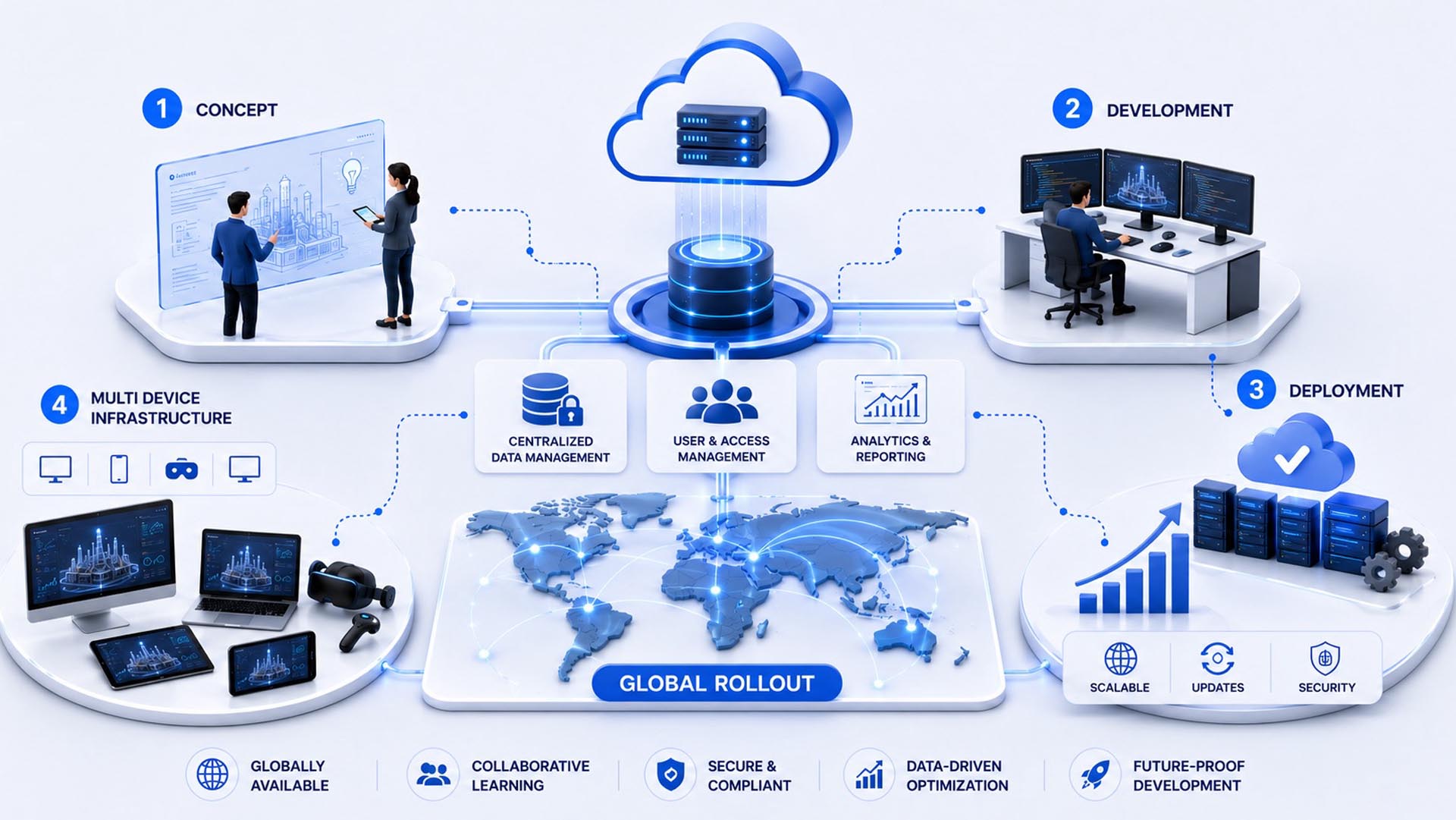
Scalable learning platforms connect realtime 3D, backend systems and global training processes into long term usable infrastructures
Visualization: Connected industrial learning platform with central data management, collaborative training spaces and scalable multi device infrastructure | © VISORIC GmbH | Munich
The image illustrates how modern training platforms are increasingly developing into connected technological ecosystems. Different devices, data sources and learning environments are connected through central platform structures.
The ability to provide content flexibly across different locations, user groups and end devices is becoming particularly relevant. Training processes can therefore be scaled internationally and developed further over the long term.
At the same time, immersive learning platforms are increasingly becoming part of strategic corporate infrastructures. Realtime 3D, artificial intelligence, digital twins and interactive learning spaces are developing into central components of modern knowledge transfer.
This shifts the focus increasingly from individual technologies to long term platform strategies that can sustainably transform industrial training processes.
The next chapter therefore analyzes how immersive learning platforms will change industrial knowledge transfer over the long term and what role interactive learning systems could play in companies in the future.
How immersive learning platforms are changing industrial knowledge transfer over the long term
With the increasing digitalization of industrial processes, not only the technological infrastructure of companies is changing, but also the way knowledge is transferred, trained and made available over the long term. Immersive learning platforms are increasingly developing into strategic tools for knowledge retention, international training processes and digital competence development. [29]
Especially in industrial environments, new requirements for modern learning systems are emerging. Technical processes are becoming more complex, product cycles shorter and international teams more connected. At the same time, the need for training environments is growing that can provide content flexibly, interactively and with long term scalability.
As a result, the role of digital learning platforms is fundamentally shifting. Realtime 3D, artificial intelligence, digital twins and collaborative learning spaces are increasingly developing from complementary technologies into central components of modern knowledge transfer. [30]
The following developments illustrate why immersive learning systems are gaining strategic importance over the long term:
- Interactive knowledge transfer → technical content becomes spatially and practically experienceable
- Scalability → training processes can be provided internationally and across different devices
- Adaptive systems → artificial intelligence enables dynamic and personalized learning processes
This development becomes particularly interesting through the increasing connection of different technologies. Virtual learning spaces are increasingly developing into intelligent platforms that combine realtime 3D, AI systems, data structures, sensors and collaborative processes. [31]
This creates new industrial experience spaces in which learning, simulation, analysis and interaction increasingly merge. Knowledge transfer is no longer understood as a static process, but as a dynamic and continuously adaptable infrastructure within modern companies.
The expert team at VISORIC GmbH in Munich develops immersive platform solutions for this purpose together with industrial partners, based on the XR Stager Industrial Metaverse and Spatial Computing infrastructure. The goal is to make interactive learning spaces, intelligent training systems and scalable platform architectures usable for different industrial fields of application.
Immersive learning platforms combine industrial knowledge transfer with realtime 3D, artificial intelligence and collaborative training processes
Visualization: Intelligent industrial learning environment with interactive training spaces, AI supported knowledge systems and scalable spatial computing infrastructure | © VISORIC GmbH | Munich
The image illustrates how industrial knowledge transfer is increasingly developing into a connected digital infrastructure. Realtime 3D, artificial intelligence, digital twins and collaborative learning spaces merge into intelligent training environments that operate much closer to real industrial processes than traditional training systems.
The ability to not only provide knowledge, but to make it actively experienceable, analyzable and scalable over the long term, is becoming particularly relevant. Learning platforms are therefore increasingly developing into strategic tools for knowledge retention, international training processes and digital competence development.
At the same time, companies today need not only individual technologies, but platform structures that can be used over the long term and flexibly connect different systems, data sources and learning processes.
This is giving rise to a new generation of industrial learning and training platforms that increasingly extend traditional training systems and form the foundation for future forms of digital knowledge transfer.
The following section brings together and contextualizes the key developments of the article. At the same time, it analyzes what role scalable platform architectures, immersive learning spaces and intelligent training systems could play for industrial companies in the future.
How immersive learning platforms are changing industrial training
The following video does not show a traditional training approach, but a real industrial platform approach for interactive knowledge transfer, developed jointly by the Siemens Power Academy and the expert team at VISORIC GmbH. The displayed learning platform “LearnERGY” is based on VISORIC’s XR Stager Industrial Metaverse and Spatial Computing infrastructure and was presented at Hannover Messe 2026.
The focus is not merely on presenting technical content, but on active interaction with complex industrial systems. Users move through interactive energy infrastructures, analyze relationships and gradually develop a spatial understanding of technical processes.
The platform illustrates several developments that are currently becoming increasingly relevant for modern industrial training systems:
- Realtime 3D → technical systems become interactive and spatially experienceable
- Industrial gaming → learning processes are based on active interaction instead of passive knowledge intake
- Spatial computing → content can be flexibly used across desktop, mobile and XR platforms
- Digital twins → real processes become usable as intelligent virtual systems
- Central platform structures → content can be managed, analyzed and scaled over the long term
The decisive difference lies in the learning principle. While traditional training systems are often based on documentation, presentations or linear learning paths, understanding here emerges directly within the context of application. Learners explore components, recognize technical dependencies and build a mental model of the overall system.
LearnERGY combines interactive knowledge transfer, realtime 3D and industrial training processes within an immersive learning platform
Visualization: Interactive industrial learning environment of the Siemens Power Academy based on VISORIC’s XR Stager Industrial Metaverse and Spatial Computing infrastructure | Presented at Hannover Messe 2026 | © VISORIC GmbH | Munich
The ability to provide content flexibly across different devices and learning environments is becoming particularly relevant. The platform can be used via traditional desktop workstations, mobile devices, large format displays or spatial computing headsets, thereby enabling flexible industrial training processes for different usage scenarios.
At the same time, the project shows how industrial learning platforms are increasingly evolving from individual XR applications into infrastructure and training systems that can be used over the long term. Realtime 3D, artificial intelligence, digital twins, backend systems and collaborative learning spaces merge into intelligent platform structures for modern knowledge transfer.
The expert team at VISORIC GmbH develops such platform solutions together with industrial partners of different sizes, from specialized mid sized companies to international industrial and technology corporations. The goal is to make technical content, processes and knowledge usable, scalable and interactively experienceable over the long term.
From immersive learning spaces to scalable industrial training platforms
Industrial knowledge transfer is currently undergoing fundamental change. Realtime 3D, artificial intelligence, digital twins, industrial gaming and spatial computing are increasingly becoming central components of modern training and learning systems.
However, the decisive factor is not the individual technology, but its intelligent connection within real industrial processes. Many companies already have CAD data, digital content, documentation or technical platforms. In practice, however, these systems often remain separated from one another and therefore unfold only a small part of their actual potential.
This is exactly where new opportunities are currently emerging. Interactive learning spaces, intelligent training platforms and immersive knowledge systems make it possible to provide complex industrial content in a much more understandable, practical and scalable way over the long term.
This becomes particularly relevant for companies that want to train international teams, explain complex machines, secure knowledge over the long term or develop new forms of digital customer and employee training.
Immersive learning platforms combine realtime 3D, artificial intelligence and industrial knowledge transfer into scalable training systems
Visualization: Scalable industrial learning platform with interactive 3D spaces, digital twins, AI supported training systems and collaborative spatial computing infrastructure | © VISORIC GmbH | Munich
Our collaboration is clearly structured and focused on platform solutions that can be used over the long term:
- Strategy and concept development → analysis of existing processes, data structures and possible learning scenarios
- Platform architecture → development of scalable infrastructure for realtime 3D, AI and immersive learning spaces
- Industrial gaming and UX → design of interactive training processes and intuitive user experiences
- Content and data pipelines → integration of CAD data, digital twins and intelligent knowledge systems
- Deployment and rollout → provision across desktop, mobile, displays and spatial computing platforms
- Long term development → scaling, optimization and integration of new technologies and AI processes
This does not create isolated XR applications, but platform structures that can be used over the long term for industrial knowledge transfer, international training processes and interactive learning environments.
This is particularly interesting for companies that are currently evaluating how artificial intelligence, immersive learning spaces, digital twins and realtime 3D can be meaningfully integrated into existing training, service or knowledge processes.
A structured conversation often already provides initial insights into which potentials, platform approaches and technological strategies could be meaningful for different industrial fields of application.
Sources and references
The following sources form the scientific and strategic foundation of the article. They are directly aligned with the individual chapters and thematic focus areas of the analysis.
- World Economic Forum, „Future of Jobs Report 2025“, analysis of workforce transformation, upskilling and future competence requirements in industrial companies. [1]
- McKinsey & Company, „Building the Workforce of the Future“, strategies for digital upskilling, industrial learning systems and organizational transformation. [2]
- Deloitte, „Future of Work and AI“, analysis of artificial intelligence, new learning structures and digital work environments. [3]
- PwC, „Workforce Transformation in the AI Era“, study on the transformation of industrial work and learning processes through AI technologies. [4]
- PwC, „The Effectiveness of Virtual Reality Soft Skills Training“, study on the effectiveness of immersive learning environments and virtual training systems. [5]
- Fraunhofer Institute, „Immersive Learning Systems“, research on XR based learning environments and interactive training systems for companies. [6]
- JMIR Serious Games, „Immersive Virtual Reality Training“, scientific study on learning effects and user interaction in virtual training environments. [7]
- Learntec, „Corporate Learning Trends Report 2025“, analysis of current developments in e learning, gamification and corporate training. [8]
- IEEE Access, „Serious Games in Engineering Education“, research on serious gaming and game based learning systems for technical training. [9]
- ResearchGate, „Gamification in Industrial Training Systems“, study on the use of playful mechanics in industrial training processes. [10]
- ScienceDirect, „Learning Effectiveness in Serious Games“, analysis of knowledge transfer and learning motivation in interactive learning systems. [11]
- Harvard Business Review, „Why Gamification Works in Learning Environments“, analysis of motivation, interaction and learning success through gamification. [12]
- Siemens, „Industrial Metaverse Research“, research on industrial metaverse concepts, virtual learning spaces and digital industry platforms. [13]
- Unity Technologies, „Realtime 3D Industry Report“, developments in realtime 3D, simulation and immersive platforms for companies. [14]
- ARENA2036, „Industrial XR and Learning Spaces“, research on collaborative XR learning environments and industrial training systems. [15]
- MIT Technology Review, „Future Learning Spaces“, analysis of future digital learning spaces and immersive knowledge transfer. [16]
- OECD, „Generative AI in Education“, study on the use of generative artificial intelligence in modern learning systems. [17]
- MDPI, „AI Supported Gamification in Learning“, research on the connection between AI technologies and game based learning mechanics. [18]
- Josh Bersin Company, „AI Powered Corporate Learning“, analysis of intelligent learning platforms and AI supported training systems. [19]
- Nature, „AI and Adaptive Learning Systems“, scientific study on adaptive learning systems and personalized knowledge transfer. [20]
- Siemens Xcelerator, „Digital Twin Infrastructure“, analysis of industrial digital twin structures and data based training systems. [21]
- NVIDIA Omniverse, „Industrial Digital Twins“, technologies for realtime simulation, virtual factories and interactive training environments. [22]
- ISO, ISO 23247 Digital Twin Framework, international standard for digital twin systems and industrial data structures. [23]
- McKinsey & Company, „Simulation and Operational Intelligence“, analysis of data driven simulation and intelligent industrial processes. [24]
- Deloitte, „Scaling XR Platforms“, strategies for scaling, integration and rollout of immersive platforms in companies. [25]
- PwC, „Enterprise XR Deployment“, study on integration and international deployment of XR learning systems. [26]
- Accenture, „Enterprise Learning Platforms“, analysis of modern learning platforms and globally scalable training structures. [27]
- Visoric Research, „Industrial Learning Pipelines and Rollout Architectures“, analysis of scalable learning pipelines, interactive training spaces and industrial training platforms. [28]
- World Economic Forum, „Future Skills and Workforce Readiness“, study on future competence models and industrial continuing education. [29]
- Siemens, „Human Centered Industrial Intelligence“, perspectives on human centered industrial learning and assistance systems. [30]
- Fraunhofer Institute, „Future Industrial Learning Systems“, research on future training methods and immersive learning platforms. [31]
- Visoric Research, „Interactive Industrial Learning Environments“, study on interactive learning spaces, industrial gaming and virtual training environments. [32]
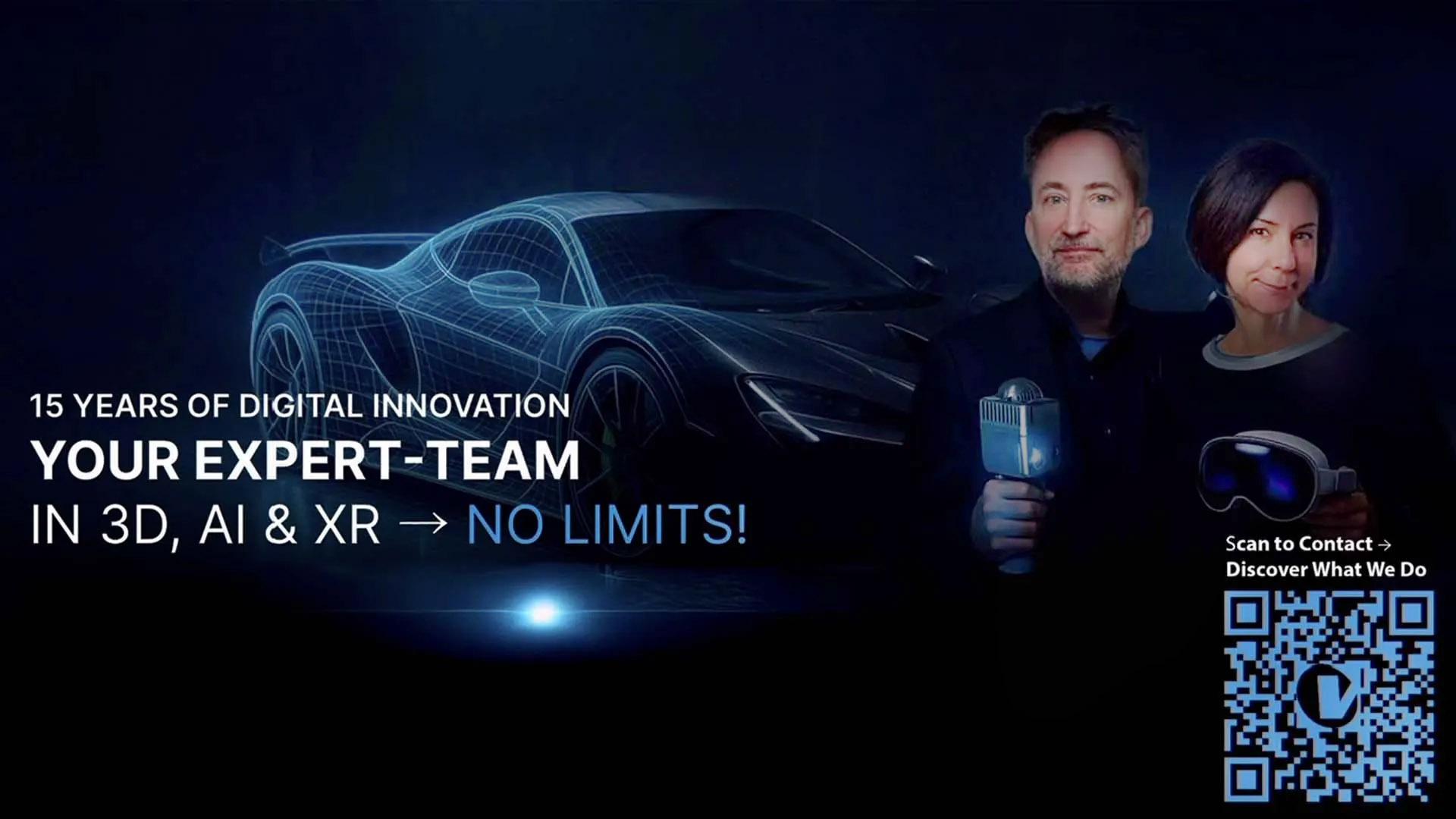
Contact Persons:
Ulrich Buckenlei (Creative Director)
Mobile: +49 152 53532871
Email: ulrich.buckenlei@visoric.com
Nataliya Daniltseva (Project Manager)
Mobile: +49 176 72805705
Email: nataliya.daniltseva@visoric.com
Address:
VISORIC GmbH
Bayerstraße 13
D-80335 Munich