

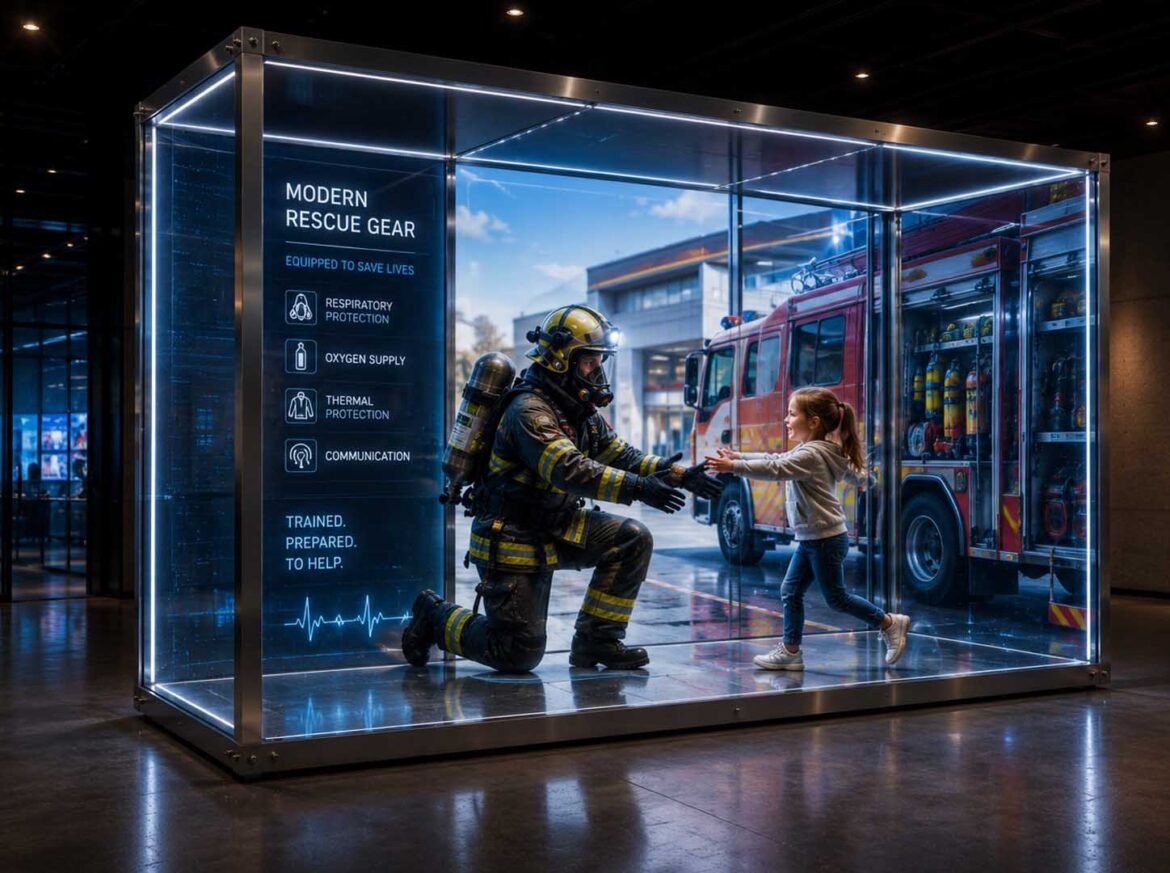
Four synchronized LED panels make a firefighter with state-of-the-art rescue equipment appear to float freely in space. The astonishing 3D effect is created through precisely calculated off-axis rendering.
Visualization: A large-format rectangular display installation made of four synchronized LED panels shows a firefighter with modern rescue equipment as well as breathing apparatus and oxygen technology. Four precisely calculated perspectives create the impression that the scene exists three-dimensionally inside the installation. | Image: © Ulrich Buckenlei | XR Stager Online Magazine | VISORIC GmbH
A firefighter, modern breathing apparatus technology, and lifesaving equipment appear to float freely inside a transparent display installation, with no VR headset or special hardware required. Such spatial visualizations open up new possibilities for presenting complex products, safety-critical technologies, and real-world deployment scenarios in an impressive way that anyone can understand.
The three-dimensional impression, however, is not created through holography but through a precisely calculated representation. Each LED panel shows its own perspective of the same virtual scene. The underlying technique is called off-axis rendering: virtual cameras are calibrated exactly to the position, size, and orientation of each individual display, so that a spatially consistent representation emerges from multiple views.[1]
The method originally comes from CAVE systems used in virtual reality, in which several projection surfaces form a walkable virtual space.[2] Today the same principle can be implemented with high-resolution LED panels in compact installations. This creates immersive presentation systems that make spatial content experienceable for a broad audience at trade fairs, in showrooms, museums, or training centers, without a headset.
For spatial computing, this is more than a visual effect. It shows, in an exemplary way, how spatial illusion, digital twins, and physical room installations grow together, and how closely fascination and technical limits sit next to each other in these systems, a point that keeps coming up in public discussion of such installations.
- Four synchronized LED panels create the illusion of a 3D object floating freely in space.
- The technique is based on off-axis rendering, calibrated to the exact physical geometry of the installation.
- The underlying principle comes from CAVE environments in virtual reality and has been simplified for everyday use.
- No tracking, no headset: the illusion works for several viewers within a defined zone at the same time.
- The technology connects physical room installations, digital twins, and spatial computing.
This article explains how perspective-correct rendering works for multi-sided LED installations, where the technique reaches its physical limits, and why exactly these limits make the difference between an impressive marketing gimmick and a robust spatial computing application. It classifies current examples and shows for which industries the effort is actually worthwhile.
From the Flat Screen to the Spatial Showcase
Screens have been showing flat images on flat surfaces for decades. Even high-resolution displays don’t fundamentally change this: a viewer sees a rectangle, regardless of the angle from which they look at it. For many applications this is sufficient, but for product presentations, artworks, or digital twins that are meant to feel spatial, it is a noticeable limitation.
Historically, this problem was solved with optical tricks. The so-called Pepper’s Ghost effect, named after a 19th-century stage technique, uses angled panes of glass to make a reflected image appear to float freely in space. The principle works, but it is tied to fixed viewing angles and elaborate physical setups.
Modern installations, like the display box shown in the current video, take a different approach. Instead of optically redirecting light, the illusion is generated entirely in rendering. Four LED panels form a closed structure, and each panel shows an individually calculated view of a shared three-dimensional scene. The combination of the four perspectives creates, in the viewer’s mind, the impression of a single, coherent object inside the structure.
This shifts the real innovation from optics to software. It is not the hardware that creates the illusion, but the precise calculation of which image must appear on which panel so that the viewer’s brain assembles the four individual images into a single, spatially consistent object.
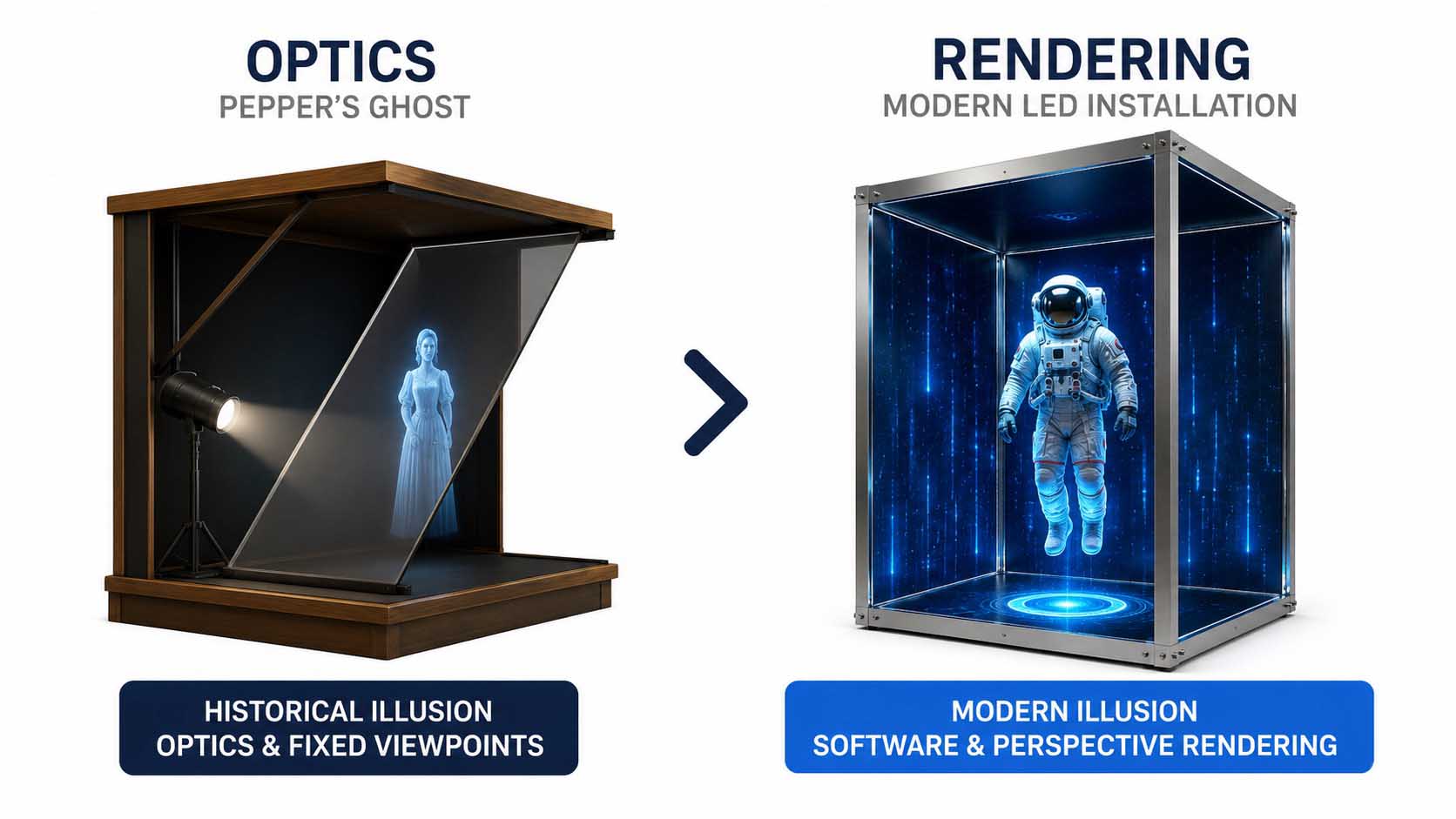
Historical illusion techniques such as the Pepper’s Ghost effect relied on optics and fixed viewing angles. Modern LED installations create the same spatial illusion entirely through software and perspective-correct rendering.
Infographic: From optical stage tricks to software-based Virtual 3D Showcases | Graphic: © Ulrich Buckenlei | XR Stager Online Magazine | VISORIC GmbH
The difference is more than a technical gimmick. Software-based illusions can be updated, swapped out, and connected to real-time data, something that is not possible with rigid glass and fixed light. A product, an artwork, or a digital twin can be re-staged as often as desired within the same physical installation, without any change to the setup itself.
This turns the display box itself into a kind of stage whose content remains interchangeable at any time. How this stage works in detail, and what calculation is needed for four flat panels to produce a coherent spatial image, is shown in the next chapter.
- Classic illusion techniques such as Pepper’s Ghost are based on optics and fixed viewing angles.
- Modern LED installations create the same illusion entirely in rendering, not in optics.
- Four panels show four individual perspectives of the same virtual scene.
- The illusion arises in the viewer’s mind through the combination of the four individual images.
- Software-based content can be updated, swapped, and connected to real-time data.
Why Perspective-Correct Rendering Becomes the Decisive Factor
For four flat panels to appear as a single three-dimensional object, it is not enough to render the same scene from four arbitrary viewpoints. Each virtual camera must be positioned and oriented exactly as dictated by the physical geometry of the installation, including the size, distance, and tilt of each individual panel.
This is exactly where off-axis rendering comes in. With a classic camera, the projection center lies symmetrically to the center of the image. With off-axis projection, the camera is deliberately positioned asymmetrically, creating an irregular view frustum that corresponds exactly to the physical arrangement of viewer and display surface.[3] This technique was originally developed for CAVE systems, in which a tracked user looks through several projection walls into a virtual scene.[4]
For an LED panel installation, this means: each of the four panels receives its own virtual camera, whose view frustum is defined exactly by the four corners of the respective physical panel. The image plane of the virtual camera remains parallel to the physical display surface, regardless of where in space this camera is located. Only this way does each individual panel produce an image that appears perspective-correct from the intended viewing position.[5]
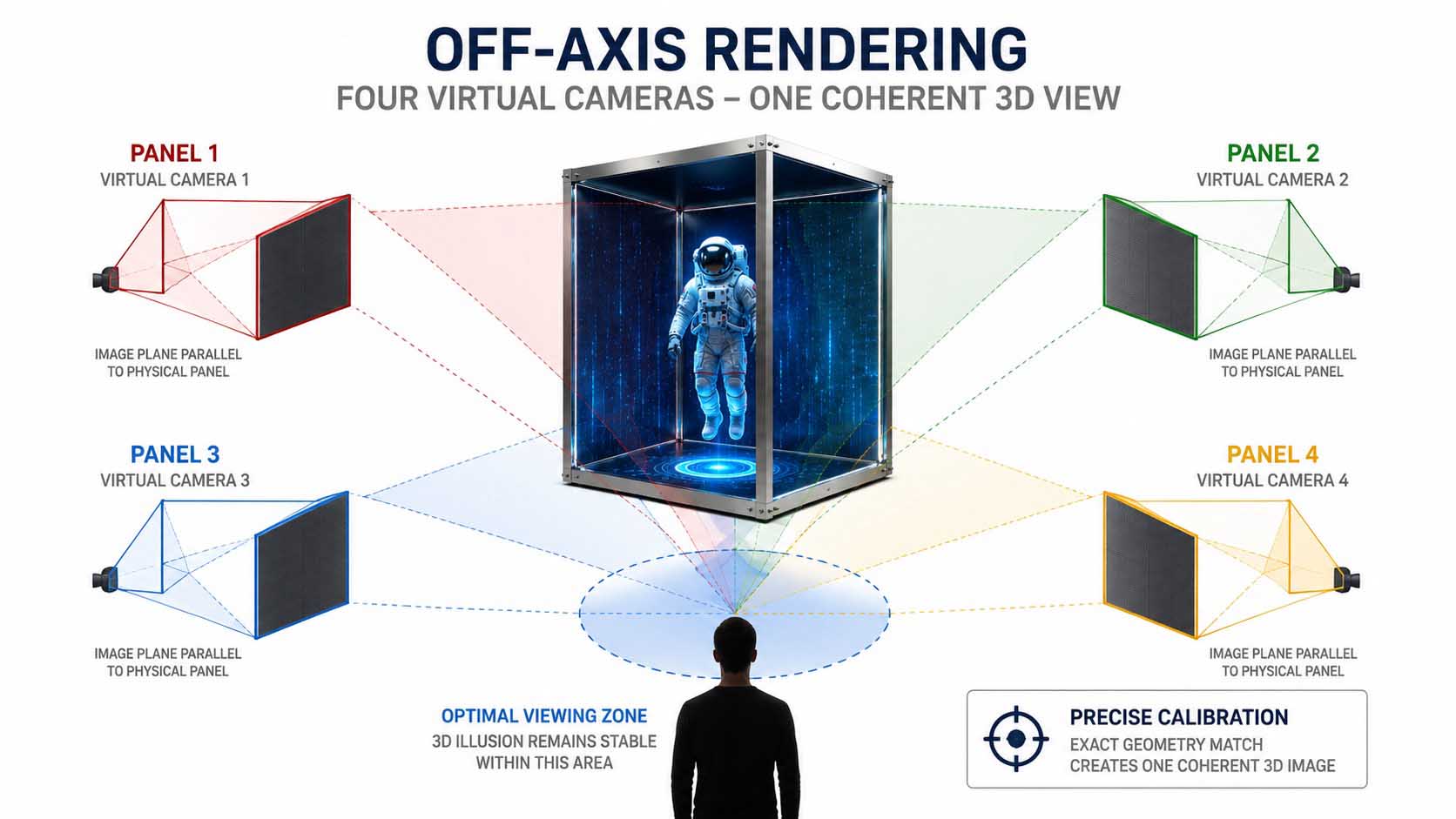
Off-axis rendering positions a separate virtual camera with an asymmetric view frustum for each panel, calibrated exactly to the physical geometry of the installation. Only this precision allows four individual images to merge into a coherent 3D impression.
Infographic: Operating principle of off-axis rendering for multi-sided LED installations | Graphic: © Ulrich Buckenlei | XR Stager Online Magazine | VISORIC GmbH
It is crucial that the calculation is optimized for a defined viewing area, not for a single point. The four view frustums are calibrated so that the illusion remains stable within a defined zone around the installation. Outside this zone, the image becomes increasingly distorted, an effect that follows inevitably from the geometry and cannot be fixed by better displays alone.
This precision is the real difference between a convincing installation and a distorted advertising screen. If the calibration between the virtual camera and the physical panel geometry is even slightly inaccurate, the spatial illusion collapses immediately, and the seemingly floating object turns back into an ordinary, flat video image.
- Off-axis rendering positions virtual cameras asymmetrically instead of symmetrically to the center of the image.
- Each panel receives its own virtual camera, calibrated to its exact physical geometry.
- The image plane of the virtual camera remains parallel to the physical display surface.
- The illusion is optimized for a defined viewing zone, not for an arbitrary location.
- Even small calibration errors cause the spatial illusion to collapse completely.
Perspective-correct rendering provides the technical foundation. What this effort is actually worth becomes clear once a pure display illusion turns into a stage for real content, for products, artworks, and above all for digital twins. That is exactly what the next chapter is about.
Digital Twins Get a Tangible Stage
A digital twin usually exists on a screen, in an app, or in a browser window. As useful as this representation is for analysis and remote access, it remains flat and rarely feels as impressive as the real object it represents. A perspective-correctly rendered LED installation changes exactly this point: it gives the digital twin a physical stage in real space for the first time.
A machine component, a vehicle concept, or a building model can not only be shown within such an installation but staged spatially. Unlike on a screen, the object does not appear behind a pane of glass but seemingly floats freely inside the structure, visible from multiple angles at once, for multiple viewers in parallel.
This opens up new possibilities for sales and product communication. A product that does not yet physically exist, because it is still in development, can already be fully animated and presented spatially. A digital twin of an industrial plant can be shown to customers or investors not as a diagram but as an impressive spatial object, complete with animation, movement, and changing scenarios.
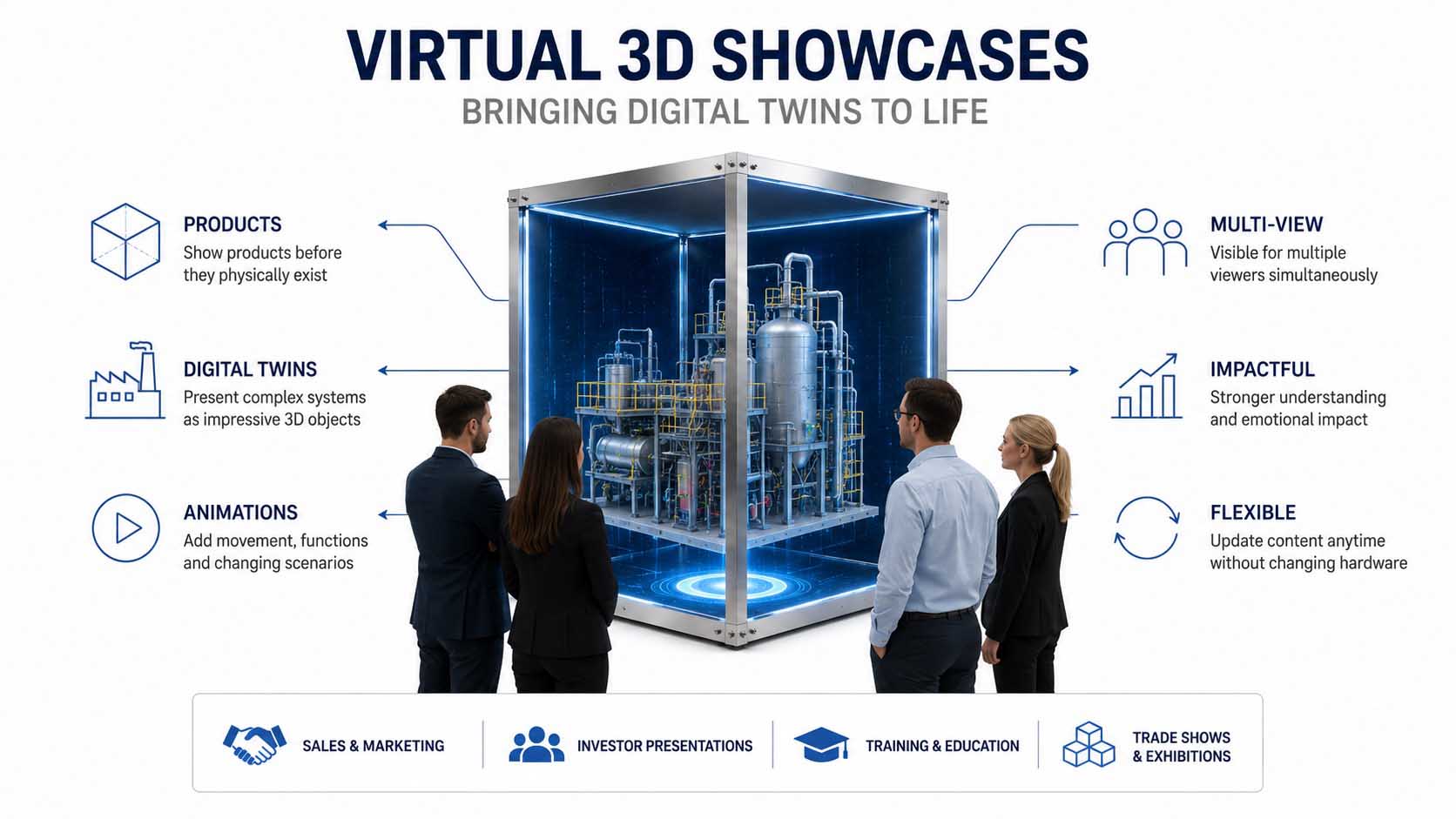
A perspective-correctly rendered LED installation makes digital twins spatially experienceable. Instead of on a screen, the object appears to float freely in space, visible to several viewers from different angles at the same time.
Infographic: Virtual 3D Showcases as a physical stage for digital twins in sales and product communication | Graphic: © Ulrich Buckenlei | XR Stager Online Magazine | VISORIC GmbH
This principle has also already established itself as an independent form of expression in the art and culture sector. The best-known example is HUMAN ONE by artist Beeple: a rotating sculpture over two meters tall, made of four LED panels, showing a digital “traveler” who walks endlessly through a constantly changing virtual landscape. The work has been shown at, among other places, M+ Museum Hong Kong and Castello di Rivoli in Turin, and is continuously updated by the artist with new content.[6]
This exact principle, physical structure plus continuously interchangeable digital content, is also what makes the technology interesting for companies. An installation, once built, does not need to be physically altered for every new campaign, every new product, or every new season. It is enough to swap out the rendered content while the hardware and calibration remain unchanged.
- LED installations give digital twins a physical, spatially convincing stage for the first time.
- Products can be presented spatially even before they physically exist.
- Multiple viewers can experience the same installation simultaneously from different angles.
- HUMAN ONE by Beeple shows how the same principle has established itself as an independent artistic form.
- Content can be swapped out without altering the physical installation itself.
As convincing as the illusion may be, it is not a true volumetric display and is subject to clear physical limits. These very limits have already been critically questioned in public discussion of such installations, and they deserve an answer that is as honest as it is technically sound. That is what the next chapter is about.
Why the Illusion Reaches Clear Limits
Whenever such an installation is shown publicly, almost the same critical questions follow: Does the illusion really work from every angle? What happens under bright ambient light? And is an ordinary video enough, or does the content need special preparation? These questions are justified, and the honest answers are technical, not disappointing.
The most convincing illusion arises within a clearly defined viewing zone, not from arbitrary angles. Off-axis rendering is calibrated for a specific area around the installation. Within this zone, the spatial impression remains stable; outside it, the image becomes increasingly distorted, because the perspective of the virtual camera no longer matches the viewer’s actual viewing angle. This is not a malfunction but a direct consequence of the underlying geometry.
Two technical approaches solve this problem in different ways. Classic CAVE systems track a single viewer’s head position and continuously recalculate the perspective, which creates a nearly perfect illusion for exactly that one person but increasingly distorts for other viewers in the same room.[7] Public LED installations mostly deliberately forgo tracking and instead calibrate for a larger, though less perfect, zone in which several people can simultaneously experience a convincing, if not pixel-precise, illusion.
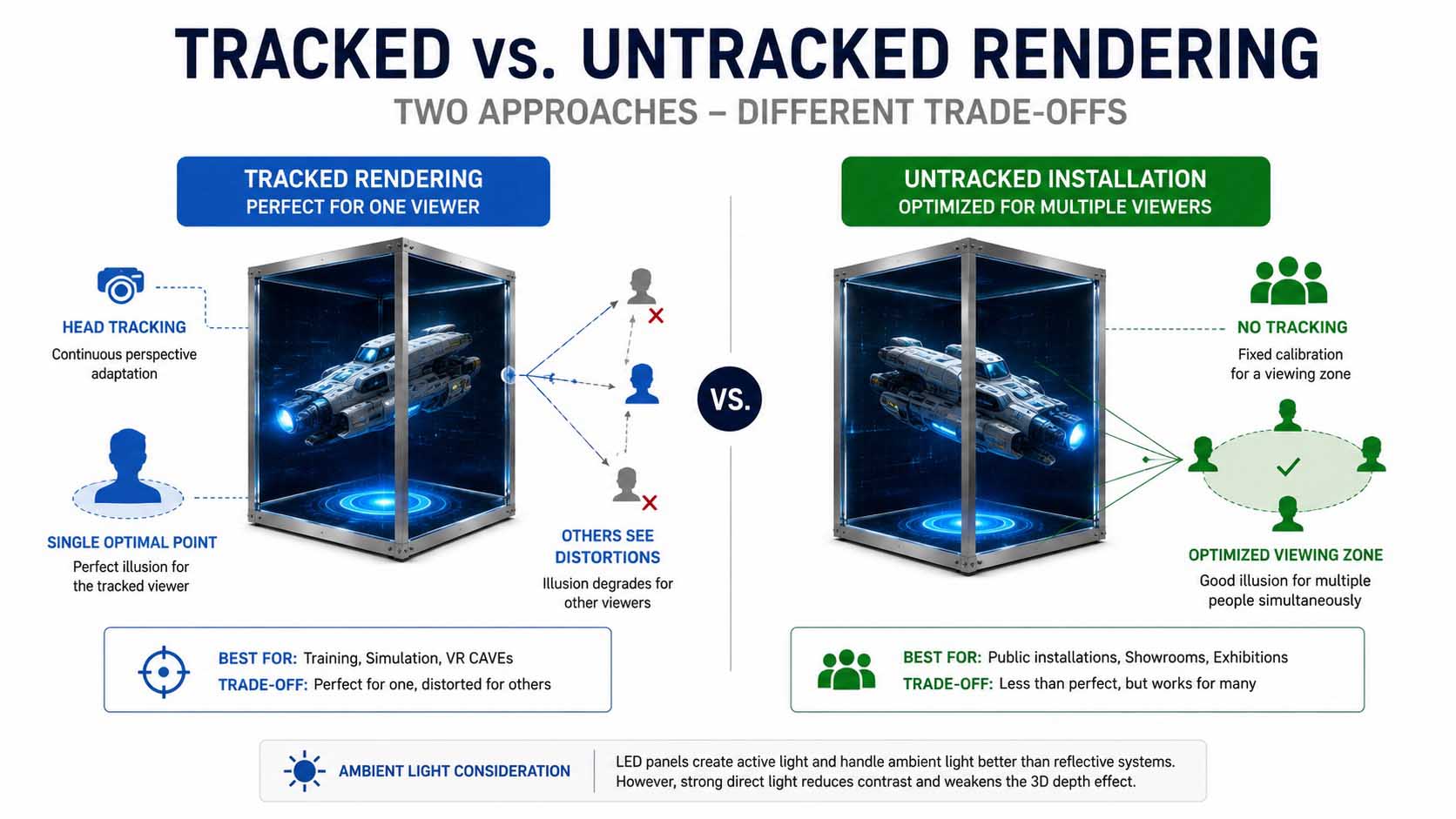
Tracked rendering creates a near-perfect illusion for a single person but distorts for other viewers in the same room. Untracked installations instead calibrate for a broader zone that works for multiple people at the same time.
Infographic: Trade-off between tracked single-viewer rendering and untracked multi-viewer zones | Graphic: © Ulrich Buckenlei | XR Stager Online Magazine | VISORIC GmbH
The same applies to ambient light: LED panels emit active light and are generally more robust against stray light than reflective techniques such as Pepper’s Ghost, but strong, direct light reduces perceived contrast and thereby weakens the sense of spatial depth. For indoor spaces with controlled lighting this is usually unproblematic; for outdoor use or brightly lit retail floors it is a real planning criterion.
And finally: an ordinary, linearly recorded video is in fact not sufficient for these installations. For the illusion to work from changing angles, the content must be created from the outset as a three-dimensional scene and rendered for the exact geometry of the respective installation. Anyone who simply splits an existing 2D video across four panels will not get a spatial illusion, only four independent, disconnected images.
- The spatial illusion is calibrated for a defined viewing zone, not for arbitrary angles.
- Tracked rendering perfects the illusion for one person but distorts it for other viewers.
- Untracked installations deliberately calibrate more broadly to serve several viewers at once.
- Strong ambient light reduces contrast and depth perception, even with actively lit LED panels.
- Ordinary 2D videos are not sufficient; content must be built from the ground up as a 3D scene.
Anyone who knows these limits plans more realistically and avoids disappointments. This same knowledge also determines in which industries the effort of such an installation actually pays off. That is what the next chapter deals with.
A Technology for Museums, Retail, Trade Fairs, and Industry
Once the technical foundations and limits are clear, the real strength of the technology can be applied purposefully: wherever an object needs spatial presence without visitors having to put on a headset or install an app.
In museums and cultural institutions, the technique already serves as an independent artistic medium, as the HUMAN ONE example shows. Curators can stage digital works spatially that keep evolving without the physical installation itself needing to change.
In retail, the same technology makes it possible to present products that don’t need to be physically on site at all. A limited sales floor can thus show a significantly larger product variety, animated, in changing color variants, and with content that can be swapped seasonally, without new hardware.
At trade fairs and in showrooms, the technique solves a classic problem: large, heavy, or not-yet-existing products can be presented compactly and impressively. A machine-building company doesn’t need to deliver a multi-ton plant to demonstrate how it works impressively; a digital twin in an LED installation is enough.
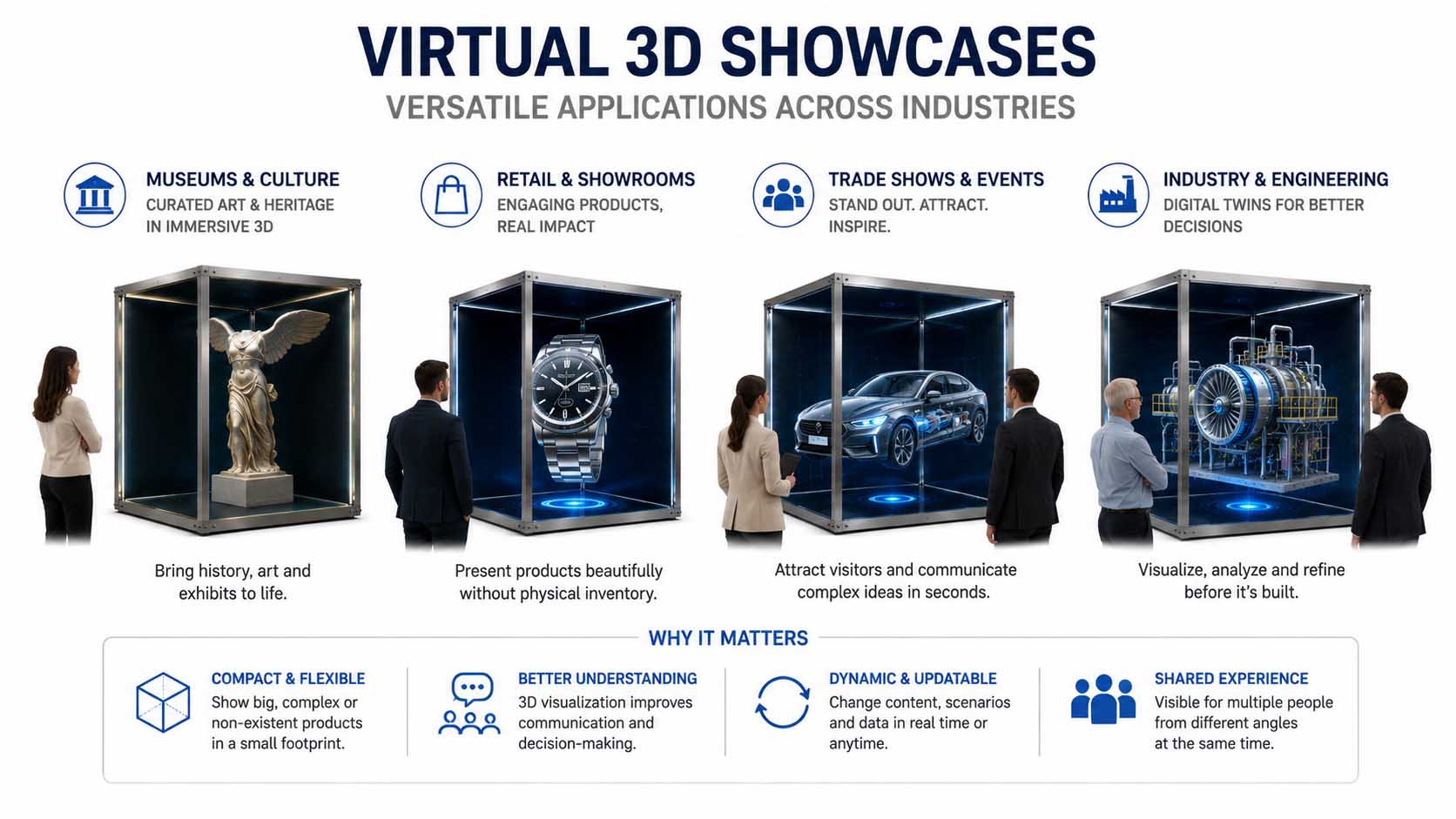
Virtual 3D Showcases can be used across industries: from curated museum art through retail and trade fair presentations to internal product discussions.
Infographic: Application fields of Virtual 3D Showcases in culture, retail, trade fairs, and industry | Graphic: © Ulrich Buckenlei | XR Stager Online Magazine | VISORIC GmbH
New applications are also emerging within companies themselves. Development teams can discuss product concepts spatially in meeting rooms instead of relying on renderings on screen. For engineering reviews, where spatial understanding determines details, this kind of representation can reduce misunderstandings that easily arise from flat representations.
What all these application fields have in common is that they benefit from the same basic condition: a clearly defined, usually limited viewing area. It is precisely where people gather around a central object that the technology has the greatest effect.
- Museums already use the technique as an independent artistic medium with changeable content.
- Retail can show more product variety than would physically fit on the floor.
- Trade fairs benefit from compact, impressive presentations of large or not-yet-existing products.
- Internal engineering reviews benefit from real spatial understanding instead of flat renderings.
- All applications benefit from a clearly defined viewing area that is usually shared by a group.
As different as these industries are, in almost every case people stand together around the same installation. How this affects the way viewers interact with such a staging, and how strongly AI-powered characters could change this interaction in the future, is shown in the next chapter.
When Viewers Become Part of the Staging
A Virtual 3D Showcase installation is rarely viewed by a single person alone. Unlike a headset, which isolates a single user, a physical LED installation brings several people together around the same object at the same time, in the same room, with the same shared perception. This is exactly where an underrated advantage lies compared to many other spatial computing technologies.
In professional contexts, this noticeably changes collaboration. When a team stands together in front of a spatially staged installation, a shared visual reference point emerges that everyone involved can refer to at the same time. Discussions about a component, a product detail, or a plant no longer need to be mediated across different screens or different viewing angles; everyone essentially sees the same object.
An obvious further development concerns interactivity itself. So far, most of these installations show pre-produced, repeating animations. Conversational, AI-powered avatars could fundamentally change this approach: instead of a linear loop, visitors could actually enter into dialogue with a digital figure inside the installation, ask questions, and receive individual answers.
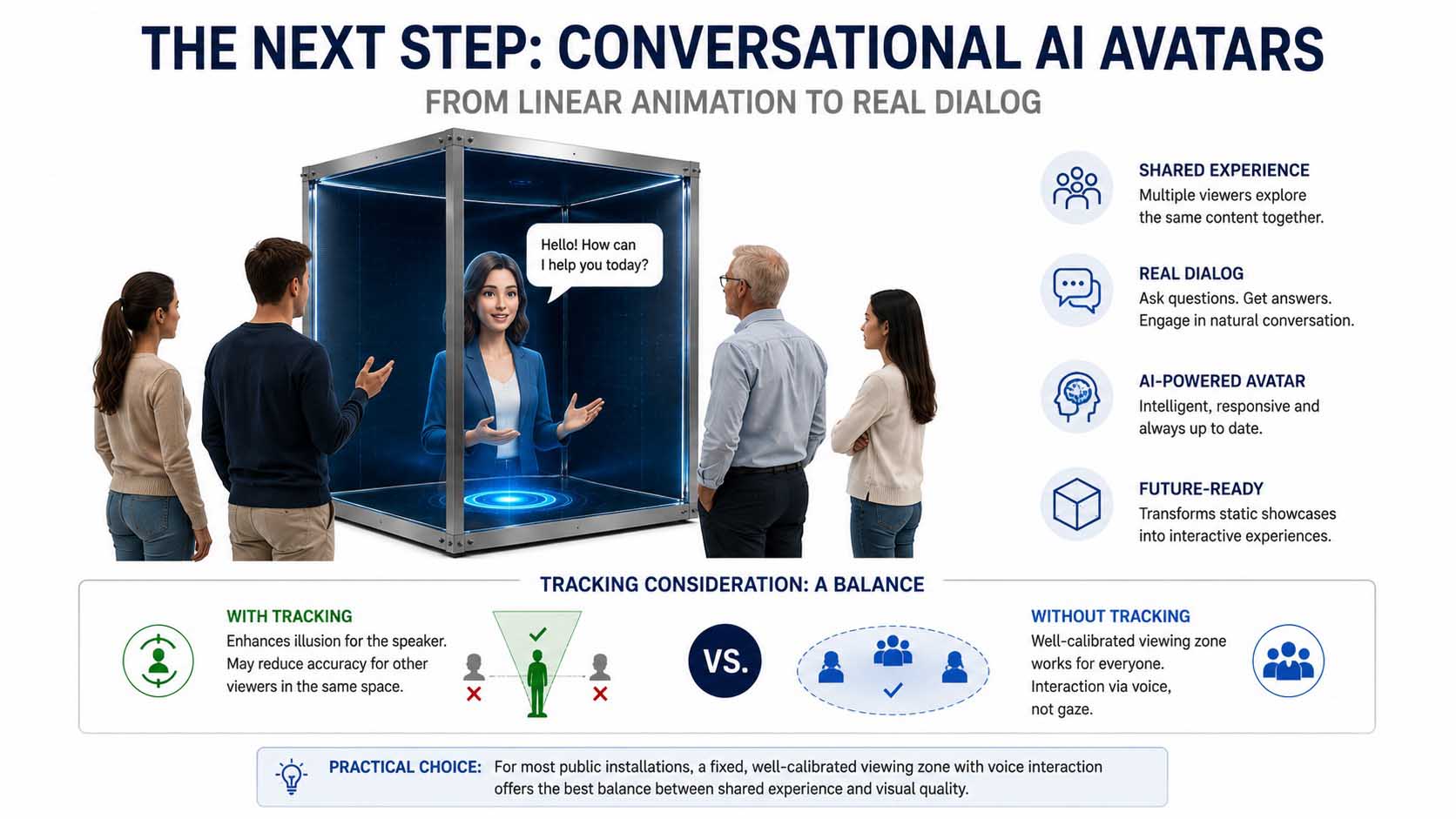
Physical showcase installations bring several viewers together around the same object at the same time. Conversational AI avatars could develop this shared experience from a linear animation into a real dialogue.
Infographic: Shared viewing and conversational AI avatars as the next stage of development for Virtual 3D Showcases | Graphic: © Ulrich Buckenlei | XR Stager Online Magazine | VISORIC GmbH
Whether such interaction requires additional tracking remains a deliberate trade-off. Head or gaze tracking could further improve the spatial illusion for a single speaker, but would tend to worsen the illusion for other viewers in the same room. For most public installations, a well-calibrated, fixed viewing zone therefore remains the more practical solution, supplemented by interaction via voice rather than gaze tracking.
In the long run, this shifts the role of such installations. A passively viewed display surface becomes an active, jointly experienced interaction space, in which people not only see an object but talk with it or about it, together with others in the same physical room.
- Physical installations bring several viewers together around the same visual reference point at once.
- Shared visual perception reduces misunderstandings in professional coordination processes.
- Conversational AI avatars could replace pre-produced loops with real dialogue.
- Individual head or gaze tracking improves the illusion for one person but worsens it for others.
- Voice-based interaction is usually more practical than visual tracking for shared installations.
Interaction and shared experience are one side of the story. For this technology to establish itself beyond individual flagship projects, it also needs a broader technological environment, open tools, comparable approaches, and growing standards. That is exactly what the next chapter is about.
From a Single Installation to an Open Ecosystem of Spatial Displays
Virtual 3D Showcase installations with four LED panels are just one approach within a much broader field of glasses-free spatial displays. Alongside them, other technologies have established themselves that build on the same basic principle, computer-based, perspective-correct rendering, but take different hardware paths.
Light-field displays such as those from Looking Glass Factory, for example, use specialized panels that output several dozen different perspectives simultaneously, allowing viewers to move sideways around the display without glasses, with a continuous parallax effect.[8] Unlike a closed four-panel box, this is a single, flat display with integrated depth optics.
This diversity of approaches is fundamentally positive: it shows that perspective-correct spatial rendering is not an isolated niche product but a technology family with growing commercial and cultural interest. Museums, brands, and technology providers are experimenting in parallel with different hardware solutions for the same basic problem: making spatial content experienceable without glasses.
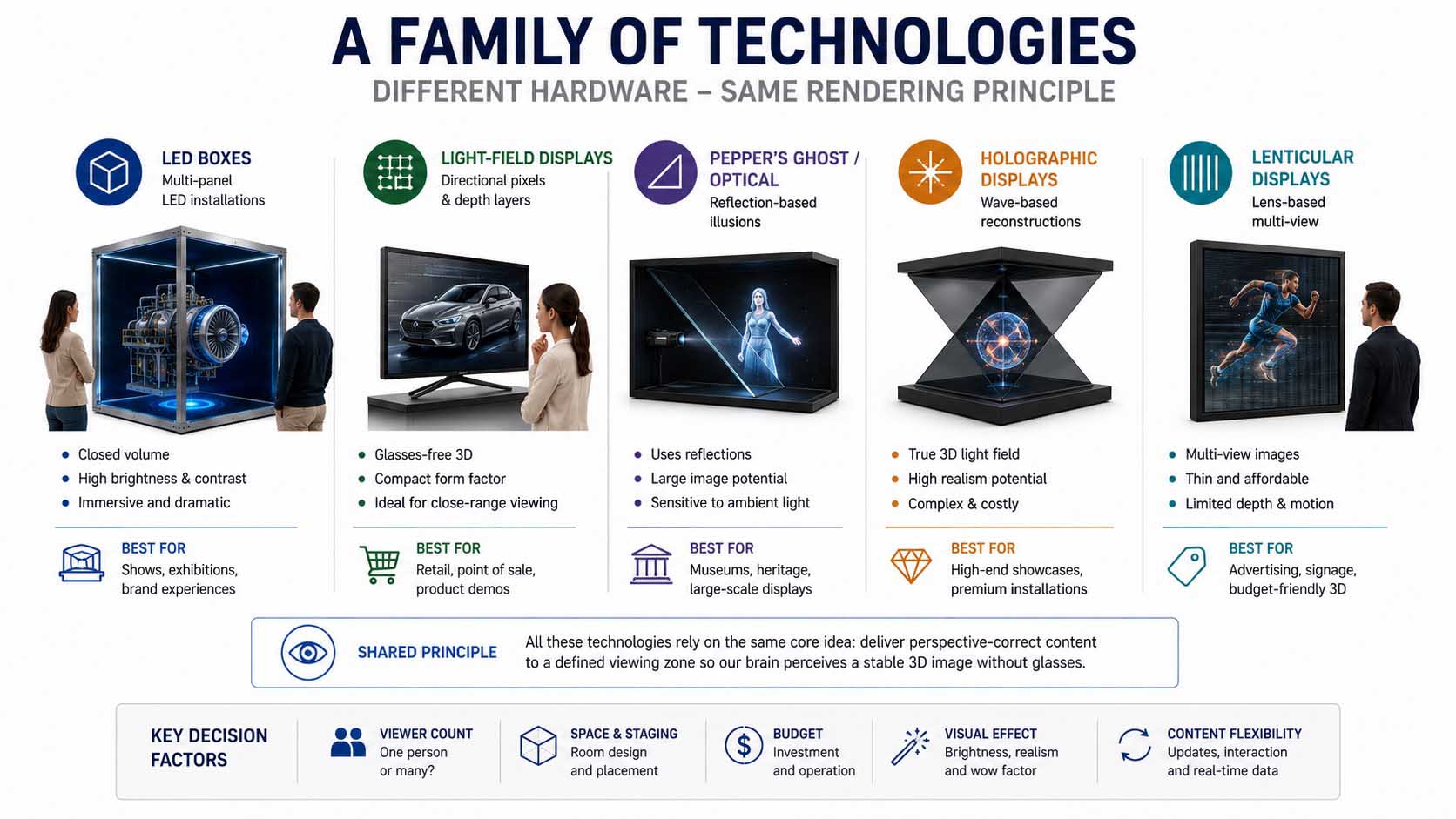
Different hardware approaches, from closed LED boxes to light-field displays to optical methods, share the same underlying principle: perspective-correctly calculated content for a defined viewing zone.
Infographic: Technology family of glasses-free spatial displays with a shared rendering principle | Graphic: © Ulrich Buckenlei | XR Stager Online Magazine | VISORIC GmbH
For companies investing in this technology, this diversity mainly means one thing: choosing the right hardware is a deliberate decision, depending on the number of viewers, the room staging, the budget, and the desired visual effect, not an off-the-shelf standard product. A closed LED box is suited to dramatic, room-filling stagings, while a light-field display is better suited to compact single-viewer applications, for example at the point of sale.
What all approaches have in common, however, is that they require the same core: precise rendering calibrated to the respective hardware and 3D content created specifically for the geometry of the installation. Anyone who has understood these basic principles once can apply them regardless of the specific hardware provider.
- Four-panel boxes are just one approach within a broader family of spatial display technologies.
- Light-field displays use specialized panels with several simultaneous perspectives.
- Different hardware approaches share the same basic principle: perspective-correct rendering.
- The choice of hardware depends on the number of viewers, room concept, and desired effect.
- Precise rendering and purpose-built 3D content remain decisive regardless of the hardware provider.
This growing technology family shows where the overall development is heading. How glasses-free spatial displays fit into the bigger picture of spatial computing, and why they play a special role there, is shown in the final chapter.
Spatial Displays as the Next Evolutionary Stage of Spatial Computing
Spatial computing is usually associated with headsets, smart glasses, and immersive environments, technologies that place a single user into a virtual or augmented reality. Virtual 3D Showcases show a different, complementary path: spatial content that becomes visible in physical space for multiple people at once, with no wearable equipment at all.
This difference is not a minor detail. Headset-based systems inevitably create individual, isolated experiences. Physical display installations, by contrast, create shared, publicly visible spatial moments, accessible to anyone who walks by, with no technical barrier to entry. For museums, retail, and public spaces, this accessibility is often more decisive than the technically more perfect but isolated immersion of a headset.
At the same time, the technology fits seamlessly into the broader development of spatial computing. The same digital twins that are shown in browsers, on tablets, or in headsets can also be shown on an LED installation using the same underlying 3D model; only the rendering method changes, not the content itself.
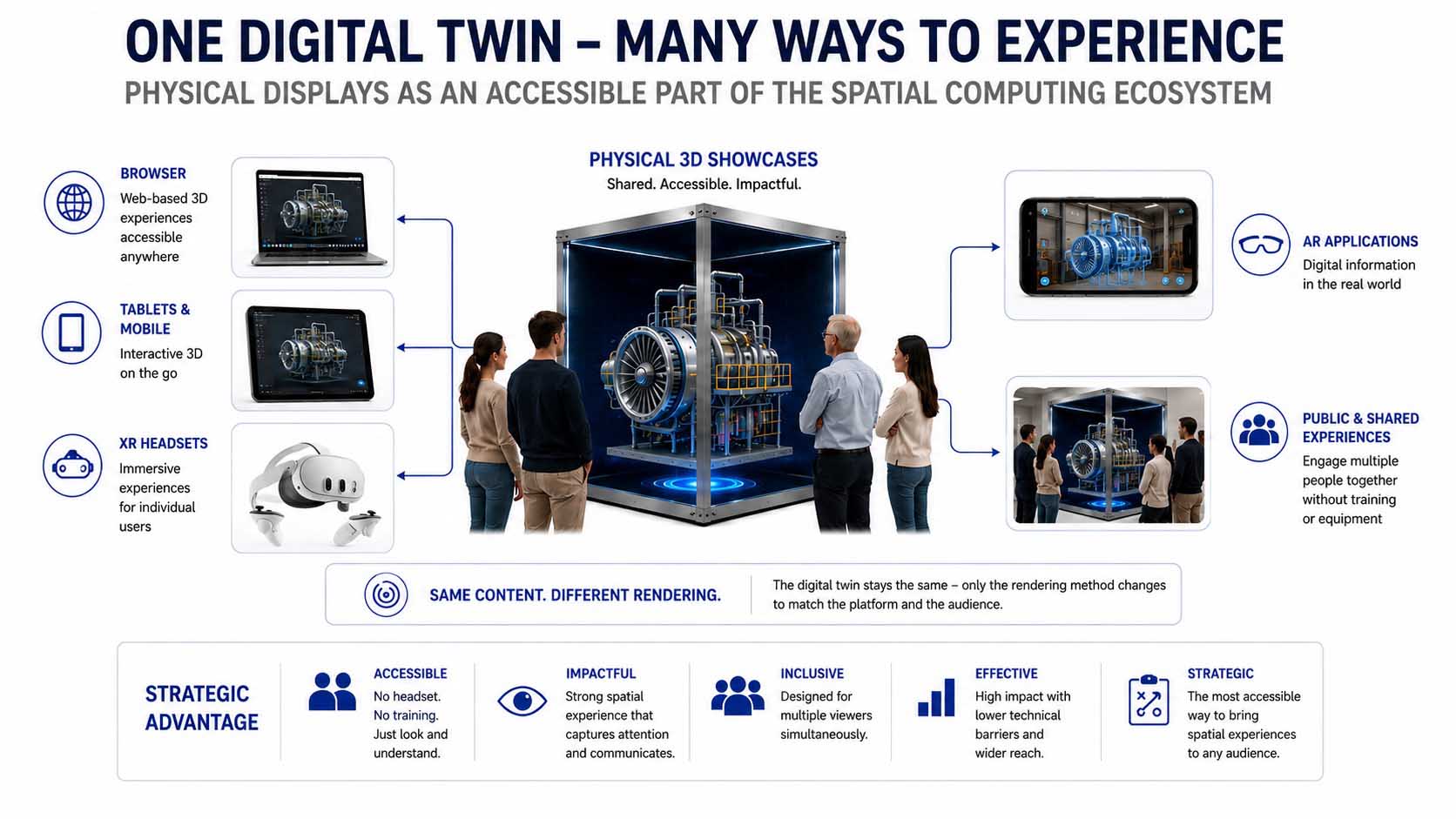
Physical Virtual 3D Showcases are an independent, complementary form of representation of the same digital twin also used in headsets, browsers, and AR applications. This makes spatial computing accessible to a broader, untrained audience.
Infographic: Physical display installations as an accessible, shared form of representation within the broader spatial computing ecosystem | Graphic: © Ulrich Buckenlei | XR Stager Online Magazine | VISORIC GmbH
For companies investing in spatial computing, this leads to a clear strategic consideration. A physical display installation is rarely the technically most demanding solution, but it is often the most accessible one, especially where visitors, customers, or trade fair attendees have no prior experience with XR technologies and yet expect a strong spatial experience.
This is exactly where the real significance of this technology lies for the coming years: it does not make spatial computing more individual, but more public, more visible, and more collectively experienceable, a counterpart to the isolated immersion of the headset and an ideal complement for every place where people gather around a shared object.
- Physical display installations complement headset-based spatial computing with shared, public experiences.
- Unlike headsets, LED installations require no technical barrier to entry for viewers.
- The same digital twins can be used equally in headsets, browsers, and physical installations.
- Physical installations are often the most accessible, not the technically most demanding, spatial computing solution.
- The technology makes spatial computing more public and collectively experienceable rather than purely individual.
This brings the article full circle. What begins with four synchronized LED panels and a precise rendering calculation develops into an independent, complementary pillar of spatial computing. How this illusion actually plays out in practice is shown in the following video.
When a Sculpture Becomes a Stage for Digital Art
The previous chapters have shown how perspective-correct rendering works, where the illusion reaches physical limits, and in which industries the effort pays off. How convincing the result is in practice is shown most impressively by a concrete, internationally known example.
The following video shows a four-panel LED installation in which a digital figure appears to float and move freely inside the structure. It shows a sequence in the style of HUMAN ONE by artist Beeple, a rotating sculpture over two meters tall made of four LED panels, which has been shown in various museums since 2021 and is continuously updated by the artist with new digital landscapes.[9]
Particularly revealing is a look at the seams of the installation: at the edges where two panels meet, the figure continues seamlessly from one panel to the next, a direct result of the precise calibration between the virtual camera and the physical panel geometry, as described in Chapter 2.
Video: Virtual 3D Showcase with perspective-correct rendering, in the style of HUMAN ONE by Beeple | Visuals by original creators @jyvisions_led_display (Instagram), Featured Artwork HUMAN ONE by Beeple | Analysis, narration, editing, and video production: © Ulrich Buckenlei | XR Stager Online Magazine | VISORIC GmbH
The video makes clear that the illusion does not rely on a single trick but on the consistent alignment of four simultaneously running, precisely synchronized renderings. For companies considering such an installation, this example shows how important the quality of content and calibration is for the final result, far more important than raw display resolution alone.
At the same time, the example makes the cultural significance of the technology visible. HUMAN ONE is not a marketing prototype but a recognized work of art shown in renowned museums. This underscores that perspective-correct rendering has long since become more than a technical gimmick, it is an independent medium of expression.
- The video shows a four-panel installation in the style of HUMAN ONE by Beeple.
- At the panel edges, the figure continues seamlessly, a direct result of precise calibration.
- The illusion relies on four simultaneously running, precisely synchronized renderings.
- Content quality and calibration matter more to the result than raw display resolution.
- HUMAN ONE shows that the technology is established as a recognized artistic medium.
This example makes tangible where Virtual 3D Showcases are heading: from a technical demonstration to an independent, culturally recognized form of spatial staging that gives art, product, and digital twin alike a stage.
From Idea to Walk-In Spatial Display Installation
A convincing Virtual 3D Showcase installation is not created by a single display but through the precise interplay of physical geometry, off-axis rendering, purpose-built 3D content, and realistic planning of the viewing zone. Only when hardware, rendering, and content are thought through together from the start does an illusion emerge that convinces in everyday use, not just in a perfectly lit demo video.
Many successful projects begin with a clearly scoped pilot installation, a product showcase at a trade fair booth, a digital twin presentation in a sales room, or a curated artistic installation. This allows the viewing zone, content pipeline, and impact to be tested under real conditions before a larger, permanent installation is built.

15 years of experience in 3D, AI, and XR: the VISORIC expert team from Munich.
Image: © Ulrich Buckenlei | XR Stager Online Magazine | VISORIC GmbH
VISORIC develops Virtual 3D Showcases and spatial display solutions from concept through to a fully calibrated installation. Our expert team from Munich combines off-axis rendering, digital twins, and real-time 3D into stagings that convince instantly in museums, sales, at trade fairs, or in meeting rooms.
- Concept development and calibration of Virtual 3D Showcases and LED panel installations.
- Content production and perspective-correct rendering for digital twins and products.
- Implementation from pilot installations to permanent, company-wide display solutions.
Would you like to realize a Virtual 3D Showcase, a spatial product staging, or an LED panel installation for your company?
Talk to the VISORIC expert team from Munich about spatial displays, digital twins, real-time 3D, and modern spatial computing platforms. Together we’ll turn your idea into a convincing, technically robust installation for a museum, sales floor, trade fair, or showroom.
Contact:
Email: info@visoric.com
Phone: +49 89 21552678
Sources and References
- Wikibooks. Cg Programming/Unity/Projection for Virtual Reality. Explanation of the principle of off-axis projection versus classic on-axis projection.
- Bruder, V. et al. A Practical Guide to Implementing Off-Axis Stereo Projection Using Existing Ray Tracing Libraries. arXiv:2311.05887.
- INAIRSPACE. Holographic LED Display: The Future of Visual Communication is Here. Classification of software-based LED illusion techniques versus classic optical methods.
- Bruder, V. et al. A Practical Guide to Implementing Off-Axis Stereo Projection Using Existing Ray Tracing Libraries. Technical foundations of asymmetric view frustums and CAVE rendering, arXiv:2311.05887.
- Wikibooks. Cg Programming/Unity/Projection for Virtual Reality. Mathematical foundations of the off-axis projection matrix.
- M+ Museum Hong Kong. Beeple: HUMAN ONE. Exhibition description of the four-panel LED sculpture and its ongoing artistic updates.
- Bruder, V. et al. A Practical Guide to Implementing Off-Axis Stereo Projection Using Existing Ray Tracing Libraries. Section on tracked single-viewer rendering in CAVE environments, arXiv:2311.05887.
- Looking Glass Factory. Hololuminescent Displays. Overview of light-field display technology as an alternative to closed LED panel installations.
- M+ Museum Hong Kong / Digicult / designboom. Beeple: HUMAN ONE. Description of the four-panel sculpture, its exhibition history, and the ongoing updates by the artist.
- VISORIC practical projects in the areas of spatial displays, digital twins, real-time 3D, and spatial computing.
- XR Stager platform for real-time 3D, digital twins, knowledge AI, and industrial spatial computing applications.
Contact Persons:
Ulrich Buckenlei (Creative Director)
Mobile: +49 152 53532871
Email: ulrich.buckenlei@visoric.com
Nataliya Daniltseva (Project Manager)
Mobile: +49 176 72805705
Email: nataliya.daniltseva@visoric.com
Address:
VISORIC GmbH
Bayerstraße 13
D-80335 Munich