

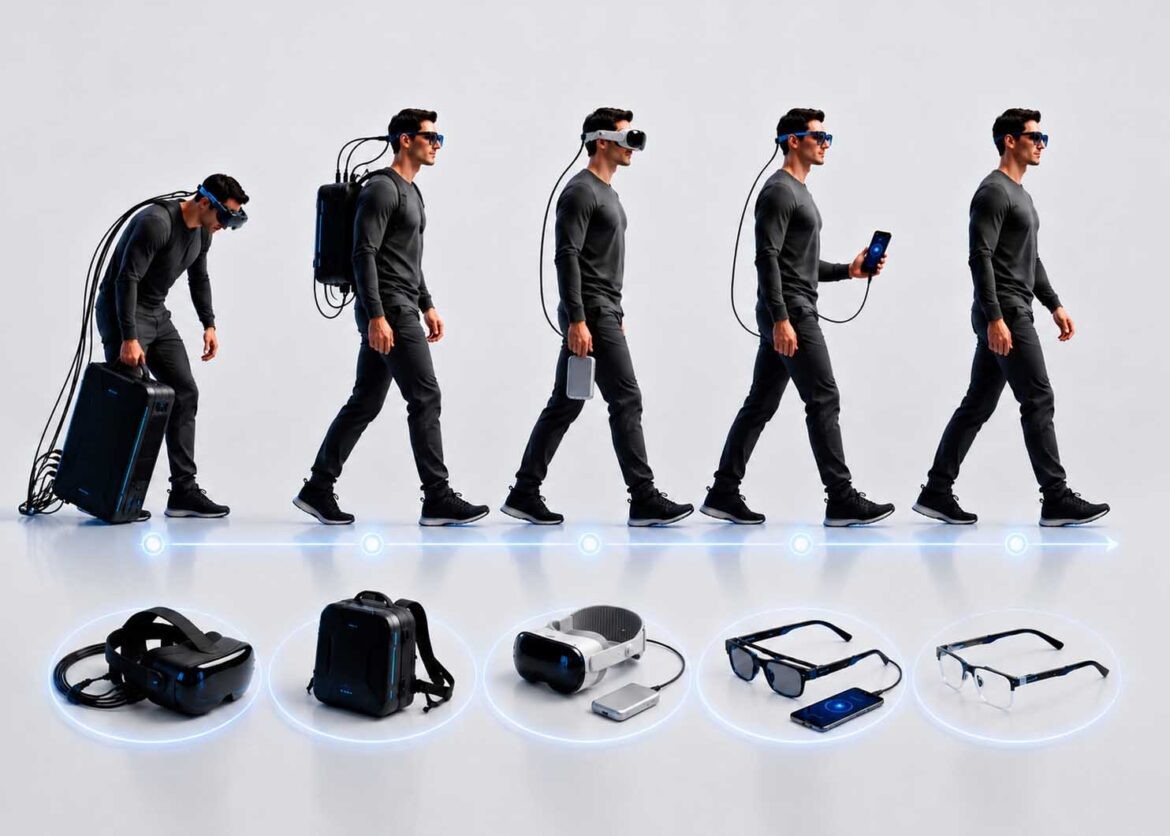
From cable-bound case to sunglasses: the evolution of spatial computing.
Image: © Ulrich Buckenlei | XR Stager Online Magazine | VISORIC GmbH
Two miniaturized displays, one per eye, produce an image with genuine spatial depth, housed in a frame barely heavier than an ordinary pair of everyday glasses. What used to be reserved exclusively for full Head-Mounted Displays is now beginning to shrink into the format of a pair of glasses.
Smart glasses today can be divided into three categories based on their display technology: pure audio and AI glasses with no display at all, glasses with a monocular display for a single eye, and a considerably smaller but growing group of binocular glasses with two displays that together produce a stereoscopic, spatial image.[1] It is precisely this third category in which one of the most significant developments in the entire spatial computing field is currently unfolding.
A current example of this is the RayNeo GT Max, a binocular AR glass with a stereoscopic display, launching on September 4, 2026, at a price between $299 and $429. Two Micro-OLED displays produce an image with a 59-degree field of view that, according to the manufacturer, feels like a virtual projection surface of up to 307 inches, housed in an everyday-ready glasses frame.[2] With this, a part of what used to be reserved exclusively for full Head-Mounted Displays such as Apple Vision Pro or Meta Quest is visibly moving toward an ordinary glasses format.
This article deliberately looks not just at a single model, but at the entire category of lightweight, stereoscopic smart glasses, compared to each other and to the Head-Mounted Displays that currently continue to deliver the technical optimum in spatial experience. It is precisely this comparison that shows most clearly where these glasses can already keep pace and where the technical limits of the format currently still lie.
What appears here as progress by individual products is part of a larger, clearly recognizable pattern. Several manufacturers are working in parallel on the same fundamental technical question: how much genuine, binocular 3D can be integrated into a frame that can be worn every day, without fully sacrificing the image quality and spatial understanding of a full Head-Mounted Display.
- Smart glasses range from pure audio-AI glasses to binocular stereo displays.
- RayNeo GT Max launches on September 4, 2026, for $299 to $429.
- Two Micro-OLED displays produce a 59-degree field of view.
- Several manufacturers pursue the same technical goal in parallel.
- Head-Mounted Displays continue to deliver the technical optimum.
This article explains how stereoscopic vision technically comes about in a pair of glasses, where current models stand in direct comparison, why Apple Vision Pro and Meta Quest 3 continue to form the reference class, and what role Artificial Intelligence plays in closing this technical gap.
From Head-Mounted Display to Slim Glasses
Spatial, three-dimensional vision on one’s own head was long synonymous with a Head-Mounted Display, or HMD for short, a device strapped over the face with visible cameras, protruding lenses, and noticeable weight on the nose. It is exactly this image that still shapes what many people understand by spatial computing today.
The currently most capable devices in this field, Apple Vision Pro and Meta Quest 3, both classic Head-Mounted Displays, continue to deliver the technical optimum in spatial experience: full positional tracking in space, high-resolution video passthrough cameras, and a field of view that already comes very close to natural human vision. A consistently lighter successor model positioned for the mass market, however, remains announced by Apple at the earliest for 2028, while the company is increasingly focusing in parallel on its own, lighter smart glasses.[3]
It is precisely in this gap, between today’s full but heavy Head-Mounted Display and a lightweight alternative that does not yet exist, that several manufacturers are currently positioning themselves with binocular, stereoscopic glasses. They deliberately do not aim to fully replace a Vision Pro or Quest 3, but rather to transfer a growing part of the spatial viewing experience into a considerably lighter, more everyday-ready format already today.[4]
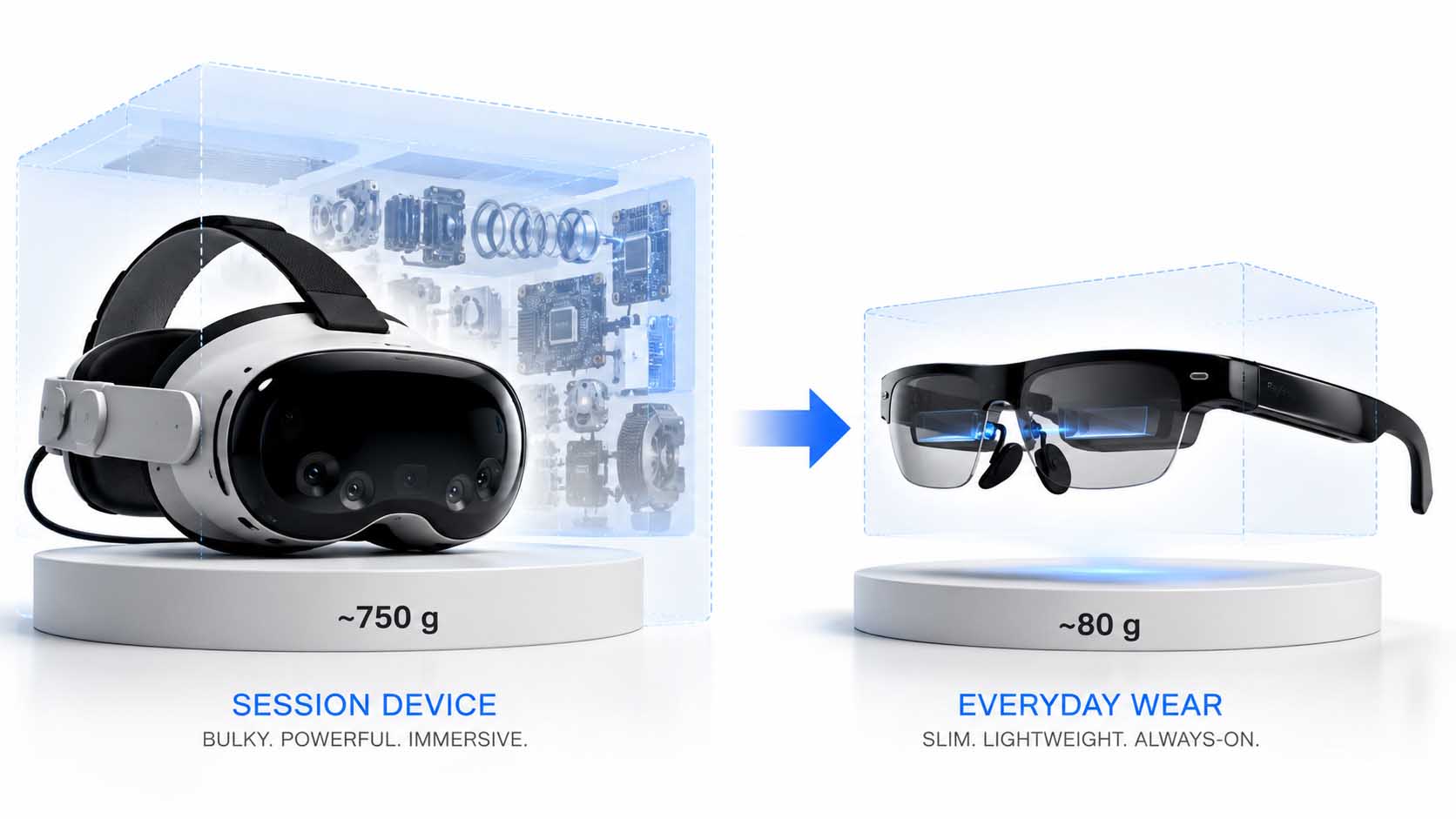
From Head-Mounted Display to everyday-ready glasses.
Infographic: development line from Head-Mounted Displays to lightweight, binocular smart glasses | Graphic: © Ulrich Buckenlei | XR Stager Online Magazine | VISORIC GmbH
This shift, from the full but heavy Head-Mounted Display to the light but not yet complete pair of glasses, fundamentally changes what spatial vision is actually good for in everyday life. A device that can be worn permanently opens up different fields of application than a headset put on for a limited session.
For such a glasses format to deliver spatial vision at all, it must first master the same basic technique that Head-Mounted Displays also use, only in a considerably smaller physical form. How stereoscopic vision works technically is shown in the next chapter.
- Apple Vision Pro and Meta Quest 3 continue to deliver the technical optimum.
- A lighter Vision Pro successor remains expected at the earliest for 2028.
- Several manufacturers already fill the gap with binocular glasses today.
- The goal is to complement, not fully replace, the Head-Mounted Display.
- Everyday wearability opens up different fields than session-based devices.
This makes clear that the development of lightweight spatial computing glasses is no niche project by individual startups, but closes a technical gap between established Head-Mounted Displays and the desire for everyday, wearable technology.
What Stereoscopic Vision Technically Means
For an eye to perceive depth, it requires two slightly different images, one per eye, each from a slightly offset perspective. The brain then merges both images into a single, spatial impression, a principle known as stereoscopy that corresponds exactly to how human vision works.
In a binocular pair of glasses, two Near-Eye Displays based on Micro-OLED technology, one per eye, take on exactly this task. In the RayNeo GT Max, for instance, both displays produce a slightly different image, the brain combines both into a spatial impression with genuine depth, at a 59-degree field of view this corresponds, according to the manufacturer, to a virtual projection surface of up to 307 inches.[5] Without this second, offset image, any representation would necessarily remain two-dimensional, regardless of the resolution of a single display.
It is precisely this difference that separates binocular glasses from the larger group of monocular display glasses, which use only a single display for one eye, usually for notifications, translations, or navigation prompts, without producing spatial depth.[6] Both approaches address different use cases, but only the binocular variant actually delivers a three-dimensional image.
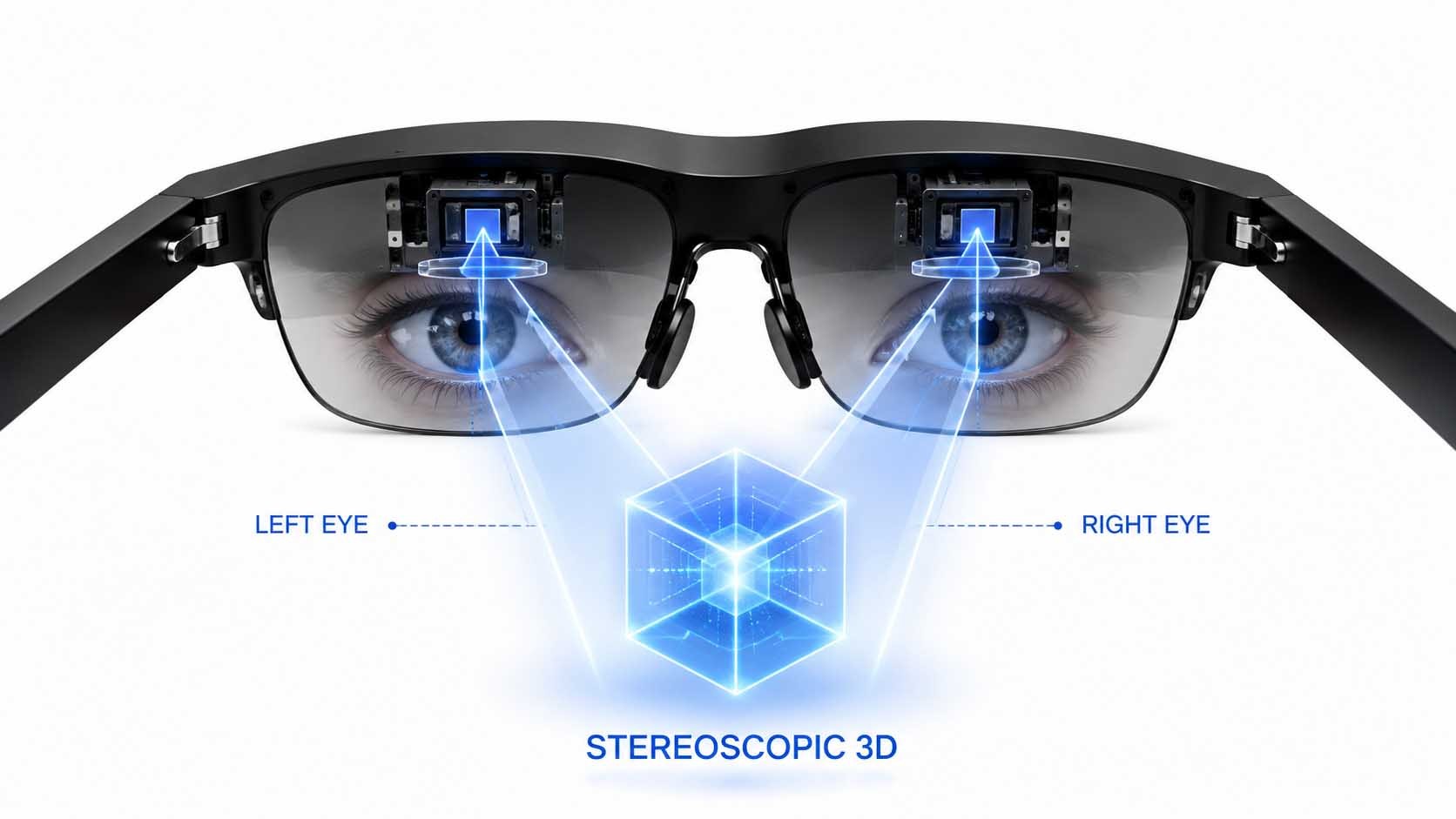
Two displays, one image, genuine depth.
Infographic: how two offset display images merge in the brain into a stereoscopic impression | Graphic: © Ulrich Buckenlei | XR Stager Online Magazine | VISORIC GmbH
For the wearer, this technical split disappears completely. What becomes perceptible is a single, coherent image with tangible depth, no double image, no consciously noticeable separation between left and right eye.
This basic technique, however, is only part of the requirement. Whether a virtual image also stays stable in position during head movement depends on a second, equally decisive capability. How this works is shown in the next chapter.
- Stereoscopy requires two slightly different images per scene.
- Two Micro-OLED Near-Eye Displays take on this task in the glasses.
- Without a second image, any representation stays necessarily two-dimensional.
- Monocular display glasses, by contrast, use only a single display.
- Only binocular displays actually deliver depth perception.
For purchasing decisions, this makes a substantial difference in practice: not every pair of glasses with a display automatically offers stereoscopic vision, a point easily overlooked given the sheer number of current product categories.
When a Head Has No Position Yet
Above pure stereoscopic representation lies a second, often underestimated requirement: the virtual image must remain stable during head movement, otherwise the representation loses visual stability with every small movement.
A chip built specifically for this purpose continuously processes data from motion sensors in the glasses frame and calculates head rotation from it. In the RayNeo GT Max, a chip called Zone 360 handles this, supporting several modes: a virtual display can stay fixed at one viewing direction, follow head movement gently, or remain stable even in motion, for instance on a train or airplane.[7]
The decisive technical difference, however, lies in what these sensors actually capture. They measure exclusively rotations of the head, so-called three degrees of freedom or 3DoF, but not actual movement through a room. For a full spatial anchoring of a virtual object at a fixed point in space, while the wearer moves freely, additional cameras for environment mapping would be required, continuously recalculating one’s own position, six degrees of freedom or 6DoF, as Meta Quest 3 already achieves today via an integrated depth projector.[8]
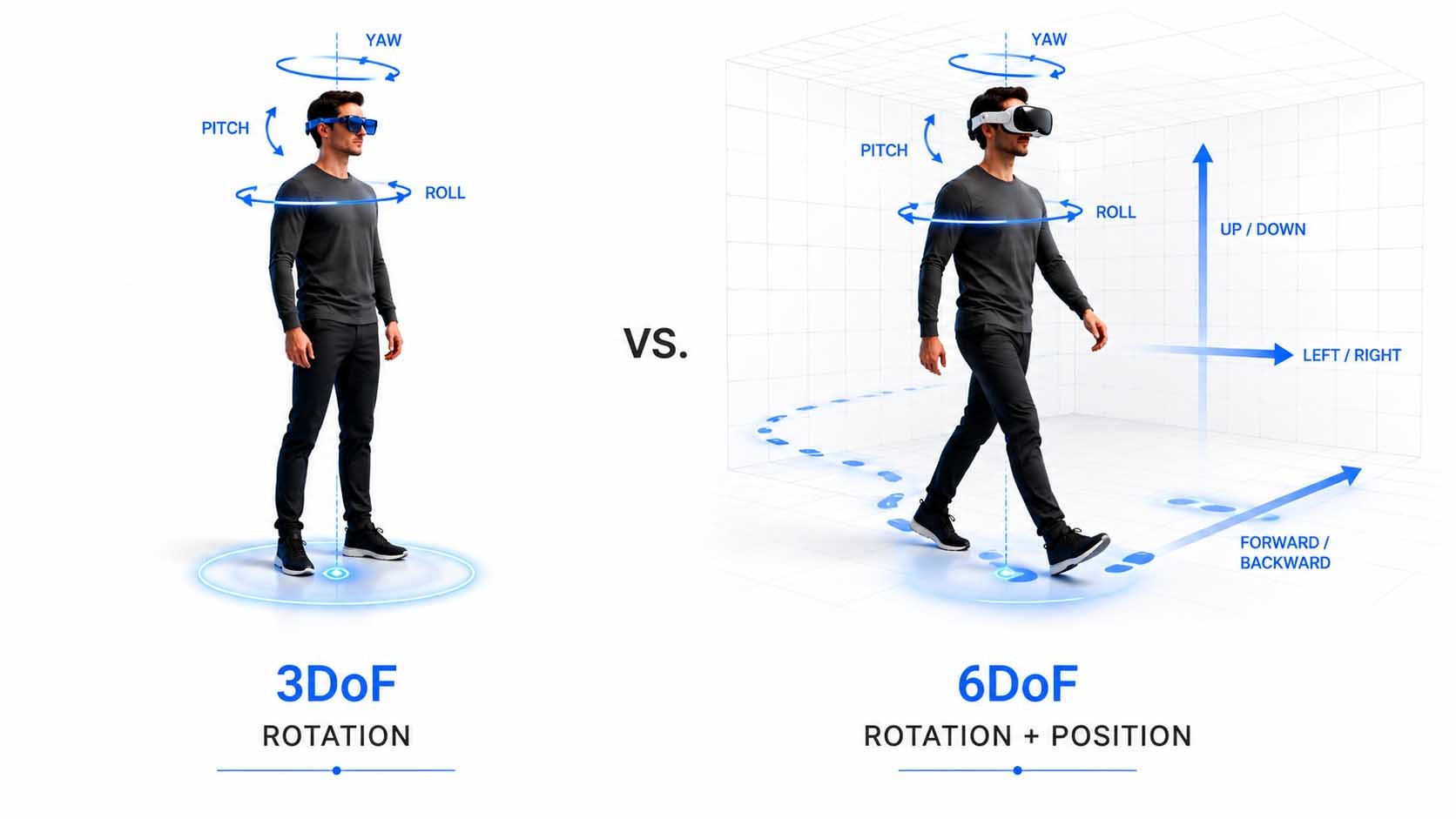
3DoF captures rotation, 6DoF adds position in space.
Infographic: the difference between pure rotational tracking and full spatial positional tracking | Graphic: © Ulrich Buckenlei | XR Stager Online Magazine | VISORIC GmbH
This difference is no technical footnote. It determines whether a virtual object is merely positioned within the field of view or actually stays anchored at a fixed spot in real space while the person moves freely, a decisive criterion for any serious spatial computing application.
It is precisely this missing step, from stable head-locked display to full spatial anchoring, that is one of the main reasons why current smart glasses do not yet fully match Head-Mounted Displays. Why this device class continues to form the reference is shown in the next chapter.
- Motion sensors capture only head rotation, not spatial position.
- 3DoF refers to pure rotational tracking of the head.
- 6DoF adds full positional tracking in space.
- Meta Quest 3 achieves 6DoF via an integrated depth projector.
- Missing 6DoF is a central technical limit of current glasses.
Anyone who knows this difference also understands why a comparison between lightweight smart glasses and Head-Mounted Displays is not solely a question of weight, but a question of actual spatial capability.
Why Apple Vision Pro and Meta Quest 3 Continue to Form the Reference
Before lightweight smart glasses can be meaningfully placed in context, it is worth looking at the devices that currently deliver the technical optimum in spatial experience, and why this optimum has so far necessarily come with weight and bulk.
Apple Vision Pro achieves, with two Micro-OLED panels and roughly 23 million pixels combined, a sharpness that no glasses format currently comes close to matching, combined with full 6DoF tracking, eye tracking, and high-resolution color passthrough. Meta Quest 3, in turn, offers a 110-degree field of view, an integrated depth projector for environment mapping, and a weight of roughly 515 grams, delivering a noticeably wider, more immersive sense of space at a considerably lower price.[9]
This capability comes at a clear technical cost: higher computing power generates more heat, larger displays and lenses require more physical space, and full positional tracking requires additional cameras plus depth sensors, three factors that so far can only be integrated into an everyday-ready glasses frame to a limited extent.[10]
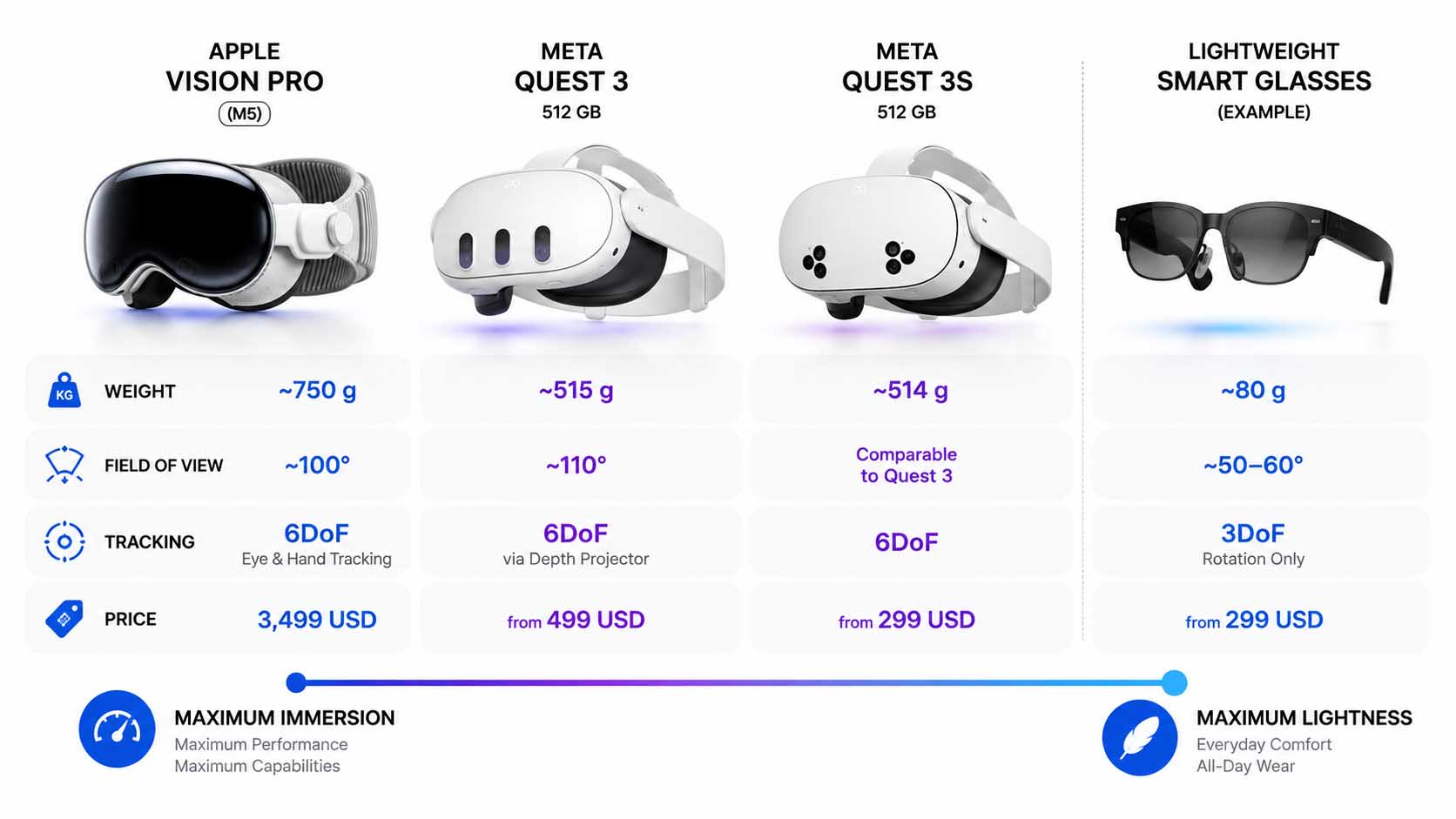
| Model | Weight | Field of View | Tracking | Price |
|---|---|---|---|---|
| Apple Vision Pro (M5) | approx. 750 g | approx. 100° | 6DoF, eye and hand tracking | $3,499 |
| Meta Quest 3 | approx. 515 g | approx. 110° | 6DoF via depth projector | from $499 |
| Meta Quest 3S | approx. 514 g | comparable to Quest 3 | 6DoF | from $299 |
The reference class: heavy, but still technically leading.
Table: technical specifications of the current reference devices for full spatial experience | Source: manufacturer data and independent trade media, as of summer 2026 | © Ulrich Buckenlei | XR Stager Online Magazine | VISORIC GmbH
For companies currently investing in spatial visualization, this means: anyone who needs maximum precision and full spatial understanding currently cannot avoid a Head-Mounted Display of this class. Anyone who instead prioritizes everyday wearability and a lightweight frame must deliberately accept compromises in tracking and image sharpness.
It is precisely against this backdrop that the current generation of lightweight, binocular smart glasses can be realistically assessed. How they compare directly with one another is shown in the next chapter.
- Apple Vision Pro achieves roughly 23 million pixels across two panels.
- Meta Quest 3 offers a 110-degree field of view at 515 grams.
- Higher computing power generates more heat and needs more space.
- Full 6DoF tracking requires additional camera sensors.
- These three factors currently hinder a lightweight glasses format.
This technical price of capability forms the benchmark against which any lightweight pair of glasses inevitably has to be measured, even if it does not yet fully reach it today.
The Current Generation of Lightweight, Binocular Smart Glasses Compared
Zoom out from a single model, and a growing group of manufacturers emerges, all working on the same fundamental question, with sometimes markedly different technical answers on display technology, field of view, and price.
The RayNeo GT Max, as one of the first binocular glasses in this price class to reach series production, comes with native Dolby Vision support and Bang & Olufsen audio, at a 59-degree field of view and a starting price of $299.[11] XREAL positions its One Pro model at the upper end of the market segment, with especially sharp imagery via its own X1 chip for image stabilization, albeit at a considerably higher price. VITURE, in turn, has received multiple awards from independent trade media for its Beast model since its market launch in April 2026, for currently the best image quality in this device class.[12]
Not every established brand offers the same display technology in this comparison, though. Meta Ray-Ban Display deliberately uses only a monocular display for one eye instead of a binocular stereo system, a decision closely tied to the optical and structural limits of a slim sunglasses frame, as Chapter 6 shows in detail. HTC, in turn, offers no visual display at all with its current consumer model VIVE Eagle, but rather a pure audio and AI glasses product, an important reminder that even established manufacturers have not yet made this technical leap across the board.
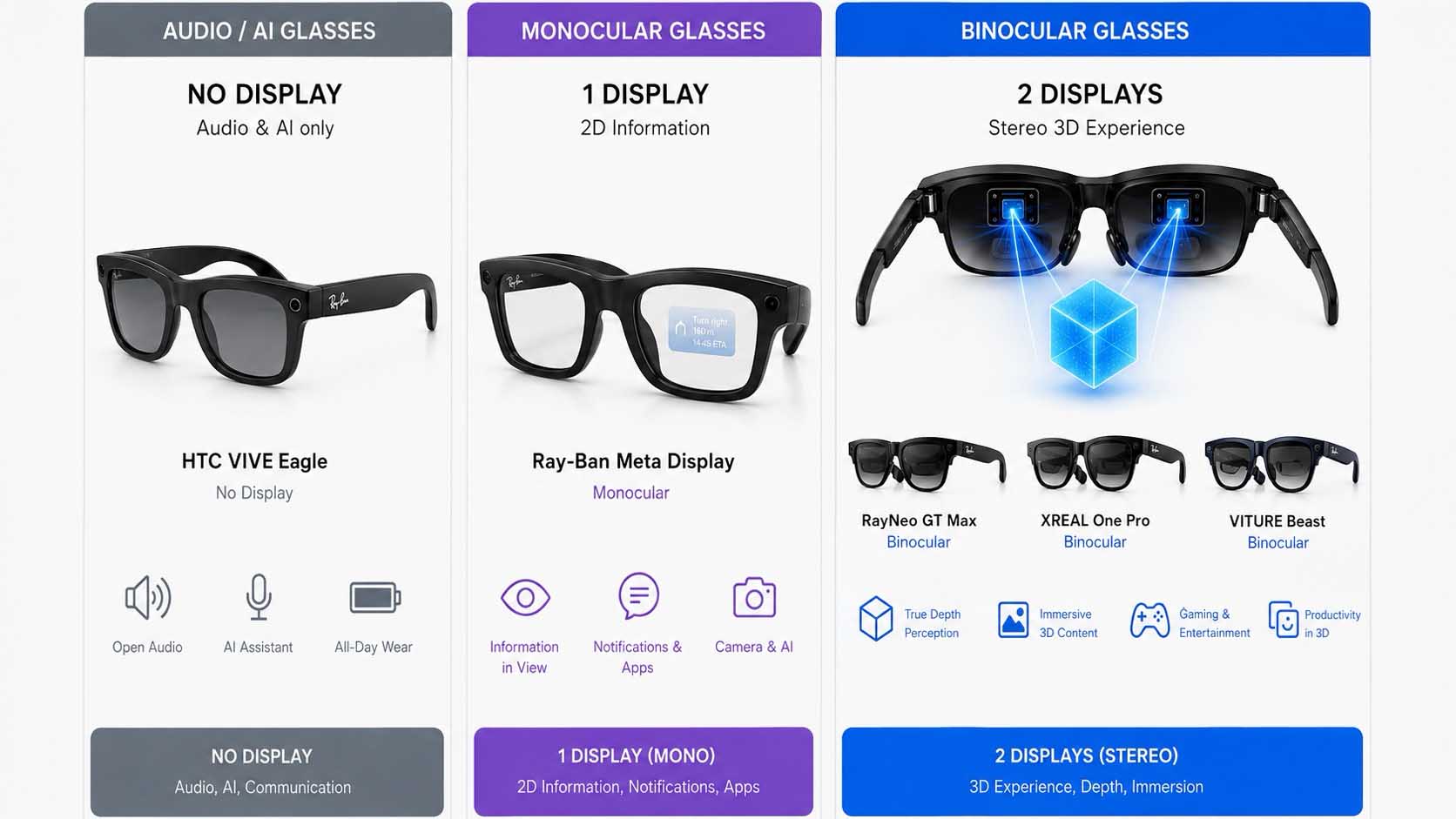
| Model | Display | Field of View | Tracking | Price | Assessment |
|---|---|---|---|---|---|
| RayNeo GT Max | Binocular, 2x Micro-OLED | 59° | 3DoF | $299–429 | First binocular glasses in this price class to reach series production |
| XREAL One Pro | Binocular, 2x Micro-OLED | approx. 57° | 3DoF, 6DoF optional | approx. $649 | Sharpest image, highest price in the comparison |
| VITURE Beast | Binocular, 2x Micro-OLED | 58° | 3DoF integrated | approx. $549 | Multiple awards, currently the best image quality |
| Meta Ray-Ban Display | Monocular, no stereo | n/a | no spatial tracking | $799 | No stereoscopic 3D, focus on information |
| HTC VIVE Eagle | No display | n/a | n/a | n/a | Pure audio and AI glasses with no display |
Five established brands, two different technical categories.
Table: comparison of current smart glasses from well-known manufacturers by display technology, field of view, tracking, and price | Source: manufacturer data and independent trade media, as of summer 2026 | © Ulrich Buckenlei | XR Stager Online Magazine | VISORIC GmbH
For buyers and companies looking to orient themselves in this market segment, this table is exactly the most important reference point before any purchasing decision: not every established brand automatically offers the same technical category, and the product name alone says little about whether a pair of glasses actually delivers stereoscopic 3D.
This range of technical approaches raises an obvious question: why haven’t even large, well-funded manufacturers such as Meta and HTC implemented full stereo 3D in their established product lines so far? That is exactly what the next chapter addresses.
- RayNeo GT Max, XREAL One Pro, and VITURE Beast offer binocular stereo.
- Meta Ray-Ban Display deliberately uses only a monocular display.
- HTC VIVE Eagle currently offers no display at all.
- The brand name alone says little about the technical category.
- Prices currently range from around $299 to over $800.
These differences are no coincidence, but the result of deliberate technical trade-offs that every manufacturer has to make within a very limited amount of physical space.
Why Small Glasses Don’t Yet Deliver the Optimum
That even established, well-funded manufacturers cannot simply integrate a Vision Pro experience into a glasses frame is due to several physical limits that cannot be circumvented through software improvements alone.
The more compact the frame, the less physical space remains simultaneously for battery, cooling, and optics. Larger fields of view and brighter displays require more energy, more energy generates more heat, and this heat can only be dissipated to a limited extent within a thin glasses temple. This is exactly where current research approaches come in: a laser-based, holographic display chip promises a bright, sharp image across a considerably larger field of view, with a lower energy requirement than today’s Micro-OLED solutions, though this technology is still at the research stage.[13]
Alongside energy and heat, a second, purely optical constraint comes into play, one that is especially relevant for a design in the style of a classic pair of sunglasses: so-called eye relief, the distance between the last optical component and the eye, as well as the eyebox, the spatial area within which the eye still sees the complete image. Both values must maintain a certain minimum distance, among other reasons so that people wearing prescription glasses can still wear the optics, with typical values in the range of roughly 20 to 40 millimeters.[14] On top of that comes the individually varying distance between the eyes, the interpupillary distance or IPD: since movable, mechanically adjustable components can hardly be precisely calibrated in a wearable device, the eyebox instead has to be optically enlarged by an estimated 10 to 20 millimeters to cover the natural range of human eye distances, a requirement that becomes considerably more demanding with two separate optical systems for a binocular image than with a single display.[14]
How strongly this purely optical trade-off can influence a product decision can be traced concretely in the example of Meta Ray-Ban Display. According to statements from Meta’s own CTO, a binocular model would have required components more than twice as expensive, since a computational disparity correction between both eye images would additionally have been necessary, and would at the same time have required more bulk and weight in a frame explicitly positioned as a slim, everyday-ready pair of sunglasses in the Ray-Ban brand design. It was precisely this optical and design-driven trade-off decision, not a lack of technical possibility, that led Meta to deliberately choose a single, monocular display, with the well-known drawback that one eye remains entirely without image information.[15]
Full 6DoF positional tracking, as Meta Quest 3 achieves via a depth projector, is subject to a similar space constraint when it comes to spatial tracking as well: it requires additional cameras and computing power for environment mapping, components that fit easily into a Head-Mounted Display but are hard to accommodate in a slim glasses temple without making the device heavier and warmer again.[16]
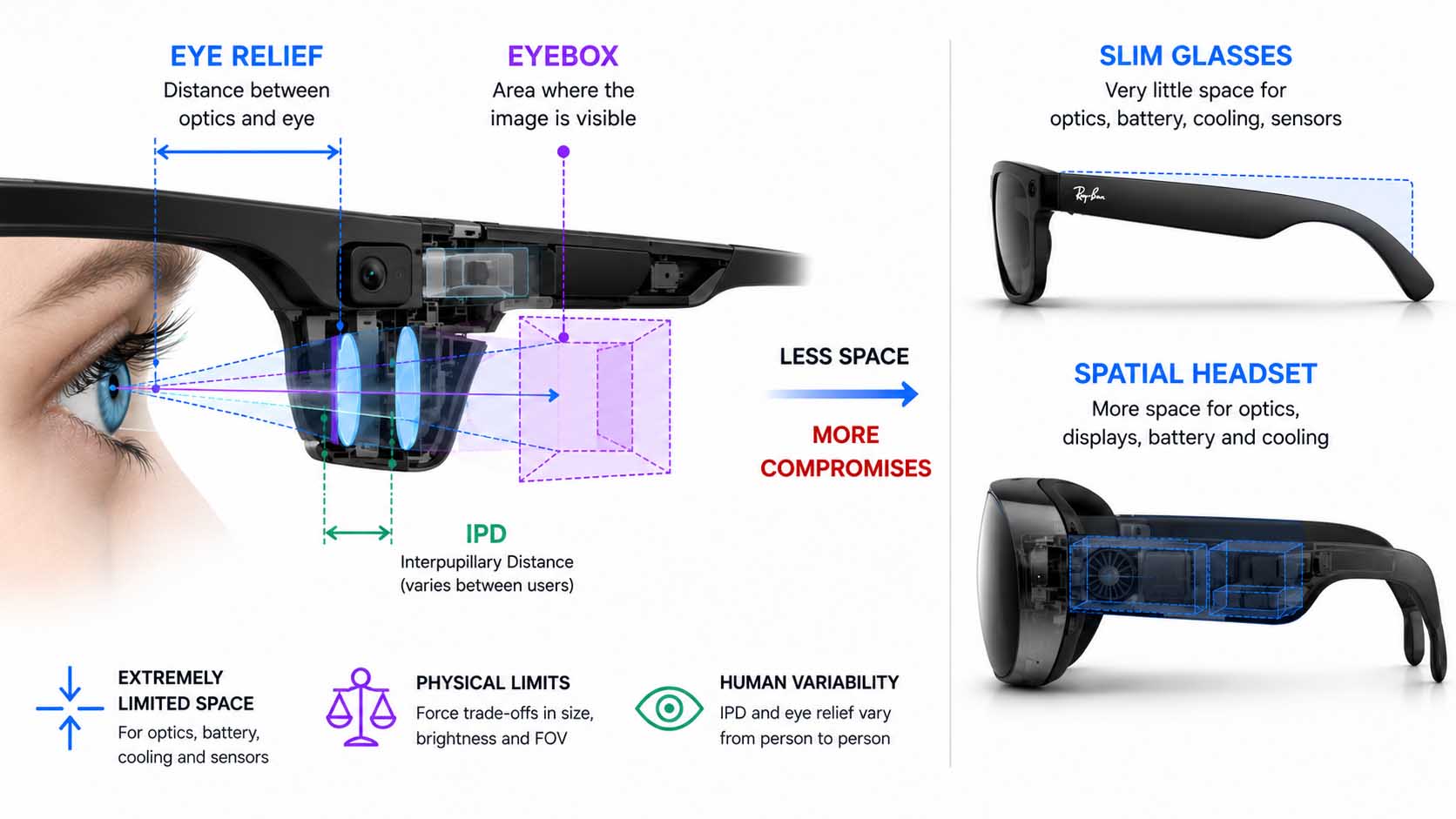
Eye relief, eyebox, and eye distance constrain the physical form.
Infographic: optical minimum distances between display, combiner, and eye as an additional form-factor constraint beyond energy and heat | Graphic: © Ulrich Buckenlei | XR Stager Online Magazine | VISORIC GmbH
These limitations are not a sign of a lack of ambition on the part of manufacturers, they are a direct consequence of the physics of small physical volumes and of optics itself. Battery, cooling, optics, and sensors compete for the same, very limited space within a glasses temple, while eye relief and eyebox simultaneously enforce a physical minimum distance to the eye that cannot be arbitrarily reduced.
Anyone who knows these limits also understands why the next advance does not necessarily come from additional hardware, but increasingly from more intelligent software that extracts more performance from less physical space. What role Artificial Intelligence plays in this is shown in the next chapter.
- More compact frames leave less room for battery and cooling.
- Eye relief and eyebox enforce an optical minimum distance to the eye.
- Individual eye distance requires an additionally enlarged eyebox.
- Meta chose cost and design over stereo 3D for Ray-Ban Display.
- These limits are physical and optical, not merely a matter of price.
These physical and optical limits explain why the next development step increasingly depends on more intelligent processing rather than on additional hardware.
When Artificial Intelligence Compensates for Missing Computing Power
What is still missing today in terms of physical space, manufacturers are increasingly trying to compensate for through more intelligent software, rather than integrating additional hardware into an already limited frame.
Current mixed-reality products integrate AI assistants directly into the glasses, systems that offload much of the computing load into the cloud or onto a paired smartphone, instead of processing it entirely within the glasses frame itself. A current example of this is the close connection between a large mobile network and AI ecosystem and a new glasses format, in which an AI assistant explains, in context, what the wearer is currently seeing, without the glasses themselves needing the full computing power of a Head-Mounted Display.[17]
Artificial Intelligence is also increasingly taking on tasks in image quality that used to require pure hardware performance: systems for real-time conversion of ordinary, two-dimensional content into an image with algorithmically computed depth already show today that part of the missing sensor hardware can be compensated for through intelligent software, without requiring additional camera hardware in the frame.[18]
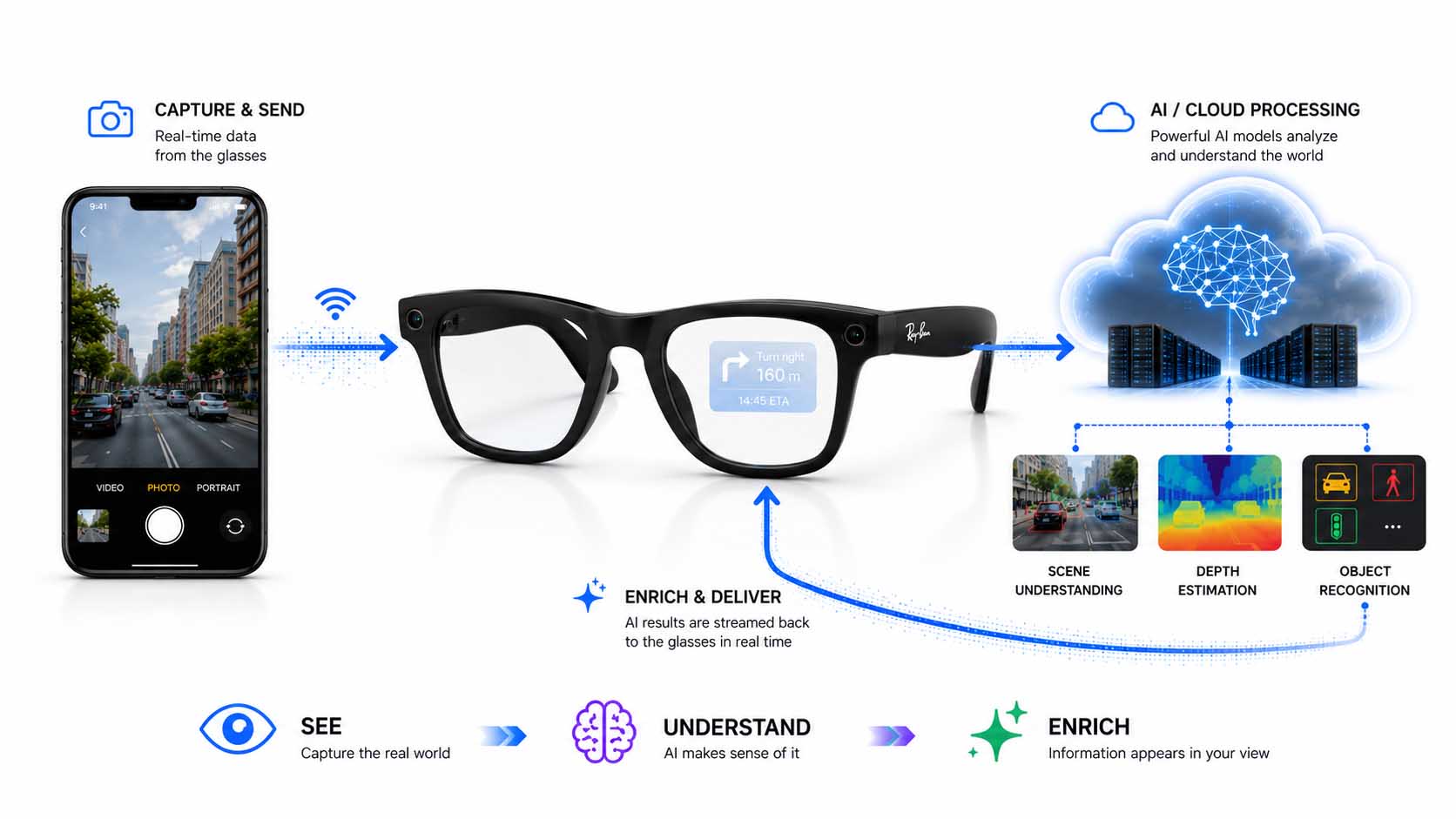
Artificial Intelligence shifts computing load from the glasses into cloud and smartphone.
Infographic: how AI-driven offloading of computing load compensates for missing hardware in the glasses frame | Graphic: © Ulrich Buckenlei | XR Stager Online Magazine | VISORIC GmbH
For users, this produces a noticeable effect: even without the full sensor suite of a Head-Mounted Display, an AI-driven pair of glasses feels increasingly context-aware, because a large part of the actual processing no longer has to take place within the frame itself.
This approach, compensating for physical limits through more intelligent software rather than additional hardware, does not replace genuine 6DoF tracking, but represents a realistic intermediate step. Where this development leads overall is shown in the final chapter.
- AI assistants offload computing load into the cloud or a smartphone.
- As a result, the glasses themselves need less computing power.
- AI can enrich 2D content in real time with algorithmic depth.
- This partly compensates for missing sensor hardware in the frame.
- AI does not replace genuine 6DoF tracking, but complements it.
This software-based compensation is also the reason why the entire product category is developing faster than pure hardware alone would allow.
From Display Glasses to Full Spatial Computing Glasses
Zoom out from the individual product comparison, and a principle emerges that matches exactly the core of every professional digital twin, demonstrated here using a pair of glasses instead of a factory floor.
The preceding chapters have shown how stereoscopic vision technically comes about, where the boundary between pure rotational tracking and full spatial tracking lies, why Head-Mounted Displays continue to form the reference, and how Artificial Intelligence is beginning to close the remaining gap. Together, these building blocks form a principle that reaches far beyond individual product names.
The difference between today’s display glasses and a future, fully capable spatial computing glass lies not in the fundamental goal, but in the current technical maturity: both pursue the same basic principle, permanently connecting physical reality and digital information within the same space, with differing degrees of technical maturity.[19] Current industry analyses confirm that exactly this connection between sensors, Artificial Intelligence, and spatial representation is gaining importance across industries in 2026, from consumer glasses to industrial digital twins.[20]
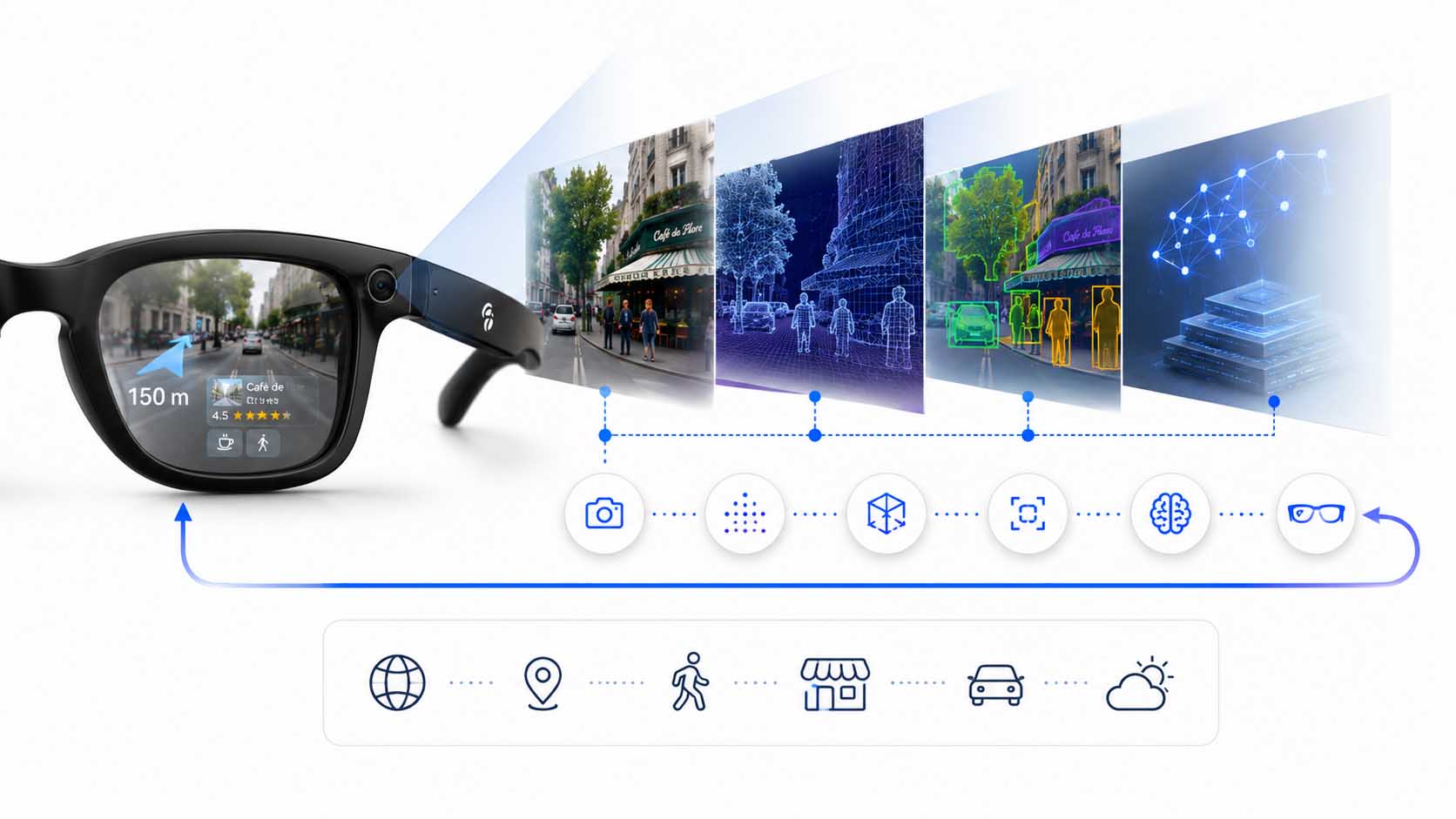
From consumer product to a building block of the digital twin ecosystem.
Infographic: lightweight spatial computing glasses as a building block of the larger digital twin ecosystem | Graphic: © Ulrich Buckenlei | XR Stager Online Magazine | VISORIC GmbH
For companies investing in digital twins and spatial computing, a clear strategic consideration follows from this. If stereoscopic 3D can already be realized today in a frame weighing around 300 grams, even if spatial tracking still needs to catch up, the question for every company becomes how quickly this technical gap will close, and how to benefit from it early, rather than acting only once the format is fully mature.
Research and early broad adoption show that the individual building blocks of this capability already exist today in the majority, though not yet fully combined into a single, everyday-ready device. The path from today’s display glasses to fully capable spatial computing glasses is therefore, for companies that act now, considerably shorter than it appears at first glance.
- Display glasses and spatial computing glasses pursue the same principle.
- Only the technical maturity distinguishes both categories today.
- Sensors, AI, and spatial representation are converging across industries.
- Stereoscopic 3D already exists in a 300-gram format.
- Full spatial tracking in glasses format is expected to follow.
This closes the circle of this article. What begins with two Micro-OLED displays in a glasses temple evolves into a foundational principle for the next generation of digital twins, far beyond a single product. Just how convincing this principle already looks in practice is shown in the video below.
When a 59-Degree Field of View Fits Into a Glasses Temple
The previous chapters have shown how stereoscopic vision technically comes about in a pair of glasses, where current models stand in comparison, and why Head-Mounted Displays continue to form the reference. Just how convincing this principle already looks in practice is most striking in the example of one concrete, current product.
Embedded below is the official product video for the RayNeo GT Max, launching on September 4, 2026, for $299 to $429. Two displays, one per eye, merge into an image with genuine depth, the Zone 360 chip keeps this image stable while the head turns, in Steady, Pinned, or Follow mode as needed.[2]
This moment, experiencing a fully capable stereoscopic image in an everyday-ready glasses frame, illustrates what the previous chapters explained technically: the basic technology for spatial vision has already arrived in glasses format, the full spatial understanding of a Head-Mounted Display is expected to follow.
Video: product introduction of the RayNeo GT Max, binocular stereo display, 59-degree field of view, Dolby Vision, and Zone 360 stabilization | Visuals by RayNeo, official product material | Analysis, script, editing, and video production: © Ulrich Buckenlei | XR Stager Online Magazine | VISORIC GmbH
The video makes clear that stereoscopic 3D in glasses format is no longer a distant future concept, but will be available starting September 2026 at a price considerably below that of a Head-Mounted Display. For companies thinking about their own spatial visualization applications, this example shows just how close a practical, wearable implementation already is.
At the same time, the video makes visible the decisive caveat explained in Chapter 3: stabilization follows head rotation, not actual position in space. It is precisely this technically precise difference that separates a convincing display glass from a fully capable spatial computing glass.
- Video shows the official RayNeo GT Max product introduction.
- Market launch on September 4, 2026, priced $299 to $429.
- Two displays produce a 59-degree field of view.
- The Zone 360 chip stabilizes the image during head rotation.
- Full spatial tracking remains an open next step.
This example makes tangible where lightweight spatial computing glasses are heading: from a convincing stereo demo in an everyday format to a fully capable, permanently wearable gateway to digital, spatial information.
From Display Glasses to Your Own Spatial Computing Solution
A reliable spatial visualization solution doesn’t come from a single glasses model, but from the thoughtful interplay of suitable hardware, AI-driven processing, and a platform that makes spatial content permanently usable, exactly the combination at the core of VISORIC’s work.
The expert team at VISORIC GmbH in Munich combines over 15 years of experience in 3D, AI, and XR with hands-on experience in spatial computing, real-time 3D, and digital twins, exactly the building blocks that also matter when deploying current smart glasses in enterprise settings, whether it’s about product visualization, training, or remote assistance. VISORIC helps companies select the right hardware for their specific use case and connect it with a permanently usable, spatial software solution.

15 years of experience in 3D, AI, and XR: the VISORIC expert team from Munich.
Image: © Ulrich Buckenlei | XR Stager Online Magazine | VISORIC GmbH
A well-thought-out pilot project, a single use case, a single product line, can often be realized considerably faster and more cost-effectively than many companies expect. VISORIC accompanies this path from the first concept through selecting the right hardware to a fully operational, permanently usable spatial application.
- Advice on the right smart glasses hardware for each use case.
- Development of spatial applications for binocular displays.
- From pilot application to a company-wide spatial computing solution.
That is exactly the right starting point for a conversation: not the big, company-wide vision, but a clearly scoped, quickly implementable first step that shows how lightweight spatial computing glasses can already be put to meaningful use today.
Do you want to find out which current smart glasses generation fits your use case, and how spatial content can be developed for it?
Talk to the VISORIC expert team in Munich about spatial computing, real-time 3D, and modern mixed-reality platforms. Together, we’ll turn your requirements into a precise, permanently usable spatial application, with a tangible advantage in everyday wearability, cost, and user acceptance.
Contact:
Email: info@visoric.com
Phone: +49 89 21552678
Sources and References
- Treeview. Smart Glasses: The Complete Guide for 2026. treeview.studio.
- RayNeo. Official press release and media kit for the GT series launch, via Venture PR, August 2026.
- VR.org. Best AR Glasses 2026: Smart Glasses Comparison & Buyer’s Guide. vr.org.
- Reality Atlas. Meta Quest 3 vs Apple Vision Pro: 2026 Comparison. reality-atlas.com.
- RayNeo. Official product specifications, GT Max, via Venture PR media kit, August 2026.
- Treeview. Smart Glasses: The Complete Guide for 2026. treeview.studio.
- RayNeo. Official product specifications, GT Max, Zone 360 chip, via Venture PR media kit, August 2026.
- UploadVR. Quest 3 Specs, Compared To Quest 2 & Apple Vision Pro. uploadvr.com.
- Apple. Official Vision Pro product page, apple.com/apple-vision-pro.
- Tech Insider. Apple Vision Pro vs Meta Quest 3 2026: $3,499 vs $499. tech-insider.org.
- TechRefreshing. Best AR Glasses In 2026: Top Smart Glasses Compared. techrefreshing.com.
- Tom’s Guide. Best smart glasses in 2026, top AR and AI glasses worth your money. tomsguide.com.
- Digital Trends via Yahoo. This breakthrough holographic display could make AR glasses a reality in 2026. tech.yahoo.com.
- Daniel Wagner. Why is making good AR displays so hard? LinkedIn Pulse, eyebox, eye relief, and interpupillary distance in AR glasses.
- UploadVR. Could A Binocular Meta Ray-Ban Display Successor Launch This Year? uploadvr.com, statement from Meta’s CTO on cost and form factor of the monocular solution.
- Treeview. Smart Glasses: The Complete Guide for 2026. treeview.studio.
- echo3D. The Best Augmented Reality Glasses in 2026. medium.com/echo3d.
- VR.org. Best AR Glasses 2026: Smart Glasses Comparison & Buyer’s Guide. vr.org.
- ISO 23247. Reference framework for digital twins, general definition and core principle.
- Spatial Computing Industry Research Report 2026. GlobeNewswire, February 2026.
- VISORIC case studies in digital twins, real-time 3D, and spatial computing.
- XR Stager platform for real-time 3D, digital twins, Knowledge AI, and industrial spatial computing applications.
Contact Persons:
Ulrich Buckenlei (Creative Director)
Mobile: +49 152 53532871
Email: ulrich.buckenlei@visoric.com
Nataliya Daniltseva (Project Manager)
Mobile: +49 176 72805705
Email: nataliya.daniltseva@visoric.com
Address:
VISORIC GmbH
Bayerstraße 13
D-80335 Munich