
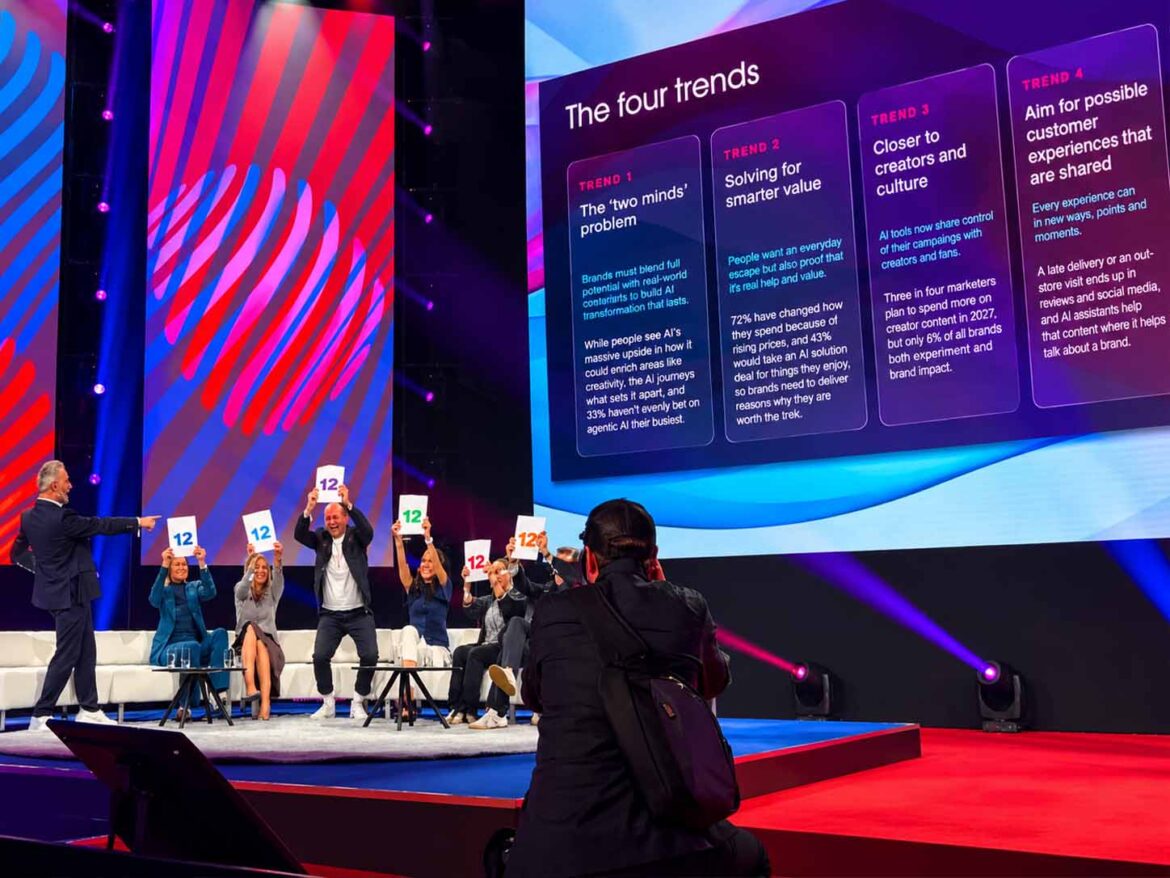
Live voting on the DMEXCO Center Stage: six marketing leaders from major brands award their points for the brand trend of 2027.
The Brands’ Trends Grand Jury x DMEXCO 2026 during the live assessment of the four trend candidates | Photo: © Ulrich Buckenlei, recorded live on the Center Stage of DMEXCO 2026 | XR Stager Online Magazine | VISORIC GmbH
The Brands’ Trends Grand Jury 2026:
Jennifer Treiber-Ruckenbrod, CMO, MINI
Lea Drusio, CMO, Nespresso
Daniel Jäger, Group Head of Media, Deutsche Telekom
Ana von Hutten, Marketing Director EMEA, Mattel Vehicles & Building Sets
Mona Roberts, CMO, Primark DACH
Rik Strubel, CMO, Douglas
On September 24, 2026, the second day of DMEXCO in Cologne, almost every conversation on the Center Stage revolved around artificial intelligence, agents that do the shopping, and prompts that replace campaigns. To close the day, six marketing leaders from major brands voted together with the live audience on four trend candidates for 2027, prepared by the market research company Kantar. The winner was not the trend most directly concerned with AI agents.[1]
The scene itself, recorded by Ulrich Buckenlei live on site at DMEXCO 2026, shows a rare format: not a single keynote, but a structured vote between an expert jury and the audience, with scores openly displayed at the end.
- The session “Brands’ Trends Grand Jury x DMEXCO 2026” took place in Cologne on September 24, 2026.
- A jury of six marketing leaders voted together with the live audience.
- Kantar put four trend candidates for 2027 to the vote.
- The jury counted for 60 percent, the audience for 40 percent of the score.
- Not the AI agent trend, but shared customer experiences won.
This article shows who sat on the jury, which four trends were up for election, how the voting worked in detail, and what the surprising winner reveals about the actual priorities of brands for 2027.
Six Marketing Leaders, One Shared Decision
The Brands’ Trends Grand Jury x DMEXCO 2026 did not consist of marketing experts in general, but of acting marketing leaders from major consumer brands, including four CMOs, spanning retail, mobility, consumer goods and telecommunications.
The jury included Rik Strubel, CMO of Douglas, Lea Drusio, CMO of Nespresso, Jennifer Treiber-Ruckenbrod, CMO of MINI, Ana von Hutten, Marketing Director EMEA for Mattel Vehicles & Building Sets, Mona Roberts, CMO of Primark DACH, and Daniel Jäger, Group Head of Media at Deutsche Telekom.[1] The panel was moderated on the Center Stage, with the audience voting live via an app in parallel to the jury’s assessment.
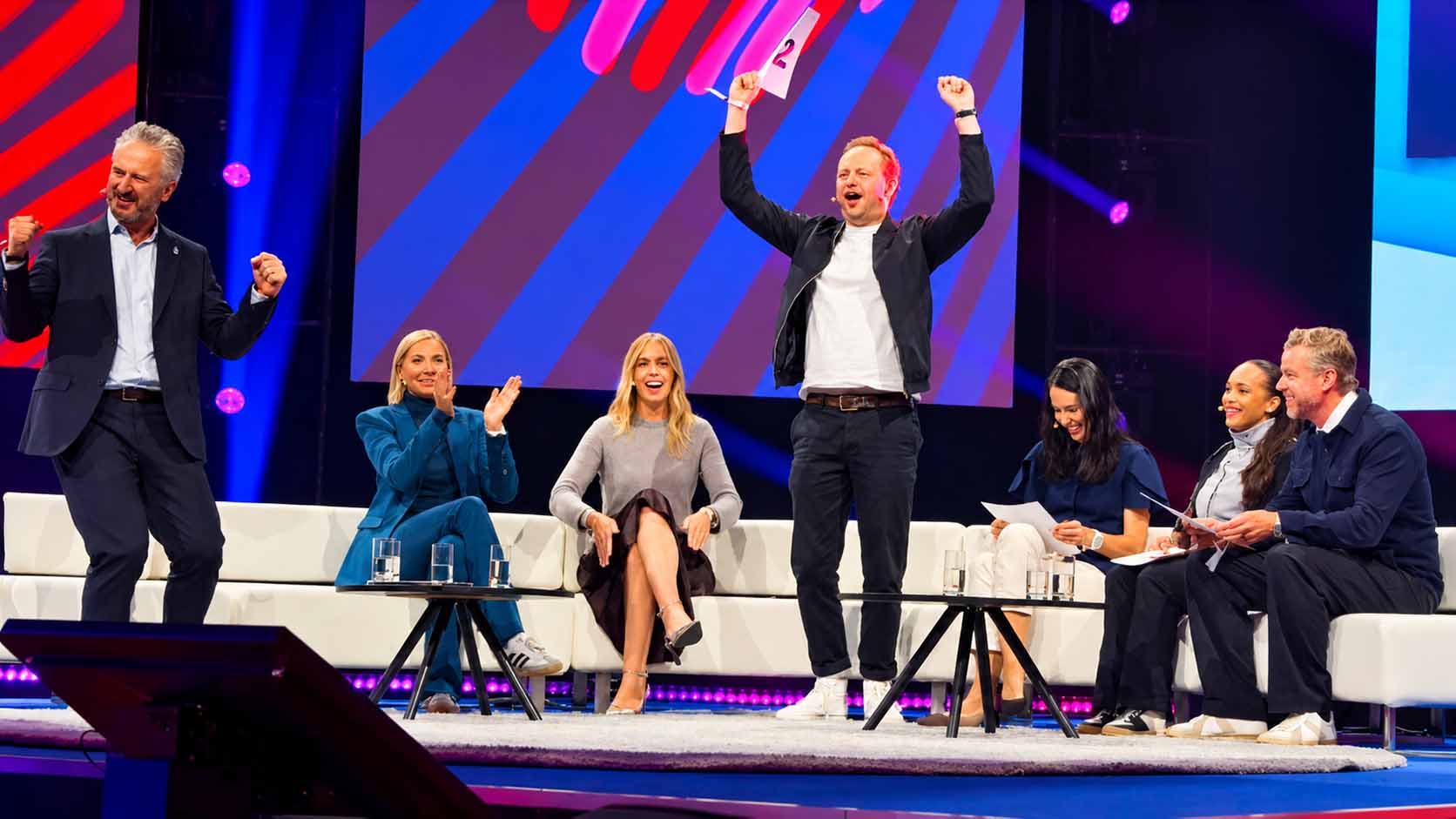
Six brands, one shared benchmark for brand value.
Photo: The jury during the live assessment of one of the four trend candidates, recorded by Ulrich Buckenlei on the Center Stage of DMEXCO 2026 | XR Stager Online Magazine | VISORIC GmbH
This composition is a statement in itself: instead of following a single brand or industry, the session brought together perspectives from beauty retail, coffee, automotive, toys, fast fashion and telecommunications, six completely different customer relationships with one shared question.
- The jury consisted of six marketing leaders from major brands, including four CMOs.
- Douglas, Nespresso, MINI, Mattel, Primark and Telekom were represented.
- The session took place on the Center Stage of DMEXCO.
- The audience voted in parallel via a live voting app.
- Six different industries reached a joint assessment.
Before the jury could vote at all, it first had to know what exactly it was judging. Kantar delivered precisely that with a pointed initial diagnosis.
The Initial Diagnosis. More Signals, Less Clarity
Before the four trend candidates were introduced, the Kantar speaker presented a concise thesis on the overall state of the marketing industry, which set the framework for the entire vote.
The core message, in essence: the era in which brands operate has changed, but the fundamental power of a strong brand has not.[1] This was made concrete with a second core thesis: more signals and more decisions, while clarity for marketing leaders is declining. Four factors were named: AI agents and creator ecosystems are changing how people choose in the first place, signals sit in separate silos while strategy execution lags behind, short-term pressure meets long-term uncertainty, and scrutiny from finance leaders is higher than ever before.
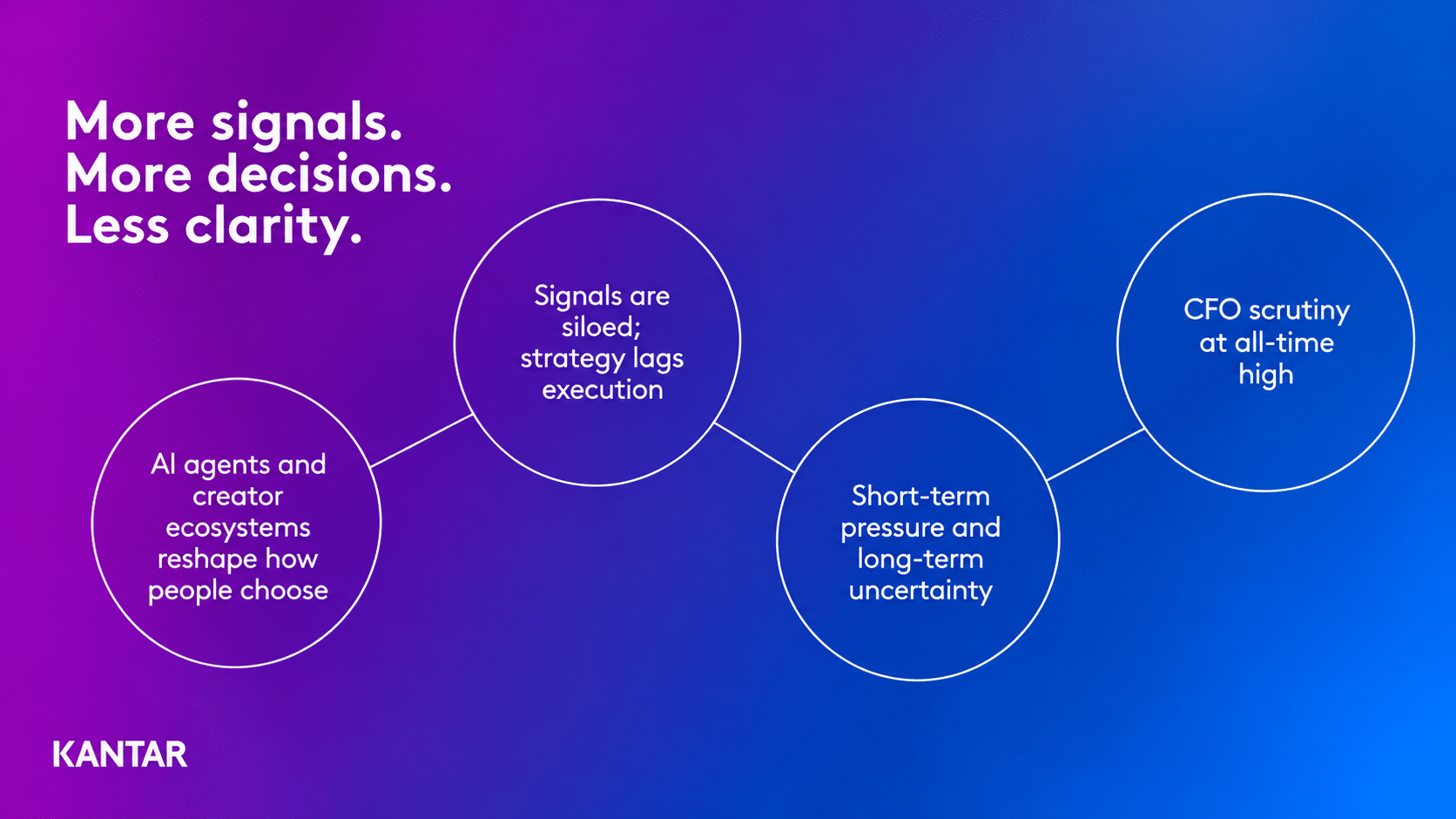
Four pressure points, one common denominator, less clarity despite more data.
Photo: Original slide from the Kantar presentation on the four causes of declining decision clarity, recorded by Ulrich Buckenlei at DMEXCO 2026 | XR Stager Online Magazine | VISORIC GmbH
This diagnosis is the real key to the later voting result: if a lack of clarity is the core problem, the winner may not be the trend with the loudest technology story, but the one that most directly creates clarity.
- Kantar considered brand value itself to be as strong as ever.
- At the same time, according to Kantar, signals grew faster than clarity.
- AI agents and creator ecosystems are changing how people choose.
- Short-term pressure and CFO scrutiny make long-term strategy harder.
- This diagnosis framed all four trend candidates.
With this diagnosis in place, Kantar introduced the first of four trend candidates, the one that addressed AI most directly.
Trend 1. The Two Minds Problem
The first trend candidate described a challenge that came up again and again throughout DMEXCO 2026: today, brands have to be convincing to two completely different recipients, to people and to the AI systems that now help shape purchasing decisions.
The concrete figure behind it: when people ask an AI assistant what to buy, according to the Kantar data shown, a brand only makes the shortlist if the AI knows what actually sets that brand apart.[1] According to this survey, 37 percent of respondents would already allow an AI agent to fill their shopping basket on its own, without checking every single product themselves.
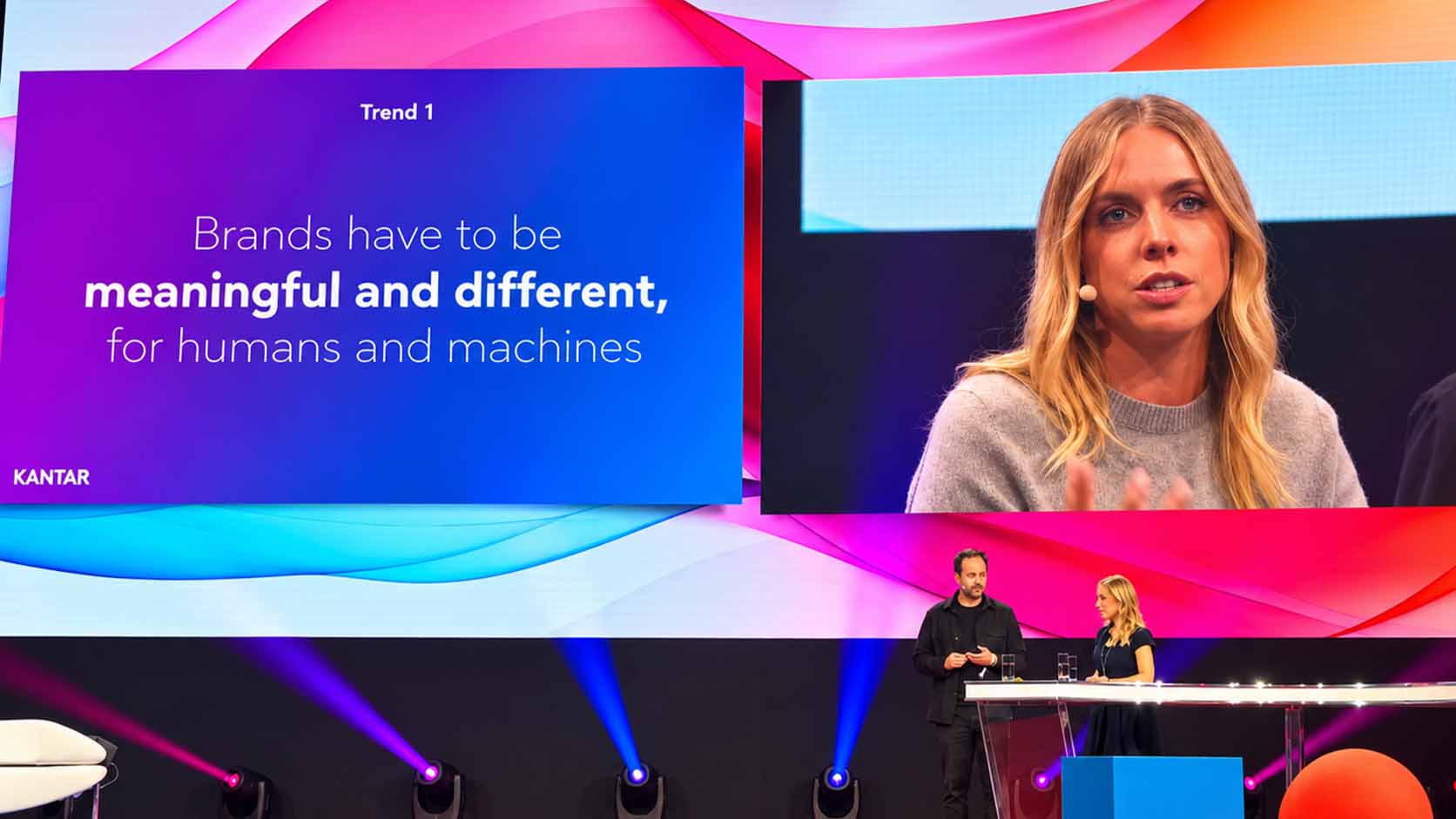
Today a brand has to win over two minds at once, the human and the machine.
Photo: Original slide on Trend 1, recorded by Ulrich Buckenlei on the Center Stage of DMEXCO 2026 | XR Stager Online Magazine | VISORIC GmbH
In terms of content, this trend was the most obvious candidate for the overall win, as it fit most directly with the AI focus of the entire conference. As the subsequent vote shows, however, obvious did not mean victorious.
- According to Trend 1, brands must convince both people and AI.
- An AI only recommends brands if it knows what makes them different.
- 37 percent would let an AI agent take over their shopping basket.
- The trend fit most directly with the AI focus of the conference.
- Nevertheless, it was not automatically the most promising candidate.
The second trend candidate moved away from AI again and turned to a completely different tension, the relationship between saving and conscious consumption.
Trend 2. Save Smart, Treat Consciously
The second candidate, presented by Kantar under the term “Treatonomics”, described a shift in consumer behavior: consistent saving in everyday life, combined with a conscious willingness to pay significantly more for individual, emotionally meaningful products.
According to the data shown, 72 percent of respondents have already changed their everyday spending because of rising prices. At the same time, 36 percent would take on short-term debt to afford things that matter to them.[1] The resulting consequence for brands: they need a clearly communicable reason why their product is worth exactly this conscious exception.
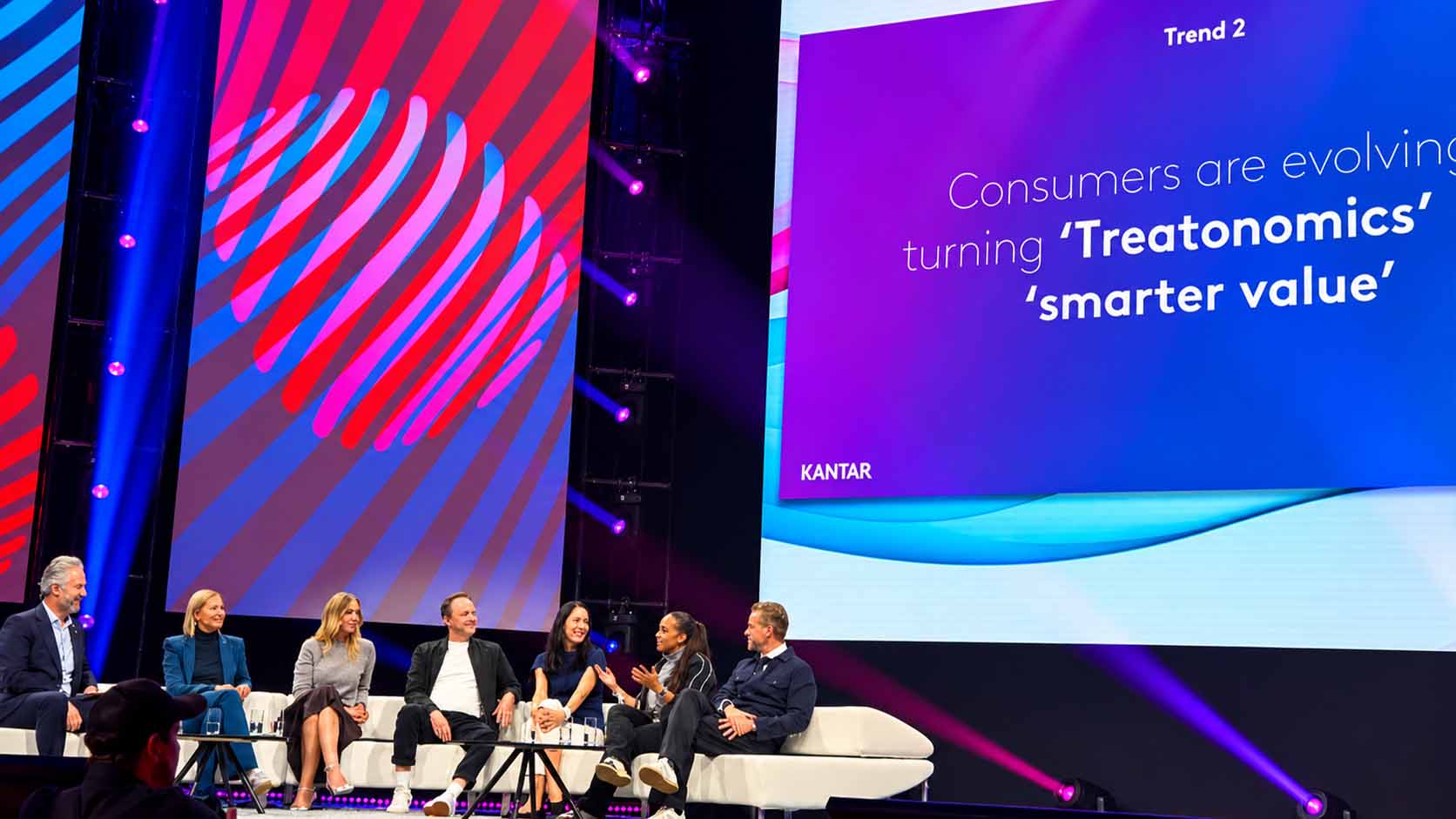
Saving in everyday life, treating yourself to what really matters.
Photo: Original slide on Trend 2, “Treatonomics”, recorded by Ulrich Buckenlei at DMEXCO 2026 | XR Stager Online Magazine | VISORIC GmbH
For brands, this trend means that pure discount strategies are no longer enough on their own. They also need to be able to clearly explain why their product belongs to the conscious exceptions for which people are willing to pay more or even take on short-term debt.
- 72 percent have changed their spending because of rising prices.
- 36 percent would take on short-term debt for things that matter.
- Everyday saving and conscious indulgence are not mutually exclusive.
- Brands need a clear reason for their exceptional status.
- According to this trend, pure discount strategies are no longer enough.
The third trend candidate shifted the focus from the purchase decision itself to the question of who actually still controls a campaign today.
Trend 3. Less Control over the Campaign Ecosystem
The third candidate described a structural shift that many marketing leaders already feel in their daily work: today, brands have far less say over how and where their campaigns actually take effect.
According to the figures shown, three out of four marketing leaders plan to invest more budget in creator content in 2027. However, only 6 percent of this content works for both reach and actual brand impact at the same time.[1] In other words: the budget for creators is growing much faster than the ability to turn it into real brand value.
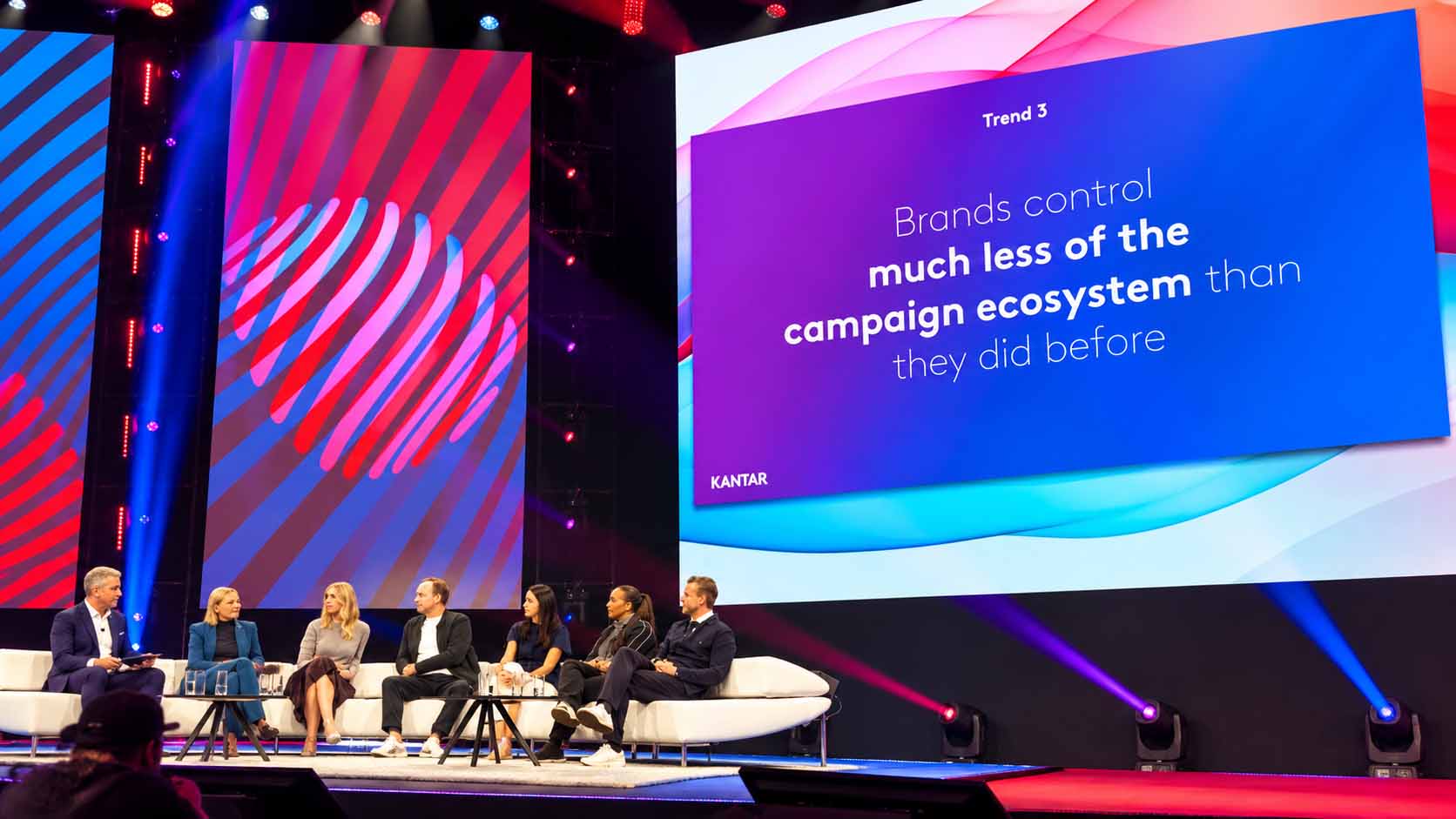
Three out of four are betting more on creators, only six in a hundred truly hit both goals.
Photo: Original slide on Trend 3, recorded by Ulrich Buckenlei on the Center Stage of DMEXCO 2026 | XR Stager Online Magazine | VISORIC GmbH
For brands, this means that more money for creator content alone does not solve the problem. What matters is the much smaller subset of content that actually achieves both goals at the same time.
- Three out of four marketing leaders will increase their creator budget in 2027.
- Only 6 percent of creator content drives both reach and brand.
- Brands increasingly lose control over their own campaign ecosystem.
- Budget growth and impact growth are clearly drifting apart.
- According to this trend, more money alone does not solve the impact problem.
The fourth and final candidate seemed the least technology-driven at first glance, and yet it became the clear winner in the end.
Trend 4. Shared Experiences as the Real Goal
The fourth candidate did not describe a new technology, but a consequence: today, almost every single experience with a brand inevitably ends up in reviews, social media posts or AI answers, whether the brand wants it or not.
The associated core message: a late delivery or an excellent store visit ultimately ends up in reviews and social media posts, and this is exactly what AI assistants draw on when people ask them about a brand.[1] This trend was backed by a concept Kantar called the “Experience Loop”, a cycle of AI answers, direct in-person experiences and user-generated content such as reviews that reinforce one another. The session also featured a quote from Amazon CEO Andy Jassy, who essentially expects that practically every customer experience will be reinvented with the help of AI.[2]
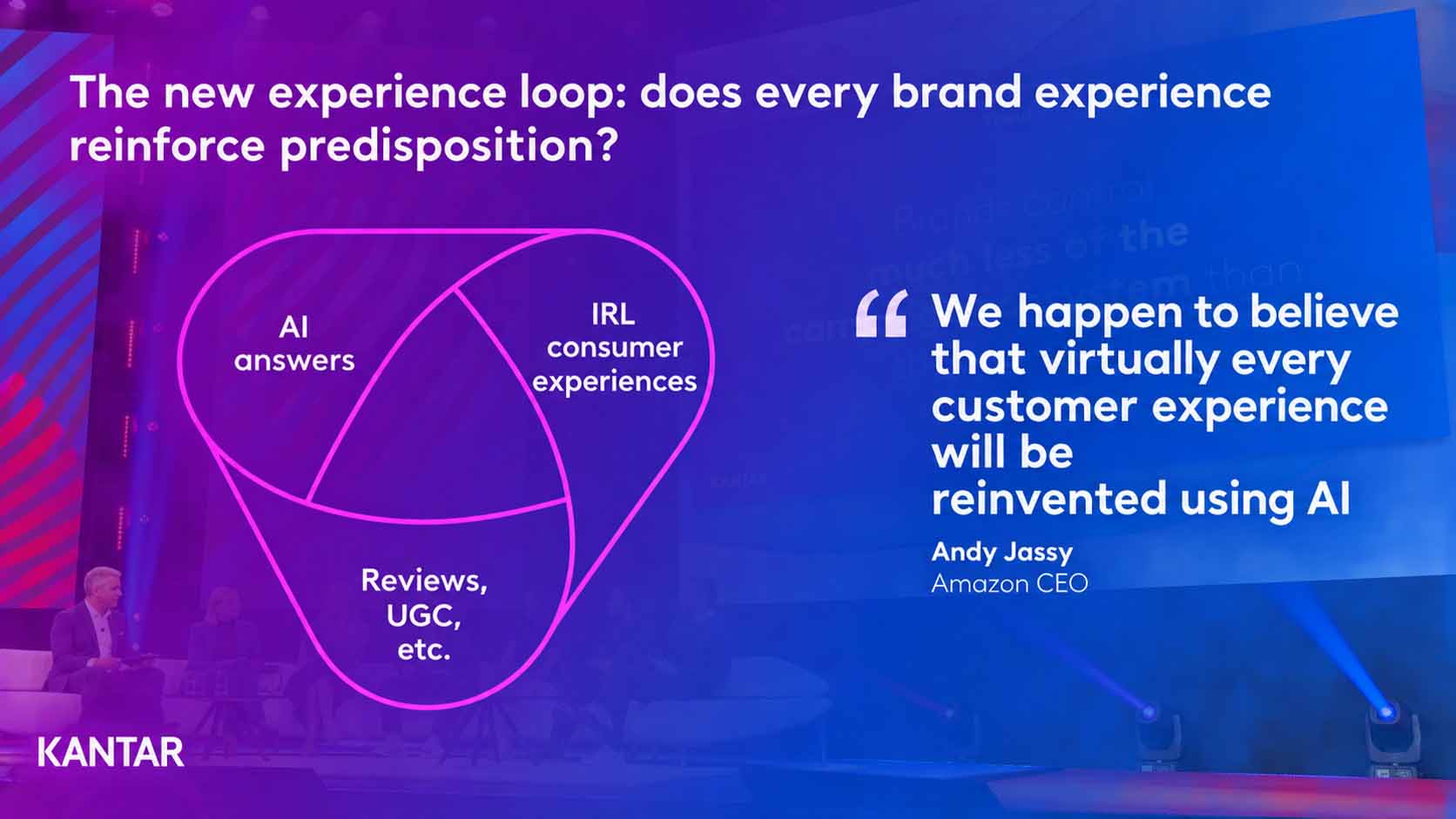
Every experience becomes a signal that shapes the next decision.
Photo: Original slide on the “Experience Loop” with a quote from Andy Jassy, recorded by Ulrich Buckenlei at DMEXCO 2026 | XR Stager Online Magazine | VISORIC GmbH
The decisive difference from Trend 1: where the first candidate treated AI as an audience in its own right alongside humans, Trend 4 positions AI merely as one of several channels through which an experience that has already happened is passed on. The experience itself remains at the center.
- Every brand experience today almost inevitably becomes publicly visible.
- AI answers draw directly on reviews and experience reports.
- The Experience Loop links AI answers, in-person experience and reviews.
- Amazon CEO Andy Jassy sees AI as a driver of new customer experiences.
- Here, AI is a channel, not the goal of brand communication in itself.
Four very different candidates, one joint vote. The next chapter shows exactly how the jury and the audience reached their verdict.
The Result. How Jury and Audience Decided Together
After all four trends had been presented, the six-member jury rated each candidate live on site with scorecards, while the audience voted in parallel via the app. Both scores were then weighted and combined: the jury counted for 60 percent, the audience for 40 percent of the overall result.
The result was clear: Trend 4, shared positive customer experiences, won with 72 points in total, of which 43.2 points came from the jury and 28.8 points from the audience.[1] Second place went to Trend 1, the two minds problem, with 45 points, followed at a clear distance by Trend 3 with 34.2 points and Trend 2 with 29.8 points.
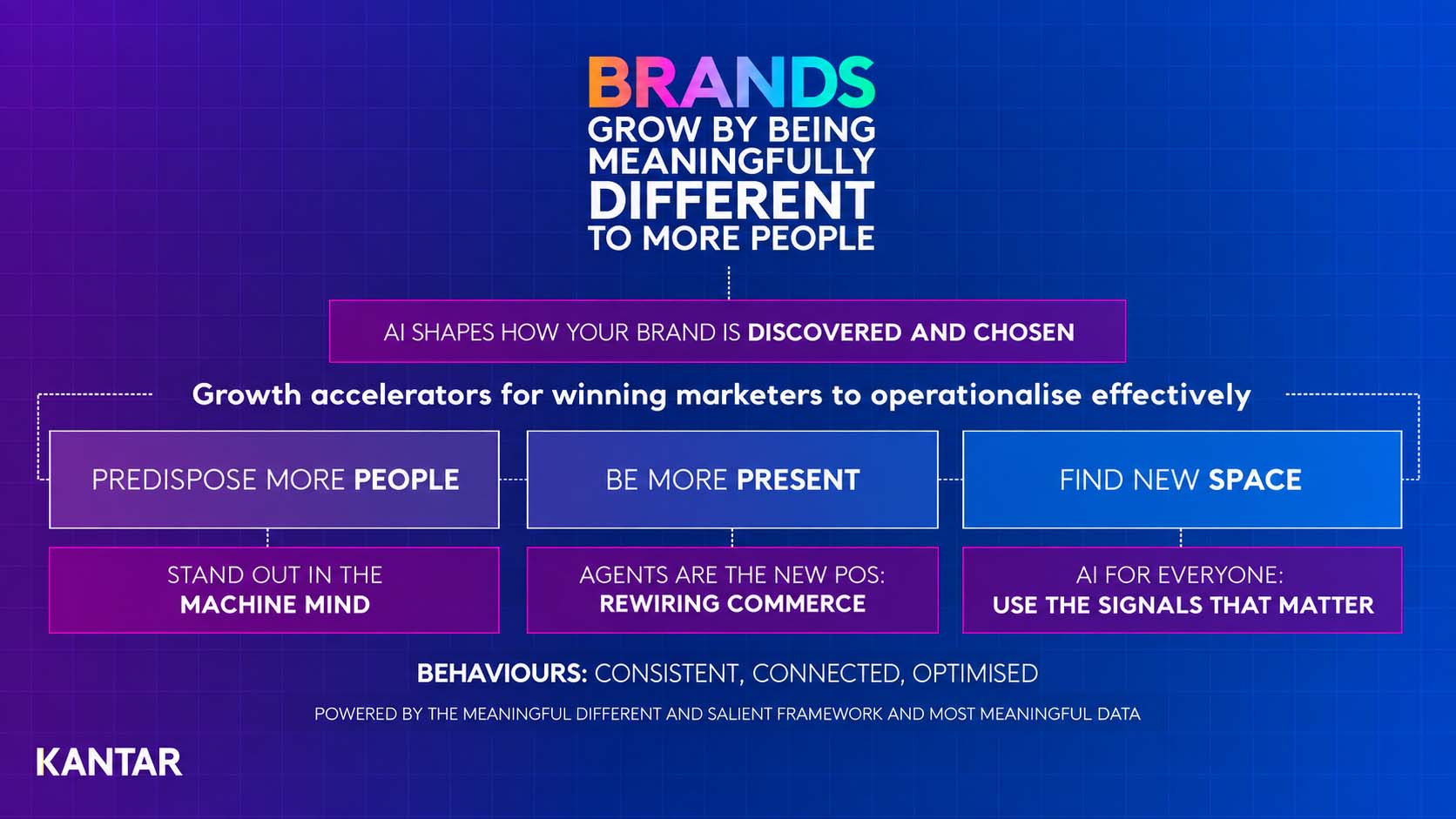
One trend won clearly, and it was not the one with the loudest AI angle.
Photo: Original results slide with the final ranking, recorded by Ulrich Buckenlei on the Center Stage of DMEXCO 2026 | XR Stager Online Magazine | VISORIC GmbH
| Rank | Trend | Total points | Jury (60%) | Audience (40%) |
|---|---|---|---|---|
| 1 | Shared positive customer experiences | 72.0 | 43.2 | 28.8 |
| 2 | The two minds problem | 45.0 | n/a | n/a |
| 3 | Less control over the campaign ecosystem | 34.2 | n/a | n/a |
| 4 | Save smart, treat consciously | 29.8 | n/a | n/a |
The margin is remarkable: the winner finished 27 points ahead of the runner-up, a clear result rather than a close neck-and-neck race.
- Jury and audience voted separately, weighted 60 to 40.
- Shared customer experiences won clearly with 72 points in total.
- The AI trend topic came second with 45 points.
- The gap to the runner-up was 27 points.
- Both voting groups, jury and audience, were disclosed transparently.
This result raises a question that goes beyond the individual session: what does the victory of Trend 4 say about the actual priorities of brands for 2027?
What the Win Really Means
At first glance, it seems surprising that a trend which does not put AI at its center wins at an AI-dominated trade show of all places. On closer inspection, however, the result fits exactly with the initial diagnosis from Chapter 2.
Kantar itself provided an explanatory framework for this, a growth model titled “BRANDS”, which calls on brands to become meaningfully different to more people.[1] According to this model, AI mainly changes how a brand is discovered and chosen, but not what defines a brand at its core. Three growth levers were named: predisposing more people by also standing out in the “Machine Mind”, being more present because AI agents are becoming the new point of sale, and finding new space by making AI usable for everyone and focusing on the signals that truly matter. The logic of Trend 4’s victory fits seamlessly here: whoever puts the actual experience at the center automatically also wins the downstream AI answers, reviews and recommendations that build on that experience.
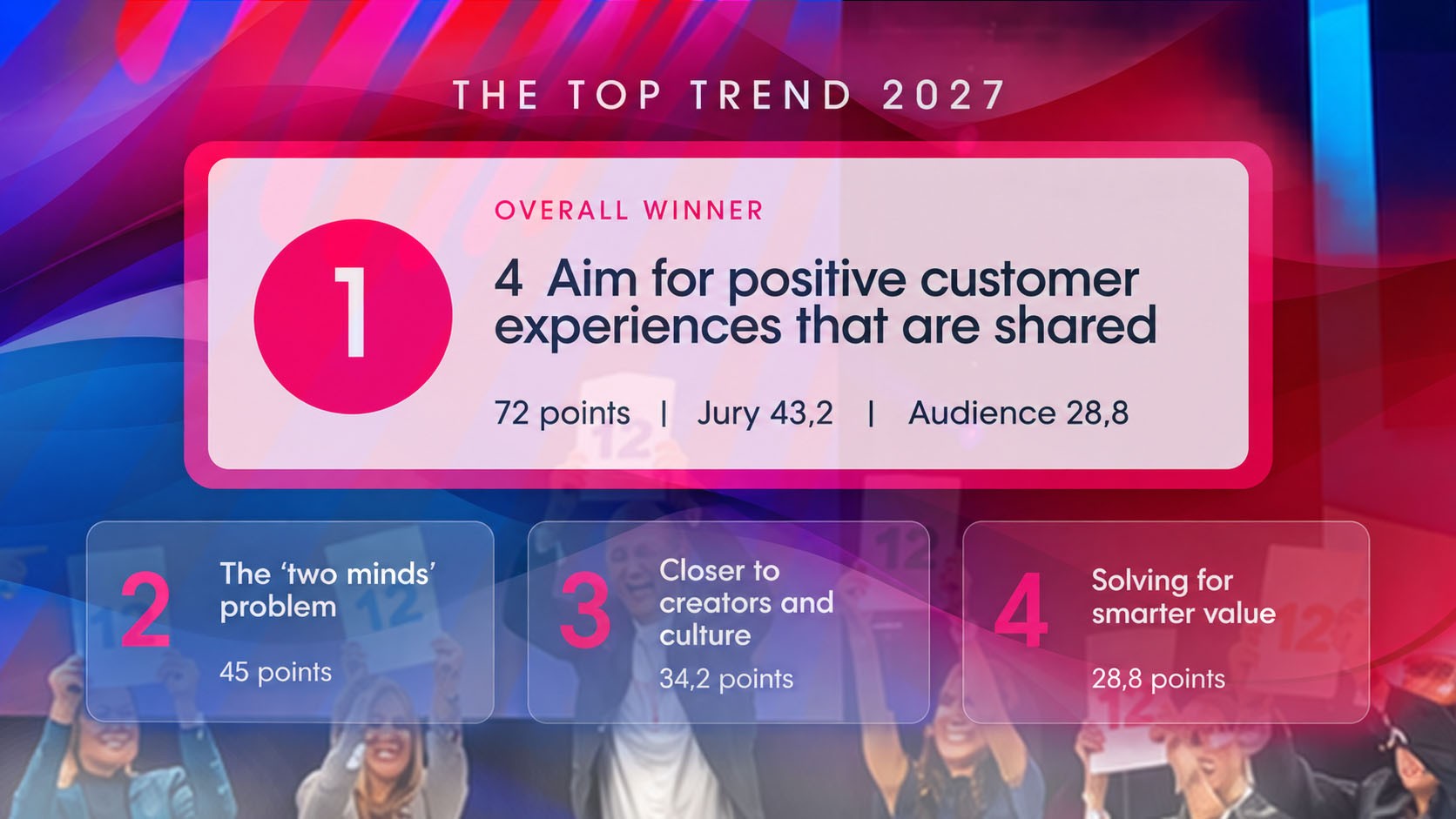
Whoever wins the experience ultimately wins the AI answer about it as well.
Photo: Original slide on the BRANDS growth model, recorded by Ulrich Buckenlei at DMEXCO 2026 | XR Stager Online Magazine | VISORIC GmbH
For marketing leaders, the result thus provides concrete guidance for prioritization: before budget flows into ever new AI interfaces, it is worth asking whether the underlying customer experience itself is already good enough to spread positively on its own, in reviews, in conversations and, indeed, in AI answers.
- Kantar’s BRANDS model sees AI as a discovery channel, not the core of the brand.
- Three growth levers: reach more people, be more present, find new space.
- A strong core experience automatically has a positive effect in AI answers too.
- This explains why Trend 4 won despite an AI-focused trade show.
- The experience itself remains the lever, AI is only the amplifier.
The Vote on Video
The entire session, from the presentation of the four trends to the final score on the big screen, was filmed by Ulrich Buckenlei live on the Center Stage of DMEXCO 2026. Among other things, the video shows the jury’s scorecards in action and the moment the overall winner is announced.
The moment four candidates become one result.
Video still: The Brands’ Trends Grand Jury during the live assessment of the four trend candidates at DMEXCO 2026 | Video: © Ulrich Buckenlei | XR Stager Online Magazine | VISORIC GmbH
From Brand Experience to Tangible Implementation
The victory of Trend 4 confirms something that is often overlooked in practice: even the most impressive AI application achieves little if the underlying experience itself is not convincing. This is exactly the interface, between genuine, tangible brand experience and its technological amplification, where the core of VISORIC’s work lies.
The expert team of VISORIC GmbH from Munich combines more than 15 years of experience in 3D, AI and Spatial Computing with hands-on expertise in designing brand experiences that remain convincing when they are later shared in reviews, social media posts or AI answers, whether for a VR product presentation, a walk-through 3D visualization or a hybrid trade show experience.
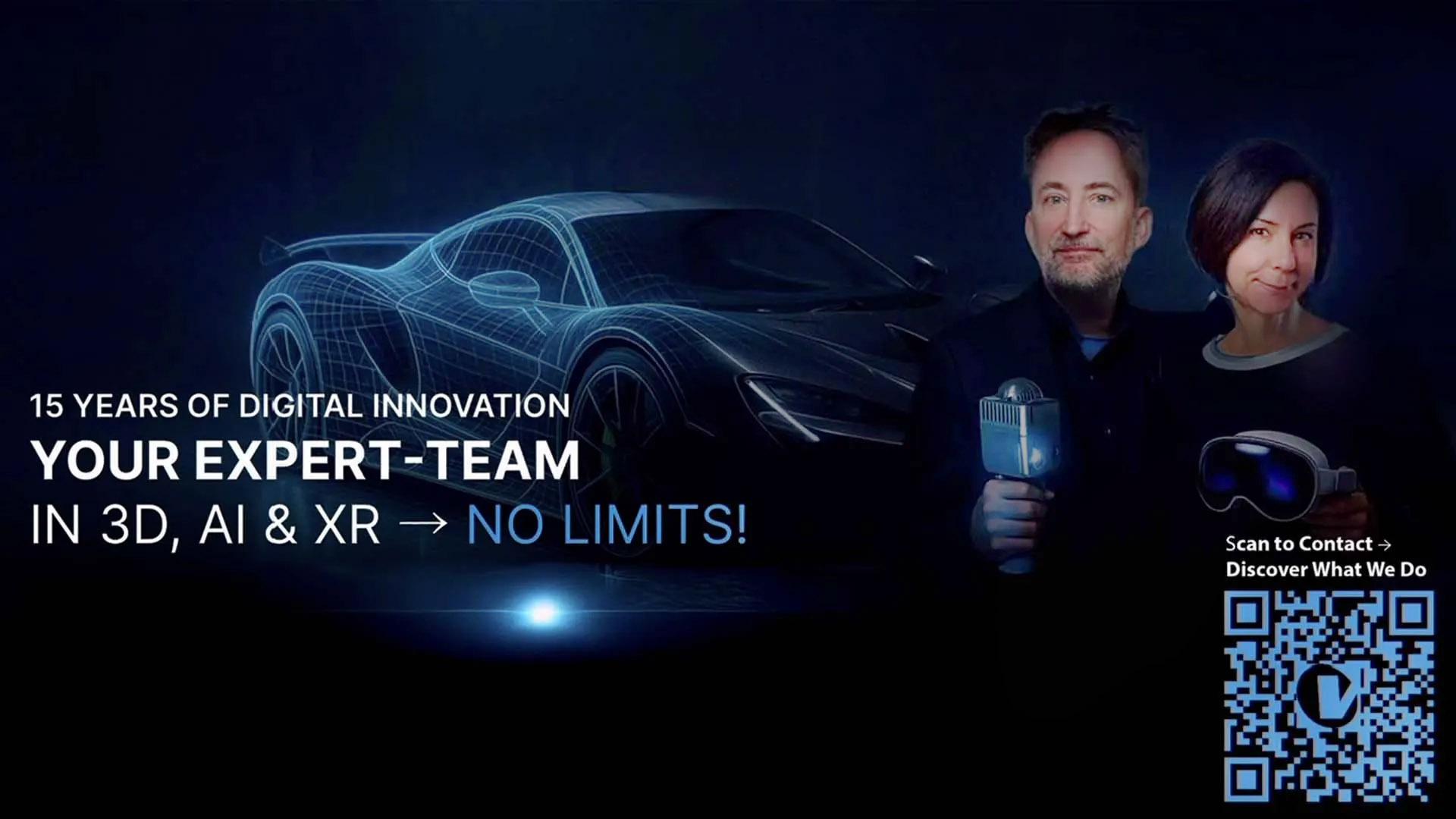
15 years of experience in making brand experiences tangible, the VISORIC team from Munich.
Image: © Ulrich Buckenlei | XR Stager Online Magazine | VISORIC GmbH
Which customer experience of your brand would be worth designing so well that it spreads on its own?
Talk to the VISORIC expert team from Munich about Spatial Computing, 3D visualization and brand experiences that convince even in an AI-shaped world of experiences.
Contact:
Email: info@visoric.com
Phone: +49 89 21552678
Sources and References
- Own video recording and photo documentation of the session “The Brands’ Trends Grand Jury x DMEXCO 2026”, recorded by Ulrich Buckenlei live on site, Center Stage, DMEXCO 2026, Cologne. Presented by Kantar.
- Statement by Andy Jassy, CEO, Amazon, quoted during the session and reproduced on the Kantar presentation slide on the trend “The return of experience in the Experience Loop”.
Contact Persons:
Ulrich Buckenlei (Creative Director)
Mobile: +49 152 53532871
Email: ulrich.buckenlei@visoric.com
Nataliya Daniltseva (Project Manager)
Mobile: +49 176 72805705
Email: nataliya.daniltseva@visoric.com
Address:
VISORIC GmbH
Bayerstraße 13
D-80335 Munich