

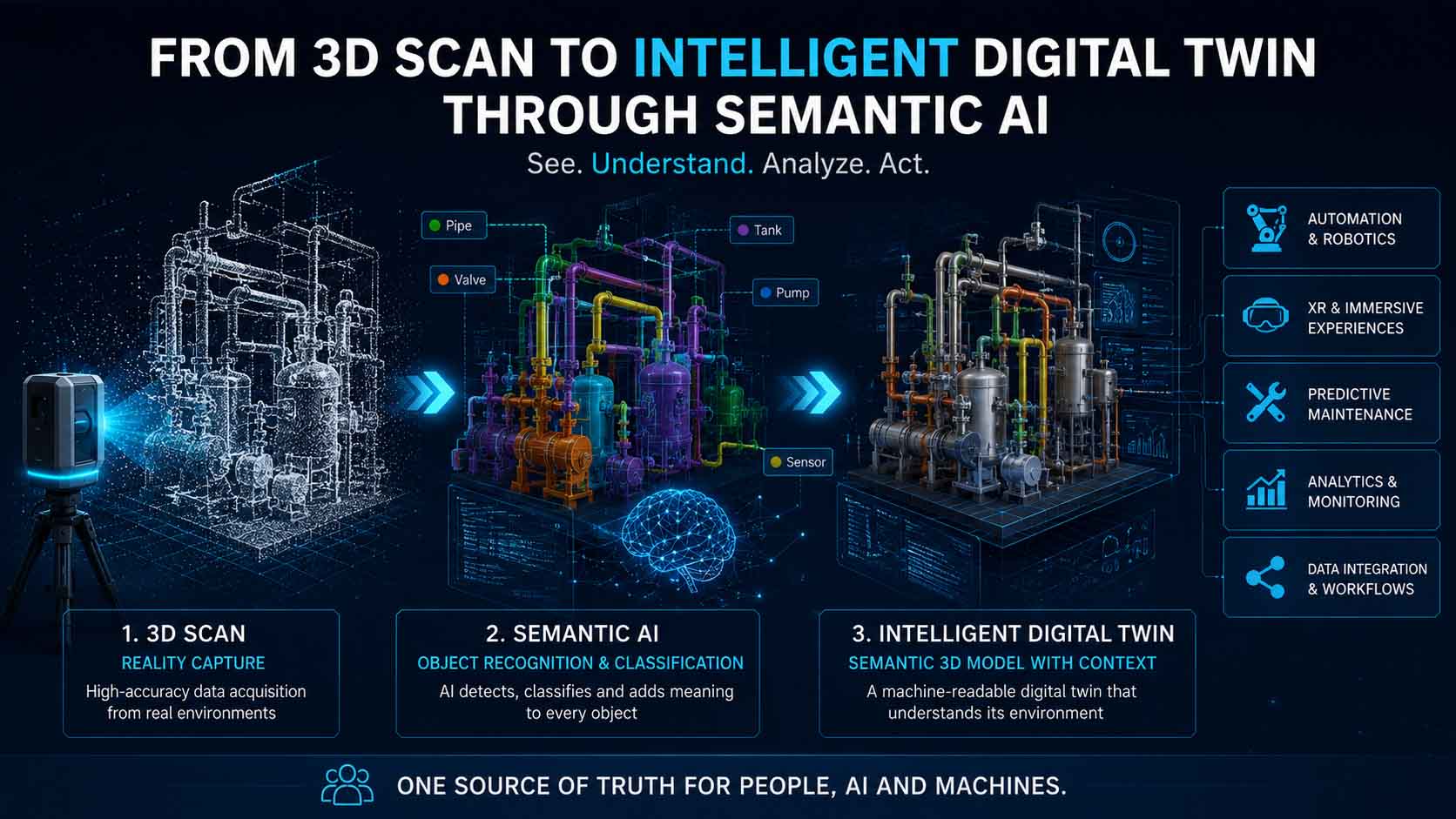
The concept image shows an industrial facility evolving from a pure 3D reconstruction into an intelligent, machine-readable digital twin through Semantic AI.
Visualization: Semantic AI, Computer Vision, Gaussian Splatting, industrial 3D scanning, object recognition, semantic segmentation, and intelligent digital twins | Image: © Ulrich Buckenlei | VISORIC GmbH
From 3D Scans to Intelligent Digital Twins through Semantic AI
Digital twins no longer describe only the geometry and appearance of real-world objects. Through Semantic AI, they are increasingly evolving into intelligent, machine-readable representations of the physical world. Objects can be automatically detected, classified, spatially contextualized, and enriched with additional knowledge. This creates a fundamental shift: a pure 3D reconstruction becomes a system that not only represents its environment but increasingly understands it.[1]
For a long time, the greatest challenge of digital twins was capturing real environments as accurately as possible. Laser scanning, photogrammetry, CAD models, and modern methods such as Gaussian Splatting enabled increasingly realistic reconstructions, but often provided only geometric information. For machines, AI systems, and automated processes, this data remained of limited practical use.[2]
This is exactly where Semantic AI comes into play. Modern computer vision models can automatically detect, classify, and enrich objects within 3D scans with semantic information. Pipelines are recognized as pipelines, pumps as pumps, valves as valves, and buildings are interpreted as functional structures within a larger system. As a result, a 3D model becomes an intelligent digital twin enriched with contextual knowledge.[3]
The cover image of this article clearly illustrates this transition. An industrial 3D scan is first captured geometrically. Artificial intelligence then analyzes individual components, adds semantic meaning, and generates a semantic model that becomes understandable for both humans and machines. This very step could initiate the next stage in the evolution of digital twins.
For industrial companies, infrastructure operators, cities, energy providers, and plant manufacturers, this development is particularly relevant. Many organizations already possess extensive 3D datasets. However, the true value emerges only when this data can be automatically interpreted, searched, and utilized for analytics, simulation, and automation processes.[4]
The concepts developed by the Munich-based VISORIC expert team increasingly demonstrate that the economic value of digital twins is not created solely through improved visualization. The decisive factor will be how intelligently real-world objects, processes, and spatial relationships can be detected, interpreted, and made available for new applications. Semantic AI, Computer Vision, Gaussian Splatting, and real-time 3D technologies are therefore converging into a unified technological platform.
The key question is therefore no longer just how realistic a digital twin looks. Much more important will be how well it understands its environment and how effectively it can support humans, AI systems, and machines.
- Semantic AI makes digital twins machine-readable
- Objects can be automatically detected and classified
- 3D scans become intelligent information models
- Computer Vision and Gaussian Splatting are converging
- Digital twins are becoming the foundation for AI and automation
The foundation for this development lies in artificial intelligence’s ability not only to capture spatial information but also to understand it semantically.
Semantic AI Learns to Understand Spatial Information
Classical computer vision focused primarily on two-dimensional images for many years. Modern AI systems now go significantly further. They not only analyze individual pixels but also recognize objects, their properties, and their spatial relationships within complex environments. This capability forms the foundation of Semantic Gaussian Splatting and the next generation of digital twins.[5]
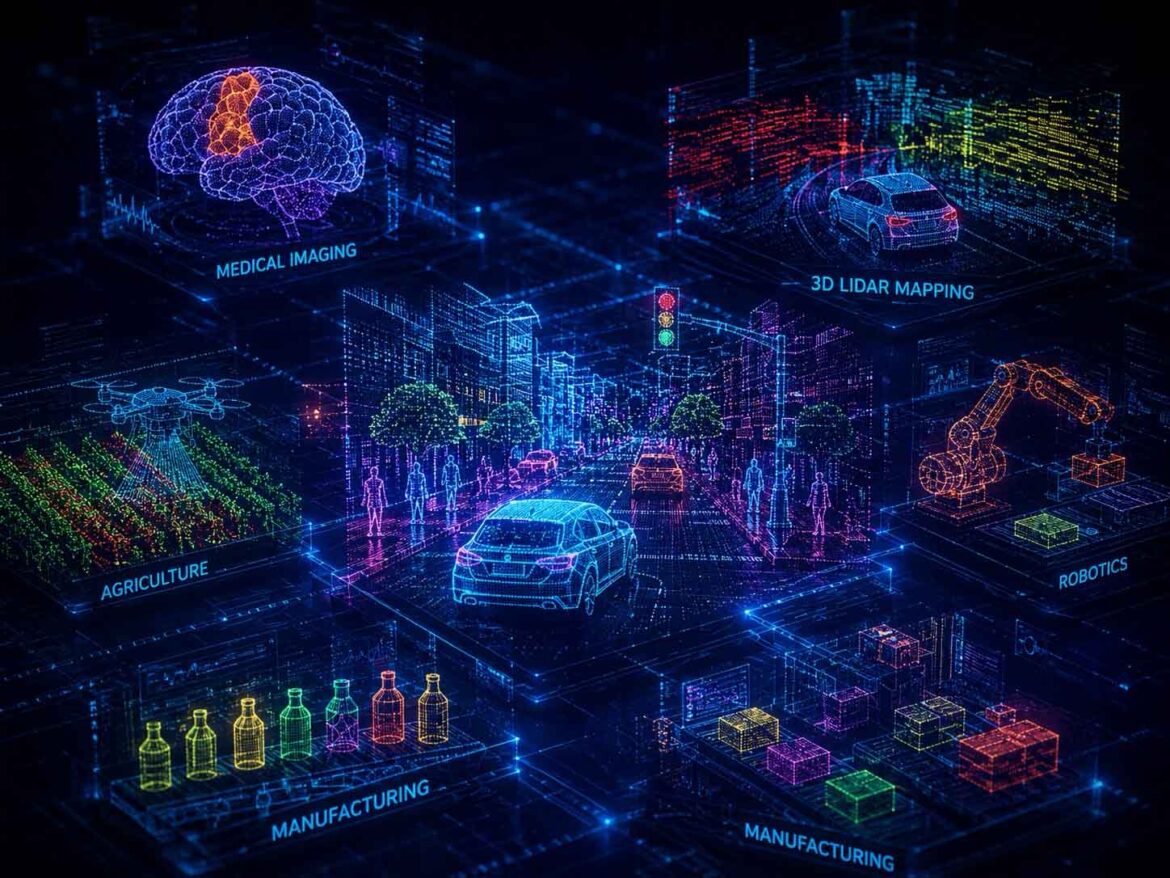
The image in this chapter illustrates the enormous range of semantic interpretation. Medical imaging, autonomous driving, agriculture, robotics, and industrial manufacturing already use semantic segmentation techniques today. Artificial intelligence not only detects objects but also understands their meaning within a larger system.[6]
This opens entirely new possibilities for digital twins. An industrial scan no longer contains only geometry and textures. Instead, it becomes a structured information space in which machines, sensors, buildings, vehicles, and production facilities can be automatically recognized and described.
The concept image illustrates how artificial intelligence analyzes spatial information and semantically interprets it across various application domains.
Visualization: Semantic AI, Computer Vision, semantic segmentation, autonomous driving, robotics, industry, and intelligent digital twins | Image: © Ulrich Buckenlei | VISORIC GmbH
This development is particularly interesting for industrial applications. Facilities, infrastructure, and production environments can not only be visualized but also automatically analyzed, searched, and evaluated. Digital twins are therefore evolving from static models into intelligent knowledge platforms.[7]
The Munich-based VISORIC expert team also increasingly considers semantic object recognition to be a key technology for future digital twin platforms. Only when real-world objects can be automatically detected and interpreted will scalable applications for maintenance, simulation, robotics, and industrial automation become possible.
- Semantic AI recognizes objects and their meaning
- 3D data becomes machine-readable
- Computer Vision enriches digital twins with contextual knowledge
- Industry, robotics, and infrastructure are converging
- Digital twins are evolving into knowledge platforms
The next stage of development begins when artificial intelligence not only recognizes individual objects but also semantically interprets complete 3D environments.
Semantic Gaussian Splatting Makes 3D Scans Intelligent
Gaussian Splatting has rapidly established itself as a powerful method for photorealistic reconstruction of real-world environments. However, its greatest limitation has been that these models looked realistic but could not understand their content. Semantic Gaussian Splatting changes exactly this.[8]
By combining Gaussian Splatting, Computer Vision, and Semantic AI, objects within a reconstructed scene can be automatically detected, classified, and enriched with additional information. A visual reconstruction thereby becomes an intelligent, machine-readable digital twin.[9]
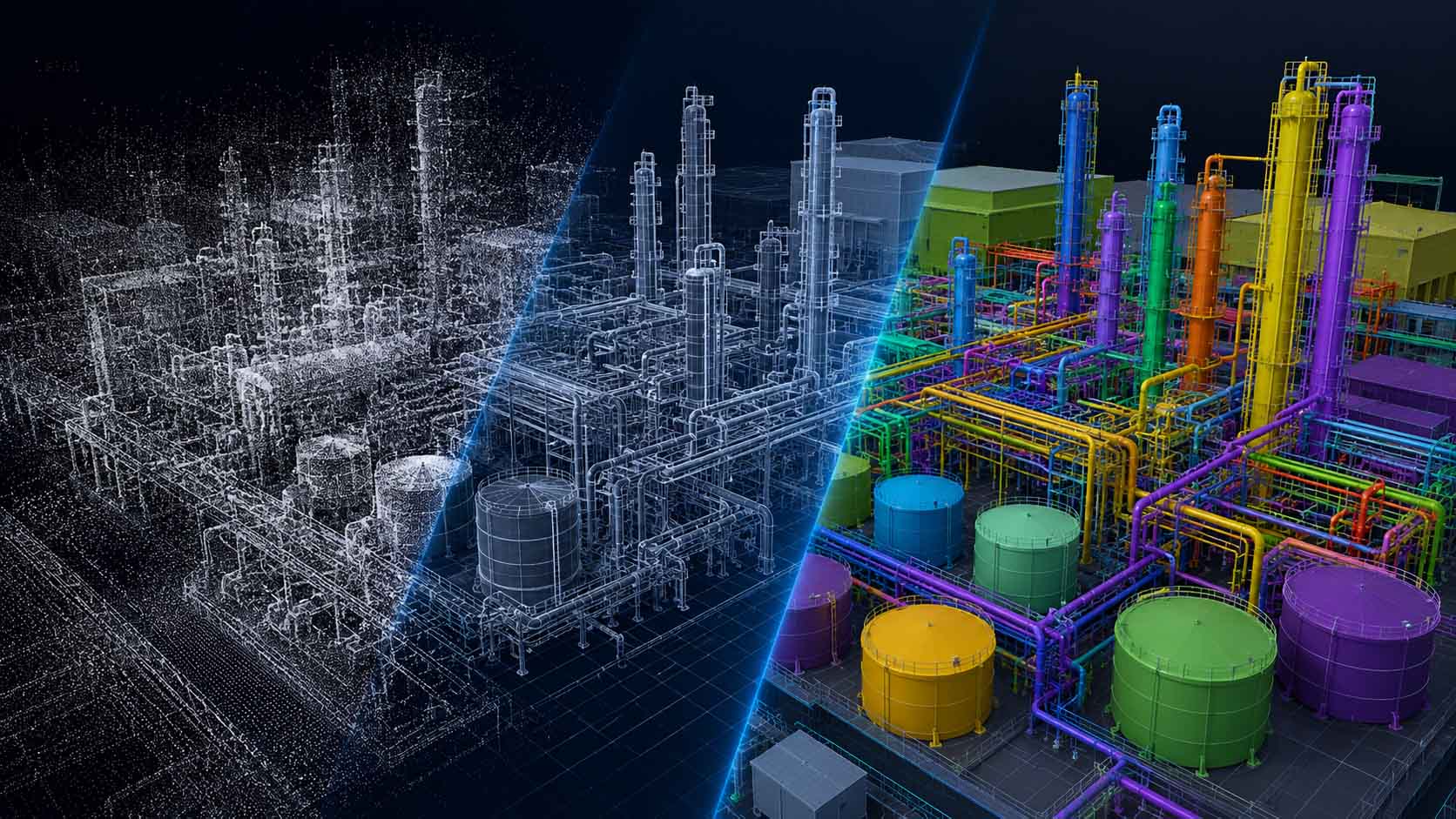
The image in this chapter exemplifies this transition. A photorealistic 3D scan of an industrial facility first becomes a semantically annotated model. Pipelines, valves, tanks, and technical components receive their own classes, attributes, and states. This then evolves into an intelligent digital twin with analytics, maintenance, and automation capabilities.
The concept image illustrates the evolution from a photorealistic 3D scan through Semantic Gaussian Splatting to an intelligent digital twin.
Visualization: Semantic Gaussian Splatting, Computer Vision, industrial facilities, semantic classification, and intelligent digital twins | Image: © Ulrich Buckenlei | VISORIC GmbH
This opens up new opportunities for companies. Digital twins can be automatically searched, analyzed, and connected to real-time data. Maintenance processes, asset management, robotics, XR applications, and industrial AI systems thus gain a common spatial information foundation for the first time.[10]
The actual innovation lies not only in visualization. The crucial capability is the automatic understanding of spatial information and making it usable for machines. This may represent one of the most important development steps for future digital twin systems.
- Gaussian Splatting becomes machine-readable through Semantic AI
- Objects automatically gain meaning and context
- Digital twins become searchable and analyzable
- Robotics and industrial AI gain spatial understanding
- New applications emerge for XR, maintenance, and automation
This creates the foundation for the next stage of development: intelligent digital twins that can analyze, interpret, and actively support their environments.
Semantic AI Understands Spatial Relationships
Automatic object recognition is only the first step toward intelligent digital twins. Semantic systems become truly powerful when they not only recognize individual objects but also understand their spatial relationships and functional dependencies.[13]
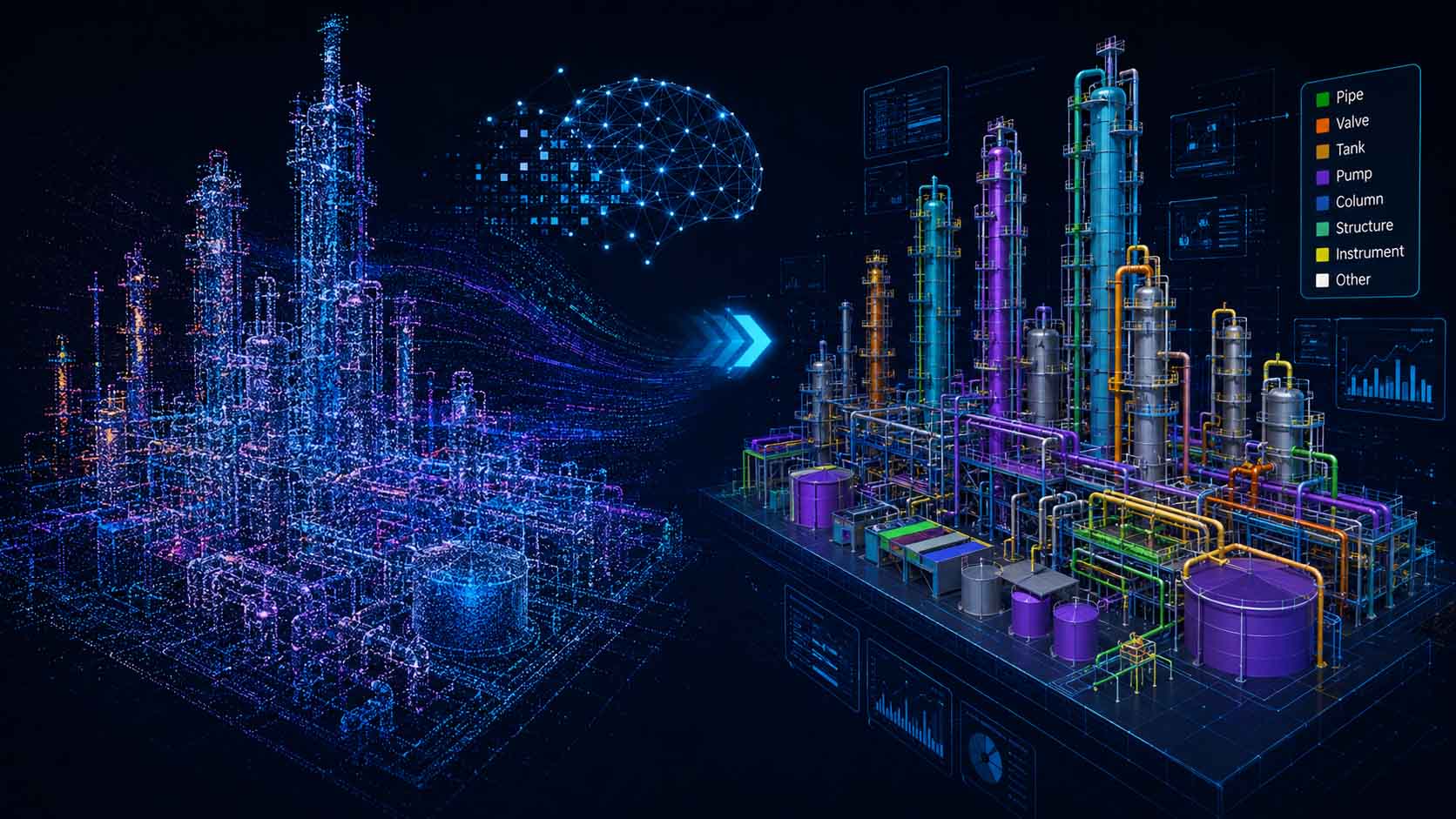
This is precisely where modern Semantic AI comes into play. Millions of individual measurement points, polygons, or Gaussian Splats become not only geometric models but also structured knowledge spaces. Artificial intelligence can identify, for example, which pipelines are connected, which valves belong to specific processes, or which machines collaborate within a production chain.[14]
The visualization illustrates how artificial intelligence creates a semantic understanding of industrial facilities based on individual objects and their spatial relationships.
Visualization: Semantic AI, spatial relationships, object graphs, industrial knowledge models, Computer Vision, and intelligent digital twins | Image: © Ulrich Buckenlei | VISORIC GmbH
This fundamentally changes the role of digital twins. Instead of a collection of individual 3D objects, a machine-readable model emerges that can understand and analyze relationships. This opens entirely new opportunities for maintenance, analytics, automation, and decision support.[15]
- Semantic AI automatically recognizes spatial relationships
- Objects become functionally interconnected
- Digital twins develop contextual understanding
- Machine-readable knowledge models emerge
- Analytics and automation potential increase significantly
When digital twins understand spatial relationships, they can independently interpret and classify complex industrial structures.
AI Automatically Creates Semantic Digital Twins
The manual structuring of digital twins has so far been one of the most labor-intensive tasks in industrial digitalization projects. Plant components must be identified, named, classified, and enriched with additional information. This is precisely the process that Semantic AI is increasingly automating.[16]
Modern AI systems can now automatically detect pipelines, pumps, valves, tanks, sensors, and electrical components and assign semantic properties to them. At the same time, existing CAD, BIM, and plant engineering data can be intelligently linked with the detected objects.[17]
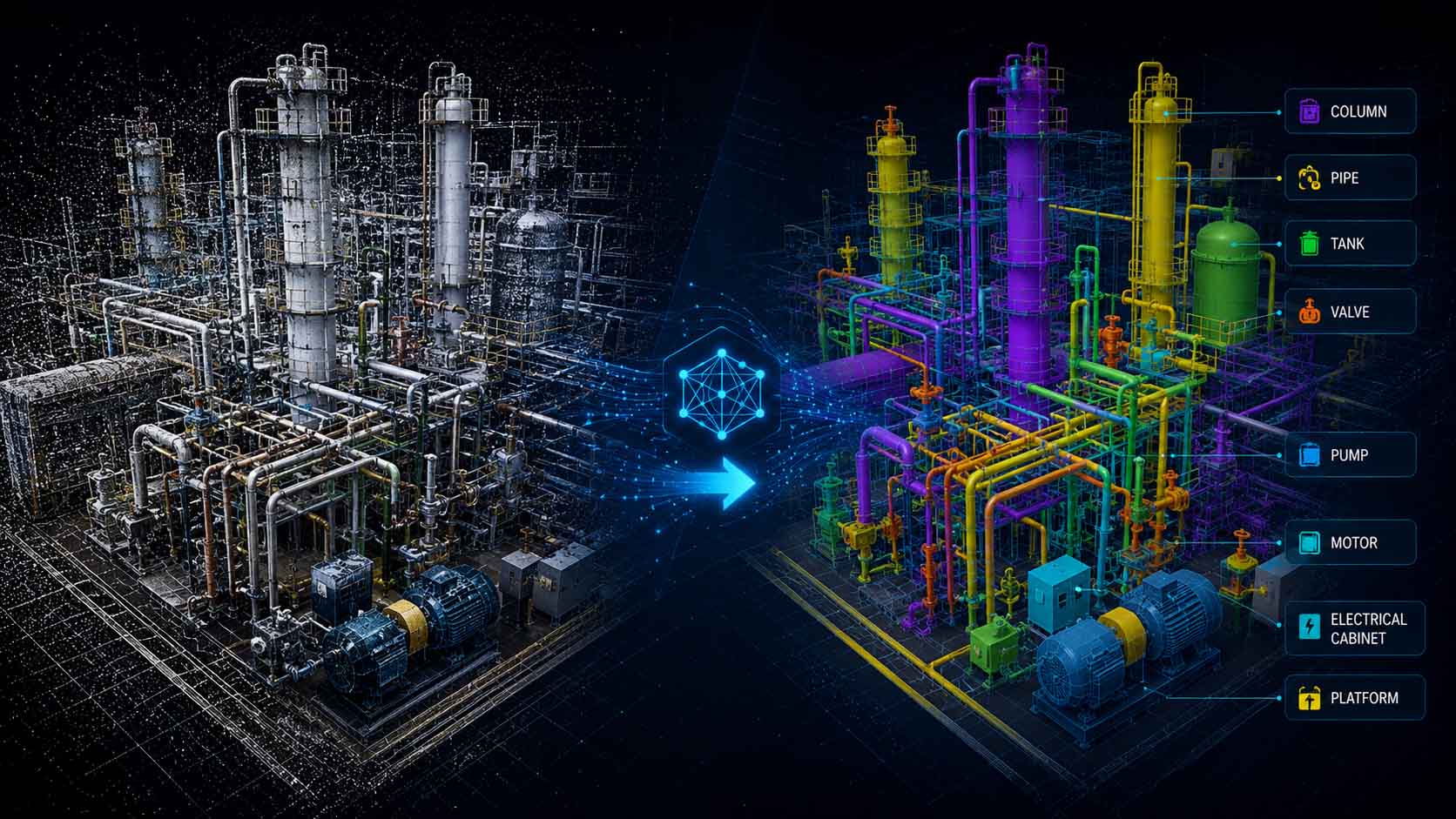
The visualization illustrates how artificial intelligence automatically detects, classifies, and transforms industrial components into structured digital twins.
Visualization: Semantic Segmentation, automatic object recognition, CAD integration, Computer Vision, and intelligent digital twin systems | Image: © Ulrich Buckenlei | VISORIC GmbH
As a result, digital twins are not only created significantly faster but also become considerably more consistent. Changes in real-world facilities can be automatically detected and integrated into existing models. This transforms the digital twin from a static representation into a dynamic information system.[18]
- Objects are automatically detected and classified
- CAD, BIM, and scan data converge
- Digital twins can be updated more efficiently
- Semantic information is generated automatically
- Machines can better understand industrial facilities
The more automation advances, the more economically viable intelligent digital twins become, even for smaller companies.
From Manual Modeling to Automated Semantics
For a long time, digital twins were primarily reserved for large industrial enterprises. Extensive modeling projects, manual object classification, and high engineering effort made economic adoption difficult for many companies. Semantic AI fundamentally changes this situation.[19]
Artificial intelligence now automates numerous tasks that previously had to be performed by specialists. Structured and semantically described models are increasingly generated automatically from 3D scans, point clouds, and Gaussian Splats. As a result, development effort, project duration, and operational costs are significantly reduced.[20]
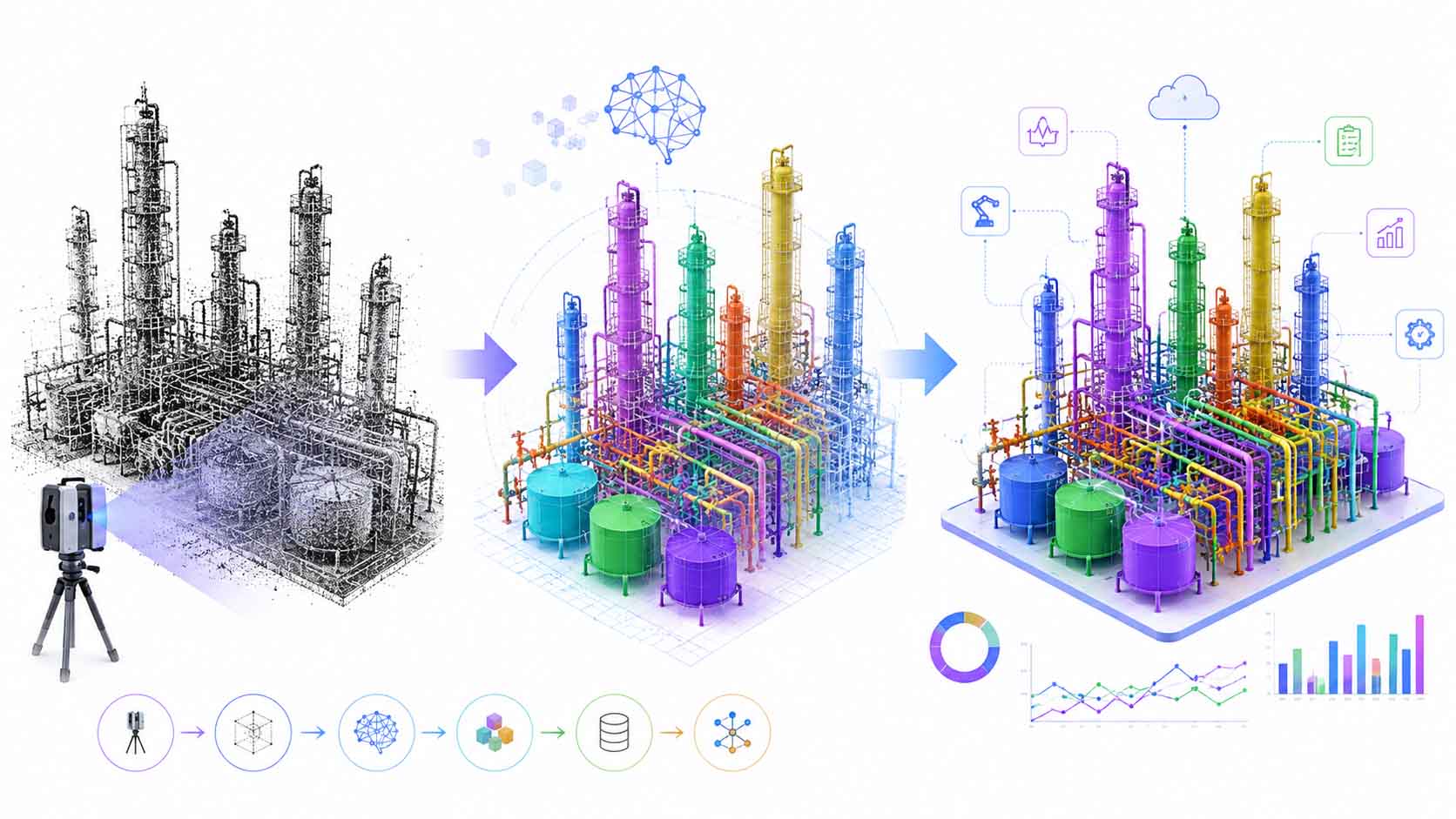
The visualization illustrates the transition from manual modeling to automated semantic digital twin workflows.
Visualization: Semantic AI, automated classification, industrial facilities, Computer Vision, and economically efficient digital twin workflows | Image: © Ulrich Buckenlei | VISORIC GmbH
This creates new economic opportunities, particularly for small and medium-sized enterprises. Digital twins can be developed with limited budgets and expanded gradually over time. As a result, the technology is increasingly becoming a scalable standard tool for industrial digitalization.[21]
- Semantic AI significantly reduces engineering effort
- Automatic classification lowers project costs
- Digital twins become economically viable for SMEs
- Cloud platforms simplify collaboration
- ROI and scalability improve significantly
As costs continue to decrease, entirely new application areas for intelligent digital twins are emerging.
New Applications Emerge Through Semantic Digital Twins
Semantic AI not only makes digital twins more intelligent but also expands their practical applications. Static 3D models evolve into interactive knowledge platforms for maintenance, training, robotics, industrial assistance systems, and autonomous processes.[22]
A semantic digital twin can now not only represent what a facility looks like but also explain which components exist, what functions they perform, and how they interact with one another. This creates entirely new forms of human-machine interaction.[23]
This development becomes particularly exciting when combined with XR technologies, robotics, and industrial automation. Technical information becomes directly visible within its spatial context. Robots, assistance systems, and AI agents can use the same semantic world model and collaborate based on a consistent data foundation.
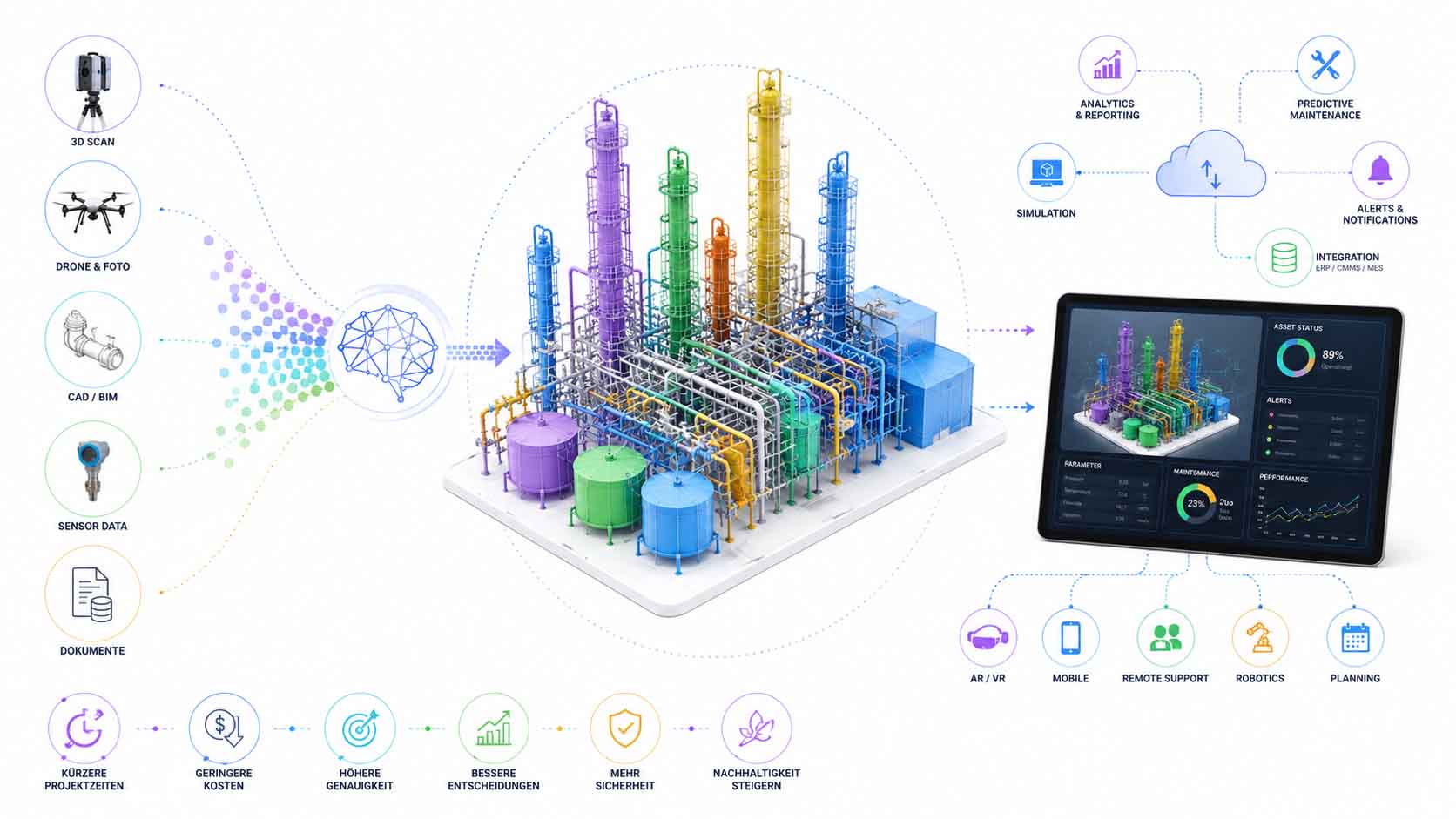
The visualization illustrates semantic digital twins as a foundation for XR, robotics, industrial assistance systems, and intelligent automation.
Visualization: Semantic Digital Twins, XR, robotics, industrial assistance systems, Computer Vision, and spatial AI | Image: © Ulrich Buckenlei | VISORIC GmbH
This creates an entirely new level of value for companies. Knowledge becomes machine-readable, processes become automatable, and digital models evolve into active assistance systems. This is where the true potential of semantic digital twins becomes apparent.[24]
The Munich-based VISORIC expert team also views Semantic AI not as an isolated technology, but as the convergence of Computer Vision, Gaussian Splatting, real-time 3D, XR, and industrial workflows.
- Semantic digital twins enable new assistance systems
- XR and robotics share common spatial knowledge models
- Industrial processes become machine-readable
- AI can better understand relationships and workflows
- Digital twins evolve into active information systems
With Semantic AI, digital twins are finally moving beyond the role of pure visualization and evolving into intelligent spatial knowledge platforms.
From Industrial Facility to Spatial World Model
Digital twins are increasingly evolving from isolated 3D models of individual facilities into connected spatial information systems. Through Semantic AI, Computer Vision, and modern Spatial Computing technologies, not only individual machines but entire factories, buildings, transport systems, and urban infrastructures can now be semantically captured and interpreted.[23]
The economic significance of this development is substantial. While digital twins were previously often limited to individual machines or production lines, scalable platforms are now emerging that can represent complete sites and infrastructures as interconnected digital systems. This creates new opportunities for planning, operation, simulation, and automation.[24]
Artificial intelligence plays a key role in this process. It connects reality capture data, Gaussian Splat reconstructions, CAD models, GIS data, and sensor networks into shared spatial information models. This creates digital twins that can not only be visualized but also analyzed, simulated, and interpreted by machines.
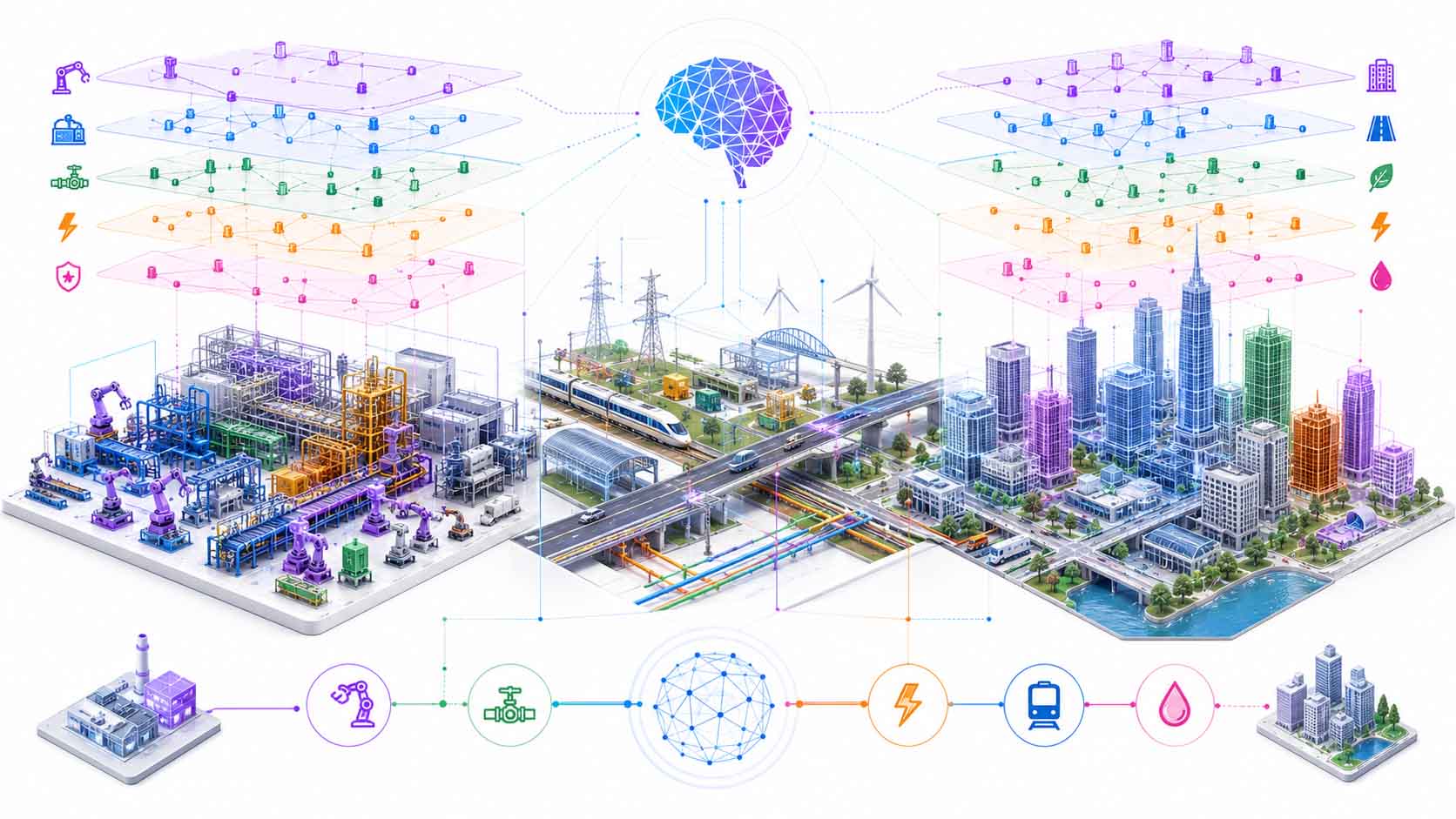
The visualization shows how semantic digital twins connect industrial facilities, infrastructure, and urban systems into shared spatial information models.
Visualization: Semantic AI, Digital Twins, Smart Cities, infrastructure, Spatial Computing, and connected spatial information systems | Image: © Ulrich Buckenlei | VISORIC GmbH
The image in this chapter illustrates the increasing convergence of industrial and urban systems. Production facilities, energy supply, transport infrastructure, and buildings are no longer viewed in isolation but understood as part of a shared spatial ecosystem.
For companies, this creates new opportunities in site planning, energy optimization, safety analysis, and simulation. At the same time, infrastructure operators and cities benefit from better decision-making foundations, greater transparency, and more efficient operational processes.[25]
The Munich-based VISORIC expert team also sees this as a central development for future digital twin platforms. In the future, the decisive factor will not only be the quality of individual models but the ability to intelligently connect different spatial information sources.
- Semantic AI connects industry, infrastructure, and urban systems
- Digital twins are evolving into shared spatial information models
- CAD, GIS, scan, and sensor data are converging
- Large systems become analyzable and simulatable
- Spatial Computing becomes the foundation of future digital twin platforms
The next stage of development goes even further. Digital twins are not only becoming more spatially intelligent but are increasingly evolving into active AI systems themselves.
The Digital Twin Becomes an Intelligent AI System
The next generation of digital twins begins where artificial intelligence no longer merely processes data but independently understands and interprets spatial relationships. Semantic AI expands digital twins with the ability to automatically detect objects, understand relationships between them, and derive new insights from them.[26]
While traditional digital twins primarily represent the current state of a facility, intelligent digital twins can additionally analyze, simulate, predict, and generate recommendations for action. Sensor values, historical operating data, computer vision results, and semantic object information merge into a shared knowledge model.[27]
This development becomes particularly exciting through the combination of Semantic AI, Predictive Analytics, and Spatial AI. Machines increasingly learn to independently interpret spatial relationships. Digital representations thereby evolve into intelligent systems that can actively support decisions and optimize processes.
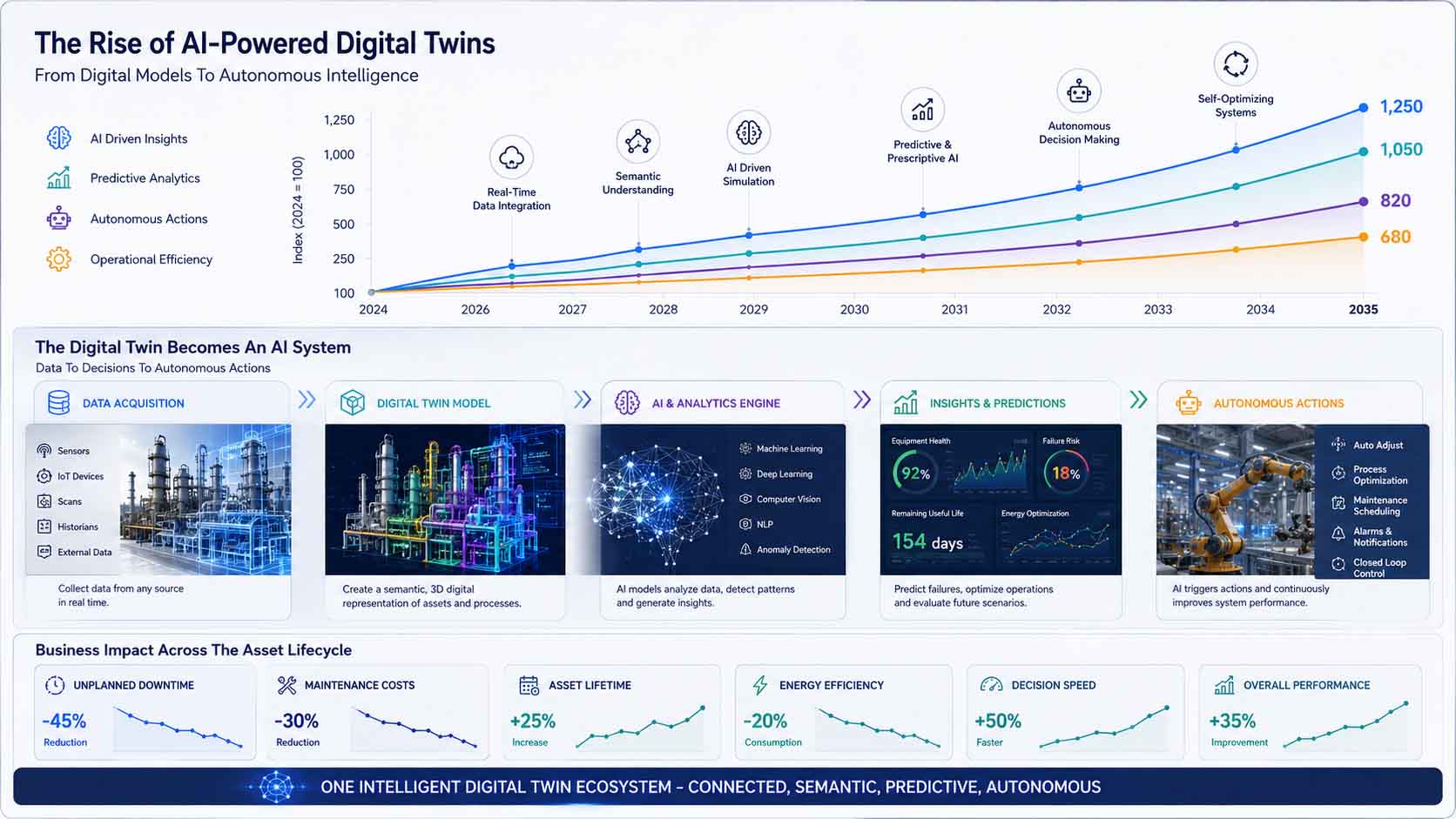
The visualization shows the evolution of digital twins from static 3D models into intelligent spatial AI systems.
Visualization: Semantic AI, Predictive Analytics, Spatial AI, Computer Vision, digital twins, and autonomous decision systems | Image: © Ulrich Buckenlei | VISORIC GmbH
The diagram in this chapter illustrates the fundamental transformation of modern digital twins. The focus is no longer solely on geometric reconstruction, but on the ability to prepare spatial information in a machine-understandable way and automatically derive insights from it.
For companies, this opens up entirely new opportunities. Maintenance can be predicted, production processes optimized, and autonomous systems supported. In the future, decisions will increasingly be based on continuously learning spatial knowledge models.[28]
The Munich-based VISORIC expert team also considers this development one of the most important technology trends of the coming years. The future of digital twins lies not only in visualization but in the intelligent connection of Semantic AI, Computer Vision, real-time data, and Spatial Computing.
- Semantic AI expands digital twins with spatial understanding
- Predictive Analytics enables predictions and optimizations
- Computer Vision automatically generates semantic information
- Spatial knowledge models support autonomous systems
- Digital twins evolve into intelligent AI platforms
The true innovation therefore no longer lies only in the reconstruction of reality. In the future, the decisive capability will be making spatial information equally understandable for humans and machines.
From Photorealistic 3D Scan to Intelligent Spatial Knowledge Model
The development of digital twins is currently being accelerated by the convergence of several key technologies. Gaussian Splatting enables photorealistic reconstructions, Computer Vision detects and classifies objects, while Semantic AI interprets spatial relationships and makes them machine-readable.
This creates digital twins that are no longer visualized exclusively for humans. They are evolving into intelligent spatial information systems that can be used equally by artificial intelligence, robots, XR systems, and future Spatial Computing platforms.
The following video demonstrates this development particularly impressively. Semantic object recognition takes place directly on a photorealistic Gaussian Splat reconstruction. Objects are detected, classified, and spatially localized. A visual reconstruction thereby becomes a machine-readable spatial model.
Video source: Nigel Hartman (@XRarchitect), SensAI Hackademy / The World Labs | Analysis, technological classification, and editorial work: © Ulrich Buckenlei | XR Stager Online Magazine | VISORIC GmbH
The greatest challenge in the future will no longer be to reconstruct reality as accurately as possible. The real task will be to prepare spatial information in such a way that humans, artificial intelligence, and autonomous systems can understand and use it equally.
For digital twins, this enables automated asset recognition, semantic analysis, and intelligent operating models. For XR and robotics, shared spatial world models form the foundation of future applications. Particularly exciting is the convergence of Gaussian Splatting, Computer Vision, Semantic AI, and Spatial Computing into a shared technological ecosystem.
- Gaussian Splatting is evolving into semantic 3D models
- Objects can be automatically detected and interpreted
- Digital twins become machine-readable
- XR and robotics use shared spatial world models
- Semantic AI forms the foundation of future Spatial Computing systems
The future of digital twins therefore no longer consists only of visual models. It consists of intelligent spatial knowledge systems that can understand, analyze, and actively support reality.
From Reality to Intelligent Spatial Model
The real challenge of modern digitalization today is no longer to capture real environments as photorealistically as possible. What increasingly matters is the ability to automatically understand and structure spatial information and make it usable for humans, artificial intelligence, and machines alike.
This is precisely where entirely new application fields are currently emerging. 3D scans, photogrammetry, LiDAR data, and Gaussian Splatting reconstructions are evolving into semantically interpretable digital models that can detect objects, understand relationships, and serve as the foundation for analytics, simulation, robotics, XR, and intelligent assistance systems.

Semantic AI connects reality capture, Computer Vision, Gaussian Splatting, and digital twins into intelligent spatial information systems.
Visualization: Semantic AI, Computer Vision, Gaussian Splatting, spatial analytics, intelligent digital twins, and Spatial Computing | © VISORIC GmbH | Munich
For companies, this development opens up new opportunities far beyond traditional visualization. Facilities, buildings, infrastructures, and production environments can not only be digitally captured but also automatically analyzed, classified, and evaluated in context. This creates digital twins that not only show what reality looks like but also understand what is contained within it.
The Munich-based VISORIC expert team develops individual solutions along the entire process chain for this purpose – from reality capture and 3D scanning to Gaussian Splatting and semantic object recognition, all the way to intelligent digital twins, XR applications, and spatial analytics platforms.
Possible application areas include:
- Automatic object recognition and asset classification in 3D environments
- Semantic digital twins for industry, infrastructure, and buildings
- Spatial analytics platforms for maintenance and operations
- XR applications with intelligent contextual understanding
- Robotics and autonomous systems with shared spatial world models
- AI-supported analytics, simulation, and decision support
The most exciting development no longer lies solely in the 3D model itself, but in its ability to intelligently interpret spatial information and make it usable.
Are you planning a project in the field of Semantic AI, Gaussian Splatting, intelligent digital twins, or spatial analytics platforms?
Talk to the Munich-based VISORIC expert team about feasibility analyses, proof-of-concepts, prototyping, and the technical implementation of intelligent spatial systems.
Contact us:
Email: info@visoric.com
Phone: +49 89 21552678
Address: Bayerstr. 13, 80335 Munich
Sources and References
- Towards Data Science – How Does AI Learn to See in 3D and Understand Space?
- NVIDIA Research – Gaussian Splatting and Neural Scene Representations.
- Digital Twin Consortium – Fundamentals of intelligent digital twins.
- World Economic Forum – Artificial intelligence and industrial digitalization.
- Stanford Vision Lab – Computer Vision and spatial object recognition.
- MIT CSAIL – Spatial AI and Scene Understanding.
- Semantic Segmentation Research – Fundamentals of semantic scene analysis.
- NVIDIA Research – 3D Gaussian Splatting for Real-Time Radiance Fields.
- Inria – Gaussian Splatting research and real-time rendering.
- OpenAI Research – Multimodal AI and visual interpretation.
- Semantic Gaussian Splatting research publications.
- CVPR – Computer Vision and semantic 3D reconstruction.
- IEEE Computer Vision Society – Spatial Scene Understanding.
- Meta AI Research – Segment Anything Model (SAM).
- Microsoft Research – Computer Vision and Spatial AI.
- NVIDIA Omniverse – AI Annotation and Scene Understanding.
- Boston Consulting Group – Generative AI in Engineering.
- Deloitte – AI Driven Industrial Transformation.
- Fraunhofer IPA – AI in industrial digital twins.
- Microsoft Mixed Reality – XR and industrial assistance systems.
- NVIDIA Isaac Sim – Robotics and physical simulation.
- PTC Vuforia – Spatial Computing and industrial applications.
- NVIDIA Omniverse – Industrial and Smart City Digital Twins.
- Bentley Systems – Infrastructure Intelligence and digital infrastructure.
- Esri – ArcGIS Digital Twins and Urban Analytics.
- NVIDIA AI Blueprint for Digital Twins.
- Microsoft Azure Digital Twins and AI Analytics.
- Siemens Industrial AI and Predictive Analytics.
- Original video material by Nigel Hartman (@XRarchitect).
- SensAI Hackademy – Spatial AI and Semantic Computing.
- NVIDIA Research – Spatial AI, Computer Vision, and Digital Twins.
- VISORIC practical projects in XR, Spatial Computing, and Digital Twins.
- NVIDIA Omniverse Enterprise – AI-supported digital twin platforms.
- Unreal Engine – real-time 3D for intelligent digital twins.
Contact Persons:
Ulrich Buckenlei (Creative Director)
Mobile: +49 152 53532871
Email: ulrich.buckenlei@visoric.com
Nataliya Daniltseva (Project Manager)
Mobile: +49 176 72805705
Email: nataliya.daniltseva@visoric.com
Address:
VISORIC GmbH
Bayerstraße 13
D-80335 Munich