
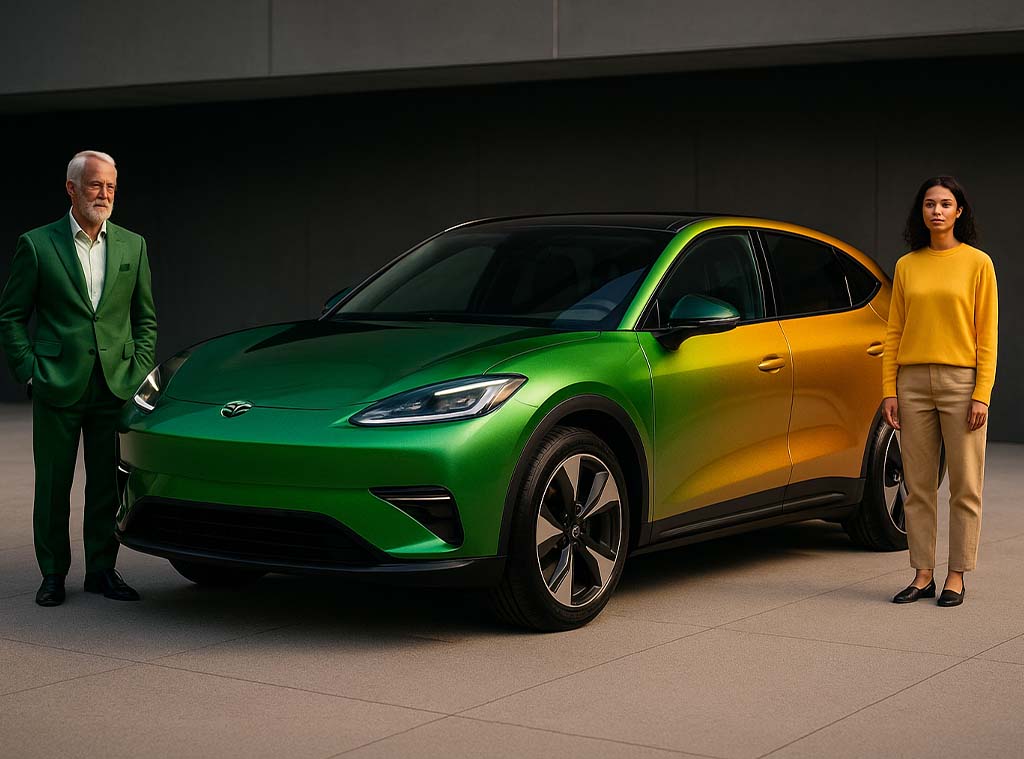
Adaptive Skin Material in Action: A vehicle that reacts in real time to the colors of its surroundings and dynamically adapts its surface.
Visualization: © Visoric Research Lab 2025 – Symbolic concept representation of a color adaptive vehicle surface
A new generation of vehicle surfaces is emerging. Surfaces that are no longer just coated but interpret data. They perceive light, colors and movements and transform these signals into dynamic changes of their own appearance.
What used to be a simple coating becomes an intelligent layer that communicates with the driver and the environment. It does not only react to external influences but adds its own expressive dimension to the vehicle similar to a living organism.
Vehicle manufacturers and research labs are already working on electrochromic systems, color modulating nanostructures and sensor based surfaces that can read and interpret stimuli. Adaptive Skin Material goes a step further. It conceptualizes a framework in which all these technologies interact and transform a static shell into a responsive identity.
When vehicle surfaces begin to interact with the world
Vehicle surfaces today are among the most stable and unchangeable elements of mobility. Paint protects, reflects and defines the identity of a vehicle for many years. At the same time manufacturers and research institutions face a central question: How can an exterior shell become more intelligent, adaptive and expressive as mobility becomes increasingly connected and digitalized? This question forms the starting point for the vision of the Adaptive Skin Material – a living vehicle surface that no longer only carries color but interprets information and translates it into visible reactions.
In parallel material science is evolving rapidly. Electrochromic coatings color variable nanoparticles and light adaptive polymers demonstrate how surfaces can dynamically change. These technologies are no longer theoretical but already used for example in intelligent building facades or reactive displays. Applied to vehicles this creates a completely new paradigm. Mobility visually adapts communicates signals and reflects its surroundings in a narrative way.
With Adaptive Skin Material new layers of functionality and expressiveness emerge. The surface begins to react to light conditions movement clothing colors of passersby or the urban environment. A vehicle becomes perceptibly more dynamic and gains a situational identity of its own. It communicates it changes it shows presence. This responsiveness goes beyond aesthetic effects. It opens paths to improved safety personalized driving experiences and a mobility culture more connected to its environment.
- Reactive vehicle identity → The outer shell adapts to surroundings light and context in real time
- Next generation material science → Nanopigments electrochromic systems and adaptive polymers change color and intensity
- New dimension of mobility → Vehicles become communicating actors in urban space
A look at this future form of mobility immediately raises the question of which technologies enable such a system and which building blocks must work together so that a vehicle surface truly appears alive. To understand Adaptive Skin Material it is worth taking a detailed look at the technical layers that transform a rigid coat of paint into responsive material intelligence.
How Adaptive Skin Material works: The technical layers behind the living vehicle surface
Adaptive Skin Material may seem magical at first glance but it is the result of a precise interplay between sensors data processing and reactive material layers. For a vehicle surface to dynamically adapt to clothing colors ambient tones or lighting conditions several technical systems must work in sync. The following graphic shows how these components are connected and which steps are necessary to create a situationally responsive vehicle skin.
At the center lies the question of how a vehicle recognizes the colors of its surroundings. Modern wide angle cameras embedded in front and rear capture the color spectrum of people objects and light sources in the environment. These sensors continuously analyze hues contrasts and dominant patterns. Based on this data a color sample is generated which serves as the foundation for later material modulation. The graphic shows two personas – green in front yellow behind – to visualize this principle. The vehicle reads the environment.
The heart of the system is the Color Interpretation Engine represented in the gray function box. All signals converge here. The engine consists of three core modules. Ambient Light Analysis captures ambient light intensity and color temperature. Color Pattern Recognition analyzes gradients and dominant chromatic patterns. Material Response Mapping calculates which areas of the vehicle surface must react and in what manner. Only through this interplay does digital input become a physical reaction.
To enable the material itself to react the vehicle surface consists of multiple layers. The graphic shows a cutaway layer structure. Beneath the transparent protective layer lies an electrochromic or nanopigment based layer that changes color via electrical impulses. Below it is an activation layer which forwards signals and a sensor layer that provides feedback on the material response. This creates the characteristic color shift – green in the front yellow in the back – that makes the vehicle appear adaptive.
The visible change on the vehicle surface is described as Surface Output. It results from localized pigment activations that respond in real time to the input from the Color Interpretation Engine. The outcome is a smooth flowing gradient that makes the vehicle appear like a living interface.
- Environment Color Detection → Cameras capture color information from surroundings clothing and lighting atmosphere.
- Color Interpretation Engine → Ambient Light Analysis Color Pattern Recognition and Material Response Mapping translate data into control signals.
- Adaptive Skin Material Layers → Multi layer material structure with electrochromic or nanopigment based layers produces color change.
- Surface Output → Localized pigment activation creates flowing gradients and a living vehicle identity.

Adaptive Skin Material: The graphic shows the interplay of environmental color detection processing unit and reactive material layers which together produce a color dynamic vehicle surface.
Visualization: © Visoric Research Lab 2025 – Technical concept graphic of the adaptive color system
After examining this technical architecture it becomes clear that Adaptive Skin Material is far more than a visual feature. The technology opens pathways to vehicles that communicate contextually support safety and enable entirely new forms of interaction. But how exactly does the intelligent material layer react to movement light and patterns? The next chapter explores the dynamic mechanisms that control this living surface.
The dynamic mechanisms behind a living vehicle surface
After understanding the technical foundations of the adaptive vehicle skin a central question now comes into focus. How does the material decide when and how it changes? Adaptive Skin Material does not only react to static color information. It continuously interprets changes caused by movement light and context. This creates the impression of a living breathing surface that responds to its surroundings within milliseconds.
The following graphic shows this dynamic process in detail. It visualizes which signals the vehicle receives how they are processed over time and how the material layers respond. Movement light dynamics and chromatic shifts form the three primary input channels captured by sensors all around the vehicle. The two people – green in front yellow behind – symbolize changing environmental conditions. Their movements and colors generate dynamic stimuli that transfer onto the vehicle surface.
At the center is the time based processing stack. Motion Vector Analysis detects direction and speed of movements in the environment. Ambient Light Variation Engine evaluates rapid changes in brightness or color temperature. Chromatic Delta Mapping measures how color spectra shift over time and identifies differences relevant to the material. All results flow into the Real Time Response Scheduler which determines activation timing and regional prioritization.
On the right side the graphic shows how these signals influence the vehicle skin. Localized pigment zones respond immediately to impulses causing color changes to appear first in the areas closest to the stimuli. From there the effect spreads across the surface creating smooth gradients that give the vehicle an organic appearance. Reaction time is under 300 milliseconds depending on the material underscoring the system’s real time capability.
The lower section summarizes these dynamic effects. It illustrates how gradients form how context sensitive areas are highlighted and how environmental motion directly affects vehicle appearance. The result is a system that does not just display color but interprets and visualizes information.
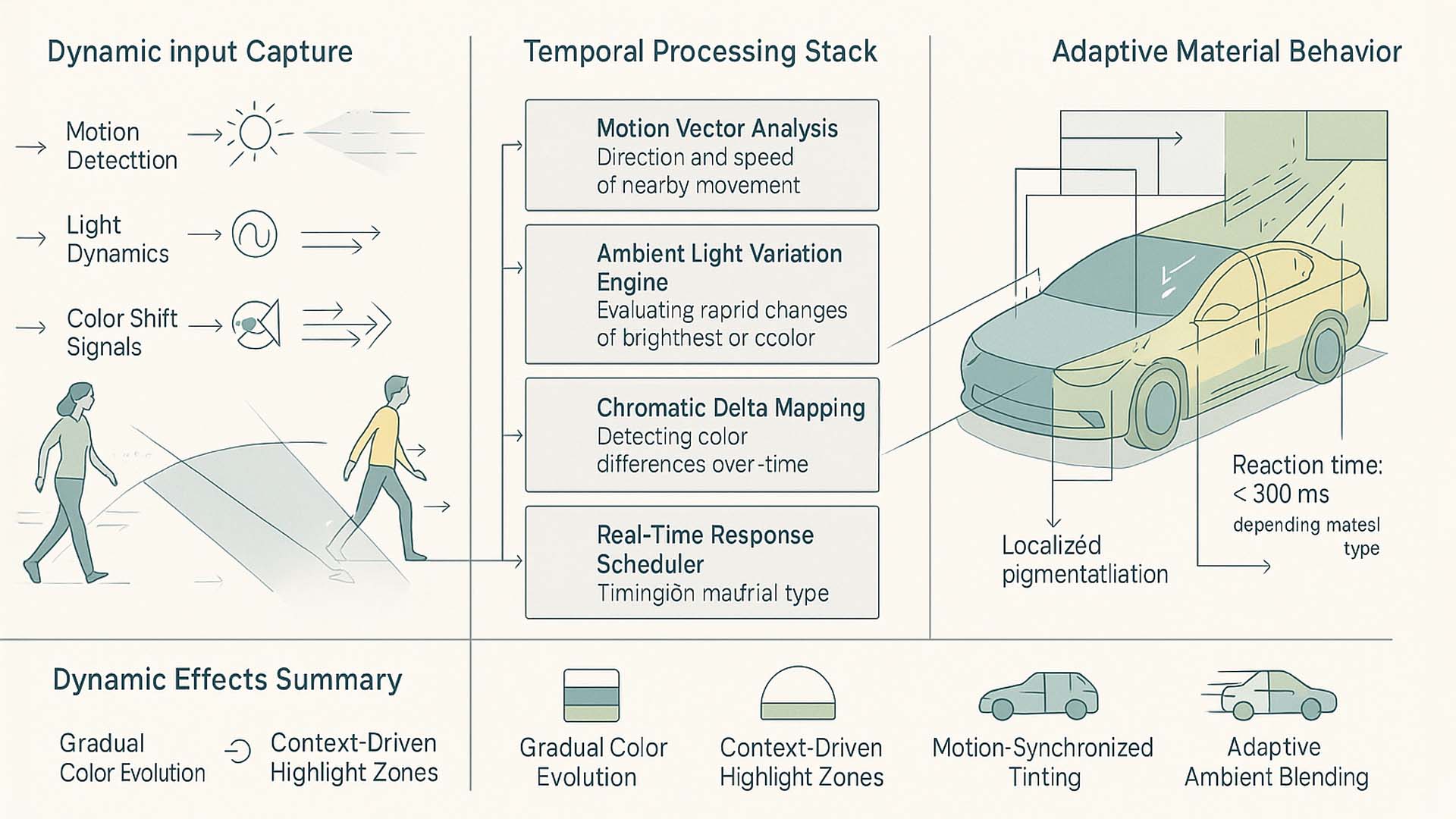
Dynamic Response Mechanisms: The graphic shows how movement light and color changes are processed to control adaptive pigment zones in real time.
Visualization: © Visoric Research Lab 2025 – Technical concept graphic of dynamic color behavior
- Motion Detection → The system detects directions and speeds of nearby movement.
- Light Dynamics → Changes in brightness and color temperature influence surface response.
- Temporal Processing Stack → Multi level time based analysis with response planning.
- Localized Pigment Activation → Color transitions begin in zones receiving initial signals.
- Adaptive Ambient Blending → The surface visually blends with its surroundings.
With this understanding it becomes clear that Adaptive Skin Material is not merely a material but a behavior. The surface reacts interprets and communicates in real time. The next chapter explores how this technology can be integrated into a broader system architecture and which components must collaborate for reliable everyday functionality.
Real time system architecture: How Adaptive Skin Material operates reliably in everyday use
For a living vehicle surface to function reliably in real world conditions it requires a robust system architecture. Adaptive Skin Material is not an isolated feature. It is a complex ensemble of sensors data processing diagnostic systems and material control. The following graphic illustrates this complete functional cycle from environmental input to localized pigment activation.
At the beginning are the Environment Sensors continuously capturing colors movements and tonal information of the surroundings. They are supported by Ambient Light Sensors which analyze brightness temperature and shadow behavior. Both sensor groups provide the essential input data determining which color accents later appear on the vehicle surface. In addition Diagnostic Sensors capture system states material parameters and safety values ensuring overall stability.
Through the Input Processing phase all signals enter the central Processing Core. This core consists of three main modules. The Color Interpretation Engine translates visual environmental data into actionable color impulses. Safety and System Diagnostics secure ongoing operation check thresholds and prevent incorrect activations. The Realtime Processing Unit determines with millisecond precision when and how material changes occur.
Once the Processing Core has made its decision the Output Coordination unit takes over. It controls Material Modulation which sets intensity and speed of color changes and executes Localization Mapping. This mapping defines which areas of the vehicle surface are activated. The graphic shows an example of Localized Pigment Activation where only a defined segment responds while the rest remains stable. This enables contextual changes that may be subtle or functionally significant.
Meanwhile a continuous loop of System Monitoring and Feedback runs in the background. Feedback from material layers diagnostic data and sensor values flows back to the control unit in real time. This closed control loop ensures the system remains reliable during weather changes rapid movements or varying lighting conditions.
The graphic compiles this architecture into a complete real time cycle an interplay of perception interpretation activation and feedback. Only this interplay transforms a reactive vehicle surface into a stable intelligent material system.
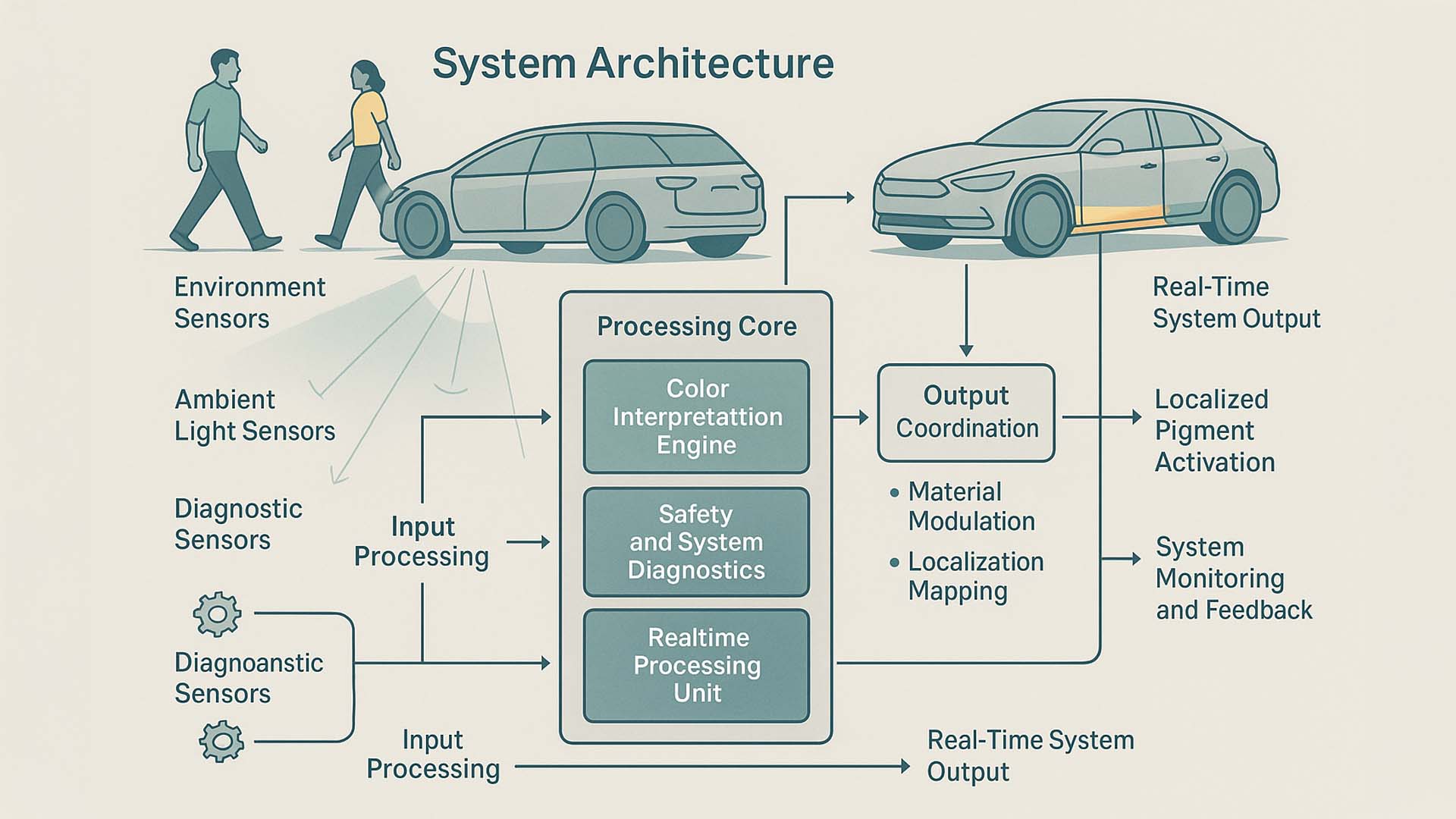
System Architecture: The graphic shows the complete real time cycle from environmental perception processing core material control and localized pigment activation.
Visualization: © Visoric Research Lab 2025 – Technical system architecture of a color adaptive vehicle
- Environment & Ambient Light Sensors → Capture color movement light and contrast.
- Diagnostic Sensors → Monitor safety material condition and system thresholds.
- Processing Core → Color Interpretation Engine Safety and System Diagnostics and Realtime Processing Unit.
- Output Coordination → Material Modulation and Localization Mapping control color changes.
- Localized Pigment Activation → The surface responds only where the context requires it.
- System Monitoring & Feedback → Continuous feedback for stable operation.
With this system level it becomes evident that Adaptive Skin Material does not only react but operates intelligently safely and reproducibly. The next chapter explores how manufacturers designers and cities may use such technologies to rethink mobility and create dynamic interactions in public spaces.
How adaptive vehicle surfaces transform mobility design and cities
Adaptive Skin Material is far more than a technological innovation. It transforms how we design vehicles how we experience them and how they are perceived in urban environments. When surfaces respond dynamically a new relationship between mobility and the city emerges. Vehicles become communicating actors that blend with their surroundings send signals and even influence social interactions.
The following graphic shows how adaptive material affects two domains: Automotive Interaction Design and Urban Integration. Adaptive technology connects both. At the center stands the vehicle whose surface transitions fluidly between green and yellow tones. This gradient demonstrates how the material can be personalized and also react contextually to people infrastructure and urban situations.
On the left the graphic presents the perspective of OEMs and designers. Color Customization describes how vehicles can adopt individual identities no longer as fixed coatings but as changeable expressive layers. Expressive Signaling shows how vehicles might use dynamic signals to inform pedestrians or other road users such as visual cues for turning attention or acknowledging presence. This expressive communication extends conventional lighting design far beyond blinking indicators.
On the right the graphic shows the urban perspective. Communicative Display represents surfaces that could serve as information or orientation elements in public environments. In dense urban contexts this supports interaction between vehicles people and infrastructure. Public Aesthetics suggests how adaptive surfaces could contribute to the aesthetic design of public spaces not as advertising but as living visual elements. Traffic Adaptation illustrates how adaptive surfaces could integrate into traffic systems highlighting light moods traffic flow or local signals.
The illustration makes clear how boundaries between vehicle city and human dissolve. What today remains separate begins to merge into an integrated mobility experience.
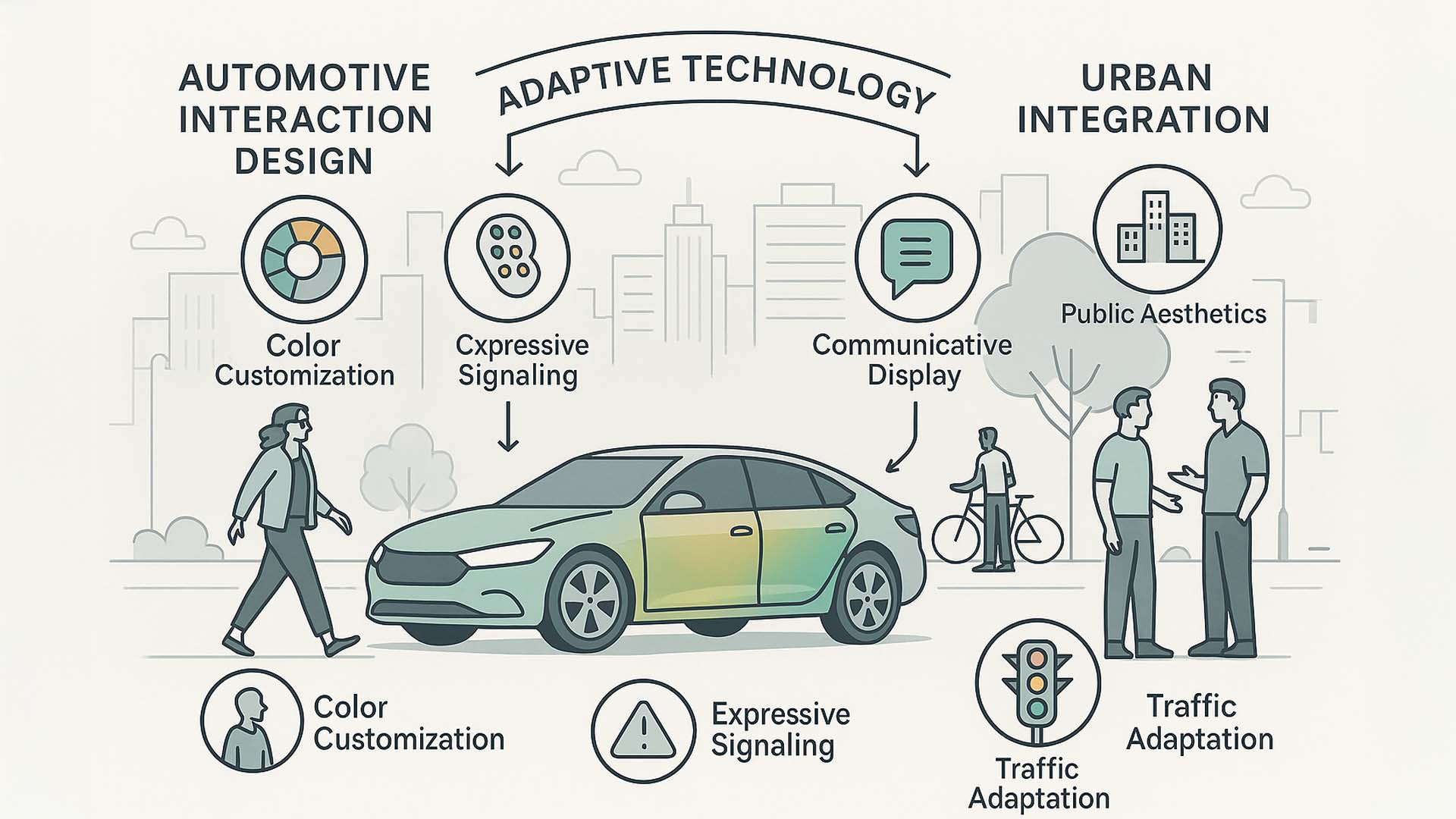
Adaptive Interaction & Urban Integration: The graphic shows how adaptive vehicle surfaces become communication media between driver city and other road users.
Visualization: © Visoric Research Lab 2025 – Concept graphic for future mobility design
- Color Customization → Surfaces become personalizable and adapt situationally.
- Expressive Signaling → Vehicles communicate visually with people and other road users.
- Communicative Display → Surfaces convey information and orientation in urban space.
- Traffic Adaptation → The vehicle dynamically fits into traffic flow and city structure.
- Public Aesthetics → Adaptive surfaces influence the visual atmosphere of urban environments.
These developments show how vehicle design communication and urban perception may fundamentally change. Yet one crucial question remains. Who makes the decisions? Which entity evaluates colors recognizes situations and steers material changes? The answer lies in intelligent systems and adaptive algorithms. The next chapter examines the central role of artificial intelligence.
The role of artificial intelligence in the adaptive vehicle surface
For Adaptive Skin Material to not only react but understand situations it requires a steering intelligence. This role is fulfilled by artificial intelligence. It interprets between environment driver and material layers. The following graphic shows how AI collects data recognizes patterns and makes predictions that translate into accurate color changes.
On the left the graphic visualizes which input data AI processes. Environment Perception includes all visual and sensor impressions such as colors materials movements and reflections. Context Evaluation considers situations such as time of day location or social proximity. Behavioral Data includes information on speed driving behavior and immediate requirements. All data flows converge and feed into the central AI system.
At the core is the AI Neural Processing. A learning model interprets the input signals. The connecting lines show how environmental data transforms into adaptive decisions. The Machine Learning component indicates continuous training improving the model with real world inputs. Beneath it the Prediction Models area shows that decisions are not just reactive but anticipatory.
On the right unfolds the effect. Pattern Recognition identifies recurring motion light and color patterns. Surface Adjustment shows the precise steering of material layers. Energy Optimization ensures each activation is executed with minimal energy use. The lines between modules demonstrate how AI structures prioritizes and translates decision processes into clear material signals.
At the bottom the graphic shows how prediction models affect the vehicle surface. The gradient symbolizes a context sensitive and energy optimized adaptive reaction.

AI Driven Adaptation: The graphic shows how artificial intelligence interprets environmental data makes predictions and steers adaptive material changes.
Visualization: © Visoric Research Lab 2025 – Concept graphic for AI controlled material modulation
- Environment Perception → Capturing visual and sensor information from the environment.
- Context Evaluation → Assessment of location and lighting conditions.
- Behavioral Data → Integration of driving dynamics.
- AI Neural Processing → Pattern recognition forecasting and adaptive decision making.
- Surface Adjustment → Precise steering of pigment based layers.
- Energy Optimization → Efficient activation for minimal energy usage.
Artificial intelligence thus becomes the central decision layer of the adaptive vehicle surface. It interprets situations orchestrates responses and evolves with every mile driven. The next chapter explores how this interplay becomes visible in motion and how Adaptive Skin Material unfolds in video.
The experience in motion: Adaptive Skin Material in action
Color shifting surfaces reveal their full impact only when seen in motion. Each adaptation is an interplay of environmental data AI decisions and physical material reactions. The following video shows how Adaptive Skin Material behaves in real time how it interprets colors and transforms its identity.
Adaptive Skin Material: The vehicle surface reacts in real time to light colors and movement stimuli from the environment.
Original footage provided by the rightful creators and discovered via @the.factlab.us. Editing voiceover and icon visualization: Ulrich Buckenlei.
The video captures the essence of this technology. Each movement each chromatic shift each impulse is interpreted by AI and translated into visible transformation. Adaptive Skin Material becomes not only a technical feature but a new medium for design safety and interaction.
The VISORIC Expert Team in Munich
Adaptive vehicle surfaces mark the beginning of a new material generation. Technologies such as Adaptive Skin Material show how vehicles dynamically transform their identity react to their environments and enable new forms of visual communication. The Visoric expert team supports companies in understanding this shift early and translating it into realizable projects. Our work connects research AI development material technologies and prototyping into solutions that are both visionary and industry ready.
Many organizations ask how adaptive materials AI driven interfaces and new sensor technologies can be integrated into products mobility concepts or urban applications. This is where we support with experience strategic clarity and interdisciplinary expertise.
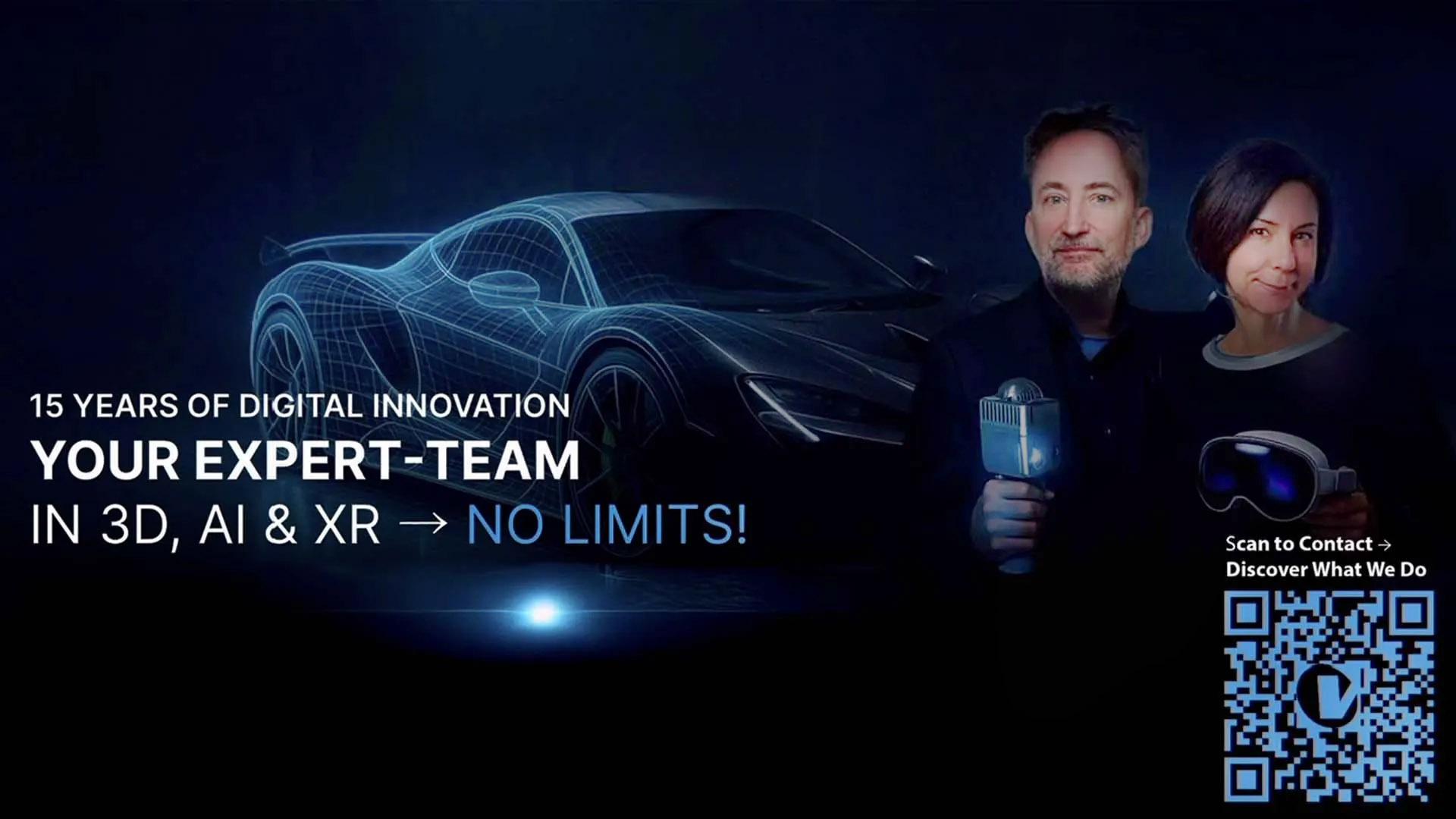
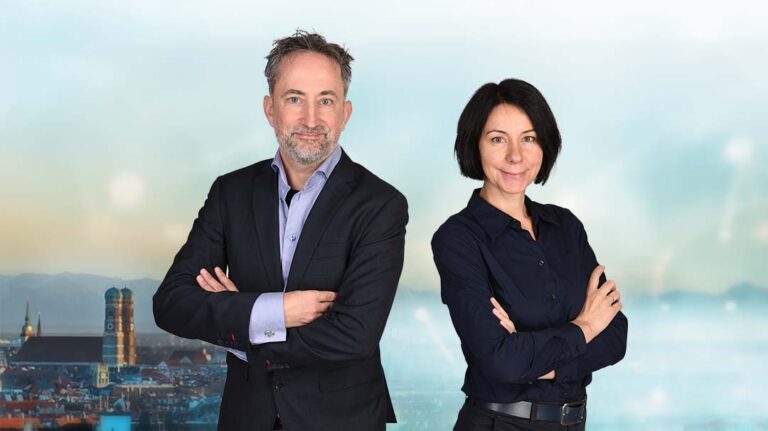
The VISORIC Expert Team: Ulrich Buckenlei and Nataliya Daniltseva discussing adaptive materials AI driven vehicle concepts and future mobility scenarios.
Source: VISORIC GmbH | Munich 2025
Visoric provides technological know how strategic clarity and a team that makes complex innovation projects understandable plannable and executable.
- Strategic technology consulting → Analysis of potentials around adaptive materials AI modulation and new mobility interfaces.
- Concept development and prototyping → Creation of early demonstrators proofs of concept and experimental material studies for dynamic vehicle surfaces.
- Software development → Implementation of AI pipelines sensor fusion real time analysis and control logic for adaptive surfaces.
- Development of visual interfaces → Design of data driven visualization systems that make material behavior understandable controllable and usable.
- End to end project support → From feasibility studies to design and towards production ready implementation in automotive urban systems or product innovation.
If you are considering integrating adaptive materials AI supported surfaces or new vehicle interfaces into your products vehicles or mobility concepts we are happy to support you. Even an initial conversation can reveal opportunities and open a path toward clear next steps.
Contact Persons:
Ulrich Buckenlei (Creative Director)
Mobile: +49 152 53532871
Email: ulrich.buckenlei@visoric.com
Nataliya Daniltseva (Project Manager)
Mobile: +49 176 72805705
Email: nataliya.daniltseva@visoric.com
Address:
VISORIC GmbH
Bayerstraße 13
D-80335 Munich